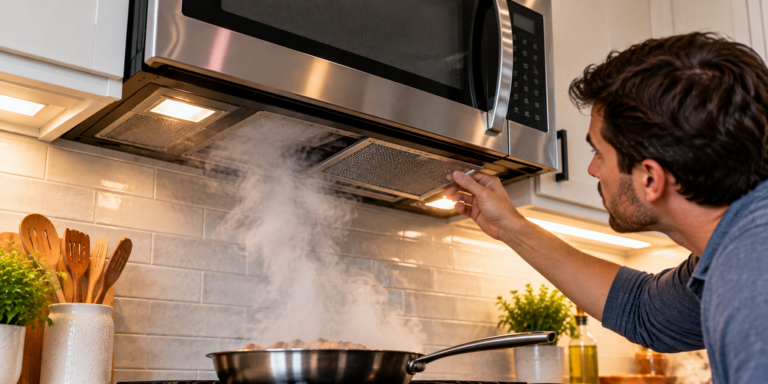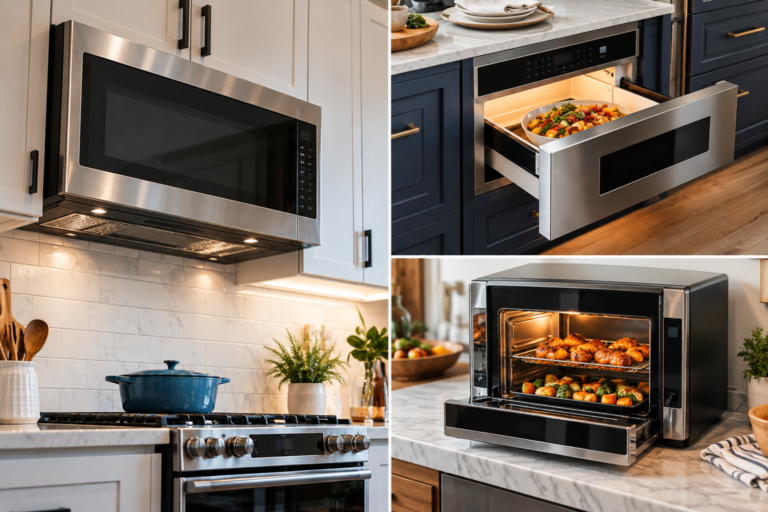
The modern air fryer is less a replacement for a deep fryer than a compact, high-velocity convection appliance. That distinction matters. A buyer expecting submerged-oil frying without the oil will encounter compromises in texture; a buyer seeking rapid roasting, reheating and browning in a smaller cavity may find the machine unusually useful.
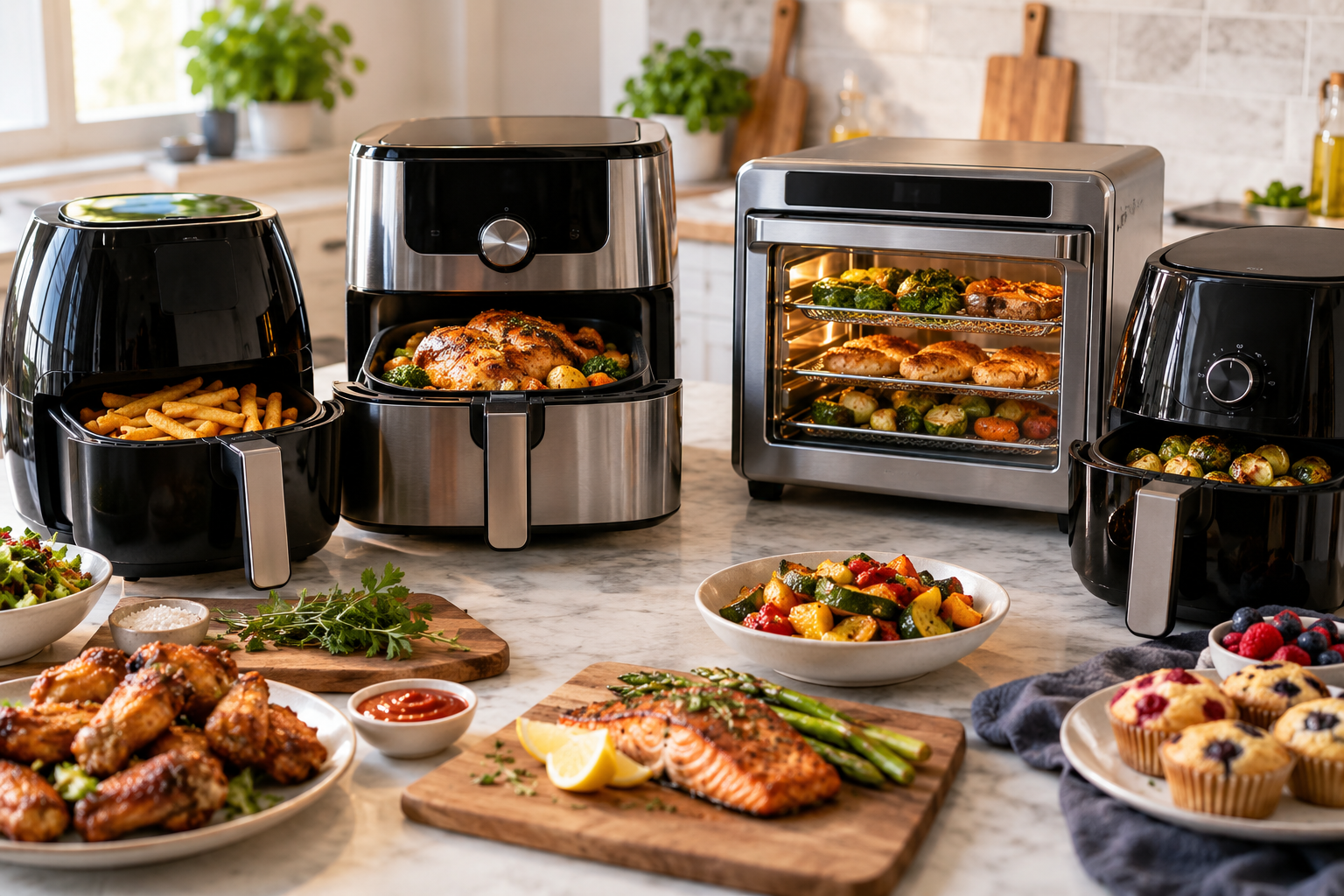
The USDA’s guidance on air fryers and food safety describes air fryers as “essentially countertop convection ovens” and explains that rapid hot-air circulation produces surface crisping. The agency says foods generally cook for 5 to 25 minutes at roughly 350°F to 400°F. It also warns against overcrowding because restricted airflow can produce uneven cooking or undercooking.
That basic physics explains why choosing among air fryers is primarily an exercise in matching geometry to cooking habits. Basket machines concentrate airflow around relatively small quantities of food. Dual-basket models divide the cooking chamber for simultaneous dishes. Glass systems emphasize visibility and removable cooking vessels. Air fryer toaster ovens sacrifice some compactness for rack space, baking flexibility and broader appliance replacement.
Our scores help separate products whose prices and layouts can otherwise make comparison difficult. Buyer Confidence is unusually consistent across this field, so Customer Sentiment, Value and our overall score become more useful differentiators. No single configuration is inherently preferable: the appropriate design changes with batch size, available counter space and the number of foods normally cooked at once.
The Shortlist: Where The Strongest Options Fit
Among conventional basket machines, the Ninja Foodi DualZone DZ201 carries our highest air-fryer-specific assessment at 9.16/10, with Customer Sentiment of 9.16, Buyer Confidence of 9.8 and Value of 8.64. Its $179.99 reference price places it above basic single-basket models, but the dual-zone architecture targets a specific household problem: cooking two foods separately rather than sequentially. A detailed Ninja DZ201 review therefore belongs on the reading list for buyers whose dinners routinely involve a protein and side requiring different treatment.
The Ninja Foodi DualZone DZ302 follows closely at 9.01/10, with 8.94 for Customer Sentiment and 8.52 for Value at $149.99. Those numbers make the Ninja DZ302 review especially relevant to shoppers comparing DualZone configurations without automatically moving to a larger or more expensive unit.
The Ninja Air Fryer XL MaxCrisp AF181 also receives 9.01/10 at $119.99. Unlike a dual-zone appliance, it makes more sense where simplicity matters more than parallel cooking. The Ninja AF181 review is consequently useful for households that want a conventional basket workflow without paying for a second independently managed cooking zone.
Cosori’s TWINFRY Double Air Fryer earns the same 9.01/10 overall assessment, alongside 8.94 Customer Sentiment and 8.52 Value at $149.99. A Cosori TWINFRY review belongs in the same research path as a Ninja DualZone comparison because both speak to a broader shift in air-fryer design: manufacturers are increasingly addressing the limitations of one small cooking chamber by dividing or enlarging usable cooking space.
The Ninja Foodi DualZone XL DZ401 also posts 9.01/10 at $199.99. Its appeal is clearest when greater cooking volume justifies a larger footprint and higher expenditure. A Ninja DZ401 review should therefore be read through the lens of actual batch size rather than the assumption that larger automatically means better.
There is also the Ninja DoubleStack XL SL401, rated 8.71/10, with Customer Sentiment of 8.5, Buyer Confidence of 9.8 and Value of 8.28 at $209.95. The Ninja SL401 review matters particularly where horizontal counter space is constrained and a buyer still wants a multi-zone approach.
These products demonstrate the central rule of the category: capacity is useful only when its physical arrangement suits the food being cooked.
Basket Air Fryer Vs Oven: The Decision That Comes First
The basket air fryer vs oven question should be settled before comparing model numbers.
A basket concentrates heated airflow around food placed in a relatively compact chamber. That arrangement is well suited to fries, wings, vegetables, reheated pizza, breaded foods and smaller proteins. Loading and shaking are straightforward, and the removable basket generally limits the number of surfaces exposed to grease.
An air fryer oven offers a wider chamber and rack-based arrangement. Its strengths are different: toast, baked dishes, larger flat foods and meals that benefit from conventional oven geometry. It can potentially displace a toaster oven as well as handling air-frying duties.
The tradeoff is surface area. A large cavity is useful only when the household uses it. Someone reheating a handful of fries does not inherently benefit from heating a substantially larger chamber.
The Breville Smart Oven Air Fryer Pro BOV900BSS illustrates the premium oven approach. At $319.95, our score is 8.71/10, with Customer Sentiment of 8.5 and Value of 8.28. The Breville BOV900BSS review should be approached as an evaluation of a multipurpose countertop oven rather than merely a fryer.
The Breville Smart Oven Air Fryer BOV860BTR costs $349.95 in our reference set and receives 8.55/10. A Breville BOV900 vs BOV860 comparison therefore deserves more scrutiny than assuming the higher-priced unit represents an automatic upgrade. Cooking functions, dimensions, intended foods and the buyer’s kitchen workflow matter more than price hierarchy alone.
At a different price level, the Ninja Digital Air Fry Countertop Oven SP101 scores 8.86/10 at $159.99, including 8.72 Customer Sentiment and 8.4 Value. The Ninja SP101 review is particularly relevant for buyers who want oven geometry without moving into Breville’s price bracket.
The Ninja Flip Toaster Oven & Air Fryer SP151 receives 8.55/10 at $149.94. Its Ninja SP151 review belongs in the same comparison, particularly for kitchens where storage and countertop configuration matter.
Single Vs Dual Basket Air Fryer
The single vs dual basket air fryer choice is often misunderstood as a capacity contest. It is more accurately a scheduling decision.
A single basket works efficiently when most meals involve one air-fried component. Its cooking space is uncomplicated and there is only one basket to load, shake and clean.
Dual baskets solve a different problem: synchronization. Separate foods can be cooked without forcing one ingredient to accept the temperature or timing of another. That flexibility becomes useful for households routinely preparing mixed meals.
The penalty is obvious. Dividing an appliance into two cooking zones does not eliminate the physical space required for those zones. A dual machine can therefore be excessive for someone mainly reheating lunch for one person.
Within Ninja’s lineup, the DZ201’s 9.16/10 score, DZ302’s 9.01/10 and DZ401’s 9.01/10 make the family consistently strong by our editorial measures. Yet the correct Ninja DualZone comparison is not merely a ranking exercise. The decision should start with how often two different foods genuinely need simultaneous cooking.
If the answer is rarely, the AF181’s $119.99 reference price becomes persuasive. If the answer is several nights each week, paying for independent zones is easier to justify.
Glass Air Fryers: Visibility Changes The Workflow
Glass air fryers offer a deceptively practical benefit: the cook can observe browning without relying entirely on timers or repeatedly interrupting cooking.
The Ninja Crispi Glass Air Fryer FN101ST receives 8.55/10, with Customer Sentiment of 8.28, Buyer Confidence of 9.8 and Value of 8.15 at $152.99. The Ninja Crispi FN101ST review is most relevant to shoppers attracted to a removable glass-vessel format rather than a conventional opaque drawer.
The Ninja Crispi FN101SG carries the same scores and reference price, so a Ninja Crispi FN101SG review should focus on configuration and exact package differences rather than expecting a meaningful editorial-score separation.
The larger-priced Ninja Crispi Pro Glass Air Fryer AS101LG reaches 8.86/10, with 8.72 Customer Sentiment and 8.4 Value at $249.99. The Ninja Crispi Pro review therefore raises a harder question: whether the buyer values the glass format enough to spend substantially more than the $119.99 AF181 or $149.99 DZ302.
Glass air fryer benefits should not be exaggerated into claims about superior cooking. Visibility is useful. A removable glass container can also change serving, storage and cleanup habits depending on the design. Neither fact proves that glass creates better heat transfer or crispier results in every recipe.
The strongest reason to choose this format is behavioral: some cooks prefer seeing food brown rather than repeatedly opening a drawer.
Air Fryer Ovens: More Space, More Questions
The Cuisinart Compact Air Fryer Toaster Oven TOA-26 receives 8.1/10 at $149.95, with Customer Sentiment of 7.62 and Value of 7.79. The Cuisinart TOA-26 review makes most sense for shoppers prioritizing a compact oven-style appliance.
The Cuisinart Air Fryer Toaster Oven TOA-70NAS receives a stronger 8.55/10, with Customer Sentiment of 8.28 and Value of 8.15 at $219.95. In a Cuisinart TOA-26 vs TOA-70NAS decision, that roughly $70 reference-price gap needs to buy functionality the household will actually use. The editorial scores favor the TOA-70NAS, while the TOA-26 preserves the lower entry price.
Other oven-style choices broaden the field. The Ninja Foodi XL Pro Air Fry Oven DT201 scores 8.55/10 at $219.99; the Ninja DT201 review therefore belongs beside Cuisinart and Breville research for buyers seeking a substantial countertop appliance.
The Geek Chef 16QT Air Fryer Toaster Oven scores 8.4/10 at $154.99. A Geek Chef 16QT review is relevant where oven capacity and moderate pricing take priority over chasing the highest editorial score.
The Nuwave Bravo Pro Smart Air Fryer Toaster Oven earns 8.4/10 at $125.99, while the Nuwave Bravo XL Pro rises to 8.55/10 at $154.99. A Nuwave Bravo Pro review and Nuwave Bravo XL Pro review should consequently examine whether the additional size or configuration of the latter warrants its approximately $29 premium.
The BLACK+DECKER Crisp ‘N Bake Air Fryer Toaster Oven receives 8.4/10 at $129.99. The BLACK+DECKER Crisp N Bake review occupies a similar value-oriented part of the market.
Then there is the Midea Flexify Slim French Door Air Fryer Toaster Oven, rated 8.4/10 at $139.99. The Midea Flexify Slim review introduces another design question: whether a French door air fryer oven better suits the physical kitchen and loading pattern than a drop-down-door appliance.
French doors are a usability feature, not a cooking result. Buyers should inspect clearance, handle position, rack access and the space available directly in front of the appliance.
The Emeril Lagasse 26QT French Door Air Fryer Toaster Oven earns 8.4/10, including 8.06 Customer Sentiment and 8.03 Value, at $149.99. An Emeril Lagasse air fryer review is therefore most useful when compared with similarly priced oven-format alternatives rather than basket fryers that solve a different kitchen problem.
Capacity: Ignore The Biggest Number On The Box
A practical air fryer capacity guide starts with food surface area rather than nominal volume.
Hot-air cooking relies on circulation. A deep pile of food can technically fit inside a basket while cooking poorly because surfaces block one another. This is why the USDA specifically cautions that overfilling can restrict airflow and cause uneven or insufficient cooking.
Capacity should therefore be interpreted through four questions:
- How many people are normally being fed?
- Is the air fryer cooking the entire meal or one component?
- Are foods normally flat and broad, or compact and irregular?
- Would two smaller independent zones be more useful than one larger chamber?
For one or two people, a compact basket may handle the majority of routine jobs without consuming excessive counter space. The Instant Pot Vortex Plus Mini Air Fryer, for example, scores 8.86/10, with 8.72 Customer Sentiment and 8.4 Value at $129.99. A Vortex Plus Mini review is appropriate for shoppers whose priority is restrained size rather than maximum batch volume.
The Instant Pot Vortex Plus ClearCook Air Fryer receives the same 8.86/10 assessment at $139.97. The Vortex Plus ClearCook review is more relevant where visual monitoring is desirable.
The Vortex Plus XL Air Fryer likewise receives 8.86/10 at $149.95. A Vortex Plus XL review becomes more pertinent as household batch requirements increase.
Capacity, in other words, is not a trophy statistic. Unused chamber volume costs counter space every day.
Nuwave Brio Plus And The Value Question
The Nuwave Brio Plus Air Fryer stands out primarily through price positioning. At $109.99, it receives our 8.55/10 score, 8.28 Customer Sentiment, 9.8 Buyer Confidence and 8.15 Value.
That makes a Nuwave Brio Plus review relevant for buyers trying to remain near the $100 threshold without dropping into an entirely different editorial-score range.
The comparison becomes sharper against the Ninja AF181 at $119.99. An additional $10 separates the reference prices, while the AF181 receives 9.01/10 overall and 8.52 for Value. Those editorial signals favor closer examination of the Ninja before purchase, although form factor and actual cooking requirements still need to decide the matter.
The lesson extends beyond those two models. Price differences below $20 can be less meaningful over several years of ownership than basket geometry, cleaning friction or whether the machine comfortably handles the household’s normal dinner.
Hybrid Appliances: When Air Frying Is Only One Job
Some machines stretch the category until “air fryer” describes only one capability.
The Ninja Foodi Indoor Grill & Air Fryer AG301 is one example. At $179.99, it earns 9.16/10, with 9.16 Customer Sentiment and 8.64 Value. The Ninja AG301 review should be approached by buyers who actually want the indoor-grill proposition. Someone interested only in fries and reheating would be paying for a broader appliance concept.
The same reasoning applies to outdoor-oriented hybrids such as products encountered in a Ninja Woodfire ProConnect review. Buyers should distinguish between air frying as the primary function and air frying as one mode inside a larger cooking system.
Feature count alone is a poor proxy for usefulness. Ten functions used twice each are less practical than three functions used every week.
What Produces Crispier Air Fryer Food?
Crisping is a moisture-management problem.
Food browns more readily when hot moving air can reach its surface and moisture can escape. Crowding interferes with that process. Wet exterior surfaces also force the appliance to spend energy evaporating water before stronger browning can occur.
For crispier air fryer food, several habits are consistently sensible:
- Leave room for air to circulate rather than filling every available centimeter.
- Dry wet ingredients before cooking where the recipe permits.
- Shake or turn foods when their shape causes surfaces to remain shielded.
- Use a small quantity of oil where appropriate rather than assuming “air fryer” means oil must always be absent.
- Cook in batches when one overloaded batch would stack food heavily.
- Check browning before automatically extending cooking at high temperature.
The last point deserves attention. Darker and crispier are not nutritionally interchangeable with better.
Research on acrylamide illustrates why simplistic health claims should be avoided. A 2024 study comparing home-prepared potatoes found mean acrylamide concentrations of 12.19 ± 7.03 μg/kg for air frying, 8.94 ± 9.21 μg/kg for deep frying and 7.43 ± 3.75 μg/kg for oven frying; the differences between cooking methods were not statistically significant. Soaking reduced measured levels across all three approaches, although the within-method reduction reached statistical significance only for deep frying.
Earlier research produced different results. A 2015 study reported that air frying reduced acrylamide by about 90% compared with conventional deep-oil frying under its experimental conditions. The contrast is instructive: temperature, potato characteristics, pretreatment, cooking duration and equipment alter the outcome. “Air fried” by itself does not establish a fixed nutritional result.
Why An Air Fryer Cooks Unevenly
When an air fryer cooking unevenly becomes a recurring problem, the appliance may not be the first culprit.
Start with loading. Airflow cannot brown a surface it cannot reach. Separate overlapping pieces, reduce the batch and repeat the recipe before blaming heating hardware.
Next consider food geometry. A thin edge and thick center do not heat at identical rates. Similarly sized pieces improve consistency.
Then examine placement. In an oven-style machine, rack position can expose foods differently to heat and airflow. In a basket machine, shaking redistributes pieces that spent the first half of cooking against the cooler or more obstructed parts of the load.
Recent food-science work has examined airflow velocity specifically because differences between central and peripheral airflow can affect moisture movement and the uniformity of acrylamide formation in potato strips. That laboratory finding reinforces a practical observation: air movement is not incidental to air frying. It is the cooking mechanism.
How To Clean An Air Fryer Without Making It A Chore
Knowing how to clean an air fryer should influence the buying decision before grease has ever touched it.
Removable parts deserve close inspection. A complicated basket assembly with inaccessible seams can make a theoretically capable machine irritating after repeated use. Oven models introduce racks, trays, cavity walls and doors that may collect splatter.
A workable routine is simple: allow the appliance to cool, remove loose crumbs, wash removable food-contact components according to manufacturer directions, wipe interior surfaces without flooding electrical areas, and prevent grease from accumulating around heating areas. Abrasive treatment should be avoided when it could damage coated surfaces.
Cleaning should also be considered when comparing glass and conventional baskets. Glass provides visibility into residue as well as food. That can encourage earlier cleaning, though it does not remove the need to clean the heating unit and surrounding structure.
The best appliance for frequent cooking is often the one that does not create an argument with its owner at the sink.
Safety Matters More Than Preset Count
Preset menus are convenient shortcuts, not substitutes for checking whether food is safely cooked.
The USDA specifies minimum internal temperatures of 145°F for fish; 145°F plus a three-minute rest for whole cuts of beef, pork, veal and lamb; 160°F for ground meats; and 165°F for poultry. It advises checking temperature with a food thermometer rather than relying solely on cooking time.
That advice is particularly relevant when changing machines. Two air fryers set to the same displayed temperature can differ in chamber shape, airflow, food load and heating behavior. A recipe’s stated minutes should therefore be treated as a cooking reference, while safe internal temperature is the decisive measure for meat and poultry.
Reading The Scores Without Losing Sight Of The Kitchen
Our ratings create several distinct clusters.
At the upper end of this field, the Ninja DZ201 and Ninja AG301 score 9.16/10. The Ninja DZ302, Ninja AF181, Cosori TWINFRY and Ninja DZ401 sit at 9.01/10. Those figures signal particularly strong editorial assessments, but they do not make the machines interchangeable.
The AG301 is a grill-air-fryer hybrid. The DZ201, DZ302 and DZ401 pursue dual-zone cooking. The AF181 represents the more straightforward basket approach. TWINFRY belongs in the double-cooking-space discussion.
Among oven-style appliances, the Ninja SP101 reaches 8.86/10 and the Breville BOV900BSS 8.71/10. The Breville is also substantially more expensive at the reference prices here. Price, however, should be divided mentally by intended use. An appliance that replaces both a toaster oven and an air fryer has a different economic role from a basket machine stored beside an existing oven.
The editorial score is therefore a decision signal, not permission to ignore geometry.
Final Considerations
The air-fryer market looks complicated because manufacturers have attached the same phrase to remarkably different machines. Strip away the branding and the choices become more orderly.
Buyers primarily cooking fries, vegetables, wings, reheated foods and modest portions should begin with basket models such as the Ninja AF181, Nuwave Brio Plus or Instant Vortex family. Households frequently preparing two foods simultaneously should move the Ninja DZ201, DZ302, DZ401 and Cosori TWINFRY higher on the research list. Kitchens seeking an oven replacement should examine the Ninja SP101 and SP151, Cuisinart TOA series, Breville BOV models, Ninja DT201, Nuwave Bravo range, Geek Chef 16QT, BLACK+DECKER Crisp ‘N Bake, Midea Flexify Slim and Emeril Lagasse French-door format.
Glass changes visibility and handling more than it changes the fundamental physics, making the Ninja Crispi FN101ST, FN101SG and Crispi Pro especially relevant to cooks who value watching browning develop.
Above all, capacity should be bought for actual meals rather than hypothetical feasts. Air frying works by moving hot air around exposed food surfaces; stuffing more food into the chamber can defeat the mechanism that made the appliance attractive in the first place.
That is why the best buying sequence starts not with brand, presets or the largest advertised capacity, but with four mundane observations: how much food is cooked, how many different foods need to cook simultaneously, how much counter space exists and how much cleaning the household will tolerate.
Once those questions are answered, a crowded category becomes considerably easier to read.