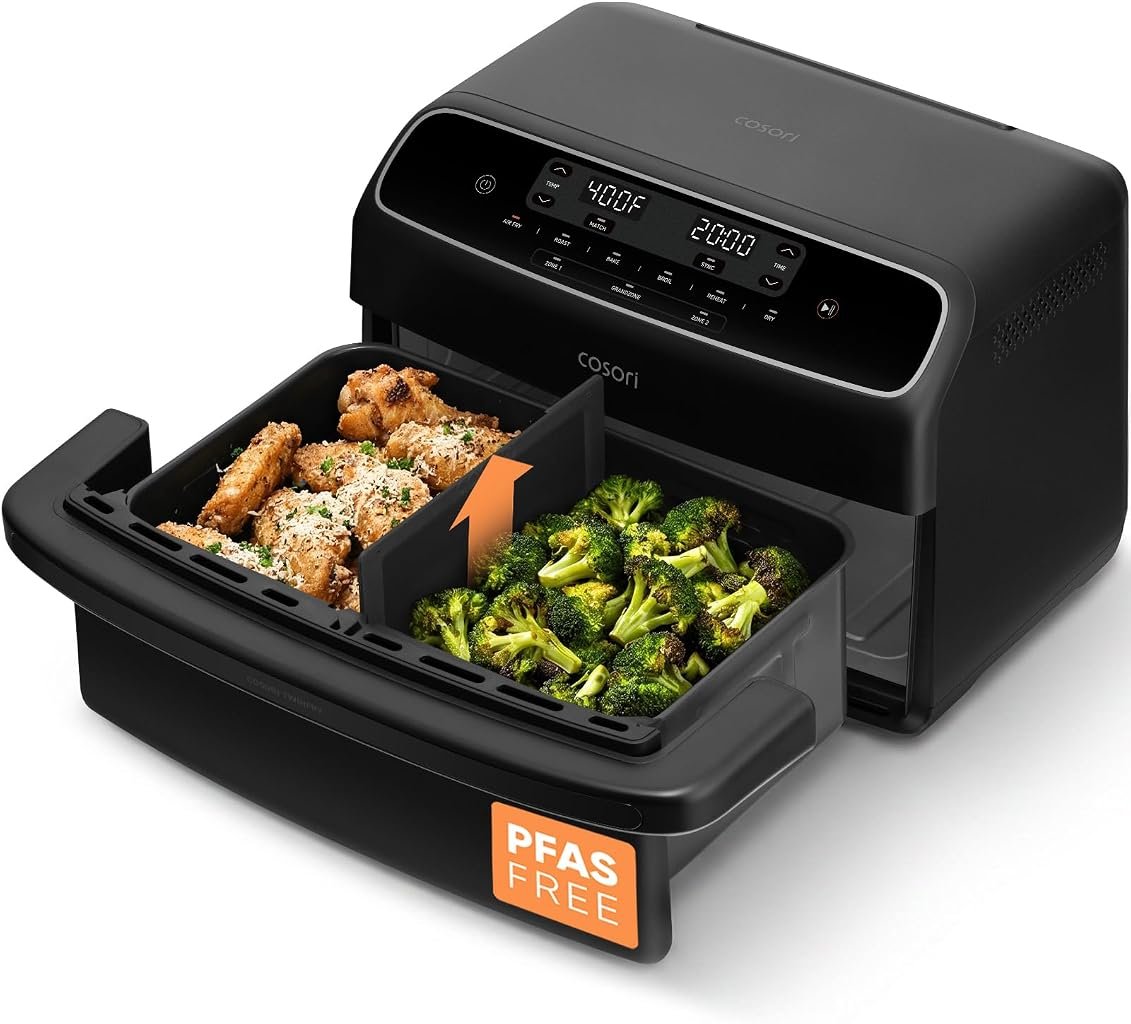
The Cosori TWINFRY Double Air Fryer approaches the dual-zone problem differently from the familiar two-drawer formula. Rather than permanently dividing the appliance into two narrow baskets, Cosori starts with one 10-liter cooking chamber and adds a removable divider. With the divider installed, the basket becomes two independently controlled 5-liter zones. Remove it, and the full chamber becomes available for larger foods.
That architectural choice is the reason the TWINFRY deserves closer examination. Dual-zone air fryers are useful because two foods can cook at different temperatures and for different durations. Their weakness is equally obvious: a physical wall permanently limits the width of each basket. Cosori’s arrangement attempts to preserve dual-zone flexibility without surrendering the advantages of a wide single chamber.
The current Cosori Dual Blaze TWINFRY 10L is specified at 2,800 watts on a 220-240-volt supply, with a 10-liter capacity, four heating elements, smart connectivity and a temperature range extending to 240°C. Cosori lists dimensions of approximately 51.8 centimeters wide, 33.8 centimeters deep and 31.3 centimeters high.
Those are substantial numbers, particularly the width and power rating. This is not a discreet personal air fryer for a corner of a cramped counter. It is a large cooking appliance intended to handle substantial quantities of food.
Our score is 9.01/10. Customer Sentiment stands at 8.94, Buyer Confidence at 9.8 and Value at 8.52. The ratings describe an appliance with an unusually coherent design proposition but meaningful demands on counter space, electrical capacity and purchase budget. The TWINFRY earns its strongest rating for Buyer Confidence because the advantages of its convertible basket can be evaluated before purchase with relatively little ambiguity.
The Convertible Basket Is The Central Idea
The TWINFRY’s most consequential feature is not Wi-Fi, a preset or even its 10-liter capacity. It is the removable divider.
Cosori specifies a large basket with an internal cooking area that can be converted into two 5-liter zones. Each side can operate with its own time and temperature settings when divided. Remove the separator, and the user regains a broad uninterrupted cooking space.
That arrangement solves a genuine problem created by conventional dual-basket fryers.
Two separate drawers are excellent when dinner consists of chicken in one basket and vegetables in the other. They become less convenient when the food itself is wide. A whole chicken, larger joint of meat or broad baking dish does not care that the appliance’s total advertised capacity is large if that capacity is split down the middle.
The TWINFRY allows capacity to change shape.
That distinction is easy to overlook when comparing air fryers purely by liters. Ten liters divided permanently into two baskets is geometrically different from ten liters that can become one chamber.
Cooking capacity is therefore not merely a question of volume. Shape matters.
Two 5-Liter Zones Change Weeknight Cooking
Install the divider and the TWINFRY becomes a dual-zone appliance.
The practical advantage is scheduling. Different foods rarely require identical conditions. Chicken pieces might need a longer cooking period than vegetables. Frozen fries may need another temperature. A conventional single-basket fryer forces the cook either to compromise or prepare the foods sequentially.
Independent zones remove much of that conflict.
Cosori’s Sync function coordinates two different programs so that both zones finish together. Match copies the same settings between the zones when both sides require identical cooking conditions.
These functions address two different problems.
Sync is about timing. If one side needs 25 minutes and the other needs 15, the machine can delay the shorter program so both finish at approximately the same point.
Match is about repetition. If both sides contain foods requiring the same settings, duplicating the program removes unnecessary button presses.
Neither feature changes the underlying physics of convection cooking, but both can reduce the mental bookkeeping involved in preparing a meal.
That is particularly relevant for households trying to use an air fryer as a partial substitute for an oven rather than merely as a machine for fries.
The 10-Liter Grand Zone Is More Than A Capacity Claim
Remove the divider and the TWINFRY becomes one large cooking chamber.
Cosori describes the main basket as approximately 38 by 22 centimeters internally, giving larger foods more uninterrupted horizontal space than they would receive in a conventional divided fryer.
The advantage is straightforward.
A large roast, broad layer of vegetables or substantial batch of potatoes can use the full chamber rather than being forced into separate narrow drawers.
That does not mean 10 liters of theoretical volume can always be filled completely while retaining ideal air-frying conditions.
Air frying depends on circulation. Food surfaces need exposure to moving hot air, and dense piles create barriers. A large chamber is most useful when it allows food to spread out, not merely when it permits a deeper pile.
This distinction should influence how capacity is judged among the best air fryers. A larger chamber can improve cooking not because every cubic centimeter should be filled, but because additional area can give food more room.
The TWINFRY’s convertible design is particularly effective on this point because the user does not permanently sacrifice that area in exchange for dual-zone operation.
Four Heating Elements Alter The Usual Air-Fryer Layout
Most basket air fryers concentrate their heating system above the food. A heating element generates heat while a fan drives hot air through the chamber.
Cosori’s Dual Blaze system uses four heating elements arranged to apply heat from above and below. The company describes the TWINFRY as having two upper and two lower heating elements across its cooking zones.
This architecture matters because the underside of food is normally one of the more difficult surfaces to brown evenly in a basket fryer.
Traditional air fryers often address the problem by asking users to shake the basket or turn food during cooking. That physically exposes different surfaces to hotter airflow.
Heating from below cannot eliminate every reason to turn or redistribute food. A dense pile of fries remains a dense pile of fries. Pieces can still shield one another from moving air. Moisture can still accumulate where food touches.
Yet upper and lower heat create a more balanced starting point than an architecture relying solely on an overhead element.
Cosori’s four-element system is therefore more meaningful than a decorative preset. It changes where thermal energy enters the chamber.
Six Cooking Modes Cover A Wide Range
The TWINFRY provides Air Fry, Roast, Bake, Grill, Reheat and Dry cooking functions, alongside the zone-management features. Its supported temperature range reaches 240°C, while documentation for CAF-TF101 variants lists a lower boundary of 35°C and cooking durations extending as long as 48 hours on supported settings.
The wide temperature range gives the appliance two different personalities.
At high temperatures, the emphasis is rapid browning, roasting and crisping. At low temperatures, the machine can handle slower drying tasks where moisture removal matters more than aggressive surface color.
That does not make it equivalent to every specialized appliance represented by a mode.
A dedicated dehydrator, for example, can provide substantially more horizontal drying area through multiple racks. A conventional oven can accommodate larger baking tins. A grill may provide different radiant heat characteristics.
The useful question is not whether the TWINFRY replaces every appliance completely. It is how many ordinary jobs it can perform well enough that another appliance does not need to be switched on.
For a household cooking moderate portions, that distinction can materially change kitchen workflow.
2,800 Watts Deserves Attention
The TWINFRY is rated at 2,800 watts for the 220-240-volt market.
That figure is substantially higher than the rated power of many smaller single- basket air fryers.
There is a logical reason. The appliance has a large 10-liter chamber, two independently usable zones and four heating elements. More heating hardware and greater cooking volume demand a different electrical design from a compact personal fryer.
Power rating should not be confused with energy consumption.
A 2,800-watt rating describes maximum electrical power under specified conditions. It does not establish that every 20-minute cooking cycle consumes electricity continuously at 2.8 kilowatts. Heating elements cycle as thermostatic control responds to temperature.
Still, the electrical requirement is not trivial.
The TWINFRY is a high-power kitchen appliance and should be operated according to its regional electrical specification and safety instructions. Buyers should also recognize that the European 2,800-watt version is designed around a 220-240-volt supply; specifications should never be transferred casually between electrical markets.
This is one area where checking the exact regional model before purchase matters more than reading a generic product description.
Energy Efficiency Is About Work Completed
Air fryers are frequently described as energy-saving appliances, but capacity changes the calculation.
A 2026 Which? comparison of air fryers and built-in ovens found that its tested air fryer consumed 0.54 kWh when cooking a roast chicken, compared with 1.157 kWh for the built-in oven. Cooking 320 grams of frozen chips required 0.287 kWh in the air fryer and 0.863 kWh in the oven.
The same comparison recorded 0.392 kWh for an air-fried jacket potato against 1.084 kWh in the oven. For cake, the figures were 0.223 kWh and 0.71 kWh respectively. Those measurements came from the specific appliances used by Which?, not the TWINFRY, and should not be interpreted as Cosori performance measurements.
Which? science team leader Steph Kipling summarized the broader pattern succinctly: “The air fryer often used less than half the energy.”
The qualification matters: batch cooking can erode that advantage.
This is where the TWINFRY’s large chamber becomes economically interesting. A 10-liter appliance can potentially complete a larger meal in one cycle than a small fryer that would require repeated batches.
That does not guarantee lower energy use than an oven for every dinner. A conventional oven can simultaneously hold several trays and substantially more food. For a large gathering, its scale may become advantageous.
The relevant comparison is therefore not watts versus watts. It is energy required to finish the entire meal.
The Appliance Is Wide
Capacity has a physical cost.
Cosori lists the TWINFRY at approximately 51.8 centimeters wide, 33.8 centimeters deep and 31.3 centimeters high. Documentation puts its weight around 9.2 kilograms.
A width above half a meter is significant on a kitchen counter.
The design may be relatively efficient for a 10-liter dual-zone appliance, but efficiency of packaging does not make the object small. A buyer with limited workspace should measure the intended location rather than relying on photographs, which can make countertop appliances appear deceptively compact.
Depth matters too. The handle extends toward the user, while safe operation requires appropriate clearance around the appliance.
Storage introduces another consideration.
A 9.2-kilogram machine is movable, but repeatedly lifting it from a low cupboard is less convenient than leaving it accessible. Countertop appliances tend to become more useful when the effort required to use them is low.
The TWINFRY therefore makes most sense where its large capacity will be used often enough to justify the permanent footprint.
Smart Control Is Useful, But Secondary
The TWINFRY supports Wi-Fi and Bluetooth connectivity and can work with Cosori’s VeSync app. Cosori describes app functions that include monitoring cooking progress and controlling relevant cooking settings, while manual activation remains necessary under the company’s stated regulatory restrictions.
Smart connectivity can be useful in a kitchen appliance, but its importance should not be exaggerated.
An air fryer still requires physical interaction. Food has to be loaded. The basket has to be cleaned. Ingredients may need inspection or redistribution. A phone cannot perform those tasks.
The app is more compelling as an information and control layer.
Being able to monitor a long cooking process without standing directly in front of the appliance can be convenient. Recipe integration can also help inexperienced users establish sensible starting settings.
But the TWINFRY’s strongest features remain mechanical: basket geometry, removable divider, independent zones and four heating elements.
If the app disappeared tomorrow, those advantages would still exist.
That is a healthy hierarchy for a kitchen appliance.
Cleaning A 10-Liter Basket Has Two Sides
Large capacity makes cooking easier and washing more awkward.
The TWINFRY’s basket is broad because it needs to create a 10-liter cooking area. That same width has to fit into a sink or dishwasher when cleaning time arrives.
Two removable crisper plates and the divider add separate pieces requiring attention. Cosori’s documentation lists those components as part of the standard package.
The removable design is sensible because food-contact components can be separated from the electrical body.
Yet no manufacturer can repeal kitchen geometry. A large drawer is simply more cumbersome to maneuver in a small sink than a compact 3-liter basket.
This is another example of the TWINFRY’s central trade: greater flexibility while cooking creates more physical appliance to manage afterward.
Regular cleaning remains preferable to allowing grease and crumbs to accumulate. Air fryers repeatedly expose residue to high temperatures, where old fats can smoke and food particles can scorch.
The TWINFRY does not create a unique maintenance problem. It simply creates a larger version of the familiar one.
The Dual-Zone Format Reduces Scheduling Friction
Cooking dinner often involves a hidden task that appliance specifications rarely quantify: coordination.
A protein needs 22 minutes. Vegetables need 15. Potatoes need longer. One item cools while another finishes. The cook becomes a traffic controller.
Dual-zone appliances address this problem directly.
With the TWINFRY divided into two zones, each side can receive independent cooking settings. Sync coordinates different durations so the two programs finish together.
That may sound like a minor convenience until it is repeated several nights each week.
Timing friction is one reason people fall back on highly processed foods or a single oven tray. The more components a meal contains, the more scheduling decisions appear.
Automating one part of that schedule does not make cooking effortless. It simply removes one calculation.
For an appliance intended to handle several components of dinner, that is a substantive design benefit.
Where The TWINFRY Is Strongest
The TWINFRY’s strengths come from the interaction of several features rather than one specification:
- The 10-liter basket can operate as one large chamber rather than remaining permanently divided.
- A removable divider creates two 5-liter zones when independent cooking is useful.
- Sync can coordinate different cooking durations so two foods finish together.
- Match duplicates settings when both zones require the same program.
- Four heating elements distribute heat from above and below.
- A temperature ceiling of 240°C provides substantial high-heat capability.
- Low-temperature settings expand the appliance into drying and gentler heating tasks.
- Wi-Fi and Bluetooth connectivity add remote monitoring and app-based controls.
- The broad basket can accommodate foods that may fit poorly into narrow conventional dual drawers.
These characteristics make the TWINFRY particularly compelling for households that genuinely alternate between two-zone dinners and large single-chamber cooking.
That distinction matters.
Someone who always cooks two small, separate portions gains less from the removable divider because a conventional dual-drawer appliance already solves that problem.
The TWINFRY earns its additional complexity when the household needs both formats.
The Drawbacks Are Mostly Physical
The TWINFRY’s disadvantages are not difficult to identify.
It is wide. At approximately 51.8 centimeters, the appliance asks for substantial counter space. It is heavy enough that constant cupboard storage may become inconvenient. Its 2,800-watt European specification requires an electrical environment appropriate to a high-power appliance.
The large basket can also be cumbersome to wash in a compact sink.
The absence of a viewing window means checking food requires opening the drawer. That is hardly unusual among air fryers, but transparent competitors demonstrate that direct visual monitoring is possible.
Then there is the fundamental limitation shared by basket air fryers: advertised capacity does not guarantee that every liter can be densely packed while maintaining ideal crisping.
Air needs space.
The TWINFRY offers more of that space than many competitors, but users can still undermine convection by treating the chamber like a storage box.
Interpreting Our Scores
Our overall score for the Cosori TWINFRY Double Air Fryer is 9.01/10.
The rating reflects a product whose main design decision solves a recognizable limitation in conventional dual-basket machines. Converting between one 10-liter chamber and two 5-liter zones gives the appliance a degree of physical flexibility that fixed twin drawers cannot duplicate.
Customer Sentiment stands at 8.94.
That figure sits close to the overall editorial rating. The small gap suggests that the strengths and compromises are relatively easy to reconcile. Buyers receive considerable flexibility, but they also live with the appliance’s width, weight and large basket.
Buyer Confidence is 9.8, the highest rating.
The reason is clarity. The TWINFRY’s advantages can be understood without relying on vague performance language. The divider is either useful to a household or it is not. A 51.8-centimeter-wide appliance either fits the intended counter or it does not. Two independently controlled zones either match the household’s cooking habits or they add unnecessary capability.
Those are questions buyers can answer before spending money.
Value is 8.52.
That lower rating reflects the fact that sophisticated flexibility only has economic value when it gets used.
A household that rarely prepares more than one small portion can obtain the basic benefits of air frying from a smaller, cheaper appliance. A household that always cooks two separate foods might be adequately served by a simpler dual-drawer model.
The TWINFRY’s strongest value appears when one household regularly needs both configurations: independent zones on Tuesday, one broad chamber on Sunday.
Who Is The TWINFRY For?
The clearest audience is a household cooking several portions at once.
Families can use the divided format for meals containing two foods with different requirements, while the undivided chamber provides space for larger single items and substantial batches.
It also makes sense for households trying to reduce routine dependence on a conventional oven.
A 10-liter air fryer is large enough to handle tasks that expose the limitations of small 2- or 4-liter models. That can reduce repeated batches, which matter for both convenience and energy use.
The TWINFRY is less convincing for one-person households unless that person regularly batch-cooks.
A compact kitchen is another difficult fit. The machine’s width cannot be negotiated away through software, and storing a 9.2-kilogram appliance after every use can become tiresome.
The buyer therefore needs to evaluate space before features.
That sounds mundane. It is also one of the most useful purchasing decisions that can be made.
Why The TWINFRY Design Matters
The air-fryer category has spent years increasing capacity and multiplying cooking zones.
The TWINFRY’s contribution is subtler: it treats the wall between those zones as optional.
That is a sensible design move because cooking requirements change from meal to meal. Permanent dividers force the appliance into one geometry regardless of what is being cooked.
A removable divider makes the geometry responsive.
The four-element Dual Blaze arrangement pushes the same idea from another direction. Instead of relying solely on overhead heat and airflow, the appliance introduces heating below the food as well.
Neither idea changes the fundamental nature of air frying. This is still convection cooking in a relatively compact chamber.
What changes is flexibility.
That is a more defensible measure of appliance development than counting presets. A seventh or eighth button may add little. Changing the physical shape of the cooking chamber can alter what actually fits inside it.
Final Considerations
The Cosori TWINFRY Double Air Fryer is a 10-liter, 2,800-watt European-market appliance built around one unusually practical decision: its dual-zone divider can be removed.
With the divider installed, two 5-liter areas can run separate cooking settings, while Sync coordinates finishing times and Match duplicates settings across both sides. Without the divider, the chamber becomes one broad cooking area. Four Dual Blaze heating elements apply heat from above and below, while the supported cooking modes cover Air Fry, Roast, Bake, Grill, Reheat and Dry.
The design gives the TWINFRY greater geometric flexibility than a conventional two-drawer machine. That matters for large foods, wide batches and households whose cooking patterns change throughout the week.
Its costs are equally tangible.
At roughly 51.8 centimeters wide and 9.2 kilograms, this is a substantial countertop appliance. The large basket requires more cleaning space. Its 2,800-watt regional specification deserves proper electrical consideration. Ten liters of capacity can still be overcrowded if food is packed too densely for effective airflow.
Our 9.01/10 overall score reflects the quality of the underlying idea rather than the number of features printed on the control panel. Customer Sentiment at 8.94 sits close behind. Buyer Confidence reaches 9.8 because the product’s suitability can be judged with unusual precision before purchase. Value at 8.52 recognizes that the additional capacity and flexibility make economic sense primarily when they are used regularly.
For a household deciding among the best air fryers, the TWINFRY poses a better question than whether two baskets are preferable to one.
It asks whether that decision should have to be permanent.
Some meals benefit from two independent zones. Others need one large uninterrupted chamber. The TWINFRY allows the same appliance to move between those requirements without forcing the cook to choose a fixed basket layout at purchase.
That flexibility is the central reason the product earns a 9.01/10 editorial score. The machine is large, power-hungry at its rated maximum and physically demanding compared with compact fryers, but those compromises purchase something concrete: cooking space that can change shape according to the meal.
For households that regularly need both configurations, that is a meaningful advantage. For households that do not, a smaller and simpler fryer will make more sense.
The TWINFRY is therefore best judged not by how much food can theoretically fit inside its 10-liter chamber, but by how effectively its convertible architecture matches the way a household actually cooks.