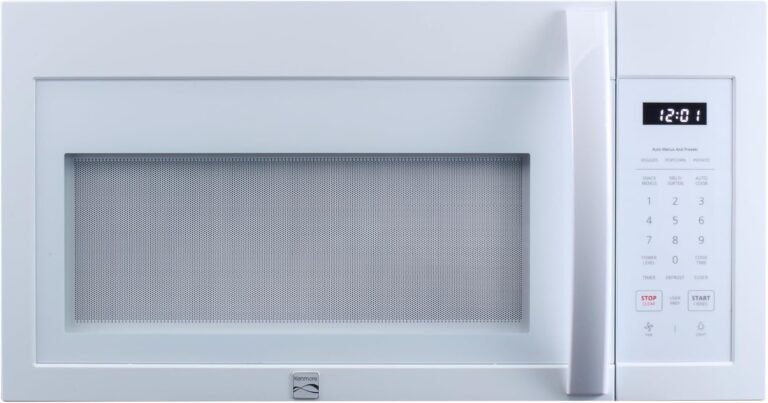
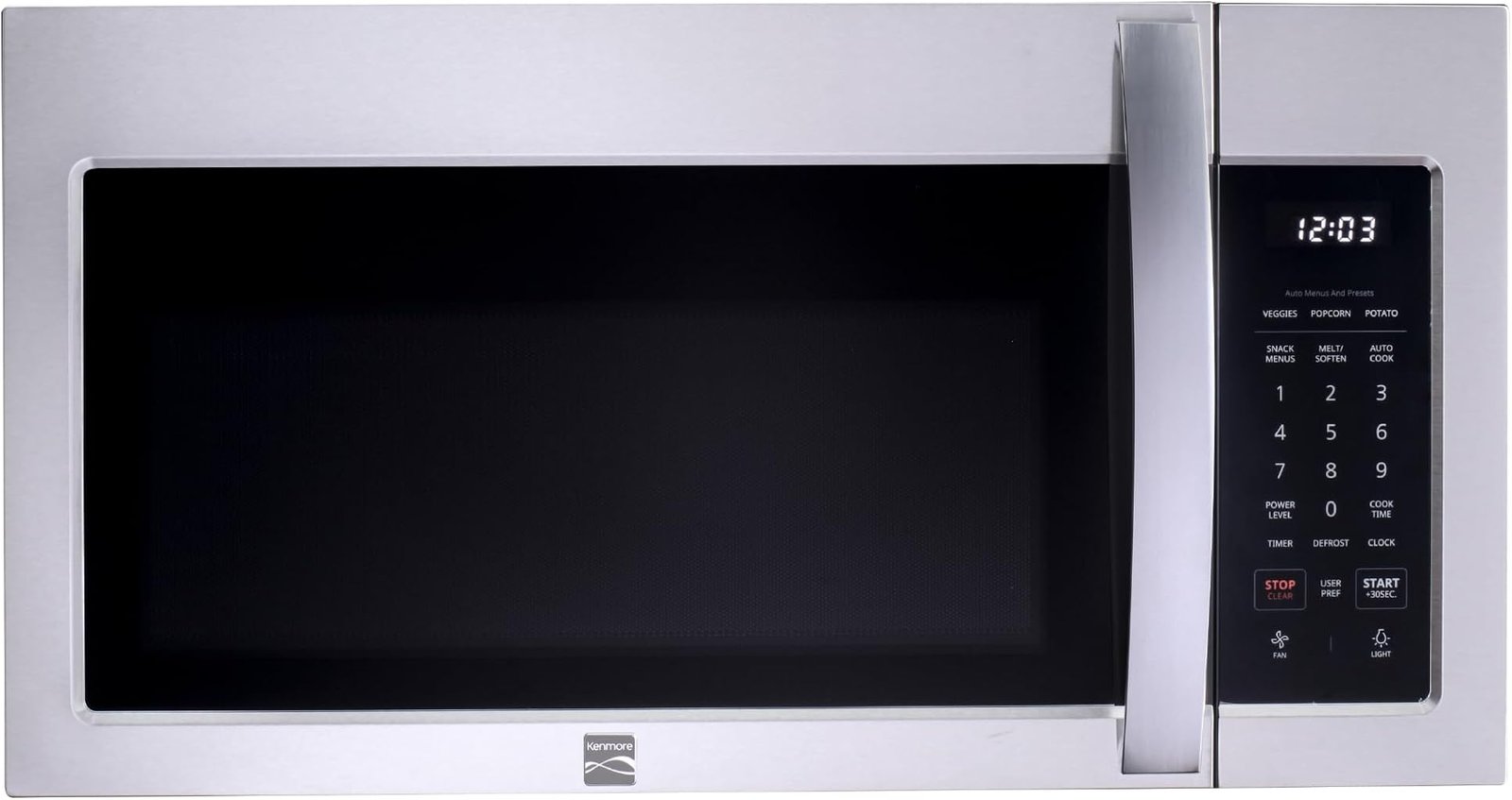
The Kenmore 1.7 cu. ft. over-the-range microwave represents a familiar kind of kitchen appliance: one expected to perform several ordinary jobs reliably rather than dazzle with an oversized list of specialty modes. It heats and reheats food, replaces a countertop microwave, illuminates the cooking surface and provides ventilation above the range. None of those duties is exotic. Their combination, however, makes an over-the-range microwave unusually dependent on both appliance design and installation quality.
Kenmore’s current 1.7-cu.-ft. stainless-steel model, 22-87063, pairs its stated capacity with 1,000 watts of cooking power, a 12.4-inch glass turntable, a 300-CFM ventilation system, two fan speeds and three ventilation configurations: top exhaust, rear exhaust or recirculation. The manufacturer’s current product specifications also identify 26 control settings, six presets, LED lighting, carbon and grease filtration, a child safety lock, Delay Start, Keep Warm and Broil functions.
Our score is 8.13/10. Customer Sentiment stands at 8.06/10, Buyer Confidence at 8.45/10, and Value at 8.03/10. Those figures sit unusually close together. There is no dramatic gap suggesting a brilliant specification undermined by questionable value, or an inexpensive appliance overcoming obvious limitations. Instead, the Kenmore presents a fairly coherent proposition: useful capacity, conventional 1,000-watt microwave power, straightforward ventilation and enough control flexibility to handle everyday cooking without becoming an unnecessarily elaborate kitchen computer.
That coherence is its central strength. Its principal restraint is equally apparent. A 300-CFM, two-speed ventilation system is functional rather than ambitious, particularly for households where smoke-heavy stovetop cooking is routine.
A 1.7-Cubic-Foot Capacity Hits a Practical Middle Ground
Capacity can become a misleading microwave specification because cubic feet are difficult to visualize at the kitchen counter.
The Kenmore’s 1.7-cubic-foot cavity is better understood alongside its 12.4-inch glass turntable. The turntable establishes a more tangible reference for dinner plates, bowls and microwave-safe containers, while the total cavity volume provides space around taller or broader dishes.
A 1.7-cu.-ft. microwave sits comfortably within the conventional full-size over-the-range category. It avoids the constrained interior of compact and low-profile designs without pushing capacity toward two cubic feet or beyond merely for specification-sheet impact.
That balance has practical consequences.
An over-the-range microwave does not live on a countertop where replacing a large model with a smaller one simply frees work surface. Its exterior dimensions affect the vertical relationship between upper cabinetry and the cooktop. Increasing cavity volume can therefore carry an architectural cost if the appliance body becomes taller.
For households regularly reheating full dinner plates, family portions, casseroles or larger microwave-safe containers, 1.7 cubic feet is a sensible capacity. A household using the microwave almost exclusively for coffee, popcorn and small bowls may receive little practical benefit from the extra interior volume.
This is where a microwave buying guide should move beyond cubic-foot comparisons. Usable dish diameter, installation height and clearance above the range can matter more than an additional fraction of a cubic foot.
The 1,000-Watt Output Is Familiar for Full-Size Microwave Cooking
Kenmore specifies 1,000 watts of cooking power.
That figure places the microwave in familiar full-size territory and makes cooking instructions easier to interpret than they can be with substantially lower-powered compact models.
Microwave wattage still requires context.
A 1,000-watt rating does not establish that every part of every dish will heat uniformly. Food composition, depth, shape, moisture, starting temperature, container design and placement all affect heating. Rotation helps expose food to changing field patterns inside the cavity, which is why the 12.4-inch glass turntable is more than a piece of removable kitchen glass.
The value of 1,000 watts is predictability. Many common microwave tasks can be performed without the extended cooking times associated with lower-output appliances.
Kenmore also provides selectable cooking controls rather than restricting the appliance to full-power operation.
Lower average power is useful when aggressive heating would produce poor results. Butter needs different treatment from soup. Chocolate needs different treatment from frozen vegetables. Defrosting meat requires a different energy pattern from rapidly heating water.
The microwave’s cooking system therefore makes more sense as a combination of output and control than as a wattage figure alone.
The Control System Is Broader Than the Exterior Suggests
Kenmore identifies 26 settings and six presets on its current 1.7-cu.-ft. model.
That is a surprisingly broad control package for an appliance that otherwise presents itself as a conventional over-the-range microwave.
The manufacturer specifically identifies Delay Start, Keep Warm and Broil among the available controls. Six presets provide automated selections for common cooking tasks. A child safety lock can disable the control panel to reduce accidental activation.
These features need to be separated by practical usefulness rather than counted as if every button carried equal weight.
Keep Warm has an obvious role when meal timing becomes uneven. Microwave cooking is frequently used at the final stage of meal preparation, when one dish is ready before another. Holding food warm can be more useful than another highly specialized preset.
Presets have a different function. They reduce button presses and remove some manual time selection from repetitive tasks. Their value rises when the household regularly cooks the foods covered by those presets and falls when users habitually enter cooking time directly.
Delay Start is more situational.
The broader point is that Kenmore has not reduced the control panel to bare-bones time-and-power operation. There is enough automation to support convenience without positioning the appliance as a connected or app-centered device.
A 300-CFM Vent System Is Adequate for Moderate Expectations
The ventilation specification deserves more scrutiny than most microwave features because airflow ratings are easy to overinterpret.
Kenmore rates the system at 300 CFM and provides two fan speeds. The appliance supports top venting, rear venting and recirculation, giving installers several ways to adapt it to the kitchen.
CFM means cubic feet per minute. It describes airflow volume under defined conditions. It does not, by itself, establish how much smoke from a pan will actually be captured in a particular kitchen.
Capture begins before air enters the blower.
Smoke and steam rise from cookware in a plume. If that plume travels outside the effective intake area-something particularly relevant with front burners-the fan cannot remove contamination it never captures. Duct resistance can then reduce airflow after capture.
The U.S. Environmental Protection Agency identifies cooking as a source of indoor particulate matter and recommends using a range hood during cooking, exhausting outdoors where possible and favoring rear burners when practical because they generally improve hood capture.
For the Kenmore, 300 CFM should therefore be treated as a moderate ventilation specification rather than an assurance of heavy-duty smoke control.
Households primarily boiling, simmering and performing moderate stovetop cooking may find the specification appropriately matched to their needs. Frequent high-temperature searing, wok cooking or frying places greater demands on capture and airflow.
Two Fan Speeds Keep Ventilation Control Simple
Kenmore provides two fan speeds.
The advantage is obvious: operation is uncomplicated. The disadvantage is equally obvious: there is little middle ground.
A multi-speed blower can let a user choose low airflow for steam or gentle simmering, a moderate setting for ordinary cooking and maximum airflow for smoke-producing work. A two-speed design compresses those choices.
This does not automatically mean poorer maximum ventilation. Number of speeds and maximum airflow are different specifications.
The limitation is control granularity.
For a household that treats the vent fan as essentially an on/high appliance whenever serious cooking begins, two speeds may be entirely sufficient. Someone who frequently leaves ventilation running for extended periods may appreciate more intermediate choices, particularly where noise becomes part of the decision.
Our assessment treats the two-speed design as a modest compromise rather than a fundamental weakness.
Three-Way Venting Improves Installation Flexibility
The Kenmore can be configured for top exhaust, rear exhaust or recirculation.
This is more consequential than it sounds.
Existing kitchens vary widely. Some have vertical ductwork disappearing through the cabinet above the microwave. Others send exhaust horizontally through the rear wall. Kitchens without exterior ductwork may rely on recirculation.
Supporting all three configurations means the appliance can accommodate several common installation arrangements without forcing every buyer into the same ventilation path.
But flexibility should not be confused with equivalence.
Exterior exhaust and recirculation accomplish different things. An externally ducted installation can carry captured cooking air outside. A recirculating installation filters air and sends it back into the kitchen.
Kenmore lists carbon air and grease filters for the current 1.7-cu.-ft. model. The grease filter addresses airborne cooking residue, while carbon filtration is associated with odor control in recirculating operation.
Filter maintenance consequently becomes part of ventilation performance.
A neglected grease filter creates resistance. A spent carbon filter cannot be expected to behave like a fresh one indefinitely. Owners should follow the model-specific maintenance instructions rather than treating filtration as a permanent, untouched component.
The Turntable Is Conventional, but Its Size Matters
The 12.4-inch glass turntable provides a useful reference for interior usability.
A microwave can advertise generous cubic capacity while still frustrating users if common plates cannot rotate without striking the cavity walls. Turntable diameter helps translate abstract volume into something closer to actual dish compatibility.
Kenmore states that the turntable rotates food during cooking to promote more even heating.
Rotation does not guarantee perfect temperature uniformity. Microwave energy interacts with food unevenly, which is why stirring, repositioning and standing time remain relevant for many foods.
Still, a rotating platform is a conventional and useful approach.
The removable glass surface also simplifies cleaning. Spills can be addressed separately rather than requiring all cleaning to happen inside the mounted appliance.
For buyers with unusually large square dishes or oversized dinnerware, actual dish dimensions should still be compared with the cavity and turntable rather than relying solely on the 1.7-cu.-ft. figure.
LED Lighting Covers Two Different Jobs
The Kenmore incorporates LED lighting inside the microwave and over the cooking surface.
Those lights have different purposes.
Interior illumination lets the user observe food during operation without opening the door. Cooktop lighting replaces the task lighting that would otherwise commonly be built into a dedicated range hood.
The manufacturer describes the cooktop lighting as bright LED illumination and also identifies energy-efficient LED lighting inside the microwave.
No defensible judgment about exact brightness should be inferred without measured illuminance data. What can be said confidently is that LED lighting addresses both required locations.
That is a small detail until an over-the-range microwave replaces a hood with good task lighting. At that point, inadequate cooktop illumination becomes noticeable every evening.
The Child Safety Lock Has a Straightforward Purpose
The control lock disables the panel to reduce accidental operation.
This is a modest feature, but microwave controls sit at an accessible height in many kitchens. Accidental button presses are plausible, particularly in households with children.
A lock does not replace supervision or safe appliance placement. It does provide a direct electronic barrier against unintended control-panel activation.
Its presence is expected at this level and useful enough to count in the Kenmore’s favor without overstating its significance.
Installation Deserves as Much Attention as the Feature List
Over-the-range microwaves are unusually unforgiving of casual replacement shopping.
A countertop microwave can often be exchanged with little more than a measurement of available counter depth and an electrical outlet check. An OTR microwave interacts with cabinetry, wall structure, mounting hardware, ductwork, electrical supply and the cooking appliance beneath it.
The nominal category width does not settle those questions.
Before purchase, the kitchen should be checked for:
- Cabinet opening width
- Upper-cabinet depth
- Vertical clearance above the range
- Existing microwave height and depth
- Door-opening clearance
- Electrical receptacle location
- Exhaust direction
- Duct size
- Mounting surface condition
- Location of wall studs or other approved structural attachment points
The mounting bracket from an existing microwave should not automatically be reused. Brackets, bolt positions and mounting requirements can differ between models even when the appliances appear similar externally.
Vent configuration also needs to be established before installation begins.
If an exterior duct already exists, the Kenmore should be configured to use the appropriate top or rear exhaust path. If the kitchen lacks exterior ducting and the appliance is installed for recirculation, expectations about smoke and contaminant removal should be adjusted accordingly.
300 CFM Versus Higher-Airflow Alternatives
A useful way to understand the Kenmore is to place its 300-CFM specification in context without turning the comparison into a ranking exercise.
The 1.7-cu.-ft. GE JVM6177 also specifies a two-speed, 300-CFM ventilation system, along with 1,000 watts of cooking power. That shows the Kenmore’s basic airflow and microwave-output figures are not unusual for the conventional 1.7-cu.-ft. OTR category.
Higher-CFM models exist, but higher maximum airflow can bring other installation considerations, including duct requirements, noise and replacement-air concerns.
The appropriate specification depends on the cooking pattern and exhaust installation.
A kitchen dominated by boiling, reheating and moderate skillet use presents a different ventilation problem from one where high-temperature frying occurs daily.
That is why ventilation deserves to be evaluated as a system rather than a single number printed beside CFM.
Our Score: 8.13/10
Our 8.13/10 score reflects a well-balanced conventional OTR microwave.
The product gets the fundamentals right on paper: 1.7 cubic feet of capacity, 1,000 watts of microwave power, a 12.4-inch rotating turntable, 300-CFM ventilation, three-way vent configuration, two fan speeds, LED lighting, multiple controls and safety locking.
Nothing about that package demands extravagant language.
The Kenmore’s appeal comes from the absence of a glaring mismatch between its primary functions. Capacity is sufficient for ordinary full-size microwave use. Cooking power is familiar. Ventilation is moderate. Controls extend beyond bare essentials without turning the interface into the central attraction.
The 8.13 score also reflects restraint. The ventilation system has only two speeds, and 300 CFM will not be the natural target for every high-smoke kitchen. Buyers seeking convection or a more specialized multi-cooking appliance should examine other product classes rather than expecting this model to perform jobs it was not built around.
Customer Sentiment: 8.06/10
Our 8.06/10 Customer Sentiment rating sits close to the overall score.
That proximity suggests a relatively coherent buyer proposition. The appliance does not depend on one spectacular specification to compensate for weaknesses elsewhere.
Its capacity, cooking power and ventilation align with familiar OTR expectations.
The product also avoids some of the complexity that can make an appliance impressive in a showroom but cumbersome during a hurried weekday dinner. Presets, Keep Warm, Delay Start and other control options exist, but ordinary timed microwave cooking remains central.
An 8.06 rating reflects positive fit rather than universal appeal.
Households prioritizing stronger ventilation, low-profile dimensions or advanced secondary cooking modes have reasons to look elsewhere. For buyers seeking a conventional 1.7-cu.-ft. OTR microwave, the specification set is easier to defend.
Buyer Confidence: 8.45/10
Our 8.45/10 Buyer Confidence score is the highest of the four editorial measures.
That rating reflects specification clarity and the existence of a current first-party Kenmore product page documenting the core appliance features.
The manufacturer identifies the capacity, turntable size, 1,000-watt output, 300-CFM airflow rating, two fan speeds, three ventilation configurations, lighting, filters and major controls.
That allows a prospective buyer to make a meaningful pre-purchase assessment rather than relying on vague marketing descriptions.
Confidence still depends on doing the installation homework.
The appliance can be perfectly suitable in specification and wrong for a particular cabinet opening, duct arrangement or clearance condition. Over-the-range appliances punish assumptions that a nominally similar replacement will automatically fit the old mounting arrangement.
Buyer confidence is therefore highest when the product specifications are paired with careful measurement.
Value: 8.03/10
Our 8.03/10 Value rating is positive but measured.
Value here comes from combining several kitchen functions in one appliance: microwave cooking, cooktop ventilation and lighting. The 1.7-cu.-ft. capacity and 1,000-watt output provide the foundation, while the 300-CFM blower and flexible exhaust configuration broaden the appliance’s role.
The value case weakens if the buyer does not need those combined functions.
A household with an excellent separate range hood has little reason to choose an OTR microwave solely for ventilation. Likewise, a kitchen where serious smoke extraction is the dominant priority may benefit from evaluating a dedicated hood rather than assuming any microwave-and-hood combination is the ideal solution.
At this score, the Kenmore makes sense as an integrated appliance rather than as a collection of impressive individual specifications.
Where the Kenmore Fits Best
The Kenmore 1.7 cu. ft. OTR microwave aligns most naturally with buyers seeking:
- A conventional full-size over-the-range microwave
- 1.7 cubic feet of interior capacity
- 1,000 watts of cooking power
- A 12.4-inch rotating glass turntable
- 300-CFM ventilation
- Top, rear or recirculating installation flexibility
- Two straightforward fan speeds
- LED cooktop and interior lighting
- Preset cooking controls
- Keep Warm and Delay Start functions
- A control-panel safety lock
Its fit becomes less compelling where high-output ventilation is the primary requirement or where cabinet-to-cooktop clearance makes a full-size OTR body undesirable.
The distinction is not a matter of one buyer being more demanding than another. Kitchen geometry and cooking habits create different requirements.
The Main Strengths
The Kenmore’s strengths are concentrated in practical specifications rather than novelty.
The 1.7-cu.-ft. cavity offers useful everyday capacity without chasing an unusually large volume. The 1,000-watt cooking output matches conventional full-size expectations. The 12.4-inch turntable gives buyers a concrete measurement for dish compatibility.
Three-way venting is another meaningful advantage because existing kitchens do not all route exhaust in the same direction.
The 26 settings and six presets provide convenience beyond simple time entry. LED lighting addresses both cavity visibility and cooktop illumination. Carbon and grease filtration support the ventilation system, particularly where recirculation is used.
The overall design is therefore coherent: each major feature addresses a routine task associated with mounting a microwave above a range.
The Main Drawbacks
The limitations begin with ventilation.
A two-speed, 300-CFM system is conventional but not unusually powerful. Households frequently producing heavy smoke should examine their ventilation requirements carefully rather than assuming the microwave format alone will provide the desired capture.
Recirculation also needs realistic expectations. Filtering air and returning it to the room is not equivalent to exhausting captured contaminants outdoors.
Full-size OTR dimensions can create another compromise. A 1.7-cu.-ft. cavity requires physical space, and the resulting appliance body can reduce the open area above the cooking surface compared with a low-profile design.
Finally, the Kenmore is best understood as a conventional microwave-plus-ventilation appliance. Buyers primarily seeking convection, air frying or a substitute for a second oven should evaluate models explicitly built around those functions.
Final Considerations
The Kenmore 1.7 cu. ft. over-the-range microwave earns its 8.13/10 overall score through balance rather than spectacle.
Its 1.7-cu.-ft. cavity is large enough for ordinary family use without making capacity the entire sales proposition. The 1,000-watt cooking output sits in familiar territory. A 12.4-inch turntable provides a practical reference for dish fit. The control package extends to 26 settings and six presets, while LED lighting and a child safety lock address routine usability.
Ventilation is the specification that deserves the closest scrutiny.
A 300-CFM maximum with two fan speeds is suitable for many conventional installations, but it should not be mistaken for a guarantee of aggressive smoke capture. Real performance depends on where the cooking plume rises, whether the appliance exhausts outdoors, the condition of the filters and the resistance imposed by ductwork.
Three-way venting gives installers useful flexibility, allowing top, rear or recirculating configurations. The choice among those configurations changes what the ventilation system can accomplish.
Our 8.45/10 Buyer Confidence score reflects the clarity of the product’s documented specifications. The 8.06/10 Customer Sentiment and 8.03/10 Value ratings remain close to the overall score, reinforcing the view that this is a balanced appliance rather than one carried by a single headline feature.
For a household using a microwave for reheating, defrosting and ordinary cooking while needing moderate cooktop ventilation, the Kenmore presents a coherent package.
For a kitchen dominated by high-temperature frying and searing, ventilation deserves a more demanding assessment. For cabinetry with limited vertical clearance, exterior dimensions and installation height deserve equal attention. And for buyers seeking convection or air-frying functions, the conventional nature of this appliance should be treated as a design boundary rather than overlooked until after installation.
That is ultimately where the Kenmore fits within a microwave buying guide.
It is not defined by novelty. It is defined by a collection of familiar specifications assembled around the daily reality of an over-the-range appliance: food has to fit, heating has to be controllable, the cooktop needs light, cooking air needs somewhere to go, and the entire machine has to coexist with cabinets and ductwork for years.
Those mundane requirements are exactly where an OTR microwave earns or loses its usefulness. The Kenmore’s specification set addresses them with relatively little drama, and that restraint is a meaningful part of its appeal.