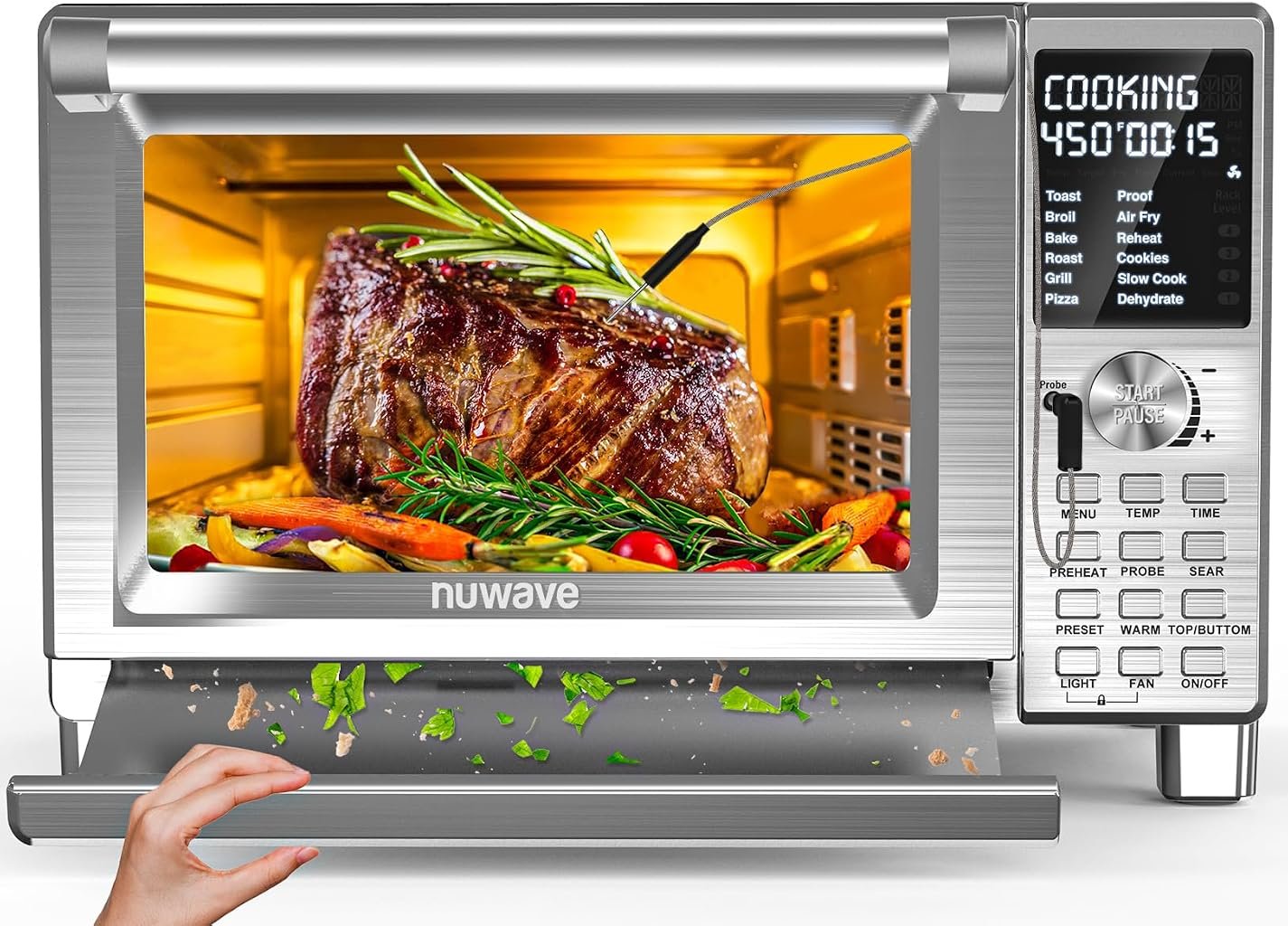
The Nuwave Bravo XL Pro Air Fryer Toaster Oven approaches countertop cooking as an exercise in control. Where a basic air fryer reduces the process to temperature and time, the Bravo XL Pro adds adjustable upper and lower heating, multiple rack positions, a digital temperature probe, a broad 50°F-to-500°F operating range, and enough interior space to make multi-rack cooking plausible rather than theoretical.
It is also a physically substantial appliance. According to Nuwave’s specifications for the Bravo XL Pro, the 30-quart oven measures 19.875 inches long, 14.75 inches wide, and 11.125 inches high, with an interior measuring 14.5 by 13 by 7.625 inches. Weight is listed at 25 pounds. The company says the chamber can accommodate a 10-pound chicken, two pounds of fries, or two 13-inch pizzas.
Those numbers immediately separate the Bravo XL Pro from compact basket fryers. This is not an appliance designed to disappear into a cupboard after lunch. It is closer to a secondary oven intended to earn a semi-permanent section of countertop.
Our score is 8.55/10. Customer Sentiment stands at 8.28, Buyer Confidence at 9.8, and Value at 8.15. The pattern is revealing. Confidence is particularly high because the product’s major specifications and operating controls are well documented. The slightly lower Customer Sentiment and Value figures reflect a more complicated proposition: size, interface complexity, cleaning, and the usefulness of advanced controls vary substantially from kitchen to kitchen.
At the $154.99 reference price used in this assessment, the Bravo XL Pro offers considerable hardware for the money. Whether that translates into genuine value depends on how much of that hardware actually gets used.
Thirty Quarts Changes the Air-Fryer Equation
Capacity is one of the Bravo XL Pro’s defining characteristics.
Thirty quarts places it well beyond the compact category. Nuwave’s stated ability to accommodate two 13-inch pizzas illustrates the chamber more effectively than the quart figure alone. Pizza requires horizontal area, and fitting two at once also requires enough vertical separation for multiple cooking levels.
The oven provides four rack positions. That creates opportunities for multi-level cooking, but it also introduces a problem familiar to every conventional oven: food on different levels does not automatically receive identical heat.
Nuwave addresses that issue with top and bottom heating elements plus forced convection. The company describes three upper and two lower heating elements working with its convection fan.
The physical arrangement matters because air-fryer ovens face a more difficult airflow problem than compact baskets. A small basket concentrates moving hot air around a relatively limited volume of food. A 30-quart chamber must circulate heat through a much larger space while coping with trays, racks, pans, and potentially several layers of ingredients.
Capacity therefore creates both the Bravo XL Pro’s greatest practical advantage and one of its more demanding engineering assignments.
The Temperature Range Is Wider Than Most Cooking Requires
The Bravo XL Pro operates from 50°F to 500°F.
That range covers dramatically different processes. Fifty degrees sits at the extreme low end of food warming and low-temperature preparation, while 500°F provides the intense heat associated with pizza, aggressive roasting, and high-temperature finishing.
More significant is the ability to adjust temperature in 5°F increments.
That granularity gives the cook more control than ovens restricted to broad steps. The difference between 375°F and 380°F will not transform every meal, but fine adjustment becomes useful when adapting recipes, managing delicate foods, or compensating for observed browning.
Independent testing by RTINGS also confirms the broad operating envelope. RTINGS measured the Bravo XL Pro’s selectable range at 50°F to 500°F and recorded a maximum power draw of 1,750 watts in its test unit. The publication also confirmed convection operation and the presence of the temperature probe.
That independent assessment is useful because advertised flexibility and measured cooking behavior are not the same question. An oven can offer numerous settings while still requiring the owner to learn how its actual heat distribution behaves.
The Smart Probe Solves a Different Problem Than a Timer
The included digital temperature probe deserves more attention than another preset button.
Cooking time is an indirect measure of doneness. Internal temperature is a direct measurement of what is happening inside the food.
That distinction matters most with large proteins. A recipe may estimate how long a chicken or roast should cook, but actual time changes with food mass, starting temperature, shape, rack position, and oven behavior.
The probe allows the Bravo XL Pro to monitor internal temperature during cooking. Rather than relying solely on elapsed minutes, the oven can use the measured food temperature as part of the cooking process.
This is particularly useful in an appliance capable of accommodating a 10-pound chicken. Larger foods expose the weakness of timer-only cooking because surface browning can occur well before the center reaches the intended temperature.
The probe does not remove the need for sound food-safety judgment, and its placement matters. A probe inserted into bone, a thin section, or the wrong part of a roast can provide an unrepresentative reading.
Used correctly, however, it gives the oven a source of information that ordinary countertop fryers rarely possess.
Independent Upper and Lower Heat Is the More Interesting Feature
The Bravo XL Pro’s ability to change the relationship between upper and lower heating is arguably more useful than its long preset list.
Most ovens conceal element management behind cooking modes. Selecting Bake or Broil determines which heaters operate and how they cycle. The Bravo XL Pro gives the cook more direct authority over that balance.
This is particularly relevant for pizza.
A pizza has two surfaces with competing requirements. The base needs enough energy to brown and develop structure, while toppings and cheese require heat from above. When those processes move at different speeds, changing overall oven temperature affects both.
Independent heat control offers another option.
If toppings are browning before the base is ready, the cook can favor bottom heat. If the crust is progressing quickly while the surface remains pale, additional upper heat can address the imbalance.
The same reasoning applies to casseroles, baked goods, roasted vegetables, and other foods where upper and lower surfaces behave differently.
This is not automation. It is the opposite: a mechanism that allows the owner to intervene intelligently.
Air Frying Benefits From the Faster Fan, but Claims Need Context
Nuwave emphasizes the Bravo XL Pro’s high-speed convection system. The manufacturer states that the redesigned fan can reach 3,000 RPM and describes it as 100 percent faster than its earlier system. Those are manufacturer comparisons, not universal measurements against every competing air fryer.
That distinction matters.
Fan speed alone does not determine air-frying performance. Chamber geometry, airflow path, heating-element output, basket design, food placement, moisture, and load size all influence browning.
A faster fan can increase air movement, but a 30-quart oven also has far more space to circulate air through than a compact basket fryer.
The practical benefit of the Bravo XL Pro is therefore less about an isolated RPM figure and more about combining substantial airflow with broad tray area.
This is where comparison with the best air fryers becomes complicated. A dedicated basket model can concentrate heat and airflow around a small portion. The Nuwave offers a larger cooking surface and the possibility of preparing substantially more food at once.
The buyer is choosing between concentration and throughput.
Multi-Rack Cooking Is Useful but Not Automatic
Four rack positions make the 30-quart chamber unusually configurable.
A cook can place food near the upper elements for stronger radiant browning, lower it to reduce top exposure, or use multiple levels when preparing larger quantities.
The challenge is that every additional tray changes airflow.
A basket or pan can act as a physical barrier inside the oven. Hot air moving through an empty chamber does not behave identically once two pizzas, trays of vegetables, or multiple racks of food are inserted.
Nuwave’s combination of upper and lower elements and forced convection is designed to reduce those differences. Yet users should still think of rack position as a cooking variable rather than a storage decision.
Multi-level cooking may require observation, rotation, or adjustment depending on the food.
That is not unique to the Bravo XL Pro. It is a consequence of cooking multiple layers inside any relatively compact heated chamber.
Presets Offer Convenience, but Customization Is the Real Story
The Bravo XL Pro includes a substantial library of preset cooking options. Depending on the exact version and accessory package, Nuwave markets a large collection of presets and recipe programs.
Large preset counts require interpretation.
A preset is usually a stored combination of temperature, time, fan behavior, or heating configuration. It does not represent a new cooking technology every time another food appears in the menu.
The Bravo XL Pro becomes more interesting when those presets are treated as starting points rather than rules.
Temperature can be adjusted. Cooking time can be changed. The heating balance can be altered. Fan behavior and rack position provide further variables.
The result is an appliance that can support two very different users.
One can rely heavily on programmed modes. Another can use the oven more like manually controlled cooking equipment.
The second user is more likely to extract the full value from the design.
The Interface Requires Some Learning
A large number of controls inevitably creates cognitive overhead.
A conventional toaster oven with three mechanical knobs can be understood almost immediately. Temperature, function, and time are visible at a glance.
The Bravo XL Pro handles far more variables. The user may need to consider function, temperature, time, fan behavior, heating-element balance, probe temperature, rack position, and whether a stored program is appropriate.
That complexity is not automatically bad. It is the cost of flexibility.
The problem appears when the appliance’s capabilities exceed the owner’s interest in learning them. A household that uses Air Fry at 400°F for nearly everything gains little from sophisticated heat management.
The Bravo XL Pro therefore rewards a brief period of experimentation. Recording successful settings for frequently cooked foods can reduce later guesswork. Pizza, vegetables, chicken, toast, and baked dishes each reveal different aspects of the oven’s behavior.
Once those patterns become familiar, the controls become less intimidating because they correspond to observable cooking problems.
The Included Hardware Supports Its Broader Ambitions
The standard Bravo XL Pro package includes an enamel baking pan, broiler rack, pull-out crumb tray, air-frying basket, digital temperature probe, and two heavy-duty cooking racks, according to Nuwave’s current product listing.
Each component has a distinct job.
- The air-fry basket exposes more food surface to moving air.
- The baking pan contains liquids and foods unsuitable for mesh.
- The broiler rack changes how food sits relative to the pan and heating elements.
- The cooking racks support cookware and create multiple vertical levels.
- The crumb tray catches loose debris below the chamber.
- The digital probe measures internal food temperature.
That collection reinforces the product’s identity as a small oven system rather than a single-purpose fryer.
It also creates more equipment to clean and store.
This is an unavoidable tension in multifunction appliances. Every accessory expands capability while adding another object that has to live somewhere when not in use.
Cleaning Is Where Large Air-Fryer Ovens Demand Patience
Air frying can be messy because rapid airflow does not discriminate between desirable convection and airborne grease droplets.
Bread crumbs, coatings, fat, and small food particles can migrate beyond the immediate cooking surface. A 30-quart chamber provides considerably more interior area for that residue to reach than a removable fryer basket.
The pull-out crumb tray helps with loose debris. Baking pans can also be positioned to intercept drippings when the cooking configuration allows it.
Neither eliminates the need to clean the interior.
Repeated heating makes old grease harder to remove, so frequent light cleaning is preferable to infrequent deep cleaning.
The glass door deserves attention as well. Grease on oven glass becomes progressively more stubborn after repeated high-temperature cycles.
For buyers accustomed to putting a fryer basket into a dishwasher, the Bravo XL Pro represents a different maintenance model. The payoff is broader cooking capability; the cost is more surface area.
Thirty Quarts Requires a Countertop Commitment
The Bravo XL Pro’s exterior dimensions are not incidental.
At nearly 20 inches in its longest dimension and 25 pounds in weight, it is not particularly convenient to move repeatedly between a cupboard and counter.
A prospective owner should therefore evaluate where it will remain during normal use.
Depth matters because the appliance must coexist with the usable work surface in front of it. Height matters beneath cabinets. Door movement requires room at the front. Ventilation and heat clearance also need consideration.
The 30-quart chamber looks attractive in isolation, but kitchen capacity is a zero-sum calculation. A larger oven consumes space that could otherwise be used for food preparation or another appliance.
The Bravo XL Pro makes the strongest spatial argument when it replaces equipment rather than joining it.
The 8.55/10 Score Reflects Capability With Conditions
Our score of 8.55/10 recognizes an unusually capable countertop oven.
The broad 50°F-to-500°F temperature range supports everything from low-temperature work to intense high-heat cooking. Four rack positions improve flexibility. Adjustable upper and lower heat gives the cook an uncommon degree of control. The digital temperature probe makes internal food temperature part of the cooking process rather than an afterthought.
The 30-quart chamber also provides genuine scale.
At the same time, the oven demands more from its owner than a simpler appliance. It requires counter space, routine cleaning, accessory storage, and enough familiarity with the controls to make advanced features useful.
Independent testing reinforces that mixed picture. RTINGS praised its cooking versatility and documented the broad temperature range, probe, convection system, and manually selectable upper and lower burners, while its broader testing also found areas where cooking behavior was less consistent.
An 8.55 score therefore reflects breadth and controllability rather than effortless perfection.
Customer Sentiment at 8.28 Reflects the Ownership Reality
Customer Sentiment stands at 8.28, below our overall score but still firmly positive.
That difference reflects daily friction.
Specifications make a 30-quart chamber sound universally desirable. In practice, a larger appliance takes more room. Multiple racks sound useful until they need cleaning and storage. A sophisticated control panel looks impressive until a hurried user simply wants to reheat lunch.
The Bravo XL Pro works best when its complexity aligns with the owner’s cooking habits.
A person who regularly bakes, roasts, air fries, makes pizza, reheats meals, and cooks larger proteins can exploit the range of controls. A person who primarily reheats frozen snacks may encounter more interface and hardware than necessary.
The 8.28 score captures that distinction. The product offers substantial capability, but capability and convenience are not identical.
Buyer Confidence at 9.8 Reflects Strong Documentation
Buyer Confidence is 9.8, the highest of our four ratings.
The Bravo XL Pro’s central specifications are unusually easy to establish. Nuwave publishes its exterior and interior dimensions, 30-quart capacity, temperature range, included accessories, rack arrangement, voltage, and supported cooking architecture.
The owner’s manual for the Bravo XL Pro also identifies the appliance as a 120-volt, 60-hertz, 1,800-watt household unit, providing another direct technical reference for the platform.
Independent testing adds another layer of verification by measuring physical cooking characteristics rather than merely repeating the marketing description.
High Buyer Confidence does not promise that every owner will prefer the interface or that every cooking mode will perform equally well. It means the product’s identity, architecture, and principal capabilities can be established with relatively little ambiguity.
Value at 8.15 Depends on Consolidation
Our Value score is 8.15 at the $154.99 reference price.
The calculation is not simply a matter of dividing the number of presets by the purchase price.
Value comes from functions that actually displace other equipment.
If the Bravo XL Pro replaces a basket air fryer, toaster, countertop oven, pizza oven for modest pizzas, and some routine use of the full-size oven, the economics become compelling. If all of those appliances already exist and work well, the Nuwave may simply add another 25-pound object to the counter.
The smart probe contributes more value to households that roast meat regularly. Adjustable top and bottom heat matters more to people who bake or make pizza. Multi-rack capacity is more useful to families than to someone cooking a single portion.
The appliance therefore has a high ceiling for value but does not reach that ceiling automatically.
Who Should Consider the Bravo XL Pro
The Bravo XL Pro makes the strongest case for households seeking a large, highly adjustable countertop oven.
Its 30-quart capacity suits larger batches. Four rack levels give cooks more freedom in arranging food. The temperature probe adds direct internal-temperature monitoring. Adjustable upper and lower heating provides a practical response to uneven surface browning.
It is particularly well matched to cooks who understand that different foods need different heat patterns.
Pizza is an obvious example, but the principle extends to baked dishes, roasted proteins, vegetables, toast, and casseroles.
The oven can also make sense for households that routinely avoid using a full-size oven for moderate quantities of food.
The important qualification is frequency. Large countertop appliances justify their footprint by being used often.
Who Should Choose a Smaller Air Fryer
A 30-quart oven is unnecessary for many air-frying jobs.
Someone preparing one portion of fries, vegetables, nuggets, or reheated leftovers may be better served by a compact basket fryer. The smaller chamber can concentrate airflow around food while requiring less counter area and fewer accessories.
Basket models also tend to simplify cleanup because the primary food-contact components are removable.
Buyers comparing the Bravo XL Pro with the best air fryers should therefore resist assuming that greater capacity is automatically better.
Capacity is useful only when it is filled often enough to justify the physical footprint.
Likewise, cooks who dislike complex interfaces may prefer a simpler toaster oven. The Nuwave’s controls are an asset only when they are understood and used.
Better Results Require Understanding the Heat
The Bravo XL Pro gives users enough control that technique becomes particularly important.
Air-fried food should be distributed so moving air can reach as much surface area as possible. Overcrowding reduces that exposure.
Rack position should be selected deliberately. Foods needing stronger top browning can benefit from greater proximity to the upper elements, while dishes vulnerable to excessive surface color may need more distance.
The temperature probe should be inserted into an appropriate thick section of food, away from bone when measuring meat.
Pizza offers an opportunity to experiment with upper and lower heater balance. Rather than immediately changing total temperature when one surface cooks too quickly, the user can alter where the energy is coming from.
For unfamiliar dishes, checking progress before the expected cooking time expires is sensible. A countertop convection oven does not necessarily reproduce the behavior of a conventional oven even when both displays show the same temperature.
The Bravo XL Pro rewards observation more than blind adherence to preset numbers.
Final Considerations
The Nuwave Bravo XL Pro Air Fryer Toaster Oven is best understood as a configurable 30-quart countertop oven that happens to be highly capable of air frying, rather than as an oversized version of a conventional fryer basket.
Its architecture supports that interpretation. A 50°F-to-500°F temperature range covers unusually diverse cooking jobs. Four rack positions create genuine multi-level flexibility. Upper and lower heating can be adjusted rather than remaining entirely hidden behind preset modes. A digital temperature probe introduces internal food temperature into the control process. The large chamber can accommodate foods that would be impractical in compact fryers.
The physical costs are equally real.
A 25-pound appliance approaching 20 inches in its longest external dimension needs a meaningful amount of kitchen space. A large air-fry oven also creates more interior surface to clean. Multiple accessories require storage. Advanced controls require attention before they become useful.
Our score of 8.55/10 reflects the depth of capability without pretending that complexity is universally desirable. Customer Sentiment at 8.28 recognizes that ownership includes cleaning, counter-space demands, accessory management, and an interface that asks for more involvement than a simple fryer. Buyer Confidence at 9.8 reflects unusually well-documented specifications backed by first-party material and independent testing. Value at 8.15 reflects an attractive proposition at the $154.99 reference price when the appliance replaces several pieces of cooking equipment.
The Bravo XL Pro therefore makes the strongest argument in a kitchen where cooking varies from day to day. Toast may be followed by air-fried vegetables, pizza, roasted chicken, baked food, reheated leftovers, or multi-rack preparation. In that environment, adjustable heat and a large chamber have repeated opportunities to justify themselves.
For a household interested almost exclusively in crisping one small basket of food, the equation changes. A simpler machine can perform that narrower job with less space, fewer controls, and easier cleanup.
That distinction is more useful than counting presets. The Bravo XL Pro’s defining characteristic is not how many buttons or stored recipes it can offer. It is the degree to which the cook can intervene in the movement and distribution of heat.
For buyers who want that authority, the Nuwave offers an unusually deep set of controls in a countertop format. For those who prefer an appliance to make most of those decisions automatically, its sophistication can become excess capacity of another kind.