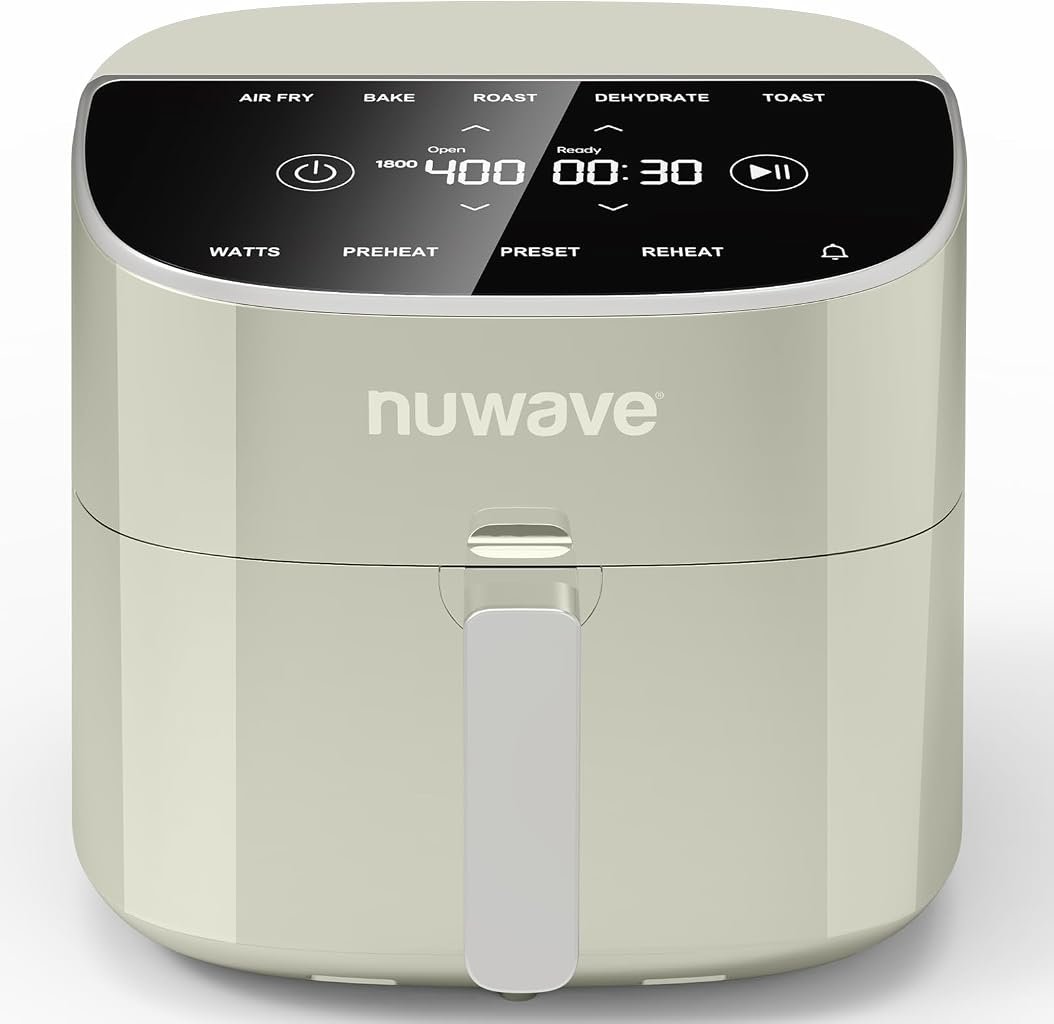
Air fryers are often sold through abundance: more presets, more accessories, more modes, more numbers competing for space on a control panel. The Nuwave Brio Plus 8 QT takes a more disciplined route. Its defining characteristics are an 8-quart single-basket format, 1,800 watts of rated power, digital touch controls, a 50°F-to-400°F temperature range adjustable in 5°F increments, and a heating system that Nuwave calls Linear T Technology.
Those specifications establish an appliance with a different emphasis from dual-basket machines. There is no divider splitting the cooking area into independent zones. Instead, the Brio Plus concentrates its capacity into one basket and focuses heavily on temperature control and airflow.
Nuwave lists the current Brio Plus 8 QT as model 37501LW and gives it dimensions of 11.5 inches deep, 11.25 inches wide, and 12.75 inches high, with a listed weight of 16 pounds. The manufacturer specifies an 8-quart capacity, 1,800-watt power rating, PFOA-free ceramic nonstick material, five cooking functions, and a one-year manufacturer’s warranty.
Our score is 8.55/10. Customer Sentiment stands at 8.28, Buyer Confidence reaches 9.8, and Value is 8.15. At the $109.99 price used for our assessment, those figures describe an air fryer with a strong technical foundation and unusually clear specifications, though its single-basket architecture will not satisfy every cooking routine.
Its central proposition is simple: rather than divide the workload into multiple zones, give one basket broad temperature control and substantial capacity.
Eight Quarts in One Basket Changes the Capacity Equation
An 8-quart specification can mean very different things depending on how an air fryer is constructed.
Dual-basket appliances often divide their headline capacity between two smaller chambers. An 8-quart dual-zone fryer, for example, may effectively provide two 4-quart baskets.
The Brio Plus takes another approach. Its capacity is concentrated in a single basket.
That matters whenever food needs uninterrupted space.
A larger single basket is better suited to foods that cannot conveniently be divided between separate drawers. It also avoids the hard physical boundary that runs through the middle of dual-zone designs.
Yet a single chamber has its own compromise.
Two foods placed inside the Brio Plus cannot receive genuinely independent temperature and timing instructions at the same time. If chicken needs one cooking schedule and vegetables another, the cook must coordinate them manually, add one food later, remove one earlier, or cook in separate batches.
The choice between single-basket and dual- basket air fryers is therefore not merely about capacity.
It is about geometry and control.
The Brio Plus favors uninterrupted space.
The 50°F-to-400°F Range Is More Interesting Than Preset Count
Nuwave specifies temperature control from 50°F through 400°F in 5°F increments.
The lower end deserves attention because many discussions about air fryers focus almost exclusively on high heat. Crisping is obviously central to the category, but a broad temperature range increases the number of jobs that can be attempted without treating every food as though it were a frozen french fry.
Five-degree adjustment increments also give the user finer numerical control than appliances restricted to larger jumps.
Precision on the display should not be confused with laboratory-level certainty inside the food, however. Food temperature and chamber temperature are different measurements. Opening the basket releases heat. Food absorbs thermal energy. Moisture evaporates. Portion size and starting temperature affect cooking.
The significance of 5°F controls is therefore not that every square inch of food is guaranteed to remain within an exact five-degree envelope.
The benefit is control resolution.
The user can make relatively small adjustments rather than being forced into broad temperature steps.
That approach fits the Brio Plus better than a large catalog of narrowly named presets would.
Linear T Technology Is the Product’s Main Technical Claim
Nuwave places considerable emphasis on what it calls Linear T Technology.
The manufacturer says the system maintains heat from 50°F to 400°F in 5°F increments and uses a heater that remains on to reduce the temperature fluctuations associated with traditional cycling designs.
That description deserves careful interpretation.
Heating appliances generally regulate temperature rather than creating a perfectly static thermal environment. The Brio Plus still operates in a physical cooking chamber affected by food mass, moisture, airflow, basket opening, and ambient conditions.
Nuwave’s claim is therefore most usefully understood as a description of its heater-control strategy rather than a guarantee that every food experiences a perfectly flat temperature curve.
The engineering idea is nevertheless relevant.
Temperature regulation can affect browning, moisture loss, cooking rate, and repeatability. An appliance that gives the user small adjustment increments is easier to tune when a familiar recipe needs slightly more or less heat.
For experienced air-fryer owners, that may prove more useful than another row of food-specific buttons.
A Five-Coil Heater and Nine-Blade Fan Drive the Airflow System
The manufacturer describes its 360-degree baking system as using a five-coil heating tube and a nine-blade fan mounted in the upper portion of the appliance.
That hardware description gets closer to what an air fryer actually does.
The U.S. Department of Agriculture describes air fryers as “essentially countertop convection ovens”. Hot air circulates rapidly around food, transferring heat and encouraging surface moisture to evaporate.
The fan and heater therefore matter more than the word “fryer” might suggest.
There is no vat of oil performing the thermal work of deep frying. The appliance depends on moving heated air around the food.
That also explains why basket arrangement matters so much.
An 8-quart basket creates useful volume, but volume alone does not guarantee crisping. Food buried beneath other food has less direct exposure to moving air.
Capacity is only useful when airflow can exploit it.
The Air Circulation Riser Has a Functional Purpose
Nuwave includes what it calls an air circulation riser with the Brio Plus. The manufacturer specifically identifies an upgraded, more secure circulation riser as part of the current design.
The idea is straightforward: food needs separation from the lowest solid surfaces of the basket so hot air can circulate more effectively around it.
This is the same reason crisper plates and perforated inserts appear across the air-fryer category.
The hardware creates a path for moving air beneath food rather than allowing the entire underside to sit against a solid surface.
It does not eliminate the need for sensible loading.
Pieces packed tightly together still shield one another. Wet foods still release moisture. Large batches can still require turning or redistribution.
The riser assists circulation.
It cannot manufacture empty space where none remains.
Auto-Pause Is Small but Sensible
The Brio Plus includes integrated sensors that pause cooking when the basket is removed and resume the cycle when the basket is returned.
This is not a glamorous feature, which may be exactly why it is useful.
Air-fried foods often need visual inspection, shaking, turning, or rearrangement. Basket removal is therefore part of normal operation rather than an exceptional event.
Automatically pausing the active cooking cycle reduces unnecessary interaction with the touch controls during those checks.
It also aligns the interface with the physical behavior of the appliance. The basket leaves; active cooking pauses. The basket returns; the cycle resumes.
Small conveniences are most effective when they disappear into routine.
The 1,800-Watt Rating Has Practical Consequences
Nuwave rates the Brio Plus at 1,800 watts.
That figure places it among substantial countertop cooking appliances rather than low-power reheating devices.
Wattage should not be converted directly into assumptions about food quality or cooking speed. Two appliances with identical electrical ratings can distribute and regulate heat differently.
The number is still operationally important.
A high-power countertop appliance creates meaningful electrical demand. Placement and electrical use should follow the manufacturer’s instructions, and users should avoid treating extension arrangements or overloaded circuits casually.
The 1,800-watt rating also helps explain why the Brio Plus can support a relatively large basket and broad cooking-temperature range within a countertop footprint.
Power is part of the system.
It is not a performance score by itself.
Ceramic Nonstick Construction Changes the Material Question
Nuwave specifies the Brio Plus cooking material as PFOA-free ceramic nonstick.
That wording is precise and should remain so.
“PFOA-free” identifies the absence of a specific chemical. It should not automatically be expanded into broader claims about every fluorinated substance unless the manufacturer explicitly documents them.
For buyers, the practical issue is that the basket uses a ceramic nonstick cooking surface intended to reduce adhesion and simplify food removal.
Nonstick surfaces still require appropriate care.
Aggressive metal utensils, abrasive cleaning methods, or improper treatment can damage many coated cooking surfaces. Following the manufacturer’s cleaning instructions therefore matters not merely for appearance but for maintaining the basket’s working surface.
Material preferences are personal, but exact labeling is more useful than broad assumptions.
The Digital Interface Favors Visibility
Nuwave uses a full digital touch interface with large white lettering on the Brio Plus. The manufacturer specifically contrasts the layout with analog buttons and labels.
Interface design is easy to dismiss when comparing air fryers on specification sheets.
Daily ownership makes it harder to ignore.
Air fryers are frequently adjusted with wet or food-covered hands nearby, used under mixed kitchen lighting, and operated while several other cooking tasks are occurring. Readable controls reduce friction.
The more interesting choice is that the Brio Plus combines a relatively modern touch interface with only five primary cooking functions.
That balance avoids one of the stranger tendencies in countertop appliances: large displays devoted to dozens of presets that differ only slightly.
Five cooking functions place greater emphasis on manual temperature and time control.
For users comfortable making those decisions, that is a rational trade.
Our 8.55/10 Score Reflects Capability Without Pretending the Format Is Universal
Our score of 8.55/10 reflects a machine with a clear technical identity.
The Brio Plus combines 8-quart capacity, 1,800 watts, a 50°F-to-400°F range, 5°F adjustments, digital controls, automatic basket sensing, a ceramic nonstick cooking surface, and a circulation system built around a five-coil heater and nine-blade fan.
Those characteristics fit together logically.
The large single basket provides space.
The airflow hardware works around that space.
The broad temperature range increases control.
Linear T Technology addresses temperature regulation.
The circulation riser helps expose more food surface to moving air.
The digital interface gives the user access to those settings.
The weaknesses are equally coherent.
A single basket cannot cook two foods under fully independent conditions at once. Eight quarts may be excessive for very small households. A 1,800-watt appliance demands appropriate electrical use. The ceramic nonstick surface requires reasonable care. The five-function interface may appear restrained to buyers attracted to extensive preset libraries.
An 8.55 score captures that balance.
Customer Sentiment: 8.28
Our Customer Sentiment score is 8.28, slightly below the 8.55 overall assessment.
The difference is modest but useful.
The Brio Plus asks buyers to appreciate manual control, single-basket capacity, and heating design more than novelty. It does not offer the instantly visible flexibility of two independent cooking zones, nor does it use a transparent glass vessel as its defining idea.
Its appeal is quieter.
An 8-quart basket is practical.
Five-degree temperature adjustments are practical.
Automatic pause and resume is practical.
A circulation riser is practical.
None needs theatrical explanation.
That creates a machine whose strongest qualities emerge from routine rather than spectacle. For households that primarily cook one food or one coordinated batch at a time, the format makes considerable sense.
For households constantly juggling two foods with different temperature requirements, enthusiasm is likely to be more restrained because the single basket imposes scheduling work that a dual-zone model can automate.
Buyer Confidence: 9.8
Buyer Confidence reaches 9.8, by far the strongest editorial score.
The reason is unusually concrete documentation.
Nuwave specifies the current Brio Plus 8 QT as model 37501LW. It publishes its capacity, wattage, dimensions, weight, cooking material, temperature range, temperature increments, heater behavior, auto-pause function, warranty, and major airflow hardware.
That gives prospective buyers a strong basis for determining fit before purchase.
The important questions are straightforward:
- Is one 8-quart basket preferable to multiple smaller zones?
- Will an 11.5-by-11.25-inch footprint fit the intended counter area?
- Is the 12.75-inch height suitable for the planned location?
- Does the household need temperatures as low as 50°F?
- Are five primary cooking functions sufficient?
- Is a ceramic nonstick basket consistent with the buyer’s material preferences?
- Will the appliance’s 1,800-watt electrical demand suit the intended setup?
Those questions are more useful than generic claims about versatility.
A buyer can measure, compare, and decide.
Value: 8.15
Our Value score is 8.15, lower than the overall score, Customer Sentiment, and Buyer Confidence.
At the $109.99 price used for our assessment, the Brio Plus offers a substantial 8-quart capacity and unusually granular temperature adjustment.
Why, then, is Value not closer to the overall 8.55 score?
Because value is not created by specifications that remain unused.
A small household cooking modest portions may gain little from an 8-quart basket. Someone who relies heavily on preset automation may not place much value on 5°F temperature increments. A household frequently preparing two foods at different temperatures may obtain more practical utility from a dual-zone appliance.
The Brio Plus therefore rewards a particular buyer.
Its value rises when the household wants a large uninterrupted basket, broad manual temperature control, and a straightforward single-zone workflow.
Its value falls when the buyer needs independent simultaneous cooking.
The $109.99 assessment price is attractive in context, but price alone cannot make the architecture fit the kitchen.
Eight Quarts Should Not Be Filled Merely Because Eight Quarts Exist
Large-capacity air fryers encourage a predictable mistake: interpreting physical volume as recommended food volume.
The USDA warns that overcrowding an air fryer can prevent sufficient air circulation and result in uneven cooking or undercooking. The agency advises cooking large quantities in batches when necessary.
That guidance is directly relevant to the Brio Plus.
The basket may hold 8 quarts, but hot air still needs pathways around food.
A loosely distributed batch of vegetables presents a different airflow problem from a dense pile of wet, overlapping pieces. Wings arranged with exposed surfaces behave differently from wings compressed into a deep mass.
The useful capacity therefore changes with the food.
This is one reason the best air fryers cannot be ranked intelligently by quart figures alone.
Basket geometry and airflow matter.
So does restraint.
Food Safety Still Requires a Thermometer
Nuwave’s temperature controls regulate the appliance, not the internal temperature of meat.
That distinction cannot be delegated to a preset.
The USDA recommends checking air-fried food with a food thermometer and specifies minimum internal temperatures of 145°F for fish; 145°F followed by a three-minute rest for whole cuts of beef, pork, veal, and lamb; 160°F for ground meat products; and 165°F for poultry.
Those numbers matter regardless of whether the air fryer is set to 350°F, 375°F, or 400°F.
A chicken breast does not become safe merely because the appliance display reports a high chamber setting.
Food thickness, starting temperature, moisture, arrangement, and heating time all affect internal temperature.
The Brio Plus gives the user unusually fine control over the appliance setting.
A thermometer verifies what happened inside the food.
The two measurements answer different questions.
Where the Brio Plus Fits Among the Best Air Fryers
The Brio Plus makes the most sense when uninterrupted basket space and temperature control matter more than independent zones.
Its strongest buyer profiles include:
- Households that regularly prepare one large batch rather than two separately controlled foods.
- Buyers who value an 8-quart single-basket layout.
- Cooks who want temperature adjustments in 5°F increments.
- Users who expect to make use of a broad 50°F-to-400°F temperature range.
- Buyers who prefer digital touch controls with large lettering.
- Kitchens that can comfortably accommodate its 11.5-by-11.25-inch footprint and 12.75-inch height.
- Users who value automatic pause and resume when inspecting or shaking food.
Its weaker fit includes households that routinely need two independent cooking temperatures simultaneously.
A dual-zone appliance is simply better structured for that job.
Very small households should also ask whether an 8-quart basket is necessary. Larger capacity can be useful without being automatically preferable.
The ideal air fryer is not the largest appliance that fits on the counter.
It is the smallest one that reliably handles the household’s real workload without creating recurring capacity problems.
The One-Year Warranty Is Adequate Rather Than Remarkable
Nuwave lists a one-year manufacturer’s warranty with VIP warranty service for the current Brio Plus.
A one-year warranty provides a defined period of manufacturer coverage, but it does not distinguish the product through unusually long protection.
This is one area where the Brio Plus appears conventional rather than ambitious.
Buyer Confidence remains high because the warranty duration is clearly stated alongside detailed specifications, not because one year is unusually generous.
Long-term ownership also depends on factors no warranty specification can fully predict: cleaning habits, coating care, frequency of use, electrical conditions, and mechanical wear.
A warranty is part of the ownership equation.
It is not a substitute for maintenance.
Strengths and Drawbacks
The Brio Plus has a coherent collection of strengths.
Its 8-quart single basket avoids the physical divider found in dual-zone designs. The 50°F-to-400°F range provides broad temperature control, while 5°F increments allow relatively fine adjustments. Its 1,800-watt rating supports a substantial countertop cooking system. Automatic pause and resume makes routine basket inspection less cumbersome. The ceramic nonstick cooking material is identified as PFOA-free. The five-coil heater, nine-blade fan, and circulation riser are all directed toward the same basic task: moving heated air around food.
Its weaknesses should be equally visible.
There are no independent cooking zones. Large capacity can encourage overcrowding. The nonstick surface requires appropriate care. The one-year warranty is conventional. Five primary functions may seem sparse to buyers who prefer extensive automated presets. At 16 pounds, the appliance is not a trivial object to move in and out of storage every day.
These drawbacks do not undermine the product’s identity.
They define the conditions under which it makes sense.
Final Considerations
The Nuwave Brio Plus 8 QT is an air fryer built around control and uninterrupted capacity rather than divided cooking zones.
Its 8-quart basket, 1,800-watt rating, 50°F-to-400°F temperature range, 5°F adjustments, digital interface, automatic basket sensing, PFOA-free ceramic nonstick material, and dedicated airflow hardware create a clear technical proposition.
Our 8.55/10 score reflects that coherence.
Customer Sentiment at 8.28 is slightly more restrained, fitting a product whose strengths are practical rather than dramatic. Buyer Confidence at 9.8 is the standout figure because Nuwave publishes unusually specific information about the current model’s dimensions, capacity, materials, controls, heating approach, and warranty. Value at 8.15 reflects a more selective calculation: the appliance is most compelling when buyers will actually use its large basket and granular temperature controls.
At the $109.99 price used in our assessment, the Brio Plus has a defensible place among the best air fryers for households seeking one substantial cooking zone.
It is less compelling for meals that repeatedly require two independent temperatures at once.
That is the central choice.
Dual-basket machines divide space to gain simultaneous control. The Brio Plus preserves one larger chamber and asks the cook to manage one cooking environment at a time.
Neither design can escape the trade.
For the Brio Plus, the wager is that a large basket, fine temperature adjustment, strong airflow hardware, and a straightforward digital interface will matter more than independent zones.
For households whose cooking habits support that wager, the design is unusually easy to understand.
And in a category crowded with features competing to sound new, clarity has practical value.