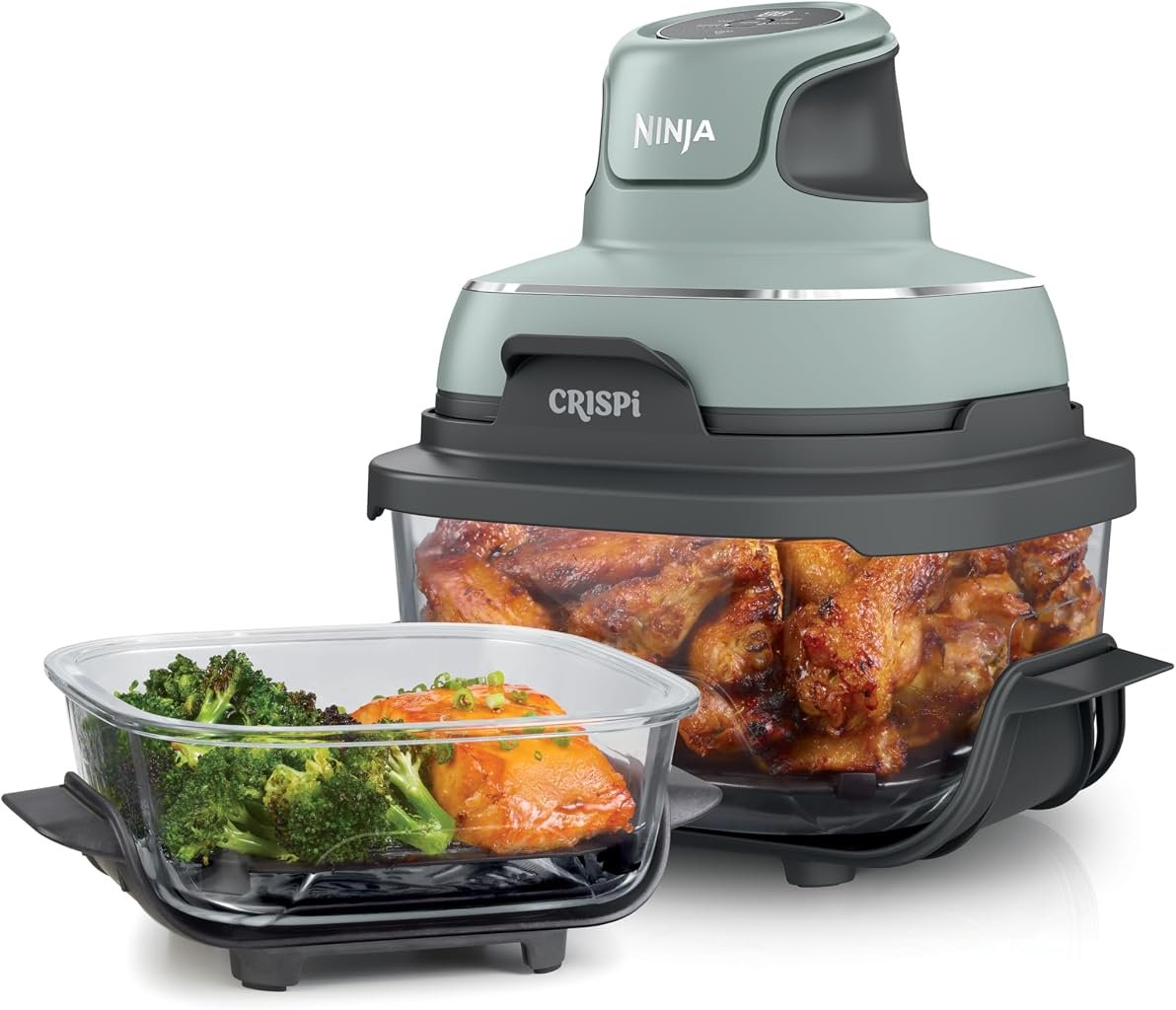
The Ninja Crispi Glass Air Fryer FN101SG approaches air frying from an unusual direction. Instead of asking how many baskets, drawers or cooking zones can be fitted into a countertop appliance, it questions whether the conventional basket needs to be there at all.
The result is a 1,500-watt cooking system built around a removable heating unit, called the Crispi PowerPod, and interchangeable glass cooking containers. The Ninja Crispi FN101SG includes a 6-cup small-batch container, a 4-quart larger container, two storage lids, two crisper plates and an adapter. Its four cooking functions are Max Crisp, Air Fry, Bake and Recrisp. Ninja lists the sage-green FN101SG at 1,500 watts and 120 volts, with a one-year warranty.
That configuration matters because it changes the workflow around an air fryer rather than merely changing the appliance’s appearance. Food can be prepared in glass, cooked in the same vessel, brought to the table and, after cooling, covered for storage. The transparent walls also expose what is happening during cooking.
There are trade-offs. Glass adds weight. Four quarts cannot match the capacity of large dual-zone fryers. The FN101SG does not provide two independently controlled cooking chambers. Its four modes are fewer than the menus found on some large countertop machines.
Our score is 8.55/10. Customer Sentiment stands at 8.28, Buyer Confidence at 9.8 and Value at 8.15. Those numbers describe a product with a coherent design and unusually high confidence in its basic proposition, but one whose value depends heavily on whether glass cooking vessels and small-batch flexibility solve problems the buyer actually has.
The Design Is The Real Story
Most basket-style air fryers follow the same basic architecture. A heating element and fan sit above an enclosed cooking chamber. Food rests in a perforated basket or on a raised plate while rapidly circulating hot air transfers energy to its surface.
The USDA’s explanation of air fryers describes them as essentially countertop convection ovens. Hot air circulates rapidly around food, promoting browning and crisping without requiring immersion in hot oil.
The Crispi retains that physical principle while reorganizing the hardware.
Instead of building the heating mechanism permanently into a large body surrounding a drawer, Ninja places the PowerPod over compatible glassware. The included 6-cup and 4-quart containers therefore become both cooking chambers and food vessels.
That distinction is more consequential than another preset button would have been.
Traditional air-fryer baskets are excellent at their primary job, but they are specialized objects. Raw ingredients are prepared elsewhere, transferred into the basket, cooked, transferred again for serving and moved once more if leftovers need refrigeration.
The Crispi attempts to shorten that chain.
Its glass containers can participate in preparation, cooking, serving and storage. Ninja includes storage lids specifically for that purpose. The containers are also dishwasher safe, as are the Crispi accessories.
For cooks who dislike accumulating bowls, plates and storage containers during a simple meal, the architecture has an obvious logic.
Two Container Sizes Make More Sense Than One Oversized Chamber
The FN101SG comes with a 6-cup vessel and a 4-quart vessel. This is arguably more useful than giving every task the same oversized chamber.
Ninja positions the smaller container for individual portions and states that a personal-size meal can cook in seven minutes, although actual cooking time necessarily varies by ingredient, quantity, starting temperature and desired doneness. The company says the 4-quart container can accommodate a 4-pound chicken with vegetables.
The significance is not merely capacity.
Air fryers depend on airflow around exposed food surfaces. A huge chamber is unnecessary when reheating a single portion of fries or cooking a small serving of vegetables. Conversely, a tiny chamber becomes frustrating when preparing a larger main dish.
Interchangeable vessels let the heating system move between those scenarios.
The smaller container also addresses one of the less discussed inefficiencies of large air fryers: countertop scale. A household does not always need eight or ten quarts of cooking volume. Sometimes lunch is one portion.
The larger 4-quart container is still modest by contemporary standards. Anyone routinely cooking large family meals should recognize that limit immediately. Ninja itself positions larger Crispi variants above this model for greater capacity.
For the FN101SG, restraint is part of the design rather than an accidental omission.
Glass Is More Than A Visual Feature
Transparent cookware gives the Crispi one advantage that opaque air-fryer baskets cannot easily duplicate: direct observation.
Cooking becomes visible.
That sounds minor until the normal air-fryer routine is considered. With a closed drawer, checking browning generally means removing the basket. The interruption is brief, but judging color and surface development still requires opening the appliance.
With transparent glass, progress can be inspected without relying entirely on a timer.
Visual feedback is particularly useful for foods where the difference between pale, browned and excessively dark can occur over a relatively short interval. Cheese, breaded foods and reheated baked goods are obvious examples.
Glass also has a different relationship with food storage than a conventional air-fryer drawer. The included lids mean leftovers can remain in the cooking vessel after it has cooled rather than being transferred immediately to another container.
Ninja describes its CleanCrisp glassware as being made for cooking and storage without PFAS or PTFE. That characteristic will matter most to buyers deliberately seeking cooking surfaces that avoid those materials.
The glass is also described by Ninja as thermal-shock resistant and suitable for moving from frozen conditions into the cooking process. That does not mean every piece of ordinary kitchen glass should be treated the same way; the claim concerns the compatible Crispi glassware.
The PowerPod Makes The Appliance Feel Different
The FN101SG’s PowerPod is rated at 1,500 watts. Ninja compares that wattage with its AF100 full-size air fryer when describing the Crispi as offering full-size air-fryer power.
Wattage alone does not determine cooking quality. Chamber geometry, airflow, temperature control, food quantity and placement all affect results. Still, 1,500 watts places substantial heating capability above relatively compact vessels.
This relationship between heating power and chamber size helps explain the underlying idea.
Rather than heating a large cavity regardless of portion size, the Crispi places its heating hardware directly over a relatively small food container. For modest meals, that is an inherently sensible arrangement.
The appliance is not magic, however. Air still needs room to move.
Packing the 4-quart container tightly with food can work against the convection mechanism. The USDA warns that overcrowding air fryers can prevent adequate circulation and produce uneven or insufficient cooking. A container’s maximum physical volume therefore should not be interpreted as its ideal crisping capacity.
This distinction matters across the best air fryers. Advertised quarts measure space; they do not measure how much food can be browned evenly in a single layer.
Four Cooking Modes Keep The Interface Focused
The Crispi provides Max Crisp, Air Fry, Bake and Recrisp.
Compared with air fryers advertising eight, ten or more programs, four sounds restrained. In practice, the limitation is less dramatic because many air-fryer programs are variations on heating temperature, fan behavior and cooking duration rather than independent cooking technologies.
Air Fry handles the obvious everyday work. Max Crisp targets aggressive surface browning. Bake accommodates foods better suited to gentler oven-style heating. Recrisp is aimed at restoring texture to previously cooked foods.
Recrisp may be the least glamorous label and one of the more practical functions.
Microwave ovens are extremely convenient for reheating, but moisture redistribution can leave breaded coatings, pizza crust and fried foods soft. Rapid dry convection attacks a different problem: restoring heat while driving moisture away from the exterior.
That makes an air fryer particularly useful for leftovers where texture matters.
The Crispi extends the idea by allowing compatible leftovers already stored in its glass container to return to the cooking system. Fewer transfers are required.
Portability Needs A Sensible Definition
Ninja describes the Crispi as portable. That description deserves interpretation.
The FN101SG is not a cordless appliance. It requires a 120-volt electrical supply, and Ninja specifies a 36-inch cord. The product is therefore portable in the sense that its modular design can be moved and stored more readily than many fixed countertop ovens, not in the sense that it can cook without mains electricity.
Ninja currently lists the FN101SG at 14.55 pounds, with product dimensions of 11.5 inches long, 9.76 inches wide and 11.81 inches high.
The system’s nesting design helps with storage, but glass creates unavoidable mass. Someone imagining an ultralight travel cooker should calibrate expectations accordingly.
Where the architecture becomes more convincing is in kitchens where permanent counter space is scarce. The PowerPod does not require the large outer shell associated with a conventional drawer-style machine.
Dormitories, apartments, recreational spaces and smaller kitchens are obvious environments where modular storage may have appeal, subject to local rules governing cooking appliances.
Energy Savings Depend On The Job
Air fryers are often presented as inherently cheaper to operate than ovens. The more accurate answer depends on the quantity of food being cooked.
A 2026 Which? comparison of air fryers and built-in ovens illustrates the distinction. In its test, an air fryer used 0.54 kWh to cook a roast chicken compared with 1.157 kWh for the built-in oven. For 320 grams of frozen chips, the figures were 0.287 kWh for the air fryer and 0.863 kWh for the oven.
For a jacket potato, the air fryer used 0.392 kWh compared with 1.084 kWh for the oven. A cake required 0.223 kWh in the air fryer versus 0.71 kWh in the oven.
Those measurements came from the specific appliances used by Which?, not the Ninja Crispi, so they should not be transferred directly to the FN101SG.
The broader lesson is more useful.
Steph Kipling, Which? science team leader, summarized the organization’s findings this way: “The air fryer often used less than half the energy, and the results were just as tasty.” She immediately identified the limitation: “the savings soon drop off if you have to cook in batches.”
That caveat fits the Crispi particularly well.
For one person’s lunch in the 6-cup container, heating a conventional oven can be disproportionate. For a large family meal requiring repeated 4-quart batches, the oven’s greater capacity can reverse the practical calculation.
Food Safety Does Not Change Because The Container Is Transparent
Glass provides visibility, not proof of doneness.
Browned chicken can still be undercooked internally. Food temperature must therefore remain the deciding measurement for safety-sensitive foods.
USDA guidance sets a safe minimum internal temperature of 165°F for poultry and 160°F for ground meat. Fish and whole cuts of beef, pork, veal and lamb are listed at 145°F, with whole cuts of those meats receiving a three-minute rest.
The same guidance warns against overcrowding an air fryer because inadequate circulation can cause uneven cooking.
That matters especially with a transparent appliance because visual confidence can become misleading. Seeing a browned exterior is useful for judging color. It cannot reveal the temperature at the center of a thick chicken breast.
A food thermometer remains a more informative accessory than another cooking preset.
Cleaning Is One Of The Crispi’s Stronger Ideas
Cleaning often determines whether a countertop appliance is used after the novelty period ends.
The Crispi’s approach is straightforward. Ninja states that its accessories are dishwasher safe, and the containers are glass rather than permanently installed cooking cavities.
That makes the surfaces exposed to food easier to separate from the heating hardware.
Glass also makes residue conspicuous. This can be aesthetically unforgiving-grease is difficult to ignore on a transparent wall-but visibility has a practical upside. Deposits do not disappear into a dark basket where they can be overlooked.
The container system can also reduce dish use. Preparing, cooking and storing food in the same vessel does not eliminate cleanup, but it can eliminate intermediate bowls and plates.
There is still a PowerPod and adapter to manage, and glass requires more deliberate handling than a lightweight metal basket. The system trades some physical ruggedness for transparency and multi-purpose utility.
Where The Crispi Compromises
The FN101SG’s unusual architecture creates genuine advantages, but it also establishes firm boundaries.
The 4-quart maximum included cooking vessel is smaller than the chambers of many family-oriented fryers. There is no independent dual-zone cooking. A household wanting chicken in one chamber and vegetables at a different temperature in another will need another appliance configuration.
Glass is heavier than thin metal. Although the containers are engineered for the system, dropping glass remains a different proposition from dropping a metal basket.
The four cooking functions also make the FN101SG less suitable for someone seeking a large multi-function countertop cooker with dedicated dehydration, roasting and other specialized settings.
Its strengths and limitations can be reduced to several practical observations:
- The 6-cup container is particularly well matched to single portions and reheating.
- The 4-quart vessel expands the system into modest family-meal territory but remains capacity constrained.
- Transparent glass makes browning visible during cooking.
- Storage lids extend the containers’ usefulness beyond the cooking cycle.
- Dishwasher-safe accessories reduce routine cleanup friction.
- The 1,500-watt PowerPod supplies substantial heating power without a traditional full-size fryer body.
- Four cooking functions prioritize frequently used modes rather than a long preset menu.
- Large meals and simultaneous dishes expose the system’s capacity limits quickly.
None of those points makes the Crispi universally preferable to a drawer air fryer. They identify the kind of kitchen problem it is designed to solve.
Interpreting Our Scores
Our score for the Ninja Crispi FN101SG is 8.55/10.
That rating reflects a product with a coherent identity. The glass-container architecture is not merely cosmetic. It changes food preparation, observation, serving, storage and cleanup enough to distinguish the appliance from conventional basket fryers.
Customer Sentiment is 8.28/10, slightly below the overall editorial score. The gap is modest but meaningful. Products built around unconventional designs often create sharper differences in preference because their defining feature is also their compromise. Someone who values glass cookware and modularity may see the Crispi’s architecture as highly practical; someone primarily seeking maximum cooking capacity may see four quarts and immediately look elsewhere.
Buyer Confidence stands substantially higher at 9.8/10.
That score reflects how clearly the FN101SG’s proposition can be evaluated. The specifications are straightforward: 1,500 watts, two included glass container sizes, four cooking functions, dishwasher-safe accessories and a defined collection of included components. There is little ambiguity about what type of appliance this is.
Value receives 8.15/10.
That is the lowest of the four ratings, and appropriately so. Value depends heavily on whether the modular glass system replaces enough other kitchen friction to justify choosing it over simpler basket-style alternatives.
A buyer who primarily wants inexpensive high-capacity air frying may find more capacity elsewhere. A buyer who repeatedly prepares single portions, reheats leftovers, dislikes opaque baskets or wants cooking vessels that transition into storage has a different value calculation.
The 9.8 Buyer Confidence score alongside 8.15 for Value captures the distinction neatly: it is easy to understand what the Crispi offers, but the usefulness of those advantages varies materially between households.
Who Is The FN101SG For?
The Crispi makes particular sense for one- and two-person households, though its 4-quart vessel broadens its usefulness beyond that group.
Its smaller container addresses a surprisingly common mismatch in kitchen appliances: using a large machine to cook very little food. Someone preparing one portion of vegetables, reheating lunch or crisping leftovers does not necessarily need an eight-quart dual-basket fryer sitting permanently on the counter.
The FN101SG also suits cooks who care about seeing their food while it cooks. That is not merely an aesthetic preference. Browning is information, and glass makes that information immediately available.
People deliberately seeking PFAS- and PTFE-free cooking vessels have another reason to examine it. Ninja states that the CleanCrisp glassware is designed for cooking and storage without those materials.
The less suitable buyer is equally identifiable.
A large household regularly preparing multiple components of dinner simultaneously will encounter the four-quart ceiling. Someone who wants independent cooking zones should look toward dual-basket equipment. A cook needing six-quart or larger single-vessel capacity will find the standard Crispi restrictive.
And anyone who dislikes handling glass cookware may prefer a conventional metal-basket format regardless of the Crispi’s other advantages.
The Broader Significance Of The Glass-Air-Fryer Idea
Air-fryer development spent years largely increasing capacity, multiplying presets and splitting baskets into separate zones. The Crispi pursues a different path: changing the vessel itself.
That is a more interesting design decision than it first appears.
Kitchen appliances create work as well as remove it. Every specialized cooking chamber eventually needs cleaning. Every transfer from preparation bowl to cooker to plate to storage container adds another object to the process.
The Crispi attempts to reduce those transitions.
It does not eliminate them, nor does glass somehow improve every recipe. The underlying cooking physics remain forced convection. Yet the surrounding workflow becomes different enough to matter.
This is where comparisons among the best air fryers need to move beyond maximum temperature and quart capacity. Two appliances can perform broadly similar heating tasks while creating very different experiences before and after cooking.
The Crispi’s strongest argument is not that glass makes hot air fundamentally different. It is that the cooking vessel no longer needs to be a dead end in the meal-preparation process.
Final Considerations
The Ninja Crispi Glass Air Fryer FN101SG is a 1,500-watt, four-function air-frying system built around an unusually coherent idea: make the cooking chamber transparent, removable and useful beyond cooking.
Its 6-cup and 4-quart CleanCrisp glass containers address two distinct meal sizes. The smaller vessel makes sense for personal portions and leftovers; the larger container extends the system to modest shared meals, with Ninja stating that it can hold a 4-pound chicken with vegetables. The PowerPod provides Max Crisp, Air Fry, Bake and Recrisp functions, while included storage lids and dishwasher-safe accessories support the prep-to-storage workflow.
The design does not escape the physics governing every air fryer. Food still needs airflow. Overcrowding still damages cooking uniformity. Internal temperature still matters more than surface color for food safety. A four-quart vessel still cannot behave like an eight-quart one merely because its walls are transparent.
Those constraints explain why our 8.55/10 overall score sits below the 9.8 Buyer Confidence rating. The concept is clear and the specifications support its intended use, but capacity and format narrow the audience. Customer Sentiment at 8.28 and Value at 8.15 reinforce the same editorial assessment.
For large households, batch cooking can erode both convenience and potential energy savings. For smaller households, the opposite can occur: a compact vessel paired with a powerful heating unit can make far more sense than warming a large oven for one meal.
That distinction defines the FN101SG.
The Crispi is not compelling because glass makes air frying mysterious or technologically new. It is compelling because the glass vessel addresses several mundane frustrations at once: invisible cooking progress, unnecessary food transfers, specialized baskets and extra storage containers.
Those are modest problems individually. Repeated every day, they become the sort of friction that determines whether an appliance earns permanent kitchen space or eventually disappears into a cupboard.
The Ninja Crispi’s case rests on reducing that friction. For the household whose portions fit its scale, that is a substantive advantage. For the household that routinely needs far more capacity, the same design becomes its limiting factor.