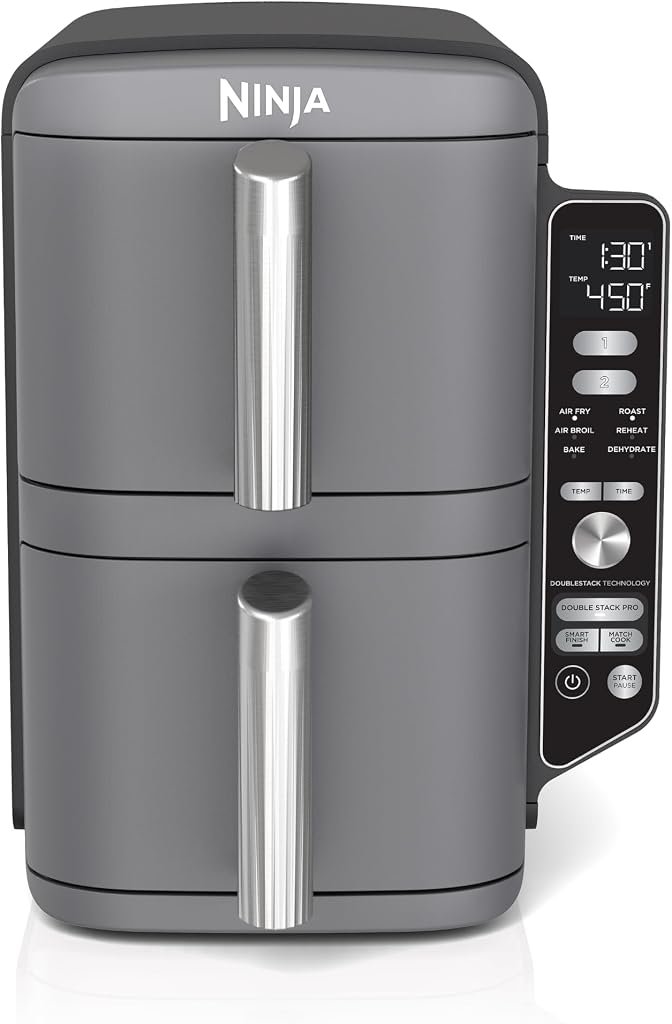
Dual-basket air fryers solve one kitchen problem while frequently creating another. They allow two foods to cook independently, but putting two baskets beside each other can consume a remarkable amount of counter width. The Ninja DoubleStack XL Air Fryer SL401 approaches that compromise from a different direction: instead of spreading two 5-quart baskets horizontally, it stacks them vertically.
That decision defines almost everything about the appliance.
The Ninja DoubleStack XL SL401 has a total stated capacity of 10 quarts, divided between two 5-quart baskets. Ninja adds removable meal racks that create two cooking levels inside each basket, allowing food to be arranged across as many as four levels. Six cooking programs cover Air Fry, Air Broil, Roast, Bake, Reheat and Dehydrate. The US model is rated at 1,690 watts on 120 volts.
This is not simply a tall version of an ordinary air fryer. The stacked geometry changes counter placement, food arrangement and the way a cook thinks about simultaneous meals.
Our score is 8.71/10. Customer Sentiment stands at 8.5, Buyer Confidence at 9.8 and Value at 8.28. The gap between those figures is instructive. The DoubleStack concept is easy to understand and its buyer fit is unusually clear, supporting the high Buyer Confidence score. Its lower Value rating reflects a more demanding calculation: vertical stacking is useful only when the household actually benefits from multiple cooking zones and levels.
The DoubleStack Idea Addresses A Real Countertop Problem
Conventional dual-basket fryers tend to be wide because their baskets sit beside one another. That layout is mechanically straightforward but can compete with cutting boards, coffee machines, kettles and other appliances for horizontal workspace.
The SL401 rotates the problem.
Ninja lists the machine at 20.83 inches long, 13.07 inches wide and 17.72 inches high. It weighs 25.13 pounds.
The 13.07-inch width is the specification that explains the DoubleStack idea. Rather than consuming the broad horizontal footprint associated with many side-by-side fryers, the appliance grows upward.
There is no free space created by this strategy. The machine is still more than 20 inches deep and nearly 18 inches tall. A kitchen with low wall cabinets may care more about height than width. A shallow counter may care more about depth.
“Space-saving” therefore requires qualification.
The SL401 saves one kind of space by demanding another. It is better described as width-conscious than physically small.
That distinction matters because kitchen counters are three-dimensional. Buyers should measure width, depth and vertical clearance before treating the stacked arrangement as an automatic solution to a cramped kitchen.
Ten Quarts Are Divided Into Two Independent Zones
The SL401’s 10-quart figure represents two 5-quart baskets rather than one uninterrupted 10-quart chamber.
That difference is central to buyer fit.
A large single basket is useful for broad foods, large roasting projects and ingredients that benefit from being spread across one uninterrupted surface. Two baskets offer another advantage: separate cooking environments.
A household can prepare a protein in one basket and vegetables in the other without requiring both foods to share the same time and temperature. Frozen fries can cook independently from chicken. A reheated side dish does not need to inherit the settings of a roasting program.
This is the familiar argument for dual-zone air fryers, but the DoubleStack preserves it while changing the physical orientation of the baskets.
The limitation remains familiar too.
Five quarts per basket imposes a boundary on the size and shape of individual foods. The combined 10-quart specification should never be mistaken for the geometry of one 10-quart cavity.
Capacity figures describe volume. Food has shape.
Smart Finish And Match Cook Solve Different Problems
Ninja equips the SL401 with Smart Finish and Match Cook.
Smart Finish allows the two zones to use different settings while coordinating their completion. Match Cook copies settings across both zones when the same program is required.
These features sound similar until an actual meal is considered.
Suppose one basket contains chicken requiring a longer cooking cycle while the other contains vegetables requiring less time. Starting both simultaneously would leave one component waiting and cooling. Smart Finish coordinates the programs so they complete together.
Match Cook handles the opposite situation. If both baskets contain the same food, duplicating the settings avoids repetitive programming.
Neither function changes air-frying performance by itself. Their purpose is workflow.
That matters more than it first appears. Multi-component dinners require constant coordination: one pan starts early, another joins later, one item rests while another finishes. A dual-zone appliance can move some of that scheduling from the cook to the machine.
The DoubleStack’s appeal therefore extends beyond capacity. It is partly an appliance for managing time.
Four Cooking Levels Are The More Unusual Feature
Two baskets are common. Four cooking levels are less so.
Ninja includes two removable stacked meal racks, one for each basket. These racks allow food to be positioned at two heights inside each 5-quart zone. Across both baskets, the appliance can therefore arrange ingredients on four levels.
That is an interesting response to the physical limitation of a basket.
Air fryers work through rapidly moving hot air. Food benefits from exposure to that airflow. Piling ingredients deeply can reduce the amount of exposed surface and create uneven cooking conditions.
A rack adds vertical surface area without requiring every ingredient to sit directly on top of another.
The idea has practical merit for foods that can be arranged in layers with adequate spacing.
Yet four levels should not be interpreted as permission to fill every available gap.
Air still has to move.
Dense food placement can obstruct circulation regardless of how many racks the manufacturer provides. Different foods can also release different amounts of moisture and fat, complicating multi-level cooking.
The racks increase organizational flexibility. They do not repeal convection physics.
Airflow Is The Foundation Of The Entire Design
The USDA describes air fryers as essentially countertop convection ovens, where rapid circulation of heated air cooks and crisps food. The agency specifically warns that overcrowding can prevent sufficient circulation and contribute to uneven or inadequate cooking.
That warning deserves extra attention in the SL401 because its defining feature encourages cooks to think vertically.
Four available cooking levels create impressive theoretical food-placement capacity, but usable capacity depends on what occupies those levels.
Thin vegetables, wings or smaller pieces can leave pathways for air. Thick, broad foods may restrict them. Moist ingredients can change conditions further by releasing water vapor during cooking.
The practical discipline is straightforward: treat the racks as a way to distribute food, not as a reason to compress more food into the chamber.
This distinction separates productive capacity from mere volume.
For buyers comparing the best air fryers, basket size is therefore only the beginning. Airflow geometry and usable surface area matter just as much.
Six Cooking Programs Keep The Control Scheme Focused
The SL401 offers six cooking programs: Air Fry, Air Broil, Roast, Bake, Reheat and Dehydrate.
That is a restrained set by modern countertop-appliance standards.
Air Fry handles the primary high-convection cooking work. Air Broil targets more aggressive surface heating. Roast provides another route for meats and vegetables. Bake broadens the appliance beyond conventional fried-style foods. Reheat addresses leftovers, while Dehydrate operates at lower temperatures over longer periods.
The value of these functions should not be measured by the number of buttons.
An air fryer does not become six physically different appliances when the cooking mode changes. The same fundamental hardware remains in use, with programs adjusting variables such as temperature, fan behavior and time.
What matters is whether those programs correspond to tasks households perform regularly.
Reheat is particularly relevant.
Microwave ovens can warm leftovers rapidly, but foods with crisp or browned surfaces frequently soften as moisture redistributes. Convection reheating can preserve or restore more surface texture.
For pizza, roasted potatoes, breaded chicken and similar foods, that can make the air fryer useful even on days when no raw ingredients are cooked.
The 1,690-Watt Rating Needs Context
Ninja specifies the SL401 at 1,690 watts, 120 volts and 15 amps.
Those figures place it firmly in high-power countertop-appliance territory.
The electrical rating does not mean every cooking cycle consumes 1.69 kilowatt-hours. Watts measure power, while energy consumption depends on power over time. Heating systems also cycle as temperature controls respond to conditions inside the appliance.
Still, a 1,690-watt appliance represents a substantial electrical load.
Owners should follow Ninja’s electrical guidance and avoid treating outlet placement as an afterthought. The SL401 is not analogous to a phone charger or small LED lamp; its heating system demands meaningful power.
The 32-inch cord also affects placement.
A narrow footprint is useful only if the intended position provides suitable electrical access and safe operating clearance.
This is another reason to evaluate the appliance as a physical kitchen installation rather than merely a specification list.
Energy Savings Depend On How Much Dinner Fits
Air fryers can use less energy than conventional ovens for appropriately sized cooking jobs, but broad claims about efficiency often ignore capacity.
A September 2026 Which? comparison of an air fryer and built-in electric oven illustrates the issue with measured examples. Cooking a roast chicken consumed 0.54 kWh in the tested air fryer and 1.157 kWh in the oven. For 320 grams of frozen chips, the figures were 0.287 kWh and 0.863 kWh respectively.
The same testing recorded 0.392 kWh for an air-fried jacket potato against 1.084 kWh in the oven. A cake used 0.223 kWh in the air fryer and 0.71 kWh in the oven. Those measurements concern the specific appliances tested by Which?, not the Ninja SL401, so they should not be treated as SL401 consumption figures.
The broader finding is still relevant.
Which? science team leader Steph Kipling observed that the air fryer in its comparison “often used less than half the energy.” The publication also found that the advantage diminishes when repeated batches are required.
This is where the DoubleStack format becomes interesting.
Two 5-quart baskets and four potential cooking levels can accommodate more components of a meal in one coordinated cycle than a small single-basket fryer.
Reducing batch cooking can preserve more of the practical energy advantage.
But a conventional oven retains an enormous advantage in absolute interior volume. When cooking for a large gathering, several oven shelves may accomplish in one cycle what even a 10-quart air fryer cannot.
Energy efficiency therefore depends on the meal, not the appliance category alone.
The Stacked Architecture Creates A Different Kind Of Capacity
Ninja says the 10-quart SL401 can accommodate two 5-pound chickens at once and feed as many as eight people.
Those manufacturer capacity claims illustrate the scale Ninja intends for the appliance, but they should not be interpreted as a universal serving guarantee.
A household’s portion sizes differ. So does the geometry of food.
Ten pounds of chicken distributed as two birds behaves differently inside an air fryer from ten pounds of fries, vegetables or irregularly shaped frozen foods. Airflow requirements change with surface area, density and moisture.
The more useful point is that the SL401 provides two substantial independent baskets rather than two tiny auxiliary compartments.
For families, that can reduce the familiar problem of finishing one air-fryer batch only to begin another.
The meal racks add another variable. When food suits vertical arrangement, usable surface area can increase without expanding the machine’s width.
That is the engineering logic behind DoubleStack in its clearest form: more cooking positions per inch of counter width.
Height And Depth Are The Price Of Narrowness
The SL401’s 13.07-inch width sounds appealing until the rest of the dimensions are considered.
It is 20.83 inches long and 17.72 inches high.
A machine that saves lateral counter space can still dominate a shallow worktop.
The height deserves particular attention under kitchen cabinets. Nearly 18 inches before accounting for appropriate operating clearance is substantial. Heat and exhaust also need somewhere to go, so fitting physically beneath cabinetry is not the same as having a suitable operating location.
Depth can be equally awkward.
At more than 20 inches long, the appliance may project significantly across some counters. Drawer operation also requires clear space in front.
This is why countertop measurements should be performed with a tape measure rather than inferred from product photographs.
The DoubleStack is narrow relative to its capacity. It is not compact in every direction.
At 25 Pounds, Storage Is A Strategic Decision
The SL401 weighs 25.13 pounds.
That is manageable for many adults but heavy enough to make repeated cabinet storage undesirable.
This matters because appliance utility is affected by friction.
A machine left accessible requires little preparation before use. A 25-pound appliance stored on a low shelf must be lifted, moved, positioned and later returned. Repeat that process several times a week and storage becomes part of the cooking experience.
The DoubleStack therefore makes its strongest practical case when it can remain on the counter.
That returns the discussion to dimensions.
Its narrowness may allow it to fit into a strip of countertop that would not accommodate a broad side-by-side fryer. But households without sufficient depth or vertical clearance may gain little from the reduced width.
Space efficiency is contextual.
Cleaning Four Levels Means More Components
Ninja includes two 5-quart baskets, two nonstick crisper plates and two stacked meal racks.
The advantage during cooking becomes a larger collection of components afterward.
If both baskets, both plates and both racks are used for a meal, each can collect grease, crumbs, seasoning and food residue.
This does not make the SL401 unusually difficult by dual-zone standards, but it exposes a recurring rule of multifunctional kitchen equipment: additional cooking surfaces create additional cleaning surfaces.
The racks deserve particular attention because narrow bars and contact points can catch baked-on residue.
Cleaning promptly after components have cooled is generally easier than allowing residue to remain through repeated heating cycles.
The large baskets also require sufficient sink or dishwasher space. A narrow appliance body does not mean every removable component is tiny.
For households using all four cooking levels frequently, cleanup should be considered part of the workflow rather than an afterthought.
Food Safety Still Comes Down To Temperature
Air fryers are exceptionally good at producing visual signals that people associate with cooked food: browned skin, crisp breading and rendered exterior fat.
Those signals cannot establish internal safety.
USDA guidance specifies 165°F for poultry, 160°F for ground meat, and 145°F for fish and whole cuts of beef, pork, veal and lamb; whole cuts of those meats require a three-minute rest. The agency recommends checking temperatures with a food thermometer.
This is particularly relevant when multiple foods are distributed across the SL401’s racks and baskets.
Position, thickness and density can affect heating rates. Two pieces that look similarly browned can have different internal temperatures.
The stacked arrangement does not change the safety standard.
Nor does Smart Finish. Coordinating two programs so they stop simultaneously is a convenience feature, not a measurement of internal doneness.
A thermometer remains the final authority for raw meat and poultry.
Where The DoubleStack XL Is Strongest
The SL401’s advantages form a coherent pattern:
- Two independent 5-quart baskets provide 10 quarts of total stated capacity.
- Vertical stacking reduces the width required by the dual-basket layout.
- Two removable meal racks create as many as four food-placement levels.
- Smart Finish coordinates different cooking programs so both zones complete together.
- Match Cook duplicates settings across the two zones.
- Six cooking programs cover air frying, broiling, roasting, baking, reheating and dehydrating.
- The format can reduce repeated batches when preparing several components of a meal.
- The narrow body can fit counter layouts where a wide side-by-side dual fryer would be awkward.
These strengths point toward a specific buyer.
The DoubleStack makes the most sense for households that need genuine dual-zone capacity but resent the width of conventional two-drawer machines.
It is not merely an air fryer with a different silhouette. Its silhouette is the feature.
The Trade-Offs Are Structural
The SL401’s compromises are closely connected to its strengths.
Vertical stacking reduces width but increases height. The appliance remains more than 20 inches deep. At 25.13 pounds, it is not something every household will want to move daily. Four-level cooking introduces additional racks to clean. Two 5-quart baskets cannot become one uninterrupted 10-quart chamber.
That last point distinguishes the SL401 from convertible-zone designs.
A removable-divider fryer can sometimes trade two zones for one broad cavity. The DoubleStack cannot change its fundamental basket geometry. Large foods must fit within an individual 5-quart basket.
The four-level system also rewards thoughtful food arrangement. Filling every available position simply because it exists can work against airflow.
This appliance offers more ways to organize food, not immunity from overcrowding.
Interpreting Our 8.71/10 Score
Our overall score for the Ninja DoubleStack XL Air Fryer SL401 is 8.71/10.
That rating recognizes a design that addresses a specific weakness of conventional dual-basket fryers without pretending that the solution is cost-free. The DoubleStack arrangement makes 10 quarts of divided capacity considerably narrower than the familiar side-by-side format, while the meal racks create additional vertical cooking positions.
Customer Sentiment stands at 8.5.
Its position below the overall editorial score reflects the practical compromises attached to the architecture. A tall, deep appliance will not suit every counter, and the four-level arrangement creates more components and more decisions than a basic single-basket fryer.
Buyer Confidence is 9.8.
That is the highest score because the buying decision is unusually concrete. Measure the counter. Decide whether two independent 5-quart zones are useful. Consider whether four-level cooking matches the household’s meal patterns. Check whether the height and depth work beneath the intended cabinetry.
There is relatively little mystery about whether the format fits.
Value is 8.28.
That figure reflects the specialized nature of the design. Someone cooking primarily for one person does not need this much divided capacity. Someone who rarely cooks two foods simultaneously may obtain more value from a simpler large-basket fryer.
The DoubleStack earns its price and physical presence when its vertical dual-zone architecture solves a recurring kitchen problem.
Who Should Buy The SL401?
The strongest candidate is a household that wants dual-zone cooking but has limited lateral counter space.
Families preparing a protein and side simultaneously can use independent zones. Households cooking larger quantities of one food can use Match Cook. Meals involving different cooking times can benefit from Smart Finish.
The racks make the machine more interesting for cooks who frequently prepare several foods at once and can use vertical separation effectively.
The SL401 is less convincing for buyers seeking one large uninterrupted cooking chamber.
It is also difficult to justify for very small portions. Heating and cleaning a 10-quart dual-basket system to prepare a modest snack is possible, but a compact fryer would perform that role with less physical overhead.
Counter dimensions may make the decision before cooking habits do.
A narrow but deep and tall machine is not universally space-efficient. It is space-efficient in a particular direction.
Why The DoubleStack Concept Is More Than Styling
Many countertop appliances distinguish themselves through extra presets, larger displays or cosmetic changes.
The DoubleStack changes geometry.
That is more consequential because geometry determines where the appliance fits and how food can be arranged.
Stacking the baskets vertically allows Ninja to retain two independent cooking zones while reducing the horizontal spread associated with the usual dual-drawer design. Adding racks then exploits the vertical dimension inside each basket as well.
The design is consistent from the countertop to the food chamber: vertical space is used to reduce pressure on horizontal space.
That does not make the approach universally preferable.
A wide appliance can fit beneath low cabinetry more comfortably. A single broad basket can accept foods that a 5-quart drawer cannot. Simpler machines create fewer components to clean.
The DoubleStack is therefore not an argument that every air fryer should be tall.
It is an argument that basket orientation should reflect the kitchen in which the appliance will live.
Final Considerations
The Ninja DoubleStack XL Air Fryer SL401 is a 10-quart dual-zone air fryer built from two vertically arranged 5-quart baskets. It uses a 1,690-watt, 120-volt electrical system, provides six cooking programs and includes two removable meal racks that can create four food-placement levels. Smart Finish coordinates different programs, while Match Cook duplicates settings between the two zones.
Its defining achievement is dimensional rather than digital.
By stacking the baskets, Ninja reduces the width demanded by a dual-zone appliance. That can make a material difference on crowded counters where lateral workspace is scarce.
The compromise appears elsewhere. At 20.83 inches deep and 17.72 inches high, the SL401 still requires substantial physical room. Its 25.13-pound weight makes permanent counter placement more attractive than repeated storage. The two 5-quart baskets remain permanently separate, preventing the machine from becoming one broad 10-quart chamber.
Four-level cooking is similarly useful within limits. The racks can increase usable food-placement area, but air circulation remains fundamental. USDA guidance against overcrowding applies regardless of how cleverly the basket is organized.
Our 8.71/10 score reflects that balance. Customer Sentiment at 8.5 acknowledges the everyday compromises. Buyer Confidence reaches 9.8 because the appliance’s suitability can be assessed unusually well before purchase. Value at 8.28 recognizes that vertical dual-zone cooking is highly useful for the right kitchen but unnecessary for simpler cooking patterns.
The SL401 therefore makes its strongest case not through maximum capacity, a long preset list or an abstract promise of faster cooking.
Its argument is architectural.
Two baskets are useful. Two baskets side by side are not always convenient. Ninja’s response is to build upward.
For households that routinely need two cooking zones and have more vertical clearance than spare counter width, that decision can solve a real spatial problem while preserving the scheduling advantages of dual-zone cooking.
For households that need a broad single chamber, cook mainly small portions or have low cabinetry above a shallow counter, the same architecture can become the wrong compromise.
That is why the DoubleStack deserves to be judged by more than its 10-quart label. Its value lies in where those 10 quarts are placed.
On that measure, the SL401 is a thoughtful, specialized interpretation of the dual-basket air fryer-one that earns its 8.71/10 editorial score by solving a physical kitchen problem rather than merely adding another button to the control panel.