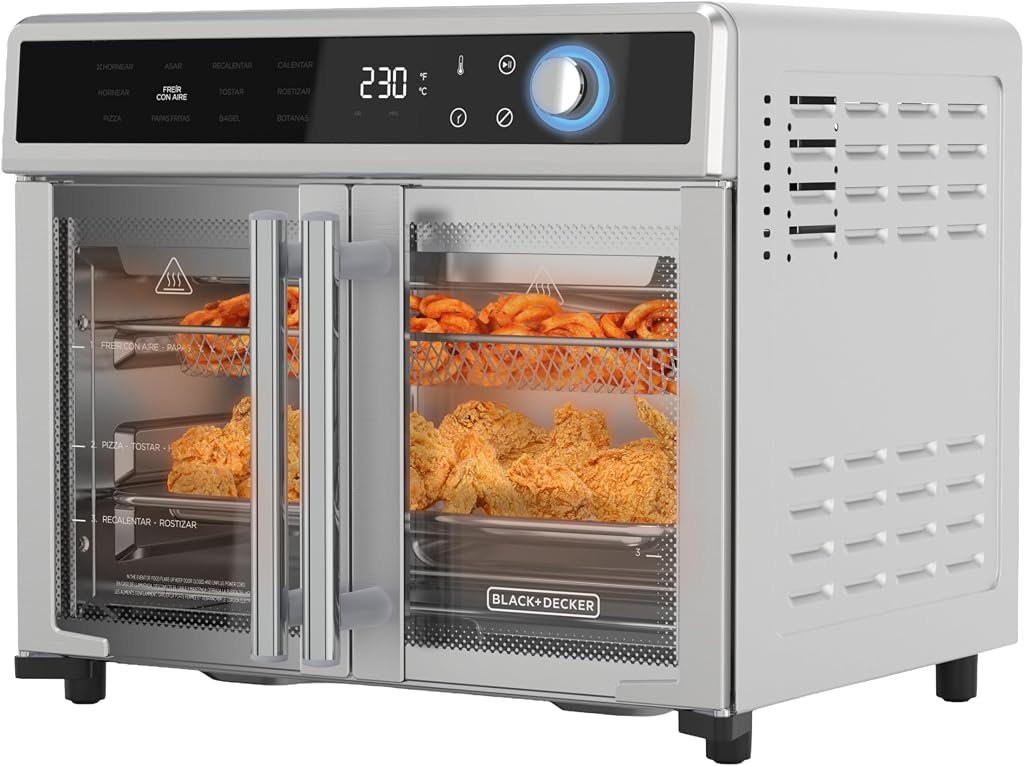
The BLACK+DECKER Crisp ‘N Bake Air Fryer Toaster Oven approaches countertop cooking from a decidedly conventional direction. Rather than surrounding air frying with touchscreens, dozens of presets, connected features, or elaborate automation, the six-slice TO3217SS combines a familiar toaster-oven layout with convection-driven air frying and three mechanical control knobs.
That restraint is central to understanding the appliance. According to BLACK+DECKER’s specifications for the TO3217SS, it accommodates six slices of bread or a 12-inch pizza, offers five cooking functions, includes a 60-minute timer with stay-on capability, and comes with an air-fry basket, bake pan, broil rack, and removable crumb tray. The manufacturer lists its weight at 14.3 pounds and height at 11.2 inches.
The result is an appliance that asks a straightforward question: how much complexity does countertop cooking actually need?
Our score is 8.4/10. Customer Sentiment stands at 8.06, Buyer Confidence at 9.8, and Value at 8.03. Those figures describe a mature concept with clearly defined capabilities, considerable versatility, and relatively few mysteries about how it operates. They also reflect the compromises inherent in combining air frying with the larger cavity and broader duties of a toaster oven.
At the $129.99 reference price used in this assessment, the Crisp ‘N Bake makes its strongest argument not as a specialized air fryer, but as a multipurpose countertop oven for households that expect one appliance to handle toast, pizza, reheating, baking, broiling, warming, and crisping.
Five Functions, Not Fifty Presets
The TO3217SS provides five cooking functions:
- Air Fry
- Bake
- Broil
- Toast
- Keep Warm
The list looks modest beside appliances advertising ten, twelve, or even more presets. Yet the difference between a cooking function and a preset deserves scrutiny.
A preset often does little more than preselect a temperature and cooking time. Bake, broil, toast, and air fry represent genuinely different ways of applying heat. The BLACK+DECKER therefore concentrates on cooking methods rather than constructing a menu of food names around essentially similar processes.
That simplicity affects everyday use. Three knobs control the appliance rather than a layered digital interface. One selects temperature or the air-fry setting, another controls the cooking function, and the timer system handles cooking duration and toast darkness. The design is closer to the toaster ovens that have inhabited kitchens for decades than to newer countertop appliances designed around screens.
Mechanical controls have disadvantages. They do not offer the same numerical precision as a digital timer, and reading small markings around a dial can be less convenient than viewing large illuminated numbers. Yet they also make the operating logic immediately visible.
There is no software hierarchy to navigate. The relationship between function, temperature, and time remains physically present on the front panel.
Air Frying Is Convection With a Specific Purpose
The phrase “air fryer” can make an ordinary heating principle sound unusually exotic. Air frying is fundamentally a form of high-intensity convection cooking.
BLACK+DECKER describes its Air Fry Technology as using high-intensity hot air to bake, brown, and crisp food with little to no oil. The TO3217SS uses convection to circulate that heated air through the oven during air frying.
The underlying process is easy to understand. Heat moves toward food through several mechanisms, while moving air accelerates heat transfer and helps carry moisture away from the surface. As the exterior dries and browns, foods can develop the crisp textures associated with frying without being submerged in oil.
That does not make air frying identical to deep frying. Immersion in hot oil transfers heat differently, and the resulting texture and flavor can differ substantially.
The better comparison is between air frying and conventional oven cooking. A high-airflow cooking environment can brown and crisp exposed surfaces more aggressively than a relatively still oven chamber, particularly when food is arranged so air can move around it.
The included mesh air-fry basket is therefore more than an accessory. Its open construction allows heated air to reach food from multiple directions.
Capacity Is Where the Oven Format Earns Its Keep
BLACK+DECKER states that the TO3217SS accommodates six slices of bread or a 12-inch pizza.
Those two measurements are more useful than an abstract capacity figure because they describe recognizable food.
Six-slice toast capacity moves the appliance beyond the smallest toaster ovens. A 12-inch pizza is large enough to make the machine useful for frozen pizza and similar foods without requiring a conventional oven.
The broader chamber also creates more horizontal cooking area than many compact basket air fryers.
That matters because air frying rewards exposed surface area. Fries piled deeply on top of one another interfere with airflow. Vegetables crowded into a small basket can steam against adjacent pieces instead of browning evenly. A wider mesh basket permits food to be distributed more broadly.
Yet oven capacity brings a countervailing cost: more air must be heated and circulated.
A dedicated basket air fryer surrounds food with a smaller chamber. That compact architecture can be advantageous when preparing small portions quickly. The Crisp ‘N Bake instead trades some specialization for the ability to handle toast, pizza, baked dishes, broiled foods, and wider batches.
Anyone comparing it with the best air fryers should therefore decide whether the primary goal is concentrated air-frying performance or broader countertop cooking.
The 60-Minute Timer Defines Its Everyday Role
The TO3217SS includes a 60-minute timer with stay-on functionality for cooking jobs requiring more time.
A one-hour mechanical timer covers a substantial portion of ordinary countertop cooking: frozen foods, vegetables, toast, pizza, reheating, smaller baked dishes, and many air-fried foods.
Stay-on capability extends the appliance beyond that boundary, but it changes the nature of supervision. Automatic shutoff is useful because it limits how long the oven runs when a timed cycle finishes. A stay-on mode intentionally removes that limit.
That makes the feature useful but deserving of deliberate handling.
Mechanical timers also require users to think differently from digital countdown systems. A digital control may allow exact minute-by-minute adjustment and display the remaining duration precisely. A mechanical dial provides a more approximate interaction.
For toast, BLACK+DECKER separates browning control from the ordinary cooking timer, an important distinction because toast is unusually sensitive to relatively small changes in heating time.
The overall interface favors directness over fine-grained automation.
Toasting Matters More Than the Air-Fryer Label Suggests
Air frying receives most of the attention in this category, but an appliance called a toaster oven still has to make toast.
The six-slice capacity gives the TO3217SS a practical advantage over two- and four-slice models for households preparing breakfast for several people. The wide chamber also makes it possible to toast breads and baked goods that do not fit comfortably into conventional pop-up toaster slots.
Toast exposes one of the central engineering challenges of multipurpose ovens: even heating.
Bread placed near a heating element can brown differently from bread positioned farther away. A wide cavity must distribute radiant and convective heat across several slices without producing dramatic differences from one position to another.
The TO3217SS relies on the familiar toaster-oven arrangement rather than specialized independent toast slots. That provides flexibility but also means toast is prepared in the same chamber responsible for pizza, baking, and air frying.
The advantage is consolidation. The compromise is that a dedicated toaster remains a more specialized tool.
Baking Gives the Appliance a Second Identity
The Bake setting may ultimately determine whether the Crisp ‘N Bake earns permanent countertop space.
A household using the appliance only for fries has bought an unnecessarily complicated air fryer. A household using it for toast in the morning, reheating at lunch, pizza or vegetables later, and occasional baking is exploiting the design much more fully.
Countertop baking has an obvious physical advantage over firing up a full-size oven for modest portions: the chamber is smaller.
A smaller cooking chamber generally contains less air and less structural material to bring to operating temperature. That can make a countertop oven a more proportionate tool for foods that fit comfortably inside it.
BLACK+DECKER explicitly positions the Bake function for foods including pizza and frozen snacks as well as reheating leftovers.
This is where the appliance’s old-fashioned architecture becomes persuasive. There is no need for the user to decide whether leftover lasagna corresponds to a specialized preset. Temperature, function, and time remain independently adjustable.
That flexibility asks slightly more of the cook, but it also avoids pretending every food fits neatly into an automated category.
Broiling Adds Useful High-Heat Flexibility
Broiling is easily overlooked when evaluating air-fry ovens, yet it expands what the appliance can reasonably do.
Broiling emphasizes direct radiant heat from above, making it useful for browning cheese, finishing surfaces, toasting open-faced foods, or adding color at the end of cooking.
That is fundamentally different from air frying.
Air frying relies heavily on rapidly moving hot air. Broiling deliberately places food in a more intense relationship with an upper heating element. A multifunction oven capable of both can approach the same meal in different stages: bake first, then broil briefly for surface browning.
The distinction illustrates why counting presets can be misleading. Five genuinely different cooking modes can provide more practical flexibility than a longer menu in which several settings merely modify temperature and time.
The Included Accessories Are Functionally Necessary
The TO3217SS comes with an air-fry basket, bake pan, broil rack, and removable crumb tray.
That accessory set maps directly to the machine’s functions.
The mesh basket permits airflow around foods during air frying. The baking pan provides a solid surface for foods that would drip or fall through mesh. The rack supports cookware and changes the food’s position relative to the heating elements. The crumb tray catches debris beneath the active cooking area.
Accessories can look secondary in a specification sheet, but countertop ovens depend heavily on them.
A mesh basket filled with fatty food can allow drippings to fall beneath it. Using an appropriate pan underneath can make cleanup substantially easier. Rack placement changes heat exposure. A neglected crumb tray can accumulate burnt debris and odors.
The oven therefore works as a small cooking system rather than a single heating box. Understanding which accessory belongs with which food can influence results almost as much as selecting the correct temperature.
Cleaning Is Simpler When Done Frequently
The removable crumb tray is one of the least glamorous features and one of the most practical.
Air frying and toasting both generate debris. Bread produces crumbs. Breaded foods shed coating. Fat can drip. High-speed air can move fine particles around an oven cavity.
A removable tray makes loose debris easier to remove before repeated heating turns it into stubborn residue.
The broader oven-style cavity, however, creates more interior surface than a removable basket fryer. That means the Crisp ‘N Bake cannot be judged solely by whether its basket is easy to wash.
Walls, racks, glass, pans, and the lower cavity all require periodic attention.
This is an unavoidable compromise in air-fryer toaster ovens. Their broader functionality exposes more surfaces to cooking residue.
Frequent light cleaning is the sensible strategy. Allowing grease to undergo repeated high-temperature cycles can turn a quick wipe into a considerably more laborious job.
The Analog Controls Are Both Strength and Limitation
Three knobs make the TO3217SS unusually legible in an appliance market increasingly filled with digital panels.
The user can look at the front and understand the machine’s basic state. Temperature is visible from the knob position. Function is visible from another. Time is represented physically.
For users who dislike menu-driven appliances, that has real value.
The trade-off is precision.
Mechanical dials cannot communicate remaining cooking time as precisely as a digital countdown. Temperature selection is also based on printed positions rather than exact electronic entry.
Neither approach is universally superior. Digital interfaces favor numerical precision and programmability. Mechanical controls favor immediate comprehension and direct adjustment.
The Crisp ‘N Bake clearly belongs to the latter camp.
That design choice also reinforces its identity as a toaster oven with air frying rather than an electronic air fryer expanded into an oven.
Where the 8.4/10 Score Comes From
Our 8.4/10 score reflects a product whose strengths are rooted in practicality.
The six-slice and 12-inch-pizza capacity is substantial enough to justify the oven format. Five cooking functions cover materially different tasks. The air-fry basket, bake pan, rack, and crumb tray provide the hardware required to use those functions properly. A 60-minute timer with stay-on capability gives the oven adequate timing flexibility for its intended workload.
The score stops short of a higher tier because simplicity produces limitations alongside advantages.
Mechanical controls sacrifice digital precision. A large oven chamber is less specialized than a compact basket when the only goal is air frying a small amount of food. Cleaning an oven cavity involves more surfaces than cleaning many drawer-style fryers.
The TO3217SS is therefore strongest when evaluated as a multipurpose oven rather than a specialist air fryer.
Customer Sentiment at 8.06 Reflects the Everyday Trade-Off
Customer Sentiment is 8.06, slightly below our overall 8.4 score.
That difference fits the ownership proposition. Appliances are experienced through repeated minor interactions, not specification sheets.
Turning a mechanical timer, cleaning crumbs, arranging food across a mesh basket, moving racks, handling a hot baking pan, and finding permanent countertop space all become part of daily ownership.
The machine’s strengths can create friction as well. A six-slice cavity is useful because it is larger, but larger appliances demand more counter area. Multiple accessories increase cooking flexibility but also create more pieces to store and wash.
An 8.06 Customer Sentiment score therefore represents a positive but measured assessment of living with the design.
Buyer Confidence Is the Standout Score
Buyer Confidence reaches 9.8.
The reason is straightforward: the TO3217SS is a clearly documented product with an uncomplicated feature set and first-party specifications that are easy to verify.
BLACK+DECKER identifies the model explicitly, documents its five cooking functions, six-slice and 12-inch-pizza capacity, 60-minute timer, included accessories, 14.3-pound weight, and 11.2-inch height.
There is little ambiguity about what is being purchased.
High Buyer Confidence does not mean every household will prefer the product or that long-term ownership can be predicted from specifications alone. It means the buying proposition itself is unusually transparent.
That transparency matters in a category where similarly named models can differ substantially in capacity, controls, door design, and cooking functions.
Value at 8.03 Depends on How Many Appliances It Replaces
Our Value score is 8.03 at the $129.99 reference price.
Value rises when the Crisp ‘N Bake replaces several pieces of equipment. A household that otherwise needs a toaster, basic countertop oven, and air fryer can extract more utility from the purchase than one already equipped with capable versions of all three.
The economics become less compelling if Air Fry is the only function that will see regular use.
This is why feature count alone is a poor way to judge multifunction appliances. An unused broiler has no practical value. An unused toast setting does not save space. A bake mode matters only if it actually prevents the larger oven from being used.
The most rational buyer evaluates the machine against existing kitchen equipment rather than against a hypothetical empty countertop.
Who Is Likely to Benefit Most
The Crisp ‘N Bake is particularly well suited to households seeking one uncomplicated countertop appliance for several recurring jobs.
Its capacity makes sense for couples and families who regularly prepare toast, frozen pizza, snacks, vegetables, reheated foods, and modest baked dishes. The air-fry function expands that workload without forcing the kitchen to accommodate a separate basket appliance.
It may also appeal to users who actively prefer physical controls.
Not everyone wants another screen in the kitchen. The three-knob interface has a mechanical clarity that can be refreshing when the task is simply selecting heat, function, and time.
The appliance also makes sense in kitchens where the full-size oven feels disproportionate for small meals.
Its strongest buyer fit is therefore defined less by culinary ambition than by frequency. An appliance used several times a day for different tasks earns counter space more convincingly than one retrieved occasionally for a single recipe.
Who Should Consider a Different Format
A dedicated basket air fryer remains the more logical format for users overwhelmingly focused on air frying small portions.
Basket models are purpose-built around compact high-airflow chambers. Their removable drawers can simplify loading, shaking, and cleanup. Someone cooking fries, wings, or vegetables for one or two people may have little reason to heat the larger chamber of a six-slice toaster oven.
Buyers demanding exact digital timing may also find the TO3217SS’s mechanical controls too approximate.
Likewise, a kitchen already equipped with a capable convection wall oven, toaster, and basket fryer may gain little from adding another appliance whose functions overlap substantially.
The Crisp ‘N Bake earns its place through consolidation. Without consolidation, it risks becoming countertop duplication.
Getting Better Results From the Crisp ‘N Bake
Air frying benefits from space around the food. Ingredients should be distributed across the mesh basket rather than piled deeply whenever practical. Air cannot crisp a surface it cannot reach effectively.
Preheating deserves attention when baking recipes call for it. The TO3217SS manual provides operating guidance for the appliance and should take precedence over assumptions carried over from a full-size oven.
Food should also be checked before the end of familiar conventional-oven cooking times when learning the appliance. A smaller chamber changes the distance between food and heating elements, while convection alters heat transfer.
For fatty or heavily breaded foods, placing the appropriate pan beneath the mesh basket can reduce the amount of debris reaching the lower oven.
The crumb tray should be emptied routinely rather than waiting for visible accumulation.
Those practices are not complicated. They reflect the same principle underlying the appliance itself: straightforward equipment performs better when the cook understands the physical process rather than relying blindly on presets.
Final Considerations
The BLACK+DECKER Crisp ‘N Bake Air Fryer Toaster Oven TO3217SS represents a relatively restrained interpretation of the multifunction countertop oven.
It does not attempt to turn cooking into a software experience. Five functions cover air frying, baking, broiling, toasting, and keeping food warm. Three mechanical knobs control the process. Capacity extends to six slices of bread or a 12-inch pizza, while the included air-fry basket, baking pan, rack, and crumb tray provide the essential supporting hardware.
That simplicity is both its appeal and its boundary.
The oven cannot offer the numerical control precision of a fully digital model. Its larger chamber is not as focused on small-batch air frying as a compact basket machine. Cleaning involves the interior surfaces and accessories associated with an actual oven rather than merely a removable drawer.
Yet those compromises make sense within the design.
Our score of 8.4/10 reflects broad practical capability without excessive complexity. Customer Sentiment at 8.06 recognizes the everyday compromises of size, cleanup, mechanical controls, and accessory handling. Buyer Confidence at 9.8 reflects a particularly clear and verifiable product identity. Value at 8.03 makes the strongest sense when the $129.99 appliance displaces multiple pieces of countertop equipment rather than duplicating them.
For someone seeking only an air fryer, the Crisp ‘N Bake is arguably more appliance than necessary. For someone seeking only a toaster, the same is true.
Its case becomes much stronger in the middle: a kitchen that needs toast in the morning, reheating at noon, crisp vegetables or frozen food in the evening, a 12-inch pizza on another night, and occasional baking or broiling without using the main oven.
That is where the TO3217SS reveals its underlying logic. It is not trying to dominate one narrow cooking task. It is trying to be useful often enough that several other appliances become unnecessary. For a countertop machine, repeated usefulness is a more demanding standard than a long feature list—and a more meaningful one.