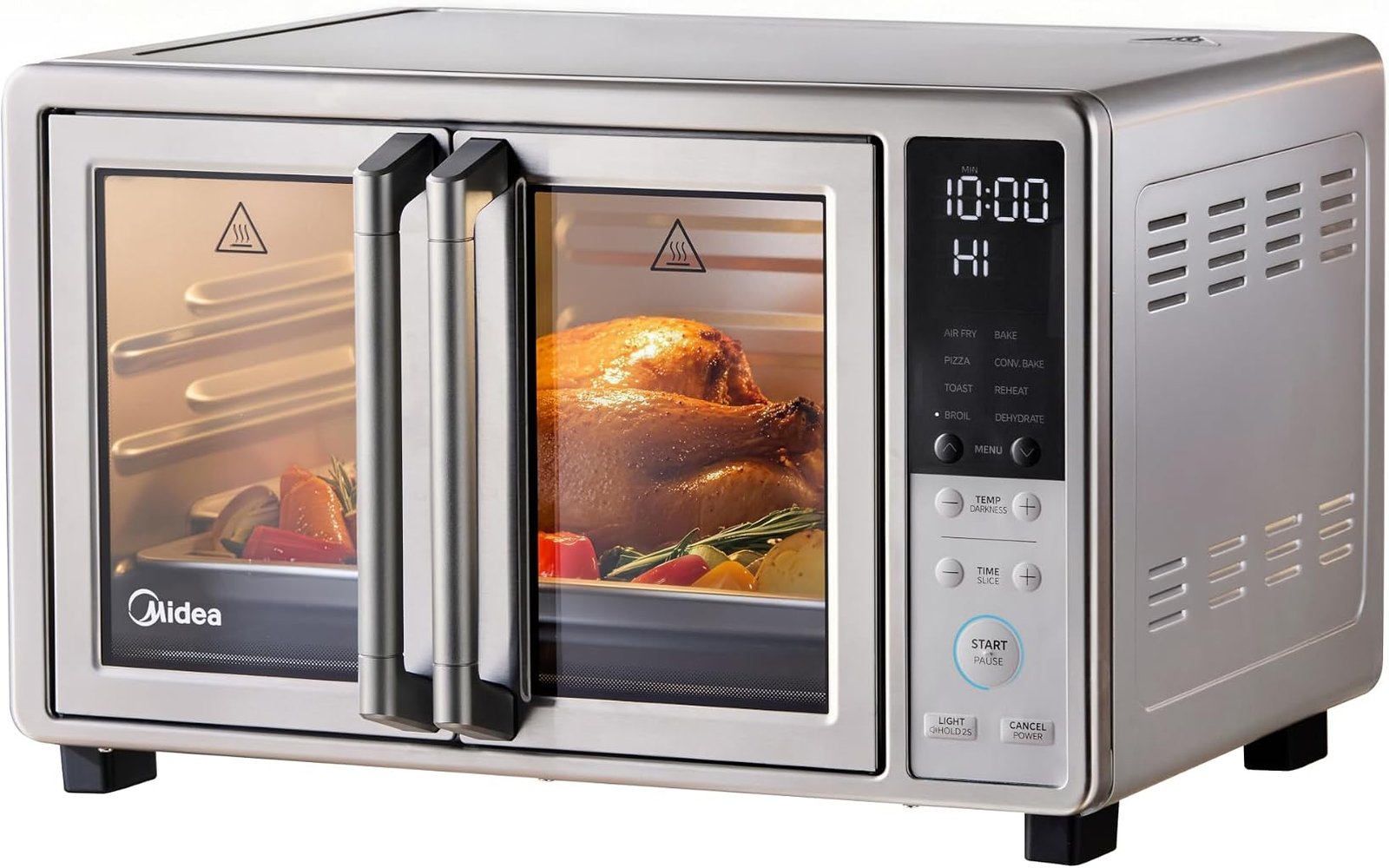
Countertop ovens have an awkward engineering assignment. They must offer enough internal capacity to justify their presence while remaining small enough that the kitchen does not begin to feel organized around an appliance. The Midea Flexify Slim French Door Air Fryer Toaster Oven, model MET26C2AST, approaches that conflict by building outward more than upward, pairing a relatively low profile with French doors and eight cooking modes.
The numbers establish the basic proposition. According to Consumer Reports’ specifications for the Flexify Slim MET26C2AST, the appliance measures about 18 inches wide, 15.7 inches deep, and 11.5 inches high. Its interior measures approximately 12.5 inches wide, 10.6 inches deep, and 6 inches high. It offers three rack positions, an interior light, digital controls, convection cooking, and a temperature range extending from 100°F to 450°F.
Those dimensions explain the word “Slim” more convincingly than marketing language could. This is not an especially narrow appliance; at approximately 18 inches across, it needs meaningful horizontal counter space. Its distinguishing dimensional characteristic is its height. That lower profile can matter beneath cabinetry, although clearance requirements mean buyers cannot simply slide it into any visually convenient opening.
Our score is 8.4/10. Customer Sentiment stands at 8.06, Buyer Confidence at 9.8, and Value at 8.03. The pattern is revealing: confidence in what the Flexify Slim is and what it can do runs considerably higher than the scores reflecting everyday fit and economic value. This is a capable multifunction oven, but its usefulness depends heavily on kitchen geometry and cooking habits.
The Flexify Slim Is an Oven First
The phrase “air fryer toaster oven” can create the wrong mental model. The MET26C2AST is better understood as a countertop convection oven that includes a dedicated air-frying mode.
Its eight functions are:
- Air Fry
- Pizza
- Toast
- Broil
- Bake
- Convection Bake
- Reheat
- Dehydrate
The MET26C2AST operating documentation provides useful detail behind those buttons. Air Fry operates between 150°F and 450°F and allows cooking periods from one minute to one hour. Bake and Convection Bake cover the same 150°F-to-450°F temperature range, with timers extending to two hours. Dehydrate drops the minimum to 100°F and can run for as long as 24 hours. Toast provides settings for one to six slices and seven darkness levels.
This range matters because multifunction appliances are often padded with presets that amount to minor variations on the same process. The Flexify Slim’s functions represent several genuinely different cooking jobs. Dehydrating at 100°F for hours is materially different from air frying at 400°F. Toasting six slices requires different controls from baking a casserole or reheating leftovers.
The appliance therefore makes more sense as a potential replacement for several smaller cooking tools than as a direct substitute for a conventional basket fryer.
Its Slim Shape Solves One Problem, Not Every Space Problem
The MET26C2AST’s proportions deserve close examination because “space-saving” can become an imprecise description in countertop appliances.
Consumer Reports measures the exterior at roughly 18 inches wide, 15.7 inches deep, and 11.5 inches high. Its measurements also show that the Flexify Slim is shorter than several larger countertop ovens in the same category.
The advantage is vertical. The disadvantage is width.
That distinction becomes significant in small kitchens. A low appliance can preserve a less obstructed sightline and fit more naturally beneath upper cabinets, but an 18-inch-wide machine still claims a substantial section of usable preparation space.
Clearance requirements also complicate the idea of squeezing it beneath cabinetry. The operating instructions call for keeping the oven approximately 10 to 15 centimeters from walls and cabinets and maintaining 30 centimeters of empty space above it. Those requirements should influence placement more than photographs showing an appliance tucked neatly against a backsplash.
A prospective owner should therefore measure the intended location in three dimensions rather than focusing on countertop footprint alone. Space behind the appliance and clearance above it are part of its functional footprint even though they never appear in exterior dimensions.
French Doors Are More Than Decoration
The French-door configuration is the product’s most visible departure from conventional toaster-oven architecture.
A traditional countertop oven usually has one large glass door hinged along its lower edge. Opening it creates a horizontal surface projecting toward the user. French doors split that opening vertically and move outward from the center.
That arrangement changes the ergonomics of loading and unloading food. There is no large horizontal door positioned beneath a hot baking tray as it is withdrawn. It also gives the Flexify Slim a distinct visual identity without requiring a more complicated cooking process.
French doors do not, however, eliminate the need for front clearance. Both panels still swing outward. Nor do they make hot accessories inherently safe to handle. Oven mitts and deliberate tray handling remain necessary.
The format is therefore best regarded as an ergonomic alternative rather than a transformation in cooking performance. Food does not care which direction the door opens. The person reaching for a hot tray might.
The 25-Quart Question
The Flexify Slim is commonly identified as a 25-quart-class appliance, but nominal volume alone is a poor measure of usable oven capacity.
Internal geometry matters more.
Consumer Reports measured an interior approximately 12.5 inches wide, 10.6 inches deep, and six inches high, with three rack positions. It also identifies capacity for six slices of toast. Those measurements offer a more useful picture of daily cooking than a quart figure.
Six inches of interior height creates an obvious trade-off. The low external profile translates into a relatively shallow cooking chamber. That is unlikely to matter for toast, fries, pizza, cookies, reheated food, vegetables, or many sheet-pan preparations. Tall cookware and unusually bulky foods require more scrutiny.
Three rack positions partially compensate by letting the user adjust proximity to the heating elements. That flexibility matters during broiling, baking, and air frying because heat exposure changes substantially as food moves vertically within a compact oven.
The result is an appliance optimized more for horizontal food arrangement than towering cookware. That is a rational compromise for a product whose identity revolves around being slim.
Air Frying Versus Dedicated Basket Models
Comparisons with the best air fryers require some discipline because oven-style and basket-style machines solve different problems.
A basket air fryer surrounds a relatively small quantity of food with rapidly moving hot air inside a compact cavity. That architecture is efficient for foods such as fries, wings, vegetables, nuggets, and small portions of meat. The basket can usually be removed in one movement and shaken during cooking.
The Flexify Slim uses a larger oven chamber and an air-fry basket. Its convection system therefore has more space to heat and more potential cooking area to exploit.
That creates a trade.
A basket fryer is generally more focused. An oven-style machine is more flexible. The Midea can toast six slices of bread, bake, broil, reheat, dehydrate, prepare pizza, and operate as a conventional or convection oven. A typical basket machine cannot perform all of those tasks with the same physical flexibility.
The buyer therefore needs to distinguish air-frying priority from overall kitchen utility. Someone primarily interested in making two portions of fries may find a basket simpler. Someone trying to reduce reliance on a toaster, countertop oven, and separate air fryer has a stronger reason to accept the Midea’s larger footprint.
Infrared SpeedHeat Needs a Grounded Interpretation
The Flexify Slim is marketed around Infrared SpeedHeat, language that risks sounding more exotic than the underlying physics requires.
Infrared radiation is a familiar component of electric cooking. Heating elements radiate energy toward food and surrounding surfaces, while convection moves heated air around the chamber. The meaningful question is not whether infrared energy exists but how effectively the oven combines radiant and convective heating.
The MET26C2AST’s manual confirms that convection is active during Air Fry, Convection Bake, and Dehydrate. Standard Bake, Pizza, Toast, Broil, and Reheat use different convection settings, with some modes operating without it.
That is useful because it shows the oven is not simply applying maximum fan speed to every preset and changing the timer. Different foods benefit from different heat behavior. Toast does not necessarily need aggressive convection. Dehydration does. Air frying relies heavily on moving hot air to increase heat transfer and encourage surface drying.
The practical advantage is control rather than technological spectacle.
Preheating Is More Nuanced Than “Fast”
The manual indicates that Air Fry, Pizza, Bake, and Convection Bake use preheating, while Toast, Broil, Reheat, and Dehydrate do not require the same preheat sequence.
That division is sensible.
A pizza or baked dish benefits from entering an already heated environment because temperature affects crust development, rise, browning, and cooking time. Toasting and reheating are less dependent on establishing a thermally stable chamber before food enters.
A countertop oven also starts with a physical advantage over a full-size range: there is simply less chamber volume and structural mass to heat. That does not mean every cooking task will finish dramatically faster. Food thickness, moisture, starting temperature, tray material, fan operation, and quantity all affect total time.
The useful question is therefore not whether the Midea can produce a spectacular preheat number. It is whether its smaller cavity reduces the friction of using an oven for ordinary meals. For many households, that is the more meaningful benefit.
The Controls Favor Precision Over Mechanical Simplicity
Consumer Reports identifies the MET26C2AST as using touchpad controls with a digital display. The arrangement fits an appliance managing multiple functions, temperatures, timers, toast quantities, and darkness settings.
Digital controls allow exact temperature and time selection more readily than approximate mechanical dials. They also create a different failure and usability profile. A rotary mechanical timer can be understood almost instantly. Digital interfaces require the user to learn the sequence for selecting a mode and modifying its settings.
The Flexify Slim therefore carries the familiar multifunction-appliance bargain: greater control in exchange for a modest learning curve.
Once the operating logic is understood, the eight-mode structure is reasonably coherent. The controls do not ask users to navigate dozens of food-specific presets. Instead, they largely correspond to cooking methods.
That is preferable to interfaces where a screen crowded with icons creates the illusion of sophistication while hiding ordinary temperature and timer controls.
Cleaning Deserves More Attention Than Feature Counts
Air-fry ovens generate a predictable maintenance challenge.
Rapid airflow helps evaporate surface moisture and promote browning, but it can also distribute grease and fine food particles around the cooking chamber. A removable basket fryer confines much of that contamination to a drawer and basket. A countertop oven exposes racks, walls, heating areas, and a larger door assembly.
The MET26C2AST includes a baking pan, baking rack, air-fry basket, and crumb tray in addition to the oven itself. That accessory package covers the basic cooking formats without requiring immediate additional equipment.
The crumb tray deserves routine attention. Crumbs and grease left near heating elements can produce smoke and odors during later cooking cycles.
Cleaning is therefore easiest when treated as frequent maintenance rather than an occasional restoration project. Wiping fresh residue is less demanding than removing polymerized grease after repeated high-temperature sessions.
French doors introduce additional glass and edges to clean as well. Their ergonomic benefit comes with more seams than a simple single-panel door.
Heat Clearance Is a Genuine Ownership Issue
One specification in the manual deserves more attention than many feature lists give it: the recommended clearance around the appliance.
Midea’s instructions specify 10 to 15 centimeters between the oven and nearby walls or cabinets, with 30 centimeters of empty space above. The manual explicitly warns that surrounding objects can be affected by heat emitted from the appliance.
That matters for any buyer attracted by the word “Slim.”
An appliance can be physically compact yet require a substantially larger operating envelope. A counter beneath low cabinets may appear perfect until the clearance requirement is measured. Likewise, placing the oven flush against a backsplash defeats the intended ventilation spacing.
This is one reason product dimensions should never be treated as installation dimensions.
The Flexify Slim’s low body remains useful, but safe placement may consume more vertical space than its 11.5-inch height suggests.
The Scores Reveal a Product With Specific Strengths
Our score of 8.4/10 reflects an appliance with a coherent design rather than an indiscriminate collection of functions.
Eight cooking modes cover genuinely different tasks. The 100°F-to-450°F overall temperature capability spans dehydration through high-temperature convection cooking. Three rack positions add flexibility, while the interior light and digital display address everyday usability. French doors distinguish the physical interaction from the standard drop-down toaster-oven design.
Customer Sentiment at 8.06 is lower than the overall score. That difference is reasonable for a multifunction appliance whose strengths create corresponding compromises. Its low profile limits interior height. Its approximately 18-inch width is not tiny. Air-fry-oven cleanup is more involved than emptying many basket models. Clearance requirements also reduce the practical space savings in some kitchens.
Buyer Confidence reaches 9.8, the highest of the four ratings. There is little ambiguity about the model’s core specifications. Consumer Reports lists the MET26C2AST in its toaster-oven testing program and confirms its convection system, wattage, temperature range, controls, measurements, interior dimensions, rack positions, and warranty. Consumer Reports also says its toaster-oven owner surveys covered 42,933 new toaster ovens purchased from 2018 through 2026, although it reports insufficient survey data to issue a Midea brand-level reliability score.
That distinction matters. High confidence in the product’s identity and specifications should not be mistaken for a prediction of long-term durability.
Value Depends on Appliance Consolidation
Our Value score is 8.03 at the $139.99 reference price.
That score becomes easier to interpret when the Flexify Slim is considered in terms of appliances displaced rather than functions advertised.
If it replaces a toaster oven and separate air fryer while reducing routine use of a full-size oven, its economics become attractive. The same purchase looks less compelling in a kitchen where a convection oven, toaster, and air fryer are already working well.
This is a recurring issue with multifunction appliances. Capability has no economic value unless it eliminates another purchase, saves meaningful space, or gets used regularly.
The Midea’s strongest value argument is therefore consolidation.
A student apartment, compact household kitchen, secondary cooking area, or family kitchen seeking a smaller alternative to firing up the main oven can make use of nearly every mode. A household interested only in occasional air frying is paying for a considerable amount of unused hardware.
Who Should Consider the Flexify Slim
The strongest buyer profile is someone seeking broad oven functionality without the height of a larger countertop model.
Its 11.5-inch external height can be advantageous where visual bulk matters, while its six-slice toast capacity and three rack positions offer more flexibility than a compact two- or four-slice toaster oven.
It also makes sense for cooks whose habits vary throughout the week. Toast at breakfast, reheating at lunch, air-fried vegetables at dinner, pizza on Friday, baking on Saturday, and dehydration occasionally are all plausible jobs for the same machine.
Households that regularly cook modest portions can also benefit from having an alternative to a full-size oven.
None of this means every function will perform identically to a specialized appliance. A dedicated toaster has a narrower job. A basket air fryer concentrates on air frying. A full-size oven accommodates cookware and foods that a six-inch-high countertop cavity cannot.
The Flexify Slim trades specialization for breadth.
Who Should Look Elsewhere
The appliance is less convincing for buyers with extremely narrow counters. An 18-inch width is substantial regardless of the Slim name.
It is also a weaker fit where overhead clearance is limited. The manufacturer’s recommended 30 centimeters of open space above the unit can undermine plans to place it beneath low cabinetry.
People primarily interested in air frying small portions should compare it carefully with basket models. Basket fryers usually offer simpler loading, shaking, and cleaning for that specific task.
Likewise, households needing to roast very tall foods or use deep cookware should pay close attention to the approximately six-inch interior height measured by Consumer Reports.
The Flexify Slim is not trying to become a miniature full-size oven in every dimension. Its proportions necessarily dictate what fits.
Using It More Effectively
The oven’s performance depends partly on how it is loaded.
Air frying works best when hot air can circulate around food. A crowded basket restricts that movement, reducing the surface area exposed to dry moving air. Spreading ingredients into a relatively even layer is preferable when crispness is the objective.
Rack position should also be treated as a cooking variable rather than an afterthought. Moving food closer to a heating element changes radiant exposure. Broiling, baking, toasting, and air frying do not necessarily benefit from the same vertical position.
For unfamiliar recipes, checking progress before the conventional-oven cooking time expires is sensible. A smaller chamber and active convection can alter browning and moisture loss.
The manual also instructs new owners to perform an initial 15-minute, 450°F bake cycle before cooking food, explaining that this burns off residual manufacturing oils and that some temporary smoke can occur during the process. Following that procedure avoids turning the first actual meal into the appliance’s burn-in cycle.
Final Considerations
The Midea Flexify Slim French Door Air Fryer Toaster Oven MET26C2AST succeeds primarily because its design has a discernible purpose. It is not merely a conventional toaster oven covered in additional preset buttons.
The low-profile body, French doors, eight cooking functions, three rack positions, interior lighting, digital controls, convection system, and 100°F-to-450°F operating range create a versatile countertop cooking platform. Independent specifications from Consumer Reports confirm a roughly 18-by-15.7-by-11.5-inch exterior and a 12.5-by-10.6-by-6-inch interior, which exposes both the attraction and compromise of the Slim design.
Its width remains substantial. Its shallow chamber will not suit every pan or food. Air-fry-oven maintenance is more involved than the simplicity offered by many removable-basket machines. Manufacturer clearance requirements also mean its practical installation space is larger than the metal enclosure alone.
Those limitations help explain the difference between our 8.4/10 overall score and Customer Sentiment of 8.06. The design is capable, but ownership asks the kitchen to accommodate its geometry. Buyer Confidence of 9.8 reflects a clearly identifiable, documented model with independently verifiable specifications. Value at 8.03 reflects a favorable proposition when several of its eight cooking modes replace other appliances, but less compelling economics when it is purchased solely for air frying.
The Flexify Slim therefore belongs in a particular kind of kitchen: one where horizontal counter space is available, vertical bulk is undesirable, and a single appliance is expected to toast, bake, convection-bake, reheat, broil, dehydrate, handle pizza, and air fry.
For that household, the French doors are not the main story, despite being the first thing anyone notices. The more meaningful achievement is fitting a credible range of oven functions into a body only about 11.5 inches tall.
For everyone else, the decision becomes simpler. Measure the counter. Measure the clearance above it. Consider which of the eight functions will actually be used. A multifunction appliance earns its space through repeated work, not through the number of modes printed beside its display.