The Geek Chef 16QT Air Fryer Toaster Oven GTO16 sits in an interesting middle ground. It is substantially more oven-like than a drawer air fryer, yet its 16-quart chamber and roughly 13-inch exterior dimensions keep it well below the scale of the large countertop ovens that can dominate a work surface.
That middle ground defines almost every strength and compromise in the product.
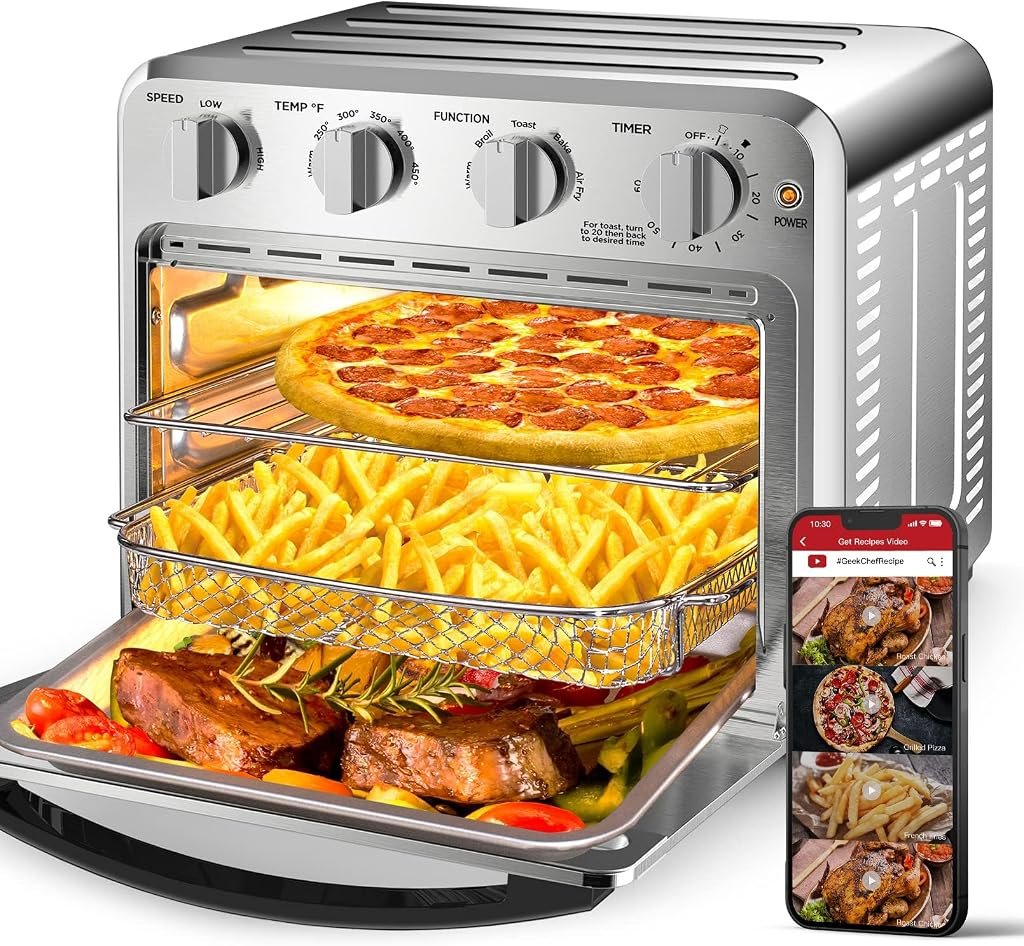
The GTO16 is rated at 1,400 watts on a 120-volt, 60 Hz supply. Its documented dimensions are 13.5 by 12.8 by 12.1 inches, and its cooking controls cover Warm, Broil, Toast, Bake and Air Fry. The 16-quart chamber is presented as large enough for four slices of toast or a 9-inch pizza.
Our score is 8.4/10. Customer Sentiment stands at 8.06/10, Buyer Confidence at 9.8/10 and Value at 8.03/10. Those ratings describe a straightforward appliance whose attraction comes from compact multifunctionality rather than an elaborate digital interface or unusually large cooking chamber.
At a reference price of $154.99, the value question is more demanding. This machine needs to earn its countertop position by doing several jobs regularly. If Air Fry, Toast, Bake and Broil all enter the weekly routine, the proposition becomes easier to defend. If the appliance is purchased only for occasional fries, a simpler basket machine may make more economic sense.
The Geek Chef’s case rests on consolidation: enough oven capability to broaden what an air fryer can do, without turning the counter into a small appliance showroom.
Sixteen Quarts Changes The Meaning Of Compact
Air-fryer capacity is difficult to compare because manufacturers use several measurements and several chamber shapes.
A drawer fryer may advertise capacity in quarts but concentrate that volume inside a deep basket. An oven-style machine distributes its space differently, emphasizing horizontal racks and trays.
The Geek Chef GTO16 takes the second approach.
The GTO16 user documentation specifies a 16-quart oven chamber inside an appliance measuring 13.5 by 12.8 by 12.1 inches. It is rated at 1,400 watts.
Those dimensions matter because a countertop appliance has two capacities: the food it holds and the kitchen space it consumes.
A very large oven can prepare substantial quantities while permanently surrendering a broad section of counter. A tiny basket saves space but may require several cooking batches. The Geek Chef attempts to split the difference.
Its 16-quart chamber is not family-banquet territory, but it provides enough space for foods that would be awkward in many compact baskets.
That is particularly useful for toast and pizza, where horizontal area matters more than deep volume.
Four Slices Of Toast And A 9-Inch Pizza Explain The Capacity Better
Quart figures are abstract. Food is easier to visualize.
Documentation for this 16-quart Geek Chef format identifies capacity for four slices of bread, a 9-inch pizza and approximately 700 grams of chicken wings.
Those examples establish the appliance’s practical scale.
Four-slice toast capacity makes it plausible as an everyday toaster replacement for a small household. A 9-inch pizza fits the compact-meal role rather than the large family-pizza role. Chicken wings can be distributed across the air-fry basket rather than dropped into a deep drawer.
This is useful capacity, but expectations should remain proportional.
A 16-quart countertop oven should not be mentally enlarged into a full-size oven simply because it has a door and racks. Large roasting dishes and substantial cookware belong to another category.
The Geek Chef is better understood as a compact oven with air-frying capability.
That distinction prevents disappointment and clarifies buyer fit.
The Five Cooking Modes Keep The Interface Understandable
The GTO16 focuses on Warm, Broil, Toast, Bake and Air Fry rather than presenting an extensive catalog of food-specific presets.
There is something refreshingly legible about that approach.
Air Fry handles high-convection browning. Bake covers conventional oven work. Broil emphasizes surface heat. Toast addresses bread browning. Warm maintains prepared food at a serving-oriented temperature.
Each mode has a recognizable purpose.
Preset counts can create an illusion of sophistication. An appliance with buttons for fries, nuggets, vegetables, chicken and fish may still be applying closely related combinations of heat, fan speed and time.
Five clearly differentiated functions can therefore be more useful than a crowded interface if the owner understands what each method does.
The Geek Chef is not trying to automate every food decision. It gives the cook a relatively small set of thermal tools.
That simplicity contributes to the 9.8/10 Buyer Confidence score. The product’s operating premise is easy to grasp.
Mechanical Controls Are Either Refreshingly Direct Or Deliberately Basic
The GTO16 uses a knob-driven control system rather than a large digital touchscreen.
Its documented controls include fan speed, temperature, cooking function and timer. The temperature control extends from Warm to 450°F, while the timer runs to 60 minutes.
This creates a very different interaction from an app-connected or heavily programmed countertop oven.
Mechanical controls are immediate. There is no menu hierarchy to navigate simply to toast bread. Temperature, function and duration remain visible as physical settings.
There is also less precision in the user interface than a digital system capable of presenting exact numerical adjustments and program information on a screen.
Whether that is a meaningful drawback depends on the cooking style.
A cook accustomed to turning oven knobs may find the Geek Chef familiar. Someone expecting a highly automated appliance with detailed digital feedback may find the interface plain.
Plain is not synonymous with inadequate.
The relevant question is whether the controls provide enough authority over the cooking methods the oven actually supports. For its five primary modes, they largely do.
A 1,400-Watt Rating Is Moderate For The Category
The GTO16 is rated at 1,400 watts.
Wattage is often treated as if it were a direct measure of cooking quality. It is not.
Heating-element position, chamber size, insulation, airflow, thermostat behavior, food quantity and cooking mode all affect performance. Two ovens with identical wattage can behave differently because the energy is being distributed through different physical systems.
Still, electrical power provides useful context.
The Geek Chef’s relatively compact 16-quart chamber does not require the same architecture as a very large countertop oven intended to accommodate large roasting dishes. Its 1,400-watt specification should therefore be interpreted alongside chamber volume rather than in isolation.
The more relevant practical issue is whether the heating system can support air frying, baking, broiling and toasting within that compact cavity.
Those are meaningfully different tasks.
Air frying emphasizes moving hot air. Broiling emphasizes intense surface heating. Baking asks for a more stable oven environment. Toasting requires controlled browning across exposed bread.
A multifunction oven has to manage those differences without becoming unnecessarily complicated.
Air Frying Is About Air Access, Not Merely Temperature
The Geek Chef includes an air-fry basket, which is one of the most important accessories in the package.
A perforated or mesh-style basket allows moving heated air to reach more of the food surface than a solid pan would permit.
That matters because air frying relies heavily on convection.
Food packed into a dense heap blocks airflow. Moisture escaping from one piece can become trapped around another. Surfaces shielded from circulating air can brown differently from exposed surfaces.
The most useful capacity is therefore not necessarily the maximum quantity that can physically be pushed into the basket.
For fries, vegetables, wings and breaded foods, spacing and distribution matter.
This is one reason oven-style air fryers can be appealing. Their baskets often encourage food to spread across a broader plane rather than settle into a deep pile.
The Geek Chef’s 16-quart architecture provides enough chamber room to exploit that arrangement without requiring the footprint of a substantially larger oven.
Air Frying Should Not Be Confused With Deep Frying
The language surrounding air fryers can encourage an unrealistic comparison.
Deep frying immerses food in hot oil. Air frying exposes food primarily to heated moving air.
Those cooking environments transfer heat differently.
An air fryer can produce browned, crisp surfaces on many foods without submerging them in cooking oil, but it does not make hot air behave physically like a liquid fat bath.
That distinction is particularly relevant for wet batters. Deep-frying oil can rapidly set the exterior of battered food. A high-convection oven does not reproduce that process exactly.
Frozen foods formulated for oven preparation, vegetables, potatoes, wings and many breaded products are generally more natural candidates for air frying.
The Geek Chef’s Air Fry mode should therefore be viewed as high-convection cooking rather than an electronic substitute for every deep-fried recipe.
That is still a useful capability. It simply benefits from realistic expectations.
Browning Should Be Controlled Rather Than Chased
Air frying, baking, broiling and toasting all encourage browning, which makes food visually and aromatically appealing. Yet excessive browning is not automatically desirable.
The U.S. Food and Drug Administration explains that acrylamide can form in certain plant foods during high-temperature cooking, including frying, roasting and baking. Acrylamide forms from sugars and the amino acid asparagine that occur naturally in food.
The FDA reports that longer cooking periods and higher temperatures generally increase acrylamide formation. For cut potato products, cooking to a golden-yellow color rather than brown can help reduce formation. The agency also states that soaking raw potato slices in water for 15 to 30 minutes before frying or roasting can reduce acrylamide formation during cooking.
The issue is not specific to Geek Chef. It applies broadly to relevant foods cooked at high temperatures.
It does illustrate why a 450°F maximum setting should be interpreted as available range rather than a default target.
Fries do not need to become mahogany-colored to prove that an air fryer works.
Visual observation remains one of the cook’s most useful controls.
Toasting May Be More Important Than Air Frying For Daily Use
Air Fry attracts attention because it distinguishes this appliance from an ordinary toaster oven. Toast may matter more often.
Breakfast routines reward simplicity.
Four-slice capacity means the Geek Chef can plausibly replace a conventional toaster for many small households.
This matters because multifunction appliances derive value from frequency.
A machine used three times a day does not need every use to demonstrate its most advanced feature. Toasting bread in the morning, warming food at lunch and air frying vegetables at dinner is exactly the kind of mixed workload that makes consolidation meaningful.
A dedicated basket fryer cannot perform every one of those jobs in the same way.
The Geek Chef’s oven door, rack and broad chamber therefore create utility beyond the Air Fry label.
Bake Mode Expands The Appliance Beyond Snacks
Bake mode gives the GTO16 access to foods that make little sense in a conventional air-fryer drawer.
Small baked dishes, suitable pans and compact recipes can use the oven chamber in a more conventional manner.
The 9-inch pizza capacity is an obvious example.
Pizza is a useful test of appliance geometry because it needs horizontal diameter. A deep basket may have considerable theoretical volume while remaining poorly shaped for a conventional pizza.
The Geek Chef’s oven layout avoids that problem.
The same logic applies to toast and other flat foods.
This is why raw quart capacity should never be the only comparison point between air fryers. Shape determines which foods actually fit.
The GTO16’s 16 quarts are arranged to support compact oven tasks rather than merely maximizing basket depth.
Broil Adds A Different Kind Of Heat
Broiling is often overlooked in discussions of air-fryer toaster ovens because Air Fry receives most of the attention.
Yet Broil addresses a distinct cooking objective.
Where baking surrounds food with oven heat and air frying emphasizes high convection, broiling concentrates intense heat toward exposed surfaces.
That can be useful for finishing foods, browning toppings or cooking items where surface heat is the priority.
The inclusion of Broil therefore makes the Geek Chef more credible as an oven replacement for selected tasks.
It also reinforces why owners should resist using Air Fry for everything.
A multifunction appliance is most useful when the operator chooses the method appropriate to the food rather than defaulting to the function printed most prominently on the product description.
Air Fry is not a universal cooking language.
Sometimes food needs baking. Sometimes it needs broiling. Sometimes bread simply needs toasting.
The Accessory Package Is Practical Rather Than Decorative
Documentation for the Geek Chef 16-quart oven identifies a baking pan, air-fry basket, wire rack and crumb tray among the included components.
Each has an obvious job.
The air-fry basket supports convection around exposed food. The baking pan provides a solid surface for foods that release liquid or require containment. The wire rack supports conventional oven-style placement. The crumb tray catches debris that would otherwise collect at the bottom of the chamber.
This is a sensible collection because the accessories correspond directly to the machine’s cooking modes.
There is still a storage issue.
When one accessory is being used, the others need somewhere to go. Compact appliances can create surprisingly noncompact collections of metal trays.
Owners with limited cabinet space should decide where those pieces will live before they begin migrating around the kitchen.
Multifunctionality can consolidate powered appliances while increasing accessory management. That exchange is common across the category.
Cleaning Is More Involved Than A Drawer Air Fryer
The crumb tray is useful because toast, breaded foods and other preparations naturally leave debris behind.
But an oven-style air fryer still has more exposed surfaces than a simple basket machine.
There is an interior cavity, a door, racks, a basket, a baking pan and a crumb tray. Grease can splatter. Cheese can drip. Fine crumbs can settle into corners.
A drawer fryer often concentrates much of its mess inside removable components. A countertop oven distributes residue over a wider area.
That does not make the Geek Chef difficult to maintain by definition. It means frequent light cleaning is preferable to infrequent heavy cleaning.
The crumb tray should be treated as routine maintenance rather than an archaeological project undertaken every few months.
A clean chamber also makes it easier to monitor new food rather than repeatedly heating residue from old meals.
The Compact Exterior Is One Of The Stronger Arguments
At approximately 13.5 by 12.8 by 12.1 inches, the GTO16 avoids the enormous footprint associated with some oven-style air fryers.
That does not make it tiny.
It still requires a permanent or semi-permanent section of heat-safe counter space and appropriate clearance during operation.
Yet the dimensions are easier to accommodate than countertop ovens stretching beyond 20 inches in width.
This is where the 16-quart format begins to make sense.
The appliance sacrifices the ability to accommodate very large cookware in exchange for a more manageable body. For apartments, smaller kitchens and counters already hosting a coffee machine or other equipment, that exchange can be rational.
Buyers should still measure.
Product photography has a remarkable ability to make countertop appliances appear as though they inhabit kitchens where counters extend indefinitely toward the horizon. Actual kitchens tend to contain walls, outlets, cabinets and yesterday’s coffee mug.
A tape measure remains one of the most reliable appliance-buying tools ever invented.
Understanding Our 8.4/10 Score
Our 8.4/10 overall score reflects a product with a clear purpose and useful versatility, tempered by a value proposition that depends heavily on how many of its cooking modes enter regular use.
Buyer Confidence is the strongest supporting rating at 9.8/10.
The reason is straightforward. Core specifications are documented: 16-quart capacity, 1,400-watt power, 120-volt operation and dimensions of 13.5 by 12.8 by 12.1 inches. The cooking controls and accessory structure are also clearly established.
A buyer can therefore understand the physical proposition with relatively little ambiguity.
Customer Sentiment stands at 8.06/10.
That lower figure reflects the compromises inherent in the format. A 16-quart oven is larger and more flexible than a compact basket, but smaller than many countertop ovens. Mechanical controls will appeal to some buyers and feel basic to others. The chamber works well for modest oven tasks but cannot imitate the interior dimensions of a large countertop model.
Value receives 8.03/10.
At a reference price of $154.99, value depends on consolidation. The appliance makes more financial sense when it replaces meaningful use of a toaster, small oven and air fryer.
If only one mode receives regular use, the economics weaken.
Where The Geek Chef Makes Its Strongest Case
The GTO16 makes its strongest argument in a small or moderately sized kitchen where several cooking functions are desirable but a large countertop oven would consume too much space.
Its compact exterior is central to that argument.
The 16-quart chamber provides enough horizontal cooking area for four slices of toast or a 9-inch pizza while remaining substantially smaller than many large oven-style air fryers.
The five core cooking functions also cover a sensible range without requiring an elaborate interface.
This makes the Geek Chef particularly relevant to buyers who value straightforward controls.
There are no grand claims required here. Warm, Broil, Toast, Bake and Air Fry cover a substantial portion of ordinary countertop cooking.
The machine’s strongest quality is not novelty. It is the way those familiar functions have been packaged into a relatively compact oven.
Where It Gives Ground
The first compromise is capacity.
Sixteen quarts is useful, but households routinely preparing large meals may quickly encounter its boundaries. A 9-inch pizza is a useful compact meal; it is not a large family pizza.
The second compromise is interface sophistication. Mechanical controls are simple, but they provide less visual feedback than a detailed digital display.
The third is cleaning. Oven-style construction means more interior surfaces than a drawer fryer.
The fourth is specialization. A buyer interested exclusively in air frying modest portions may find a basket model more direct and easier to wash.
The fifth is price. At the $154.99 reference figure, the Geek Chef benefits from regular use across several functions. Its value case weakens when Bake, Toast and Broil sit idle.
These are not obscure technical defects. They are the predictable costs of combining several cooking methods in a compact body.
Who Is Most Likely To Benefit?
The Geek Chef 16QT is best aligned with a household seeking a compact countertop oven that can also perform dedicated air-frying duties.
It fits particularly well where:
- Counter space is limited enough that a very large oven would be inconvenient.
- Four-slice toast capacity is sufficient for normal breakfast needs.
- A 9-inch pizza fits typical meal habits.
- Air frying will be used alongside baking, broiling and toasting.
- Straightforward knob controls are preferable to navigating digital menus.
- A removable basket, baking pan, wire rack and crumb tray can be stored conveniently.
- The household wants to reduce routine dependence on a full-size oven for smaller dishes.
- Cooking quantities generally fit a 16-quart chamber.
The weaker fit is a household regularly preparing large meals or expecting substantial vertical cooking room.
Likewise, someone interested only in air frying small portions may find the oven architecture unnecessary.
Practical Habits For Better Ownership
A few habits can make the GTO16 easier to live with:
- Measure the intended counter position before purchase rather than estimating from photographs.
- Leave appropriate operating clearance around the appliance according to its safety instructions.
- Spread food across the air-fry basket rather than building unnecessarily dense piles.
- Use the baking pan for foods likely to release liquid or fat rather than allowing drippings to collect freely.
- Empty the crumb tray regularly.
- Clean the basket before repeatedly heating oils and residue onto its surface.
- Match the function to the food: Broil, Bake, Toast and Air Fry are different tools.
- Monitor browning visually, particularly with potatoes and bread.
- For cut potatoes, FDA guidance recommends golden-yellow rather than brown coloring when reducing acrylamide formation is a goal.
- Store accessories somewhere convenient enough that changing cooking modes does not become irritating.
- Treat 16 quarts as compact-oven capacity rather than assuming it can handle every dish normally prepared in a full-size oven.
The last point may be the most useful. Appliances become disappointing when expectations are built around category names rather than physical dimensions.
Final Considerations
The Geek Chef 16QT Air Fryer Toaster Oven earns our 8.4/10 score by taking a relatively restrained approach to multifunction countertop cooking.
Its documented 16-quart capacity, 1,400-watt rating and 13.5-by-12.8-by-12.1-inch body establish a machine that sits between two familiar extremes. It offers substantially more cooking flexibility than a simple basket air fryer while avoiding the enormous footprint of many large countertop ovens.
The five core functions-Warm, Broil, Toast, Bake and Air Fry-are easy to understand and sufficiently different to justify their presence.
The 9-inch pizza and four-slice toast capacities communicate the intended scale particularly well. This is an appliance for compact meals and everyday cooking rather than oversized roasting projects.
That physical honesty is one of its strengths.
A buyer who needs to prepare a large pizza, substantial roast or large baking dish should choose an appliance with a chamber designed for those foods. No amount of multifunction labeling can create interior dimensions that are not there.
Within its intended scale, however, the Geek Chef offers a useful mixture of cooking methods.
Air Fry gives the appliance access to high-convection browning. Bake handles small oven dishes. Broil provides concentrated surface heating. Toast makes the machine relevant at breakfast. Warm gives prepared food somewhere to wait.
Those modes can allow one appliance to absorb jobs otherwise divided among several pieces of kitchen equipment.
That consolidation explains the high 9.8/10 Buyer Confidence score. The machine’s identity is easy to understand, and its core specifications are documented clearly.
Customer Sentiment at 8.06/10 and Value at 8.03/10 are more restrained because suitability is more personal.
A compact household using all five functions can derive meaningful utility from the GTO16. A large household may encounter capacity limits. A dedicated air-fryer user may prefer the easier cleaning of a drawer model. A buyer who expects digital automation may find the mechanical controls sparse.
At the $154.99 reference price, those distinctions matter.
The Geek Chef should therefore be compared with the best air fryers according to workload rather than feature count. Basket fryers remain attractive for direct, compact air frying. Large air-fryer ovens offer greater capacity and cookware flexibility. The GTO16 takes a middle path: modest oven capacity, broad enough functionality and an exterior that does not demand an enormous section of counter.
That middle position is both its strength and its boundary.
It will not replace a full-size oven for every meal. It will not clean as quickly as the simplest removable basket. It will not satisfy buyers seeking a highly programmed digital interface.
What it can do is cover a surprisingly broad portion of ordinary small-scale cooking inside a 16-quart format.
For a kitchen where four slices of toast are enough, a 9-inch pizza is a realistic meal and Air Fry will share duties with Bake and Broil, the architecture is sensible. The owner gains several cooking methods without accepting the footprint of a much larger oven.
For households routinely feeding more people or preparing larger dishes, the same compactness becomes restrictive.
Our 8.4/10 assessment reflects that balance. The Geek Chef GTO16 is most credible not as an attempt to perform every possible kitchen task, but as a compact appliance with a manageable collection of useful ones.
Its success ultimately depends on matching the chamber to the household. Sixteen quarts can feel generous when breakfast is four slices of toast and dinner is a small pizza with air-fried vegetables. It can feel cramped when the menu grows beyond those dimensions.
That is why measurement, meal habits and function usage matter more than a long feature list. When those three align with the GTO16’s design, the appliance offers a rational route to countertop consolidation without demanding that the kitchen surrender half its working surface.