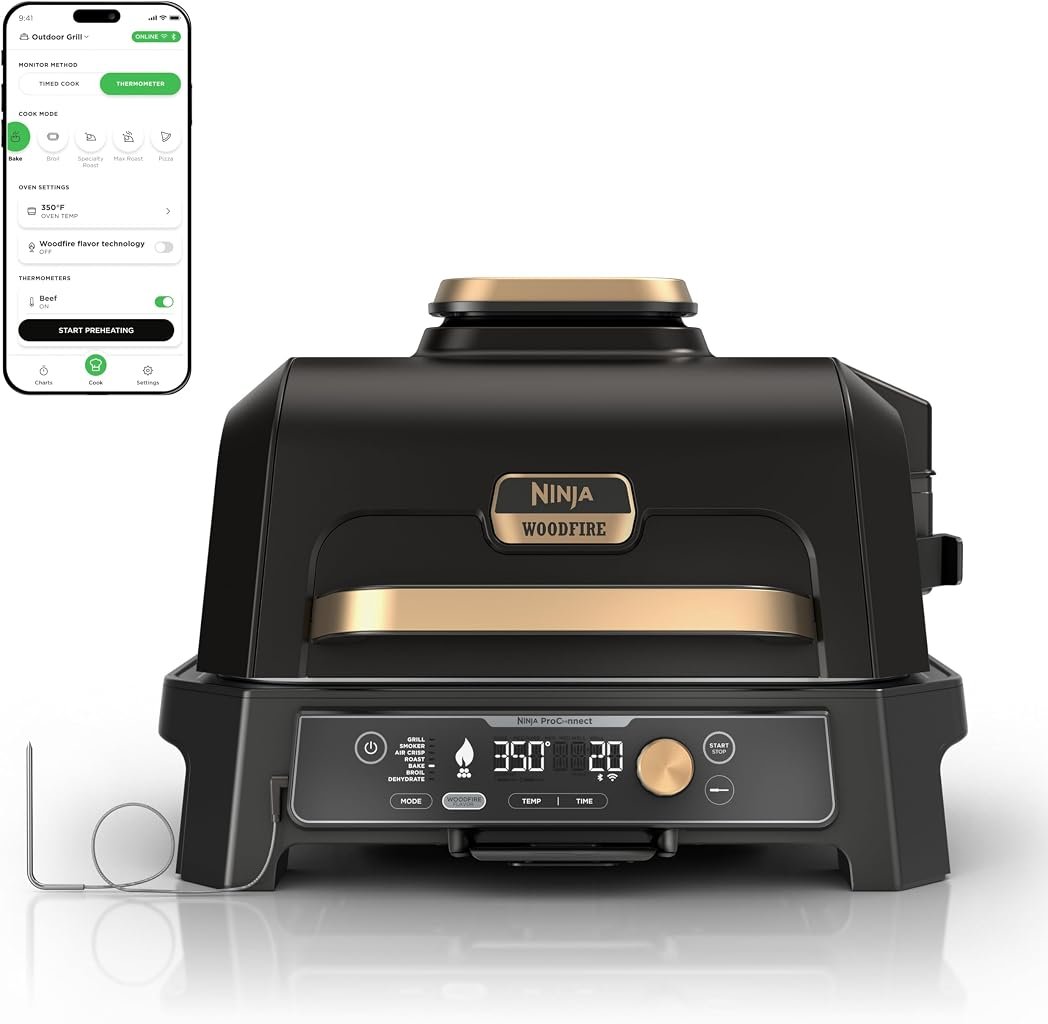
The Ninja Woodfire ProConnect Premium XL Outdoor Grill & Smoker occupies an unusual position in outdoor cooking. It is electrically heated, burns a small quantity of real wood pellets for smoke, connects to a smartphone, monitors two foods with separate temperature probes, and can switch among grilling, smoking, air frying, roasting, baking, broiling, and dehydrating.
That combination makes the appliance difficult to judge by the standards of a conventional propane grill or pellet smoker. Electricity supplies its cooking heat; pellets primarily supply smoke. There is no large pellet hopper continuously feeding a combustion chamber, nor does the user manage propane cylinders or charcoal beds. The result is a different interpretation of outdoor cooking-one focused on temperature control, relatively compact dimensions, and several cooking methods sharing the same heated chamber.
The Premium XL designation matters. This is model OG951, not the smaller original Woodfire or the single-probe ProConnect XL. According to Ninja’s specifications for the OG951, the grill provides 180 square inches of cooking area, 30 percent more than the original Ninja outdoor grill. Ninja states that this surface can accommodate two full racks of ribs, 10 burgers, four pounds of wings, two seven-pound chickens, or a 10-pound brisket. It also includes two integrated food thermometers.
Our score is 8.71/10. Customer Sentiment stands at 8.5, Buyer Confidence at 9.8, and Value at 8.28. Those figures describe a sophisticated and unusually flexible outdoor cooker whose strongest qualities are control, versatility, and space efficiency rather than the elemental simplicity associated with charcoal or gas.
At the $379.99 reference price used in this assessment, its value depends heavily on consolidation. Someone who needs an outdoor grill, smoker, and air fryer has a much stronger economic case than someone seeking only a basic surface for burgers.
Electricity Does the Cooking While Pellets Supply the Smoke
Understanding the Woodfire system begins with a distinction that its appearance can obscure.
This is fundamentally an electric cooker.
Wood pellets are used to generate smoke rather than provide the primary source of cooking energy. Ninja describes its Woodfire Technology as electrically powered while using burning wood pellets for smoke flavor. That arrangement separates heat management from smoke generation.
A traditional pellet smoker generally burns pellets to produce both heat and smoke. Temperature regulation therefore depends partly on controlling pellet combustion and airflow. The Ninja can use its electrical heating system to regulate cooking temperature while the small pellet compartment creates smoke.
That division has practical consequences.
The appliance does not need a large hopper of fuel for ordinary operation. Pellet consumption can remain relatively modest because the pellets are not responsible for maintaining the cooking chamber’s entire thermal load.
The trade-off is philosophical as much as mechanical. Traditional barbecue enthusiasts accustomed to managing fire may find the process unusually automated. Users who primarily care about repeatable temperatures and smoke flavor may see the same characteristic as a benefit.
Neither perspective changes what the machine actually is: an electric outdoor cooker with supplemental wood-pellet smoke.
The XL Cooking Surface Is a Meaningful Upgrade
The 180-square-inch cooking surface is one of the most consequential differences between the ProConnect Premium XL and the original Woodfire.
Thirty percent more cooking area changes the types of meals that fit comfortably inside the appliance.
Ten burgers represent enough capacity for a modest gathering. Two racks of ribs begin to make the smoker relevant for family barbecue rather than isolated portions. A 10-pound brisket places genuinely substantial cuts within the physical limits of the cooking chamber.
The shape of that capacity matters as much as the number.
Grilling demands usable surface area because foods usually perform better when distributed rather than stacked. Burgers cannot simply be piled vertically to exploit theoretical volume. Wings being air fried also benefit from exposure to moving hot air.
Ninja’s four-pound wing claim therefore communicates something useful about practical throughput, while the 10-burger figure describes the grill area in terms that are easier to visualize than square inches.
Yet 180 square inches remains compact beside a full-size backyard grill.
The Premium XL is better understood as a relatively spacious compact cooker than a replacement for a large multi-burner gas grill at a major gathering.
Seven Cooking Functions Give the Hardware Several Identities
The OG951 provides seven primary functions:
- Grill
- BBQ Smoke
- Air Fry
- Roast
- Bake
- Broil
- Dehydrate
That list can look like ordinary multifunction-appliance marketing until the physical differences among the modes are considered.
Grilling emphasizes high surface temperatures and direct browning. Smoking emphasizes lower-temperature cooking combined with wood smoke. Air frying relies heavily on forced convection. Roasting and baking use the enclosed chamber more like an outdoor oven. Broiling emphasizes intense upper heat, while dehydration requires sustained lower temperatures and airflow.
These are not seven entirely separate appliances hidden inside one box, but neither are they merely seven labels for identical heating behavior.
The practical appeal comes from moving between methods without moving food preparation to another machine.
A cook might smoke chicken and finish it at a higher temperature, grill steaks while monitoring their internal temperatures, air fry wings outdoors, or bake a side dish without heating the kitchen.
That last point becomes particularly relevant in warm weather. Outdoor electrical cooking can shift a meaningful source of heat away from the indoor kitchen.
ProConnect Is More Useful Than Connectivity for Its Own Sake
Smartphone connectivity can easily become decorative technology. A grill does not become better simply because it has an app.
The OG951’s ProConnect system has a more defensible purpose because outdoor cooking contains long periods of waiting interrupted by moments when action matters.
Ninja says the ProConnect app can monitor and control cooking time and temperature for two different proteins, display cooking charts, and send notifications when the grill is preheated, when food should be added, and when food should be flipped.
That is a logical application of remote monitoring.
Smoking a large cut can take hours. Standing beside the cooker for that entire period adds little. A temperature alert can tell the cook when the food has reached a target rather than requiring repeated trips outside to check a display.
Connectivity is less consequential during a short grilling session. Someone cooking burgers for several minutes per side will probably remain nearby regardless of what the phone reports.
The app therefore earns its place primarily during longer cooks and multi-protein meals.
Two Thermometers Are the Premium Model’s Defining Upgrade
The OG951 includes two built-in food thermometers.
That feature separates the Premium XL from closely related versions with a single probe.
The benefit is not merely having a backup thermometer. Each probe can monitor a different food.
Consider chicken and steak cooking simultaneously. Those proteins can require different target temperatures and may reach those targets at different times. Monitoring them independently is more informative than measuring chamber temperature or relying on one timer.
The same logic applies to cuts of different thickness.
A large roast and a smaller piece of meat do not cook at identical rates simply because they entered the grill together. Two probes allow the appliance to treat internal temperature as two separate data streams.
This can reduce guesswork, but probe placement remains critical.
A temperature sensor positioned against bone, inserted too shallowly, or placed in an unusually fatty section can report a temperature that does not represent the center of the food. Connected cooking cannot compensate for poor measurement technique.
Used properly, however, dual probes are more than a convenience. They change how confidently mixed meals can be managed.
The Grill Still Requires Cooking Judgment
Automation can create the impression that outdoor cooking has become entirely programmable.
It has not.
Surface browning, moisture, thickness, fat content, starting temperature, wind, ambient conditions, and personal preference still affect results.
A thermometer answers one important question: what temperature has been reached at the probe tip?
It does not determine whether a steak has developed enough surface crust, whether barbecue sauce is beginning to scorch, whether chicken skin has become sufficiently crisp, or whether a particular level of smoke is desirable.
The ProConnect system therefore works best as an information layer rather than a substitute for observation.
That distinction is important because the OG951’s technology could otherwise encourage unrealistic expectations. The machine can automate temperature management more effectively than a simple charcoal grill, but cooking remains a physical process rather than a software transaction.
Woodfire Smoke Is Convenient but Different From a Large Smoker
The pellet system is one of the OG951’s most distinctive features.
Instead of asking the user to manage a large fuel supply, the Woodfire system uses a comparatively small quantity of pellets to create smoke inside an electrically heated cooking environment.
This makes smoking accessible to people who do not want to manage a traditional smoker.
The approach also changes the smoke profile.
A large offset smoker, charcoal cooker, and electric appliance with a compact pellet smoke source do not expose food to identical combustion environments. Smoke intensity, airflow, combustion temperature, fuel quantity, and cooking duration all influence flavor.
Independent long-term use reported by TechWalls in its ProConnect Premium XL review found that the appliance could produce noticeable smoke flavor while remaining substantially more compact than traditional outdoor equipment. That assessment also observed the practical limitation of the relatively small smoke box during longer cooking sessions.
That is a useful way to frame the Woodfire system.
It provides real wood smoke without requiring the pellets to power the entire cook. It should not be assumed to reproduce every characteristic of a much larger wood-burning smoker.
Air Frying Outdoors Is More Rational Than It Initially Sounds
Air frying may appear misplaced on an outdoor grill.
In practice, the function fits the machine’s architecture surprisingly well.
Air frying is essentially high-powered convection cooking in a chamber designed to expose food to rapidly moving heated air. The Woodfire already contains an enclosed electric cooking system capable of controlled heat and airflow.
The XL capacity gives the function additional relevance. Ninja specifies room for up to four pounds of wings.
That makes the OG951 potentially useful for outdoor gatherings where fried-style side dishes would otherwise require repeated trips to an indoor air fryer.
Smoke can also be introduced during compatible cooking modes, giving foods a character unavailable from many conventional countertop fryers.
Still, buyers comparing the OG951 with the best air fryers should recognize the fundamental difference in purpose.
A countertop basket fryer is optimized for indoor convenience and small-batch cooking. The Ninja is an outdoor cooking platform whose air-frying function shares space with grilling and smoking hardware.
Someone interested only in fries has no compelling reason to buy this much machine.
Outdoor-Only Operation Changes the Buying Decision
The Woodfire ProConnect Premium XL is designed for outdoor use.
That requirement should be treated as a central product characteristic rather than a footnote.
A conventional countertop air fryer can operate in a kitchen throughout the year. The OG951 needs a suitable outdoor location and access to electrical power.
That can be liberating in a patio, balcony, deck, or backyard environment where gas or charcoal cooking is inconvenient. It can also be restrictive during severe weather or in residences with rules governing outdoor appliances.
Electrical access deserves particular consideration.
Unlike a propane grill, the Ninja cannot simply be positioned anywhere in a yard and supplied from a portable cylinder. It needs a suitable power source.
The cable path should also be considered from a safety and convenience perspective. Outdoor cooking areas are frequently farther from receptacles than indoor countertops are.
This is a grill whose fuel logistics are simple but whose electrical logistics matter.
The Absence of Open-Flame Cooking Changes the Experience
Traditional grilling culture is closely associated with fire.
The Woodfire takes a different route. Electricity generates the primary cooking heat, while pellets provide smoke.
This eliminates much of the direct fuel management associated with charcoal and propane. There is no charcoal chimney to light and no gas cylinder to monitor.
The absence of conventional flame-driven cooking also means the sensory experience differs.
There is less fire management, less adjustment of vents, and less interaction with a live fuel bed. For some cooks, those activities are central to barbecue. For others, they are obstacles between preparation and dinner.
The OG951 is clearly aligned with the second group.
Its objective is controlled outdoor cooking with smoke, not preservation of traditional fire-management rituals.
Compact Dimensions Are Part of the Appeal
The Premium XL is larger than the original Woodfire but remains compact relative to many freestanding grills and smokers.
That matters for patios and smaller outdoor areas.
A conventional grill cart can dominate limited space. A full-size pellet smoker adds a hopper, legs, shelves, and a large barrel-shaped chamber. The Ninja concentrates its cooking system into a countertop-style body.
The compromise is that a stable supporting surface becomes necessary.
Its size also makes portability possible in a broad sense, but portable should not be confused with lightweight picnic equipment. Independent measurements put the appliance near 40 pounds. Moving it occasionally is plausible; carrying it casually over long distances is another matter.
A dedicated stand or sturdy outdoor table can therefore become part of the real ownership footprint even though it is not built into the grill itself.
Cleanup Is Simpler Than Managing Ash but Still Necessary
Electric heating reduces one source of mess: there is no large bed of charcoal ash to remove.
That does not make the OG951 self-cleaning.
Grilling produces grease. Smoking leaves residue. Air frying can scatter small food particles. Sauces can caramelize onto hot surfaces.
The grill grate and grease-management components therefore need routine attention.
The pellet system creates another maintenance point. Burned pellet material and smoke residue accumulate differently from ordinary cooking grease and should not simply be ignored across repeated sessions.
The advantage is that the mess is relatively localized.
Compared with cleaning a large smoker containing ash, grease, and combustion debris, the Ninja’s maintenance routine is more contained. Compared with washing a small indoor air-fryer basket, it is more involved.
Again, the appropriate comparison depends on which appliance the OG951 is replacing.
Capacity Is Excellent for Its Footprint but Has Limits
Ninja’s capacity claims help establish the intended audience: two racks of ribs, 10 burgers, four pounds of wings, two seven-pound chickens, or a 10-pound brisket.
Those quantities are substantial for a compact electric cooker.
They are not catering capacity.
A large family gathering can still exceed the available surface quickly, particularly when several different foods require simultaneous grill space.
Ten burgers may sound generous until buns, vegetables, sausages, or other items need heat at the same time.
Smoking is somewhat more forgiving because large cuts can use the chamber efficiently for hours. Grilling tends to expose the limits of surface area more quickly because ingredients generally need direct access to the cooking surface.
The Premium XL therefore sits in an appealing middle ground: materially larger than a small countertop grill, materially smaller than a conventional backyard cooking station.
Our 8.71/10 Score Reflects Breadth With Real Boundaries
Our score for the Ninja Woodfire ProConnect Premium XL is 8.71/10.
The rating recognizes a well-integrated combination of outdoor cooking methods.
The 180-square-inch surface provides useful capacity. Seven cooking functions broaden the appliance beyond grilling. Real wood pellets create smoke without becoming the primary heating fuel. Two food thermometers improve multi-protein cooking, while ProConnect monitoring reduces the need to remain beside the grill during long sessions.
The limitations are equally concrete.
The grill requires outdoor electrical access. Its smoke system is smaller and less fuel-intensive than a traditional smoker. The cooking surface, although substantially larger than the original Woodfire, remains far below that of many full-size grills. Smartphone connectivity introduces another layer of setup that some users simply will not need.
At $379.99, it also costs enough that unused functionality becomes economically relevant.
An 8.71 score reflects a sophisticated compact outdoor cooker rather than a universal substitute for every grill and smoker.
Customer Sentiment at 8.5 Reflects Everyday Friction
Customer Sentiment stands at 8.5, slightly below our overall score.
The difference reflects the gap between technical capability and routine ownership.
The Woodfire concept is elegant when viewed as a system: electricity handles temperature, pellets add smoke, probes monitor food, and the app carries information to the user.
Daily use introduces less glamorous details.
The grill still has to be cleaned. Pellet residue has to be managed. Electrical placement matters. A large brisket still requires hours. App connectivity may be irrelevant to someone standing beside the grill. A compact cooking surface can become crowded during a larger gathering.
These are not design failures. They are the friction points that appear when an ambitious feature set meets an actual patio.
The 8.5 Customer Sentiment score reflects an appliance whose advantages remain substantial without pretending ownership is effortless.
Buyer Confidence at 9.8 Reflects a Clearly Defined Product
Buyer Confidence reaches 9.8, the highest rating in our assessment.
The reason is unusually straightforward: the OG951 is well defined.
Ninja clearly identifies its 180-square-inch cooking area, seven cooking functions, dual thermometers, ProConnect capabilities, pellet-based Woodfire system, and stated food capacities. The distinction between the Premium XL and neighboring Woodfire models can also be established from the hardware.
That matters in a product family containing several visually similar machines.
The Premium XL’s second thermometer is not a cosmetic difference. It changes how two foods can be monitored simultaneously. The XL cooking area likewise distinguishes it from the smaller original platform.
Independent coverage and retail documentation also consistently identify the OG951 as the seven-function, app-connected model with two built-in thermometers.
A Buyer Confidence score of 9.8 does not predict individual unit longevity. It reflects confidence that buyers can establish what the product is, what hardware it includes, and what its major functions are before committing to it.
Value at 8.28 Depends on Appliance Consolidation
Our Value score is 8.28 at the $379.99 reference price.
That is a favorable rating, but it sits below both our overall score and Buyer Confidence because the economics depend heavily on use patterns.
A buyer who wants a grill, smoker, outdoor air fryer, and connected food-temperature monitoring system can extract considerable utility from one compact appliance.
A buyer who needs only a grill is paying for far more infrastructure than necessary.
The same logic applies to smoking. Someone who smokes large cuts every weekend and wants a deep traditional smoke profile may place greater value on a dedicated smoker with substantially more fuel capacity and cooking area.
The Ninja’s value is strongest when versatility prevents other purchases.
That is the economic argument behind multifunction cooking equipment. Seven functions do not create seven times the value. Replacing two or three machines that would otherwise be purchased separately can.
Who Is Most Likely to Benefit
The OG951 is particularly well matched to households with limited outdoor space that still want several cooking methods.
Patio and balcony users with appropriate outdoor electrical access can obtain grilling, smoking, and convection cooking without installing a full-size grill station.
The dual probes also make sense for households that regularly prepare different proteins simultaneously.
Someone cooking chicken and steak can monitor separate internal temperatures. A cook smoking two cuts of different thicknesses can follow each independently.
The appliance also fits people who enjoy barbecue flavor but have little interest in maintaining charcoal fires or managing a large pellet hopper.
Technology is central to that proposition rather than incidental to it.
The Woodfire Premium XL is for a cook who wants smoke but also wants temperature automation.
Who Should Look Elsewhere
Traditional barbecue enthusiasts who regard fire management as part of the experience may find the Woodfire too automated.
Large-party hosts may find 180 square inches restrictive.
People who primarily want an air fryer can buy a simpler indoor machine without the outdoor-use requirement. Buyers interested solely in grilling can obtain much larger cooking surfaces from conventional gas or charcoal equipment at comparable prices.
The OG951 also makes less sense where outdoor electrical access is inconvenient.
Its versatility cannot compensate for a location where supplying power becomes a recurring nuisance.
These limitations do not undermine the design. They define the buyer for whom the design makes sense.
Better Results Begin With Using Each System Deliberately
The Woodfire’s versatility can encourage users to treat every mode as interchangeable. Better cooking requires the opposite approach.
Grilling should prioritize surface contact, adequate preheating, and enough space around food for predictable browning.
Smoking benefits from patience and attention to internal temperature. The pellets contribute flavor, but the cook still controls seasoning, food preparation, target temperature, and resting.
Air frying depends on airflow. Four pounds of wings may physically fit, but arrangement still affects exposed surface area and crisping.
The two probes should be placed in representative thick sections of food rather than near bone or shallow surfaces.
ProConnect alerts should be treated as information rather than commands that override observation. If the surface of a food needs more browning after the center reaches temperature, the cooking strategy has to account for both.
Technology works best here when it informs cooking judgment rather than replacing it.
Final Considerations
The Ninja Woodfire ProConnect Premium XL Outdoor Grill & Smoker is a carefully integrated attempt to solve several outdoor-cooking problems with one electrically powered platform.
Its 180-square-inch surface is 30 percent larger than the original Ninja outdoor grill and can accommodate quantities that move the appliance beyond strictly small-batch cooking. Seven cooking functions cover grilling, BBQ smoking, air frying, roasting, baking, broiling, and dehydration. Two built-in thermometers allow separate foods to be monitored simultaneously, while ProConnect brings cooking temperature, food temperature, alerts, and selected controls to a phone.
The Woodfire system is the feature that gives those components a common identity.
Electricity provides controllable cooking heat. Real wood pellets add smoke. The user therefore gains wood-smoke flavor without asking a pellet fire to maintain the entire thermal environment.
That design is neither a traditional smoker nor a conventional electric grill with a decorative pellet accessory. It is its own category of outdoor cooker, and it should be evaluated accordingly.
Its compromises are easy to identify. A 180-square-inch grill cannot match the working area of a large backyard grill. The pellet smoke system cannot be assumed to reproduce the combustion characteristics of a large wood-burning smoker. Electrical power restricts placement. Outdoor-only operation limits year-round convenience in difficult climates. Connectivity adds usefulness during long cooks but contributes little when the user is already standing beside the grill.
Our 8.71/10 score reflects a product whose individual systems reinforce one another more often than they conflict. Customer Sentiment at 8.5 recognizes the practical friction of cleaning, electrical placement, limited surface area, and connected features that will matter more to some owners than others. Buyer Confidence at 9.8 reflects the OG951’s clearly documented hardware and capabilities. Value at 8.28 reflects an attractive proposition at the $379.99 reference price when the machine genuinely replaces several outdoor cooking tools.
The strongest case for the Premium XL therefore comes from consolidation rather than novelty.
A household that wants a smoker, grill, outdoor air fryer, and connected temperature monitoring can use almost every major part of the machine. A household that wants only a hot grate for occasional burgers cannot.
That distinction prevents the seven-function specification from becoming an empty numbers exercise. The OG951 earns its place when those functions correspond to actual meals: ribs slowly smoked on one weekend, steaks monitored by separate probes the next, four pounds of wings air fried for a gathering, or a brisket watched remotely while the cook spends time somewhere other than beside the grill.
The technology does not remove cooking from the process. It removes some of the fuel management and repetitive monitoring.
For the right outdoor space, that is the Woodfire ProConnect Premium XL’s defining achievement: not recreating charcoal, gas, a large pellet smoker, and one of the best air fryers perfectly, but combining useful elements of all four approaches in a compact electric system without pretending that their differences have disappeared.