The Ninja Flip Toaster Oven & Air Fryer SP151 is built around a problem that has little to do with recipes and everything to do with real kitchens: countertop appliances consume space even when they are doing absolutely nothing.
Ninja’s answer is unusually physical. When the SP151 is not cooking, its oven body can rotate upward against the backsplash. Ninja states that this configuration reduces the counter space it uses by 50%. The mechanism allows the company to build a relatively wide cooking chamber without asking the owner to surrender that horizontal surface throughout the day.
That feature gives the SP151 a more coherent identity than another toaster oven carrying an Air Fry button.
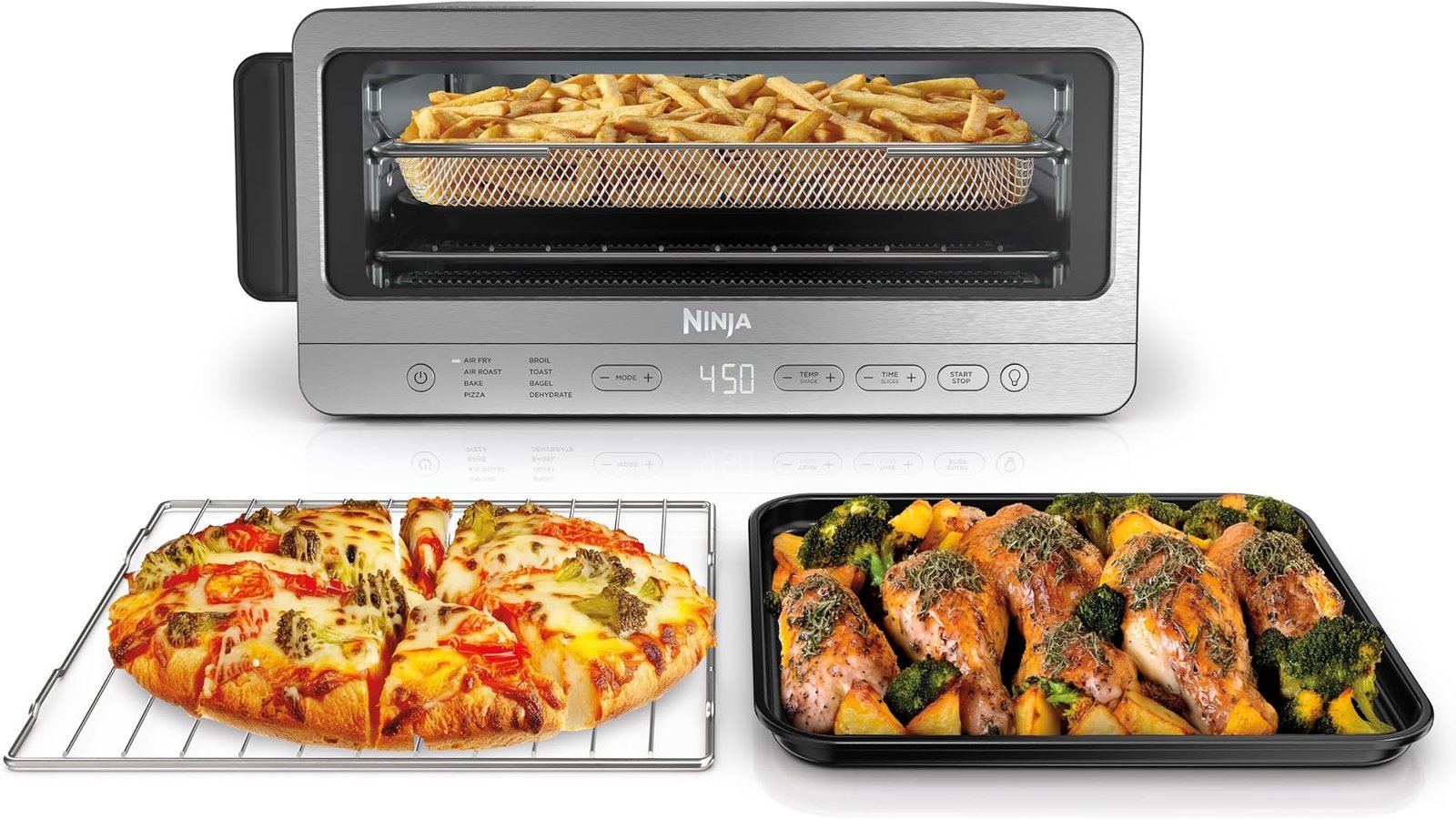
The specifications reinforce its broader ambitions. The SP151 is an 1,800-watt, 120-volt appliance with eight functions: Air Fry, Roast, Broil, Bake, Pizza, Toast, Bagel and Dehydrate. Ninja specifies capacity for up to four pounds of food or a 12-inch pizza, while the included equipment consists of an air-fry basket, sheet pan, wire rack and removable crumb tray.
Our score is 8.55/10. Customer Sentiment stands at 8.28/10, Buyer Confidence at 9.8/10 and Value at 8.15/10.
Those figures describe an appliance with a particularly convincing design concept and well-documented specifications, tempered by the ordinary compromises of oven-style air frying: a shallow chamber, multiple components to clean, considerable electrical power and a reference price of $149.94 that makes regular multifunction use important to the value equation.
The SP151 is not simply competing to make crisp potatoes. It is competing for permanent residency on the kitchen counter. The flip mechanism is its argument for why it deserves the address.
The Flip Mechanism Changes The Space Calculation
Traditional countertop ovens create an awkward equation.
A large chamber is useful while cooking, but the appliance occupies exactly the same amount of counter when nobody is hungry. Reducing exterior dimensions usually means reducing interior capacity as well.
The Ninja SP151 product documentation takes another route. The appliance rotates upward for storage, and Ninja says it uses 50% less counter space in that position.
That does not make its physical mass disappear.
The SP151 still weighs 19.84 pounds according to Ninja’s current specification page. It still needs an appropriate location near the backsplash, and owners have to account for its dimensions in both horizontal and vertical configurations.
Yet horizontal counter area is often the resource under greatest pressure in a kitchen.
Cutting boards, coffee machines, mixing bowls, groceries and meal preparation all compete for it. An appliance capable of giving some of that area back after cooking solves a more practical problem than another preset would.
The flip mechanism therefore deserves to be treated as structural engineering rather than a storage gimmick.
It shapes the entire product.
A Wide, Shallow Oven Has Its Own Logic
The SP151 does not resemble a compact full-size oven shrunk evenly in every direction.
Its chamber is wide and comparatively shallow. That geometry makes sense when viewed alongside the foods Ninja says it can accommodate: a 12-inch pizza, up to six slices of bread and as much as four pounds of ingredients. Retail documentation also identifies room for six chicken breasts.
Those examples reveal more than a capacity figure expressed in quarts ever could.
Pizza needs diameter. Toast needs surface area. Fries and vegetables benefit when they can spread across an air-fry basket instead of forming a deep mound.
The SP151’s shape is therefore well matched to foods that are relatively flat or can be distributed horizontally.
The compromise is vertical clearance.
A deep basket fryer can hold food in a different configuration. A tall countertop oven can accommodate cookware or ingredients that need more headroom. The Ninja’s flip-up architecture inevitably constrains how much vertical chamber space can exist inside a body intended to rotate toward the backsplash.
That is not an accidental defect. It is the cost of the central design decision.
The relevant buyer question is not whether more height would be useful. More room is almost always useful. The question is whether width or height better matches the food routinely prepared in the household.
Eight Functions Cover A Sensible Range
The SP151 provides Air Fry, Roast, Broil, Bake, Pizza, Toast, Bagel and Dehydrate.
That collection is broad without becoming absurdly granular.
Air Fry targets high-convection browning. Roast handles foods that benefit from sustained dry heat and airflow. Broil emphasizes surface heat. Bake covers conventional oven work. Pizza addresses one of the chamber’s natural geometric strengths. Toast and Bagel specialize bread preparation, while Dehydrate moves in the opposite direction from rapid high-temperature cooking by focusing on gradual moisture removal.
The distinctions matter.
Multifunction appliances can inflate their feature counts by assigning separate buttons to foods rather than genuinely different cooking processes. Fries, nuggets and vegetables do not automatically represent three fundamentally different oven capabilities merely because each receives a label.
Ninja’s eight functions are more defensible because several correspond to recognizably different cooking objectives.
That contributes to our 9.8/10 Buyer Confidence score. The controls map onto tasks that are easy to understand before purchase.
A buyer should still ask how many will actually be used.
Eight functions are valuable only when they migrate from the control panel into the household routine.
OvenCrisp Technology Is More Than A Preset Name
Ninja describes the SP151’s heating system as OvenCrisp Technology, combining infrared heating with rapidly circulating hot air. The company attributes the system’s cooking behavior to the relationship between direct heat and convection rather than airflow alone.
That distinction is technically meaningful.
Air frying relies heavily on convection, but oven cooking is rarely governed by a single mechanism. Food can receive heat through radiation from heating elements, convection from moving air and conduction where it contacts a hot pan or rack.
Changing the balance between those mechanisms changes cooking behavior.
Broiling needs a different thermal emphasis from dehydrating. Toasting bread is not identical to roasting chicken. Pizza introduces its own relationship between crust, toppings, pan contact and surrounding heat.
The SP151’s eight programs therefore have a plausible engineering foundation in a system capable of combining heating elements with variable air movement.
No control system can remove ingredient variability.
A thick chicken breast does not behave like a thin one. Frozen fries begin at a different temperature from refrigerated vegetables. Moisture content changes browning. Crowding changes airflow.
OvenCrisp manages the appliance. The cook still manages the food.
Six Infrared Heating Elements Provide A Broad Temperature Range
Retail specifications for the SP151 identify six infrared heating elements and a temperature range of 85°F to 450°F.
That span helps explain how one appliance can support both Dehydrate and high-temperature cooking functions.
Dehydration needs relatively gentle heat over an extended period. Broiling, roasting and air frying operate at the more aggressive end of the cooking spectrum.
A wide temperature range is useful because multifunctionality depends on more than having several names printed around a control panel.
The appliance has to create meaningfully different thermal environments.
Still, maximum temperature should not be mistaken for preferred temperature.
The existence of a 450°F setting does not mean every food benefits from being cooked there. Time, thickness, moisture and desired browning remain relevant.
High heat is a capability, not an instruction.
The 1,800-Watt Rating Deserves Practical Attention
The SP151 is rated at 1,800 watts and 15 amps on a 120-volt supply.
That is substantial electrical demand for a countertop appliance.
It is also consistent with what the machine is being asked to do. The SP151 has to generate enough heat for roasting, broiling, baking, pizza and high-convection air frying while supporting a relatively broad chamber.
Wattage alone does not predict food quality.
Element placement, airflow, control logic, chamber geometry and food arrangement matter enormously. A higher wattage figure does not automatically make one oven better than another.
Electrical load does matter in the kitchen, however.
High-powered heating appliances should be used according to the manufacturer’s electrical and safety instructions. Running several high-draw devices simultaneously on the same household circuit can exceed what that circuit is designed to carry.
The SP151 should therefore be treated like the serious heating appliance its 1,800-watt rating indicates, not like a low-power countertop gadget.
Four Pounds Of Air-Fry Capacity Needs Context
Ninja states that the SP151 can air fry up to four pounds of ingredients.
That figure sounds straightforward until airflow enters the discussion.
The amount of food that physically fits inside an air-fry basket is not necessarily the amount that should be densely packed into it for every recipe.
Air frying depends on moving heated air contacting exposed food surfaces. When ingredients form a deep, compact pile, the pieces on the exterior interact with airflow differently from those buried inside.
Steam can also accumulate between crowded pieces.
The wide chamber helps because food can be distributed horizontally.
For fries, vegetables, breaded foods and similar ingredients, spreading the load can be more useful than maximizing the basket’s physical fill level.
Turning or redistributing food during cooking may also help expose surfaces that began in less favorable positions.
Capacity should therefore be interpreted as available space rather than a command to fill every corner.
A 12-Inch Pizza Reveals The Chamber’s Real Strength
Pizza is an unusually informative capacity measurement.
Unlike a pile of fries, a pizza cannot simply be compressed into a smaller cooking vessel. Diameter is diameter.
Ninja specifies that the SP151 can accommodate a 12-inch pizza.
That makes the chamber relevant to an ordinary meal format rather than merely snacks and side dishes.
It also demonstrates why comparing the best air fryers solely by quart capacity can be misleading.
A deep basket may provide considerable volume while lacking the horizontal geometry needed for pizza. An oven-style air fryer can distribute its internal space differently.
The SP151’s chamber favors broad foods.
That characteristic extends beyond pizza. Toast, open sandwiches, breaded fillets, vegetables and many sheet-pan preparations also benefit from horizontal area.
The machine’s geometry is therefore not universally better. It is better suited to a particular family of foods.
Six-Slice Toast Capacity Strengthens The Everyday Argument
The ability to toast up to six slices of bread gives the SP151 a credible daily role beyond air frying.
That matters because breakfast may do more for appliance economics than spectacular weekend recipes.
An appliance used every morning can justify its counter position far more easily than one activated twice a month for fries.
Toast and Bagel modes also give the SP151 an opportunity to replace a separate toaster.
That is where multifunction appliances begin to make spatial sense.
If one device replaces a toaster, handles pizza, reheats food, air fries vegetables and takes over selected baking and roasting jobs, the counter-space calculation changes. The appliance is no longer merely adding itself to the kitchen. It may be displacing other equipment.
The flip mechanism amplifies that effect by reducing the SP151’s resting footprint after breakfast.
The combination is more compelling than either feature would be alone.
Air Frying And Deep Frying Remain Different Processes
Air-fryer marketing often compresses two distinct cooking methods into one familiar word.
Deep frying surrounds food with hot oil. Air frying primarily exposes food to heated moving air.
The physical mechanisms differ.
Oil transfers heat differently from air, and immersion affects crust formation, moisture movement and the behavior of coatings.
Air frying can still produce crisp, browned surfaces on many foods without requiring them to be submerged in oil.
Frozen foods formulated for oven preparation, potatoes, vegetables, chicken pieces and breaded foods are obvious candidates.
Wet batter is more complicated because it does not receive the immediate setting action created by immersion in hot oil.
The SP151 should therefore be evaluated as a high-convection oven capable of air frying rather than as a deep fryer that somehow misplaced its oil.
That distinction creates more realistic expectations.
Browning Is A Cooking Variable, Not A Competition
High-convection appliances are exceptionally good at encouraging browning. That does not mean the darkest result is automatically the best target.
The U.S. Food and Drug Administration’s guidance on acrylamide and food preparation explains that acrylamide can form in certain plant foods during high-temperature cooking methods such as frying, roasting and baking. It forms from naturally occurring sugars and the amino acid asparagine.
The FDA states that longer cooking periods and higher temperatures generally produce more acrylamide. For cut potato products, it advises cooking to a golden-yellow color rather than brown when reducing acrylamide formation is the objective. Soaking raw potato slices in water for 15 to 30 minutes before frying or roasting can also reduce formation.
Toast receives similar advice: lighter brown bread contains less acrylamide than darkly toasted bread, according to the agency.
None of this is specific to Ninja.
It concerns high-temperature cooking chemistry across appliances and cooking methods.
For the SP151 owner, the practical lesson is simple: visual observation remains useful even when a digital appliance is controlling time and temperature.
Dehydrate Gives The Low End Of The Temperature Range A Purpose
Dehydrate can look like an unusual addition beside Air Fry and Broil, but it demonstrates the flexibility of the SP151’s heating range.
Air frying seeks relatively rapid heat transfer and surface browning. Dehydration seeks gradual moisture removal.
Those are fundamentally different objectives.
The SP151’s reported 85°F-to-450°F operating range provides room for both low-temperature and high-temperature functions.
Dehydration also benefits from horizontal food arrangement.
Fruit slices, herbs and other suitable foods generally need exposed surface area rather than a deep pile. The SP151’s wide chamber is logically compatible with that requirement.
The feature still has to earn its keep.
A household that never dehydrates food receives no practical benefit merely because the button exists.
This is a recurring theme with multifunction appliances: capability is not the same thing as value. Value appears when capability becomes routine.
The Included Accessories Match The Cooking Architecture
Ninja includes an air-fry basket, sheet pan, wire rack and removable crumb tray with the SP151.
The collection is functional rather than ornamental.
The air-fry basket exposes food to moving air. The sheet pan handles foods requiring a solid surface or containment. The wire rack supports broader oven use. The crumb tray catches debris generated by bread and other foods.
Each component corresponds to an identifiable cooking or maintenance need.
The disadvantage is accessory management.
When the air-fry basket is inside the oven, the sheet pan and rack need somewhere to go. When the pizza comes out, hot accessories need a safe landing area.
Multifunction appliances can reduce the number of powered machines in a kitchen while increasing the number of loose metal objects in a cabinet.
Planning storage is mundane, but it affects whether the appliance feels convenient after the novelty fades.
Cleaning Is The Price Of Oven-Style Flexibility
The SP151’s removable crumb tray helps with one predictable source of mess.
Toast creates crumbs. Pizza can release cheese or toppings. Roasting can create grease. Air frying can move fine food particles around the chamber.
An oven-style air fryer therefore spreads cleaning responsibility across more surfaces than a simple drawer fryer.
The basket, sheet pan, rack, crumb tray, interior surfaces and door all require attention depending on what has been cooked.
Ninja’s current specifications state that the SP151 is not dishwasher safe.
That makes routine maintenance more relevant.
Allowing residue to experience repeated heating cycles can make later cleaning more difficult. Crumbs should not be treated as permanent interior decoration.
The flip-up design may help expose parts of the appliance that would otherwise sit close to the backsplash, but it does not eliminate the basic maintenance burden of an oven.
The trade is straightforward: more cooking formats produce more surfaces capable of collecting dinner.
The Flip Position Still Needs Space
A 50% reduction in counter-space use is meaningful, but it should not be interpreted as a 50% reduction in the physical appliance.
The SP151 still has height, width and depth when flipped.
Cabinet clearance matters. Backsplash configuration matters. Electrical outlets matter. Objects stored behind or above the appliance matter.
A buyer should therefore measure the intended location in both configurations.
First, the SP151 needs enough working area in its horizontal cooking position.
Second, it needs enough clearance to rotate and remain safely stored vertically.
That two-position requirement is unusual.
It also illustrates why the flip design is clever without being magical. The appliance is rearranging its physical volume, not abolishing it.
For kitchens where horizontal surface area is scarce but vertical clearance is available, the trade can be excellent.
For counters trapped beneath low cabinetry, the calculation can be different.
Understanding Our 8.55/10 Score
Our 8.55/10 overall score reflects a product whose design is more thoughtful than its category label suggests.
The 9.8/10 Buyer Confidence rating is the strongest supporting figure.
Ninja clearly identifies the SP151’s 1,800-watt rating, 120-volt electrical specification, eight functions, four-pound food capacity, 12-inch pizza compatibility, included accessories and flip-up storage concept.
That documentation makes the product’s intended use unusually easy to understand.
Customer Sentiment stands at 8.28/10.
That lower score reflects the reality that the design asks buyers to accept specific compromises. The shallow chamber favors broad foods over tall cookware. Oven-style construction creates more cleaning surfaces than a drawer machine. The flip system is most useful only when the kitchen layout accommodates it.
Value receives 8.15/10.
At the $149.94 reference price, the SP151 makes its strongest financial case when several of its functions become routine. Toast, Bagel, Pizza, Bake, Roast and Air Fry can collectively displace meaningful use of other equipment.
A buyer using only Air Fry receives a narrower return from the same hardware.
That explains why Value sits below our 8.55/10 overall assessment.
Where The SP151 Makes Its Strongest Case
The SP151 is most convincing in kitchens where countertop space is constrained but the owner still wants the horizontal cooking area of an oven-style air fryer.
That combination is difficult to achieve with conventional designs.
Make the oven smaller and capacity falls. Make it larger and counter space disappears.
Ninja changes the storage orientation instead.
The resulting appliance can accept a 12-inch pizza, toast multiple slices of bread and air fry up to four pounds of ingredients while still rotating upward when cooking ends.
That makes the SP151 particularly relevant to apartments, smaller kitchens and counters already supporting other permanent equipment.
Its eight functions strengthen the case because the machine can potentially replace or reduce dependence on several appliances rather than merely joining them.
The best fit is not the person searching for the smallest air fryer.
It is the person who wants a relatively broad cooking surface without permanently losing the equivalent amount of working counter.
Where The Design Gives Ground
The first compromise is vertical chamber space.
The SP151 is shaped around its flip mechanism and broad cooking area. Foods or cookware requiring substantial height may fit less naturally than pizza, toast, vegetables and other flatter preparations.
The second compromise is cleaning.
The air-fry basket, sheet pan, rack, crumb tray and oven interior create a larger maintenance ecosystem than a removable drawer.
The third is electrical demand. At 1,800 watts and 15 amps, the appliance is a substantial countertop load.
The fourth is accessory storage.
The oven itself can rotate away, but its basket, sheet pan and rack still need somewhere to live.
Finally, there is the question of unused capability.
A buyer who never bakes, roasts, makes pizza, toasts bread or dehydrates food may be purchasing a sophisticated solution to a simple air-frying problem.
A basket fryer could be more direct for that household.
Who Is Most Likely To Benefit?
The Ninja SP151 is well aligned with households that want oven-style flexibility but dislike the permanent footprint of conventional countertop ovens.
It makes particular sense where:
- Horizontal counter space is scarce between meals.
- There is adequate clearance for the flip-up storage position.
- A 12-inch pizza matches normal meal habits.
- Toast and Bagel modes can replace a separate toaster.
- Air frying will share duties with baking, roasting and broiling.
- Food is often prepared in broad, relatively shallow arrangements.
- Four-pound air-fry capacity is useful without requiring a much larger oven.
- The owner is comfortable washing multiple oven accessories rather than one drawer and basket.
- A 1,800-watt countertop appliance is appropriate for the intended electrical setup.
The weaker fit is equally identifiable.
Households routinely using tall cookware or preparing very large meals may prefer a deeper countertop oven. Buyers interested almost exclusively in small batches of fries may prefer a compact basket model.
Practical Habits For Better Ownership
Several habits follow naturally from the SP151’s design:
- Measure both the cooking position and flip-up storage position before purchase.
- Keep the rotation path clear rather than surrounding the appliance with objects that have to be moved every time it is stored.
- Spread air-fried food across the basket whenever possible instead of treating four-pound capacity as an instruction to build a dense pile.
- Use Pizza, Bake, Roast and Broil according to the food rather than defaulting automatically to Air Fry.
- Empty the removable crumb tray regularly.
- Clean oil and food residue before repeated heating makes deposits harder to remove.
- Plan storage for the basket, sheet pan and wire rack.
- Observe browning rather than relying exclusively on programmed time.
- For potatoes, FDA guidance favors golden-yellow rather than dark brown cooking when reducing acrylamide formation is the objective.
- Treat the 450°F upper range as available capability rather than a universal cooking target.
- Account for the appliance’s 1,800-watt electrical demand when other high-powered kitchen devices are operating.
These habits are not glamorous. Neither is reclaiming counter space. Both have more influence on long-term satisfaction than another button labeled for a specific frozen snack.
Final Considerations
The Ninja Flip Toaster Oven & Air Fryer SP151 earns our 8.55/10 score because its central design idea addresses one of the most persistent weaknesses of countertop ovens: they remain large when they are idle.
The flip-up mechanism changes that equation.
Ninja states that the appliance consumes 50% less counter space when stored upright against the backsplash. The oven can still accommodate a 12-inch pizza and air fry up to four pounds of ingredients, while retail specifications also identify six-slice toast capacity.
That relationship between capacity and storage is the SP151’s strongest argument.
Its eight cooking functions—Air Fry, Roast, Broil, Bake, Pizza, Toast, Bagel and Dehydrate—extend the appliance beyond the role of a dedicated air fryer. OvenCrisp Technology combines infrared heating with circulating hot air, while the 1,800-watt platform supplies the electrical power expected from a substantial countertop oven.
None of those capabilities eliminate the compromises created by the design.
The chamber is broad rather than tall. Multiple accessories mean multiple cleaning jobs. The 19.84-pound appliance does not become physically small merely because it rotates. Vertical storage requires suitable clearance. Its high electrical demand deserves the same attention as other powerful heating appliances.
The scoring reflects those exchanges.
Buyer Confidence reaches 9.8/10 because the SP151 has a clearly documented purpose, specifications and accessory set. Customer Sentiment at 8.28/10 reflects a more personal question: whether the shallow chamber and flip architecture fit the household’s cooking habits and kitchen layout.
Value at 8.15/10 requires similar context.
At the $149.94 reference price, the SP151 becomes easier to justify when it replaces meaningful use of a toaster, conventional countertop oven and dedicated air fryer. The financial argument weakens when seven of its eight modes remain untouched.
This is why comparisons with the best air fryers should begin with architecture rather than feature count.
A compact basket fryer is easier to understand, often easier to clean and particularly well suited to modest portions. A large countertop oven provides greater vertical flexibility and may accept more cookware. The SP151 pursues a third route: a wide oven-style cooking area that can rotate away from the counter when its work is finished.
For the right kitchen, that is more than a novelty.
Countertop space is consumed every hour an appliance sits horizontally, not merely during the minutes when its heating elements are active. A design that returns part of that surface after dinner can create daily utility that never appears in a recipe.
The flip mechanism also makes the SP151’s other functions more consequential.
Toast can replace morning use of a separate toaster. Pizza takes advantage of the wide chamber. Air Fry uses the broad basket for high-convection cooking. Roast, Bake and Broil extend the appliance into conventional oven work. Dehydrate makes use of the lower end of the temperature range.
Together, those jobs create the strongest version of the SP151’s value proposition: one appliance doing enough recurring work to justify both its price and the space it still consumes.
That does not make it universally preferable.
A household with generous counter space may care little about the flip mechanism. A cook who regularly uses tall casserole dishes may prefer a deeper oven. Someone preparing only small portions may be better matched to a basket fryer.
Our 8.55/10 assessment reflects a product that knows which problem it is trying to solve.
The SP151 does not attempt to make a countertop oven physically tiny. Instead, it rearranges the oven when the cooking stops. That distinction sounds simple, but it produces a genuinely different ownership experience.
For households where a 12-inch pizza, several slices of toast, vegetables, chicken and air-fried foods represent realistic portions—and where counter space is too useful to surrender permanently—the Ninja Flip SP151 presents a coherent balance of cooking area, multifunction capability and storage efficiency.
Its strongest feature happens after the meal, when a fairly substantial oven gets out of the way.