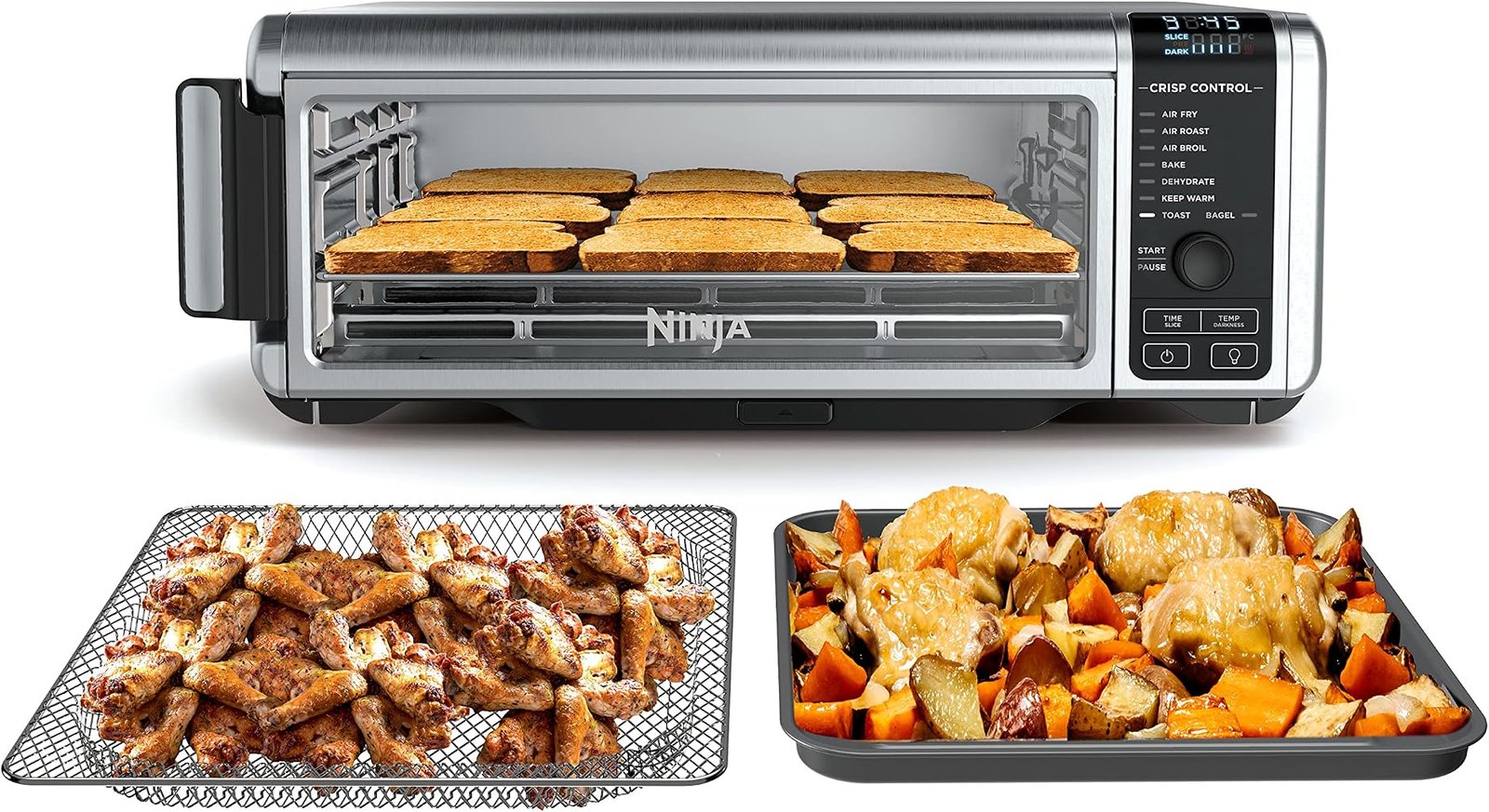
The Ninja Digital Air Fry Countertop Oven SP101 addresses one of the least glamorous problems in countertop cooking: appliances need somewhere to live when dinner is over. Instead of making a conventional toaster oven slightly smaller, Ninja designed the SP101 so that the entire cooking chamber can pivot upward after use, reducing the amount of counter surface it covers while stored vertically.
That single design choice gives the SP101 a different identity from most oven-style air fryers.
This is still a substantial cooking appliance. The U.S. SP100-series documentation specifies 1,800 watts, while the SP101 provides eight cooking functions: Air Fry, Air Roast, Air Broil, Bake, Toast, Bagel, Dehydrate and Keep Warm. The oven uses a shallow, wide cooking chamber rather than the deep cavity associated with many countertop ovens. Ninja’s documentation also provides dedicated instructions for its flip-up storage position.
Our score is 8.86/10. Customer Sentiment stands at 8.72/10, Buyer Confidence at 9.8/10 and Value at 8.4/10. That pattern describes a product with a particularly clear design purpose: deliver oven-style air frying and everyday toaster-oven functions while addressing the countertop-space penalty that normally accompanies this category.
Its compromises are equally clear. The low-profile chamber that makes vertical storage possible also limits vertical cooking room. Cleaning involves more surfaces than a simple basket machine. Eight functions create flexibility, but not every household needs them.
The SP101 therefore succeeds or fails according to a surprisingly practical question: does a wide, shallow oven that can stand upright fit the kitchen better than a smaller basket that remains permanently horizontal?
The Flip-Up Design Is The Defining Feature
Countertop appliances usually create a simple spatial problem. They are purchased because they are more convenient than a full-size oven, then remain on the counter consuming work space even when they are not cooking.
Ninja’s response is mechanical rather than electronic.
The SP101 can be rotated upward into a vertical storage position after use. Ninja’s documentation specifically includes a procedure for “Flip-Up-And-Away Storage,” making the feature part of the appliance’s intended operating design rather than an improvised storage technique.
This matters because footprint is not merely a cosmetic concern.
A countertop oven may technically fit in a kitchen while still making food preparation more irritating. Cutting boards, mixing bowls, coffee equipment and groceries all compete for the same horizontal surface. Reducing the oven’s resting footprint can return usable counter area between meals.
The design does not make the appliance disappear. Its mass and height still exist when it is upright, and the oven needs an appropriate location where the stored position makes sense. It must also cool before being moved into that position.
Yet the approach is more thoughtful than simply shaving an inch from the oven’s width and declaring it compact.
For buyers with limited work surfaces, storage architecture can matter as much as cooking capacity.
Eight Functions Cover Distinct Cooking Jobs
The SP101’s eight modes are Air Fry, Air Roast, Air Broil, Bake, Toast, Bagel, Dehydrate and Keep Warm. These are documented in Ninja’s SP100-series owner material and SP101 support resources.
The list is relatively restrained compared with countertop ovens advertising a dozen or more presets.
That restraint is not necessarily a weakness.
Air Fry emphasizes high-airflow browning. Air Roast addresses roasting applications. Air Broil emphasizes high-temperature surface cooking. Bake provides conventional oven-style preparation. Toast and Bagel deal with bread specifically. Dehydrate targets extended moisture removal, while Keep Warm addresses prepared food.
These are sufficiently different jobs to justify separate controls.
Preset inflation can make multifunction appliances appear more sophisticated than they are. A machine does not become materially more capable merely because one general cooking method has been divided into numerous food-specific buttons.
The SP101’s eight-mode structure is comparatively easy to understand. Most users will recognize what each mode is intended to accomplish without studying a long menu.
That contributes to the machine’s strong Buyer Confidence rating. Its feature set is broad, but the underlying proposition remains legible.
The Wide, Shallow Chamber Changes Capacity
The SP101’s cooking chamber is unusual because much of its useful space is horizontal.
The oven can accommodate a 13-inch pizza, and the platform is designed around foods that spread across a tray or basket rather than foods requiring substantial vertical clearance. Retail specifications for the U.S. SP101 also identify capacity for a 13-inch pizza and up to nine slices of toast.
That shape has practical advantages.
Pizza naturally benefits from width. Toast needs horizontal area rather than height. Air-fried vegetables, potatoes and breaded foods often cook more effectively when spread across a relatively shallow layer because more surface area remains exposed to moving hot air.
This is an important distinction when comparing capacity claims.
A tall cooking chamber and a wide cooking chamber may contain similar theoretical volume while behaving very differently in actual meal preparation. One may accommodate a compact whole chicken more naturally; another may provide more useful area for fries, toast or pizza.
The SP101 clearly favors the second approach.
That makes the appliance particularly logical for foods that can be arranged across its cooking surface. It is less naturally suited to unusually tall cookware or foods requiring substantial vertical headroom.
The same geometry that enables the flip-up storage concept creates this limitation. Design rarely gives something without taking something else.
1,800 Watts Put It Firmly In Countertop-Oven Territory
Ninja’s U.S. owner documentation specifies the SP100-series platform at 120 volts, 60 Hz and 1,800 watts.
That power rating places the machine in familiar territory for substantial countertop cooking appliances.
Wattage alone does not determine cooking quality. Chamber dimensions, element placement, fan behavior, temperature control and food arrangement all affect what happens after electricity reaches the appliance.
Still, 1,800 watts matters from a practical standpoint.
A kitchen circuit supporting other high-draw appliances deserves attention. Running multiple substantial heating appliances on the same circuit can create electrical-load issues depending on the household installation.
The rating also reinforces the fact that the SP101 is not merely a toaster with an additional fan. Air frying, broiling and roasting require a system capable of generating and moving significant heat through the chamber.
The more interesting engineering question is how Ninja directs that heat.
Digital Crisp Control Coordinates Heat And Airflow
Ninja describes its cooking system as Digital Crisp Control technology. On the closely corresponding SP101 platform, the company explains that multiple heating elements and variable airflow are used to regulate temperature, heat source and air movement according to the selected cooking function.
That architecture is significant because Air Fry, Toast and Bake should not behave identically.
Toasting bread requires controlled surface browning. Baking needs a comparatively stable heated environment. Air frying relies more aggressively on moving hot air around exposed food surfaces. Broiling shifts the emphasis toward intense surface heat.
If every program simply activated the same heaters and fan at identical intensities, the different labels would have little technical meaning.
The SP101’s control philosophy instead treats heat source and airflow as variables.
This does not mean the machine can compensate for every cooking mistake. Overcrowding remains overcrowding. Thick food takes longer than thin food. Moist ingredients behave differently from dry ones. Frozen food begins from a different thermal state than refrigerated food.
Digital control can manage the appliance. It cannot standardize dinner.
Air Frying Works Best When The Basket Is Not Treated Like A Bucket
The SP101 includes an air-fry basket intended to expose food to moving heated air.
That design works best when food surfaces remain accessible.
Air frying depends heavily on convective heat transfer. If ingredients are packed tightly into a deep pile, the outer pieces intercept airflow while interior pieces receive a different cooking environment. Steam released from food can also accumulate between crowded pieces.
The temptation to overload is understandable. A wide basket looks like unused capacity when it is not filled to the edges.
But usable capacity and maximum physical capacity are not identical.
For fries, vegetables, breaded foods and similar preparations, a shallower distribution generally gives moving air more opportunities to contact exposed surfaces. Turning or redistributing food during cooking can further reduce uneven browning.
This is where the SP101’s broad cooking area becomes useful. Its architecture encourages spreading food outward rather than stacking it upward.
Among the best air fryers, chamber geometry can matter as much as advertised capacity because the shape determines how easily food can be arranged for convection.
Air Frying Still Is Not Deep Frying
Air-fryer terminology has always invited a comparison that deserves qualification.
Deep frying immerses food in hot oil. Air frying relies primarily on heated moving air, often with little added oil. The two methods transfer heat differently.
That difference affects crust formation, moisture loss and flavor.
The practical appeal of the SP101’s Air Fry mode is therefore not that it somehow reproduces an oil bath without oil. It is that many foods capable of browning under dry convection can develop crisp surfaces without requiring deep-fat immersion.
Frozen foods formulated for oven preparation are natural candidates. Potatoes, vegetables and many breaded foods also fit the method well.
Foods built around wet batter can behave very differently because there is no surrounding oil to set the coating immediately.
Understanding that distinction produces more realistic expectations than assuming that the word “fry” guarantees deep-fryer texture.
The SP101 is fundamentally a high-convection oven with a specialized basket and cooking program. That is useful technology without requiring exaggerated comparisons.
High-Temperature Cooking Rewards Visual Judgment
Air frying and roasting encourage browning, but darker is not always a useful objective.
The U.S. Food and Drug Administration explains that acrylamide can form in certain foods during high-temperature cooking, including frying, roasting and baking. Acrylamide forms from naturally occurring sugars and the amino acid asparagine rather than coming from packaging or the environment.
The agency reports that longer cooking periods and higher temperatures generally result in more acrylamide formation. For cut potato products, the FDA advises cooking toward a golden-yellow color rather than brown when reducing acrylamide is the objective. Soaking raw potato slices in water for 15 to 30 minutes before frying or roasting can also reduce formation during cooking.
The issue is not specific to Ninja or air fryers. It concerns certain foods exposed to high-temperature cooking.
It does reinforce the usefulness of observation.
An air fryer can provide a temperature and timer, but browning is visible information. Potatoes approaching the desired color do not need additional cooking merely because a preset still has several minutes remaining.
Cooking technology is most effective when automation and observation work together.
Toast And Bagel Modes Make Daily Use More Plausible
Air Fry may dominate the product name, but Toast and Bagel could determine how often the SP101 is actually switched on.
This distinction matters economically.
An appliance used only for occasional fries is specialized equipment. An appliance that handles breakfast toast, reheating, baking and dinner preparation can become part of the daily kitchen routine.
The SP101’s wide chamber is naturally suited to bread.
Dedicated Toast and Bagel functions also acknowledge that bread browning is not identical to general baking. Toasting is repetitive, often performed under time pressure and sensitive to relatively small differences in browning.
The more frequently these ordinary modes are used, the easier it becomes to justify the counter space consumed by the appliance when it is horizontal.
Then, when breakfast is finished, the oven can be rotated upward.
That relationship between everyday cooking and storage is arguably more important than any single high-performance specification.
Dehydrate Adds Range, But Patience Is Required
Dehydrate is the least ordinary of the eight functions.
Where Air Fry emphasizes rapid surface heating, dehydration seeks gradual moisture removal. The goals are nearly opposite.
That makes the mode meaningful rather than decorative.
Fruit, herbs and other suitable ingredients can benefit from controlled drying, but dehydration is inherently time-intensive. It should not be confused with the speed-oriented appeal often associated with air frying.
The shallow chamber can work logically for dehydration because drying benefits from spreading ingredients across exposed surfaces.
Yet the feature has value only if the household actually dehydrates food.
This sounds obvious, but multifunction appliances are often evaluated by counting everything they can theoretically do. A rarely used mode does not repay the buyer simply by existing on the control panel.
Dehydrate improves the SP101’s range. It should not dominate the buying decision unless dehydration is already part of the user’s kitchen routine.
Air Broil And Air Roast Fill The Gap Between Frying And Baking
Air Broil and Air Roast deserve attention because they demonstrate how Ninja has segmented dry-heat cooking.
Roasting generally suits foods where broader heat exposure and browning are desirable. Broiling places greater emphasis on intense surface heat. Adding airflow can influence how heat and moisture behave around the food.
These functions make the SP101 more useful for proteins, vegetables and dishes that do not naturally belong in an air-fryer basket.
They also help the appliance operate as a genuine countertop oven.
This is an important distinction for buyer fit.
Someone wanting only a basket fryer may regard the additional modes as unnecessary. Someone hoping to reduce use of a full-size oven can view them differently.
The economic value of a multifunction oven rises when it takes over tasks that would otherwise require preheating a much larger appliance.
The SP101’s shallow cavity imposes limits on what can physically fit, but within those limits, the variety of dry-heat methods is sensible.
Cleaning Is Easier In Some Areas And Harder In Others
Ninja’s documentation addresses both everyday cleaning and deeper cleaning, and the design includes a removable crumb tray. The flip-up architecture also provides access to areas that would be awkward to reach on a conventional fixed countertop oven.
That is helpful, but an oven-style air fryer still presents more cleaning surfaces than a basic drawer machine.
The air-fry basket can collect baked-on oils and food particles. The sheet pan receives drips and residue. Toast produces crumbs. The interior walls can accumulate grease. The door provides another visible surface.
Routine cleaning is therefore preferable to waiting for residue to become heavily baked onto components.
The removable crumb tray is particularly useful because bread crumbs and small food particles naturally collect at the bottom of toaster ovens. Removing them regularly prevents the interior from becoming a geological record of previous meals.
The flip-up design adds another benefit: once properly cooled and positioned according to the instructions, access around the underside and rear becomes less awkward than with many fixed ovens.
Storage engineering and maintenance engineering intersect here.
Vertical Storage Does Not Eliminate The Need To Measure
The flip-up feature can free horizontal counter area, but buyers should resist interpreting it as proof that the SP101 fits every small kitchen.
It still has physical dimensions in both cooking and storage positions.
Cabinet height, backsplash position, electrical outlets and nearby objects all affect where the oven can reasonably live. The appliance also needs an appropriate working position while operating.
The correct approach is to measure for two configurations.
First, measure the area needed while the oven is horizontal and cooking. Second, consider where the appliance extends when rotated upward for storage.
That two-position planning is unusual but necessary.
A conventional toaster oven asks only, “Does it fit?” The SP101 asks, “Does it fit twice, in two different orientations?”
For some kitchens, that is precisely why the design works. The oven can consume depth while cooking and surrender much of that work surface afterward.
For others, low overhead cabinets may reduce the advantage.
A tape measure remains more reliable than assumptions based on product photography.
Understanding Our 8.86/10 Score
Our 8.86/10 score reflects an appliance with an unusually coherent relationship between cooking capability and storage design.
Buyer Confidence receives 9.8/10, the strongest supporting rating.
The reason is straightforward. Ninja’s documentation establishes the 1,800-watt electrical rating and eight cooking functions, while the owner’s materials provide explicit instructions for cooking, cleaning and flip-up storage.
There is little ambiguity about what the appliance is trying to accomplish.
Customer Sentiment stands at 8.72/10, close to our overall score. That figure reflects a product whose fundamental proposition is broadly understandable but still sensitive to household preferences.
The shallow oven chamber will be an advantage for pizza, toast and spread-out air-fried foods. It will be a limitation when a cook needs more vertical room.
Value receives 8.4/10.
At a reference price of $159.99, the SP101 has to justify itself through more than occasional air frying. The economics improve when Toast, Bake, Air Roast, Air Broil and other functions replace meaningful use of a separate toaster or full-size oven.
That explains why Value trails the overall score. The hardware is capable, but value is realized through frequency.
Where The SP101 Makes Its Strongest Case
The strongest argument for the SP101 is not simply that it combines eight cooking modes.
It is that those modes are housed inside an appliance designed to surrender counter area after cooking.
That matters in kitchens where work surface is limited but a full-featured countertop oven remains desirable.
The wide chamber also suits foods that benefit from horizontal area: pizza, toast, vegetables, fries, breaded items and many sheet-pan-style preparations.
The 1,800-watt platform and dedicated Air Fry, Air Roast and Air Broil modes give it enough functional breadth to handle more than reheating.
Its strongest buyer is therefore someone who wants oven-style flexibility but dislikes the permanent footprint of conventional countertop ovens.
That is a narrower and more interesting proposition than simply saying it cooks food quickly.
Where It Gives Ground
The shallow chamber is the most obvious compromise.
Wide foods fit naturally; tall foods do not benefit from the same geometry. Buyers expecting the interior proportions of a conventional toaster oven should examine their normal cookware and recipes carefully.
Cleaning is another compromise. The removable crumb tray and accessible design help, but racks, pans, baskets and interior surfaces still need maintenance.
The oven also requires manipulation for vertical storage. The flip-up system is useful, but it adds a physical step that does not exist with a permanently positioned appliance.
Eight functions may also exceed the needs of buyers who simply want an air fryer for modest portions.
Finally, the $159.99 reference price places pressure on utilization. If Toast, Bake and the other oven functions are ignored, a simpler basket machine may provide a more direct route to the same primary task.
These limitations are not contradictions. They are consequences of the design choices that make the SP101 distinctive.
Who Is Most Likely To Benefit?
The SP101 makes particular sense for households that value horizontal cooking area but cannot comfortably dedicate that same counter area to an oven all day.
It aligns well with buyers who:
- Regularly prepare toast, bagels or pizza.
- Want air frying alongside conventional oven functions.
- Prefer spreading food across a wide basket rather than stacking it deeply.
- Have limited usable counter surface between meals.
- Expect to use Air Roast, Air Broil or Bake in addition to Air Fry.
- Have adequate vertical clearance for the flip-up storage position.
- Want an appliance that can reduce some routine use of a full-size oven.
- Are willing to clean an oven cavity, basket, tray and crumb system rather than only a removable drawer.
The weaker fit is a household primarily preparing small portions in a compact basket.
A buyer who rarely toasts, bakes, roasts or broils may be paying for capabilities that remain idle.
Practical Habits For Better Ownership
Several habits follow naturally from the SP101’s architecture:
- Measure both the horizontal cooking position and vertical storage position before purchase.
- Allow the appliance to cool as directed before moving it into its stored orientation.
- Spread air-fried food across the basket rather than building unnecessarily deep piles.
- Rotate or redistribute food when needed to improve exposure to moving air.
- Remove crumbs regularly instead of allowing them to accumulate beneath repeated cooking cycles.
- Clean the air-fry basket before oils and food particles become repeatedly baked onto the mesh.
- Use Toast, Bagel, Bake, Air Roast and Air Broil according to the cooking task rather than treating Air Fry as the universal setting.
- Watch the color of potatoes and bread during high-temperature cooking. FDA guidance indicates that lighter browning can reduce acrylamide formation compared with darker cooking.
- Store accessories where they remain easy to reach. Multifunction modes lose practical value when the required tray or basket is inconvenient to retrieve.
- Judge capacity by usable food arrangement rather than by how much food can physically be forced into the chamber.
These are ordinary habits, but ordinary habits determine whether a countertop appliance becomes useful infrastructure or expensive storage.
Final Considerations
The Ninja Digital Air Fry Countertop Oven SP101 earns our 8.86/10 score because its most distinctive feature addresses a real kitchen problem rather than merely adding another cooking preset.
Its flip-up storage architecture allows a wide countertop oven to reclaim counter area between uses. The 1,800-watt U.S. platform and eight functions—Air Fry, Air Roast, Air Broil, Bake, Toast, Bagel, Dehydrate and Keep Warm—give the machine enough range to handle breakfast, reheating, baking, browning and dinner preparation within the same shallow chamber.
That chamber is central to the entire design.
Its width provides useful area for pizza, toast and foods spread across an air-fry basket. Its limited height is the corresponding compromise. Buyers expecting a miniature conventional oven with generous vertical room may find the proportions restrictive.
The storage system creates another exchange. The oven can move out of the way more effectively than many competitors, but doing so requires appropriate clearance and an additional movement after cooking and cooling.
Cleaning remains part of ownership as well. The crumb tray and accessible design help, yet an oven-style air fryer inevitably has more exposed cooking surfaces than a simple drawer machine.
Those factors explain why Buyer Confidence reaches 9.8/10 while Value stands at 8.4/10. The SP101’s purpose is unusually clear, but financial value depends on whether the household uses enough of its functions. Customer Sentiment at 8.72/10 sits close to our overall 8.86/10 score because the product’s compromises are closely tied to individual kitchen layout and cooking habits.
At the $159.99 reference price, the strongest economic case comes from consolidation.
A household that uses the SP101 for morning toast, reheating, pizza, vegetables, air-fried foods, baking and roasting can distribute its cost across numerous recurring jobs. A household that turns it on twice a month for fries cannot make the same argument.
That distinction matters when comparing the best air fryers.
Basket models often offer simpler cleaning, compact dimensions and direct access to food. Larger oven-style machines provide broader cooking area and greater versatility. The SP101 adds another variable by allowing its oven body to rotate upward after use.
That feature does not automatically make it superior to either architecture. It makes the machine unusually specific about the problem it is solving.
For kitchens where counter depth is precious during food preparation, the ability to reclaim work surface can matter every day. For kitchens with abundant counter space, the flip-up mechanism may be less consequential.
The SP101 is therefore most convincing when three needs intersect: substantial horizontal cooking area, multiple dry-heat cooking methods and limited permanent countertop space.
When those conditions exist, its design is remarkably coherent. The wide chamber supports pizza, toast and spread-out air frying. The cooking modes cover genuinely different tasks. The storage mechanism addresses the physical inconvenience created by that width.
When those conditions do not exist, a conventional basket fryer or deeper countertop oven may fit the household more naturally.
Our 8.86/10 assessment reflects that balance. The Ninja SP101 is not merely an air fryer with a door, nor is it a conventional toaster oven carrying an Air Fry button for decoration. Its shallow cooking chamber, airflow-focused modes and flip-up architecture were designed around a particular vision of countertop cooking: broad working area while the machine is active, reduced horizontal intrusion when it is not.
That is a practical idea rather than a flashy one, and practical ideas tend to reveal their value through repetition. Every pizza that fits across the chamber, every breakfast that uses the Toast setting and every time the oven rotates upward to return counter space reinforces the same design argument.
The SP101 earns its strongest recommendation not through the number eight on its function list, but through the relationship between those functions and the physical space they inhabit. For households that recognize their own kitchen problems in that relationship, the design has considerable merit.