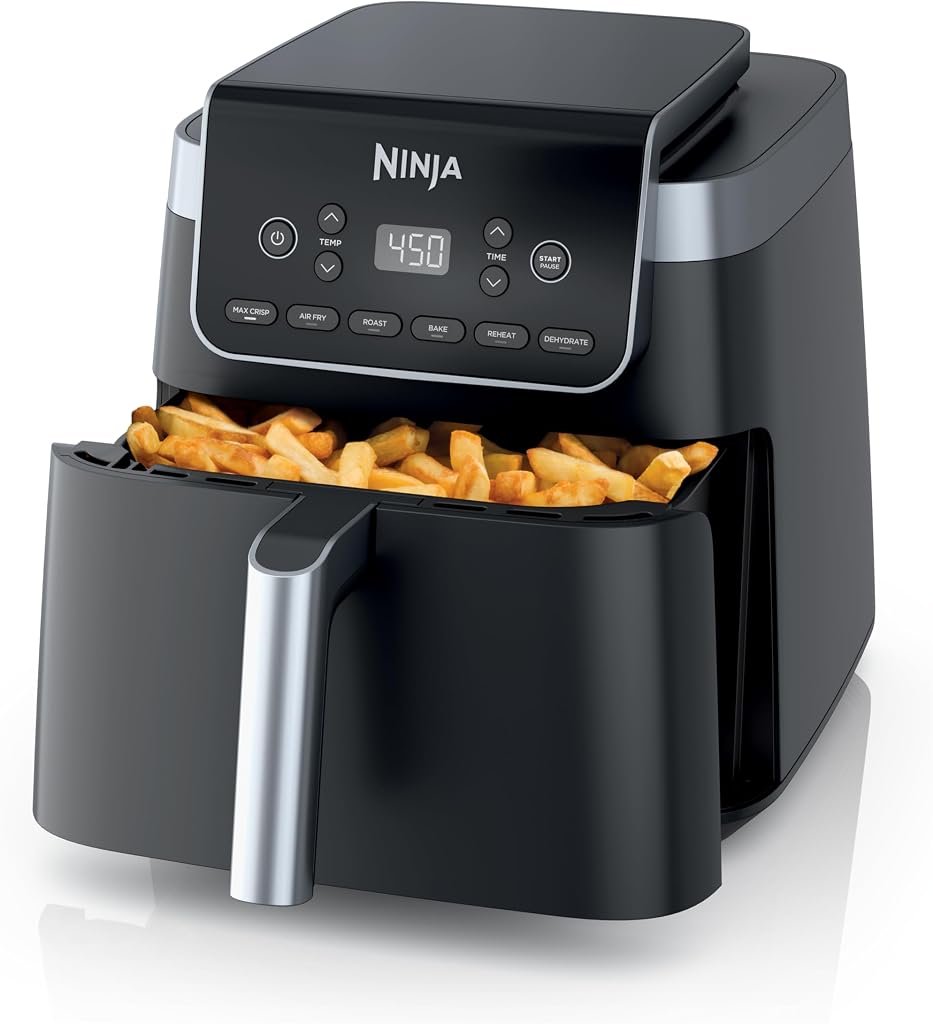
Air-fryer design has spent much of the past decade moving in two directions. Manufacturers have either enlarged the conventional basket or divided the appliance into two independently controlled cooking zones. The Ninja Air Fryer XL MaxCrisp AF181 takes the first route and pursues it with unusually clear priorities: one 6.5-quart basket, 1,750 watts of power, a maximum cooking temperature of 450°F and six cooking functions.
There is little mystery about the proposition. The Ninja AF181 Air Fryer Pro XL is built for households that want more room than a compact air fryer provides but do not necessarily want the additional width, controls and complexity of a dual-basket appliance. Ninja specifies capacity for as much as 5 pounds of French fries or 9 pounds of chicken wings, though physical capacity and ideal crisping capacity are not always the same thing.
Our score is 9.01/10. Customer Sentiment stands at 8.94, Buyer Confidence at 9.8 and Value at 8.52. The unusually high Buyer Confidence score reflects a mature, readily understood design rather than technological novelty. Value is lower because buyers are paying for capacity and high-temperature performance while accepting the restrictions inherent to a single cooking zone.
That distinction defines the AF181. It is not trying to reinvent air frying. It is trying to make the familiar basket-style formula more useful.
A 6.5-Quart Basket Changes The Practical Equation
Air-fryer capacity is frequently reduced to a quart figure, but volume alone gives an incomplete description of how much food an appliance can cook effectively.
Air fryers rely on rapidly moving hot air. The USDA describes air fryers as essentially countertop convection ovens in which quick circulation of heated air produces the crisp exterior associated with the category. The agency also warns that overcrowding can obstruct circulation and result in uneven or inadequate cooking.
This creates an important distinction between fitting food and air-frying it well.
Ninja says the AF181’s 6.5-quart basket and crisper plate can hold up to 5 pounds of French fries or 9 pounds of chicken wings. Those figures establish the physical scale of the basket. They should not be interpreted as a guarantee that every food will brown identically when the chamber is loaded to its maximum stated quantity.
Crisping rewards exposed surface area. Fries stacked deeply create different airflow conditions from chicken pieces distributed with space between them. Moisture escaping from food also has to go somewhere; dense loading can create a more humid cooking environment and reduce surface dehydration.
The AF181 nevertheless provides meaningful headroom over small personal fryers. A 6.5-quart chamber gives households greater freedom to spread food rather than simply pile it higher.
That can be more useful than the capacity figure itself suggests.
Max Crisp Is Built Around Heat
The feature emphasized most heavily in the AF181’s identity is Max Crisp.
Ninja specifies a maximum temperature of 450°F for this mode and describes its MaxCrisp technology as surrounding food with superheated air. The intended application is obvious: rapid browning and crisping, particularly with frozen foods.
Temperature alone does not determine cooking quality. Air velocity, chamber geometry, food composition, moisture and load size all affect the final result. Yet a 450°F ceiling gives the AF181 more thermal headroom than appliances restricted to 400°F.
That extra temperature is most relevant when surface texture is the objective.
Frozen fries, breaded foods and similar products benefit from rapid exterior heating because crispness depends partly on removing surface moisture while promoting browning. The challenge is balancing that exterior development against the time required to heat the interior.
Max Crisp should therefore be viewed as a specialized high-temperature tool rather than the default setting for every ingredient.
Gentler foods do not become better merely because the appliance can run hotter.
This is why the presence of six cooking functions matters more than a single headline temperature.
Six Functions Cover The Core Jobs
The AF181 provides Max Crisp, Air Fry, Air Roast, Bake, Reheat and Dehydrate.
That collection avoids a common appliance-industry habit: presenting numerous variations of temperature and timing as if each represented an entirely different cooking technology.
The AF181’s modes instead correspond to recognizable tasks.
Air Fry handles the standard convection work associated with the category. Max Crisp pushes toward more aggressive high-temperature cooking. Air Roast broadens the appliance’s usefulness for meat and vegetables. Bake addresses foods that require oven-like heating. Reheat targets leftovers. Dehydrate operates at the opposite end of the temperature spectrum, where moisture removal rather than rapid browning is the objective.
The usefulness of these modes depends on how often they replace another appliance.
Reheat deserves particular attention. Microwave ovens are fast, but foods such as pizza, fried chicken, roasted potatoes and breaded leftovers can soften as moisture redistributes during microwave heating. Forced convection takes another route, reheating while encouraging moisture to leave the surface.
For households that frequently save cooked food, the air fryer can therefore become as much a reheating appliance as a raw-food cooker.
Dehydration is more specialized. It expands the AF181’s technical range, but buyers primarily interested in dehydrating large quantities should remember the obvious geometric limitation: one basket provides less drying area than a purpose-built multi-rack dehydrator.
The feature is useful. It does not turn the AF181 into every appliance whose function appears on its control panel.
One Large Basket Versus Two Smaller Baskets
The AF181’s most significant purchasing decision is not Ninja versus another brand. It is one basket versus two.
A single 6.5-quart basket offers simplicity. There is one temperature environment, one cooking timer and one large uninterrupted space. Large individual foods can make better use of that geometry than they could two narrow compartments.
The trade-off appears when dinner contains foods requiring different cooking conditions.
Chicken and vegetables may need different temperatures or durations. A dual-zone machine can run each independently. The AF181 cannot. One component must either join the other under a compromise setting or be cooked separately.
That does not automatically make dual-zone equipment superior.
Two baskets introduce their own compromises. Dividing total volume can restrict the size of individual items. The appliance is usually wider. Controls are more involved. Some households rarely cook two foods requiring genuinely independent conditions.
The AF181 therefore makes the strongest case for itself when meals revolve around one principal air-fried component or several foods compatible with the same cooking program.
For wings, fries, roasted vegetables or a large batch of one snack, one large chamber is easy to understand.
For simultaneous proteins and sides requiring different temperatures, the limitation becomes immediately visible.
1,750 Watts Bring Both Power And Electrical Demands
Ninja rates the AF181 at 1,750 watts on a 120-volt supply. It lists amperage at 14.6 amps.
Those specifications are consequential.
A 1,750-watt appliance can deliver substantial heating power to a relatively compact cooking chamber, but it also represents a meaningful electrical load. Buyers should follow the manufacturer’s electrical and placement instructions and avoid casual assumptions about sharing heavily loaded circuits with other high-power kitchen equipment.
High wattage also does not mean the AF181 consumes 1.75 kilowatt-hours every time it cooks something. Wattage measures power. Energy consumption depends on power draw over time, and heating elements cycle rather than necessarily operating at maximum output continuously throughout every program.
The more useful comparison is energy required to finish a particular meal.
That is where air fryers can have a structural advantage over conventional ovens: they heat a much smaller space.
Air Fryer Energy Savings Have A Catch
A September 2026 Which? comparison of air fryers and conventional ovens demonstrates how substantial the difference can be for modest quantities of food.
In that test, cooking a roast chicken required 0.54 kWh in the tested air fryer and 1.157 kWh in the built-in oven. Cooking 320 grams of frozen chips required 0.287 kWh in the air fryer compared with 0.863 kWh in the oven. A jacket potato consumed 0.392 kWh versus 1.084 kWh, while the air-fried cake required 0.223 kWh compared with 0.71 kWh in the oven. These figures concern the appliances tested by Which?, not the AF181, so they should not be treated as measurements of Ninja’s machine.
The larger lesson is directly relevant.
Which? science team leader Steph Kipling summarized the findings: “The air fryer often used less than half the energy, and the results were just as tasty.” The qualification that followed matters just as much: “the savings soon drop off if you have to cook in batches.”
This is precisely where the AF181’s 6.5-quart capacity earns its place.
A larger basket can reduce the need for repeated cooking cycles. If enough food fits comfortably into one cycle while retaining adequate airflow, the appliance preserves more of the convenience and potential energy advantage associated with air frying.
Yet there is a boundary. A full conventional oven can still accommodate vastly more food and multiple trays simultaneously.
For a crowd, scale eventually favors the oven.
The 450°F Maximum Needs Context
A 450°F maximum temperature looks impressive on a specification sheet, but it should not become an invitation to cook everything at maximum heat.
Higher temperature accelerates exterior browning. It can also accelerate burning.
The relationship between temperature and food is not linear. A recipe that takes 20 minutes at a moderate setting cannot simply be placed at maximum temperature for a proportionally shorter period with an expectation of identical results. The surface and center heat at different rates.
This matters with thick foods.
Chicken can become deeply browned outside before the center reaches a safe temperature. Breaded food can darken while frozen interiors remain insufficiently heated. Sugary coatings can burn rapidly.
Max Crisp therefore makes most sense for foods suited to short, aggressive cooking and for applications where exterior texture is the priority.
The ordinary Air Fry and Air Roast modes will often be more appropriate for foods needing time for heat to penetrate toward the center.
High maximum temperature expands capability. Judgment still determines whether that capability is useful.
Food Safety Requires More Than Browning
Air fryers are particularly good at producing visible signs associated with doneness: browning, crispness and rendered exterior fat.
None is a substitute for internal temperature.
USDA guidance states that poultry should reach 165°F internally. Ground meats require 160°F. Fish and whole cuts of beef, pork, veal and lamb require 145°F, with whole cuts of those meats receiving a three-minute rest.
The agency also specifically warns against overfilling an air-fryer basket because restricted circulation can contribute to uneven cooking.
That guidance is particularly relevant to an XL model.
Large capacity can tempt the user to treat the basket as a container to be filled rather than a convection chamber whose performance depends on moving air.
A food thermometer therefore belongs alongside an appliance such as the AF181 whenever raw meat or poultry is being cooked. The crispest chicken skin on the table says nothing definitive about the temperature beside the bone.
Counter Space Is Part Of The Cost
Capacity cannot be created without physical dimensions.
Ninja lists the AF181 at 16.3 inches long, 12.6 inches wide and 14.17 inches high, with a weight of 12.57 pounds. The cord measures 31.2 inches.
Those figures make pre-purchase measuring worthwhile.
Countertop appliances have an unusual economics of space. The purchase price is paid once, but the appliance may consume workspace every day. An air fryer that is too inconvenient to leave accessible may eventually be stored in a cabinet, introducing the friction of retrieving and replacing a 12.57-pound appliance whenever it is needed.
The AF181’s single-basket design helps keep its footprint more straightforward than many wide dual-zone machines, but the depth remains substantial.
Buyers should measure the intended position rather than assuming that “space-saving” means small.
Clearance requirements in the owner’s documentation also deserve attention. The appliance moves heated air and should be installed and operated according to Ninja’s safety instructions rather than wedged tightly into whatever unused corner happens to remain.
Cleaning Is Conventional But Sensibly Handled
Ninja supplies the AF181 with a 6.5-quart nonstick basket and crisper plate. Both are described as dishwasher safe.
This is less visually novel than glass cooking systems or removable heating modules, but conventionality has advantages.
The basket comes out. The crisper plate comes out. Both can be cleaned separately from the appliance body.
Routine cleaning still matters because air fryers circulate hot air around food containing fats, crumbs and seasoning. Residue accumulates. Grease exposed repeatedly to high temperatures can smoke, while old food particles can scorch.
Dishwasher compatibility lowers the barrier to cleaning but does not remove every maintenance task. The interior and heating area still require appropriate care according to the manufacturer’s instructions.
Nonstick surfaces also reward restrained handling. Abrasive cleaning tools can shorten their useful life.
For many owners, the most sensible habit is the least sophisticated one: clean the removable components regularly rather than waiting for a visible layer of residue to announce that maintenance has been neglected.
The AF181’s Main Strengths
The AF181’s design produces several concrete advantages:
- The 6.5-quart basket provides more usable flexibility than compact personal air fryers.
- A 450°F maximum supports aggressive crisping when the food suits high-temperature cooking.
- Six functions cover air frying, roasting, baking, reheating and dehydration without an excessively complicated control scheme.
- The 1,750-watt heating system provides substantial power for the chamber size.
- A single uninterrupted basket can accommodate foods that would fit awkwardly into divided cooking zones.
- Dishwasher-safe removable components simplify routine cleaning.
- The 6.5-quart format can reduce batch cooking compared with smaller basket fryers.
These strengths point toward a particular household rather than every household.
The AF181 is most coherent when one large basket is more useful than two smaller independent zones.
The Trade-Offs Are Equally Clear
The same design imposes limits.
There is only one cooking zone. Foods requiring different temperatures cannot be controlled independently. The 1,750-watt electrical demand deserves attention. The 16.3-inch depth requires meaningful counter space. Maximum capacity should not be confused with ideal capacity for uniform crisping.
The nonstick basket may also be less appealing to shoppers deliberately looking for glass or stainless-steel food-contact surfaces.
Then there is price.
Value in an air fryer cannot be separated from frequency of use. Someone who uses the AF181 four or five times a week for meals that would otherwise require a full oven can extract substantial utility from the appliance. Someone who already owns an effective convection oven and rarely cooks small or medium portions may simply be adding another large object to the kitchen.
An unused air fryer has terrible economics regardless of its specification sheet.
Interpreting Our 9.01/10 Score
Our overall score for the Ninja AF181 is 9.01/10.
That rating reflects a product whose specifications align closely with the core job expected from a basket air fryer. There is enough capacity to move beyond personal portions, enough heating power to support high-temperature cooking and enough functional range to cover more than fries and frozen snacks.
Customer Sentiment stands at 8.94/10.
Its proximity to the overall score matters. There is little separation between our editorial assessment and the broader measure of buyer satisfaction represented by Customer Sentiment. The product concept is straightforward, and that reduces the opportunity for expectations to become detached from what the appliance actually does.
Buyer Confidence is higher at 9.8/10.
That is the strongest rating in the set. The AF181 is not dependent on an unusual cooking architecture or experimental format. Its specifications are easily interpreted: one large basket, six modes, 1,750 watts and a 450°F maximum. Buyers can assess whether those characteristics match their cooking habits without decoding a complicated system.
Value is 8.52/10.
The gap between Buyer Confidence and Value deserves attention. Confidence that a product will fit a clearly defined use case does not mean its economics are equally attractive to every household.
The AF181 offers significant capacity, but households needing two independent cooking zones may find better functional value in a dual-basket design. Small households preparing tiny portions may be paying for space they rarely use. Large families may still exceed its capacity and return to batch cooking.
The 8.52 Value rating therefore reflects a strong but use-dependent proposition.
Who Should Buy The AF181?
The clearest candidate is a household that has outgrown a compact air fryer but does not need two separately controlled baskets.
That includes cooks who routinely prepare wings, fries, vegetables, breaded foods and other relatively large single batches. It also includes households using an air fryer for reheating leftovers, roasting smaller meals and reducing dependence on a conventional oven.
The 6.5-quart capacity is particularly relevant to people who have found smaller fryers frustrating because every meal turns into two cycles.
The AF181 becomes less convincing when simultaneous cooking flexibility matters more than uninterrupted basket space.
A household regularly preparing a protein at one temperature and a side dish at another should examine dual-zone alternatives. Someone mainly cooking single-person portions can reasonably question whether a 6.5-quart appliance deserves the counter space.
Buyers comparing the best air fryers should therefore resist treating capacity as a ranking system. More quarts are useful only when those quarts solve an actual cooking problem.
Why The AF181 Feels Mature Rather Than Novel
There is little radical about the AF181.
That is partly its strength.
Air fryers no longer need novelty to justify their existence. Their underlying mechanism is well understood: concentrated convection can heat relatively small quantities of food rapidly while promoting surface browning.
The more meaningful design questions now concern capacity, geometry, temperature range, cleaning and workflow.
The AF181 answers those questions conservatively. It enlarges the basket, retains a familiar drawer configuration, offers six recognizable modes and pushes maximum temperature to 450°F.
No transparent glass chamber changes the cooking ritual. No second basket creates synchronization controls. No oversized touchscreen attempts to turn frozen fries into a software project.
For buyers who view an appliance primarily as a tool, that restraint has merit.
Final Considerations
The Ninja Air Fryer XL MaxCrisp AF181 is a 1,750-watt, 6.5-quart single-basket air fryer with six cooking functions and a maximum temperature of 450°F. Ninja specifies capacity for as much as 5 pounds of French fries or 9 pounds of chicken wings, while the removable nonstick basket and crisper plate are dishwasher safe.
Its strengths are tightly connected. Large capacity reduces the likelihood of batch cooking. A single uninterrupted basket accommodates foods that divided chambers can make awkward. Max Crisp supplies additional thermal headroom for foods that benefit from aggressive surface browning. Air Roast, Bake, Reheat and Dehydrate broaden its usefulness beyond conventional air frying.
Its limitations are equally structural. One basket means one cooking environment. Maximum stated capacity does not guarantee maximum crisping performance when food is densely packed. The 1,750-watt power rating creates a meaningful electrical load, and the appliance requires enough counter space to accommodate a body more than 16 inches deep.
Our 9.01/10 overall score reflects how successfully those choices fit the purpose of a large conventional air fryer. Customer Sentiment at 8.94 sits close behind, while the 9.8 Buyer Confidence rating reflects the clarity of the product’s proposition. Value at 8.52 is lower because the economics depend on whether a household actually needs this much single-zone capacity.
The distinction between the AF181 and more elaborate competitors is therefore not a question of which appliance has the longest feature list.
It is a question of kitchen behavior.
For households that regularly cook one substantial batch and want enough room to avoid repeatedly running a smaller machine, the AF181’s design is logically aligned with the job. For households routinely cooking two foods under different conditions, a dual-zone fryer solves a problem this machine does not attempt to solve.
That is ultimately what separates useful appliance design from specification accumulation. The AF181 does not need to perform every countertop cooking task. It needs to provide enough space, heat and airflow to make one large basket genuinely useful.
On that narrower and more meaningful standard, its 9.01/10 editorial score is well earned.