The central problem with many air fryers is not whether they can brown a chicken wing or revive yesterday’s fries. It is scheduling. A single basket asks the cook to decide what gets cooked first, what waits, and what risks cooling while the second part of dinner catches up.
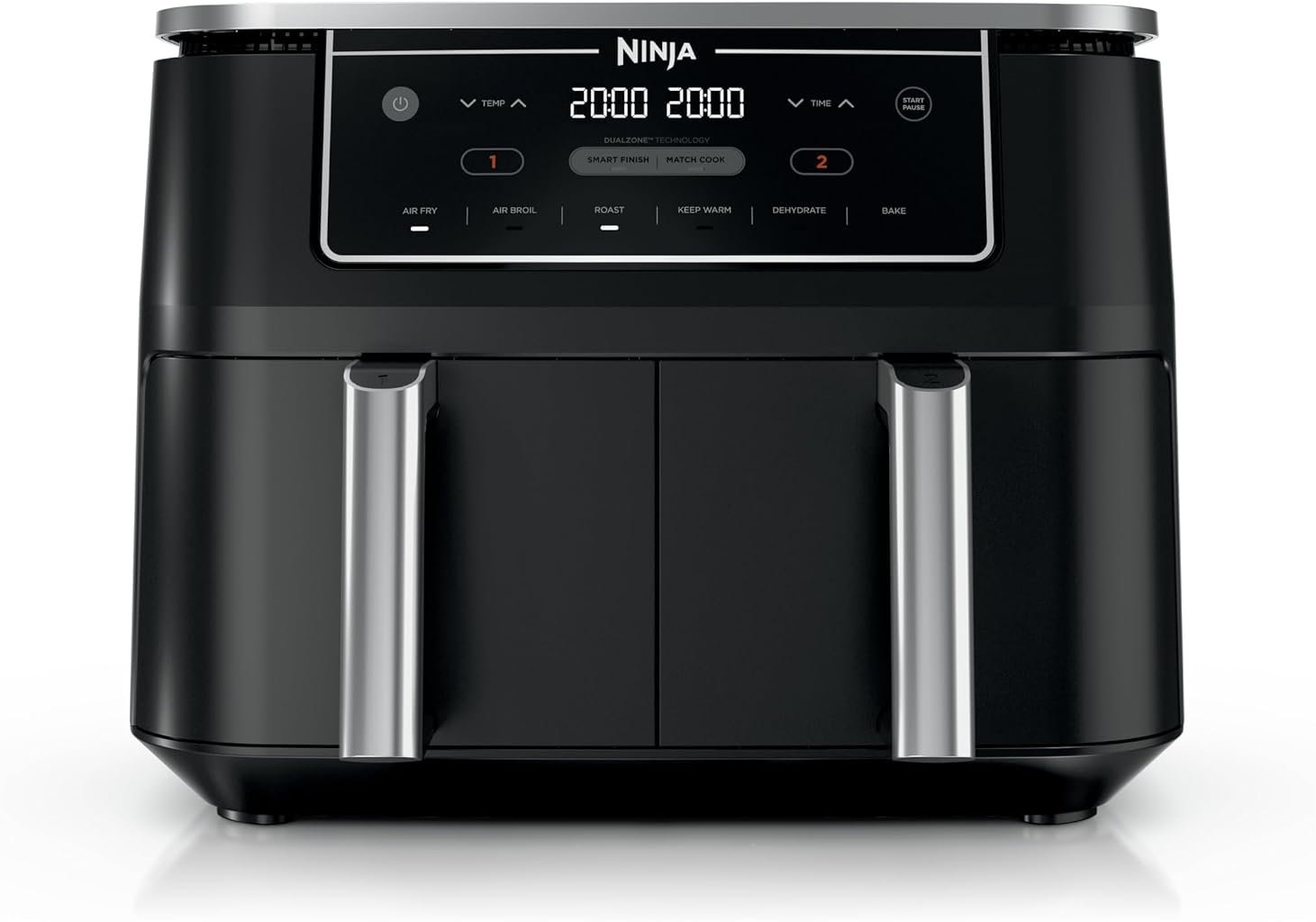
The Ninja Foodi DualZone Air Fryer DZ302 attacks that problem physically. Rather than treating a large cooking chamber as one undivided space, it uses two independent 5-quart baskets. Each zone can handle its own cooking settings, while Smart Finish can coordinate foods with different cooking schedules and Match Cook can duplicate settings when both baskets are being used for the same job.
That distinction gives the DZ302 a clearer purpose than many multifunction countertop appliances. It is a 10-quart air fryer in total, but that figure needs an asterisk in the buyer’s mind: the capacity is divided into two 5-quart zones. The split is simultaneously the appliance’s greatest strength and its principal limitation.
Our score is 9.01/10. Customer Sentiment stands at 8.94, Buyer Confidence at 9.8, and Value at 8.52. At the $149.99 price used in our assessment, the DZ302 makes a particularly coherent argument for households that regularly cook two foods at once.
It makes a weaker argument for anyone who simply wants one enormous uninterrupted basket.
DualZone Is the Reason This Machine Exists
The DZ302 should be evaluated from the baskets outward rather than from its list of cooking programs.
The machine provides two independent 5-quart zones, each with its own basket. Ninja’s broader DualZone design philosophy centers on independent baskets and synchronized cooking, allowing a main dish and side to follow different schedules rather than forcing one food to wait for another.
That sounds like a small convenience until it is translated into an actual meal.
Chicken may need one temperature and cooking duration. Vegetables may need another. A single-basket fryer forces those foods into the same cooking environment or requires sequential batches. The first approach compromises control; the second creates a timing problem.
Smart Finish addresses the latter. The user can program different cooking instructions for the two zones, and the system coordinates their operation so the cycles finish together.
Match Cook solves the opposite problem. When both baskets contain the same food, settings can be copied across the two zones rather than programmed independently.
The two functions therefore should not be confused.
Smart Finish is about synchronization between different foods. Match Cook is about scaling one cooking job across both baskets.
That distinction is the heart of this Ninja Foodi DualZone Air Fryer DZ302 review because it explains why a dual-basket appliance can be more useful than a single large basket even when their total capacities appear similar on paper.
Ten Quarts Does Not Mean One 10-Quart Cooking Space
Capacity labels are among the easiest air-fryer specifications to misunderstand.
The DZ302 offers 10 quarts in aggregate, divided between two 5-quart baskets. That is very different from a hypothetical single 10-quart drawer.
The divided design is beneficial when cooking two foods. It can be restrictive when cooking one physically large item that needs uninterrupted horizontal or vertical space.
A pile of wings can be divided between the baskets. Two side dishes can be separated. A protein can cook in one zone while vegetables cook in the other.
A single oversized item cannot magically pass through the wall separating the zones.
This makes the DZ302’s capacity highly dependent on food geometry.
For batch cooking, separation can actually be useful. Dividing food between baskets may provide more opportunities to distribute pieces rather than stacking them deeply. Air frying depends on hot air reaching exposed surfaces, so usable surface area frequently matters more than the headline quart figure.
The USDA explains that overcrowding an air fryer can restrict air circulation, leading to uneven cooking or undercooking. The agency describes air fryers as “essentially countertop convection ovens,” a useful reminder that airflow is not a secondary feature. It is the cooking mechanism.
For the DZ302, the practical interpretation is straightforward: two 5-quart baskets should not be treated as permission to compress ten quarts of food into dense layers.
Physical capacity and effective crisping capacity are different measurements.
Six Cooking Functions Cover More Than Air Frying
The DZ302 provides six cooking programs: Air Fry, Air Broil, Roast, Keep Warm, Dehydrate, and Bake. Its documented operating range extends from 105°F to 450°F, giving the appliance enough temperature variation to cover low-temperature dehydration as well as high-temperature browning.
The six functions are useful, although they should not distract from the machine’s more consequential feature: independent zones.
Air Fry addresses the familiar crisping workload. Air Broil pushes toward intense surface browning. Roast provides another route for proteins and vegetables. Bake expands the machine’s use beyond foods conventionally associated with frying. Dehydrate uses the lower end of the temperature range. Keep Warm deals with holding food rather than cooking it from raw.
There is an appealing restraint here. Six modes are enough to broaden the machine without turning the control panel into an encyclopedia of presets.
Preset counts are also poor proxies for capability. Many countertop cooking modes are variations in temperature, fan behavior, and time rather than entirely different cooking technologies.
The DZ302’s six-function list therefore matters less than the fact that those functions can be deployed across two independently controlled zones.
That is where the machine earns its complexity.
Smart Finish Is More Useful Than It Sounds
Kitchen appliances often contain features with names more impressive than their practical effect. Smart Finish is different because it addresses a recurring logistical problem.
Consider a basic dinner consisting of chicken and vegetables.
If the chicken requires a longer cycle than the vegetables, starting both simultaneously means one finishes too early. Starting the vegetables later requires the cook to track two schedules manually. Cooking them sequentially leaves one component waiting.
Smart Finish automates that timing relationship.
This does not mean the appliance determines when food is safely cooked. It synchronizes programmed cooking cycles; it does not replace judgment or a food thermometer.
That distinction matters particularly with meat.
The USDA advises checking internal temperature rather than relying on color or cooking time alone. Poultry should reach 165°F. Ground meats should reach 160°F. Fish and whole cuts of beef, pork, veal, and lamb have a safe minimum of 145°F, with a three-minute rest specified for those whole cuts.
Smart Finish can make two timers agree. It cannot tell whether the thickest section of a chicken breast has reached 165°F unless temperature is independently measured.
Automation is useful precisely when its boundaries are understood.
Match Cook Makes the Split Capacity Less Restrictive
A dual-basket machine creates a peculiar contradiction: the divider that provides flexibility can become an inconvenience when both zones are doing exactly the same thing.
Match Cook helps reduce the control-panel friction.
If both baskets contain wings, vegetables, fries, or another food being cooked under identical settings, Match Cook allows the same instructions to be applied across the zones.
The value is not culinary sophistication. It is operational simplicity.
Instead of treating the DZ302 like two separate appliances every time both baskets are loaded, the user can make the two zones behave more like a coordinated larger fryer.
The divider still exists physically, of course. A large food item cannot cross it. But for foods that naturally divide into portions, the full 10-quart aggregate capacity becomes easier to exploit.
This is an important distinction when comparing the DZ302 with single-basket candidates among the best air fryers.
A large single basket offers uninterrupted space.
The DZ302 offers independent control.
Neither architecture is inherently superior. Their usefulness changes with the meal.
IQ Boost Adds Another Layer to Power Management
The DZ302 also incorporates IQ Boost, which is intended to distribute power across the cooking zones when Smart Finish or Match Cook is not selected.
This feature is less immediately visible than having two baskets, yet it illustrates an engineering challenge inherent to dual-zone appliances.
Two independent cooking chambers share one electrical appliance. The system must manage available power while controlling separate heating environments.
The DZ302 is rated at 1,690 watts and 120 volts. That wattage places it squarely in the territory of a substantial countertop heating appliance, so kitchen circuit conditions and the manufacturer’s electrical instructions deserve the same attention given to other high-power countertop equipment.
IQ Boost should not be interpreted as unlimited power. It is a power-management feature within the machine’s electrical envelope.
Its practical relevance is greatest when the two zones are being used independently without the synchronized Smart Finish or mirrored Match Cook modes.
The 9.01/10 Our Score Reflects a Focused Design
Our score of 9.01/10 places the DZ302 high in our air-fryer assessment because its hardware and controls are unusually aligned with one another.
The machine is large because it contains two substantial cooking zones.
Its control system is more involved than a basic fryer because those zones can operate independently.
Smart Finish exists because independent zones create separate timelines.
Match Cook exists because independent zones occasionally need to behave identically.
IQ Boost exists because two cooking chambers require coordinated power management.
In other words, the features are not merely accumulated. They respond to consequences created by the dual-basket architecture.
That coherence matters.
A product with twenty unrelated modes is not automatically more capable in daily use than one with six functions designed around a clearly defined cooking pattern.
The 9.01 score does not erase the DZ302’s drawbacks. Its split capacity is poorly suited to unusually large foods requiring one open chamber. Two baskets mean two cooking components to handle and clean. The body is necessarily larger than that of many compact single-basket machines. Households preparing small portions may rarely exploit the second zone.
Those limitations are substantial enough to prevent the score from drifting into indiscriminate praise.
They are also predictable. The DZ302 makes little effort to disguise what it is.
Customer Sentiment: 8.94
Our Customer Sentiment score is 8.94, closely tracking the 9.01 overall score.
That proximity is significant within our editorial framework. The central product idea is not difficult to appreciate: two foods can cook under different conditions without forcing the household into back-to-back batches.
The concept becomes especially relevant at dinner, where air fryers can encounter an ironic limitation. They are often praised for speed, yet a small single basket can turn a two-component meal into a sequence of separate cooking cycles.
The DZ302 addresses that bottleneck directly.
Its appeal weakens when the second basket is rarely necessary. A one-person household reheating a modest lunch does not extract the same benefit from two 5-quart zones as a household regularly coordinating a main dish and side.
The Customer Sentiment score should therefore be read alongside cooking habits rather than in isolation.
This is a machine built for parallel work.
Buyer Confidence: 9.8
Buyer Confidence reaches 9.8, the strongest of the four editorial measurements.
The reason is clarity.
The DZ302 does not require buyers to decipher an obscure use case. It has two independent 5-quart baskets, 10 quarts of combined capacity, six cooking programs, a 105°F-to-450°F operating range, Smart Finish, Match Cook, and IQ Boost.
Ninja also sells replacement components specifically identifying compatibility with the DZ302, including a 5-quart right basket. That provides useful confirmation of the individual basket capacity and model ecosystem without relying on vague category descriptions.
A buyer can therefore ask concrete questions before spending money:
- Are two different foods frequently cooked at the same meal?
- Would two 5-quart baskets be more useful than one uninterrupted chamber?
- Is there enough counter space for a dual-basket appliance?
- Will six cooking functions cover the intended workload?
- Is synchronized finishing genuinely useful, or would a simple single basket be sufficient?
The more often the answers favor simultaneous cooking, the stronger the DZ302’s fit becomes.
Value: 8.52
Our Value score is 8.52, lower than the overall score, Customer Sentiment, and Buyer Confidence.
That gap deserves attention.
At $149.99 in our pricing snapshot, the DZ302 is not being judged merely on the cost of producing hot circulating air. Less complicated air fryers can perform basic crisping and reheating for buyers who do not need independent zones.
The additional value rests in avoiding sequential cooking.
That is an unusual benefit because it is measured partly in workflow rather than specifications. Two baskets can reduce the need to finish one food, remove it, start another, and then reheat or hold the first batch.
For households encountering that sequence several times each week, the extra hardware has a clear job.
For households that almost always cook one item, much of the DZ302’s engineering remains idle.
An 8.52 Value score therefore fits the product well. The appliance offers considerable functionality at the assessed price, but buyers only capture that value when dual-zone cooking matches their routine.
Unused capacity has no practical return.
Cleaning: Twice the Baskets, but Manageable Components
Dual-zone cooking introduces an obvious cleaning question: does cooking two foods create twice the work?
Not necessarily, though there are more pieces.
The DZ302 uses two cooking baskets and two crisper plates. Ninja identifies compatible crisper plates as components that nest inside the basket for airflow and cleanup, and its documentation for the DZ302 describes dishwasher-safe crisper plates.
Two baskets mean additional surfaces compared with a compact one-drawer fryer. If both zones are used for greasy foods, both will need attention.
On the other hand, independent baskets can prevent flavors, sauces, and residues from mixing. A heavily seasoned protein does not need to share a cooking surface with a relatively plain vegetable.
Cleaning habits should also affect the purchasing decision more than they often do. An appliance that is technically capable of cooking an entire meal can become inconvenient if its components are awkward to wash in the buyer’s actual sink or dishwasher.
The DZ302’s removable basket architecture is familiar and straightforward, but its scale should not be ignored.
Large capacity produces large dishes.
The Counter-Space Question Cannot Be Avoided
Two 5-quart baskets have to exist somewhere physically.
That sounds obvious, yet countertop dimensions are often treated as an afterthought when air fryers are purchased online. A dual-basket machine can consume materially more working space than a compact single-basket model.
The relevant measurement is not only whether the appliance can be squeezed between a coffee maker and wall.
The baskets need room to be removed comfortably. Ventilation requirements must be respected. Nearby objects should not interfere with hot exhaust. The machine should be positioned on a stable surface appropriate for a high-powered cooking appliance.
A household planning to store the DZ302 after every use should also consider the inconvenience of repeatedly moving a comparatively large appliance.
Frequent users are more likely to leave it permanently on the counter.
That transforms footprint from a specification into a daily cost.
Where the DZ302 Fits Among the Best Air Fryers
The phrase best air fryers becomes useful only after the buyer defines the job.
For small portions and simple reheating, a compact single basket can be more rational.
For very large individual foods, an uninterrupted basket or oven-style chamber may be preferable.
For toast, sheet-pan cooking, pizza, and baking dishes, an air fryer toaster oven offers a different geometry.
The DZ302 belongs in the conversation when meals repeatedly contain two air-fried components.
Its strongest buyer profiles include:
- Households regularly preparing a protein and side at different temperatures.
- Families frustrated by sequential air-fryer batches.
- Batch cooks who can divide the same food across two 5-quart baskets.
- Users who want air frying alongside roasting, baking, broiling, dehydrating, and warming.
- Buyers who value synchronized finishing more than one uninterrupted cooking chamber.
- Kitchens with enough permanent counter area for a dual-basket appliance.
Its weaker fit includes small households cooking one portion at a time, kitchens where counter depth is scarce, and buyers whose recipes regularly require one large open cooking area.
This is not a matter of the DZ302 being too capable. It is a matter of paying for the correct kind of capability.
Food Safety Matters More Than Synchronized Timers
The DZ302 can coordinate cooking schedules, but food safety remains governed by internal temperature and handling.
USDA guidance says air fryers generally cook food through rapid hot-air circulation and warns against overfilling because inadequate circulation can result in uneven cooking. The agency recommends checking food with a thermometer rather than trusting appearance alone.
That advice has particular relevance in a high-capacity dual-basket machine. A nominal 10-quart total capacity can tempt users to fill both baskets aggressively. Yet airflow still needs access to food surfaces.
More food is useful only if it cooks properly.
The same caution applies to raw breaded stuffed chicken products. USDA specifically advises consumers not to cook raw stuffed breaded chicken breast products in an air fryer and instead to follow the cooking instructions supplied for those products.
The DZ302’s convenience therefore should not encourage improvisation where package instructions or safe minimum temperatures require a different approach.
A synchronized dinner is useful. A safely cooked dinner is non-negotiable.
Strengths and Drawbacks
The DZ302’s strengths are concentrated around parallel cooking.
Two independent 5-quart baskets allow foods to follow separate cooking schedules. Smart Finish coordinates different cycles. Match Cook simplifies using both zones for one larger batch. Six functions cover common air-fryer and countertop-cooking duties. The 105°F-to-450°F range accommodates low-temperature dehydration through high-temperature crisping. IQ Boost manages power across the dual-zone architecture.
The drawbacks come largely from the same design.
Ten quarts is divided rather than uninterrupted. The appliance requires more counter space than a compact single-basket fryer. Using both zones creates more removable components to clean. Small households may leave half the machine unused during routine meals. Buyers wanting a large open chamber for oversized foods may find the divider frustrating rather than useful.
The DZ302 therefore does not win its 9.01/10 score by eliminating compromise.
It earns that score because its compromises follow logically from a useful and clearly executed design.
Final Considerations
The Ninja Foodi DualZone Air Fryer DZ302 is best understood as a scheduling appliance that happens to cook with rapidly circulating hot air.
Its 10-quart headline capacity matters, but the more meaningful specification is two independent 5-quart zones. That split changes how a meal can be organized. A protein no longer has to share the exact temperature and duration of its side dish. Two batches of the same food can use both baskets under matched settings. Different cycles can be coordinated to end together.
Those capabilities explain our 9.01/10 overall score.
Customer Sentiment at 8.94 reinforces the practical appeal of the concept. Buyer Confidence at 9.8 reflects a product whose purpose is unusually easy to understand before purchase. Value at 8.52 is slightly more restrained because a dual-basket design only earns its additional complexity when both zones are actually used.
At the $149.99 price applied in our assessment, the DZ302 presents a strong editorial proposition for households routinely cooking complete meals rather than isolated snacks.
The buyer still needs to make one fundamental choice.
If the priority is one large, uninterrupted cooking chamber, the DZ302’s divider is a structural limitation. If the priority is preparing two foods independently and having them arrive at the table together, that same divider becomes the reason to own it.
The distinction is refreshingly physical. No software subscription, elaborate automation, or inflated preset count is required to explain the product.
There are two baskets.
For the right kitchen, that changes dinner.