Air fryer shopping has produced an oddly precise vocabulary for an imprecise problem. A machine is described as 4 quarts, 6 quarts, 8 quarts or perhaps 10 liters, and the number appears to settle the question of size.
It does not.
Capacity measures internal volume. Dinner has geometry.
A chicken breast needs horizontal area. A whole chicken needs height as well as width. French fries need enough room for air to move between pieces. A pizza needs diameter. Two separate foods may benefit more from independent baskets than from one large chamber. A family cooking six servings of wings faces a different capacity problem from a family cooking one whole roast.
That is why choosing among the best air fryers requires more than matching a quart number to household size.
The USDA describes an air fryer as essentially a countertop convection oven, using rapidly circulating hot air to cook and crisp food. Capacity therefore affects more than how much food can physically be squeezed inside. It affects airflow, food arrangement, batch count, cooking time and whether the appliance is proportionate to the meal.
A larger air fryer can solve genuine problems. It can also create new ones: more counter space, heavier baskets, larger components to wash and unnecessary chamber volume for modest portions.
The useful capacity is the amount of food that fits while the appliance can still cook it as intended.
Air Fryer Capacity Is Not the Same as Food Capacity
A six-quart air fryer contains roughly six quarts of theoretical internal volume. That does not mean six quarts of solid food belong in the basket.
Air is part of the recipe.
The USDA specifically advises users not to overfill an air-fryer basket because crowding can interfere with circulation and lead to uneven cooking or undercooking.
That warning exposes the central weakness of capacity labels.
Volume counts empty space above the food. It counts depth that may be unsuitable for foods requiring a single layer. It can make a tall, narrow basket look comparable to a broad, shallow basket even though the two accommodate dinner very differently.
Consider burger patties.
Four patties need floor area. Stacking them vertically does not turn a small basket into a four-burger machine merely because the total volume is sufficient.
French fries behave differently. They can overlap and can be shaken during cooking, so basket depth becomes more useful.
A whole chicken creates yet another problem. It requires a three-dimensional cavity with adequate clearance around the bird.
The capacity number remains the same measurement in all three cases. Its practical meaning changes with the food.
Quarts and Liters Need Translation
American air fryers are commonly advertised in quarts, while many international markets use liters.
One U.S. liquid quart equals approximately 0.946 liters.
That means:
| Advertised Capacity | Approximate Equivalent |
|---|---|
| 2 quarts | 1.9 liters |
| 3 quarts | 2.8 liters |
| 4 quarts | 3.8 liters |
| 5 quarts | 4.7 liters |
| 6 quarts | 5.7 liters |
| 7 quarts | 6.6 liters |
| 8 quarts | 7.6 liters |
| 10 quarts | 9.5 liters |
| 12 quarts | 11.4 liters |
These conversions are mathematically useful and culinarily incomplete.
A six-quart basket and a 5.7-liter basket are essentially describing similar volume. Neither number tells the buyer the basket’s width, length or usable cooking surface.
Capacity comparisons should therefore remain within the same measurement system where possible, then move quickly to internal dimensions.
Basket Shape Can Matter More Than One Extra Quart
Two air fryers can have similar stated capacity and radically different usefulness.
A narrow basket gains volume by extending upward. A wide square basket gains volume partly through floor area. For foods that cook most evenly when spread out, the second geometry can be more useful even if its advertised capacity is slightly smaller.
This creates a useful rule for comparing similarly sized basket air fryers:
Floor area deserves priority over volume when the household frequently cooks foods in a single layer.
Chicken breasts, burgers, fish fillets, steaks, breaded cutlets and many vegetables benefit from horizontal space.
Fries, wings and small vegetables can tolerate more overlap because they can be shaken or redistributed during cooking.
Manufacturers do not always publish basket-floor dimensions. When they do, those measurements can be more revealing than the headline capacity.
When they do not, photographs showing the basket beside known food sizes can at least expose whether the chamber is unusually tall and narrow.
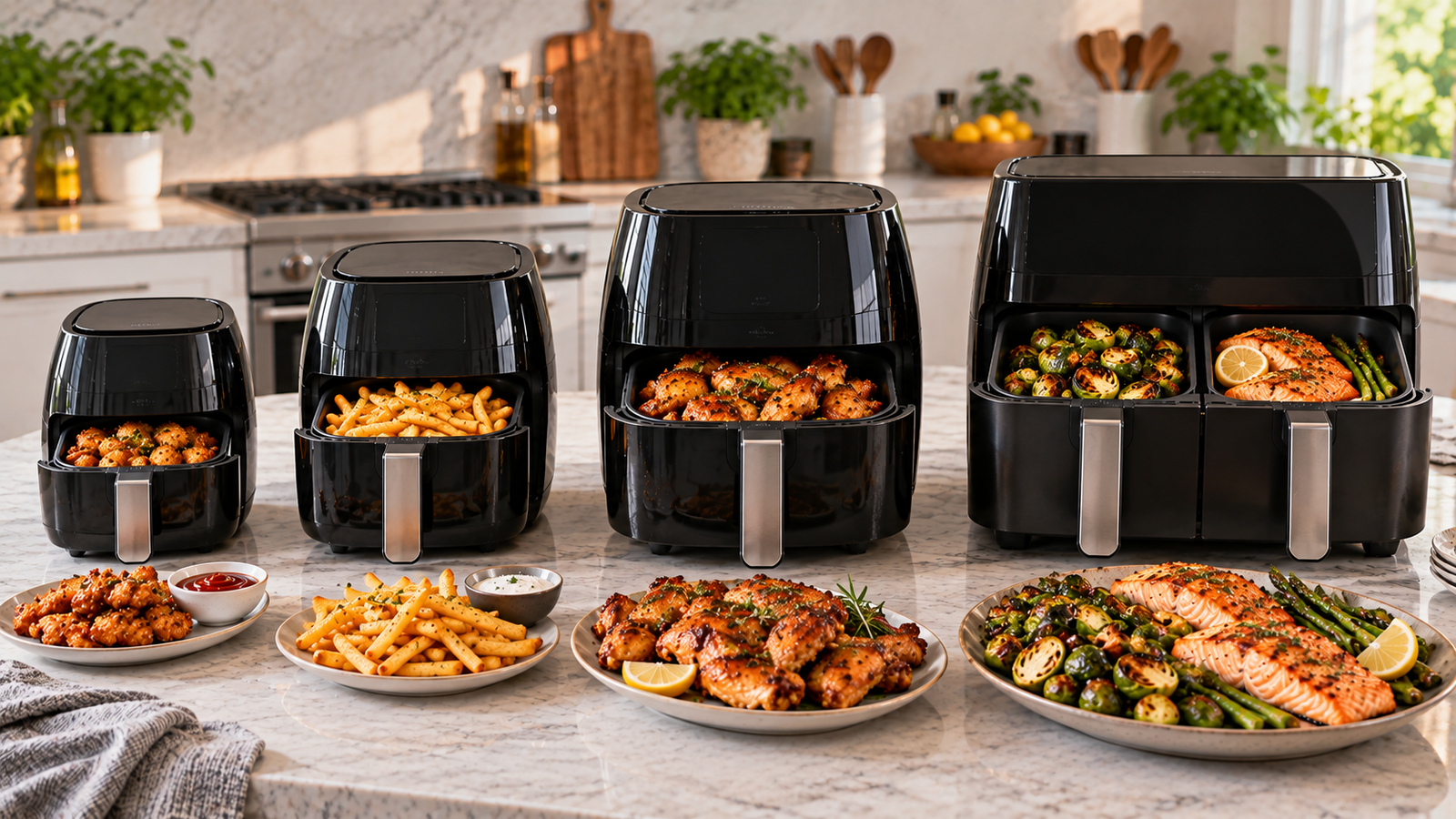
Small Air Fryers: Roughly 2 to 4 Quarts
The smallest mainstream air fryers make their strongest case through proportionality.
A two- to four-quart basket can work well for one person, couples preparing modest portions or households primarily using the appliance for snacks, reheating and side dishes.
Their advantages are physical.
They usually require less counter area than large family machines. Their baskets are lighter. They can be easier to store. The smaller chamber is well matched to small quantities of food.
The limitation appears when dinner expands.
A compact basket may hold enough fries for one or two people but struggle with several chicken breasts arranged without overlap. A whole chicken may be impossible or require selecting a particularly small bird.
Batch cooking can erase some of the convenience that motivated the purchase.
Cooking two consecutive loads means the first load waits while the second cooks. Reheating the first batch afterward adds another cycle.
Small capacity therefore works best when the household’s normal portion size is genuinely small, not merely when the household has few people.
A couple that routinely meal-preps six portions has a large-capacity workload despite having a two-person household.
Medium Air Fryers: Roughly 4 to 6 Quarts
The four- to six-quart category represents a practical middle ground for many kitchens.
It offers more room for several portions without automatically moving into the exterior dimensions associated with the largest basket machines or oven-style models.
This range can accommodate many everyday air-fryer jobs: vegetables, chicken pieces, fish, fries, reheating and moderate batches of frozen foods.
Yet even here, geometry matters.
A six-quart circular basket may accommodate food less efficiently than a broad five-quart square basket. A model advertised for a particular number of servings may perform differently depending on whether those servings are fries, chicken breasts or a single roast.
Household labels such as “family size” should therefore be treated as approximate descriptions rather than capacity standards.
The more useful test is whether a typical dinner fits in one cooking cycle.
If the answer is usually yes, the size is probably proportionate.
Large Basket Air Fryers: Roughly 6 to 8 Quarts
Moving beyond six quarts creates room for larger portions and larger individual foods.
This range can make sense for families, frequent batch cooking and households wanting enough width for larger proteins.
The trade begins on the countertop.
Larger baskets require larger housings. The appliance may become too bulky to move into a cabinet after every use, effectively converting a purchase decision into a permanent allocation of kitchen space.
Basket weight also rises.
A large drawer loaded with food can become noticeably heavier than its empty specification suggests. This matters when shaking fries or wings midway through cooking.
Cleaning scales with size as well. A large basket may not fit conveniently in a small sink or dishwasher rack.
These are not arguments against large capacity. They are reminders that capacity exists outside the cooking chamber too.
Every extra inch of useful interior volume must live somewhere when dinner is over.
Extra-Large Air Fryers: 8 Quarts and Beyond
Capacity above eight quarts can describe several very different appliances.
One may use a single enormous basket.
Another may divide eight or ten quarts between two independent drawers.
A third may be an oven-style appliance whose capacity is measured across a tall chamber with several rack positions.
Those designs should not be treated as interchangeable merely because the numbers overlap.
An eight-quart single basket can devote its entire footprint to one large food.
An eight-quart dual-basket model divided into two four-quart drawers cannot fit an eight-quart-sized object in either basket, though it can cook two different foods independently.
An oven-style model can accommodate wide foods and baking dishes but may distribute its volume vertically.
The larger the advertised capacity becomes, the less useful the number becomes without knowing the architecture.
Dual-Basket Capacity Requires Different Arithmetic
Dual-zone air fryers are especially vulnerable to capacity misunderstanding.
A 10-quart dual-basket air fryer may sound enormous. If it consists of two five-quart drawers, its total volume is indeed 10 quarts, but its largest uninterrupted cooking chamber remains five quarts.
That distinction is crucial for whole foods.
A large chicken cannot extend through the wall separating the baskets. Neither can a long fish fillet, wide baking dish or oversized cut of meat.
Dual baskets instead trade uninterrupted geometry for independence.
One drawer can cook chicken at one temperature while the other handles vegetables at another. Some models synchronize the two zones so foods with different cooking durations finish together.
That can make 10 divided quarts more useful than 10 uninterrupted quarts for one household and less useful for another.
The correct capacity question is therefore not merely “How many quarts?”
It is “How many quarts per usable cooking zone?”
Flexible Dividers Change the Calculation
Some newer air fryers use one large drawer with a removable divider.
This architecture addresses a longstanding capacity compromise.
With the divider installed, the machine can operate as two zones. Remove it and the same drawer becomes a larger uninterrupted cooking chamber.
That arrangement can accommodate a broad food one day and two independently managed foods another, depending on how the heating and control system is engineered.
Buyers should verify exactly what happens when the divider is removed.
Does the appliance truly operate as one large zone? Are both heaters used? Can temperature be controlled uniformly? What are the actual internal dimensions?
“Flexible capacity” should describe physical and functional flexibility rather than merely a removable piece of plastic or metal.
Oven-Style Capacity Is a Different Measurement Problem
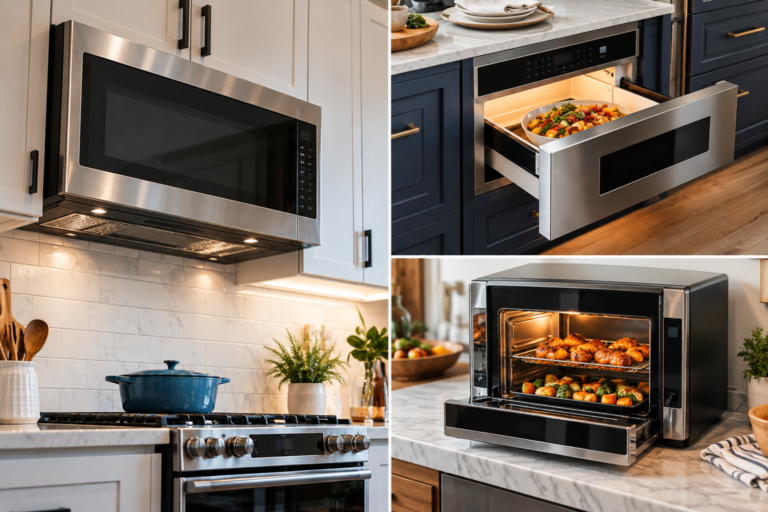
Air fryer toaster ovens and French door air fryer ovens commonly advertise much larger capacities than basket models.
That does not automatically mean they air fry dramatically more food at once.
Oven capacity includes vertical space.
A 26-quart countertop oven may fit a 12-inch pizza, several slices of toast or a roasting dish. Those are capabilities that a conventional basket may not offer.
Air frying, however, often works best when food is distributed across a perforated basket or mesh tray with room for circulation.
Loading multiple racks simultaneously can alter airflow and browning. The top tray may experience different radiant heat from the bottom tray. Some foods may require rack rotation.
The oven’s total volume therefore describes versatility more effectively than it describes single-layer air-frying capacity.
For oven-style machines, tray dimensions deserve more attention than quart capacity.
Household Size Is Only a Rough Starting Point
Air fryer guides frequently assign capacities to household sizes: a small model for one or two people, a medium machine for three or four, and a large fryer for bigger families.
That framework is convenient but incomplete.
People do not eat standardized portions.
A two-person household that cooks two chicken breasts and a small serving of vegetables has a different capacity requirement from two people preparing six meal-prep portions every Sunday.
Children and adults consume different quantities. Teenagers can turn supposedly generous family capacity into a small-batch appliance with remarkable speed.
Entertaining changes the equation again.
The useful sizing method begins with the largest routine cooking load rather than the number of chairs at the table.
Start With Ten Real Meals
One of the most reliable ways to select capacity requires no product research at all.
A household can write down ten meals or foods it genuinely expects to prepare in the air fryer.
For example:
- Four chicken breasts
- Two salmon fillets
- 1.5 pounds of French fries
- Six chicken thighs
- Roasted broccoli for four people
- A whole chicken
- Frozen appetizers for guests
- Two steaks
- Leftover pizza
- Chicken wings for four people
Each food then needs to be translated into physical arrangement.
Can it overlap?
Does it need a single layer?
Does it require shaking?
Is it one large object?
Does a baking dish need to fit?
Would two foods benefit from separate temperatures?
This exercise exposes the required geometry far more accurately than choosing “family size” from a retailer’s filter.
Crowding Has a Food-Safety Dimension
Capacity is not merely a convenience issue.
The USDA warns that overfilling can interfere with air circulation and cause food to cook unevenly or remain undercooked.
That becomes particularly consequential with raw meat.
A basket packed with chicken pieces may develop browned surfaces while thicker or shielded portions heat more slowly.
The USDA recommends checking food with a thermometer and specifies 165°F for poultry, 160°F for ground meats, 145°F for fish, and 145°F followed by a three-minute rest for whole cuts of beef, pork, veal and lamb.
A larger basket can therefore provide more than convenience when it allows raw foods to be arranged with appropriate spacing.
Capacity does not replace temperature verification, but insufficient capacity can make even cooking harder to achieve.
Bigger Is Not Automatically More Energy Efficient
The argument for buying extra capacity “just in case” deserves scrutiny.
An oversized appliance can be useful when it prevents repeated batches. It can be inefficient when most meals use only a fraction of its chamber.
The Energy Saving Trust reports that cooking accounts for around 3% of average household energy use and explains that an air fryer can cost less to operate than a full-size electric oven for small quantities of food.
Its example for Great Britain puts cooking 600 grams of chicken breast at £0.14 in an air fryer versus £0.20 in an electric oven.
The mechanism is not mysterious. Heating a smaller space for an appropriately sized meal can require less energy than heating a large oven.
Capacity matching therefore matters.
A small air fryer may perform an individual meal efficiently but require three consecutive batches for a family dinner. A larger machine may complete the same workload in one cycle.
Conversely, heating an oversized chamber every morning for one slice of reheated pizza wastes part of the capacity advantage.
The most efficient size is often the smallest machine that can handle routine meals without excessive batching.
Batch Cooking Changes the Capacity Equation
A machine that is slightly too small creates recurring time costs.
Suppose one batch requires 18 minutes.
Two batches do not merely require 36 minutes. Loading, unloading, shaking, checking and potentially reheating the first batch can extend the process further.
Food quality can also diverge between batches. The first batch sits while the second cooks. Serving temperatures become inconsistent.
This is where additional capacity can have disproportionate value.
Moving from a four-quart to a six-quart machine may not sound transformative on paper, but if the larger basket converts two routine cycles into one, the practical difference is substantial.
Capacity should therefore be evaluated around batch thresholds.
The question is not whether the larger machine holds 50% more theoretical volume.
The question is whether it eliminates a second cooking cycle.
Counter Space Places a Ceiling on Capacity
Every capacity decision eventually collides with kitchen dimensions.
Large basket air fryers can become surprisingly deep. Dual-basket models can become wide. Oven-style machines can consume substantial width, depth and height simultaneously.
The appliance also requires working clearance.
A drawer needs space to pull forward. French doors need room to swing sideways. Hot air needs to vent according to manufacturer instructions. Hot baskets and trays need a safe landing area.
Measuring only the appliance body is therefore insufficient.
A practical measurement includes:
- Appliance width
- Appliance depth
- Appliance height
- Drawer travel
- Door swing
- Ventilation clearance
- Distance to an electrical outlet
- Space for removing hot food
- Cabinet clearance above the appliance
A large air fryer that forces the coffee machine into permanent exile may be larger than the kitchen can meaningfully support.
Storage Changes the Ideal Size
Some air fryers live permanently on the counter.
Others travel between a cabinet and the worktop every time they are used.
That distinction can change the ideal capacity dramatically.
A large machine may be perfectly manageable as a stationary appliance but irritating when lifted several times a week. Weight, handles and cabinet height become part of capacity planning.
Dual-basket models can be particularly awkward because width makes them harder to maneuver through crowded storage spaces.
Oven-style machines may simply be too large for routine storage.
A buyer planning to put the appliance away after every use should measure the storage location before comparing cooking specifications.
The best capacity is useless if retrieving the machine becomes enough of a nuisance that it stays in the cabinet.
Whole Chickens Expose Capacity Marketing Quickly
Whole chickens are commonly used in air-fryer capacity claims because they provide an intuitive image of size.
They are useful, but only when weight and clearance are specified.
A fryer that accommodates a four-pound chicken is demonstrating more than raw volume. It is demonstrating that a three-dimensional object of that approximate size fits within the cooking geometry.
Yet “fits a whole chicken” still does not answer every question.
The bird needs clearance from heating elements and enough surrounding space for hot air to circulate. A chicken pressed tightly against basket walls is not using the chamber in the same way as one with air moving around it.
Buyers who frequently cook whole poultry should therefore examine manufacturer-stated weight capacity alongside actual internal dimensions.
Pizza Creates the Opposite Geometry Problem
Pizza barely cares about chamber depth.
It cares about diameter.
A deep six-quart basket may have substantial volume yet fail to accommodate a 10-inch pizza without cutting or folding it.
An oven-style air fryer with similar or larger total volume can be far better suited because the chamber is broad and flat.
This illustrates why food shape should precede capacity.
A household mainly cooking fries and wings needs a different chamber from one expecting pizza, flatbreads and open-faced sandwiches.
Quarts cannot express that distinction.
The Useful Capacity Checklist
Before selecting a size, a buyer can reduce the decision to a series of physical questions:
- What is the largest routine meal? Size for recurring demand rather than rare holiday cooking.
- How many foods need a single layer? Horizontal area matters when overlap harms cooking.
- Will food be shaken? Foods that tolerate redistribution can use depth more effectively.
- Are whole foods common? Chickens, roasts and long fish fillets need uninterrupted dimensions.
- Are two temperatures needed simultaneously? Dual zones may matter more than total volume.
- How many batches are acceptable? Extra capacity becomes valuable when it eliminates routine second cycles.
- What cookware needs to fit? Oven-style machines should be measured against pans, pizzas and dishes.
- Where will the appliance live? Counter and storage dimensions set a hard physical limit.
- How heavy is the loaded basket? Large capacity can make shaking and cleaning more demanding.
- How will it be cleaned? A basket too large for the sink or dishwasher changes the ownership experience.
- How often will the full capacity be used? Oversizing creates permanent bulk for occasional benefit.
- Can food circulate properly? Capacity is useful only when adequate airflow remains around the load.
These questions transform “What size air fryer should be purchased?” into a much more answerable problem.
A Practical Capacity Range by Cooking Pattern
Capacity recommendations work better when attached to workloads rather than rigid household counts.
| Cooking Pattern | Capacity Range Worth Examining |
|---|---|
| Snacks, reheating, one-person portions | 2-4 quarts |
| One or two moderate portions | 3-5 quarts |
| Routine meals for two to three people | 4-6 quarts |
| Larger family portions | 5-8 quarts |
| Large batches of wings, fries or vegetables | 6-10+ quarts |
| Two foods requiring separate settings | Dual-zone models, sized per basket |
| Whole chickens and bulky proteins | Broad 6+ quart basket, subject to internal dimensions |
| Pizza, baking dishes and toast | Oven-style model sized by rack dimensions |
| Large multi-function countertop cooking | 20+ quart oven formats, subject to actual tray area |
These ranges are starting points, not guarantees.
A broad five-quart basket can outperform a narrow six-quart basket for certain meals. A dual eight-quart machine can be less useful for one large chicken than a single seven-quart basket. A 25-quart oven can offer enormous overall volume while providing only one optimally positioned air-fry tray.
The architecture always modifies the number.
Final Considerations
Air fryer capacity looks numerical but behaves geometrically.
Quarts and liters describe internal volume. They do not reveal how effectively that volume accommodates chicken breasts, fries, pizza, whole poultry or two foods requiring different temperatures.
That is why buying by household size alone frequently produces mismatches.
A compact two-person household can need a large air fryer because it batch-cooks meals for the week. A family of four can function comfortably with a moderate basket if the air fryer usually prepares only vegetables or side dishes. A household interested in pizza and baking may gain more from an oven-shaped chamber than from a deep basket carrying a larger quart figure.
Usable surface area deserves particular attention.
Foods that cook best in a single layer need width and length. Foods that can be shaken can make better use of depth. Whole foods require uninterrupted three-dimensional clearance. Dual-zone cooking sacrifices some of that uninterrupted space in exchange for independent control.
Batch count provides another useful measurement.
If a smaller air fryer repeatedly forces two cooking cycles, moving one size upward can save more time than the difference in quart figures suggests. If a large machine spends nearly every day cooking a tiny portion, its extra chamber volume is mostly permanent countertop baggage.
Energy considerations reinforce the same principle. Smaller cooking chambers can use less energy than full-size ovens for modest meals, but a small air fryer running several consecutive batches can surrender part of that advantage. Matching capacity to routine food quantity matters more than assuming smaller or larger is inherently more efficient.
Counter space imposes the final limit.
The air fryer must physically coexist with the kitchen. Drawer travel, door swing, ventilation, electrical placement, cleaning and storage all belong in the sizing calculation. Capacity that cannot be accommodated comfortably outside the cooking chamber is not useful capacity.
The most reliable buying method therefore begins with food rather than appliances.
List ten meals. Measure the largest items. Identify which foods need a single layer. Count how often two separate batches would be necessary. Decide whether independent cooking zones matter. Then measure the counter.
Only after those steps should the quart figure enter the discussion.
The right air fryer is not the largest machine the kitchen can hold. Nor is it automatically the smallest machine capable of containing dinner. It is the smallest practical cooking architecture that handles the household’s routine workload without chronic crowding, repeated batches or awkward compromises.
Capacity is useful when it is filled intelligently. Empty space is merely something else to heat, clean and store.