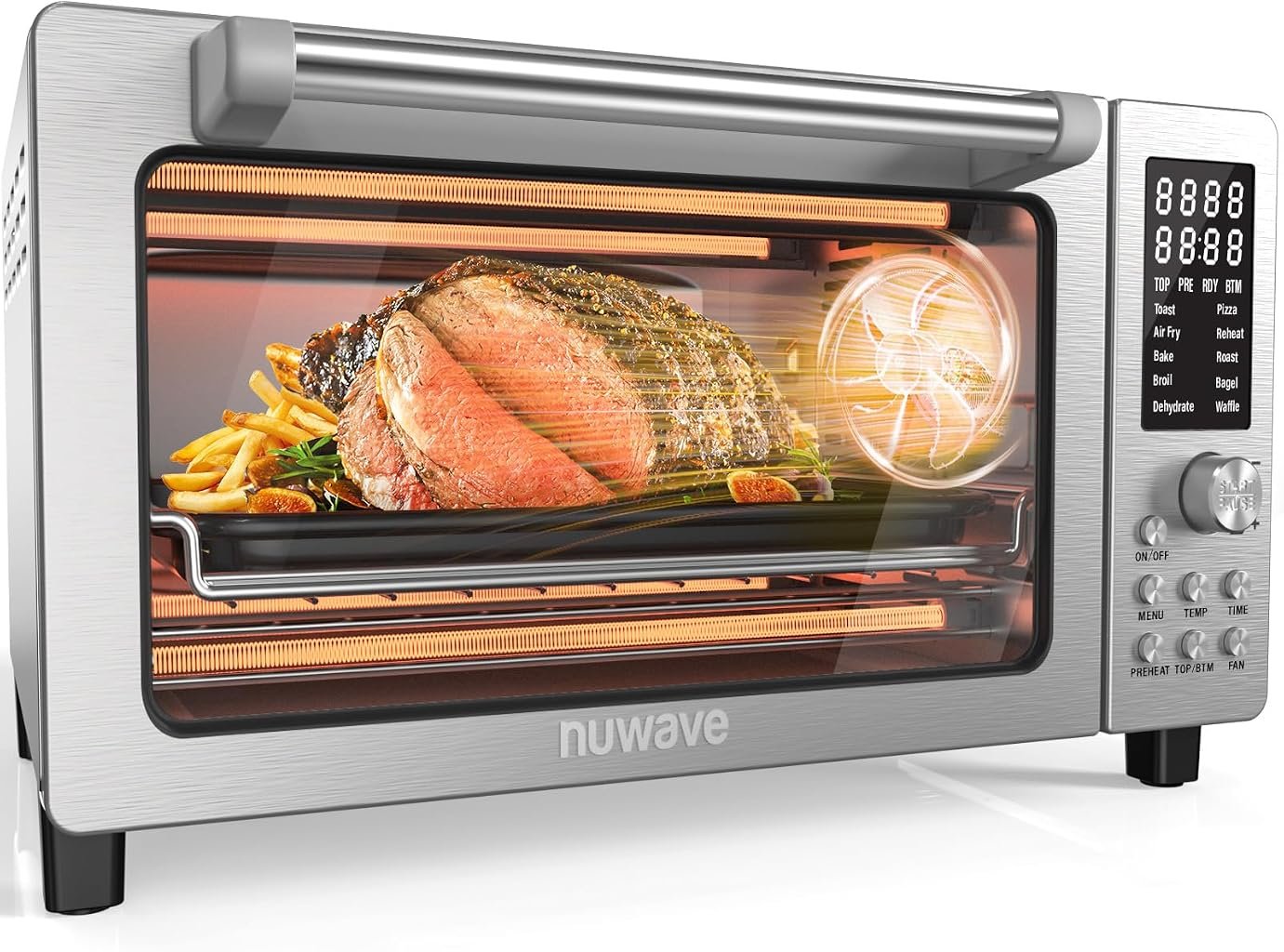
The Nuwave Bravo Pro Smart Air Fryer Toaster Oven belongs to a branch of countertop cooking that rejects simplicity as the primary objective. Many air fryers ask the user to select a temperature, choose a time, and press start. The Bravo Pro Smart adds another layer: control over how heat reaches the food.
That distinction defines the appliance more accurately than its lengthy name. This is a countertop convection oven with air frying, but it also permits adjustment of upper and lower heating behavior and fan speed. The cook can therefore alter not only temperature and duration but the distribution and movement of heat inside the chamber.
Documentation for the 21-quart Bravo Pro Smart identifies a 1,800-watt appliance with a temperature range from 50°F to 450°F, adjustable in 5°F increments. The oven provides a set of programmed cooking modes while retaining manual control over temperature, time, fan operation, and the balance between upper and lower heaters.
Our score is 8.4/10. Customer Sentiment stands at 8.06, Buyer Confidence at 9.8, and Value at 8.03. Those ratings describe an appliance with substantial technical flexibility and a well-defined feature set, offset by a control system that asks more of its owner than a basic basket air fryer or mechanical toaster oven.
At the $125.99 reference price used for this assessment, the Bravo Pro Smart makes the most sense for cooks who will actually use its unusually broad heat controls. Someone seeking little more than frozen fries and reheated pizza can buy a simpler machine. Someone interested in adjusting convection strength and changing the relationship between upper and lower heat has far more to work with here.
A 21-Quart Oven With a Different Philosophy
The Bravo Pro Smart is fundamentally a countertop oven rather than a basket air fryer enlarged into another shape.
Its 21-quart chamber provides room for foods that benefit from a broad horizontal cooking surface. Documentation for this Bravo Pro Smart family describes capacity for a 12-inch pizza and six slices of bread, while the included equipment typically consists of a cooking rack, baking pan, air-fry basket, and crumb tray.
That immediately places the machine in a different category from compact drawer-style fryers.
A basket air fryer is designed around one highly effective physical arrangement: a relatively small chamber, intense convection, and food held in a perforated basket. The Nuwave has to perform a wider collection of jobs. It must toast, bake, broil, reheat, air fry, handle pizza, work at low temperatures, and accommodate foods that would be awkward inside a deep basket.
The compromise is predictable. More versatility means more controls, more accessories, a larger physical footprint, and a greater learning burden.
The benefit is equally straightforward. One appliance can handle jobs that might otherwise require a toaster, air fryer, and countertop oven.
The Temperature Range Is Genuinely Broad
A temperature range of 50°F to 450°F gives the Bravo Pro Smart far more flexibility than a machine designed only for high-temperature crisping.
At the upper end, 450°F supports pizza, broiling, browning, and other high-heat cooking. The lower end changes the nature of the appliance. Fifty degrees Fahrenheit is far below ordinary baking temperatures and allows the controls to support long, gentle processes that would be impossible on an air fryer whose operating range begins around 170°F or 180°F.
The controls adjust temperature in 5°F increments. That degree of granularity is useful not because every recipe requires laboratory-level precision, but because it allows the cook to make small changes without being restricted to broad preset steps.
The Bravo Pro Smart operating documentation also states that temperature can be altered while cooking rather than requiring the cycle to be stopped and restarted.
That feature fits the appliance’s broader philosophy. The Bravo Pro Smart is designed around intervention. It expects the cook to observe food and modify settings when necessary.
For experienced cooks, that can be liberating. For someone who wants a single button labeled “fries,” it can feel unnecessarily elaborate.
Adjustable Top and Bottom Heat Is the Defining Feature
The ability to change upper and lower heat distribution is where the Bravo Pro Smart becomes more interesting than an ordinary air-fry toaster oven.
Many countertop ovens determine heating-element behavior automatically. The user selects Bake, Broil, Toast, or Air Fry, and the appliance decides which elements operate and how aggressively.
The Nuwave allows more direct involvement.
Bravo Pro documentation describes TOP/BTM control that changes the balance between the upper and lower heating elements. Some versions allow adjustment in 10-percentage-point increments.
This matters because the upper and lower surfaces of food do not always need equal treatment.
Consider pizza. Too much upper heat can darken cheese before a thick crust develops enough color underneath. Excessive lower heat can produce the reverse problem. A cook able to alter the heat balance can respond to what the food is actually doing rather than accepting a fixed heating pattern.
The same principle applies to baked foods. A dish browning too rapidly on top may benefit from less upper heat. A pale bottom crust can call for more energy from below.
This does not guarantee perfect results. Control is not the same thing as automatic accuracy. It does, however, give the user a mechanism for correcting a problem that many ovens force them to solve by moving racks, covering food with foil, or changing overall temperature.
Fan Control Makes Convection Less Binary
Convection is often presented as an on-or-off feature. The Bravo Pro Smart takes a more adjustable approach.
Its controls provide multiple fan settings, ranging from no fan to progressively stronger airflow. Documentation identifies FAN3 as the fastest setting, with lower FAN2 and FAN1 levels and FAN0 switching the fan off.
That is a meaningful capability.
Strong convection is desirable during air frying because rapid airflow increases heat transfer and helps remove moisture from food surfaces. Those effects encourage browning and crisping.
The same airflow is not automatically ideal for every cooking task. Delicate foods can behave differently under aggressive convection, while traditional baking sometimes benefits from gentler air movement.
Variable fan control therefore gives the oven a wider personality than a dedicated air fryer.
This is also where comparisons with the best air fryers become more nuanced. A strong basket fryer can be exceptionally effective at one job because its chamber, fan, basket, and heating system are all arranged around rapid convection. The Bravo Pro Smart accepts a larger chamber and more complicated controls in exchange for the ability to change its behavior.
Neither approach is inherently superior. They address different kitchens.
Presets Are Only the Starting Point
The Bravo Pro family includes programmed modes covering familiar tasks such as Air Fry, Toast, Pizza, Bake, Bagel, Broil, Roast or Grill depending on version, Waffle, Dehydrate, and Reheat. Some variants also expose Frozen and Keep Warm functions in their menu structure.
The exact appeal of these presets is not that they eliminate cooking judgment.
A preset supplies a starting configuration. Food size, moisture, quantity, starting temperature, rack position, and personal preference can all change the required cooking time.
The more important capability is that the Bravo Pro Smart does not trap the user inside those defaults. Temperature and time can be changed, fan behavior can be modified, and heat distribution can be adjusted.
That separates a useful preset from an inflexible one.
The result is an unusual combination. A novice can begin with programmed settings, while a more experienced cook can gradually move toward manual adjustments.
There is a cost: the control panel contains more concepts to learn than a basic oven with three knobs.
The Learning Curve Is Real
More control creates more decisions.
A conventional toaster oven may have a temperature dial, function dial, and timer. The Bravo Pro Smart asks the user to understand menu selection, temperature, time, fan speed, preheating, and upper-versus-lower heat distribution.
None of these controls is individually difficult. Their combination creates the learning curve.
A new owner preparing a pizza could simply choose the Pizza mode and begin cooking. A more involved user might alter the temperature, change the fan speed, adjust top and bottom heat, modify the cooking time, and select a rack position.
The appliance therefore rewards familiarity.
This is not necessarily a defect. Cameras with manual controls are more complicated than point-and-shoot models for the same reason: control requires choices. The problem appears only when buyers pay for those choices and never use them.
For households that prefer pressing one button and walking away, much of the Bravo Pro Smart’s engineering will be wasted.
Air Frying Still Depends on Food Arrangement
No amount of electronic control repeals the basic physics of air frying.
Hot air must reach exposed food surfaces. A perforated air-fry basket helps by allowing airflow around and beneath ingredients, but overcrowding can still reduce crisping.
A pile of frozen fries several layers deep presents a different airflow problem from the same quantity spread across a broad surface. Moisture escaping from one piece can affect neighboring food, while hidden surfaces receive less direct moving air.
The Bravo Pro Smart’s oven-style basket provides a relatively wide cooking surface. That can be useful for foods that benefit from being spread rather than stacked.
The trade-off is that the oven cavity is larger than the compact chamber surrounding food in many dedicated basket models.
Anyone buying primarily for air frying should therefore think in terms of batch shape rather than capacity alone. Wide, relatively shallow batches suit oven-style air frying particularly well.
Pizza Is Where the Heat Controls Become Easy to Understand
Pizza offers perhaps the clearest example of why independent heat control matters.
A pizza is two cooking problems stacked vertically. The crust needs enough energy from below to become structured and browned, while cheese and toppings need heat from above. Those processes do not always progress at the same rate.
Nuwave’s adjustable upper and lower heater system allows that balance to be changed. The guidance for the Bravo Pro family specifically discusses varying heater ratios for pizza styles, illustrating the intended purpose of the feature.
This is more useful than simply adding another pizza preset.
A preset assumes a generalized pizza. Adjustable heat recognizes that a thin frozen pizza, a thick fresh pizza, and a heavily topped pizza behave differently.
The same reasoning carries into other foods. Browning the surface and cooking the underside are separate thermal problems. The Bravo Pro Smart gives the cook direct access to that relationship.
Low-Temperature Cooking Expands Its Usefulness
The 50°F lower temperature boundary broadens the oven’s potential beyond conventional baking and air frying.
Dehydration is the obvious example. Removing moisture effectively requires relatively low heat over extended periods rather than the aggressive temperatures used for roasting or crisping.
The oven’s time controls also change according to temperature. Documentation for the Bravo family permits very long operation at lower temperatures, shorter maximum durations through the middle of the temperature range, and a one-hour maximum at the highest settings.
That graduated arrangement makes practical sense. Dehydration can require many hours. High-temperature broiling does not.
The low end of the range also gives the appliance greater flexibility for warming and other gentle heating tasks.
This breadth matters when assessing value. A machine used only at 400°F for fries is leaving a large portion of its capability untouched.
Capacity Should Be Judged by What Fits
The 21-quart label provides a useful category reference, but usable geometry matters more than volume alone.
A 12-inch pizza and six slices of bread communicate the chamber’s practical scale more clearly. Those foods require horizontal area, which is one of the main advantages of the oven format.
The appliance is therefore large enough to move beyond single-serving cooking without reaching the dimensions of a conventional range oven.
That middle position is appealing but not cost-free.
A 21-quart countertop oven requires dedicated space. It is not the sort of appliance most households will want to retrieve from a high cabinet every morning and return after dinner.
Potential owners should measure the intended counter location, including depth and ventilation space, before assuming the machine will fit comfortably.
Countertop capacity is always purchased with countertop area.
Accessories Matter More Than They First Appear
The Bravo Pro Smart’s cooking rack, baking pan, air-fry basket, and crumb tray are functional components rather than decorative extras.
The air-fry basket maximizes exposed area for convection. The baking pan contains foods and catches liquids. The rack supports cookware and determines vertical position. The crumb tray collects debris below the main cooking area.
Rack position deserves particular attention.
Food placed closer to an upper heating element receives stronger radiant exposure. Moving it lower changes the relationship between top heat, bottom heat, and airflow. When an oven also allows electronic adjustment of heating-element balance, rack placement becomes another variable in the cooking process.
This sounds complicated because it can be.
The advantage is that the Bravo Pro Smart gives cooks several ways to correct uneven browning. The disadvantage is that users have to learn which adjustment solves which problem.
Cleaning Is the Price of Oven-Style Versatility
A countertop air-fry oven exposes more surfaces to food residue than most drawer-style machines.
Grease can reach the basket, rack, baking pan, crumb tray, door, and interior walls. High-speed airflow can move small crumbs and droplets beyond the accessory holding the food.
The removable crumb tray reduces some of that burden, but routine maintenance remains necessary.
This is especially relevant when cooking fatty foods in the mesh basket. A baking or drip pan positioned appropriately below can intercept material that would otherwise reach the bottom of the oven.
Frequent cleaning also prevents repeated heating from turning grease into darker, harder residue.
The trade is familiar across this category. Basket air fryers usually concentrate mess in fewer removable components. Air-fry toaster ovens expose a larger chamber but provide far greater cooking flexibility.
Our 8.4/10 Score Reflects Control With a Cost
Our score of 8.4/10 reflects an appliance with an unusually adjustable cooking system.
The 50°F-to-450°F temperature range is broad. Five-degree adjustment increments allow fine changes. Multiple fan settings make convection variable rather than binary. Adjustable upper and lower heat gives the user another tool for controlling browning. A 21-quart oven chamber provides enough scale for a 12-inch pizza and six slices of toast.
The score also recognizes the burden attached to those capabilities.
The Bravo Pro Smart is more complicated than a three-knob toaster oven. It requires more counter space than a compact basket fryer. Oven-style air frying creates a broader cleaning job. Owners who never alter fan speed or heat distribution will receive little benefit from two of its defining controls.
An 8.4 rating therefore represents substantial capability rather than universal suitability.
Customer Sentiment at 8.06 Reflects Everyday Friction
Customer Sentiment stands at 8.06, modestly below our overall score.
That gap reflects the difference between engineering potential and daily interaction.
A highly adjustable oven can produce a satisfying ownership experience for someone interested in controlling heat. The same interface can frustrate a person who simply wants dinner started with minimal thought.
Cleaning also matters more after the hundredth meal than it does while reading a feature list. So does countertop space. So does remembering which fan setting or rack position worked well for a particular food.
The 8.06 figure reflects a favorable ownership proposition with meaningful friction attached.
The Bravo Pro Smart rewards participation. That is an advantage only when the owner wants to participate.
Buyer Confidence at 9.8 Is the Strongest Rating
Buyer Confidence reaches 9.8.
The Bravo Pro Smart has a clearly documented operating system. Its temperature range, fan controls, adjustable heating distribution, menu structure, rack positions, and accessory arrangement are described in available product manuals. The control logic is unusually transparent once the documentation is examined.
The Bravo Pro owner documentation, for example, identifies the cooking rack, baking pan, air-fry basket, crumb tray, rack positions, menu settings, temperature controls, and heating behavior.
That level of documentation reduces ambiguity about what the appliance actually does.
A high Buyer Confidence score should not be interpreted as a prediction that every unit will operate indefinitely without failure. It reflects confidence in product identity, specifications, and the clarity of the buying proposition.
Value at 8.03 Depends on Using the Advanced Controls
Our Value score is 8.03 at the $125.99 reference price.
That rating is closely tied to utilization.
If the Bravo Pro Smart replaces a toaster, countertop oven, and air fryer while also handling dehydration, pizza, broiling, and reheating, its value proposition becomes substantially stronger.
If it is purchased to make fries twice a week, much of the appliance is unnecessary.
The adjustable fan and heating-element controls sharpen this distinction. They are unusual capabilities at this price level, but unused capabilities do not create practical value.
The strongest buyer therefore is not necessarily the person who cooks the most. It is the person likely to exploit several different forms of heat control.
Who Should Consider the Bravo Pro Smart
The appliance fits cooks who want more authority over countertop cooking without moving to a full-size oven.
Pizza makers can benefit from changing upper and lower heat. Air-fryer users can employ stronger convection. Bakers can reduce fan intensity. Low-temperature cooking extends the machine’s usefulness into dehydration and gentle warming.
It also makes sense for households trying to consolidate appliances.
A single countertop machine capable of toast, air frying, pizza, baking, broiling, reheating, and dehydration can reduce the need for several smaller devices, provided the household actually uses those functions.
The 21-quart format is particularly appropriate for users who find small basket fryers restrictive but do not need an oversized countertop oven.
Who Should Choose Something Simpler
The Bravo Pro Smart is harder to justify for buyers who value minimal interaction above flexibility.
A basic basket fryer can make frozen fries, vegetables, wings, and other small foods with fewer decisions. A mechanical toaster oven can handle toast and basic baking without requiring the user to think about fan speed or heater ratios.
The Nuwave also asks for permanent counter space. Buyers whose kitchens already feel crowded should weigh the cost of that footprint against the number of appliances it could replace.
Its advanced controls are therefore both the reason to buy it and the reason some households should not.
A feature only improves an appliance when the user benefits from having it.
Final Considerations
The Nuwave Bravo Pro Smart Air Fryer Toaster Oven is a 21-quart countertop oven built around unusually adjustable heat management.
Its 50°F-to-450°F operating range, 5°F temperature increments, variable convection fan, adjustable upper and lower heating behavior, broad cooking menu, and oven-style capacity create more manual authority than many countertop air fryers offer.
Those features make the Bravo Pro Smart particularly interesting for cooks who notice why food is browning unevenly and want a direct way to respond. More bottom heat, less top heat, stronger convection, gentler convection, a different rack position, or a small temperature adjustment are all available as deliberate choices.
That control is not free. The interface requires learning. The 21-quart body needs countertop space. Cleaning is more involved than washing a removable fryer drawer. A user who never moves beyond default presets may own considerably more machine than necessary.
Our 8.4/10 score reflects that balance. Customer Sentiment at 8.06 recognizes the friction created by complexity, space, and maintenance. Buyer Confidence at 9.8 reflects the unusually clear documentation of the appliance’s functions and controls. Value at 8.03 reflects a favorable proposition at the $125.99 reference price when its broader capabilities are actually used.
The Bravo Pro Smart is therefore not compelling because it promises to remove every decision from cooking. Its identity points in the opposite direction.
It gives the cook more decisions to make.
For households seeking maximum simplicity, that can be unnecessary. For cooks who have encountered pale pizza crusts, over-browned toppings, convection that feels too aggressive, or countertop ovens with too little control, those additional decisions can be precisely what makes the appliance useful.
The defining question is not whether the Nuwave can air fry. Many appliances can. The more revealing question is whether the owner wants to control how the oven applies heat after the Air Fry button has already been pressed.