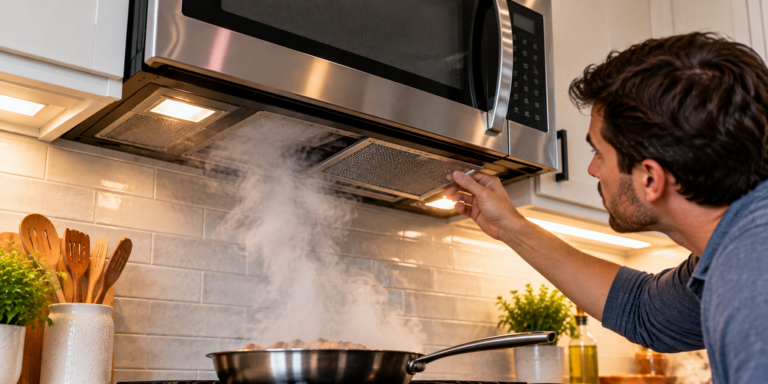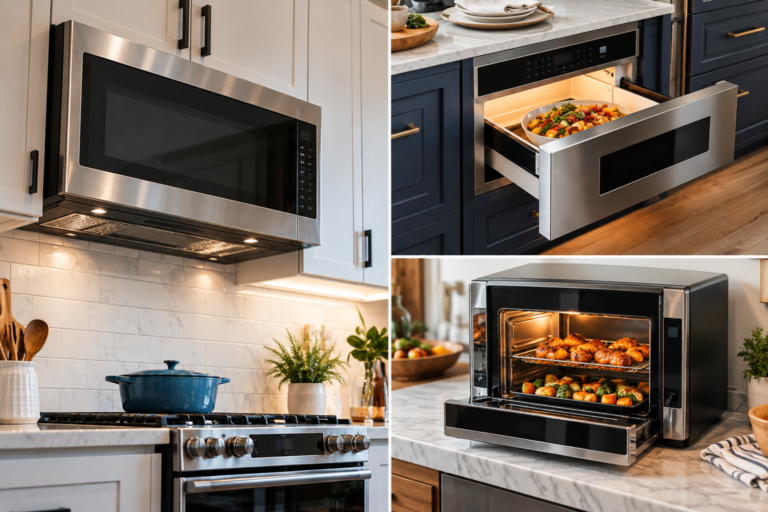
The argument between a basket air fryer and an air fryer toaster oven is often framed as though two different cooking technologies are fighting for countertop supremacy. Mechanically, the distinction is less dramatic. Both appliances circulate heated air around food. The more revealing differences involve geometry, usable cooking area, airflow, access, batch size and what else the appliance is expected to do.
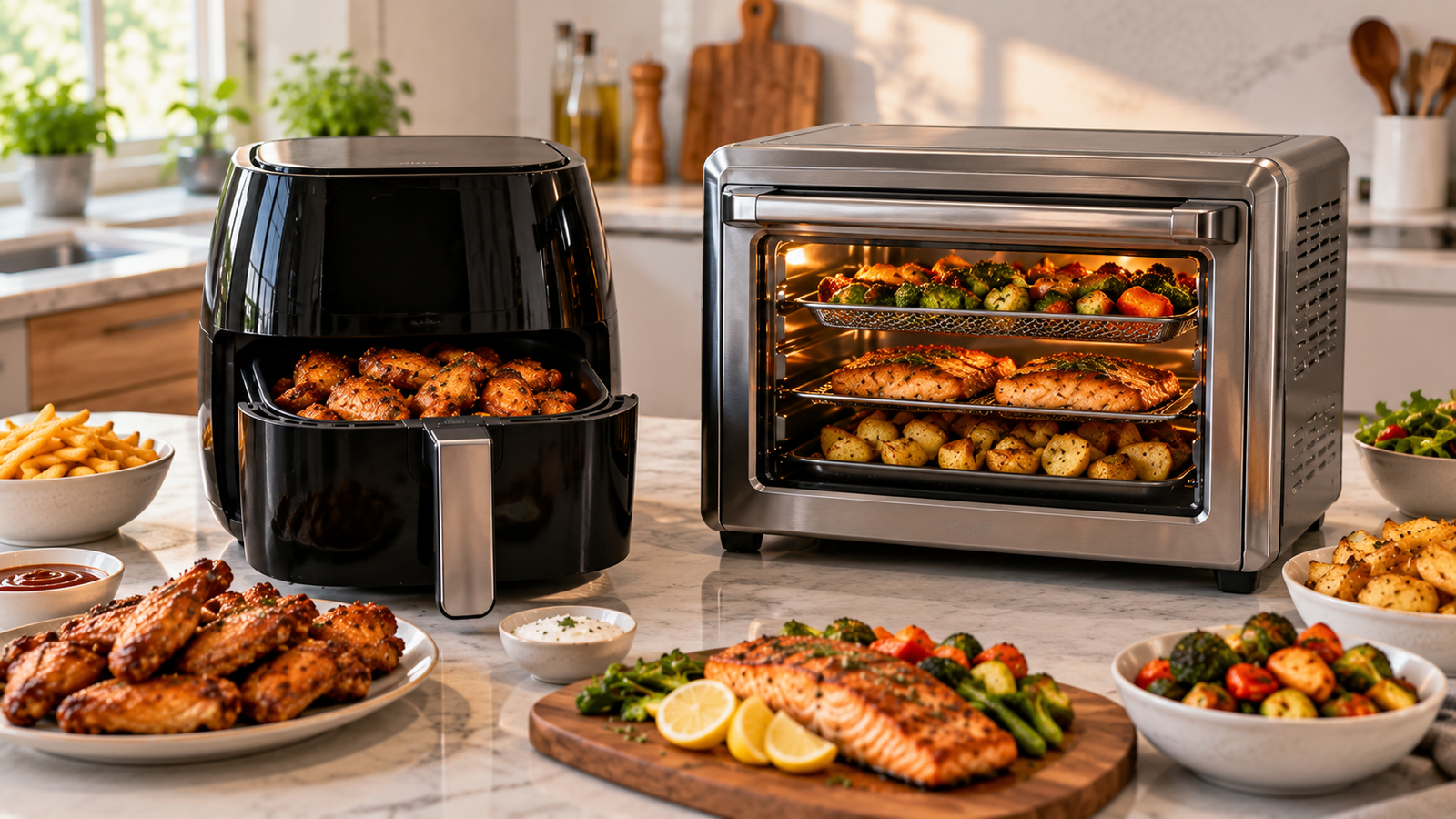
That distinction matters because “air fryer” describes a cooking method more effectively than it describes a single appliance shape. The USDA describes air fryers as essentially countertop convection ovens, using rapidly circulating hot air to heat and crisp food. A basket model packages that process into a relatively compact drawer. An air fryer toaster oven spreads the cooking chamber horizontally and adds the door, racks and broader functions associated with a countertop oven.
That architectural difference changes far more than appearance.
Basket models tend to make sense when air frying itself is the priority: smaller batches, frozen foods, vegetables, wings, reheating and frequent short cooking cycles. Air fryer toaster ovens become more compelling when the appliance is also expected to toast bread, accommodate wider foods, bake in conventional pans or perform duties that might otherwise require a separate toaster oven.
Neither design has an automatic claim to superiority. The useful question is what happens when hot-air cooking meets the dimensions and habits of an actual household.
The Two Formats at a Glance
| Decision Factor | Basket Air Fryer | Air Fryer Toaster Oven |
|---|---|---|
| Basic cooking method | Rapid hot-air circulation | Rapid hot-air circulation |
| Cooking vessel | Pull-out basket or drawer | Rack, tray or basket inside oven cavity |
| Typical strength | Focused air-frying workflow | Multi-function countertop cooking |
| Food access | Pull out basket | Open front door |
| Food arrangement | Often deeper and more compact | Usually broader, flatter cooking area |
| Toasting | Model-dependent, uncommon on basic units | Common |
| Baking | Possible, but container dimensions are restrictive | Generally more flexible |
| Visibility while cooking | Often limited unless window-equipped | Usually easier through glass door |
| Batch strategy | May require multiple loads | Wider cavity can suit larger or flatter foods |
| Cleaning | Basket and insert are often removable | Racks, trays, basket, crumb tray and cavity require attention |
| Counter-space profile | Often narrower | Often wider |
| Best fit | Air-frying-first households | Multi-function-oven households |
The table exposes the real dispute. A basket air fryer concentrates the design around one primary process. An air fryer toaster oven distributes its engineering across several cooking jobs.
That can make the simpler appliance more effective for one kitchen and the more flexible appliance more useful for another.
Air Frying Is Convection With Different Priorities
The phrase “air frying” creates an impression of a cooking process fundamentally separate from oven cooking. The physics are more familiar.
A heating element raises air temperature while a fan moves that heated air around food. Heat reaches the food through several mechanisms, including convection and radiation, while moisture evaporates from the surface. Browning reactions then help produce the color, aroma and crust associated with roasted and fried foods.
The USDA says foods in an air fryer generally require about 5 to 25 minutes at 350°F to 400°F, while emphasizing that individual appliances vary and safe internal temperatures still need to be verified.
A basket air fryer tends to place food relatively close to the heat source and moving air within a small cavity. The perforated basket exposes multiple surfaces to circulation.
An air fryer toaster oven uses the same broad principle but operates in a larger chamber. Food commonly sits on a mesh basket, rack or tray. The expanded cavity creates room for foods that would be awkward inside a deep drawer.
The design trade-off is therefore concentration versus flexibility.
Heating a compact chamber can be advantageous for modest portions. Expanding the chamber provides more usable geometry but also increases the amount of interior space the appliance must manage.
Basket Geometry Is More Important Than Advertised Volume
Capacity numbers can be deceptive.
A manufacturer might describe a basket air fryer in quarts or liters, but food does not cook in abstract volume. A pile of French fries uses space differently from chicken breasts. Four burgers need surface area rather than depth. A piece of fish may fit by weight yet fail to fit comfortably by length.
The USDA explicitly warns against overfilling an air-fryer basket because crowding can interfere with air circulation and lead to uneven cooking or undercooking.
That advice points to one of the most useful purchasing principles: usable floor area can matter more than headline capacity.
A tall, narrow basket can advertise substantial volume while forcing food into layers. A broad basket may accommodate the same meal in a shallower arrangement.
This is also why shaking food midway through cooking is common with basket machines. Fries, nuggets and vegetables can overlap, leaving some surfaces less exposed to moving air. Shaking redistributes them.
Air fryer toaster ovens approach the problem differently. A broad mesh tray can spread food across a larger horizontal surface. That geometry can be convenient for items such as fish fillets, open-faced sandwiches, pizza, flatbreads or rows of vegetables.
Yet spreading food over a wider tray does not guarantee superior browning. Fan strength, heating-element placement, rack position, temperature control and food load all affect results.
Shape is an opportunity, not a performance guarantee.
Basket Air Fryers Favor Focused, Repetitive Cooking
The basket format is particularly coherent when the appliance has a narrow job description.
Consider a household that regularly cooks frozen fries, chicken pieces, roasted broccoli and reheated leftovers. A drawer can be loaded, inserted and removed with little ceremony. There is no oven rack to reposition and no large door to open.
That workflow has practical value because frequency changes the definition of convenience. An appliance used five times a week is judged differently from one used twice a month.
Basket models can also be attractive in narrow kitchens. They commonly trade width for height and depth, although individual dimensions vary considerably. The critical measurement is not merely whether the machine fits the counter. Space is also needed for ventilation and safe operation according to the manufacturer’s instructions.
Drawer clearance matters too. A basket must travel outward. A machine that technically fits beneath a cabinet may still be irritating if the user cannot comfortably pull the basket out and place it somewhere when hot.
The format therefore rewards buyers who examine workflow rather than capacity alone.
Air Fryer Toaster Ovens Make a Different Space Argument
An air fryer toaster oven is usually harder to classify as a single-purpose appliance.
Its front door reveals the underlying proposition. It is an oven first in physical architecture, with air frying integrated into that platform.
That makes wider foods easier to accommodate. Toast is an obvious example. So are pizzas, casseroles, baking dishes and foods that benefit from lying flat rather than being stacked in a basket.
The trade is exterior size.
Air fryer toaster ovens can claim a substantial section of countertop because their internal usefulness depends on width. That can be justified when they replace a conventional toaster and perhaps reduce use of a full-size oven. It becomes harder to defend when a household already owns appliances performing those tasks and only wants a machine for fries and vegetables.
Counter space is not free merely because it lacks a price tag.
A useful comparison therefore asks how many existing appliances the toaster-oven format can genuinely displace. If the answer is “none,” its broader capability may become redundant. If it replaces both a toaster and a smaller convection oven while adding air frying, its footprint tells a different story.
Energy Efficiency Depends Heavily on Portion Size
Air fryers are frequently associated with lower energy consumption, but the explanation is primarily physical rather than mysterious. A smaller cooking chamber can require less energy than heating a large conventional oven for a modest quantity of food.
The Energy Saving Trust estimates that cooking accounts for around 3% of an average home’s energy use and reports that an air fryer can be cheaper to operate than an electric oven when preparing the same small meal. Its example puts cooking 600 grams of chicken breast at £0.14 in an air fryer versus £0.20 in an electric oven in Great Britain.
Independent consumer testing illustrates the same principle. In a 2026 comparison, Which? measured 0.287 kWh to cook 320 grams of frozen chips in a basket air fryer, compared with 0.863 kWh in the built-in electric oven used for the test. The air fryer took 23 minutes; the oven took 33.
Those numbers should not be generalized into a universal percentage saving. Appliance size, wattage, food quantity, preheating, cooking duration and electricity price all alter the calculation.
Batching is especially consequential.
A small basket may use relatively little energy per cycle, yet cooking three consecutive loads changes the arithmetic. Which? science team leader Steph Kipling summarizes the limitation precisely: “However, the savings soon drop off if you have to cook in batches, so an oven may still be the most economical choice when cooking for a crowd.”
That observation applies directly to the basket-versus-toaster-oven decision. The smallest chamber is not necessarily the lowest-energy solution when it has to repeat the job several times.
The Air Fryer Toaster Oven Can Win Through Consolidation
Running cost is only one form of efficiency.
Kitchen efficiency also involves the number of appliances purchased, stored, cleaned and navigated.
A basket air fryer and a toaster sitting side by side may collectively consume more useful counter area than one appropriately sized air fryer toaster oven. Conversely, replacing a compact basket with a huge multi-function oven can create wasted capacity.
The decision becomes a small exercise in household logistics.
An air fryer toaster oven makes particular sense when toast is prepared frequently and conventional baking functions are genuinely useful. Some models add broiling, roasting, dehydration, proofing or slow cooking, though capabilities vary and buyers should treat each feature individually rather than assuming every oven-format air fryer includes it.
The basket model makes a cleaner argument when those functions already exist elsewhere or are irrelevant.
This is why lists of the best air fryers increasingly contain radically different shapes. They are solving overlapping rather than identical problems.
Air Frying Does Not Make Food Automatically Healthy
Health claims deserve similar restraint.
Air frying is often compared with deep-fat frying, and the reduction in cooking oil can be substantial. A 2015 study comparing air-fried and deep-fat-fried French fries reported substantially lower fat content in the air-fried product, though air frying required considerably longer processing in that experiment: about 21 minutes compared with nine minutes for deep-fat frying.
That supports a narrow proposition: replacing immersion frying with hot-air cooking can greatly reduce the amount of frying oil involved.
It does not turn every air-fried food into a nutritionally equivalent product.
Frozen breaded foods still contain whatever fat, sodium and refined ingredients were present before entering the appliance. Vegetables do not acquire additional nutrients merely because the fan is powerful. Portion size remains portion size.
Acrylamide provides an even stronger warning against simplistic health claims.
One 2015 potato study found air frying reduced acrylamide by about 90% compared with conventional deep-oil frying under its experimental conditions. A later study published in 2024 found the highest mean acrylamide measurement in its air-fried potatoes, followed by deep frying and oven frying, although differences between cooking methods were not statistically significant.
The apparent contradiction is informative rather than inconvenient. Acrylamide formation is affected by food composition, pretreatment, temperature, time and browning. “Air fried” is not enough information to predict a single chemical outcome.
The more defensible health advantage is straightforward: air frying makes it possible to produce browned, crisp foods with substantially less added oil than deep-fat immersion frying in many preparations.
Indoor Air Quality Adds Another Dimension
High-temperature cooking affects the kitchen environment as well as the food.
A University of Birmingham study compared emissions from several cooking methods and found air frying produced substantially lower particulate matter and volatile organic compound emissions than pan frying, stir-frying and deep-fat frying under the study’s controlled conditions. The researchers used a campus research kitchen intended to approximate domestic cooking more closely than a laboratory chamber.
That does not establish that every air fryer is pollution-free or that basket and toaster-oven formats emit identical levels. Food composition, grease, temperature and appliance design can change emissions.
Ventilation still matters. The Energy Saving Trust recommends keeping kitchens well ventilated when cooking at high temperatures, including when using an air fryer.
This is another reason to resist the idea that countertop electric cooking somehow removes ordinary kitchen-safety considerations.
Cleaning Can Decide Which Appliance Actually Gets Used
Cooking performance receives most of the attention before purchase. Cleaning often determines usage after purchase.
Basket machines have an obvious advantage in containment. Grease, crumbs and food debris tend to collect inside a removable basket and drawer. Many models have removable inserts, and some manufacturers permit dishwasher cleaning of specific components.
The disadvantage is geometry. Mesh, perforations, corners and nonstick surfaces can collect residue. Abrasive cleaning may damage coatings, so manufacturer instructions matter.
Air fryer toaster ovens spread the mess across more components. Crumbs can reach the crumb tray. Grease can land on racks, mesh baskets, trays, walls and the door. High-fat foods can create splatter.
Their advantage is access. Opening a large front door can make the cavity easier to see and reach than the deep interior around a basket mechanism.
No universal winner exists here. The relevant question is what kind of cleaning a household dislikes more: washing a basket frequently or periodically cleaning a larger oven cavity and several accessories.
Food Visibility Is a Small but Persistent Difference
Traditional basket fryers hide the food while the drawer is closed.
That encourages cooking by time, smell and periodic inspection. Opening the drawer generally pauses cooking on modern models, but repeated checking can still interrupt the process.
Newer basket models sometimes incorporate windows, reducing that disadvantage.
Air fryer toaster ovens generally have glass doors. Food can be inspected without opening the appliance, particularly when an interior light is present.
This sounds minor until the appliance is used daily.
Browning is visual. Cheese can move from melted to scorched quickly. Toast changes by the minute. Pastries reveal doneness through color and expansion. Visibility gives the cook information without disturbing the chamber.
For foods that are shaken halfway through cooking, however, the basket mechanism remains highly convenient. Pulling out a drawer and tossing fries can be simpler than removing or manipulating a hot oven tray.
The formats reward different interactions.
Safety Still Requires a Thermometer and Attention
An air fryer is not a substitute for food-safety verification.
The USDA advises users to avoid overfilling the basket and to measure safe internal temperatures with a food thermometer. Its guidance lists 145°F for fish; 145°F plus a three-minute rest for whole cuts of beef, pork, veal and lamb; 160°F for ground meats; and 165°F for poultry.
Those rules apply regardless of whether the food is cooked in a basket or on a tray.
A browned exterior can create false confidence because surface color does not reveal the temperature at the center of thick meat.
Fire safety also deserves ordinary caution. The National Fire Protection Association states that cooking is the leading cause of home fires and home fire injuries, and identifies unattended cooking as the leading cause of kitchen fires. Its guidance advises regular checking during baking and roasting and keeping combustible materials away from cooking areas.
Countertop convenience should therefore not be interpreted as permission to ignore a hot appliance.
When a Basket Air Fryer Makes More Sense
The basket format aligns especially well with households that define the appliance primarily through air frying.
Its advantages become more relevant when:
- Most meals involve one or two people.
- Fries, vegetables, wings, nuggets and reheated foods dominate usage.
- Short, frequent cooking sessions are common.
- Narrower counter width is preferable.
- Toasting is handled elsewhere.
- Large baking dishes and wide foods are uncommon.
- Shaking food midway through cooking feels easier than handling trays.
- A removable cooking drawer matches the preferred cleaning routine.
A buyer in this category should examine basket shape closely. Square, broad baskets often use their nominal capacity more practically than narrow designs when cooking foods that benefit from a single layer.
The advertised quart or liter figure should be treated as one measurement, not the entire capacity story.
When an Air Fryer Toaster Oven Makes More Sense
The toaster-oven format better matches a household asking one appliance to perform several distinct jobs.
Its advantages become more relevant when:
- Toast is made frequently.
- Pizza, flatbreads or open-faced foods are routine.
- Baking dishes need to fit.
- A broad cooking surface matters more than basket depth.
- Food visibility is valued.
- Several oven-style cooking modes will genuinely be used.
- The appliance can replace an existing toaster or countertop oven.
- Sufficient permanent counter space is available.
Buyers should pay particular attention to usable rack dimensions rather than exterior capacity language alone.
They should also inspect what “air fry” physically means on a particular model. A mesh basket supplied with the oven can expose food to airflow more effectively than a solid baking tray, but the manufacturer may specify particular rack positions and loading limits.
Those instructions are part of the appliance’s design, not administrative clutter.
The Better Buying Method Starts With Dinner
Choosing between these formats becomes easier when specifications are temporarily ignored.
A household can write down ten meals or snacks it expects the appliance to prepare most often. Then each meal can be translated into geometry.
French fries need exposed surface and shaking room. A pizza needs diameter. Chicken breasts need horizontal area. Toast needs rack space. A casserole needs height, width and compatible cookware. A whole chicken needs three-dimensional clearance.
Only then do liters, quarts, wattage and preset counts become useful.
The same method works for household size. Cooking two portions once is different from cooking six portions across three sequential batches. Energy efficiency, time and convenience all change when the machine has to repeat itself.
This explains why a basket air fryer can feel exceptionally efficient for one household and oddly restrictive for another.
The appliance has not changed. The workload has.
Final Considerations
The basket air fryer and air fryer toaster oven are close relatives separated by architecture.
Both use concentrated hot-air circulation to cook food. Both can brown, roast, reheat and crisp. Neither should be confused with deep-fat frying, and neither format automatically guarantees better cooking results merely because it carries an air-fry setting.
The basket design concentrates the proposition. Its smaller chamber, pull-out drawer and perforated cooking vessel are well aligned with modest portions, frequent air frying and foods that benefit from shaking. For one- or two-person meals, that focus can also translate into attractive energy use compared with heating a much larger conventional oven.
The air fryer toaster oven expands the proposition. Its wider chamber, front door, racks and trays accommodate foods that do not naturally belong in a deep basket. Toast, pizza, baking dishes and flatter arrangements become easier to integrate into the same appliance. The cost is generally greater countertop commitment and a cleaning routine spread across more surfaces.
Energy comparisons reinforce rather than settle the argument. Small air fryers can use considerably less electricity than full-size ovens for small meals, but repeated batches erode that advantage. A larger cooking chamber can become the more rational tool when the alternative is running a smaller appliance several times.
Health claims require equal discipline. Air frying can sharply reduce dependence on cooking oil compared with deep-fat frying, but chemical changes such as acrylamide formation depend on far more than the appliance label. Temperature, food composition, pretreatment, cooking duration and browning all matter.
The practical decision therefore begins with three measurements: food quantity, food shape and available counter space.
For households primarily seeking fast hot-air cooking of modest portions, a basket air fryer usually aligns more naturally with the job. For households seeking an appliance that also functions as a toaster, small oven and platform for wider foods, an air fryer toaster oven offers a more coherent use of its larger footprint.
The distinction is less glamorous than the marketing surrounding either category, but more useful. One design concentrates airflow around a basket. The other gives that airflow an oven-shaped room. The better choice is the one whose geometry matches what actually reaches the dinner table.