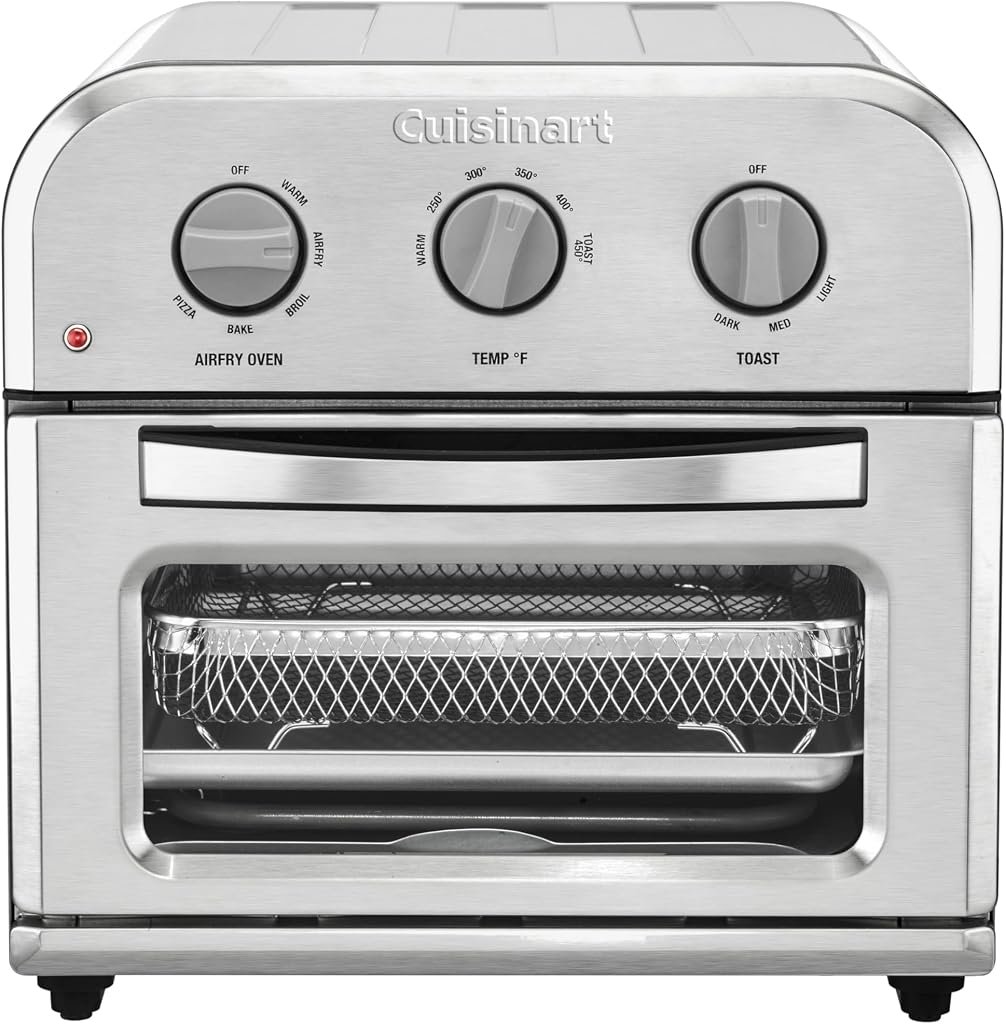
The Cuisinart Compact Air Fryer Toaster Oven TOA-26 approaches the air-fryer category from a different direction than the familiar pull-out-basket machine. Instead of asking a countertop appliance to do one principal job, Cuisinart packages air frying alongside convection baking, convection broiling, toasting, pizza cooking and warming in a stainless-steel countertop oven measuring 11.5 inches long, 12.5 inches wide and 11.5 inches high.
That combination explains much of the TOA-26’s appeal, but it also defines its compromises.
Our score is 8.1/10, placing the TOA-26 firmly in the very-good range. Customer Sentiment stands at 7.62/10, Value at 7.79/10 and Buyer Confidence at a notably higher 9.8/10. Those numbers describe an appliance with a fairly clear identity: this is a compact, multipurpose countertop oven from an established kitchen-appliance manufacturer, backed by a three-year limited warranty, but its relatively small cooking chamber and deliberately simple controls will not fit every household.
The result is more interesting than a generic air fryer with a different door attached. The TOA-26 is fundamentally a small oven that happens to air fry, and buyers should evaluate it accordingly.
A Small Countertop Oven With Six Cooking Functions
Cuisinart gives the TOA-26 six functions: Air Fry, Convection Bake, Convection Broil, Toast, Pizza and Warm. According to the manufacturer’s official TOA-26 specifications, the appliance can air fry as much as 2.5 pounds of food, offers adjustable heat up to 450°F and includes an air-fryer basket, baking/drip tray, oven rack and crumb tray.
That list reveals why comparisons with conventional basket air fryers can become misleading.
A basket machine is usually optimized around one chamber and one style of cooking. The TOA-26 instead provides a rack-based oven cavity with a viewing window. That arrangement gives users direct visual access to food and accommodates cooking formats beyond a deep basket.
The distinction matters in everyday use. Toast belongs naturally in a toaster-oven layout. Pizza also makes more conceptual sense on a rack or tray than inside a deep drawer. Broiling requires exposure to intense upper heat. Baking benefits from an oven-style cavity. Air frying, meanwhile, relies on heated moving air reaching exposed food surfaces.
Putting these jobs into one appliance reduces the number of countertop machines a kitchen might require. It does not mean every function will replace a dedicated appliance for every household.
That difference is central to this review.
Compact Really Does Mean Compact
The TOA-26 measures 11.5 by 12.5 by 11.5 inches and weighs 15 pounds. Its footprint is therefore one of its defining characteristics rather than an incidental specification.
Countertop appliances create a peculiar household problem. Consumers often buy them because they simplify cooking, then discover that three or four convenience appliances collectively consume an inconvenient amount of kitchen space.
The TOA-26 attempts to solve that problem through consolidation.
Its six modes potentially cover tasks that might otherwise involve a toaster, toaster oven and air fryer. For apartments, small kitchens, secondary kitchens, dorm-style spaces where permitted, or households reluctant to surrender large sections of countertop, that approach has obvious practical merit.
The trade-off is capacity.
Cuisinart specifies an air-frying capacity of up to 2.5 pounds. That is enough to make the TOA-26 materially more capable than a tiny personal appliance, but the word “compact” should still guide expectations. A buyer routinely preparing large batches for several people has different requirements from someone reheating leftovers, cooking vegetables, making toast or preparing smaller portions.
Compactness is not automatically an advantage. It is an exchange: less countertop consumption for less interior room.
The TOA-26 makes that exchange deliberately.
The Case for Oven-Style Air Frying
The proliferation of products marketed among the best air fryers has blurred distinctions between fundamentally different designs. Basket machines, dual-basket models and air-fryer toaster ovens all use rapidly circulated hot air, yet their physical layouts affect how owners interact with them.
The TOA-26 uses the toaster-oven format.
Its front viewing window is more useful than it may initially sound. Browning is not perfectly predictable. Thickness, moisture, sugar content, starting temperature and portion size can alter cooking behavior. A window permits a cook to inspect food without relying entirely on an electronic preset.
Cuisinart has also resisted turning the TOA-26 into a screen-dominated appliance. Its controls are straightforward and comparatively traditional.
That simplicity divides buyers into two camps.
Anyone accustomed to digital countdowns, multiple programmed foods and extensive automated settings may find the interface sparse. Someone who prefers selecting a cooking function and adjusting the appliance directly may see the same design as refreshingly uncomplicated.
Neither interpretation changes what the machine actually is. The TOA-26 favors manual interaction over software-heavy convenience.
That design decision helps explain why its Buyer Confidence score reaches 9.8/10 while Customer Sentiment is lower at 7.62/10. Our assessment is that the fundamental proposition is easy to understand and the manufacturer clearly documents the machine’s dimensions, capacity, functions, accessories and warranty. Satisfaction is more dependent on whether the buyer actually wants a compact manual-control toaster oven rather than a large digital basket fryer.
Temperature Range And Cooking Flexibility
The TOA-26 reaches 450°F, giving it the high-temperature capability expected of a countertop convection oven. That ceiling supports the browning-oriented jobs associated with air frying, pizza and broiling as well as conventional baking applications at lower settings.
Yet high heat deserves more thoughtful use than simply turning every air-fried food as dark and crisp as possible.
The U.S. Food and Drug Administration explains that acrylamide can form naturally in certain plant-based foods during high-temperature cooking, including frying, roasting and baking. The agency says that longer cooking and higher temperatures generally increase its formation and advises cooking cut potato products to a golden-yellow rather than brown color when consumers wish to reduce acrylamide formation.
This is relevant to any air fryer, not specifically a defect of the TOA-26.
The broader lesson is practical: maximum temperature is capability, not an instruction to use maximum heat indiscriminately. Air frying rewards observation. Potatoes, breaded foods and other browning-sensitive ingredients should be checked as they approach the desired color rather than left cooking merely because a generic timer has not expired.
Here the viewing window becomes more than a cosmetic feature. It allows visual monitoring without treating a preset duration as unquestionable.
Six Functions Do Not Mean Six Separate Appliances
Multi-function appliance marketing often encourages consumers to count functions as though each additional setting were equivalent to buying another machine. That arithmetic is too generous.
The TOA-26’s six settings are better understood as six operating configurations within one compact convection-oven platform.
Air Fry emphasizes high-velocity heated air. Convection Bake is aimed at oven-style baking. Convection Broil addresses high-heat browning. Toast handles bread browning with a dedicated shade selector. Pizza provides a setting for one of the most common countertop-oven jobs, while Warm addresses holding and reheating duties.
This versatility has genuine household utility, but buyers should judge functions by the meals they actually prepare.
A person who air fries frozen potatoes twice a week and does little else may be better matched to the simplicity of a basket design. Someone who makes toast at breakfast, reheats pizza at lunch, roasts vegetables at dinner and occasionally bakes small items has a much stronger reason to prefer the Cuisinart format.
The appliance therefore makes its best argument through consolidation rather than specialization.
Controls: Simplicity Has A Cost
There is something almost stubbornly conventional about a countertop appliance that does not attempt to turn every cooking decision into a digital menu.
The TOA-26 uses physical controls and a toast-shade selector. For some kitchens, that reduces friction: there are fewer menus between deciding what to cook and beginning the process.
For other buyers, the absence of a more elaborate digital interface is a genuine drawback.
Digital air fryers can provide precise countdown displays and convenient presets. Those features are particularly useful in households where several people use the same appliance and want repeatable workflows with little adjustment.
The TOA-26 asks for more active judgment.
That is not inherently inferior, but it changes the buyer profile. The machine suits cooks comfortable looking at food, adjusting settings and learning how a compact convection oven behaves. Buyers seeking extensive automation should recognize that this Cuisinart is intentionally more traditional.
Accessories And Everyday Maintenance
Cuisinart includes four removable pieces: an air-fryer basket, baking/drip tray, oven rack and crumb tray.
That package is sensible because each component corresponds to the physical realities of oven-style cooking. The air-fryer basket exposes more food surface to circulating air. The rack supports oven-style dishes. The baking/drip tray manages foods inappropriate for an open basket while also catching drippings. The crumb tray addresses the debris inevitably produced by toast and other dry foods.
The removable crumb tray deserves particular attention in regular use.
Toaster ovens collect residue gradually, often without drawing much attention until crumbs and grease have accumulated. A routine of emptying the crumb tray and cleaning cooking surfaces after messy foods is more effective than waiting for buildup to become obvious.
The window also has a mundane but real maintenance consequence: grease films are visible. Owners who value the stainless-steel appearance will need to clean the appliance periodically rather than treating it as a maintenance-free box.
That is ordinary toaster-oven ownership, but it is still part of the experience.
Where The TOA-26 Is Strongest
The TOA-26’s strongest attribute is not raw capacity. Nor is it technological novelty. Its advantage is the concentration of several frequently used cooking methods into a physically compact machine.
The 11.5-by-12.5-inch countertop footprint is particularly meaningful where space is scarce. A larger air-fryer oven may offer more interior volume, but extra capacity loses some practical value if the appliance is too large to remain accessible and therefore spends most of its life stored away.
The stainless-steel exterior and front window also give the TOA-26 the visual language of a conventional toaster oven rather than a large plastic cooking pod. Appearance is subjective, but integration matters for an appliance likely to remain permanently on display.
Its three-year limited warranty further supports our 9.8/10 Buyer Confidence rating. Warranty duration does not predict whether an individual appliance will fail, but clearly documented manufacturer support reduces uncertainty surrounding ownership.
The strongest use case is consequently easy to identify: a buyer with limited counter space who genuinely intends to use several of the six functions.
Where It Gives Ground
The same design decisions create the principal limitations.
First is capacity. An appliance designed around compact dimensions cannot simultaneously provide the cooking area of a substantially larger countertop oven. The 2.5-pound stated air-fry capacity establishes a practical ceiling. Larger households, batch cooks and anyone routinely preparing high-volume meals should think carefully about whether compactness is actually desirable.
Second is the control philosophy. The TOA-26 is not centered on a large digital display or an extensive library of automated presets. Buyers who equate modern air-fryer convenience with push-button programs may prefer another format.
Third, an oven-style air fryer should not be assumed to behave identically to a basket model. Geometry matters. Food placement matters. Airflow around the food matters. Crowding a basket or tray can interfere with exposure to moving hot air, making portion discipline part of successful air frying.
Finally, multifunctionality does not eliminate specialization. A dedicated toaster, large oven or basket air fryer can still be preferable for a particular job. The TOA-26’s argument is that one compact appliance can perform many routine jobs credibly enough to reduce reliance on several separate devices.
That is a different proposition from claiming that it replaces every one of them without compromise.
Understanding The 8.1/10 Overall Score
Our 8.1/10 score reflects a product with a coherent purpose and relatively few mysteries about what the buyer is getting.
The 9.8/10 Buyer Confidence score is the strongest figure because the core ownership proposition is unusually straightforward: known dimensions, documented 2.5-pound air-frying capacity, six clearly identified functions, included accessories and a three-year limited warranty.
Value, at 7.79/10, is more conditional.
At a reference price of $149.95, value depends heavily on function utilization. A household using Air Fry, Toast, Bake, Pizza and Warm modes can distribute that purchase price across several routine kitchen jobs. Someone using only Air Fry has less reason to pay for an oven-style format and its additional hardware.
Customer Sentiment at 7.62/10 sits below our overall score. That difference reinforces the central editorial judgment: the TOA-26 is easier to recommend for a clearly defined buyer than as a universal air-fryer answer.
Its limitations are visible in advance rather than hidden. It is compact. Its air-frying capacity is finite. Its controls favor direct operation over extensive automation. Those characteristics can be either advantages or disadvantages depending on the kitchen.
Who Should Buy The Cuisinart TOA-26?
The strongest candidates are households where countertop space matters and the appliance will perform several jobs.
It is particularly well aligned with one- or two-person households, smaller kitchens, people replacing an aging toaster oven, and cooks who prefer a windowed oven cavity to a deep pull-out basket. It also makes sense for buyers who routinely toast bread or reheat pizza and therefore need more than air frying alone.
Its 2.5-pound stated air-fry capacity gives it enough room for meaningful cooking rather than novelty-sized portions, but frequent large-family meal preparation pushes against the central premise of the machine.
Buyers primarily interested in maximum air-frying volume should compare larger alternatives. Buyers primarily interested in automated programs should look closely at digital controls elsewhere. Buyers who need one compact appliance to move between toast, vegetables, pizza, baked dishes, warming and air-fried foods are much closer to the TOA-26’s intended audience.
Using It More Effectively
A few habits can make an oven-style air fryer easier to live with:
- Avoid packing the air-fryer basket so tightly that food surfaces are shielded from circulating air.
- Use the viewing window to judge browning instead of treating cooking times as absolute.
- Keep the crumb tray clean, particularly after toast and foods that shed breading.
- Use the baking/drip tray where grease or juices could otherwise reach the bottom of the oven.
- Treat 450°F as the upper end of the machine’s capability rather than the default setting for every recipe.
- For potatoes and similar foods, favor the desired crispness without pushing unnecessarily toward very dark browning. The FDA reports that cooking cut potatoes to a golden-yellow rather than brown color can reduce acrylamide formation.
- Measure the intended countertop location before purchase. The body is compact, but practical placement also requires usable space around the appliance and enough room to open its front door safely.
These habits are not glamorous. They are, however, more consequential than collecting dozens of preset buttons that may rarely be used.
Final Considerations
The Cuisinart Compact Air Fryer Toaster Oven TOA-26 earns its 8.1/10 score by being unusually clear about what kind of appliance it wants to be.
It is not the answer for a buyer seeking maximum batch capacity. It is not designed around an elaborate digital interface. Nor should six cooking functions be mistaken for six completely independent appliances packed into one stainless-steel enclosure.
Its proposition is narrower and more credible.
The TOA-26 places Air Fry, Convection Bake, Convection Broil, Toast, Pizza and Warm functions inside an 11.5-by-12.5-by-11.5-inch countertop appliance, reaches 450°F, handles up to 2.5 pounds for air frying, includes the core rack, basket and tray accessories, and carries a three-year limited warranty.
Those specifications create a persuasive fit for smaller kitchens and moderate portions, especially where a conventional toaster oven would already earn permanent counter space.
Our Value rating of 7.79/10 reflects the other side of that equation. The price makes more sense when several functions are used regularly. For air frying alone, specialization may offer a cleaner route. Customer Sentiment at 7.62/10 similarly indicates that the format carries trade-offs rather than universal appeal.
Buyer Confidence of 9.8/10 is the clearest signal. The TOA-26 is a mature, understandable appliance concept with plainly documented capabilities and limitations. There is little need to romanticize it.
For the right kitchen, that lack of drama is arguably the point. A countertop appliance earns its space when it handles recurring jobs without demanding more room or complexity than those jobs deserve. The Cuisinart TOA-26 makes that argument through compact dimensions, broad cooking utility and deliberately straightforward operation.
Among the best air fryers for shoppers specifically seeking a toaster-oven format, the meaningful question is therefore not whether the TOA-26 has the longest feature list. It is whether its combination of compact size, 2.5-pound air-fry capacity, six cooking modes and manual-style controls matches the way the kitchen is actually used.
For smaller households and space-conscious cooks who want an air fryer to function as more than an air fryer, the answer can be compelling. For large batches, extensive automation or air-frying as the sole priority, the limitations become equally clear.
That specificity is ultimately the TOA-26’s defining quality: it does not need to be everything to everyone. It needs to make sense on a crowded counter, and for the buyer whose cooking habits align with its dimensions and functions, it makes a disciplined case for staying there.