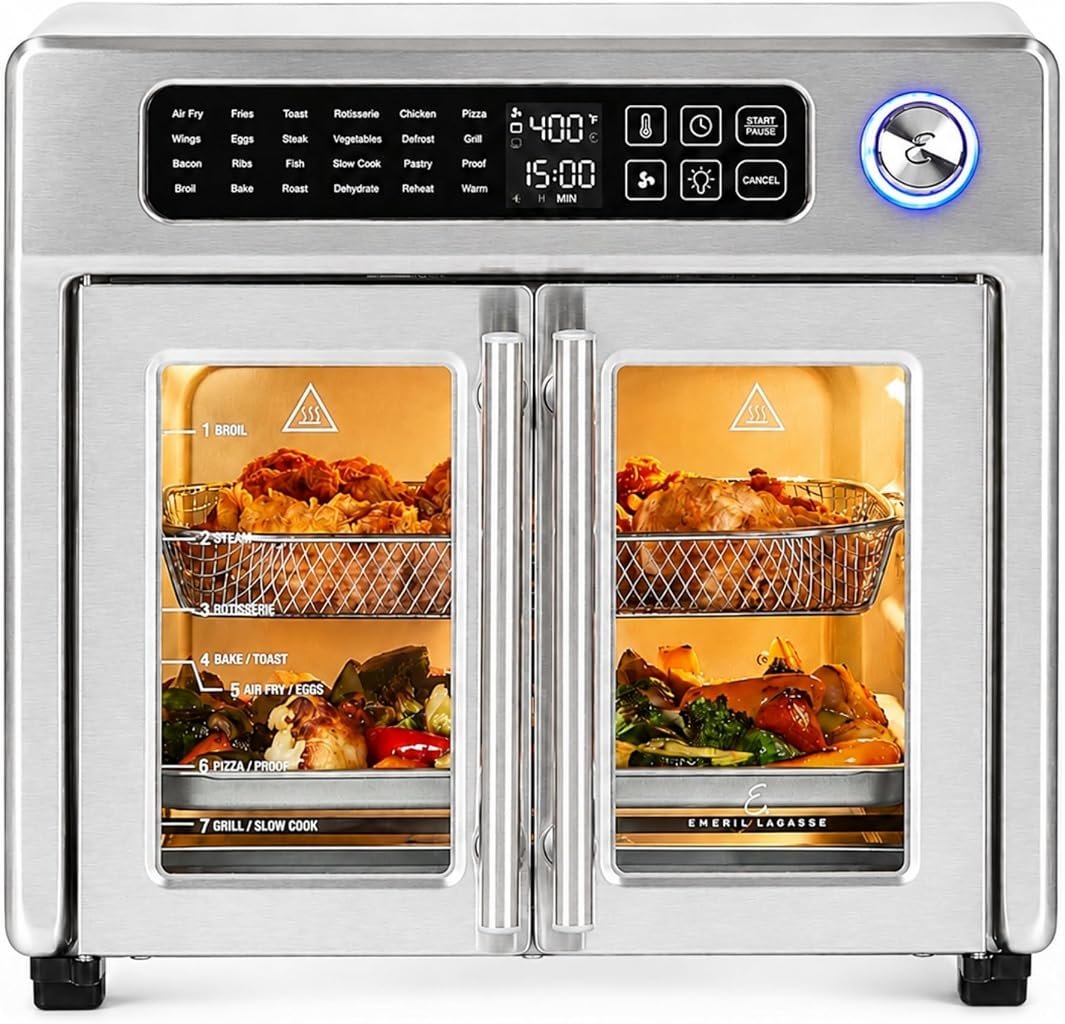
The Emeril Lagasse 26QT French Door Air Fryer Toaster Oven belongs to a class of countertop appliances that has stretched the original air-fryer concept almost beyond recognition. Instead of a compact basket intended mainly for fries, vegetables and breaded foods, this is a 26-quart, 1,700-watt countertop oven with French doors, an LED control panel, multiple cooking programs and a temperature range extending to 500°F.
That breadth creates opportunity and complication in almost equal measure.
Our score is 8.4/10. Customer Sentiment stands at 8.06/10, Buyer Confidence at 9.8/10 and Value at 8.03/10. The scores describe a machine with a clearly defined purpose and substantial cooking flexibility, tempered by the practical realities of its size, accessory management and multipurpose design.
The central question is not whether it can air fry. It is whether a household has enough use for its larger oven architecture to justify giving it permanent countertop territory.
For the right kitchen, the answer is credible. For someone simply looking for a fast basket in which to cook two portions of fries, this machine may be more oven than necessary.
A 26-Quart Air Fryer Is Really A Countertop Oven
The phrase “air fryer” can obscure what this appliance physically is.
According to the official Emeril Lagasse product specifications, the oven provides 26 quarts of capacity, equivalent to 24.6 liters, and measures approximately 16.9 inches deep, 15.8 inches wide and 14.8 inches high. The manufacturer positions that capacity for preparing food for four to six people.
Those dimensions place it far beyond the small-basket category.
The distinction matters because countertop space is effectively another specification. Capacity sounds universally desirable until a large appliance arrives in a kitchen where the coffee machine, blender, stand mixer and microwave have already negotiated their borders.
The Emeril Lagasse oven therefore asks buyers to make a physical commitment.
In exchange, its 26-quart cavity provides substantially more flexibility than the cooking chamber of a small basket air fryer. The manufacturer says it can accommodate a whole chicken or a 12-inch pizza. That makes it relevant not only for snacks and side dishes but also for meals that would ordinarily send the cook toward a conventional oven.
This is the first major dividing line. Buyers who prioritize minimal footprint should look carefully at smaller alternatives. Buyers who want a countertop appliance capable of handling several oven duties have a stronger reason to accept its dimensions.
French Doors Are More Than A Styling Exercise
The twin French doors are the most visually distinctive element of the design.
They give the appliance an appearance closer to a miniature commercial oven than the familiar pull-out drawer associated with air fryers. Yet their value is not purely aesthetic.
An oven-style door creates direct visual access to the cooking chamber and allows trays, racks and other accessories to move horizontally into the appliance. The French-door arrangement divides the front opening into two sections rather than requiring one large door to swing downward.
That architecture also changes how the appliance fits into a working kitchen. A basket fryer requires clearance to pull a drawer outward. A conventional toaster oven requires room for its front door to swing down. French doors distribute the opening movement differently.
No door mechanism eliminates the need for clearance around a hot countertop appliance, but the format can make interaction with a large oven cavity feel less cumbersome.
There is also a less glamorous side. Two doors mean additional edges, hinges and glass surfaces to keep clean. A large transparent front makes grease and splatter more visible. Anyone expecting the polished exterior to remain pristine without regular wiping will quickly encounter the physics of cooking fat.
The doors improve access and define the product visually, but they do not repeal kitchen maintenance.
The 1,700-Watt Heating System Deserves Attention
The manufacturer’s owner manual identifies model FAFO-001 as a 1,700-watt appliance operating on 120 volts at 60 Hz. It specifies 26 quarts, or 1,519 cubic inches, of capacity and a temperature range from 75°F to 500°F.
That 500°F upper limit is significant.
Many countertop cooking tasks do not require maximum heat, but higher available temperatures broaden the range of browning and roasting applications. At the other end, low-temperature capability supports cooking methods that require substantially gentler heat.
The wide range helps explain why this appliance is better evaluated as a countertop cooking system than merely as one of the best air fryers.
Air frying is only one expression of forced convection. The basic mechanism uses heated moving air to transfer energy to exposed food surfaces, accelerating moisture loss and promoting browning. A larger convection oven can apply the same principle while also supporting trays, racks and foods that would be awkward in a deep basket.
The compromise is straightforward: heating a larger cavity differs from heating a small basket. Greater interior flexibility means more internal volume, and more volume changes how a machine fits into daily routines.
Air Frying Without Pretending It Is Deep Frying
Air-fryer marketing has sometimes encouraged a false equivalence between convection cooking and immersion frying.
They are not the same process.
Deep frying surrounds food with hot oil. Air frying exposes food to rapidly moving heated air, usually with a relatively small quantity of oil on the surface or no added oil for foods that already contain fat.
That distinction affects texture, flavor and heat transfer.
The Emeril Lagasse oven uses a dual-speed fan system intended to circulate heated air around food. In practical terms, this gives the appliance a mechanism for concentrating convection around exposed surfaces while retaining the physical flexibility of an oven.
Expectations should remain grounded. A battered food designed specifically for deep-fat immersion does not automatically behave identically under circulating air. Frozen foods formulated for oven or air-fryer preparation are a different matter, as are vegetables, potatoes and foods that naturally brown under dry heat.
The more useful reason to choose air frying is not the fantasy that hot air has somehow become cooking oil. It is the ability to produce browned and crisp surfaces through intense convection without filling a vessel with deep-frying oil.
That is a meaningful distinction on its own.
High Heat Also Rewards Restraint
The 500°F maximum setting gives the oven considerable thermal headroom, but maximum heat is not a universal recipe.
The U.S. Food and Drug Administration explains that acrylamide can form naturally in some plant foods during high-temperature cooking processes such as frying, roasting and baking. The agency states that longer cooking periods and higher temperatures generally increase acrylamide formation. It recommends cooking cut potato products to a golden-yellow rather than brown color when consumers wish to reduce acrylamide.
The FDA also reports that soaking raw potato slices in water for 15 to 30 minutes before frying or roasting can reduce acrylamide formation during cooking.
These observations apply broadly to high-temperature cooking rather than specifically to this appliance.
They nevertheless illustrate why temperature range should be understood as flexibility rather than a competition to cook everything at the highest possible setting. Potatoes, toast and other starch-rich foods benefit from visual judgment. More browning is not automatically better.
The French-door oven format helps here because food remains visible through the front. A cook can inspect browning rather than relying exclusively on a timer or preset.
Presets Broaden The Cooking Vocabulary
The Emeril Lagasse product page describes a large collection of cooking presets covering methods such as air frying, baking, broiling, dehydrating, roasting and slow cooking.
The important point is not the sheer number.
Preset counts can become a weak proxy for usefulness. Twenty programs that a household rarely touches do not necessarily create more practical value than six settings used every day.
The more revealing issue is the range of cooking methods represented.
Air frying and roasting emphasize browning. Baking addresses more conventional oven work. Broiling applies intense heat to food surfaces. Dehydrating moves in the opposite direction, using lower heat and longer duration to remove moisture. Slow cooking addresses another distinct pattern of preparation.
This range makes the oven potentially useful throughout a meal rather than only for a side dish.
That is where multifunction appliances either justify themselves or fail. If the owner regularly moves between several modes, consolidation becomes meaningful. If nearly every meal uses Air Fry and nothing else, much of the machine’s architecture becomes unused capacity.
Capacity Is A Strength With A Counterweight
Twenty-six quarts is arguably the product’s defining specification.
The manufacturer describes the cavity as suitable for a whole chicken, a 12-inch pizza or a tray of cookies. Those examples communicate the difference between this appliance and a conventional basket fryer more effectively than the raw quart figure does.
A 12-inch pizza requires horizontal room. A whole chicken requires both width and vertical clearance. Cookies require usable tray area.
This type of capacity can reduce the number of batches required for family cooking.
Yet capacity carries a physical cost. The oven measures nearly 17 inches deep and almost 16 inches wide. A kitchen with shallow countertops or substantial cabinetry overhead needs careful measurement before purchase.
The appliance should also be treated as something likely to remain on the counter. Large countertop ovens lose convenience quickly if using them requires lifting and relocating a substantial appliance before every meal.
That practical issue should influence purchasing decisions at least as much as preset counts.
The Controls Reflect A Different Kind Of Air Fryer
The oven uses an LED display rather than relying solely on traditional toaster-oven dials.
This matters because a multifunction machine places greater demands on its interface.
A basic basket fryer may need little more than temperature and time. A large oven supporting numerous cooking methods must communicate function, duration and heat settings without forcing the user to decipher the machine each time dinner begins.
Digital control also allows preset-driven operation while retaining manual adjustment.
Still, presets should be treated as starting points rather than unquestionable instructions. Food varies in mass, thickness, water content and starting temperature. A refrigerated chicken portion and a room-temperature vegetable do not respond identically merely because both fit inside the same program category.
The most reliable use of any countertop oven combines the machine’s controls with observation.
That principle becomes more relevant as an appliance grows more capable. More functions create more possibilities, but they also ask the cook to understand what each cooking method is trying to accomplish.
The Rotisserie Dimension Changes The Experience
The oven’s accessory system includes equipment for rotisserie cooking, adding another distinction from ordinary basket machines.
Rotisserie cooking rotates food relative to the heat source. That movement can expose different surfaces during cooking rather than leaving the food stationary on a tray.
It is an attractive capability for poultry and similar foods, but it also introduces additional hardware.
This is a recurring theme with the Emeril Lagasse oven: flexibility has a storage cost.
Racks, trays and specialized accessories need somewhere to live. The oven may consolidate several cooking appliances into one housing, but it does not make physical cooking equipment disappear.
For households with ample cabinet space, that may be trivial. In a very small kitchen, accessory storage deserves consideration alongside the dimensions of the oven itself.
The best multifunction appliance is not necessarily the one with the greatest number of attachments. It is the one whose attachments are used often enough to justify keeping them accessible.
Cleaning Is Where Large Air-Fryer Ovens Reveal Their Nature
Air-fryer toaster ovens are not self-cleaning environments.
The combination of high heat, moving air, exposed heating elements, bread crumbs, melted cheese, cooking fat and food particles guarantees maintenance.
A basket fryer concentrates much of its mess inside removable components. An oven spreads potential residue across a larger cavity, trays, racks, glass and interior surfaces.
The Emeril Lagasse model therefore benefits from frequent light cleaning rather than occasional rescue operations.
Crumbs should be removed before they accumulate. Grease should be addressed before repeated heating turns it into a stubborn film. Rotisserie or roasting tasks involving fatty foods deserve particular attention because splatter can travel farther than it would inside a closed basket.
This does not negate the machine’s versatility. It simply establishes the price of that versatility in minutes spent cleaning.
Anyone comparing large oven-style models with the best air fryers in basket form should include maintenance in the comparison rather than looking exclusively at capacity and cooking programs.
Understanding The 8.4/10 Editorial Score
Our 8.4/10 score reflects a machine with substantial capability and a clear audience.
Buyer Confidence is exceptionally high at 9.8/10. The reasoning is straightforward. Core specifications are clearly documented: 26-quart capacity, 1,700-watt rated power, a 75°F-to-500°F temperature range and LED controls are established in the manufacturer documentation. The manufacturer also provides concrete dimensions and capacity guidance.
That creates clarity about the basic proposition.
Customer Sentiment at 8.06/10 is lower because living with a large multifunction oven is more subjective than reading its specification sheet. A buyer who wants substantial capacity and numerous cooking modes may see the footprint as reasonable. Someone seeking a small air fryer may view the same dimensions as excessive.
Value receives 8.03/10.
At a reference price of $149.99, the economic argument depends on utilization. The machine becomes more rational when air frying, roasting, baking, reheating and other oven functions are all regularly used. A buyer using only one cooking mode extracts less value from the same hardware.
The scores therefore tell a consistent story: confidence in what the product is can be higher than enthusiasm for whether every household needs it.
Where The Emeril Lagasse Oven Makes Its Strongest Case
The appliance is strongest when replacing overlapping countertop equipment.
A household considering both an air fryer and a toaster oven has a natural reason to investigate a machine combining those functions. Add roasting, dehydrating, rotisserie capability and other cooking modes, and consolidation becomes a credible argument.
Its 26-quart capacity is also significant for households that find small basket machines frustrating.
Cooking in repeated batches can erase part of the convenience associated with air frying. If the first batch is cooling while the second is still cooking, theoretical speed matters less at the dinner table.
The larger oven chamber addresses that problem by offering more usable cooking space.
Its French doors and visible cavity also suit cooks who prefer watching food rather than repeatedly opening a basket.
These advantages share one theme: the machine works best for someone who wants an oven-style experience.
Where It Gives Ground
The first compromise is size. At roughly 16.9 inches deep, 15.8 inches wide and 14.8 inches high, this is a substantial countertop object.
The second is complexity. More cooking methods mean more settings, accessories and operational choices. Buyers who value extreme simplicity may find a basic basket fryer easier.
Third is cleanup. A large cavity and several accessories create more surfaces requiring attention.
Fourth is efficiency of purpose. Someone who wants almost nothing beyond air frying modest portions does not automatically benefit from a 26-quart oven simply because it can perform more tasks.
Fifth is permanence. An appliance this large works best when it has a dedicated location. Kitchens where every device must be stored after use may find a smaller machine more practical.
None of these weaknesses invalidate the design. They identify the circumstances under which the design makes sense.
Who Should Consider It?
The strongest buyer profile is a household that wants one countertop machine to handle several dry-heat cooking jobs.
It fits especially well where:
- Meals are regularly prepared for several people.
- A toaster oven is already part of the kitchen routine.
- A small basket air fryer would require frequent batch cooking.
- Pizza, poultry, roasting and reheating matter alongside fries and snacks.
- A visible oven cavity is preferable to a closed drawer.
- Rotisserie and dehydration functions have genuine household uses.
- The countertop can permanently accommodate an appliance roughly 16 inches wide and 17 inches deep.
The weaker fit is almost the mirror image: limited countertop space, very small portions, infrequent cooking and a strong preference for one-button simplicity.
That buyer may be happier with a compact basket model.
Practical Habits For Better Ownership
Several habits can make a large air-fryer oven more manageable:
- Measure the intended countertop position before purchase, including practical clearance around the appliance.
- Keep frequently used accessories accessible rather than storing them somewhere inconvenient.
- Avoid crowding food when air frying; moving air needs access to exposed surfaces.
- Monitor food through the doors as browning progresses rather than relying entirely on preset duration.
- Clean grease and crumbs frequently before repeated heating makes deposits harder to remove.
- Match the cooking mode to the food instead of defaulting automatically to Air Fry.
- Use the 500°F maximum selectively; maximum capability is not the appropriate setting for every recipe.
- With potato products, aim for the desired crispness without excessive darkening. The FDA advises that golden-yellow coloring can help reduce acrylamide formation compared with brown cooking.
- Think in terms of appliance replacement. If the oven can genuinely replace several devices already being used, its countertop footprint becomes easier to justify.
The last point is particularly revealing. Large multifunction appliances are most useful when they remove duplication rather than merely adding capability.
Final Considerations
The Emeril Lagasse 26QT French Door Air Fryer Toaster Oven earns its 8.4/10 rating by offering a broad and coherent alternative to the conventional basket air fryer.
Its 26-quart capacity, 1,700-watt heating system, 75°F-to-500°F operating range, French-door architecture and multiple cooking modes place it closer to a genuine countertop oven than a snack-oriented air fryer. That distinction defines both its strengths and its compromises.
The machine can handle cooking formats that would be awkward or impossible in many small baskets. It can accommodate a 12-inch pizza and a whole chicken according to the manufacturer, while the large cavity supports cooking for several people. Air frying therefore becomes one part of a larger cooking system.
That system requires space.
Nearly 17 inches of depth is not a trivial countertop commitment. Accessories require storage. Glass and interior surfaces require cleaning. The larger feature set asks more from the user than a minimalist air fryer with two controls.
Those realities explain the gap between our 9.8/10 Buyer Confidence score and the lower 8.06 Customer Sentiment and 8.03 Value scores. The machine’s identity is unusually clear; its suitability is more selective.
At the $149.99 reference price, value rises sharply when the oven is used across several functions. A household that air fries dinner, reheats leftovers, cooks pizza, roasts poultry, dehydrates ingredients and uses the rotisserie capability can distribute the purchase across many recurring tasks. A household cooking two servings of frozen fries once a week cannot.
The distinction matters when evaluating the best air fryers. A feature-rich appliance should not automatically outrank a simpler one. The appropriate architecture depends on the work expected from it.
The Emeril Lagasse 26QT French Door model makes its strongest argument in kitchens where an air fryer and countertop oven would otherwise exist separately. Its large chamber and broad temperature range allow it to address both categories without pretending they are identical.
That is a more defensible proposition than chasing novelty.
For households with adequate counter space, several mouths to feed and enough varied cooking to use the oven beyond Air Fry mode, the machine offers a rational form of consolidation. Its capacity can reduce batch cooking, its doors provide easy visual access and its range of cooking methods allows it to participate in meals from reheating through roasting.
For a small household seeking maximum simplicity, the same characteristics can become unnecessary weight, volume and complexity.
Our 8.4/10 assessment therefore reflects a product whose appeal grows with the number of jobs it is genuinely asked to perform. It is not compelling because it is large or because its control panel contains numerous options. It is compelling when those attributes solve actual kitchen problems.
The Emeril Lagasse 26QT French Door Air Fryer Toaster Oven is ultimately less interesting as an oversized air fryer than as a compact alternative to a conventional oven for selected everyday cooking. Viewed through that lens, its French doors, large cavity, broad temperature range and multifunction architecture form a logical package.
Its success in any particular kitchen will be determined by something far less glamorous than the number of programs on the control panel: whether the household uses enough of that capability often enough to justify the space it takes up.