The Ninja Foodi DualZone Air Fryer DZ201 addresses a problem that conventional air fryers quietly create. A single basket may cook quickly, but dinner rarely consists of one food. Once a second dish enters the schedule, speed can turn into sequencing: cook the chicken, remove it, start the vegetables, keep the chicken warm, and hope both components reach the table in acceptable condition.
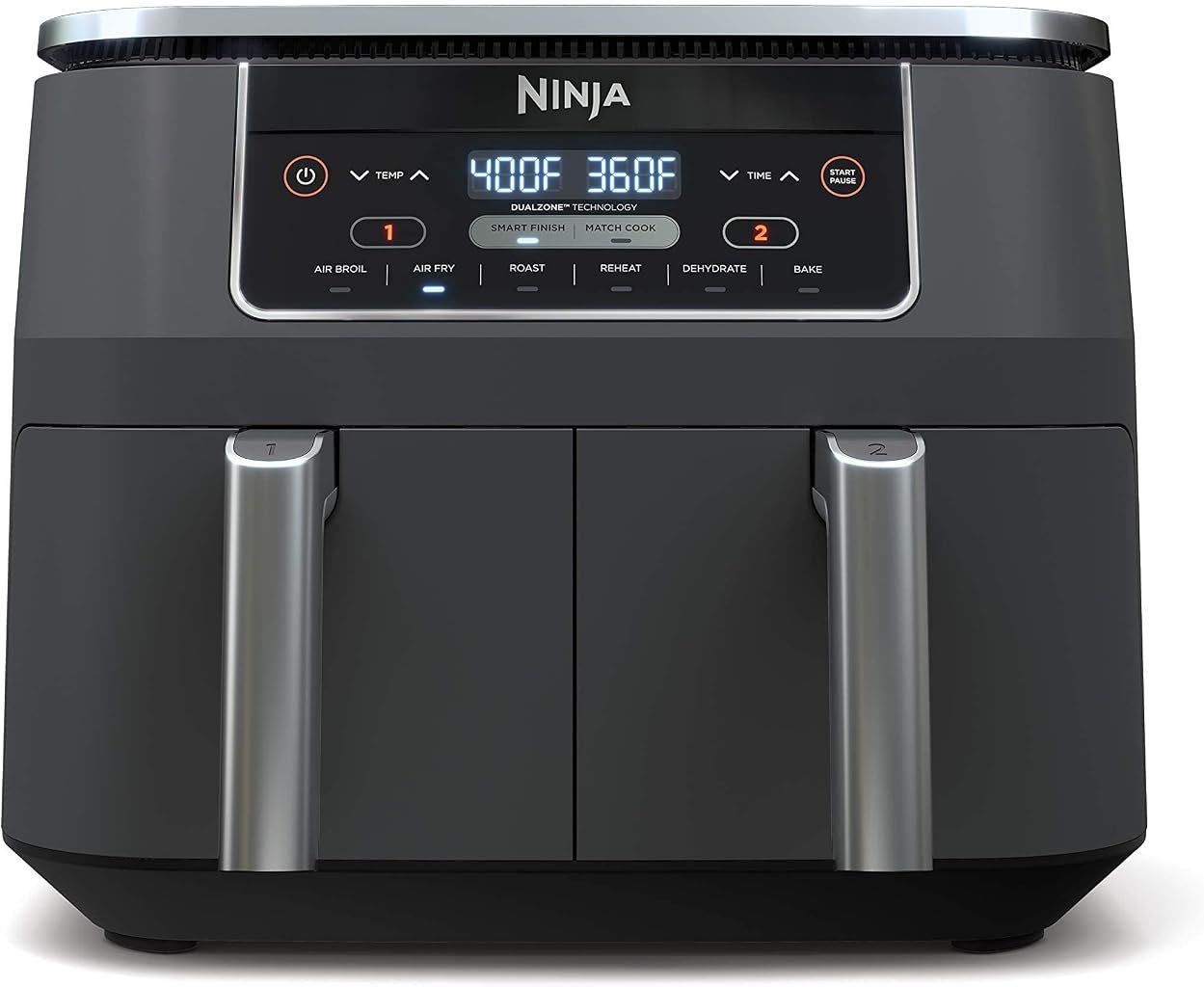
The DZ201 changes that arrangement through two independent cooking zones. Ninja identifies the DZ201 series as an 8-quart, two-basket DualZone air fryer, splitting its total capacity between two 4-quart zones. Each basket has its own cooking environment, allowing different foods to run under different settings. Smart Finish coordinates separate cooking cycles so they end together, while Match Cook copies settings across zones when both baskets are performing the same job.
That architecture gives the DZ201 a remarkably clear purpose. It is not simply a large air fryer divided for visual effect. Its controls exist because the divider creates two genuinely separate cooking tasks.
Our score is 9.16/10. Customer Sentiment is also 9.16, Buyer Confidence reaches 9.8, and Value stands at 8.64. At the $179.99 price used for our assessment, those figures place the DZ201 among the strongest air-fryer propositions in our editorial framework, provided the buyer actually needs dual-zone cooking.
That qualification matters. Two baskets solve one set of problems while creating another.
Two Independent Baskets Change the Meal, Not Just the Appliance
The defining feature of the DZ201 is physical separation.
Ninja’s DualZone architecture uses two independent baskets, and the DZ201 series has an 8-quart total capacity. The basic arithmetic is simple: two 4-quart zones.
The practical consequences are more interesting.
A conventional single-basket air fryer asks foods to share temperature, airflow, and timing. That works when everything being cooked has similar requirements. It becomes awkward when a protein and vegetable need different treatment.
The DZ201 lets the two sides behave independently.
One basket can cook a main dish while the other handles a side. Different temperatures and durations can be selected rather than forcing both foods into a compromise setting. This can eliminate the familiar air-fryer ritual in which the first batch waits on a plate while the second one cooks.
For households already satisfied with one-food-at-a-time cooking, that benefit will sound less dramatic. For households routinely coordinating two components, the difference is structural.
This is why dual-zone capacity should not be interpreted merely as “more space.”
It is more control over how that space is divided.
Eight Quarts Is Useful, but the Divider Changes What Fits
The DZ201 belongs to Ninja’s 8-quart DualZone family. That capacity is substantial, but the number needs to be read correctly.
There is no single 8-quart cavity.
Instead, the appliance provides two 4-quart zones. That distinction determines which foods make sense inside it.
Wings, fries, vegetables, smaller cuts of meat, and foods that naturally divide into portions can be distributed between the two baskets. A physically large item requiring one uninterrupted chamber cannot use the combined volume in the same way.
The divider is therefore both the DZ201’s advantage and its constraint.
That may sound contradictory, but it is the unavoidable geometry of dual-basket cooking. Separating two foods gives each one independent control, yet the same wall prevents the appliance from becoming one enormous drawer when independence is unnecessary.
Capacity shoppers should consequently think beyond quarts.
Surface area, food shape, and loading depth matter because air frying relies on circulating hot air. A basket may physically contain a large amount of food while still being too crowded for effective airflow.
The U.S. Department of Agriculture’s food-safety guidance reinforces the point. USDA advises that food should not be overcrowded because air needs to circulate around it. A packed basket may cook less evenly even when the lid or drawer closes without difficulty.
The DZ201 offers generous aggregate capacity. It does not repeal the physics of convection.
Smart Finish Solves a Real Timing Problem
Smart Finish is one of the DZ201’s most consequential functions because it addresses an inconvenience created by cooking two different foods.
Suppose one zone contains chicken requiring 20 minutes while the second contains vegetables requiring 12.
Without synchronization, the cook has several options. Both foods can start simultaneously and one can finish early. The shorter cycle can be started manually eight minutes later. The foods can be cooked sequentially. None is especially difficult, but each adds monitoring or waiting.
Ninja describes Smart Finish as staggering start times so both zones finish together. That principle is central to the DualZone platform.
The feature does not make cooking decisions on behalf of the user. The cook still selects the relevant programs, temperatures, and times. Smart Finish coordinates the schedules after those instructions are entered.
That boundary deserves emphasis because appliance automation is often described too broadly.
Smart Finish synchronizes timers. It does not verify that meat has reached a safe internal temperature, determine whether vegetables have the desired texture, or compensate automatically for every difference in portion thickness.
It solves scheduling.
That is a narrower achievement than autonomous cooking, but a far more useful one than many decorative presets.
Match Cook Handles the Opposite Situation
Smart Finish is designed for different foods. Match Cook addresses identical or similarly prepared batches.
When both zones need the same settings, Match Cook mirrors one zone’s configuration onto the other. This reduces repetitive programming and makes the divided appliance behave more like one coordinated high-capacity system.
Consider a large batch of wings.
The divider prevents the DZ201 from becoming one 8-quart basket, but wings can naturally be divided between two 4-quart zones. Match Cook allows both sides to operate under matching settings.
This is where the DZ201’s architecture becomes particularly logical.
Different foods benefit from independence.
Identical foods benefit from mirrored controls.
The hardware does not change, but the interface adapts to both scenarios.
For buyers comparing candidates among the best air fryers, that distinction is more informative than simply counting presets. A machine with many cooking programs can still force every item into one physical chamber. The DZ201 uses its electronics to manage two separate cooking environments.
Six Functions Cover the Core Workload
The DZ201 series provides six cooking functions. Ninja identifies its 8-quart DualZone platform with Air Fry, Broil, Roast, Bake, Reheat, and Dehydrate functions on current versions of the format.
The list covers most of the jobs expected from a basket air fryer without turning the interface into a directory of narrowly differentiated modes.
Air Fry handles the machine’s primary crisping duties. Broil focuses more intense heat on surface browning. Roast extends the appliance toward proteins and vegetables. Bake provides another route for foods not naturally associated with frying. Reheat targets cooked foods and leftovers. Dehydrate addresses low-temperature moisture removal.
Six functions should not be interpreted as six entirely separate cooking technologies. They operate through combinations of heating, airflow, temperature, and time.
That distinction is useful when comparing countertop appliances.
Preset inflation can make a control panel appear more capable than the hardware beneath it. Ten named buttons are not automatically more useful than six intelligently chosen modes.
The DZ201’s stronger argument is not the number six.
It is that those functions exist within two independently controlled zones.
Our 9.16/10 Score Reflects Coherent Engineering
A 9.16/10 editorial score demands more than an unusual feature.
The DZ201 earns its position because the machine’s major components support the same objective.
Two baskets create independent cooking spaces.
Smart Finish manages different schedules.
Match Cook simplifies identical schedules.
The six cooking modes broaden what can be done inside those zones.
The 8-quart aggregate capacity provides enough total room to make two-zone cooking useful without moving into the still larger 10-quart class.
That coherence matters more than novelty.
The product also has limitations that prevent its score from becoming an exercise in enthusiasm. The divider makes oversized foods harder to accommodate. Two baskets produce more washing than one when both are used. The appliance requires more counter area than many compact single-basket models. Buyers who rarely prepare two foods simultaneously may pay for hardware they seldom exploit.
Those drawbacks are not design mistakes. They are the costs of the design choice.
The 9.16 score reflects how effectively the DZ201 executes its intended job, not an assumption that every kitchen requires that job.
Customer Sentiment: 9.16
Our Customer Sentiment score also lands at 9.16.
The alignment with the overall score suggests a product proposition with relatively little editorial tension. The feature responsible for the appliance’s size and complexity is also the feature most likely to justify owning it.
Dual-zone cooking is easy to understand because the problem is familiar.
A meal contains two foods.
They need different treatment.
Both should be ready together.
The DZ201 provides a physical and electronic system for dealing with that situation.
That simplicity of purpose matters in a category where manufacturers often add features faster than households discover reasons to use them.
The Customer Sentiment score does not imply universal suitability. A compact household preparing one portion at a time has a very different relationship with an 8-quart dual-basket appliance than a family regularly cooking a main dish and side.
Fit remains more useful than popularity.
Buyer Confidence: 9.8
Buyer Confidence is our strongest score at 9.8.
The DZ201 benefits from a mature, easily understood architecture. SharkNinja’s own patent documentation identifies the DZ201 series as an 8-quart, two-basket air fryer with DualZone technology, providing unusually direct confirmation of the product family’s core configuration.
The buying decision can therefore be reduced to concrete questions rather than vague promises.
- Does the household regularly cook two foods at the same time?
- Are two 4-quart baskets more useful than one larger uninterrupted chamber?
- Is synchronized finishing likely to reduce meal-management friction?
- Does the kitchen have enough permanent counter area for a dual-basket appliance?
- Will the baskets accommodate the foods normally prepared?
- Are Air Fry, Broil, Roast, Bake, Reheat, and Dehydrate sufficient for the intended workload?
If those answers align with the DZ201’s structure, there is relatively little ambiguity about what the buyer is getting.
High Buyer Confidence does not mean zero compromise.
It means the compromises are visible before purchase.
Value: 8.64
Value receives an 8.64 score, lower than Our Score, Customer Sentiment, and Buyer Confidence.
That difference is informative.
At $179.99 in our pricing snapshot, the DZ201 costs more than many competent single- basket air fryers. A buyer who only needs reheating, frozen-food crisping, and occasional vegetables can accomplish those tasks with simpler hardware.
The DZ201 asks the household to pay for parallelism.
Its economic argument becomes stronger as sequential cooking becomes more annoying.
If dinner regularly requires one air-fried food after another, two independent baskets can reduce waiting, manual timer coordination, and the need to keep the first batch warm.
If the second basket remains empty most evenings, that advantage disappears.
Value therefore depends less on the number of people in the household than on the structure of its meals.
A two-person household that routinely cooks a protein and vegetable simultaneously could exploit DualZone more effectively than a larger household using the air fryer only for one batch of fries.
Capacity does not create value by itself.
Usage does.
Cleaning Two Baskets Is a Trade-Off, Not a Footnote
The dual-zone format inevitably creates more removable cooking surfaces than a single-basket fryer.
When both zones are used, there are two baskets and two crisper plates requiring attention. Ninja describes the crisper plates on its 8-quart DualZone platform as dishwasher safe, reducing some of the burden.
Still, dishwasher compatibility should not be confused with zero maintenance.
Grease, crumbs, sauces, and rendered fat accumulate during cooking. The machine’s interior areas also require routine care according to manufacturer instructions.
The two-basket design can occasionally make cleanup more orderly because different foods remain physically separated. A heavily seasoned protein does not share the same basket with lightly seasoned vegetables.
But there is no escaping the arithmetic: using two cooking chambers creates more cooking surfaces than using one.
That trade is reasonable when the second basket saves an entire sequential cooking cycle.
It is harder to justify when the second zone is unnecessary.
Counter Space Deserves a Serious Measurement
Air fryers are often purchased as though countertop space were elastic.
It is not.
An 8-quart dual-basket appliance needs room for two side-by-side cooking zones, controls, heating hardware, ventilation, and safe basket removal. Even when the machine technically fits a counter, it can interfere with preparation space or neighboring appliances.
The buyer should therefore measure the intended location rather than rely on photographs.
The important dimensions include not only the appliance footprint but also the working area needed to pull out both baskets comfortably. Required clearances and placement instructions in the owner’s documentation should be respected.
Storage introduces another question.
A compact fryer can be lifted into a cabinet after use without much thought. Larger dual-basket appliances are more likely to become permanent countertop residents simply because repeatedly moving them is inconvenient.
That turns size into an everyday ownership characteristic.
A product can cook dinner brilliantly and still be wrong for a kitchen that resents seeing it every morning.
Airflow Still Determines Crisping
The presence of two baskets does not change the basic science of air frying.
USDA describes air fryers as “essentially countertop convection ovens.” Rapidly moving hot air transfers heat to food while surface moisture evaporates and browning develops.
Crowding interferes with that process.
A basket filled deeply with overlapping food may technically hold more, but exposed surface area shrinks and circulation becomes less effective. Shaking or turning suitable foods can help redistribute pieces during cooking.
The DZ201 offers an interesting advantage here because a large batch can sometimes be divided across two baskets rather than piled into one.
That does not guarantee better results. Food type, size, moisture, temperature, arrangement, and cooking duration still matter.
But the second basket creates another physical area in which food can be distributed.
For foods such as wings, fries, or vegetables, that can be more useful than treating the total 8-quart capacity as a container that should be filled to its geometric limit.
Food Safety Is Not Automated by Smart Finish
Smart Finish can coordinate two cooking cycles, but safe cooking still depends on internal temperature.
The USDA states that only a food thermometer can reliably verify the destruction of harmful bacteria. The agency specifies 165°F for poultry, 160°F for ground beef, pork, lamb, and veal, and 145°F for whole cuts of beef, pork, lamb, and veal followed by at least a three-minute rest.
That guidance matters in a machine built around synchronized finishing.
Two timers reaching zero simultaneously does not establish that two foods are equally cooked internally.
Thickness varies. Starting temperatures vary. Food arrangement varies.
A chicken breast in Zone 1 and vegetables in Zone 2 may finish their programmed cycles together while still requiring independent checks for doneness and safety.
The distinction is mundane but consequential.
Smart Finish manages time.
A thermometer verifies temperature.
Where the DZ201 Fits Among the Best Air Fryers
The best air fryers are not identified by one universal capacity, basket count, or feature list. Architecture determines suitability.
The DZ201 is particularly well aligned with:
- Households that regularly prepare two air-fried foods for the same meal.
- Buyers frustrated by sequential batches in a single-basket machine.
- Cooks who frequently need different temperatures or cooking durations at once.
- Batch cooking where food can be divided naturally between two 4-quart baskets.
- Kitchens where an 8-quart dual-zone format fits comfortably.
- Buyers who value synchronized completion more than one uninterrupted cooking chamber.
- Users who will make regular use of roasting, baking, reheating, broiling, or dehydrating alongside air frying.
Its weaker applications are equally identifiable.
Someone cooking primarily for one may find the second zone unnecessary. Buyers who routinely prepare physically large foods may prefer a single open basket or oven-format machine. Very small kitchens may find a side-by-side dual-basket footprint difficult to justify.
The DZ201 should therefore be selected because of its divider, not despite it.
The DZ201 Versus a Larger 10-Quart DualZone
The existence of larger DualZone models creates a predictable question: why choose 8 quarts when 10 are available?
More capacity is useful only when it solves a recurring constraint.
The DZ201’s two 4-quart baskets provide 8 quarts total. Larger DualZone models can move to two 5-quart zones and 10 quarts overall. That additional volume can help households cooking larger batches, but it also tends to increase the physical commitment demanded from the countertop.
The decision should be made by examining actual batch sizes.
If two 4-quart baskets routinely accommodate the intended meals, additional capacity may contribute little beyond unused space. If the household frequently reaches the practical limits of 4-quart zones, moving upward becomes rational.
This is one of the recurring absurdities of appliance shopping: capacity is often treated as though unused volume were inherently beneficial.
It is not.
The right capacity is the one that handles normal meals without creating unnecessary bulk.
Strengths and Drawbacks
The DZ201’s strengths are concentrated around meal coordination.
Two independent 4-quart baskets allow different foods to cook simultaneously. Smart Finish can synchronize different cooking cycles. Match Cook simplifies using both zones under identical settings. Six cooking functions broaden the machine beyond basic air frying. Eight quarts of total capacity provides meaningful batch flexibility without automatically moving into the larger 10-quart class.
Its drawbacks arise from the same architecture.
The combined 8-quart capacity cannot function as one uninterrupted 8-quart chamber. Two baskets require more cleaning when both are used. The side-by-side configuration demands meaningful counter area. Small households may rarely need both zones. Buyers focused on oversized foods may prefer a large single basket or countertop oven.
These compromises are unusually easy to identify before purchase.
That transparency is part of the reason Buyer Confidence reaches 9.8.
Final Considerations
The Ninja Foodi DualZone Air Fryer DZ201 earns its 9.16/10 score by solving a narrow but remarkably common kitchen problem: two foods need to be cooked differently, yet dinner should arrive at the table at the same time.
Its 8-quart capacity is useful, but the number alone misses the point. Two independent 4-quart zones are the meaningful specification.
Smart Finish turns those zones into coordinated cooking schedules. Match Cook allows them to behave as parallel copies when the same food fills both baskets. Six cooking functions extend the machine beyond straightforward air frying without burying its purpose beneath an excessive list of presets.
Customer Sentiment at 9.16 aligns exactly with our overall score, reinforcing the strength of the basic proposition. Buyer Confidence at 9.8 reflects how clearly the product’s architecture communicates its intended use. Value at 8.64 is more restrained because less expensive single-basket machines remain entirely rational for households that do not need parallel cooking.
At the $179.99 price applied in our assessment, the DZ201 therefore makes the strongest sense when its second basket will be used regularly.
For one-food cooking, the machine is more complicated than necessary.
For oversized foods, the divider can become an obstacle.
For kitchens with very little counter space, two side-by-side zones impose a physical cost.
But when the recurring problem is a chicken-and-vegetable dinner, two different frozen foods, separate dietary preferences, or a large batch that can be divided between baskets, the architecture becomes difficult to dismiss as mere convenience.
The DZ201 does not eliminate kitchen timing.
It makes two timelines easier to manage.
For households that routinely cook in pairs, that is a meaningful distinction.