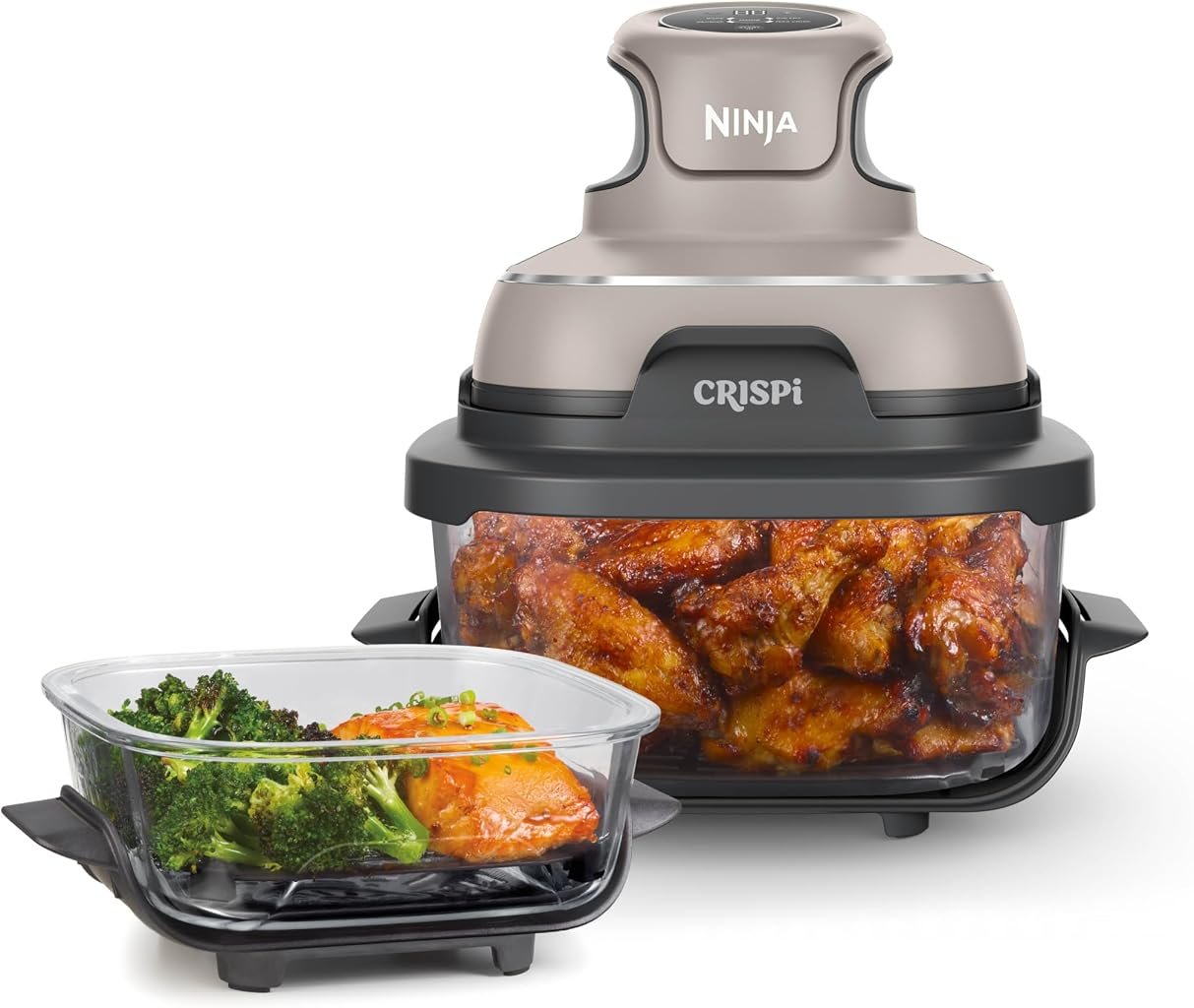
Air fryers have spent years converging on a familiar shape: a heating unit on top or behind a dark cooking chamber, usually paired with a removable coated basket. The Ninja Crispi Glass Air Fryer FN101ST takes a visibly different route. Its cooking chamber is glass, its heating hardware is concentrated in a removable PowerPod, and the system is designed around containers that can move between preparation, cooking, serving, and storage.
That architecture is more consequential than it initially appears. The Ninja Crispi FN101ST combines a 1,500-watt PowerPod with two CleanCrisp glass containers: a smaller 6-cup vessel and a larger 4-quart vessel. Ninja lists four cooking functions-Max Crisp, Air Fry, Bake, and Recrisp-and preset cooking modes reaching up to 450°F.
Our score is 8.55/10. Customer Sentiment stands at 8.28, Buyer Confidence at 9.8, and Value at 8.15. At the $152.99 price used for this assessment, those numbers describe a product with a compelling design identity but a more specific audience than a conventional large-basket fryer.
The Crispi is not simply trying to become another entry among the best air fryers. It attempts to change what the cooking vessel does before and after the fan stops.
The Central Idea: Make the Container Do More
The strongest argument for the FN101ST is not raw capacity or a huge collection of presets. It is workflow.
Traditional basket air fryers generally divide cooking into separate stages involving separate containers. Food may be prepared in a bowl, transferred into the fryer basket, moved to a serving dish, and eventually placed into another container for refrigeration.
The Crispi system is designed to collapse several of those steps. Ninja supplies storage lids for its glass containers, and the company explicitly positions the vessels for preparation, cooking, serving, and storage.
That is a meaningful design decision because cleanup is partly a function of how many objects a meal touches. A dishwasher-safe air-fryer basket helps, but avoiding an unnecessary bowl or storage container can be equally useful.
Glass also makes the food visible. Conventional air fryers often require the drawer to be opened when the cook wants to inspect browning. The Crispi allows visual inspection through the cooking vessel.
Visibility does not alter convection physics. It does, however, make the process easier to observe.
That distinction matters. A transparent chamber should not be interpreted as evidence that the appliance cooks better merely because the cook can see inside. Its benefit is informational: browning and general progress are visible without treating every inspection as a small excavation.
A Two-Container System Rather Than One Oversized Basket
Capacity figures deserve careful interpretation with any air fryer, and the FN101ST is no exception.
The package includes a 6-cup container for smaller portions and a 4-quart container for larger batches. Ninja states that the larger vessel can accommodate a 4-pound chicken with vegetables. The manufacturer separately describes the 4-quart CleanCrisp container as capable of feeding up to six people, although serving claims naturally vary with food type and appetite.
The dual-container strategy has an advantage that one oversized basket cannot reproduce efficiently. Small quantities can be placed in a small vessel rather than rattling around an unnecessarily large cooking chamber.
Conversely, the 4-quart container gives the system enough room to move beyond single-serving reheating.
Still, 4 quarts should be understood for what it is. Buyers regularly preparing large quantities of wings, vegetables, fries, or multiple components for a large household may find a 6-quart-plus basket or a dual-zone machine more practical.
Air-fryer capacity also cannot be judged entirely by volume. Surface area matters because food exposed directly to circulating hot air generally has a better opportunity to brown than food buried beneath another layer.
The USDA specifically warns that overcrowding an air fryer can prevent sufficient air circulation, producing uneven cooking or undercooking. The practical lesson is simple: a container’s theoretical capacity and its useful crisping capacity are not necessarily identical.
Four Cooking Modes Keep the Interface Focused
The FN101ST offers four functions: Air Fry, Max Crisp, Bake, and Recrisp.
That list looks restrained beside countertop appliances advertising eight, ten, or more modes. Yet function counts are among the least reliable ways to judge an air fryer.
Many cooking presets are variations on combinations of temperature, airflow, and time. The number printed on the control panel does not automatically indicate greater cooking capability.
The Crispi’s four modes cover its central jobs without turning the interface into a catalog.
Air Fry handles conventional air-frying duties. Max Crisp addresses higher-heat crisping. Bake broadens the system beyond foods normally associated with air frying. Recrisp targets leftovers and foods whose texture deteriorates during refrigeration.
That last mode fits particularly well with the glass-container concept. A meal can be stored in the vessel and later returned to the cooking system rather than transferred into another pan solely for reheating.
For a household focused on straightforward cooking and reheating, four purposeful settings can be preferable to a long menu of rarely touched programs.
Buyers wanting dehydration, roasting presets, extensive manual control, or the breadth of a countertop oven should look beyond the FN101ST. The Crispi’s identity rests on container flexibility and compact architecture, not maximal program count.
The PowerPod Is the Design’s Defining Hardware
Instead of building the fan and heating assembly into a large permanent appliance body, Ninja places the cooking hardware in its Crispi PowerPod.
The system is rated at 1,500 watts. Ninja compares that wattage with its full-size AF100 air fryer, although wattage alone should never be treated as a direct measurement of cooking performance.
The more interesting consequence is physical separation. The heating unit works with the compatible glass containers rather than enclosing the cooking chamber inside a conventional drawer-based chassis.
Ninja lists the assembled product dimensions at 11.5 inches long, 9.76 inches wide, and 11.81 inches high, with a total listed weight of 14.55 pounds. The electrical specification is 120 volts and 1,500 watts, with a 36-inch cord.
Those figures reinforce the FN101ST’s positioning as a relatively compact cooking system, although “portable” needs sensible interpretation.
This is still a 1,500-watt cooking appliance requiring mains electricity. Portability means it can be moved and stored more readily than many countertop ovens or bulky dual-basket machines. It does not turn air frying into a cordless activity.
Glass Is More Than an Aesthetic Decision
The CleanCrisp glassware is central to the product’s appeal.
Ninja states that its CleanCrisp glass containers are free from PFAS and PTFE, and the company lists the Crispi accessories as dishwasher safe. For buyers specifically trying to avoid PTFE-coated cooking surfaces, that is a concrete material distinction rather than a stylistic preference.
The glass also changes the ownership experience in less obvious ways.
Food can be inspected through the sides. The same container can function as cookware and storage. Glass does not hide staining or residue in the way a dark basket sometimes can, which may encourage more immediate cleaning.
There are trade-offs.
Glass is heavier than thin metal or polymer components. It also demands more careful handling. Anyone accustomed to pulling a lightweight air-fryer drawer out one-handed should expect a different physical experience from a substantial glass vessel containing hot food.
Transparency can also reveal just how messy air frying is. Fat droplets, crumbs, condensation, and baked residue are easier to see when the chamber is transparent. The visibility that makes cooking satisfying also makes neglected cleaning difficult to ignore.
That is arguably a fair bargain.
Cleaning Is One of the Better Parts of the Concept
Ninja states that all Crispi accessories are dishwasher safe and designed to nest for storage.
That matters because cleaning friction frequently determines whether a countertop appliance becomes a daily tool or an occasional nuisance.
The FN101ST contains multiple removable components rather than one basket, so there are potentially more individual pieces to manage. The package includes two glass containers, two crisper plates, two storage lids, and a container adapter in addition to the PowerPod.
Yet the glass-vessel strategy can reduce the number of unrelated dishes involved in a meal. Preparation, cooking, serving, and storage can occur within the same container when appropriate.
There is an important distinction between dishwasher compatibility and maintenance-free ownership, however. Grease can accumulate around air-frying equipment, and removable components still need regular cleaning.
The transparent cooking vessels make residue particularly obvious, which is either a minor annoyance or a useful reminder depending on perspective.
What the 8.55/10 Our Score Means
Our 8.55/10 score places the Ninja Crispi FN101ST firmly in the upper part of our editorial scale without pretending that its unusual architecture eliminates compromise.
Its strongest characteristics are coherent rather than spectacular in isolation.
A 1,500-watt heating system is not extraordinary by itself. A 4-quart vessel is not unusually large. Four cooking modes do not set a category record. Glass cookware is hardly new.
The significance lies in how those elements are assembled.
The removable heating unit, transparent cooking containers, small and large vessel options, storage lids, dishwasher-safe accessories, and nestable design all support the same proposition: fewer transitions between preparing, cooking, serving, reheating, and storing food.
Products often accumulate features without developing a clear identity. The FN101ST largely avoids that problem.
Its limitations are equally coherent. Capacity is more constrained than large single-basket or dual-zone alternatives. Four cooking functions will feel modest to buyers searching for extensive multifunctionality. Glass adds weight and requires care. There are no independent dual cooking zones.
Those are not trivial compromises, which is why an 8.55/10 score fits better than an indiscriminate near-perfect rating.
Customer Sentiment: 8.28
Our Customer Sentiment score is 8.28.
That figure supports the broader assessment that the Crispi concept resonates without being universally suited to every air-fryer buyer.
Its design asks consumers to rethink the familiar drawer. Some will see transparent cookware, interchangeable container sizes, and integrated storage as a cleaner way to cook. Others will simply prefer pulling out a traditional basket, shaking it, and sliding it back into place.
Neither workflow is inherently correct.
The FN101ST makes the strongest sense when its glass-container concept solves an existing annoyance: too many dishes, difficulty seeing food during cooking, awkward leftover storage, or a conventional air fryer consuming more permanent counter space than desired.
Buyer Confidence: 9.8
Buyer Confidence is the strongest editorial signal here at 9.8.
That high figure reflects a product whose intended use is unusually easy to identify. The buyer is not purchasing a vaguely differentiated black box with another set of presets. The physical design itself explains the proposition.
Ninja documents the container sizes, included components, dimensions, wattage, cooking functions, dishwasher compatibility, compatible surfaces, and one-year limited warranty.
That specificity makes fit easier to judge before purchase.
A buyer can measure the storage area, decide whether 4 quarts is sufficient, assess whether glass is desirable, and determine whether four functions cover the intended cooking workload.
High Buyer Confidence does not mean the appliance fits everyone. It means the product’s identity and trade-offs can be evaluated with relatively little ambiguity.
Value: 8.15
Our Value score is 8.15, the lowest of the four editorial measures.
At $152.99 in our pricing snapshot, the FN101ST asks buyers to place monetary value on the glass system itself.
Someone comparing air fryers purely by quarts per dollar or number of presets per dollar can find alternatives that look more aggressive on paper. Large conventional baskets are widely available, while dual-basket models can provide independent cooking zones that the Crispi does not offer.
The FN101ST earns its value score through a different calculation.
The package includes two glass cooking vessels, two storage lids, two crisper plates, an adapter, and the PowerPod. The vessels are intended to extend beyond cooking into preparation and storage. The entire system is designed to nest.
For someone who values those characteristics, the price is easier to defend.
For a buyer who wants nothing more than the largest possible basket for the money, the argument weakens considerably.
Where the FN101ST Fits Among the Best Air Fryers
The best air fryers are not necessarily the machines with the longest specification sheets. They are the ones whose physical architecture matches the household’s actual cooking pattern.
The FN101ST fits particularly well into several situations:
- Small households that alternate between individual portions and modest shared meals.
- Buyers who prefer cooking surfaces without PFAS or PTFE.
- People who want to see food while it cooks.
- Kitchens where permanent countertop space is limited.
- Meal-prep routines where food moves directly from preparation to cooking and then into refrigeration.
- Buyers who value dishwasher-safe removable accessories.
- Households more interested in air frying and reheating than independent dual-zone cooking.
Its weaker fit is equally identifiable.
Large families regularly cooking high-volume batches may prefer greater capacity. People who routinely cook two foods at different temperatures at the same time will probably gain more from a dual-zone fryer. Buyers replacing a toaster oven may prefer an oven-format machine with toast, broil, roast, and larger horizontal cooking surfaces.
The Crispi should therefore be judged as a specialized answer to a particular workflow rather than an attempt to dominate every air-fryer category.
Food Safety Still Comes Down to Temperature
Transparent cookware creates useful visibility, but visual doneness is not the same as safe internal temperature.
The USDA describes air fryers as essentially countertop convection ovens and recommends using a food thermometer rather than relying on exterior appearance. Poultry should reach 165°F; ground meats 160°F; fish 145°F; and whole cuts of beef, pork, veal, and lamb 145°F followed by a three-minute rest.
The agency also warns against overcrowding because restricted airflow can lead to uneven or insufficient cooking.
That advice is particularly relevant to a transparent fryer. Being able to watch chicken brown through glass is convenient, but color cannot reveal the internal temperature of the thickest section.
The same principle applies to the 4-quart capacity. Just because food physically fits inside the container does not mean packing every available centimeter will produce the desired air-fried texture.
Air needs somewhere to go.
Strengths and Drawbacks
The FN101ST’s strengths follow a consistent design philosophy rather than a random feature list.
Its transparent glass cookware provides continuous visual access to food. Two container sizes improve flexibility between personal portions and larger meals. The cooking vessels can participate in preparation and storage. Dishwasher-safe accessories reduce cleaning friction. The 1,500-watt PowerPod keeps the heating architecture compact. Four cooking modes cover the system’s core purposes without an unnecessarily crowded interface.
The drawbacks are just as practical.
Four quarts is not enormous. Glass adds weight and breakability compared with conventional metal baskets. There are no independent cooking zones. Buyers seeking extensive countertop-oven functionality will find the four-mode system restrictive. Its value proposition also depends heavily on whether the glass-container workflow is genuinely useful to the household.
A conventional air fryer can be cheaper and simpler.
A dual-zone fryer can coordinate two foods more effectively.
A countertop air fryer oven can provide greater horizontal cooking area and a broader set of oven functions.
The Crispi’s response to those alternatives is not that it does everything they do. It does something structurally different.
Final Considerations
The Ninja Crispi Glass Air Fryer FN101ST is one of the more thoughtfully differentiated air-fryer designs because its central innovation occurs in the cooking vessel rather than in another row of electronic presets.
Our 8.55/10 score reflects that strength while preserving room for the compromises inherent to a 4-quart glass system. Customer Sentiment at 8.28 supports a favorable assessment of the overall proposition. Buyer Confidence at 9.8 is particularly strong because the product’s purpose, dimensions, capacity, materials, functions, and included accessories are clearly defined. Value at 8.15 is more restrained because buyers can obtain greater raw capacity or different functionality elsewhere for similar money.
The strongest reason to choose the FN101ST is therefore not simply that it air fries.
It is the sequence surrounding the cooking itself.
Food can be prepared in glass, cooked where it can be seen, brought to the table in the same vessel when appropriate, covered for storage, and returned for recrisping. That reduces the boundaries between cookware, serving ware, and leftover containers in a way a conventional drawer air fryer does not naturally reproduce.
For large-volume batch cooking, independent dual-zone meals, or broad countertop-oven duties, other designs make more sense. For buyers who prioritize visible cooking, glass surfaces, compact storage, small-to-medium batches, and fewer container transfers, the FN101ST presents a coherent alternative.
The glass is what attracts attention. The workflow is what justifies it.