The modern air fryer succeeds partly because its name understates what the appliance actually is. It does not fry in the conventional sense. The USDA describes air fryers as essentially countertop convection ovens: heating elements generate hot air, while rapid circulation transfers that heat across the food’s surface. The result can reproduce some of the browning and crispness associated with frying while requiring far less cooking oil.
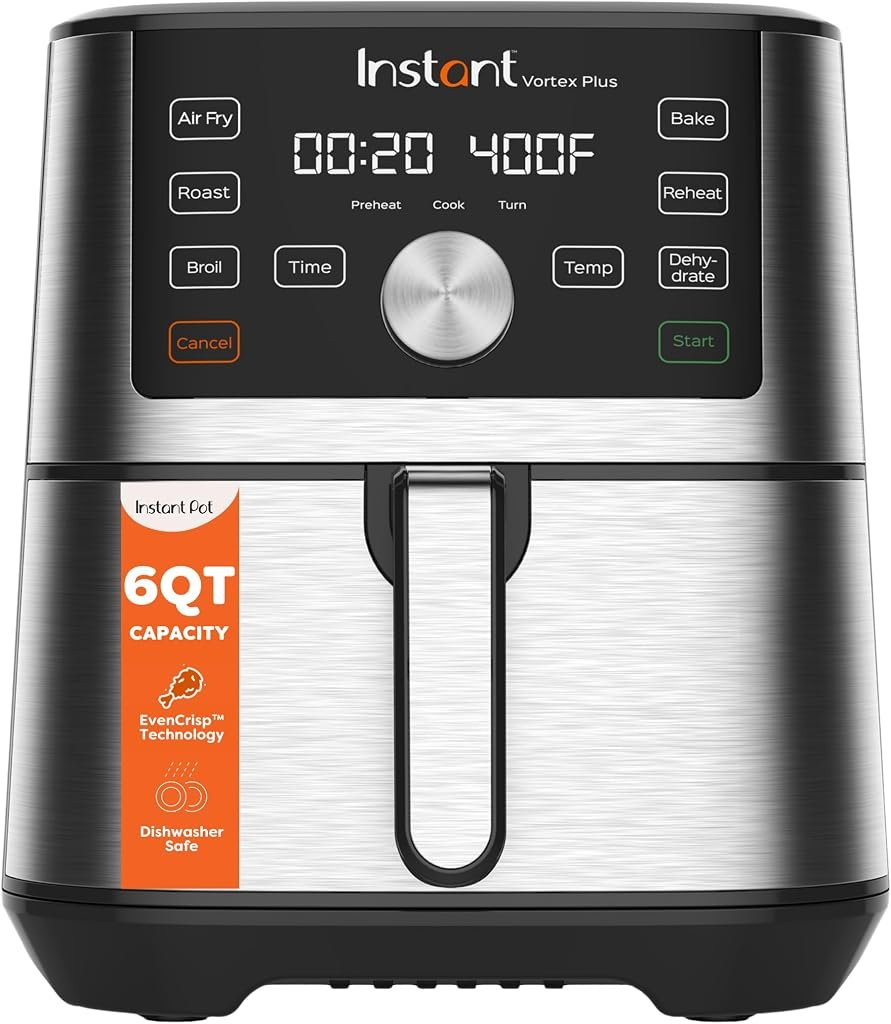
Within that category, the Instant Pot Vortex Plus occupies an interesting middle ground. It is neither a tiny appliance intended mainly for frozen fries nor a sprawling dual-basket machine built around simultaneous meal preparation. The current 6-quart Vortex Plus combines a 1,700-watt heating system with six cooking functions-air fry, roast, broil, bake, reheat and dehydrate-and, depending on the version, features such as a ClearCook viewing window and OdorErase filtration.
That configuration makes the Vortex Plus less about novelty than everyday utility. Its appeal rests on a straightforward proposition: heat a relatively small cooking chamber rapidly, circulate that heat aggressively, and avoid warming a full-size oven when dinner does not require one.
The proposition largely works. The more interesting question is where its advantages stop.
The Vortex Plus Formula
Instant Pot currently lists several Vortex models, which makes precise naming more significant than it initially appears. The standard Vortex 6QT is a four-function appliance, while the Vortex Plus 6QT expands the repertoire to six functions: air fry, bake, roast, broil, dehydrate and reheat. Its adjustable temperature range runs from 95°F to 400°F, or approximately 35°C to 205°C. The manufacturer specifies a 6-quart chamber, 1,700-watt power rating and 120-volt electrical supply for the US model.
Those numbers explain much of the appliance’s character.
A 1,700-watt heating element is substantial for a countertop device, but raw wattage is only one part of air-fryer performance. The central advantage comes from concentrating that heat inside a chamber dramatically smaller than a conventional oven. Less interior volume needs to reach cooking temperature, while forced convection continually moves hot air across exposed food.
Instant Pot calls its airflow system EvenCrisp. The company also states that it can produce crisp results using 95% less oil than traditional deep frying. That 95% figure should be read for what it is: a manufacturer claim comparing cooking-oil usage, not evidence that every air-fried recipe contains exactly 95% less fat or calories than its deep-fried counterpart. Food composition, coatings and the amount of oil added by the cook still matter.
That distinction is easily lost in air-fryer marketing. Air frying changes a cooking method. It does not rewrite the nutritional composition of the ingredients placed in the basket.
Why The Six-Quart Size Makes Sense
Capacity is one of the least intuitive specifications in the air-fryer market. Six quarts sounds generous when expressed as volume, but usable cooking capacity depends heavily on surface area.
Air fryers need moving air.
Pile food deeply into the basket and the appliance begins surrendering the characteristic that makes it effective. Moisture becomes trapped between pieces, surfaces shield one another from rapidly moving air, and crispness can become uneven.
The USDA explicitly warns against overcrowding an air-fryer basket because restricted circulation can result in uneven or inadequate cooking. For larger quantities, its guidance is uncomplicated: cook in batches.
This gives the Vortex Plus 6QT a practical identity. Instant Pot says the capacity can accommodate as many as six portions, but portion count should not be confused with six large portions of every possible food. A vegetable side, chicken pieces and a shallow layer of potatoes impose very different spatial demands.
For foods where browning matters, a somewhat underfilled basket is often preferable to a technically full one.
That means prospective owners should think in terms of cooking area rather than advertised volume alone. A household preparing modest quantities can exploit the machine’s speed efficiently. Someone routinely cooking a large tray of food for several people may spend enough time running consecutive batches that a conventional fan oven becomes more logical.
ClearCook Is More Useful Than It Sounds
The ClearCook version adds a viewing window to the basket. On paper, that feature risks sounding cosmetic. In routine cooking, it solves a legitimate design problem.
Traditional basket air fryers hide the food. Checking progress requires pulling the basket out, inspecting the contents and returning it to the machine. Doing so is easy, but every inspection interrupts the heated environment.
The Vortex Plus ClearCook lets the cook visually monitor browning without opening the basket. Instant Pot also specifies six customizable presets, dishwasher-safe cooking baskets and trays, overheat protection and automatic shutoff. The listed dimensions are approximately 11.8 inches wide, 14.9 inches long and 13 inches high.
Those dimensions deserve more attention than countertop-appliance advertising usually gives them. An air fryer is useful partly because it is readily accessible. An appliance that must be retrieved from a cabinet every evening introduces friction; one permanently installed on a counter consumes scarce workspace.
Before buying, measuring the intended location-including vertical clearance and space for ventilation-is more useful than studying another page of recipes.
Six Functions Do Not Mean Six Appliances Disappear
Multi-function cooking modes require equally sober interpretation.
Air fry, roast, bake and broil are not six entirely independent mechanical systems hiding inside the chassis. They are different applications of the same underlying combination of electrical resistance heating, airflow, temperature and timing. The modes alter how that hardware is controlled.
That does not make them meaningless. Presets can reduce repetitive adjustment, while low-temperature dehydration broadens the appliance’s usefulness. Reheating is particularly well suited to forced convection because foods such as pizza, roasted potatoes and breaded leftovers can regain surface texture that microwave heating often softens.
Yet the presence of a bake button does not mean a six-quart air fryer can replace a full-size oven for every baker. Basket geometry constrains pan size. Small internal dimensions limit batch volume. Recipes developed for conventional ovens can require adjustments because concentrated convection alters heat transfer.
The Vortex Plus therefore works better as an alternative oven for appropriately sized jobs than as a literal substitute for every other heating appliance in the kitchen.
Energy Efficiency Is A Question Of Portion Size
One of the strongest arguments for air fryers is energy use, but the useful version of that argument needs a qualifier: quantity matters.
A September 2026 Which? comparison of air fryers and ovens tested foods including chicken, chips, a jacket potato and cake. Science team leader Steph Kipling summarized the findings directly: “The air fryer often used less than half the energy, and the results were just as tasty.” She immediately added the important limitation: “the savings soon drop off if you have to cook in batches.”
That is the economic logic behind an appliance such as the Vortex Plus.
A smaller heated chamber can be highly efficient when preparing one modest meal. If a cook must operate it two or three times to produce the quantity that fits into a conventional oven in one cycle, the calculation changes.
Rated wattage alone also cannot establish the cost of preparing a meal. A 1,700-watt appliance running for 15 minutes does not consume the same amount of electricity as one drawing that power for an hour. Actual consumption depends on heating cycles, duration, temperature and recipe.
The meaningful comparison is therefore energy per finished meal, not simply watts printed on the appliance.
Cooking Performance Depends On Airflow
The physical principles behind the Vortex Plus favor certain foods.
Breaded foods, potatoes, roasted vegetables, wings and other relatively small pieces expose considerable surface area to moving hot air. Moisture can escape rapidly while exterior temperatures rise sufficiently for browning. Foods that benefit from a dry, crisp surface are natural candidates.
Very wet batters are a different matter. So are dishes requiring large pans, substantial liquid or considerable vertical space.
There is also a recurring operational mistake: assuming that more food means better efficiency because every cubic inch of the basket is being used.
Air fryers invert that logic. Empty space can be productive because it permits circulation.
For crisping, arranging food in a reasonably open layer and turning or shaking it when appropriate can matter more than selecting a sophisticated preset. The appliance supplies heat and airflow; food placement determines how effectively both reach the surface.
This is why capacity claims require interpretation when comparing the best air fryers. A physically larger basket may offer greater useful capacity even when two models advertise similar volume, while dual-zone machines address the problem differently by dividing food between independently controlled compartments.
Food Safety Still Requires A Thermometer
Fast cooking can create another misconception: browned food is not necessarily safely cooked food.
The USDA recommends checking internal temperature with a food thermometer rather than relying on exterior appearance. Its air-fryer safety guidance specifies 165°F for poultry, 160°F for ground meats, and 145°F for fish and whole cuts of beef, pork, veal and lamb, with the latter whole cuts receiving a three-minute rest.
This matters because rapid convection can brown the exterior efficiently. A crowded basket, unusually thick piece of meat or partially frozen ingredient can still produce temperature differences between the surface and center.
The correct workflow is mundane but reliable: avoid excessive crowding, follow appropriate cooking guidance and verify high-risk foods with a thermometer.
Cleaning And Maintenance
Air fryers tend to accumulate grease in precisely the places where users would rather not find it: beneath removable trays, around basket edges and near surfaces exposed to circulating aerosolized fats.
The Vortex Plus ClearCook addresses part of the burden with dishwasher-safe cooking baskets and trays. That reduces routine cleaning effort, although dishwasher compatibility does not eliminate the need to clean the larger cooking cavity and exterior.
The stainless-steel ClearCook version introduces another feature: OdorErase. Instant Pot describes it as a built-in filtration system intended to reduce lingering cooking odors. It is a useful distinction for kitchens where cooking smells are a recurring concern, though it should not be confused with kitchen ventilation. An air filter incorporated into a countertop appliance and an externally vented range hood solve problems on very different scales.
Maintenance also affects long-term performance. Residual grease repeatedly exposed to high heat can smoke and create odors, while accumulated crumbs can scorch. Regular cleaning is therefore less about keeping the appliance photogenic than preserving predictable operation.
Where The Vortex Plus Has An Advantage
The strongest case for the Vortex Plus emerges from ordinary meals rather than ambitious cooking projects.
Its 6-quart capacity provides more flexibility than very small personal air fryers without immediately moving into the bulk of large dual-basket designs. The 95°F-to-400°F temperature range supports both low-temperature dehydration and high-temperature browning, while 1,700 watts supplies substantial heating power for the chamber size.
The ClearCook window improves monitoring. Dishwasher-safe removable components address a routine annoyance. Six cooking functions cover the methods most likely to benefit from compact forced convection.
The design also avoids an increasingly common problem in countertop appliances: adding complexity merely because electronics make it possible. Six modes are enough to cover genuinely distinct cooking tasks without turning dinner into menu navigation.
Its limitations are equally concrete.
- Six quarts is not unlimited family capacity, particularly when food needs separation for crisping.
- A 1,700-watt appliance places a meaningful electrical load on a circuit.
- Countertop dimensions matter in smaller kitchens.
- Batch cooking can undermine the time and energy advantages that make an air fryer attractive.
- Bake and roast modes broaden its usefulness but do not duplicate the physical capacity of a conventional oven.
- A viewing window makes monitoring easier, but it cannot correct overcrowding or poor food placement.
These are not unusual defects. They are consequences of the appliance format.
How The Editorial Scores Translate Into Buyer Fit
Our overall score for the Vortex Plus is 8.86/10. That places it in a range where the product’s underlying format and feature set make sense for frequent use, while leaving enough room for meaningful compromises around capacity, counter space and batch cooking.
Customer Sentiment stands at 8.72/10. The figure is slightly below the overall editorial score, a difference small enough to suggest broad alignment between the product concept and everyday expectations rather than a dramatic gap between specification and ownership.
Buyer Confidence is considerably higher at 9.8/10. In practical terms, that reflects a product proposition that is easy to understand. This is not an appliance dependent on an experimental cooking technique: countertop forced-convection cooking is established, and the Vortex Plus has a clearly defined collection of functions.
Value receives 8.4/10, the lowest of the four figures. That is the score buyers should examine most carefully because air-fryer value is highly dependent on usage. Someone who reheats, roasts or air-fries modest portions several times a week can extract far more utility from the machine than a household already satisfied with a capable convection oven and routinely preparing large meals.
The difference between the 9.8 Buyer Confidence score and 8.4 Value score captures the Vortex Plus particularly well. Confidence in what the appliance does can be high without implying that every kitchen needs one.
Who Should Buy It
The Vortex Plus makes the most sense for households that frequently cook quantities small enough to fit comfortably into its basket. Singles and couples can exploit that characteristic particularly well, while families can use it effectively for sides, snacks, reheating and appropriately sized main dishes.
It also suits kitchens where conventional-oven preheating feels disproportionate to the quantity being prepared. Heating an entire oven cavity for a handful of vegetables or yesterday’s pizza is precisely the sort of job where a smaller convection chamber has an architectural advantage.
Large households face a different equation. If dinner routinely involves several pounds of food spread across multiple trays, basket capacity becomes the bottleneck. Repeated cycles add time, and the energy advantage can diminish-as the Which? testing illustrates.
Buyers should therefore ask a more revealing question than “How many people does it serve?”
They should ask: “How much food does this household usually cook at once?”
That distinction predicts satisfaction more accurately.
Final Considerations
The Instant Pot Vortex Plus represents a mature version of the basket-style air fryer: 1,700 watts, a 6-quart chamber, six useful cooking modes and, on ClearCook variants, the welcome ability to watch food brown without repeatedly opening the basket.
Its strengths come from physics rather than gadgetry. A small chamber reaches cooking conditions quickly. Forced convection accelerates surface heating. Less oil is needed than immersion frying. Small meals can consume materially less energy than cooking the same food in a full-size oven, although that advantage shrinks when repeated batches become necessary.
Its weaknesses follow the same logic. The basket is finite. Air needs space to circulate. Six cooking programs cannot create more physical capacity, and a powerful countertop oven cannot make every conventional oven redundant.
Our 8.86/10 score therefore reflects an appliance with a well-defined purpose rather than one that attempts to replace an entire kitchen. Customer Sentiment at 8.72, Buyer Confidence at 9.8 and Value at 8.4 reinforce that distinction: the underlying proposition is convincing when the household’s cooking habits match the machine’s scale.
For buyers comparing the best air fryers, capacity should be considered alongside usable basket area, power, cleaning requirements and actual meal size. Features matter, but routine determines value.
The Vortex Plus is at its most rational when it prevents a larger oven from being switched on for a smaller job. That may sound less dramatic than the usual language surrounding countertop appliances. It is also a more useful standard by which to judge one.