An air fryer that produces one scorched chicken wing beside another with pale skin is not necessarily broken. Neither is a machine that leaves the center of a batch of fries softer than the pieces around the perimeter. Uneven cooking is often the visible result of a less visible problem: moving hot air is not reaching every piece of food under the same conditions.
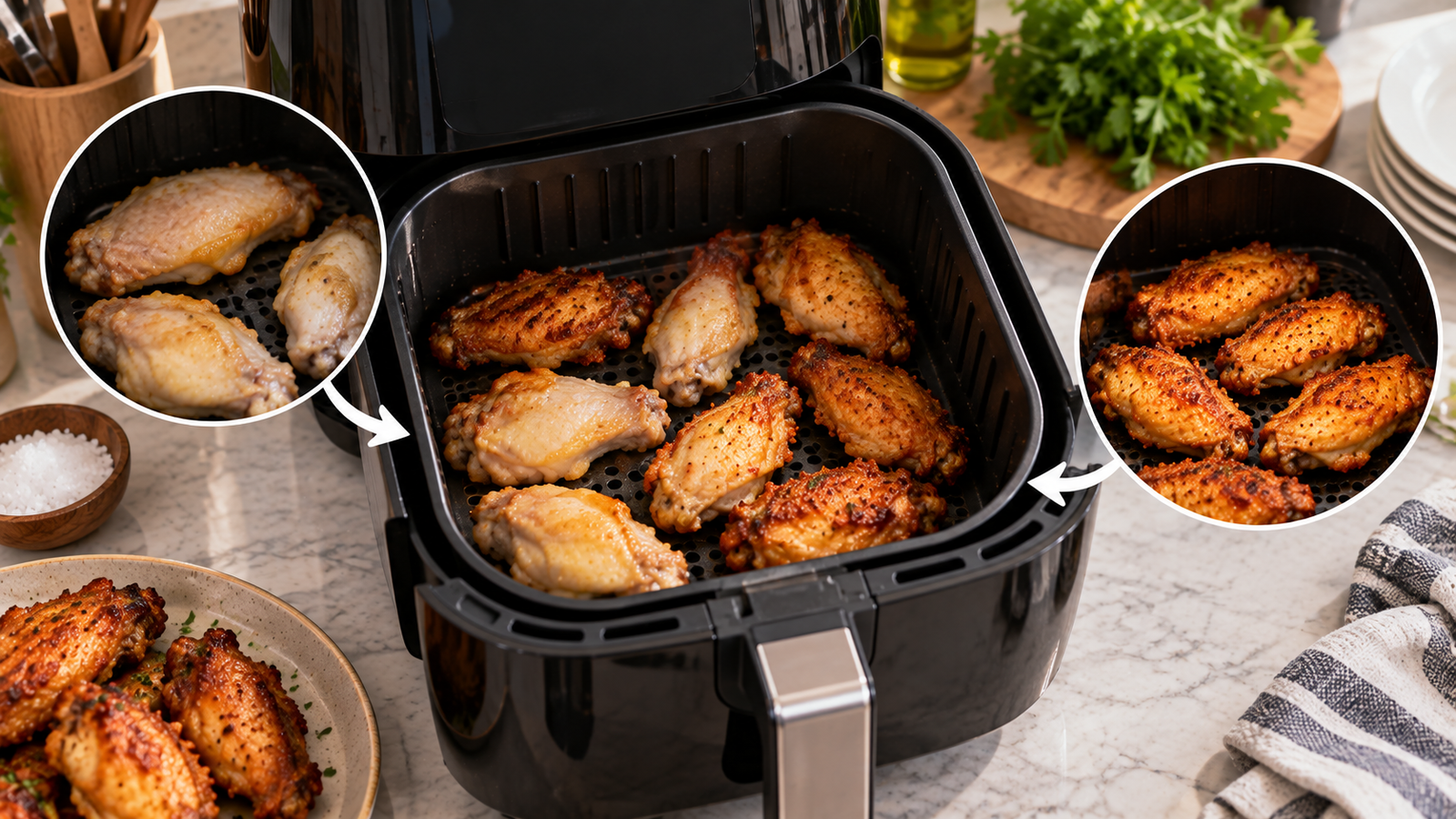
That distinction changes the troubleshooting process.
An air fryer is essentially a compact convection appliance. The U.S. Department of Agriculture describes air fryers as countertop convection ovens that use rapidly circulating hot air to cook and crisp food. Typical cooking temperatures are about 350°F to 400°F, or approximately 177°C to 204°C, and many foods require roughly 5 to 25 minutes.
Those numbers, however, do not mean every point inside the basket experiences identical heat transfer. Basket geometry, airflow, food placement, moisture, food thickness and the quantity loaded into the machine can all alter the result.
Recent research offers an unusually revealing example. A 2025 study published in Food Chemistry investigated airflow velocity in an air fryer and found measurable differences between central and peripheral areas. Under the experimental conditions, acrylamide accumulation in potato strips around the peripheral area was at least 1.5 times higher than in the central area. The researchers linked the differences to airflow velocity, water migration and changes in the food’s microstructure.
The finding does not mean every air fryer has the same center-versus-edge pattern. It does demonstrate something home cooks often discover empirically: forced-air cooking is not automatically uniform cooking.
Fortunately, most uneven results can be diagnosed without replacing the appliance.
Start With the Most Common Cause: An Overloaded Basket
When an air fryer cooks unevenly, the first inspection should be brutally simple: look at how much food is inside.
The machine needs exposed surfaces.
Hot air has to travel around the food, transfer energy to it and carry moisture away. When fries, vegetables, wings or breaded pieces are packed into a dense mass, food blocks other food. Some surfaces receive fast-moving hot air while others remain hidden at contact points.
The result is a basket containing several cooking environments at once.
Exposed pieces can brown rapidly. Buried pieces release moisture but have limited opportunity to lose it. Food touching neighboring pieces may remain comparatively soft. A pile of wet vegetables can create a particularly unforgiving situation because moisture evaporating from several pieces enters a confined area simultaneously.
USDA guidance specifically cautions against overfilling an air-fryer basket because doing so can lead to uneven cooking.
The Fix
Reduce the batch size before changing the temperature.
Arrange larger foods in a single layer whenever practical. Small items such as fries do not necessarily require military precision, but they should remain loose enough to move when the basket is shaken.
A useful test requires no measuring equipment. Cook the same food twice at the same temperature and for the same duration, but halve the quantity in the second batch. If the smaller batch cooks substantially more evenly, the appliance has effectively identified the problem.
This is why advertised basket capacity should not be confused with effective crisping capacity. A basket may physically hold a large quantity while producing better browning with considerably less.
Among the best air fryers, usable cooking area can therefore matter as much as headline capacity. A wider cooking surface may allow more food to receive direct airflow without being stacked deeply.
Check Whether the Food Is Actually Uniform
The appliance is frequently accused of inconsistency when the food itself is inconsistent.
A 10-millimeter potato stick and a 20-millimeter potato wedge cannot reasonably be expected to finish together. The smaller piece has less distance for heat to travel and more surface area relative to its mass. It will lose moisture and brown differently.
The same problem affects chicken breasts, vegetables, fish portions and homemade breaded foods.
Irregular dimensions create irregular cooking.
Frozen foods can introduce another variable. Ice crystals or frost accumulated during storage can create wet patches as they melt. Fresh vegetables of different sizes contain different quantities of water. Meat portions can differ substantially in thickness even when their weights look similar.
The Fix
Cut foods to approximately equal dimensions rather than merely equal lengths.
Thickness deserves particular attention because heat must travel toward the center. A long, thin strip may cook more rapidly than a short, thick piece despite appearing larger.
When cooking meat, group similarly sized pieces together. If unavoidable differences exist, check the smaller pieces first and remove them when they are ready rather than forcing every piece to remain in the basket until the largest one finishes.
For frozen food, separate pieces before cooking whenever possible. A frozen cluster behaves like one thick object until it begins breaking apart.
Shake the Basket Instead of Expecting Airflow to Do Everything
The fan circulates air; it does not levitate the food.
Every piece resting against the basket has an underside receiving different heat exposure from the surface facing upward. Pieces in the center may also experience different air velocities from pieces closer to the perimeter.
That is not merely theoretical. The 2025 Food Chemistry research found that differences in airflow velocity between central and peripheral regions altered moisture behavior and acrylamide distribution in potato strips.
Movement during cooking is the simplest correction.
The Fix
For fries, diced potatoes, vegetables and other loose foods, shake the basket around the midpoint of cooking. A larger batch may benefit from more than one shake.
For burgers, chicken pieces, breaded cutlets, fish and other larger items, turn each piece rather than merely jostling the basket.
The purpose is redistribution. Pieces that were near an edge move toward the center. Surfaces that were pressed against the basket become exposed.
There is little benefit in opening the machine every minute. Each interruption releases heat and slows the cooking process. The objective is strategic redistribution, not constant interference.
Examine Surface Moisture
Two visually identical pieces of food can cook differently when one enters the basket wetter than the other.
Water absorbs heat before evaporating. A wet surface therefore delays the transition toward dry browning. This is particularly noticeable with washed potatoes, wet vegetables, thawed meat and tofu.
Moisture can also migrate between pieces when the basket is crowded. The resulting steam can soften surfaces that would otherwise brown.
Air frying depends heavily on heat and mass transfer-the movement of heat into food and water out of it. Recent food-science research comparing air-fried and deep-fat-fried foods has continued to document meaningful differences in heat transfer, water loss and structural development between the two cooking methods.
The Fix
Dry wet foods before they enter the basket.
Vegetables can be spun or towel-dried. Potatoes should be thoroughly dried after washing or soaking. Moisture on meat and poultry surfaces can be blotted with disposable kitchen paper while observing safe handling procedures.
If oil is being used, distribute a modest amount evenly rather than leaving some pieces dry and others saturated.
Uneven oil distribution can become uneven browning distribution.
Consider Preheating When the First Batch Is Patchy
Some air fryers reach operating temperature rapidly enough that manufacturers do not require preheating for every recipe. Others benefit from it for particular foods.
Preheating can matter when consistency is the objective because it creates a more stable starting condition.
Without preheating, food begins cooking while the heating element, basket and internal air are still warming. The temperature profile during those first minutes is therefore changing rapidly.
A hot chamber gives each piece a more comparable starting point.
The Fix
Follow the appliance manufacturer’s instructions first. If preheating is permitted but optional, test a short preheat for foods that have been browning inconsistently.
The experiment should change only one variable. Use the same quantity, arrangement, temperature and cooking duration as before.
If preheating improves uniformity, incorporate it into that recipe.
The principle is broader than air frying: repeatable cooking requires repeatable starting conditions.
Do Not Assume the Displayed Temperature Is the Whole Story
An air fryer set to 200°C does not necessarily hold every cubic centimeter of its cooking chamber at exactly 200°C continuously.
Heating elements cycle. Fans move air along particular paths. Food absorbs energy and releases water vapor. Opening the basket changes chamber conditions. Appliance design affects how quickly the system recovers.
The displayed setting is therefore a control target, not a map of every local temperature around every piece of food.
This distinction becomes especially useful when food consistently burns in the same location.
The Fix
Run a controlled food test.
Arrange similar pieces in identifiable positions-front, back, center and sides-and cook them without moving them. If the same location repeatedly browns more aggressively across several batches, the appliance probably has a persistent hot zone.
Once identified, compensate by rotating or redistributing food partway through cooking.
Persistent extreme differences are another matter. If one region routinely burns while another remains substantially undercooked despite modest batch sizes and proper turning, the machine may warrant inspection under the manufacturer’s troubleshooting or warranty procedures.
Make Sure Air Can Move Under the Food
An air-fryer basket is perforated for a reason.
Air does not merely pass across the top. Depending on the appliance design, openings in and around the basket help establish the circulation pattern that cooks the food.
Blocking those openings can alter performance.
Solid liners, improperly sized parchment, excessive foil or accumulated debris can interfere with airflow. Loose parchment can create another problem if the manufacturer has not approved its use: powerful circulating air can lift lightweight material toward the heating element.
The Fix
Use liners only according to the manufacturer’s instructions and ensure accessories are intended for the specific cooking method.
Avoid covering more ventilation area than necessary.
Inspect the removable basket and crisper plate for blocked perforations. Baked-on grease, crumbs and food residue can gradually restrict openings, particularly when cleaning focuses only on visible upper surfaces.
Cleaning is therefore not merely cosmetic. The air path is part of the cooking system.
Check Basket and Crisper-Plate Installation
Removable components can look correctly installed while sitting slightly out of position.
If a crisper plate is tilted, reversed or not fully seated, food may sit at an unintended distance from the heating element or airflow channels. Some appliances also rely on specific basket positioning for proper operation.
The Fix
Allow the appliance to cool completely, remove the components and reinstall them according to the manual.
Check that:
- The crisper plate sits level.
- Rubber feet or supports, where fitted, are positioned correctly.
- The basket slides completely into the appliance.
- No accumulated food debris prevents components from seating properly.
- Accessories are compatible with the appliance and do not obstruct required vents.
This is a mundane check, but troubleshooting often rewards mundane checks before expensive theories.
Look at Where the Air Fryer Is Sitting
An air fryer is a heat-producing appliance that requires appropriate ventilation.
Pushing it tightly against a wall, enclosing it under unsuitable cabinetry or obstructing external intake and exhaust areas can affect heat management and create a safety concern.
Exact clearance requirements vary by manufacturer and model, so generic distances should not replace the appliance manual.
The Fix
Place the machine on a stable, heat-resistant surface with the ventilation clearances required by its manufacturer.
Inspect external vents for grease, dust or objects that could impede airflow.
The machine should also sit level. A dramatically tilted appliance can affect food positioning, grease movement and basket stability.
Separate Browning Problems From Doneness Problems
“Unevenly cooked” can describe two very different complaints.
One is cosmetic and textural: some fries are brown while others are pale.
The other is a food-safety issue: one chicken piece has reached a safe internal temperature while another has not.
The second problem cannot be diagnosed reliably by color.
The USDA states that consumers cannot see, smell or taste harmful bacteria that may cause foodborne illness and recommends measuring safe internal temperatures with a food thermometer.
For poultry, including wings, thighs and breasts, the USDA minimum is 165°F, or 73.9°C. Ground beef, pork, lamb and veal require 160°F, or 71.1°C. Whole cuts of beef, pork, veal and lamb require 145°F, or 62.8°C, followed by at least a three-minute rest. Fish and shellfish have a listed minimum of 145°F.
The Fix
Measure several pieces when a batch contains different sizes.
The USDA advises placing the thermometer in the thickest appropriate portion and avoiding bone, fat or gristle where relevant. For poultry parts, the probe should enter the thickest area while avoiding bone.
If one chicken breast reaches 165°F while another measures substantially below that point, visual browning is irrelevant. The cooler piece needs additional cooking.
This also helps diagnose the cause. If similarly sized pieces show large internal-temperature differences, basket position and airflow deserve investigation. If the thickest pieces are consistently coolest, food geometry is the more likely explanation.
Be Careful With Raw Stuffed Breaded Chicken
Some foods deserve a separate warning because their exterior can be especially misleading.
USDA air-fryer guidance specifically states that raw, stuffed, breaded chicken breast products should not be cooked in an air fryer and directs consumers to follow the manufacturer’s cooking instructions for those products.
A browned breaded exterior does not establish that the interior has received adequate heating.
This is an example of why troubleshooting uneven air-fryer cooking cannot focus exclusively on appearance. Crispness and safety are separate measurements.
Test Whether the Problem Follows the Food or the Machine
A useful diagnostic experiment can distinguish recipe problems from appliance problems.
Choose a food that can be cut into highly uniform pieces. Arrange a modest quantity in a single layer. Use no unusual liner or accessory. Preheat if the manufacturer recommends it. Cook at a normal recipe temperature.
Do not shake the basket during the first test.
Observe where browning occurs.
Then repeat the experiment, but rotate or redistribute the pieces halfway through.
If the second batch becomes much more uniform, the machine probably has normal airflow variation that can be managed through turning.
If both batches show severe and repeatable temperature differences in the same locations, despite proper loading, the appliance deserves closer attention.
This method is more informative than repeatedly changing temperature, cooking time, oil quantity and batch size simultaneously. Changing five variables at once can improve dinner while revealing almost nothing about what was wrong.
Recognize the Signs of a Possible Hardware Problem
Technique cannot correct every defect.
A machine that previously cooked predictably but suddenly becomes severely uneven deserves a different investigation from a new appliance producing mildly patchy fries.
Potential warning signs include unusually long cooking times, failure to reach normal browning temperatures, a fan that sounds materially different from its usual operation, repeated shutdowns, electrical smells, smoke unrelated to ordinary food residue, visible damage or a heating element that appears to operate abnormally.
The appropriate response is not home electrical surgery.
Unplug the appliance and consult the manufacturer’s troubleshooting guidance. If the unit is under warranty, use the approved service process. Internal electrical repairs expose users to mains voltage, high-temperature components and stored electrical energy.
If smoke, sparking, melted components or damaged wiring appears, stop using the appliance.
Why Design Differences Matter
Not every uneven result is user error.
Air-fryer geometry influences airflow. Fan dimensions, fan speed, heater placement, basket dimensions and the resistance created by food can alter how hot air travels through the chamber.
The 2025 Food Chemistry study is especially instructive because increasing blade size in its experimental system intensified uneven airflow distribution. The researchers reported that higher peripheral airflow velocity affected water loss, surface wrinkling, porosity and acrylamide formation in potato strips.
That does not create a universal ranking of appliance designs. It demonstrates that airflow engineering has measurable effects on food.
Consequently, two air fryers operating at the same displayed temperature can require different cooking times and different turning schedules. USDA guidance likewise states that cooking times vary with appliance size and power.
Recipes should therefore be treated as starting parameters rather than laboratory guarantees.
A Practical Troubleshooting Order
When dinner is already underway, a diagnostic hierarchy is more useful than a catalogue of theories.
Work through the problem in this order:
- Reduce the quantity in the basket.
- Separate pieces and create more exposed surface area.
- Make food pieces more uniform in thickness.
- Dry excessive surface moisture.
- Shake small foods or flip larger pieces midway through cooking.
- Preheat if the appliance instructions permit or recommend it.
- Remove unnecessary airflow obstructions such as unsuitable liners.
- Check that the basket and crisper plate are properly installed.
- Clean blocked basket perforations and accessible vents according to the manual.
- Test whether browning repeatedly concentrates in the same area.
- Use a thermometer when uneven cooking involves meat, poultry, fish or reheated leftovers.
- Consult the manufacturer if severe unevenness persists under controlled conditions.
This order matters. Overloading is easier to correct than a suspected fan fault, and it is far more common in everyday cooking.
When Uneven Cooking Is Actually Normal
Perfectly identical browning is an unrealistic standard for many foods.
A Brussels sprout has curved leaves, exposed cut surfaces and different local moisture levels. Chicken wings vary in shape and thickness. Hand-cut potatoes rarely have identical dimensions. Breaded foods develop microscopic variations in coating thickness.
Even an appliance with well-distributed airflow cannot erase all of those differences.
The practical objective is controlled variation: food should reach appropriate internal doneness without some pieces becoming badly overcooked while others remain raw or substantially underdone.
Minor differences in browning can often be corrected with a final shake and a short additional cooking interval. Severe differences call for diagnosis.
That distinction prevents unnecessary replacement of a functioning appliance while still recognizing when performance has moved beyond ordinary variation.
Final Considerations
Uneven air-fryer cooking is usually a heat-transfer problem disguised as a recipe problem.
The fan must move hot air around the food. The food must expose enough surface area to that air. Moisture must escape. Pieces must be similar enough in size to progress at roughly comparable rates. The basket must permit circulation rather than obstruct it.
When any one of those conditions fails, the symptoms appear on the plate: pale centers in a batch of fries, overbrowned edges, soggy undersides, chicken pieces finishing at different times or vegetables ranging from barely tender to scorched.
The most effective fixes are correspondingly physical rather than mysterious. Reduce the load. Separate the food. Standardize thickness. Dry wet surfaces. Shake or turn the batch. Keep air passages clear. Measure internal temperatures when safety is involved.
Only after those variables have been controlled does it make sense to suspect the appliance itself.
That sequence is useful because an air fryer does not cook evenly merely because a fan is spinning. Research demonstrates that airflow velocity can vary within an air-frying system and that those differences can materially affect moisture movement and food chemistry. The engineering challenge is therefore real, even in a compact countertop appliance.
For everyday cooking, however, the response does not require an engineering degree. It requires treating airflow as an ingredient.
Give hot air room to move, give similarly sized food comparable exposure, move the food when the machine cannot redistribute it by itself, and verify internal temperature rather than trusting color. When those habits become routine, uneven cooking becomes easier to diagnose-and far less likely to ruin the meal.