The Breville BOV900BSS Smart Oven Air Fryer Pro and BOV860BTR Smart Oven Air Fryer approach the same countertop problem from noticeably different directions. Both combine air frying with the functions expected from a sophisticated toaster oven. Both use Breville’s Element iQ system, digital PID temperature control and convection. Both are 1,800-watt appliances. Yet the similarities conceal a substantial difference in scale.
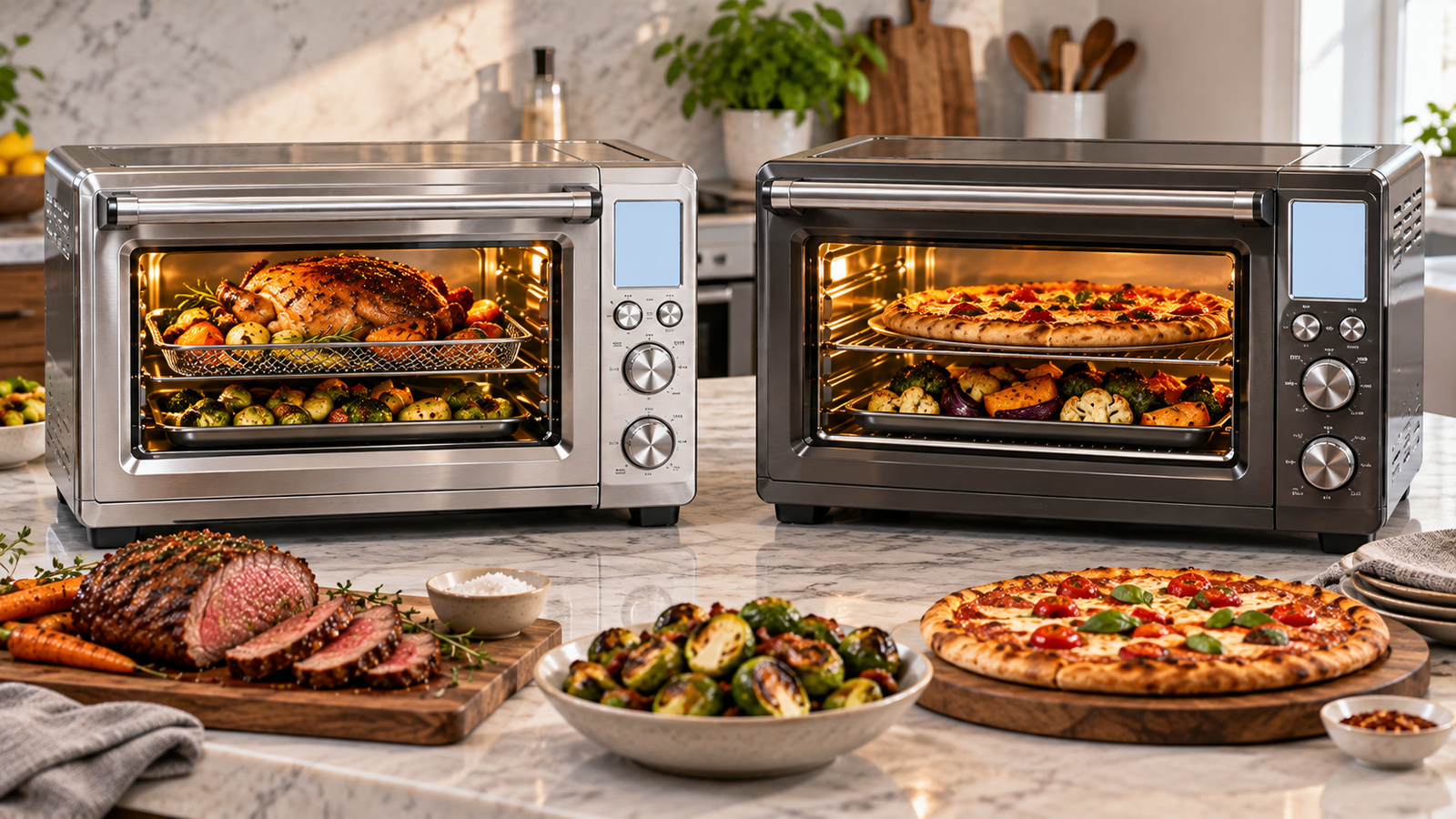
The BOV900BSS is the larger, heavier and more functionally expansive machine. It provides 13 preset cooking functions, a one-cubic-foot interior, room for nine slices of toast and enough stated capacity for a 14-pound turkey. The BOV860 platform provides 11 functions in a 0.8-cubic-foot chamber, with capacity for six slices of toast, a 13-inch pizza or a whole chicken.
Price adds an unusual wrinkle. At the prices assessed here, the BOV900BSS costs $319.95 while the Black Truffle BOV860BTR costs $349.95. The larger Pro therefore costs $30 less in this comparison despite offering greater stated capacity and two additional cooking functions.
That inversion makes the Breville BOV900BSS vs BOV860BTR comparison more interesting than the familiar “pay more, get more” equation. The BOV860BTR instead makes its case around a smaller physical presence and a distinctive Black Truffle finish, while the BOV900BSS prioritizes capacity and functional range.
Our scores reflect that tension. The BOV900BSS receives an 8.71/10 overall score, compared with 8.55/10 for the BOV860BTR. The difference is narrow because countertop appliances are not judged by feature count alone. An oven that fits comfortably into a kitchen can be more useful than a more capable machine that consumes too much working space.
Breville BOV900BSS vs BOV860BTR at a Glance
| Category | Breville BOV900BSS | Breville BOV860BTR |
|---|---|---|
| Product | Smart Oven Air Fryer Pro | Smart Oven Air Fryer |
| Price assessed | $319.95 | $349.95 |
| Our Score | 8.71/10 | 8.55/10 |
| Customer Sentiment | 8.5/10 | 8.28/10 |
| Buyer Confidence | 9.8/10 | 9.8/10 |
| Value | 8.28/10 | 8.15/10 |
| Cooking functions | 13 | 11 |
| Interior capacity | 1 cu. ft. | 0.8 cu. ft. |
| Toast capacity | 9 slices | 6 slices |
| Pizza capacity | 13 inches | 13 inches |
| Power | 1,800W | 1,800W |
| Convection | Regular and Super Convection | Regular and Super Convection |
| Dehydrate preset | Yes | No |
| Proof preset | Yes | No |
| Slow Cook | Yes | Yes |
| Interior light | Yes | Yes |
| Weight | 38.89 lb. | 28.66 lb. |
| Warranty | 2-year limited product warranty | 2-year limited warranty |
Breville’s Smart Oven Air Fryer Pro specifications identify a one-cubic-foot interior, 13 presets, 1,800 watts, a temperature range of 80°F to 480°F and dimensions of 21.4 inches wide by 17.3 inches deep by 12.7 inches high.
The smaller Smart Oven Air Fryer platform is specified at 0.8 cubic feet, 11 presets, 1,800 watts and 28.66 pounds, with capacity for six slices of toast, a 13-inch pizza, a whole chicken or a nine-cup muffin tray.
Those numbers establish the central choice: BOV900BSS buyers obtain more oven, while BOV860BTR buyers surrender capacity in exchange for a materially smaller and lighter appliance.
The BOV900BSS Is Not Merely the BOV860BTR With Two Extra Buttons
Feature counts often create false precision. Thirteen sounds better than 11 because 13 is larger. Kitchen utility is less obedient to arithmetic.
Both ovens cover an unusually broad foundation. The BOV860 offers Toast, Bagel, Broil, Bake, Roast, Warm, Pizza, Air Fry, Reheat, Cookies and Slow Cook. The BOV900 Pro contains those same core functions while adding Proof and Dehydrate.
Those two additions are specialized rather than ornamental.
Proof is relevant to bread and enriched dough preparation, where controlled warmth can simplify fermentation. Dehydrate is aimed at sustained low-temperature drying, and Breville states that the Pro can dehydrate food on as many as four trays.
A household that never makes bread and has no interest in dehydration should not assign imaginary value to either function. For such a buyer, the difference between 13 and 11 presets contracts immediately.
The BOV860BTR already includes the modes that define most daily countertop-oven work: toast, bake, roast, broil, pizza, reheating, cookies, warming, slow cooking and air frying. That is an extensive repertoire without Proof or Dehydrate.
The BOV900BSS becomes more compelling when those specialist functions overlap with actual cooking habits. This is a recurring theme among the best air fryers and combination ovens: the number printed beside “functions” matters less than the percentage of those functions that will genuinely be used.
Capacity Creates the More Consequential Difference
The larger distinction is inside the oven.
Breville specifies the BOV900BSS at one cubic foot. Its interior can accommodate nine slices of toast, a 13-inch pizza, a 9-by-13-inch baking pan, a 12-cup muffin tray or a 14-pound turkey.
The BOV860 platform has a 0.8-cubic-foot interior and is specified for six slices of toast, a 13-inch pizza, a whole chicken or a nine-cup muffin tray.
Measured by stated cubic volume, the Pro provides 25% more interior capacity than the 0.8-cubic-foot BOV860.
That is not a trivial increase. Nor should it be confused with proof that every food cooks faster or better in the larger oven. Capacity and cooking performance are separate questions, and no invented head-to-head test belongs in the gap between them.
The practical benefit is flexibility.
A 13-inch pizza fits either oven, meaning the larger BOV900BSS provides no stated pizza-diameter advantage for that particular task. Toast tells a different story: nine slices rather than six represents a 50% increase in stated slice capacity. Muffin capacity rises from nine cups to 12, about 33%.
The Pro’s ability to accommodate a 9-by-13-inch baking pan also matters because that pan format is deeply embedded in home baking and casserole recipes. A countertop oven able to handle it can take on jobs that would otherwise push a household toward its full-size oven.
That does not automatically make the larger machine preferable. Capacity is valuable only when it is used.
Countertop Geography Favors the BOV860BTR
The BOV900BSS pays for its capacity with physical mass.
Breville lists it at 21.4 inches wide, 17.3 inches deep and 12.7 inches high, with a weight of 38.89 pounds. The BOV860 platform is listed at 18.9 by 15.9 by 10.9 inches in Breville’s current specification presentation and weighs 28.66 pounds.
The weight difference is 10.23 pounds. The Pro is roughly 35.7% heavier than the BOV860.
That difference changes the ownership experience for anyone who does not intend to leave the oven permanently on the counter. Moving almost 39 pounds out of a cabinet whenever air-fried vegetables are wanted is a very different proposition from shifting a 28.66-pound appliance. Neither qualifies as particularly light, but the distinction is meaningful.
Width is similarly consequential. The Pro requires several additional inches of horizontal room. In a large kitchen, that may be inconsequential. In a galley kitchen, apartment or counter already divided among a coffee maker, kettle, stand mixer and food-preparation area, those inches become contested territory.
This is where the BOV860BTR earns its strongest defense against the larger model. It retains the central Breville cooking architecture while reducing the exterior commitment.
The Black Truffle finish also distinguishes the BOV860BTR aesthetically from the brushed stainless BOV900BSS configuration assessed here. Finish should not be mistaken for cooking capability, but a countertop appliance of this size is furniture-like in its visual permanence. Color can reasonably enter the decision when the machine will remain exposed every day.
Element iQ Is Shared Ground
The comparison becomes more balanced when the heating systems are examined.
Both models use Breville’s Element iQ architecture and digital PID temperature control. Breville describes the system as directing power among heating elements according to the selected cooking environment, while PID control is intended to reduce temperature overshoot and maintain stable temperatures.
The BOV900BSS uses six independent quartz heating elements. Breville also equips the Pro with two-speed convection: regular convection and Super Convection.
The BOV860 likewise provides dual-speed convection, including a Super Convection mode intended to create greater airflow for air frying. Breville states that convection can reduce cooking time by up to 30%, although that figure is a manufacturer claim rather than an independently established result for every recipe.
This shared architecture matters because the BOV860BTR is not simply a stripped-down oven with an air-fry label attached. Its reduced size does not remove the digital temperature-control system, dedicated Air Fry setting or dual-speed convection concept that defines this Breville family.
For buyers primarily interested in those capabilities, the smaller model preserves much of the functional core.
Air Frying Is Only Part of the Story
Calling either machine an air fryer can undersell what it physically is.
Basket-style air fryers concentrate cooking around a relatively compact chamber. These Breville models are countertop ovens that also employ high-airflow convection for air frying. Their broader purpose includes toast, pizza, baking, roasting and several lower-intensity heating tasks.
That distinction affects buyer expectations.
Someone who primarily cooks modest portions of fries, wings or vegetables may place greater emphasis on air-frying workflow than on fitting a 9-by-13-inch pan. Someone attempting to replace several countertop devices may view the oven functions as equally significant.
The BOV900BSS makes the stronger appliance-consolidation argument because its larger cavity and Dehydrate and Proof modes widen its potential workload. Its ability to accommodate a 14-pound turkey is particularly revealing. Breville is positioning this machine not merely as a toaster with circulating air but as an alternative cooking chamber for substantial meals.
The BOV860BTR is more restrained. It can still roast a whole chicken, handle a 13-inch pizza and perform slow cooking, but its 0.8-cubic-foot capacity places a clearer boundary around what belongs inside.
The Price Relationship Changes the Value Calculation
The prices assessed here create an unusual result.
The BOV900BSS is $319.95. The BOV860BTR is $349.95. Readers comparing the specific retail configurations can inspect the BOV900BSS listing and the BOV860BTR listing directly.
That puts the BOV860BTR $30 above the Pro, approximately 9.4% more than the BOV900BSS price assessed here.
The relationship deserves scrutiny because the Pro simultaneously offers the larger cavity and additional functions.
Our Value score consequently favors the BOV900BSS at 8.28/10 versus 8.15/10 for the BOV860BTR. The difference remains moderate rather than dramatic because value cannot be divorced from fit. Paying less for a larger machine is attractive only when the buyer has room for that larger machine.
The BOV860BTR therefore makes a less conventional value argument. Its justification is not “more features per dollar.” It is obtaining the desired Breville cooking platform in a smaller body and Black Truffle finish.
That can be entirely rational. Residential counter space has economic value even though appliance specifications rarely assign it a dollar figure.
Accessories Reinforce the Difference in Scale
Breville includes a 13-inch pizza pan, two oven racks, a 9-by-13-inch broil rack and enamel roasting pan, and a mesh basket rack for air frying and dehydrating with the BOV900 Pro.
The BOV860 includes an air-fry basket, 8.25-by-12-inch broiling rack and enamel roasting pan, 13-inch nonstick pizza pan and wire rack.
Again, the accessories reveal design intent.
Both ovens arrive prepared for pizza and air frying. The Pro’s larger roasting equipment and second oven rack align with its larger chamber, while its mesh basket has a second stated purpose in dehydration.
Neither accessory package should be treated as inherently superior without considering the food being prepared. A second rack has little value if a buyer never needs it. A larger roasting pan becomes meaningful when larger meals are routine.
The pattern is consistent: the Pro rewards households that exploit scale.
The Displays and Interior Lights Reduce Everyday Friction
Both machines use LCD interfaces rather than relying exclusively on mechanical knobs and printed temperature markings.
On the BOV860, the LCD communicates the selected cooking function and indicates when preheating has finished before beginning the cooking countdown. It also has an integrated interior oven light that switches on automatically at the end of the cooking cycle and can be activated while food is cooking.
The BOV900 similarly provides an LCD interface for its 13 cooking functions and an integrated oven light.
These are not dramatic features, but countertop ovens are repetitive-use appliances. Small interface conveniences accumulate across hundreds of breakfasts, reheated lunches and weeknight dinners.
An interior light, for example, allows food to be inspected without immediately opening the door. An LCD showing the active program reduces ambiguity about what the oven has been asked to do.
Neither model establishes a decisive advantage here. Their shared interface philosophy is more notable than their differences.
Customer Sentiment, Confidence and Editorial Scores
Our overall assessment gives the BOV900BSS 8.71/10 and the BOV860BTR 8.55/10.
Customer Sentiment is 8.5/10 for the Pro and 8.28/10 for the BOV860BTR. Buyer Confidence is identical at 9.8/10. Value stands at 8.28/10 and 8.15/10, respectively.
The scores describe a close comparison rather than a rout.
The Pro’s advantage comes from an unusual combination at the assessed prices: it costs $30 less while providing a larger cavity, greater toast and muffin capacity, and two additional cooking modes. Those factors collectively explain its higher overall and Value scores.
The BOV860BTR remains close because size itself has utility. A countertop oven cannot be assessed as though kitchen space were infinite.
The two-year limited warranty is another area of broad parity. Breville lists a two-year limited warranty for the BOV860 and a two-year product warranty for the BOV900 Pro, with the current Pro specification also identifying separate five-year coverage for glass defects.
Who Is Better Suited to the BOV900BSS?
The BOV900BSS fits buyers who intend to use a countertop oven as a substantial secondary oven rather than mainly as an air fryer with extra functions.
Its profile is particularly coherent when:
- A 9-by-13-inch baking pan needs to fit.
- Nine-slice toast capacity has practical value.
- Large roasting jobs are expected.
- Proofing bread dough is part of the household’s cooking routine.
- Food dehydration is genuinely useful.
- Multiple rack positions and the larger accessory package will be used.
- A roughly 21.4-inch-wide appliance can remain on the counter.
- The $319.95 assessed price remains below the BOV860BTR alternative.
The Pro also makes sense for kitchens where a full-size oven is inconvenient for smaller meals but a genuinely roomy secondary cooking chamber is still desirable.
Its weakness is equally physical. A 38.89-pound countertop oven measuring more than 21 inches wide demands planning. Buyers should measure the intended location rather than assume that “countertop” means compact.
Who Is Better Suited to the BOV860BTR?
The BOV860BTR better fits buyers who want most of the Smart Oven Air Fryer experience without committing to the Pro’s dimensions.
Its case becomes stronger when:
- A 0.8-cubic-foot cavity is sufficient.
- Six slices of toast cover normal demand.
- A 13-inch pizza is the largest routinely relevant flat-food capacity.
- Proof and Dehydrate would rarely or never be selected.
- Lower weight matters because the appliance may be moved.
- Counter width is constrained.
- The Black Truffle finish is preferred enough to justify its role in the purchase decision.
The BOV860BTR still carries 11 presets, Super Convection, Air Fry, Slow Cook, digital PID control, an interior light and a substantial accessory set. Calling it the lesser machine solely because its specification sheet contains two fewer cooking modes misses the point.
It is the more space-conscious interpretation of the same basic idea.
Measuring Before Buying Is More Useful Than Counting Presets
This comparison ultimately exposes a recurring weakness in appliance shopping: specifications are often ranked without considering the kitchen around them.
A one-cubic-foot oven is more capacious than a 0.8-cubic-foot oven. That is measurable. Thirteen functions are more than 11. That is arithmetic. Nine slices exceed six.
Yet none of those facts establishes how often the additional capacity will matter.
A household that bakes bread, hosts dinners, dehydrates fruit and regularly uses 9-by-13-inch cookware has multiple reasons to exploit the BOV900BSS. The larger cavity is not theoretical in that setting.
A household that mainly air fries vegetables, reheats leftovers, makes toast and occasionally cooks a pizza may experience the comparison differently. The BOV860BTR already handles those categories while taking up less space and weighing about 10 pounds less.
That is why measuring the intended counter location before purchasing is unusually consequential here. The Pro’s extra capability is visible on paper; its extra bulk becomes visible in the kitchen.
Final Considerations
The Breville BOV900BSS and BOV860BTR share enough technology to make their differences unusually focused.
Both are 1,800-watt air fryer toaster ovens. Both employ Element iQ and PID temperature control. Both provide dual-speed convection, dedicated air frying, LCD interfaces, interior lights and broad collections of cooking presets. Both can accommodate a 13-inch pizza.
The BOV900BSS then expands outward. Its one-cubic-foot chamber is 25% larger by stated volume than the BOV860’s 0.8-cubic-foot interior. It handles nine slices of toast rather than six, accommodates a 12-cup rather than nine-cup muffin tray, accepts a 9-by-13-inch baking pan and is specified for a 14-pound turkey. Proof and Dehydrate raise its preset count to 13.
The BOV860BTR answers with restraint. At 28.66 pounds, the BOV860 platform is more than 10 pounds lighter than the Pro. Its exterior is smaller, while its 11 cooking modes retain the functions many households are likely to use most often.
At the prices assessed here, however, the economic balance tilts toward the Pro. The BOV900BSS costs $319.95 against $349.95 for the BOV860BTR. That unusual pricing relationship helps produce our 8.71/10 overall score and 8.28/10 Value score for the BOV900BSS, compared with 8.55/10 and 8.15/10 for the BOV860BTR.
The scores do not turn the BOV900BSS into a universal choice. Its extra width, depth and 38.89-pound weight impose costs that do not appear on a receipt.
For buyers with sufficient counter space who will exploit larger cookware, bigger batches, proofing or dehydration, the BOV900BSS is the more capability-focused fit and carries the stronger value proposition at these prices.
For buyers whose kitchen has tighter physical boundaries and whose cooking routine fits comfortably within six-slice, 0.8-cubic-foot capacity, the BOV860BTR presents the more compact interpretation without abandoning the central Breville technologies.
The distinction is ultimately less about which oven can accumulate the longest specification sheet than about which one converts its specifications into regularly used capacity. In that respect, the tape measure beside the countertop can reveal more than another row of features ever will.