A treadmill designed around older users faces a more demanding assignment than simply moving a belt at a chosen speed. For this audience, the decisive questions concern control, support, accessibility, stability, and whether the machine’s performance range corresponds to the way it will actually be used. A high maximum speed means little if the user feels uneasy getting onto the deck. Elaborate software matters less if the emergency stop is difficult to reach.
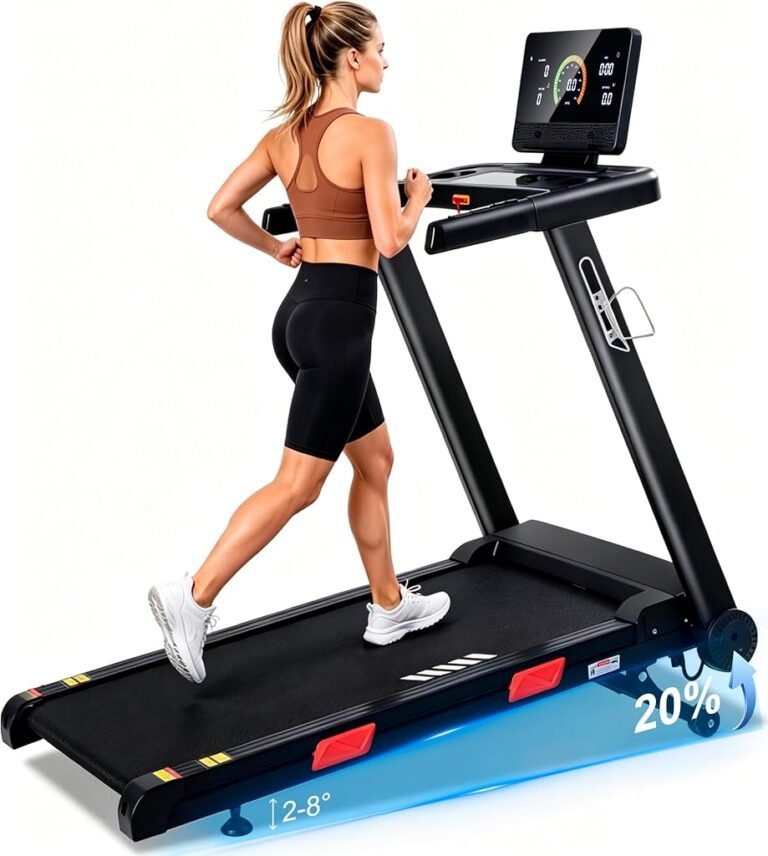
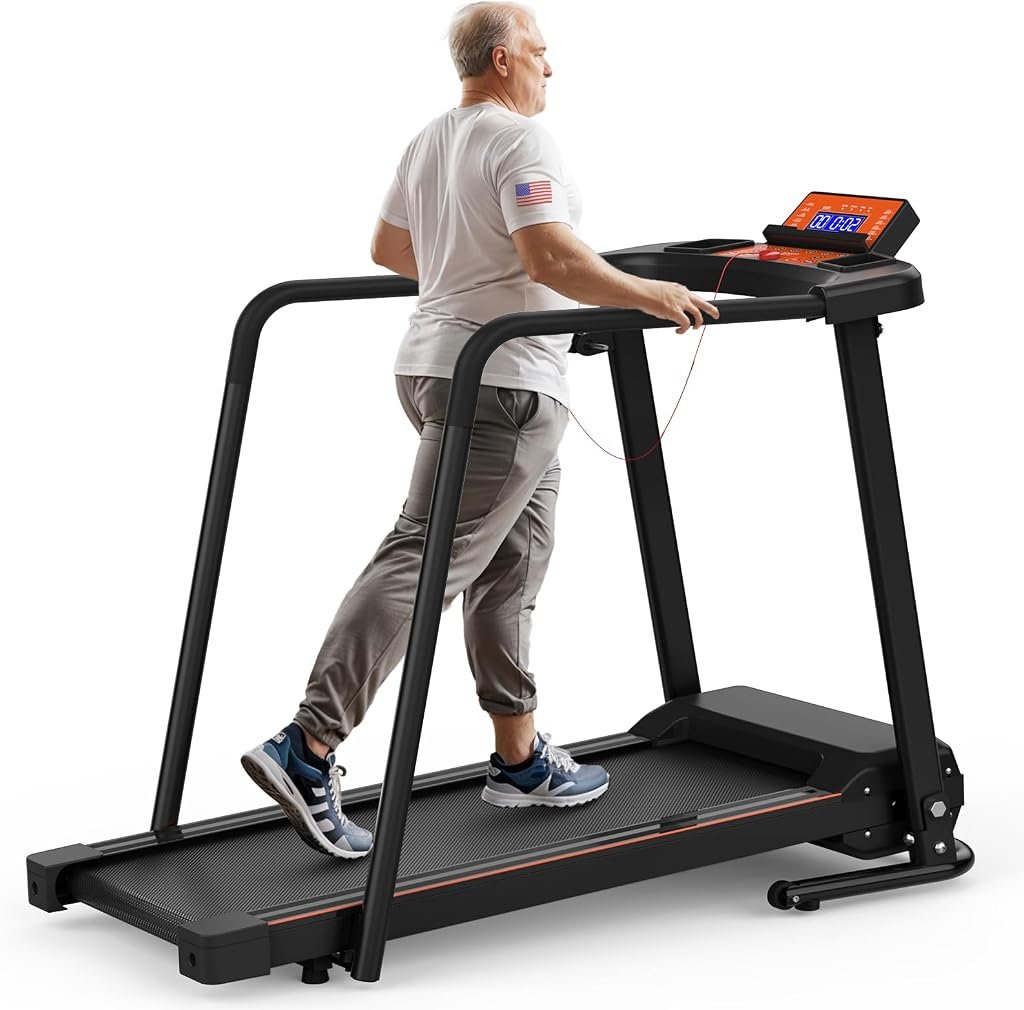
The FYC Treadmill for Seniors with Extended Handrails approaches the problem from the right direction. Identified as model JK0805L, it combines detachable extended handrails, a magnetic safety key, a folding frame, a 300-pound stated user capacity, a 2.5 HP motor, speeds reaching 6 mph, shock absorption, and optional app connectivity. Its published dimensions are approximately 51.2 inches long, 24 inches wide, and 42.6 inches high, while the machine weighs about 61.7 pounds. These specifications are documented in records for the FYC JK0805L and correspond to the product identifier associated with this machine.
That combination establishes a clear identity. This is primarily a walking and light-jogging treadmill rather than a running platform disguised with senior-friendly accessories.
At an evaluated price of $319.99, that distinction matters.
Our score is 7.85/10. Customer Sentiment is 7.62, Buyer Confidence is 8.57, and Value is 7.79. The spread is informative. Buyer Confidence sits substantially above the other ratings because the FYC has a readily understandable purpose and several features that directly address older users. Customer Sentiment is more restrained because senior-oriented equipment is unusually sensitive to individual mobility, balance, gait, and expectations.
The machine earns a good rating, but the recommendation comes with boundaries.
Extended Handrails Are the Defining Feature
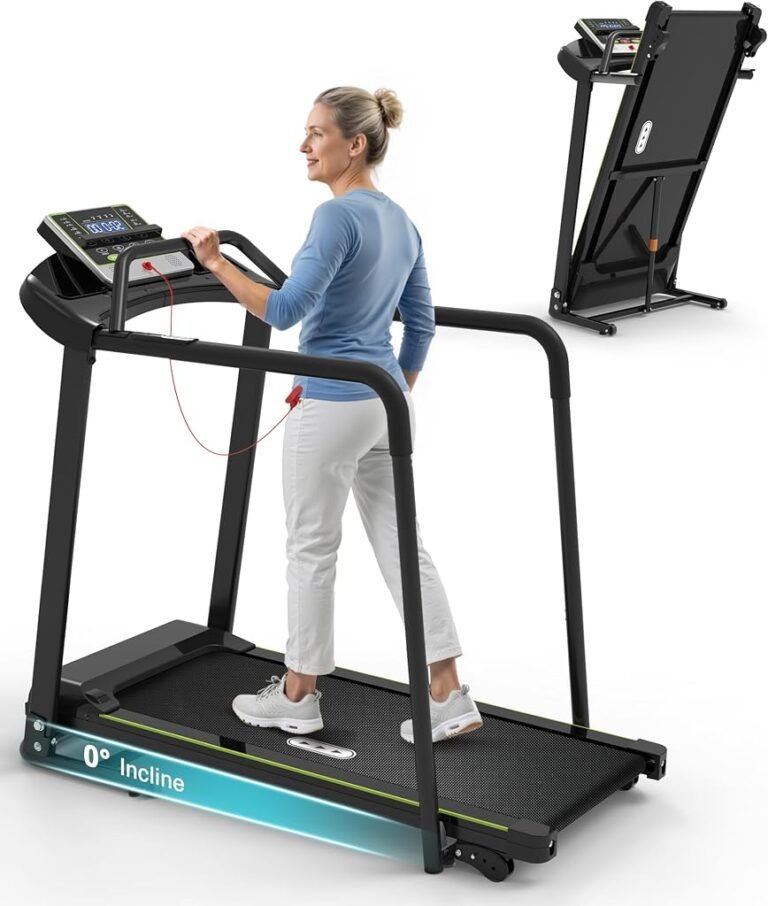
The extended handrails distinguish the FYC from ordinary compact treadmills.
Product documentation describes detachable long armrests intended to provide additional gripping support. The FYC product listing associated with the same model identifier also identifies a magnetic safety key that stops the treadmill when removed.
Those features deserve more attention than the motor number.
Conventional treadmills frequently use short horizontal rails around the console. They can help with mounting and provide a place for pulse sensors, but they do not necessarily give a hesitant walker continuous support farther along the deck.
Longer rails change that geometry.
A user can potentially establish a grip before beginning movement and retain access to support through a larger portion of the walking cycle. For someone whose confidence is limited by age-related changes in balance or mobility, that can be more relevant than whether a treadmill reaches 8 or 10 mph.
The detachable design also adds flexibility. Not every user needs extensive side support, and a household sharing one treadmill may include people with very different preferences.
Still, rails should not be mistaken for a guarantee against falls.
A user leaning heavily on handrails can alter natural walking mechanics. Anyone who requires substantial weight-bearing support merely to remain upright may need equipment selected with professional clinical guidance rather than assuming a consumer treadmill is appropriate rehabilitation hardware.
The FYC is a home exercise machine with supportive features. That is different from specialized medical equipment.
The Six MPH Ceiling Makes Sense for the Intended Audience
The FYC’s maximum speed is 6 mph.
On a conventional running treadmill, that number would be restrictive. Six miles per hour corresponds to a 10-minute-mile running pace, leaving no room for faster recreational running or speed intervals.
For a treadmill centered on older walkers, the calculation changes.
A comfortable walking pace for many users sits far below the maximum. Brisk walking likewise requires only a fraction of the machine’s full speed range. Six mph therefore leaves substantial room above ordinary walking while still permitting light jogging for users capable of it.
That makes the performance envelope internally coherent.
Increasing the maximum to 10 or 12 mph would add little practical benefit for the machine’s central audience while potentially requiring different engineering priorities. The FYC instead emphasizes moderate speed alongside extended rails and compact construction.
For households comparing the best treadmills for home, this is an example of why bigger numbers should not automatically win. A treadmill built around 12 mph running is not inherently better for an older adult who intends to walk at 2.5 mph. It may simply be optimized for another person.
The relevant question is whether the speed range provides enough progression without paying for capacity that will never be used.
For walking-centered exercise, 6 mph does.
The 300-Pound Capacity Is Useful but Not Heavy-Duty by Current Standards
FYC states a maximum recommended user weight of 300 pounds.
That is a practical capacity for many households, but buyers should resist interpreting it as an exceptional heavy-duty rating. Residential treadmills with 350- and 400-pound published limits are readily available.
The distinction becomes especially relevant for senior buyers because body weight can interact with mobility and balance.
Someone near the machine’s stated maximum may reasonably prefer additional capacity margin. The issue is not simply whether the treadmill can technically accept a given user’s weight. The user also needs to feel confident stepping onto the deck, walking between the rails, and maintaining a stable gait.
A manufacturer’s capacity figure should therefore function as a boundary, not as the sole measurement of structural suitability.
Anyone above 300 pounds should select another treadmill. Buyers significantly below the limit can move on to other questions: rail position, belt dimensions, step-up height, control accessibility, and available floor space.
A 2.5 HP Motor Fits the Moderate-Speed Design
The FYC uses a stated 2.5 HP motor.
Horsepower numbers attract attention because they appear to reduce treadmill engineering to a simple comparison. They do not.
Published motor ratings across consumer fitness equipment are not necessarily generated under identical testing conditions. Horsepower alone cannot establish sustained output, thermal behavior, noise, controller quality, or long-run durability.
The better question is whether the motor specification makes sense beside the machine’s intended operating range.
Here, it does.
The treadmill reaches 6 mph rather than trying to support high-speed running. Its central use cases are walking, faster walking, and limited jogging. A 2.5 HP published motor specification is therefore better interpreted as one component of a moderate-speed system rather than a number that needs to defeat competing treadmills on a comparison chart.
For senior users, smooth low-speed control matters more than theoretical maximum power.
A machine that accelerates predictably from a gentle pace is more useful to a cautious walker than one carrying a larger horsepower claim but designed primarily around running.
The Compact Footprint Creates Both Advantages and Trade-Offs
The FYC measures approximately 51.2 inches deep, 24 inches wide, and 42.6 inches high, with a listed weight around 61.7 pounds.
Those measurements place it firmly in the compact home-treadmill category.
That can be advantageous in bedrooms, apartments, shared living rooms, and other spaces where a conventional treadmill extending 70 or 80 inches into the room would be impractical.
Lower machine weight can also make repositioning easier than with full-size treadmills weighing well over 100 pounds.
Yet compactness always involves engineering trade-offs.
A shorter overall frame limits the space available for the walking deck, motor housing, uprights, and support structure. Buyers should therefore pay close attention to usable belt dimensions and their own stride rather than judging fit from exterior dimensions alone.
For slow and moderate walking, a compact deck can work well. Faster movement demands more longitudinal room because stride length tends to increase.
This again supports the view that the FYC is primarily a walking machine.
Its physical architecture, rail design, and 6 mph ceiling point toward controlled household exercise rather than sustained running.
Folding Is Useful Only When the Owner Can Operate It Comfortably
The FYC uses a foldable design, which gives it an obvious appeal in smaller homes.
The benefit should not be overstated.
A folding treadmill still needs enough open floor space for safe exercise. It also needs a storage position that does not obstruct doors, hallways, furniture, or emergency routes.
For an older user, another question arises: can the folding mechanism be operated comfortably?
A storage feature loses much of its value if raising, lowering, or moving the machine requires strength or balance the primary user does not have.
Before purchase, households should consider:
- Where the treadmill will remain during exercise.
- Whether it genuinely needs to be folded after each session.
- Who will fold or reposition it.
- Whether the storage position blocks normal movement through the room.
- Whether electrical access remains practical.
- Whether there is adequate clearance behind the treadmill during use.
- Whether the delivery path can accommodate the machine.
The FYC’s relatively modest machine weight may help with mobility, but no older user should assume that “portable” means effortless to move.
The Safety Key Is More Important Than the App
The FYC includes a magnetic safety key intended to stop operation if it is pulled away.
For an older user, that is far more consequential than Bluetooth connectivity.
The current ASTM F2115-25 treadmill specification addresses treadmill stability, handrails, foot rails, accessible controls, rear-roller protection, moving-surface traction, pinch and catch points, and stopping systems. ASTM specifies that motorized treadmills incorporate a prominently labeled, accessible stop switch capable of stopping the moving surface and powered incline motion.
The reasoning is straightforward. When balance is lost, stopping quickly matters.
A safety key should therefore be treated as operating equipment rather than an accessory left dangling unused from the console.
For an older walker, several habits deserve priority:
- Attach the safety key correctly before starting.
- Begin at a slow speed.
- Learn the stop control before increasing pace.
- Keep the area behind the treadmill clear.
- Wear secure footwear.
- Keep children and pets away from the moving belt.
- Avoid loose clothing that could approach moving components.
- Stop the belt before stepping off whenever possible.
- Keep both the deck and surrounding floor dry.
- Avoid sudden speed changes when balance feels uncertain.
These actions are mundane. That is precisely why they matter. Safety failures often emerge from ordinary routines rather than spectacular mechanical events.
App Connectivity Is Secondary
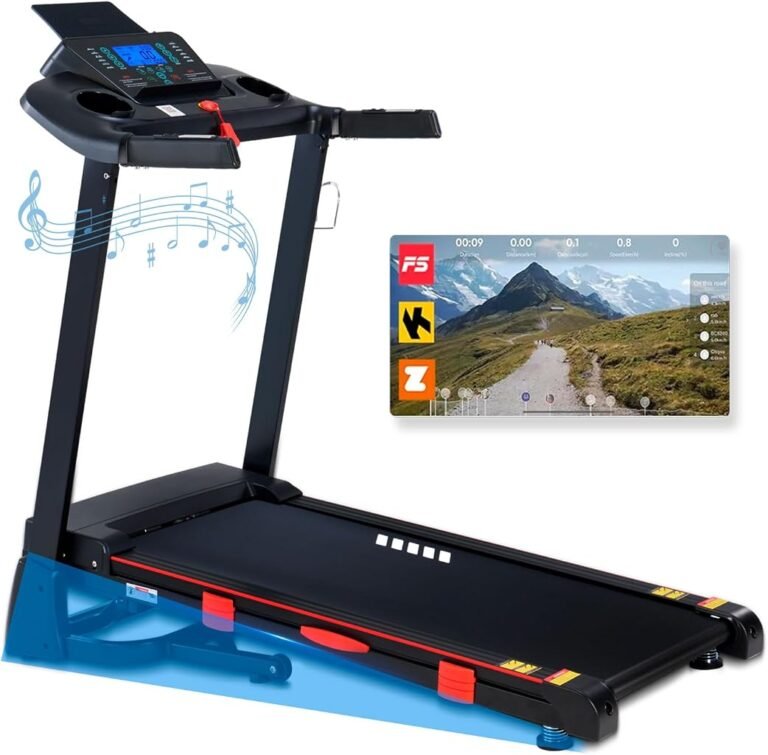
The FYC supports optional app control and Bluetooth connectivity. Product descriptions also refer to workout tracking and virtual-route functions.
Those features may make exercise more engaging for some users.
They should remain secondary in a senior-focused buying decision.
Software can change. Mobile operating systems can change. An application can disappear from an app store or become less useful after an update. The physical rails, deck, controls, safety key, and motor remain part of the treadmill regardless.
For older buyers who enjoy digital tracking, app connectivity is a bonus. For someone who dislikes smartphones, the treadmill should remain usable without making an app central to ordinary operation.
That distinction is especially relevant when technology is being purchased by adult children for parents. A feature considered effortless by one generation can create unnecessary friction for another.
The better interface is the one the actual user understands.
Treadmill Walking Is Only One Part of Healthy Aging
The case for regular physical activity in later life is much broader than treadmill ownership.
The CDC guidance for adults aged 65 and older recommends at least 150 minutes of moderate-intensity aerobic activity each week, or 75 minutes of vigorous activity, or an equivalent combination. Older adults are also advised to perform muscle-strengthening activity on at least two days and include activities that improve balance.
That final element matters greatly when evaluating a treadmill with extended handrails.
Walking on the FYC can contribute toward aerobic activity. It does not replace balance training or muscle-strengthening exercise.
In fact, a person who always relies heavily on treadmill rails should not assume that supported walking alone addresses balance.
The CDC also advises people who have difficulty meeting the full recommendations to remain as physically active as their abilities and conditions allow. That approach is particularly relevant to older adults because physical capability varies enormously among people of the same chronological age.
One 70-year-old may jog comfortably. Another may need hand support for slow walking. Age alone cannot determine treadmill suitability.
Extended Rails Do Not Turn a Consumer Treadmill Into Rehabilitation Equipment
The FYC is marketed with recovery-oriented language, and its long rails make that association understandable.
Still, the distinction between supportive home fitness equipment and rehabilitation equipment should remain sharp.
Someone recovering from surgery, stroke, serious injury, or neurological illness may have requirements that go well beyond extended rails. Gait asymmetry, dizziness, weakness, altered sensation, medication effects, and cardiovascular limitations can change what constitutes safe exercise.
A consumer treadmill should not independently determine a rehabilitation plan.
For users already cleared for home walking, however, extended rails can solve a practical problem. They provide more places to establish hand contact than short console rails.
That is a legitimate design advantage without turning the FYC into something it is not.
Our Score: 7.85/10
Our score of 7.85/10 places the FYC firmly in good territory.
Its strongest attribute is design focus.
The extended detachable handrails directly address the needs of users who want more support than a conventional compact treadmill provides. The magnetic safety key adds an appropriate emergency mechanism. A 300-pound stated capacity accommodates a broad user range, while the 6 mph maximum keeps the machine useful for walking and light jogging.
Its compact dimensions and folding frame also make sense for home use.
The score stays below the excellent range because specialization creates compromises.
This is not a treadmill for serious running. Buyers seeking large running decks and high speeds should look elsewhere. A 300-pound limit is useful but not unusually high. App features add convenience without materially changing the machine’s physical capability.
The 7.85 score therefore reflects a focused product whose value depends heavily on matching the intended user.
Customer Sentiment: 7.62
Customer Sentiment is 7.62, the lowest of our four editorial ratings.
That score deserves context.
Senior-oriented fitness equipment generates highly individual experiences because users differ dramatically in balance, stride, mobility, confidence, body size, and prior exercise experience.
Extended rails that feel reassuring to one person can feel unnecessary to another. A compact deck can feel spacious at slow walking speeds yet restrictive to somebody trying to jog. A folding mechanism can be highly useful in one household and almost irrelevant in another.
The 7.62 rating therefore reflects a product category where personal fit has an unusually large effect on satisfaction.
That is not a reason to reject the treadmill. It is a reason to measure carefully and define the user’s actual exercise pattern before buying.
Buyer Confidence: 8.57
Buyer Confidence reaches 8.57, significantly above Customer Sentiment.
That gap is one of the most informative parts of the assessment.
The FYC’s purpose is clear. It is a compact treadmill built around walking, supportive rails, moderate speed, folding storage, and a 300-pound stated user limit.
Several decisive specifications are documented before purchase: approximately 51.2-by-24-by-42.6-inch exterior dimensions, roughly 61.7-pound machine weight, 6 mph maximum speed, 2.5 HP motor specification, 300-pound capacity, folding construction, Bluetooth connectivity, and extended detachable rails.
That clarity makes buyer screening relatively straightforward.
Someone wanting a 10 or 12 mph treadmill can reject it immediately. Someone above 300 pounds can choose a higher-capacity model. A buyer specifically seeking longer hand support has a concrete reason to keep the FYC under consideration.
Confidence rises when a machine’s limits are as visible as its advantages.
Value: 7.79
Value is 7.79 at the evaluated price of $319.99.
That score sits close to the overall 7.85 rating because the price and capability are reasonably aligned.
The FYC offers more than a basic walking pad. Buyers are getting an upright treadmill frame, extended detachable handrails, a safety key, folding capability, app connectivity, a 300-pound stated capacity, and speeds extending to 6 mph.
Yet $319.99 also enters a crowded section of the treadmill market.
Buyers without a need for extended rails can find compact treadmills with higher maximum speeds or different deck configurations around similar prices. Someone seeking only low-speed walking may find cheaper equipment adequate.
The extra value therefore comes primarily from the support-oriented design.
If the long rails solve a real problem, the economics become more favorable. If they do not, competing treadmills may allocate more of their cost toward capabilities the buyer will actually use.
Who This Treadmill Fits Best
The FYC makes the strongest case for older adults who can walk independently but prefer additional hand support during indoor exercise.
It also suits households seeking:
- Extended detachable rails rather than short console grips.
- A moderate 6 mph maximum rather than high-speed running capability.
- A magnetic emergency-stop system.
- A 300-pound stated user capacity.
- Folding storage.
- A relatively compact overall footprint.
- Optional digital workout tracking.
- One machine capable of slow walking through light jogging.
Adult children purchasing equipment for older parents should pay particular attention to control simplicity and room placement rather than treating the feature list as the entire decision.
The person using the treadmill should feel comfortable with the machine, not merely own it.
Who Should Consider Another Treadmill
The FYC is a weaker fit for serious runners. Six mph is simply too restrictive for sustained faster running.
Users above the 300-pound published capacity also need another model.
Older adults who require substantial physical assistance for walking should not assume extended handrails alone make unsupervised treadmill exercise appropriate. Specialized equipment or professional guidance may be necessary.
Likewise, buyers who want a very large running surface should compare the FYC carefully with full-size machines. Compact dimensions inevitably impose limits on usable exercise space.
At the opposite extreme, a highly mobile user who dislikes holding rails and wants brisk running capability may obtain better value from a conventional treadmill.
The FYC’s specialization is both its advantage and its boundary.
Final Considerations
The FYC Treadmill for Seniors with Extended Handrails is most convincing when judged as a walking-centered home treadmill rather than a conventional running machine with extra metal attached to the sides.
Its identity is clear: model JK0805L, a compact foldable treadmill with detachable extended handrails, a magnetic safety key, 300-pound stated capacity, 2.5 HP motor, and maximum speed of 6 mph. Its approximately 51.2-by-24-inch floor dimensions keep the overall machine relatively compact, while a weight around 61.7 pounds makes it lighter than many full-size treadmills.
The long rails are the feature that changes the buying calculation.
For an older adult who walks independently but feels more confident with accessible hand support, they address a genuine usability issue. The safety key adds another appropriate safeguard. The 6 mph ceiling is more than adequate for walking and allows limited jogging without pretending the machine is intended for fast running.
The drawbacks are equally concrete.
A 300-pound capacity excludes some users. Compact construction cannot offer the same exercise area as a much larger treadmill. The motor and speed specifications are aligned with moderate exercise rather than athletic running. Digital functions should be treated as supplementary rather than central.
Our score of 7.85/10 captures that balance.
Customer Sentiment at 7.62 is more restrained because physical fit varies sharply among senior users. Buyer Confidence at 8.57 is much stronger because the treadmill has an identifiable audience and well-defined operating boundaries. Value at 7.79 recognizes that $319.99 is reasonable when the extended rails are genuinely useful, while buyers who do not need them have a wider field of alternatives.
The broader health context also deserves perspective. CDC guidance for people 65 and older combines aerobic exercise with muscle-strengthening and balance activities. A treadmill can make regular aerobic movement more accessible, especially when weather, traffic, or outdoor surfaces make walking less convenient. It cannot substitute for the other forms of activity recommended for healthy aging.
That makes the FYC most useful as one component of a wider routine.
The purchasing decision should therefore begin with the person rather than the machine. Can the intended user step onto the deck comfortably? Are the rails positioned where support is naturally needed? Can the controls and emergency stop be reached without confusion? Is the walking area suitable for the user’s gait? Does the 300-pound capacity provide enough margin? Will the folding mechanism actually be manageable in the intended household?
When those answers align, the FYC has a coherent purpose. It gives cautious walkers more physical support than many compact treadmills, keeps speeds within a range suitable for walking and light jogging, and does so without requiring the floor space of a large running platform.
For an older adult who values additional hand support but remains capable of independent treadmill walking, that focused design can matter far more than another machine’s higher speed, steeper incline, or longer catalog of workout programs.