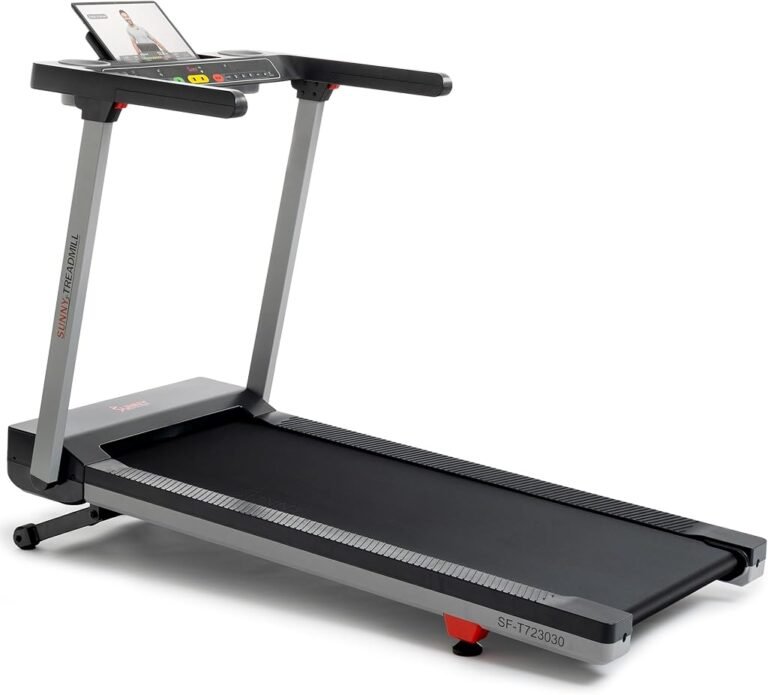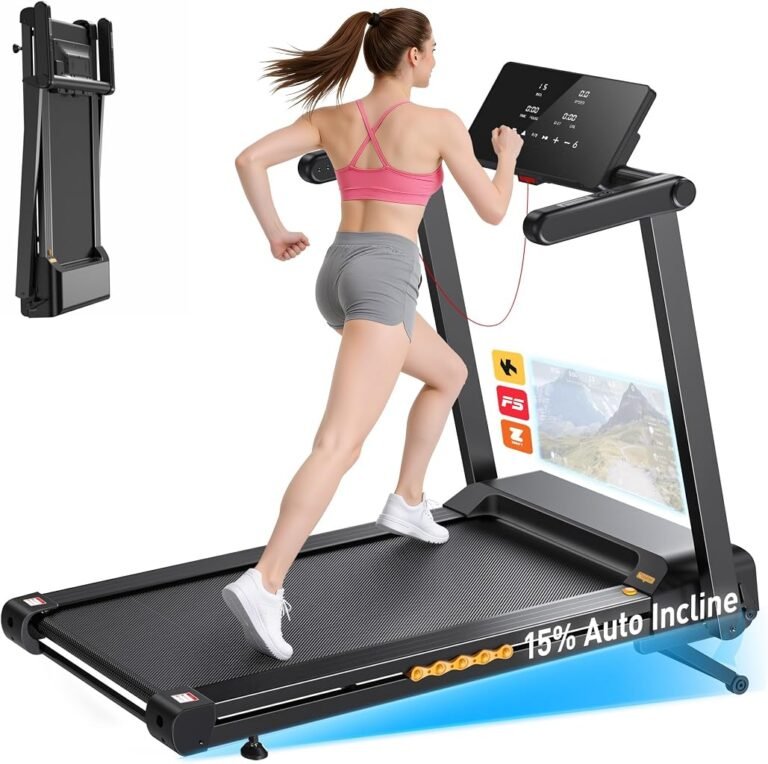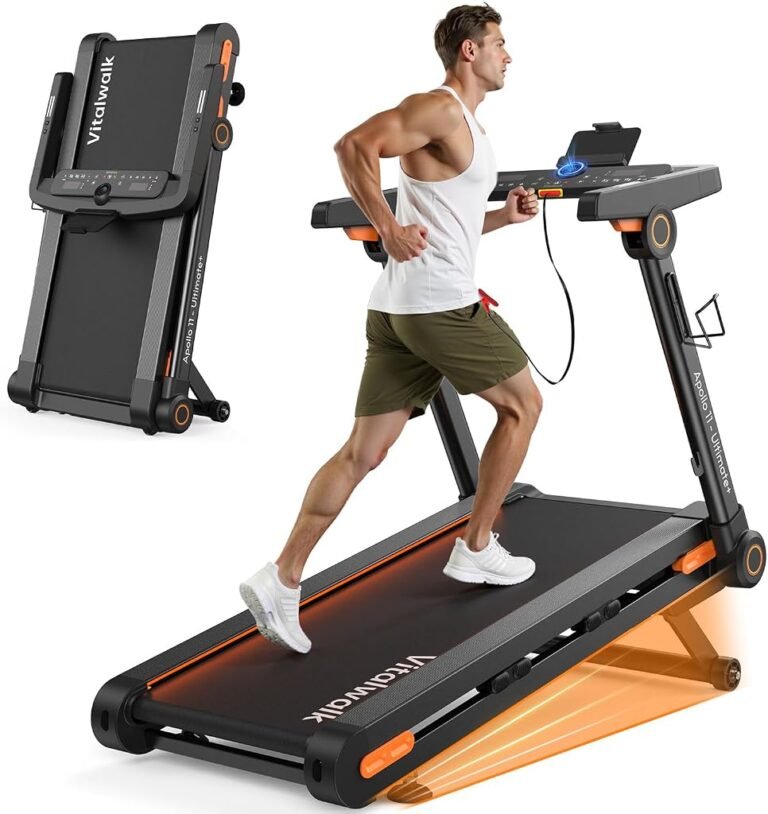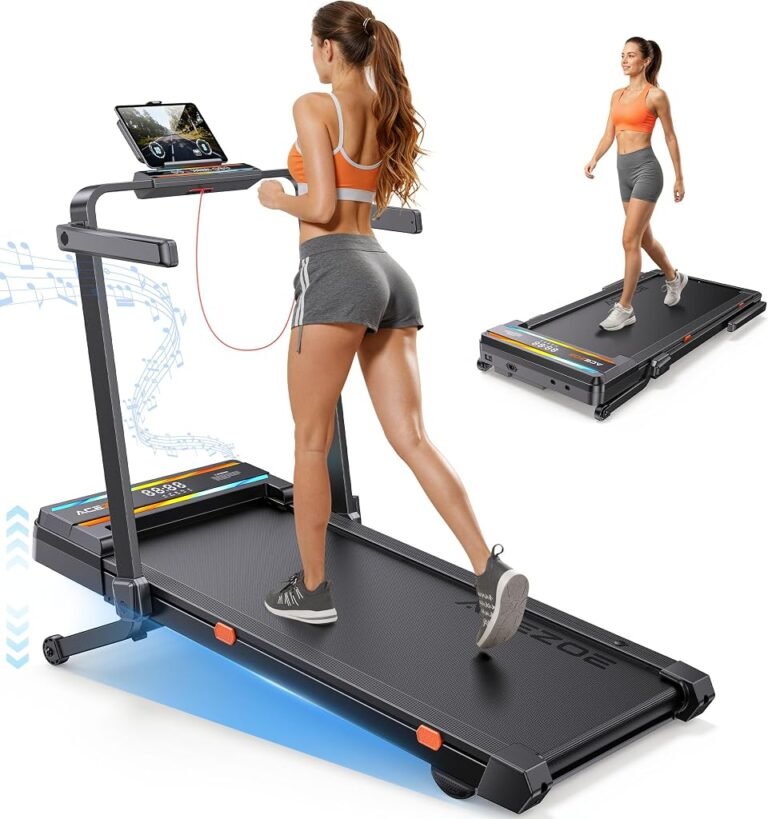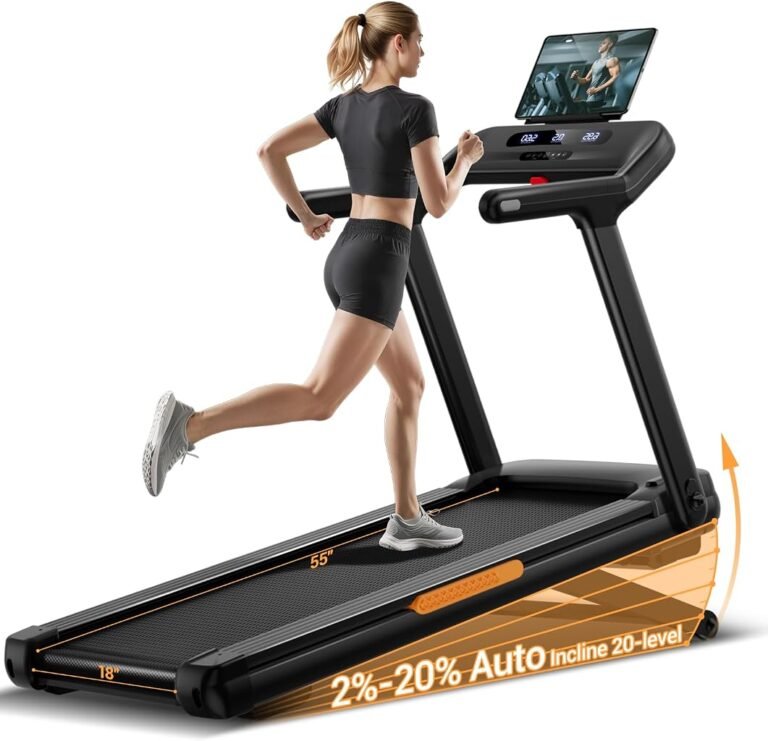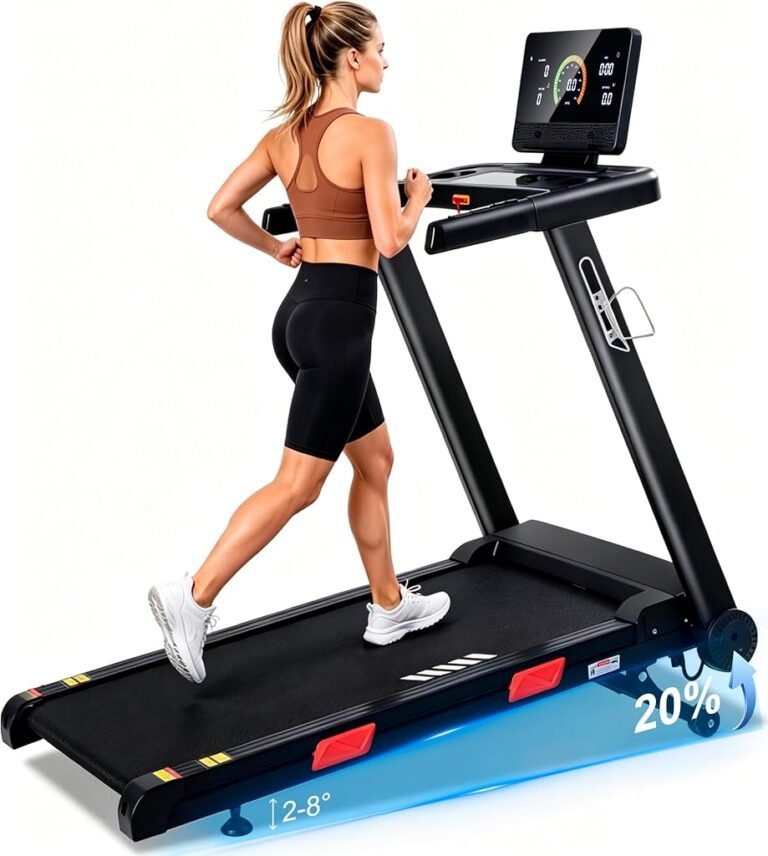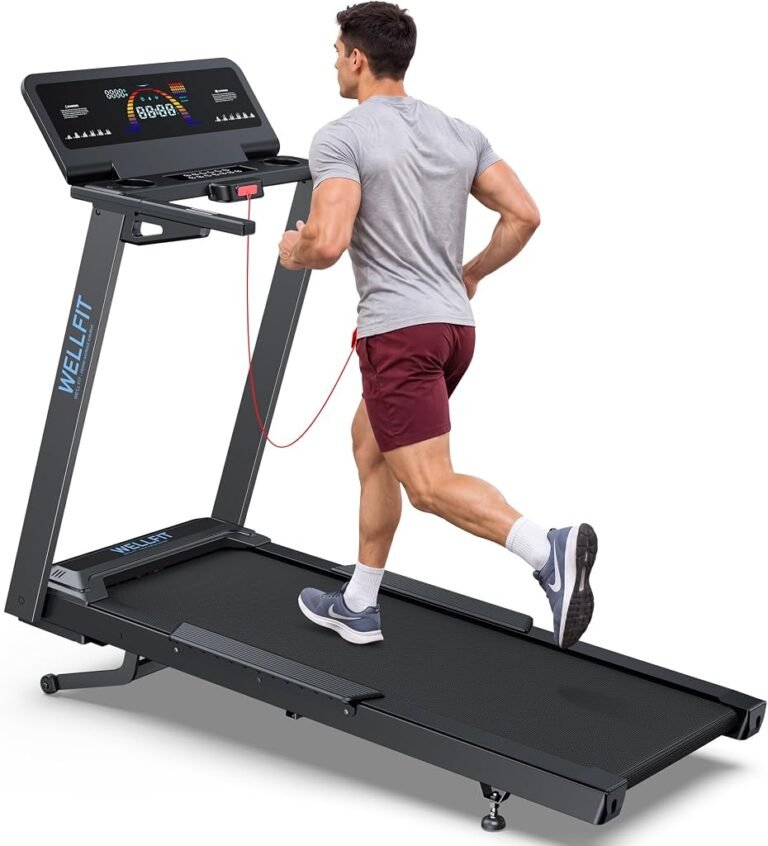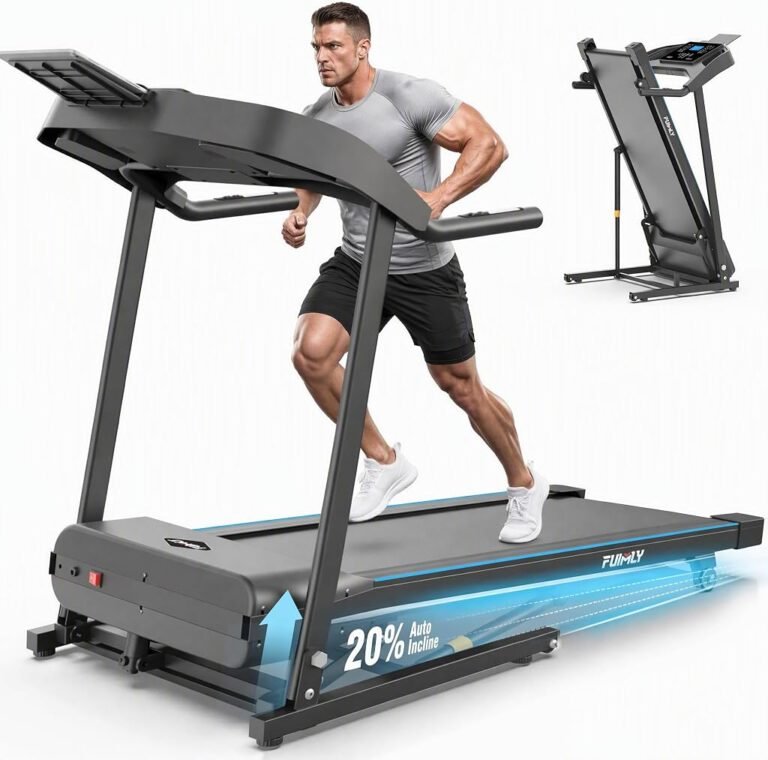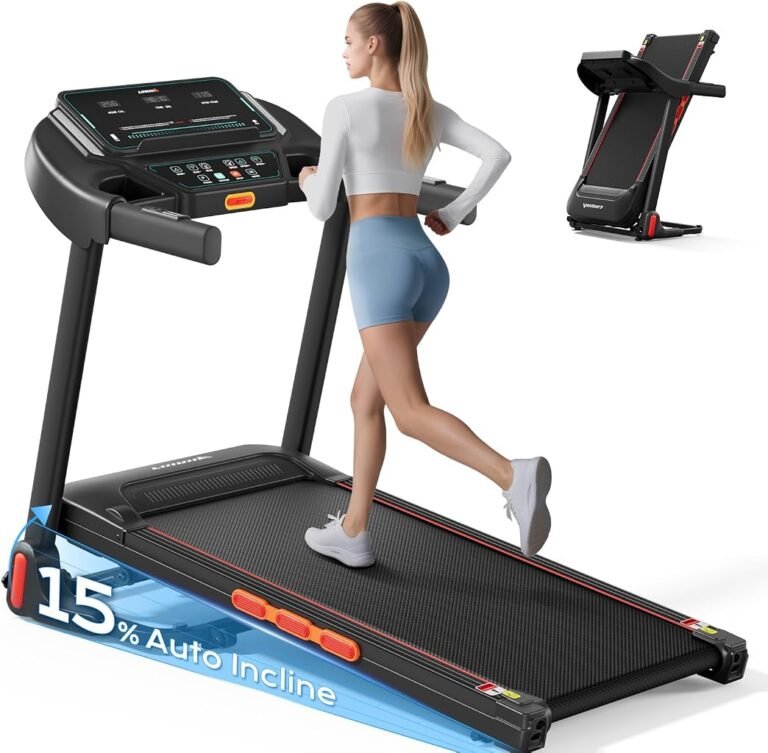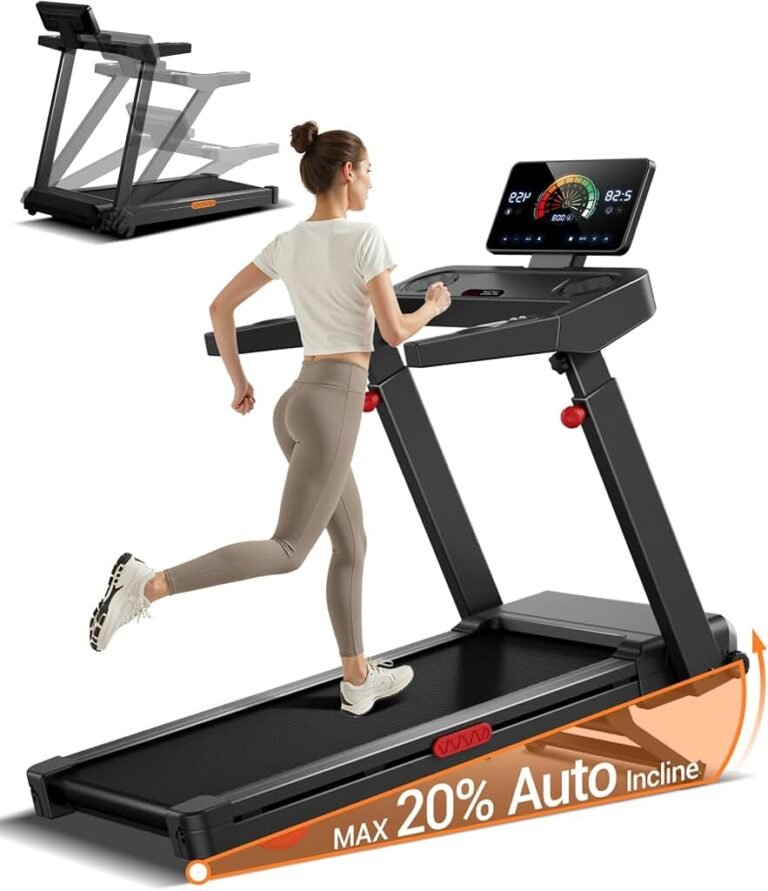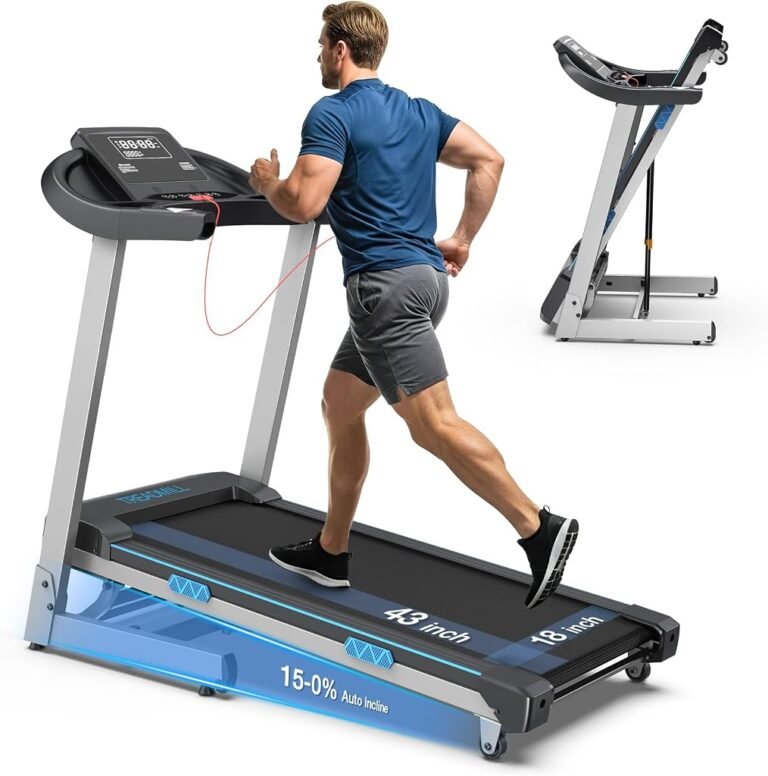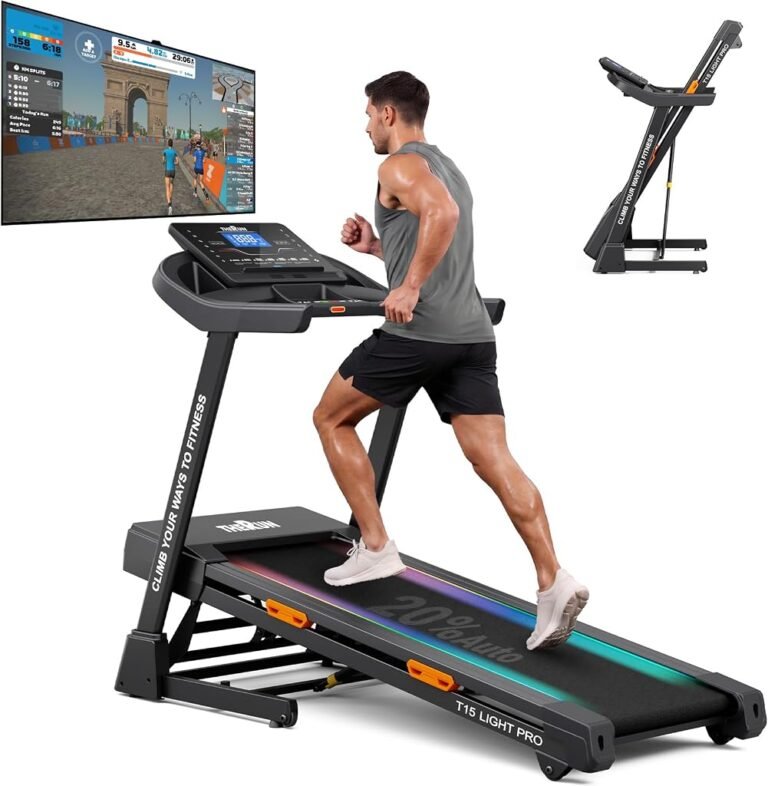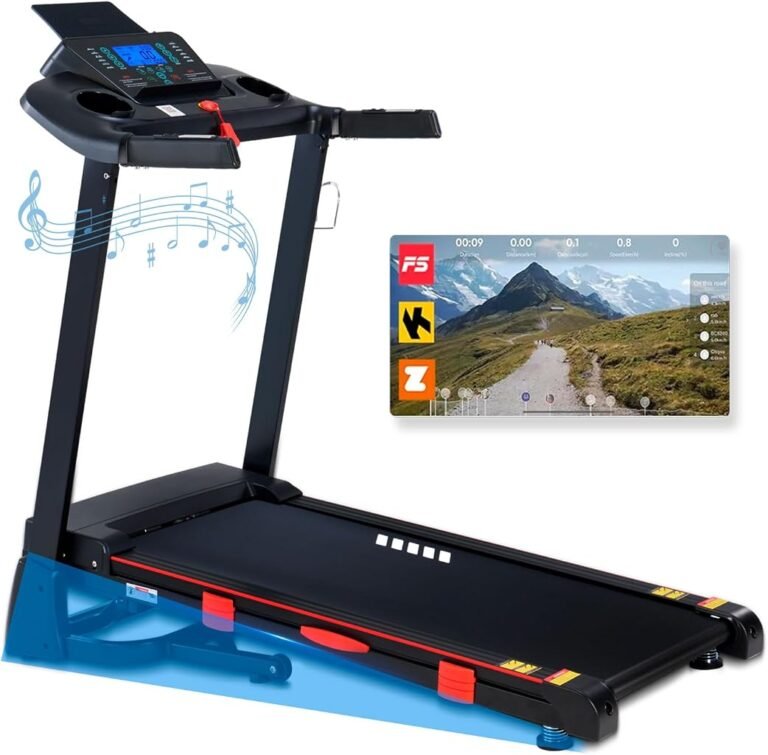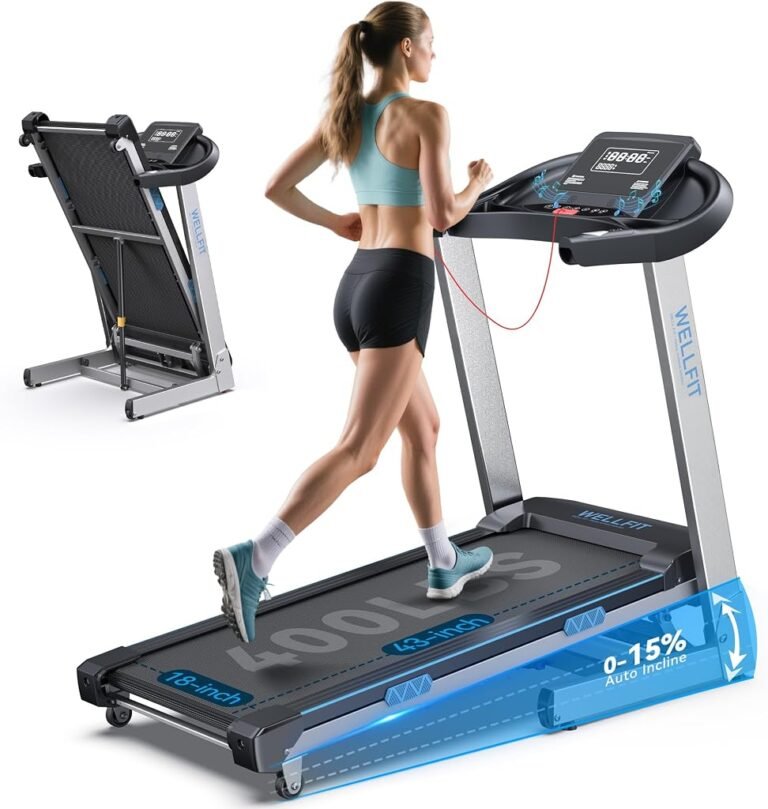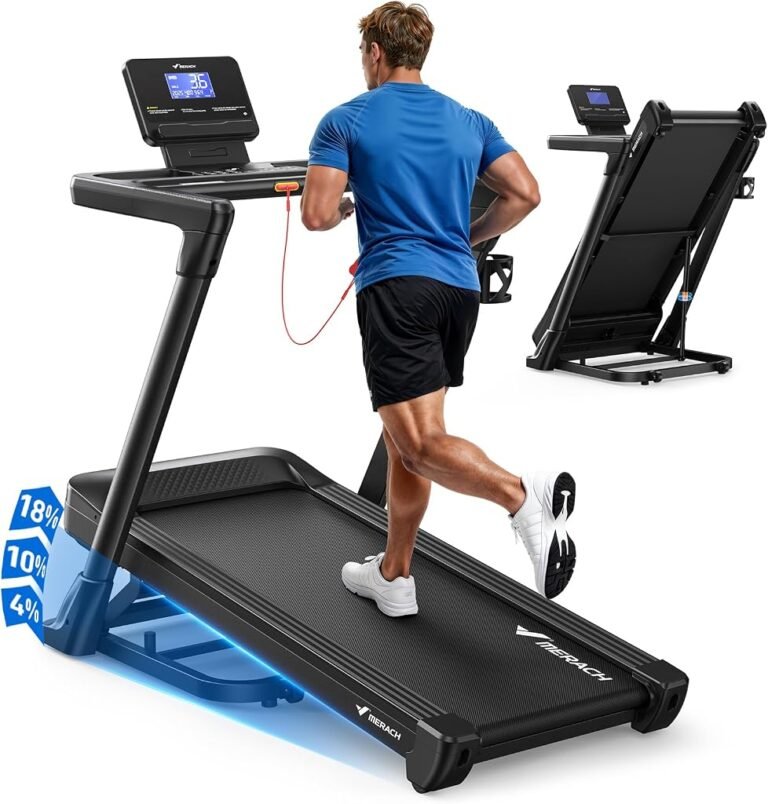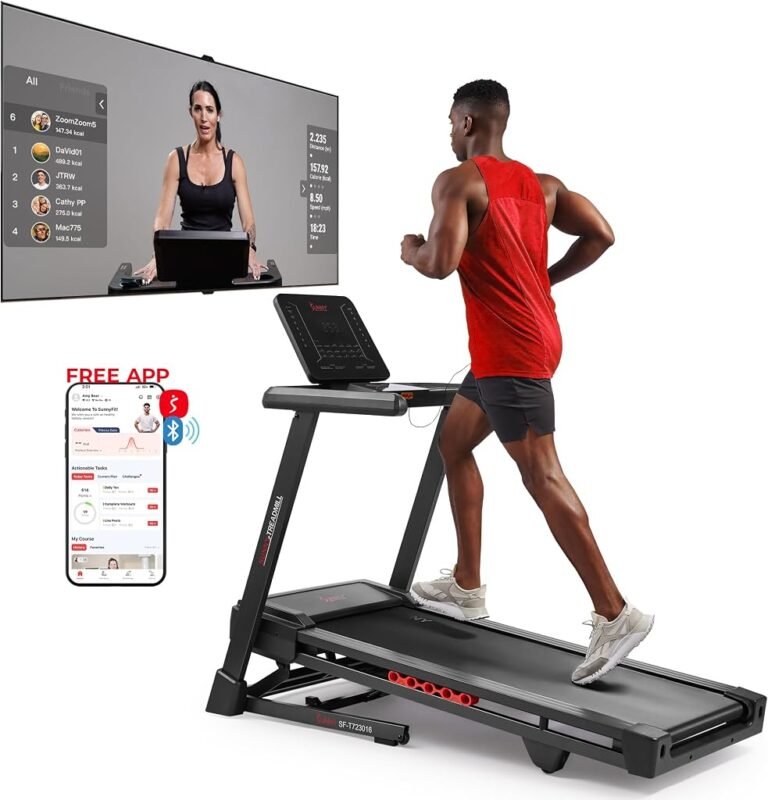
The UMAY Fitness Auto Incline Foldable Treadmill is built around a proposition that sounds simple until the specifications are placed beside one another. It combines a 20% maximum automatic incline, speeds up to 8 mph, a stated 400-pound user capacity, a 4 HP maximum motor rating, hydraulic folding and a touchscreen-oriented control system in a machine aimed squarely at home exercise. The current product listing identifies UMAY as the brand and describes those core specifications directly.
At an evaluated price of $309.99, that combination creates immediate interest. Automatic incline is usually more meaningful than decorative extras because it changes how exercise can be structured. A substantial user-capacity rating broadens potential fit. Folding hardware addresses the stubborn domestic problem of where a treadmill goes when nobody is using it.
Our score is 7.84/10, placing the treadmill in good territory. Customer Sentiment is 7.62, Buyer Confidence reaches 8.51, and Value stands at 7.79. Those numbers form a fairly consistent picture. The machine offers appealing specifications and a credible home-cardio proposition, yet its relatively compact format and specification-heavy marketing require buyers to separate features that materially alter exercise from figures that should be interpreted with restraint.
This is not a machine whose case rests on one dramatic specification. Its appeal comes from the interaction of incline, speed range, folding construction and user capacity.
For the right household, that combination is more useful than a higher maximum speed or a larger entertainment screen.
The 20% Auto Incline Is the Main Event
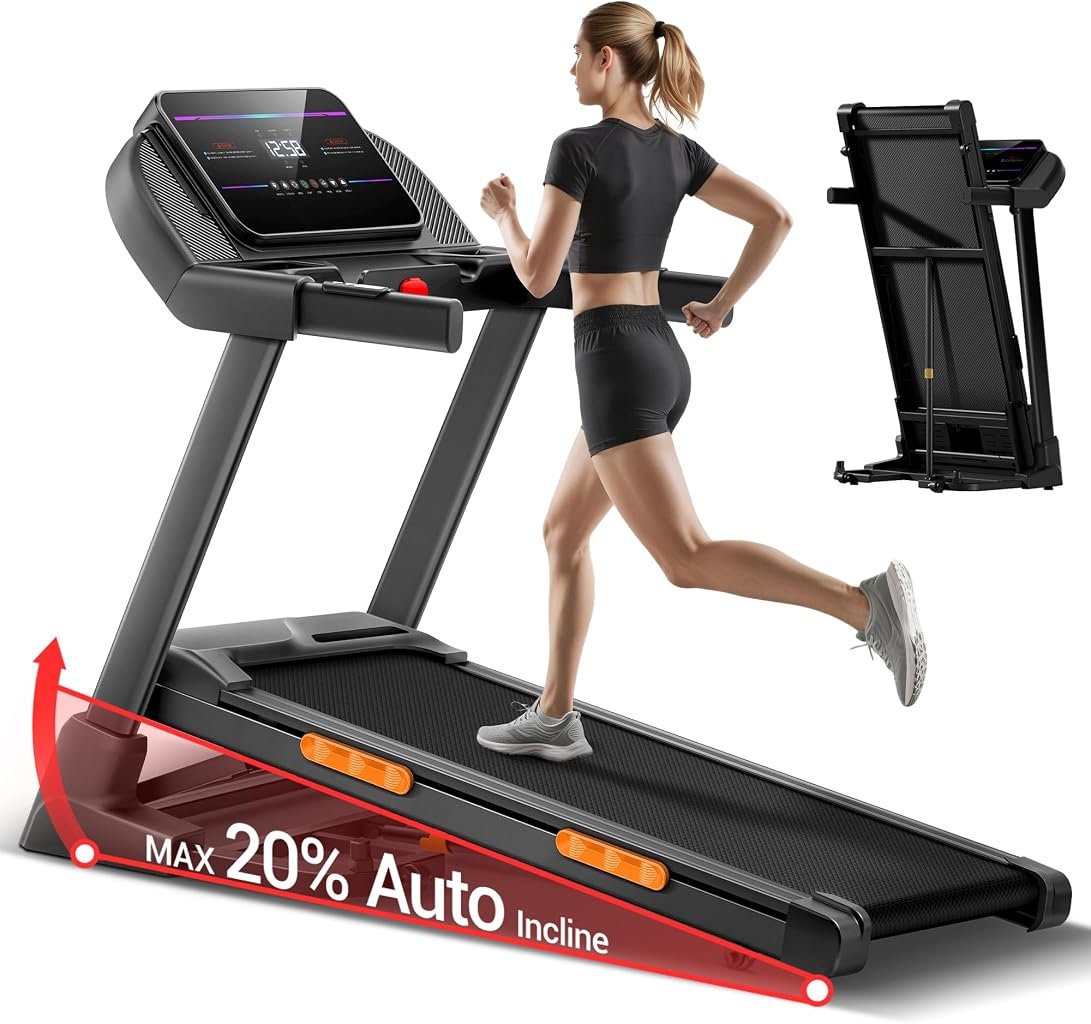
UMAY lists a maximum incline of 20%, with the current listing describing 20 automatic incline levels.
That deserves more attention than most of the secondary features.
Incline changes treadmill exercise without requiring a corresponding increase in speed. A user can walk relatively slowly while making the session more demanding by raising the deck. That can be particularly useful for people who prefer walking, want hill-based intervals or do not enjoy faster running.
The CDC explains exercise intensity through the effort required from the body, distinguishing moderate activity from vigorous activity through changes in breathing, heart rate and exertion rather than assigning a single universal walking speed.
That framework helps explain why incline matters.
A speed that feels easy on a level belt can feel markedly different when the deck rises. The treadmill therefore allows workload to change even if pace stays relatively stable.
The American Heart Association makes the same point more concretely. In its guidance on walking intensity, Barry Franklin, Ph.D., discusses how grade increases the energy cost of treadmill walking and advises, “But build up slowly.”
That short instruction is particularly appropriate for a machine capable of reaching 20%.
Maximum incline should be understood as available range, not an instruction to spend every session near the upper setting.
Twenty Percent Is Capacity, Not a Daily Goal
A large incline number can distort buyer expectations.
The temptation is to interpret 20% as though the treadmill becomes more useful only when the deck is pushed near its limit. In practice, modest changes in grade can meaningfully alter walking difficulty long before maximum elevation appears.
A more sensible progression might begin with level walking, then introduce low grades, followed by moderate incline intervals as conditioning improves.
This gives the treadmill several possible identities across one week.
It can support easy recovery walking.
It can support brisk level sessions.
It can create sustained uphill walks.
It can alternate higher and lower grades without requiring the user to stop and mechanically reposition the deck.
That final point separates automatic incline from manual systems.
Manual incline can be perfectly functional for a user who chooses one angle before exercising. Automatic adjustment is far better suited to sessions where elevation changes repeatedly.
The difference is not cosmetic. It alters how the machine can be programmed into a routine.
The 8 MPH Ceiling Defines the Running Audience
The current listing gives the treadmill a maximum speed of 8 mph, with an operating range beginning at 0.6 mph.
Eight miles per hour corresponds to a 7-minute-30-second mile.
That is fast enough for walking, brisk walking, jogging and moderate recreational running. It is also enough speed for many households where treadmill use is primarily aerobic rather than performance-oriented.
Faster runners need to look more carefully.
A runner who routinely trains above 8 mph will reach the machine’s ceiling. Someone planning high-speed intervals may find that limitation even sooner.
This is where treadmill specifications need context.
A 12 mph maximum is not automatically more useful than an 8 mph maximum for a person who rarely travels faster than 4 mph. Conversely, an incline-focused machine cannot satisfy a runner whose workouts require speeds beyond its mechanical range.
The UMAY model therefore fits most naturally between a walking treadmill and a dedicated high-speed running platform.
Its strongest identity is broad home cardio rather than specialized running.
Automatic Incline and Moderate Speed Make a Sensible Pair
The combination of 20% incline and an 8 mph maximum is more coherent than it may first appear.
Large running treadmills often emphasize high speed because they are intended for faster athletic training. A home machine with a more restrained speed ceiling can create difficulty through grade instead.
This gives users another route to progression.
A workout can become harder because speed increases.
It can become harder because incline increases.
It can become longer.
Or those variables can be adjusted independently.
That flexibility matters for users who prefer controlled progression.
An incline-focused session, for example, might keep pace relatively stable while elevation rises and falls. A brisk walking session could use only modest grade. A recreational runner could stay near level and work more through speed.
The treadmill does not force every user into the same exercise style.
That flexibility is one reason automatic incline deserves more weight in this review than peripheral connected features.
The 400-Pound Capacity Is Significant, but It Needs Proper Interpretation
UMAY states a 400-pound maximum user capacity for the current model.
That figure is meaningful because user capacity immediately determines whether some buyers can reasonably consider a treadmill.
A higher stated limit expands the machine’s potential audience.
It also separates this product from many compact treadmills and walking pads that publish substantially lower limits.
Yet maximum capacity should never be transformed into claims it does not support.
A 400-pound rating does not independently prove motor life, frame longevity, belt durability or identical operating characteristics for every user below that threshold.
It is a stated maximum.
That distinction matters because “heavy duty” language can easily encourage buyers to assume a level of durability that no single capacity figure can establish.
For people closer to the maximum, leaving some operating margin can also be prudent, particularly if the machine will be used frequently or at demanding incline settings.
The specification remains a strength. It simply needs to be read for what it actually says.
The 4 HP Figure Deserves Similar Restraint
The current product specifications list maximum horsepower at 4 HP, while UMAY describes a brushless motor.
The number looks impressive, but treadmill motor ratings are notoriously difficult to compare when manufacturers use different methods of describing output.
A maximum horsepower figure should not automatically be read as continuous operating power.
Nor should it be used as a shortcut for predicting service life.
The more useful observation is that the motor specification accompanies a published speed range of 0.6 to 8 mph and a 400-pound capacity.
Those figures describe what the machine is intended to support.
Buyers should judge whether that operating envelope matches their routine rather than treating horsepower as a trophy number.
A treadmill is not improved merely because one number on the specification sheet is larger.
Folding Hardware Solves a Very Ordinary but Very Real Problem
Treadmills are furniture when they are not moving.
That blunt fact explains why foldability matters so much in home fitness.
A treadmill may offer excellent exercise capability and still be a poor household purchase if it permanently blocks a bedroom, office or shared living area.
UMAY describes a hydraulic folding system with transport wheels, allowing the deck to be folded when the machine is not in use.
The hydraulic mechanism addresses two separate issues.
First, it reduces the floor area used by the treadmill while stored.
Second, it makes the folding process more manageable than a design in which the user simply lifts and lowers a heavy deck without assistance.
The integrated wheels also make repositioning more plausible.
Still, “foldable” and “portable” should not be treated as synonyms.
A treadmill with substantial structural components, a motor and incline hardware remains an appliance-sized object. Folding changes its shape. It does not make mass disappear.
Buyers should measure the intended workout space, storage space, doorway width and path between the two before ordering.
The best treadmills for home are often those that create the least friction between exercise sessions.
A technically capable machine that is awkward to deploy may slowly become expensive scenery.
The Compact Footprint Requires Trade-Off Awareness
The current retail page lists product dimensions of approximately 24 inches deep, 24.8 inches wide and 52 inches high in its published specification table.
Product dimensions on folding equipment can refer to a particular configuration, so buyers should verify both deployed and folded measurements immediately before purchase.
That is especially important for a treadmill.
Running comfort depends heavily on usable belt dimensions and the amount of room around the machine.
A treadmill can look compact in photographs while still requiring substantial clearance once positioned for use.
Buyers should therefore measure the actual location rather than estimating from product images.
A few minutes with a tape measure can reveal more about household compatibility than a page of marketing language.
Touch Controls Are Useful When They Reduce Interruption
The current listing describes a touchscreen-oriented control system and identifies touch control among the machine’s features.
Controls matter most when they reduce interruption during exercise.
Incline treadmills in particular benefit from accessible adjustment because users may change grade several times during a session.
The interface should therefore be judged by a basic question: can speed and incline be changed without breaking walking rhythm?
That matters far more than whether the control surface looks technologically sophisticated.
Exercise equipment has a peculiar tendency to advertise screens as though the screen performs the workout.
It does not.
The belt, deck, motor and incline mechanism define the machine’s physical usefulness. The interface merely determines how easily those systems can be controlled.
Folding and Incline Together Create the Strongest Use Case
Either feature alone is common.
Folding treadmills exist at many prices.
Incline treadmills do as well.
Combining meaningful automatic incline with a storage-oriented design is more interesting because the two features address separate problems.
Incline addresses exercise variety.
Folding addresses household space.
The buyer who needs both receives more benefit from the package than someone who needs only one.
That helps explain why the treadmill earns a solid score without reaching the very top of our scale.
Its strongest advantages are conditional.
A person with a dedicated home gym may barely care that it folds.
Someone who never uses incline gains little from 20 levels of automatic grade.
A walker in a small apartment who actively wants hill training could value both every week.
The same machine can therefore represent very different value depending on the household.
Our Score: 7.84/10
Our overall score is 7.84/10.
That places the UMAY Fitness Auto Incline Foldable Treadmill comfortably in good territory.
The score reflects a useful combination of 20% automatic incline, an 8 mph maximum speed, folding construction and a stated 400-pound capacity.
Those are not decorative specifications. Each can materially affect whether the treadmill fits a buyer.
The score stops short of the 8-point range because the machine remains a home-focused compromise rather than a specialized running platform.
Faster runners can outgrow the speed ceiling.
Buyers who do not need incline may find simpler alternatives.
Compact folding construction also demands closer attention to working dimensions and stride compatibility than a large conventional treadmill does.
The 7.84 rating therefore reflects capability with boundaries.
That is a healthier way to view home fitness equipment than pretending every machine is suitable for every body and every workout.
Customer Sentiment: 7.62
Our Customer Sentiment score is 7.62.
It is the lowest of the four main ratings.
That gap is informative.
Treadmills are unusually dependent on subjective fit.
Noise that seems unobtrusive to one household may bother another.
A belt that feels comfortable to one user may feel restrictive to someone with a longer stride.
One owner may use the folding system every day, while another leaves the machine open permanently.
Incline itself creates another divide. Users who enjoy hill walking can regard automatic grade as central to the treadmill. Level walkers may barely engage with it.
A 7.62 score indicates generally favorable sentiment while acknowledging that everyday satisfaction is less uniform than the specification sheet might suggest.
This is not surprising for a machine attempting to satisfy walking, jogging, incline training and compact-storage needs simultaneously.
Buyer Confidence: 8.51
Buyer Confidence is our strongest rating at 8.51.
The product is relatively easy to understand.
Its major specifications are explicit: UMAY branding, automatic incline up to 20%, 8 mph maximum speed, a stated 400-pound capacity, folding hardware and a 4 HP maximum motor rating. The current retail page confirms those headline details.
The associated product listing should still be checked immediately before purchase because marketplace titles, sellers, availability and pricing can change.
Buyer Confidence remains higher than Customer Sentiment because the machine’s basic proposition is straightforward even though personal fit varies.
A buyer who knows the required speed, capacity, incline and storage needs can determine fairly quickly whether the treadmill belongs on the shortlist.
That clarity has real value.
Value: 7.79
Our Value score is 7.79.
At $309.99, the specification package is attractive when the machine’s main features align with actual use.
Automatic incline has obvious value for hill walkers.
Folding has obvious value in rooms that need to serve several purposes.
A 400-pound capacity can be decisive for buyers excluded by lower-rated machines.
An 8 mph ceiling covers the needs of a broad group of recreational users.
Yet value disappears quickly when features go unused.
A level walker with abundant floor space does not gain much from paying for incline and folding mechanisms.
A fast runner gains less from a machine capped at 8 mph regardless of price.
The treadmill therefore earns its value score through versatility rather than universal economics.
It is a good deal for the right routine, not automatically the right treadmill because the price is accessible.
What the UMAY Treadmill Gets Right
Several attributes work together particularly well:
- The 20% automatic incline provides a wide range for hill-oriented walking and progression.
- Speeds up to 8 mph cover walking, jogging and moderate recreational running.
- The stated 400-pound capacity broadens potential user fit.
- Hydraulic folding addresses storage demands in shared rooms.
- Transport wheels make repositioning more practical.
- Touch-oriented controls support quicker adjustments during changing incline sessions.
- The motor and speed specifications are aligned with home cardio rather than extreme running performance.
The machine’s greatest success is coherence.
Its main features all point toward a user who wants more capability than a basic walking pad while still caring about domestic space.
Where Buyers Should Be More Critical
The speed ceiling is the first limitation to examine.
Eight miles per hour is sufficient for many users but restrictive for faster runners.
The second issue is physical fit.
Buyers should verify the current running-area dimensions and compare them against stride length and intended speed before purchase.
The third issue is the 20% incline itself.
A large maximum does not make every workout better. Most users will gain more from progressive use across lower and moderate grades than from repeatedly pursuing the highest setting.
The fourth issue is horsepower interpretation.
The 4 HP maximum figure should remain a specification, not a promise of commercial-machine durability.
Finally, storage should be measured rather than imagined. Folding reduces space requirements, but the treadmill still needs a realistic home.
Who Is the Best Fit?
The strongest audience includes brisk walkers who want substantial incline variation.
Recreational joggers also fit comfortably within the published 8 mph range.
The treadmill can make sense for people who prefer increasing grade rather than running faster.
Households with limited exercise space have another reason to consider it because the folding system allows the room to regain some usefulness between workouts.
The CDC recommends that adults receive at least 150 minutes of moderate-intensity aerobic activity each week, or 75 minutes of vigorous activity, alongside muscle-strengthening activity on two or more days.
A treadmill in the home can help divide that aerobic target across shorter sessions without a commute to a gym or dependence on outdoor conditions.
That convenience is mundane, but mundane advantages often decide whether equipment gets used.
Who Should Look Elsewhere?
Faster runners should evaluate machines with higher maximum speeds.
Users who need a particularly long or wide running area should confirm current deck measurements before choosing this model.
People who never intend to use incline may get comparable practical utility from a simpler treadmill.
Buyers with a permanent home gym may place little value on folding.
Anyone whose body weight exceeds the stated maximum needs a machine with a higher published capacity.
The UMAY model works best when its design solves several household needs at once.
It becomes less compelling when a buyer is paying for capabilities that will remain untouched.
A Smarter Way to Use the Incline Range
A 20% maximum invites overly ambitious early sessions.
That is unnecessary.
A more sustainable structure begins by establishing comfortable walking on a level or slight grade.
From there, short incline intervals can be added.
As conditioning improves, either duration or grade can increase.
Speed does not have to increase simultaneously.
The CDC notes that physical activity can be spread throughout the week, which supports the idea of repeated manageable sessions rather than occasional extreme efforts.
This makes a home incline treadmill particularly adaptable.
A short walk before work can be easy.
A later session can use hills.
A weekend workout can last longer.
The machine does not need to operate near its mechanical limits to be useful.
Why the Category Makes Sense
Compact folding treadmills with substantial incline exist because many households face two competing realities.
People want more exercise options at home.
They do not necessarily want a large piece of gym equipment permanently dominating a room.
A folding incline treadmill tries to negotiate that conflict.
The machine can offer more training variation than a flat walking pad while demanding less permanent space than many traditional running treadmills.
That middle ground is where the UMAY model makes its strongest case.
Its specifications are not aimed at the fastest runner.
They are aimed at the much larger group of people who walk, jog, climb and need the room back afterward.
That is a rational place to compete.
Final Considerations
The UMAY Fitness Auto Incline Foldable Treadmill earns our 7.84/10 overall score because its core capabilities form a credible home-cardio package rather than a random collection of features.
The 20% automatic incline is its strongest asset. It gives walkers and recreational runners a way to adjust difficulty without relying entirely on speed. The 8 mph ceiling covers a broad range of everyday exercise, while the stated 400-pound capacity expands potential buyer fit.
Folding construction addresses the space problem that often determines whether a treadmill works in an actual home rather than merely looking attractive on a product page.
Customer Sentiment at 7.62 is positive but restrained, reflecting how strongly treadmill satisfaction can depend on personal stride, household space, noise expectations and workout style.
Buyer Confidence at 8.51 is stronger because the main proposition is easy to evaluate. The buyer can compare incline, maximum speed, capacity and folding needs directly against intended use.
Value at 7.79 is favorable at $309.99, provided that automatic incline and compact storage are features the household will genuinely use.
Among the best treadmills for home, the most sensible machines are rarely those with the longest specification sheet. They are the ones whose limitations line up with what the buyer does not need and whose capabilities line up with what the buyer will use repeatedly.
For walkers, incline-focused exercisers and moderate runners who need a folding machine, this UMAY treadmill lands in a sensible part of that equation. For faster runners or people seeking a large dedicated running platform, its 8 mph ceiling and home-oriented design point elsewhere.
The final assessment is therefore measured but favorable: a capable incline treadmill with useful household practicality, a broad stated capacity and enough training range to serve many everyday users, provided its physical dimensions and speed ceiling match the person who will actually step onto the belt.