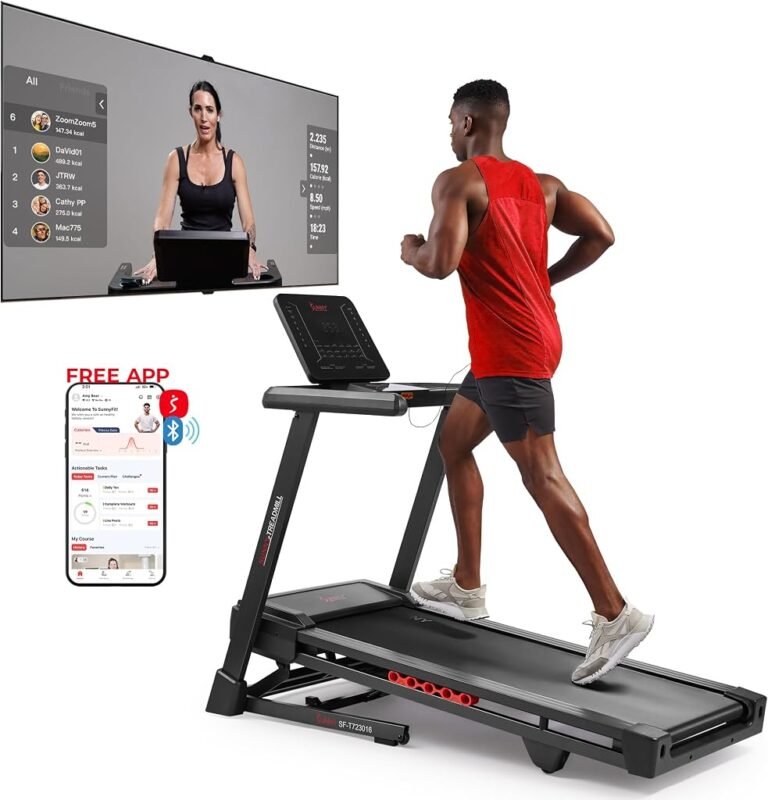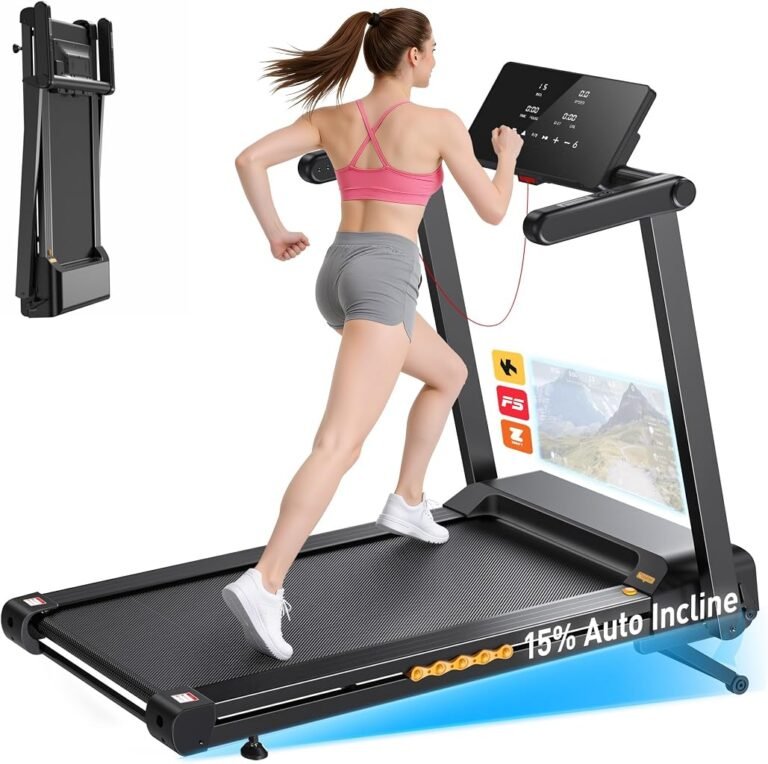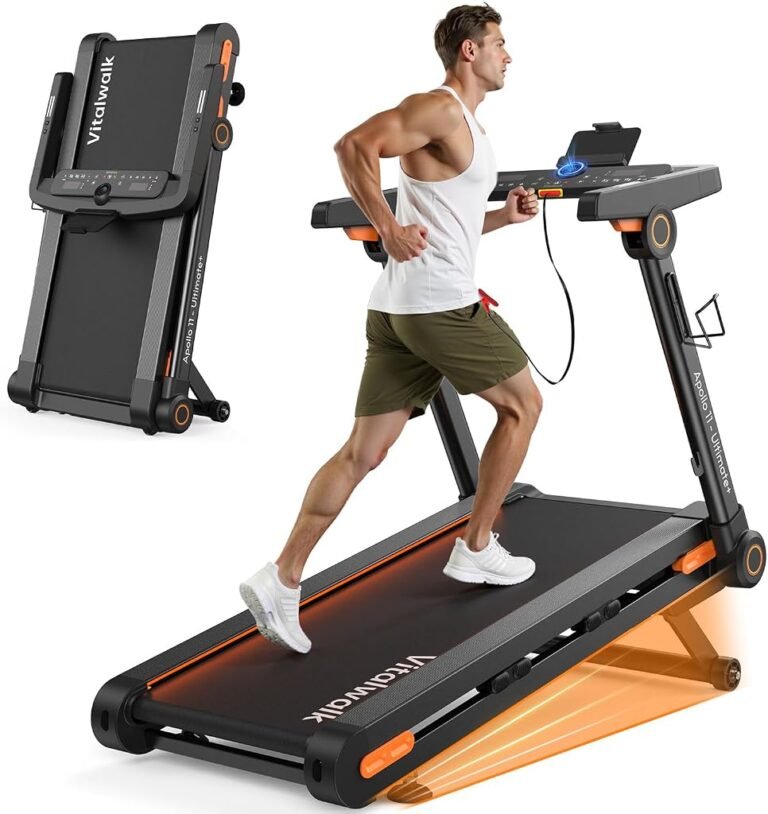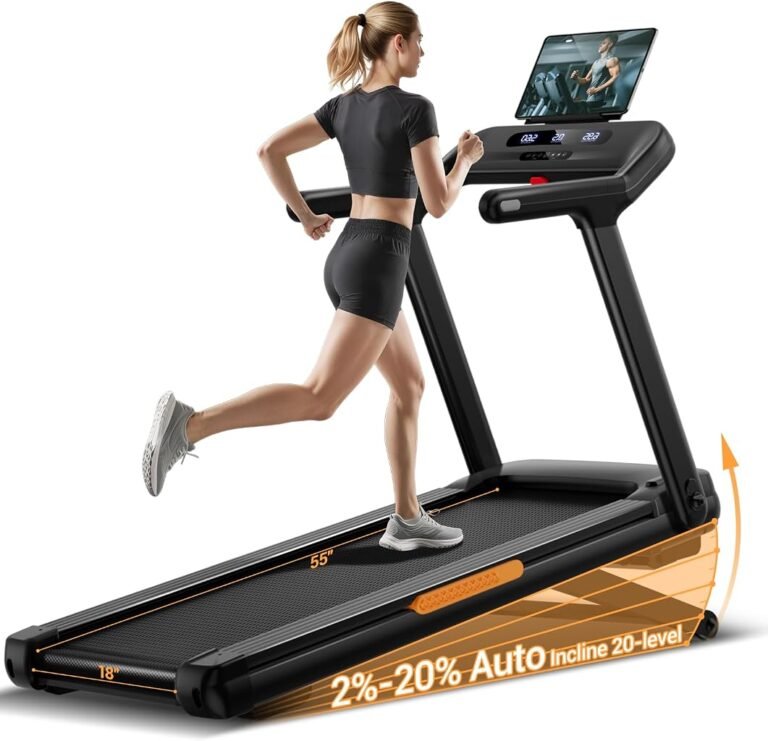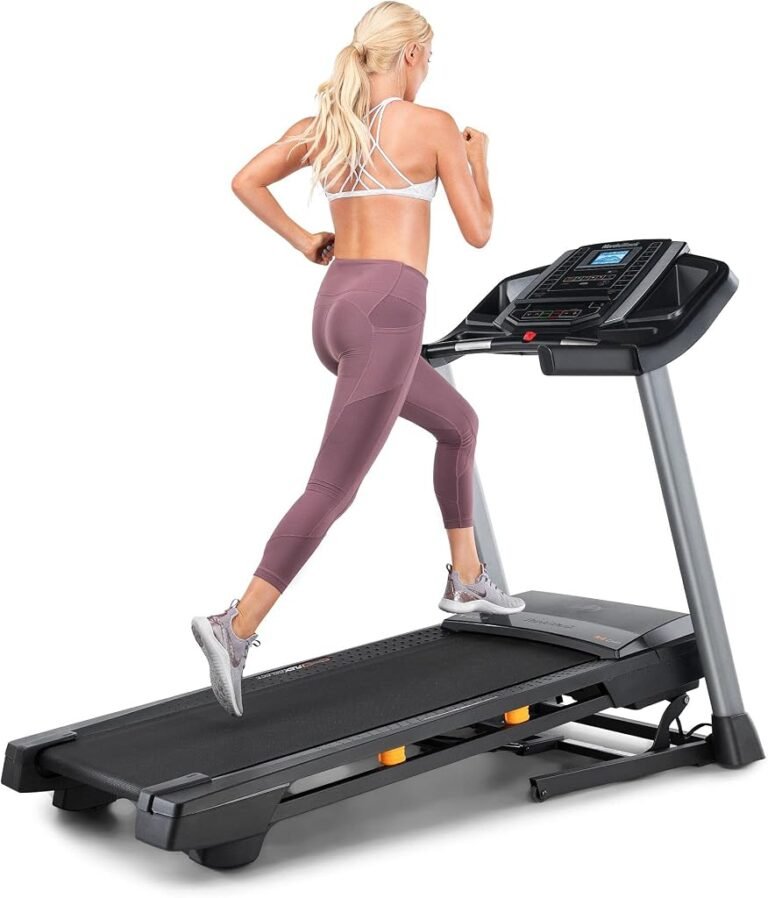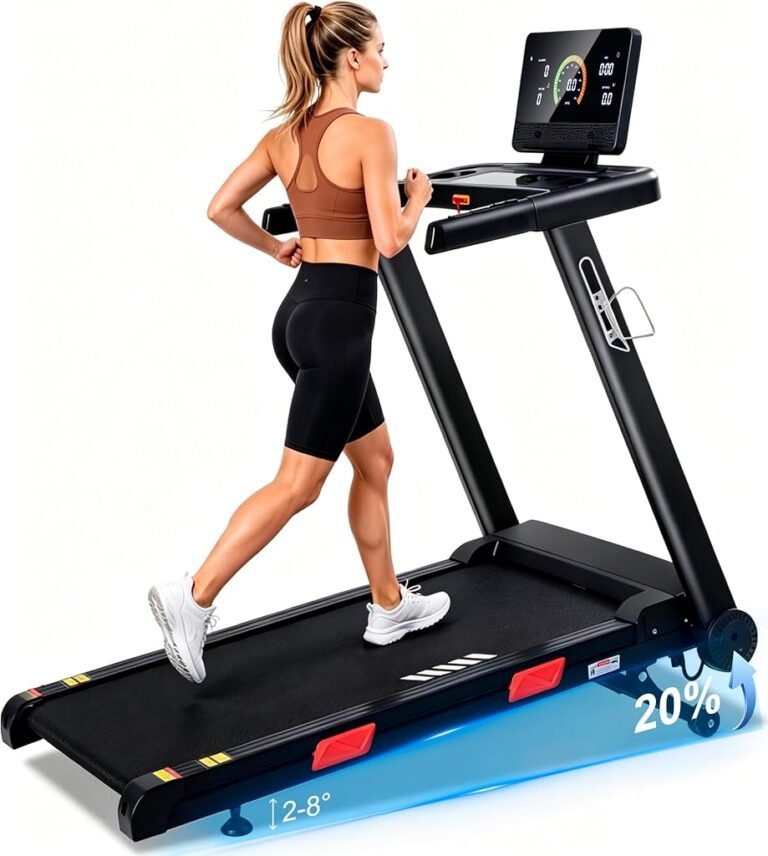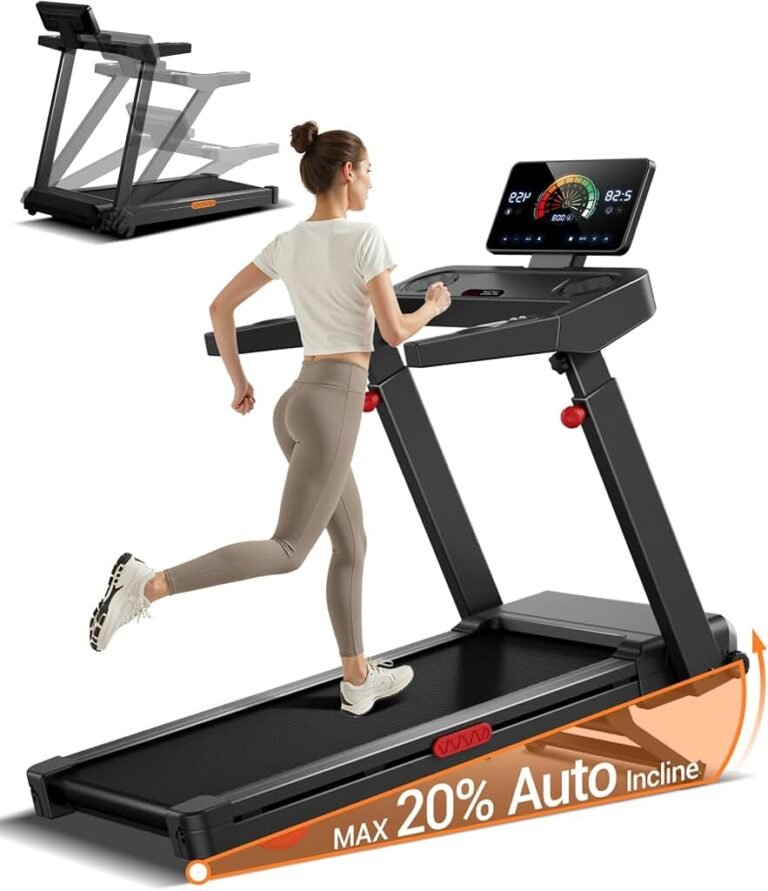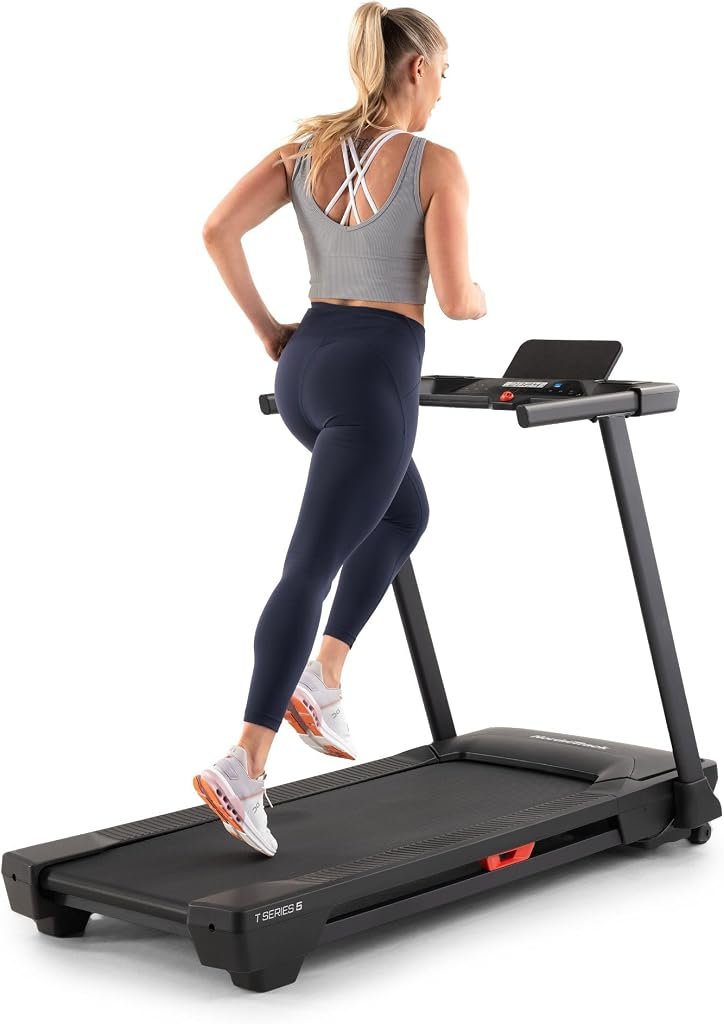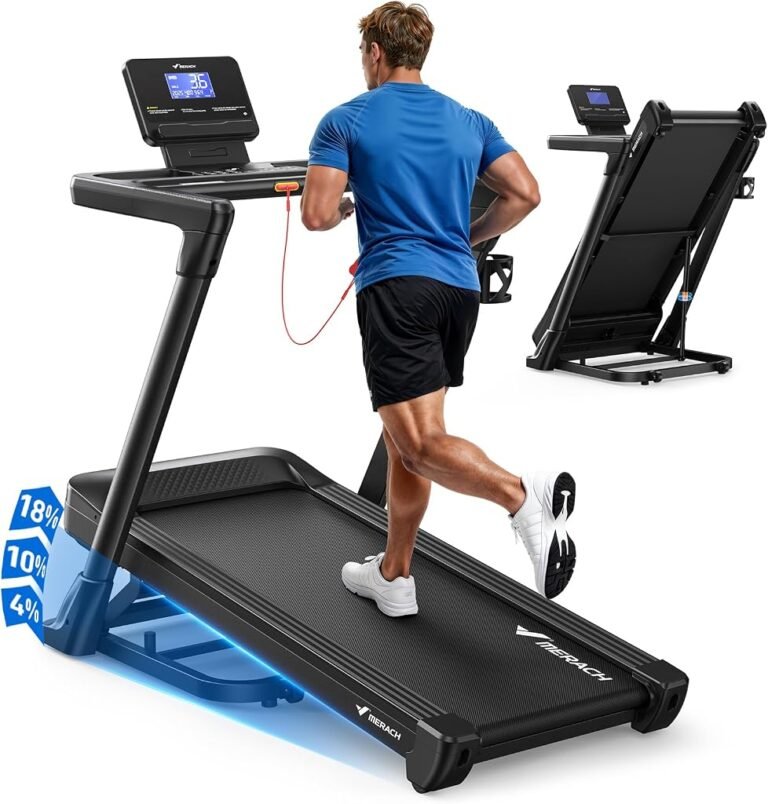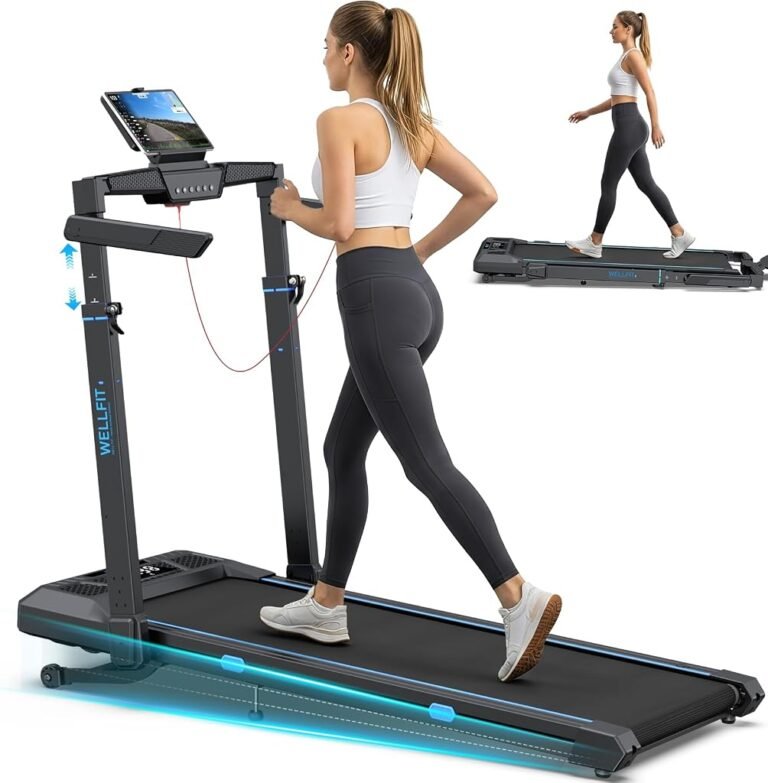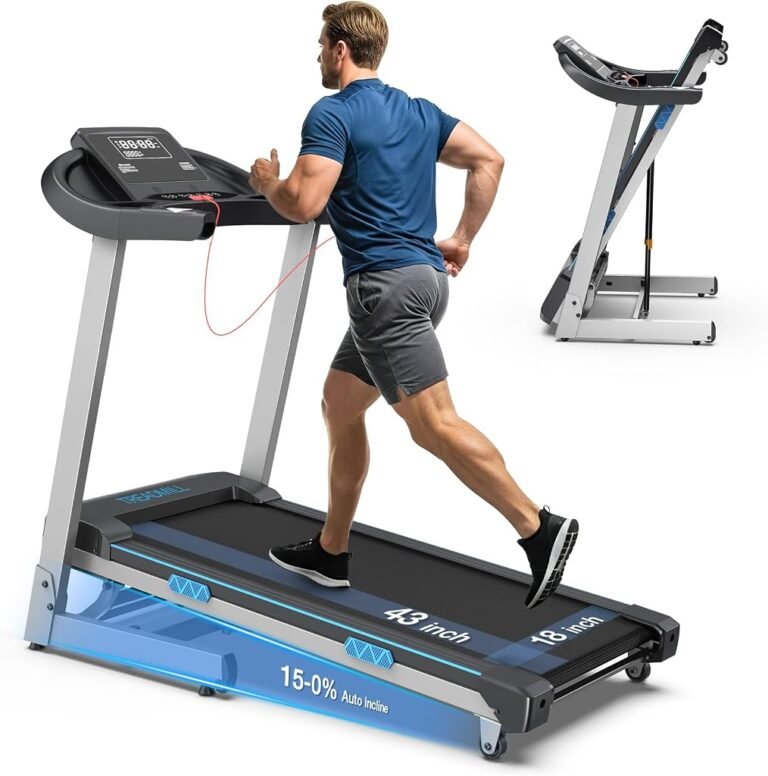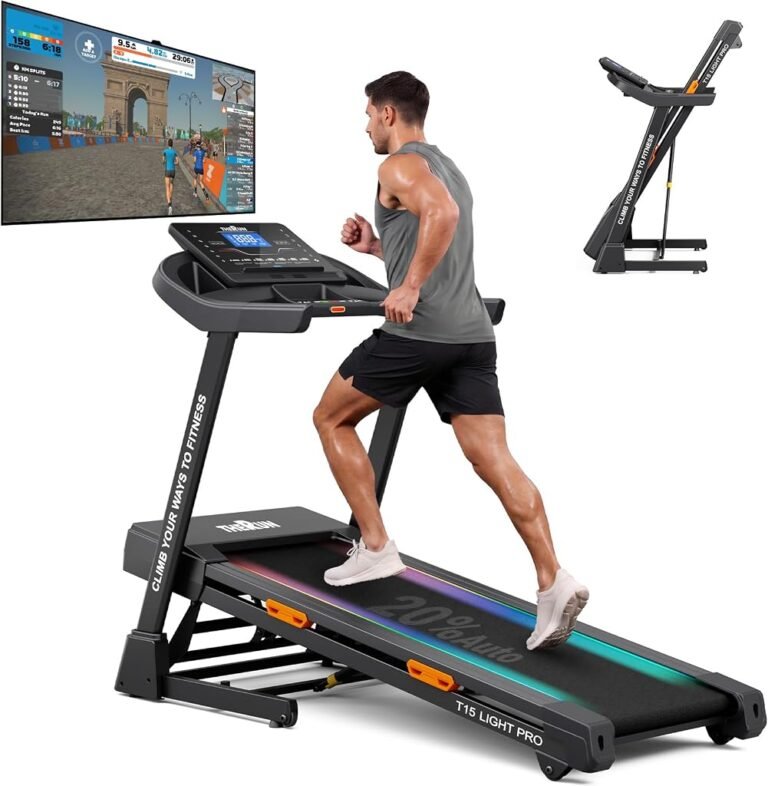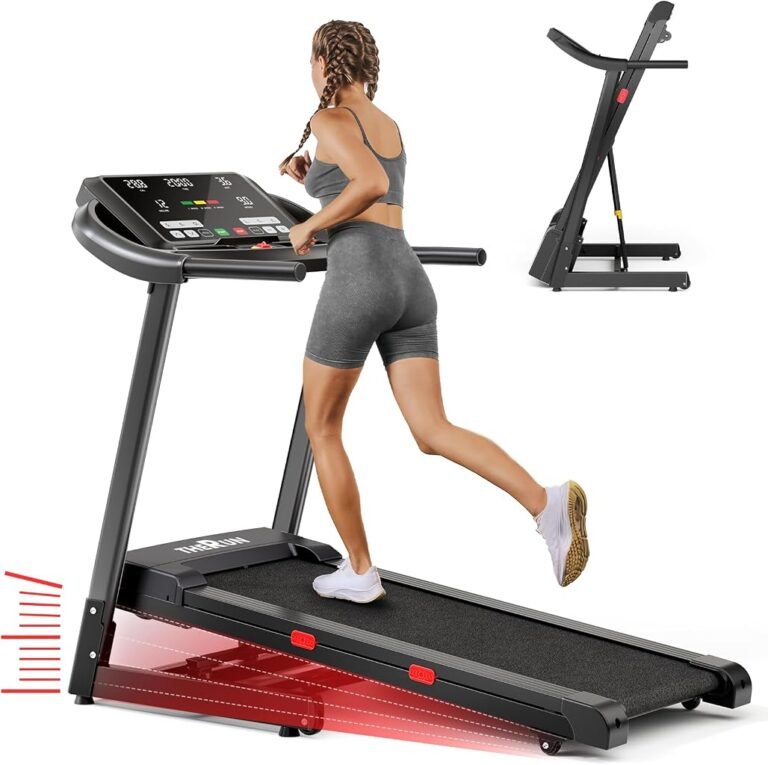
The MERACH T12 sits in a part of the treadmill market where design priorities tend to collide. Buyers want a machine compact enough for a spare room or apartment, stable enough for regular walking and jogging, strong enough to accommodate a broad range of users, and capable enough to avoid feeling like an oversized walking pad after the novelty fades.
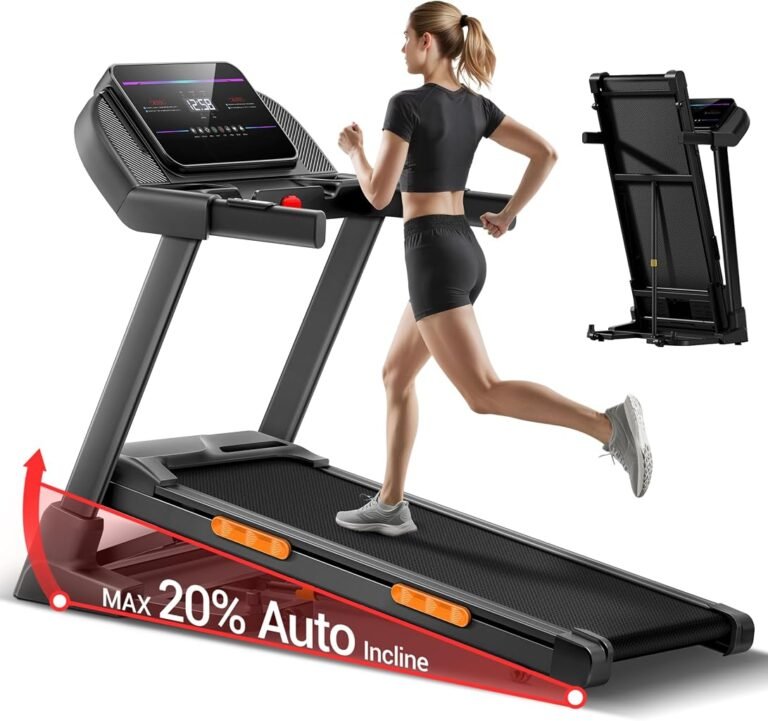
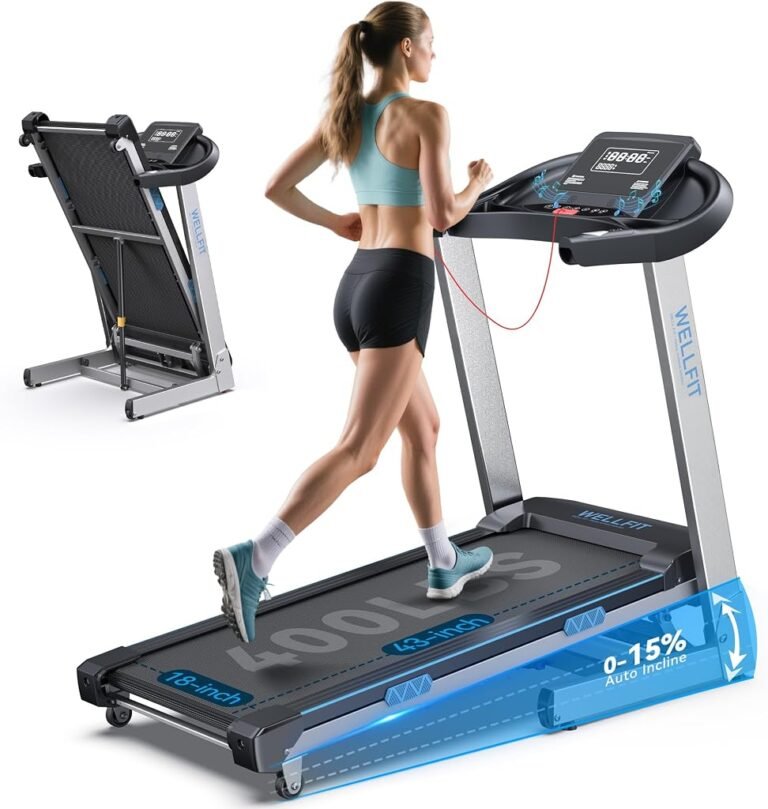
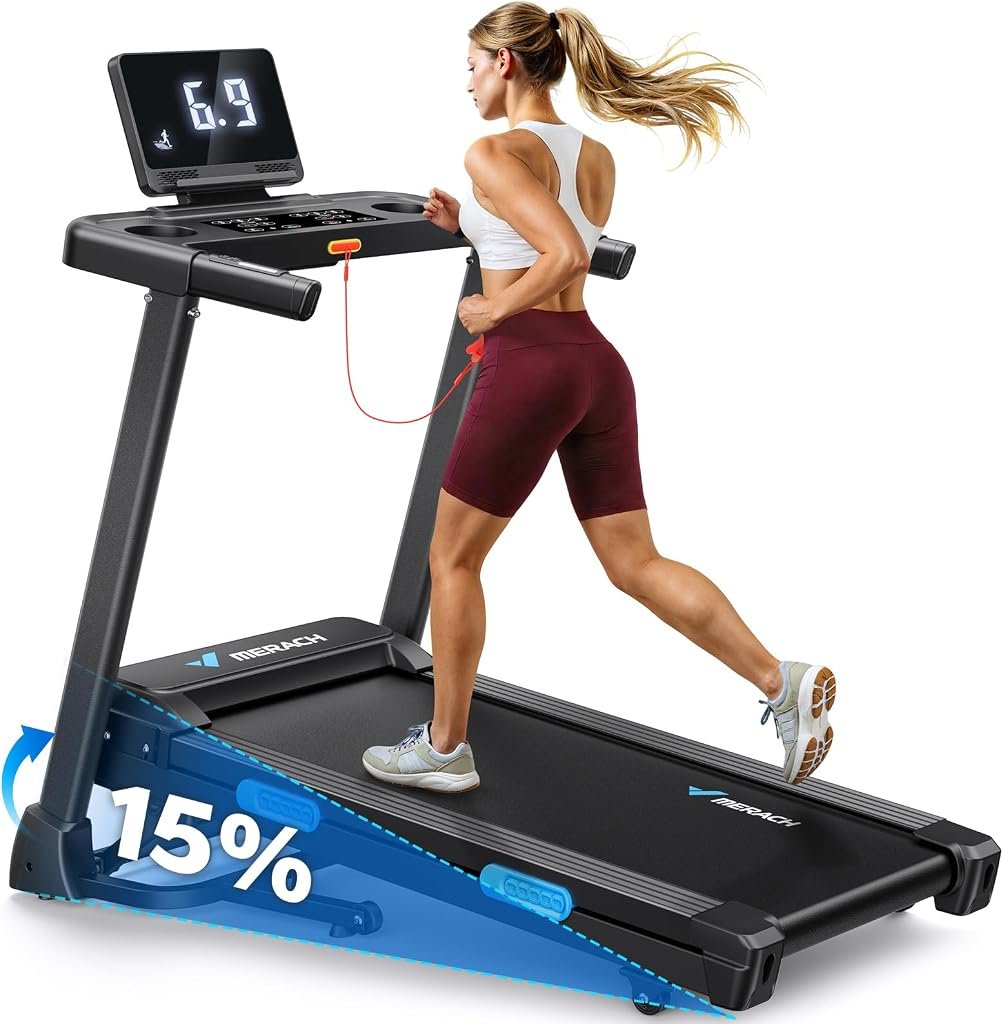
At an evaluated price of $359.99, the T12 attempts to reconcile those demands with a foldable frame, automatic incline up to 15%, a stated 300-pound user capacity, a 0.5-7.5 mph speed range and a 2.5 HP maximum motor rating. MERACH also lists a 42.5-by-16.5-inch running belt, app connectivity, heart-rate monitoring and a folded footprint of roughly 5 square feet on its official product page.
That makes the T12 more ambitious than a flat under-desk treadmill, yet clearly smaller and slower than a large running platform built around long strides and high-speed training.
Our score is 8.52/10, placing the machine in excellent territory. Customer Sentiment reaches 8.28, Buyer Confidence is particularly strong at 9.65, and Value stands at 8.15. Those ratings point toward a product with a coherent purpose and unusually easy-to-understand specifications, while leaving room for practical compromises around belt size, top speed and compact construction.
The T12 does not need to impersonate a gym treadmill to justify itself. Its stronger argument is narrower: it offers substantial incline capability, moderate running speed and folding convenience in a format designed for homes where square footage is part of the buying decision.
The T12 Has a Clearer Identity Than Many Compact Treadmills
Compact treadmills often struggle with identity.
Some are walking pads dressed up with handrails. Others are smaller versions of running treadmills that sacrifice too much belt area in the pursuit of storage convenience. The MERACH T12 is easier to categorize.
MERACH describes the machine as a foldable treadmill with up to 15% automatic incline, a 2.5 HP maximum motor rating, speeds from 0.5 to 7.5 mph and a 300-pound user limit. The official specifications list unfolded dimensions of 55.12 by 27.56 by 45.67 inches and a folded size of 25.6 by 27.6 by 49.2 inches.
Those numbers establish the basic trade.
The treadmill gives up the expansive deck and higher speed ceiling associated with larger running machines in exchange for a much smaller household footprint. That is not a defect when the buyer understands the exchange before purchase.
A compact treadmill should be evaluated according to whether its reduced size still supports the workouts its owner intends to perform.
For walking, incline training and moderate jogging, the T12 presents a credible specification set. For long-stride running at faster speeds, its geometry deserves closer examination.
The 15% Auto Incline Is the Defining Feature
The headline feature is the 15% automatic incline.
That capability changes the T12 from a simple compact treadmill into a more flexible aerobic training machine.
A flat treadmill largely asks users to manipulate speed and duration. Adding automatic grade creates another way to change workload. This is especially useful for people who prefer brisk walking over running or who want hill-style intervals without repeatedly increasing pace.
The CDC explains that aerobic intensity depends on how hard the body is working, with moderate activity raising breathing and heart rate and vigorous activity demanding substantially greater effort. The guidance also emphasizes that activity does not need to happen in one uninterrupted session.
Incline gives users a practical way to manipulate that effort.
A slower uphill walk can be substantially more demanding than a level walk at the same speed. This creates options for users who want to raise exercise intensity while keeping movement controlled.
The American Heart Association offers a particularly useful example in its discussion of walking and treadmill grade. Barry Franklin, Ph.D., explained that walking at 2 mph on a treadmill with a 3.5% incline can carry the same energy cost as faster level walking. His advice was concise: “But build up slowly.”
That advice fits the T12 well.
A 15% ceiling is most useful because it creates room for progression. It does not mean users should race toward maximum elevation. Lower grades can provide meaningful variation long before the treadmill reaches its upper limit.
Automatic Incline Is More Useful Than Manual Adjustment for Structured Sessions
Manual incline mechanisms can increase workload, but they are cumbersome when the goal is variation.
A manually adjusted treadmill normally requires the user to stop, leave the belt and physically change the deck position. That may be acceptable for someone who prefers one fixed grade throughout a workout.
It is far less convenient for interval-style training.
Automatic incline allows grade changes during the session. That makes several structures practical:
- Flat walking followed by progressive hill segments.
- Alternating incline and recovery intervals.
- Steady uphill walking at moderate speed.
- Sessions where speed remains stable while grade increases.
- Gradual progression across several weeks without changing the basic walking pace.
This is where the T12 earns much of its appeal.
Compact treadmills are often bought because they are easy to store. The T12 adds a feature that affects exercise quality rather than storage alone.
That makes the machine more defensible at $359.99 than a similarly sized treadmill whose main distinction is simply that it folds.
The 7.5 MPH Top Speed Establishes Its Natural Audience
MERACH lists a maximum speed of 7.5 mph.
That translates to an 8-minute-per-mile pace.
For walking, brisk walking, jogging and moderate recreational running, that ceiling is generous enough for many home users.
For faster runners, however, 7.5 mph can become restrictive.
This is an important distinction because treadmill specifications are often interpreted as a contest in which larger numbers automatically win. In reality, the better question is whether a machine’s speed range covers the user’s actual training.
A person whose routine consists primarily of 2.5-to-4-mph walking with varying incline has little need for a 12-mph maximum. A runner who performs intervals faster than 8 mph has an entirely different requirement.
The T12 is therefore best treated as a walking, incline and moderate-running machine.
That identity fits its compact dimensions.
The Running Belt Is Compact and Buyers Should Treat It That Way
The official running surface measures 16.5 inches wide by 42.5 inches long.
This is one of the specifications buyers should inspect most carefully.
A compact belt supports compact storage. Those two characteristics are directly related. There is no engineering trick that allows a short treadmill to unfold into an enormous running deck without adding mechanical complexity and size elsewhere.
For walking, a 42.5-inch belt may be entirely workable for many users. Walking typically involves a shorter stride than running.
As speed rises, stride length generally increases, making available belt length more consequential.
Taller runners, people with naturally long strides and anyone planning sustained faster running should compare the T12’s belt dimensions with larger treadmills before choosing it.
The 16.5-inch width also reinforces the compact character.
Again, this is not automatically negative. A machine designed for apartments and folding storage has different priorities from a large basement treadmill.
The risk comes only when buyers expect full-size running geometry from compact hardware.
A 300-Pound User Limit Broadens the Potential Audience
MERACH states that the T12 supports users up to 300 pounds.
That gives the treadmill relevance across a reasonably broad range of body weights.
Capacity figures should still be interpreted carefully.
A stated maximum user weight defines a limit. It does not, by itself, prove long-duration durability, motor longevity or identical performance at every point below that maximum.
A 170-pound walker and a user near 300 pounds place different mechanical loads on the treadmill.
For buyers closer to the stated ceiling, the operating margin deserves consideration, especially when workouts involve steeper incline or frequent use.
Still, the 300-pound figure is useful because many lightweight compact treadmills target lower capacities.
Here, MERACH is clearly attempting to combine reduced footprint with a relatively broad stated user range.
The 2.5 HP Motor Rating Should Not Be Overinterpreted
MERACH lists maximum motor power at 2.5 HP and describes the unit as brushless. The company also states that the treadmill operates below 40 dB.
The motor figure is worth understanding in context.
Horsepower numbers in consumer treadmill marketing can be difficult to compare because manufacturers may describe motor output under different measurement conditions. A maximum rating is not necessarily equivalent to sustained continuous output.
For that reason, 2.5 HP should not be converted into assumptions about years of service, heavy running workloads or commercial-grade operation.
What can be said confidently is that the motor is specified for the T12’s published 0.5-7.5 mph operating range.
That is the specification relationship that matters most.
The motor does not need to support speeds the treadmill cannot reach.
Folding Is Not a Side Feature on a 105.8-Pound Machine
MERACH lists the T12 at approximately 105.8 pounds, with a folded footprint of about 5 square feet.
That weight reveals something useful about the design.
The T12 is compact, but it is not a lightweight walking pad that can casually be carried under one arm.
Folding therefore matters because it changes how much floor space the treadmill uses while stored, not because it transforms the machine into a tiny object.
MERACH describes a hydraulic soft-drop folding system, and the listed folded dimensions are 25.6 by 27.6 by 49.2 inches.
Households considering the T12 should measure both the exercise area and storage location before purchase.
Doorways matter.
Ceiling clearance can matter when the treadmill stands folded.
Furniture placement matters.
Transport between floors matters even more when more than 100 pounds of equipment is involved.
This mundane geometry can decide whether a treadmill becomes convenient equipment or an ongoing household obstruction.
App Connectivity Is Useful, but the Mechanics Matter More
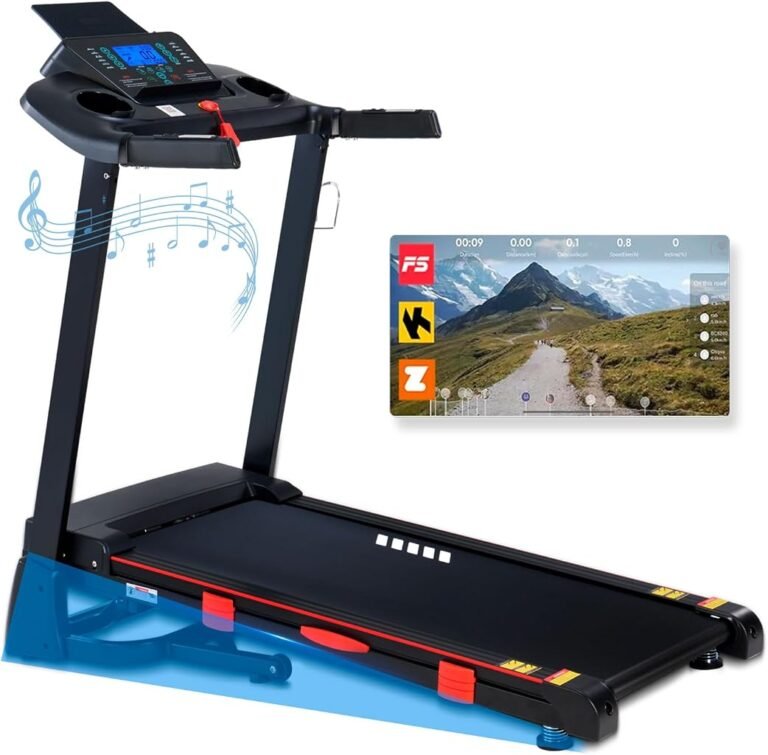
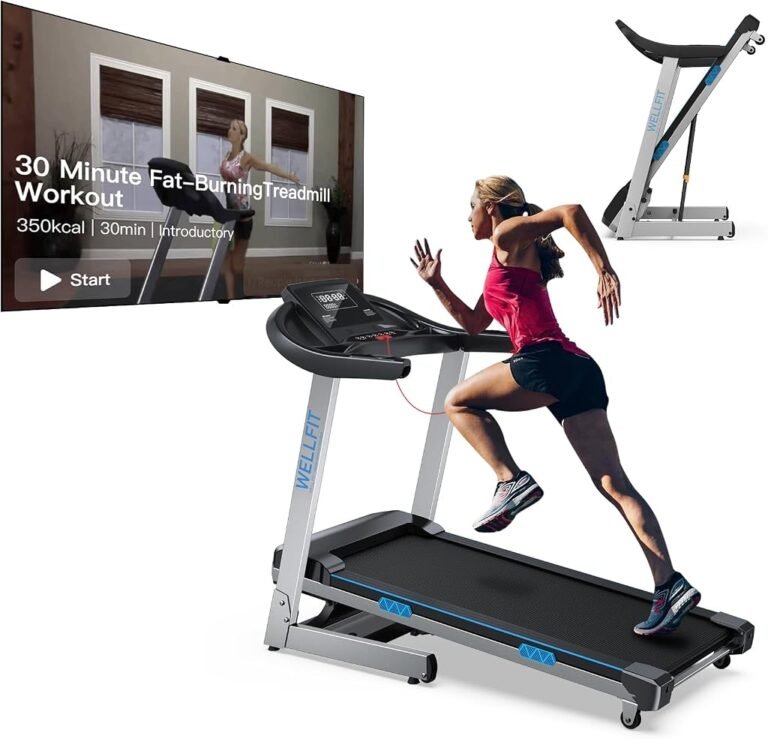
The T12 supports the MERACH app on iOS and Android. MERACH describes functions including workout tracking, scenic routes, coached sessions and interactive features.
That adds variety, but the app should remain secondary in the buying decision.
Software changes.
Phones change.
Subscription models and app features can change.
A treadmill’s belt dimensions, incline mechanism, speed range and weight limit are far harder to alter after purchase.
The sensible priority is therefore mechanical fit first, connected features second.
An owner who enjoys app-guided exercise may appreciate the additional layer of structure. Another user may ignore the app entirely and still receive most of the treadmill’s functional benefit from incline, speed control and the basic display.
The T12 does not need software to justify its physical design.
Heart-Rate Monitoring and Display Data Add Basic Feedback
MERACH lists heart-rate monitoring and a digital display covering calories, time, speed, distance and incline.
These are useful reference points during exercise.
Speed and incline tell users what the machine is doing. Time and distance help structure sessions. Heart-rate data can offer an additional measure of exercise response.
Calorie estimates deserve more caution.
Treadmill calorie displays are best treated as estimates because energy expenditure varies with body size, physiology, movement efficiency and other factors.
The more useful approach is consistency.
A person who walks for 30 minutes at the same speed and grade can compare sessions without pretending that a display has measured laboratory-grade energy expenditure.
The screen is therefore most useful as a session-management tool rather than a precision metabolic instrument.
Our Score: 8.52/10
Our overall score is 8.52/10.
That rating reflects an unusually coherent compact-treadmill package.
The T12 combines 15% automatic incline, a 0.5-7.5 mph speed range, a 300-pound stated user limit, foldable construction and app compatibility without pretending to be a high-speed running machine.
Its compromises are visible rather than hidden.
The belt is compact.
The maximum speed will not satisfy faster runners.
At roughly 106 pounds, it is movable equipment rather than truly portable equipment.
Those limitations make sense in relation to the machine’s design goals.
The score reaches excellent territory because the T12 offers several features that directly affect exercise versatility while retaining a footprint suited to smaller homes.
Customer Sentiment: 8.28
Our Customer Sentiment score is 8.28.
That is a strong result, although it sits below both the overall score and Buyer Confidence.
The difference is understandable.
Compact treadmills are sensitive to personal fit. Belt dimensions that feel entirely comfortable to one walker can feel constrained to another. Some buyers will use automatic incline constantly. Others will discover that they prefer level walking.
Noise perception also varies substantially by room construction, flooring and household expectations.
An 8.28 score indicates favorable ownership sentiment without suggesting universal suitability.
That is exactly where a compact hybrid treadmill should land.
The T12 is specific enough to have a strong audience and constrained enough that some users should choose something larger.
Buyer Confidence: 9.65
Buyer Confidence is the strongest rating at 9.65.
The reason is straightforward: MERACH publishes an unusually useful collection of specifications for the T12.
The official page lists incline, speed, motor rating, user capacity, belt dimensions, folded dimensions, product weight, display functions and app compatibility.
That makes comparison easier.
One wrinkle deserves scrutiny: marketplace naming around the associated product identifier has not always been perfectly consistent across retail metadata. The associated marketplace listing should therefore be checked immediately before purchase to confirm that the displayed brand and model match the MERACH T12 being evaluated.
Buyer Confidence remains high because the T12 itself is clearly documented by MERACH.
The buyer should simply make sure the listing being purchased corresponds to that machine.
Value: 8.15
Our Value score is 8.15.
At $359.99, the strongest economic argument comes from the combination of automatic incline and folding construction.
A flat compact treadmill can cost less.
A larger dedicated running treadmill can cost substantially more.
The T12 sits between those categories and gives buyers a meaningful training feature without moving into the physical scale of a large running platform.
Value is strongest for users who will regularly use incline.
Someone who intends to walk exclusively at 0% grade may be paying for mechanical complexity that adds little to that routine.
A user who alternates level walking, incline intervals and moderate jogging is more likely to exploit the machine’s full capability.
That distinction keeps Value below Buyer Confidence.
The treadmill is easy to understand. Its economic efficiency still depends on whether the household actually uses what it offers.
What the MERACH T12 Gets Right
The T12 combines several features effectively:
- Automatic incline up to 15% adds meaningful workout variation.
- A 0.5-7.5 mph speed range covers walking, jogging and moderate running.
- The 300-pound stated capacity broadens user compatibility.
- Folded dimensions reduce its storage footprint substantially.
- The 42.5-by-16.5-inch belt helps keep the machine compact.
- Heart-rate monitoring and basic display metrics support session tracking.
- App connectivity adds optional structure without defining the machine.
- A stated 105.8-pound product weight suggests a more substantial frame than ultra-light walking pads.
The design works because these features point toward the same user: someone who wants more training range than a walking pad offers but does not need a large, high-speed running treadmill.
Where Buyers Should Be More Critical
The running belt deserves the closest scrutiny.
A 42.5-inch length is compact. Taller users and faster runners should assess whether it provides enough stride room.
The 7.5 mph speed limit is another dividing line. Recreational walkers and joggers may never approach it, while faster runners can reach the ceiling quickly.
The machine’s weight also requires realistic planning.
At more than 100 pounds, moving it between rooms is a different task from rolling a very light walking pad away after every session.
Finally, buyers should verify marketplace branding before ordering. Product pages can change, and the listing should explicitly match the MERACH T12 model expected by the purchaser.
Who Is the Best Fit?
The T12 is best suited to incline walkers, brisk walkers, recreational joggers and moderate runners who value compact storage.
It also makes sense for households in which one treadmill will serve several users with different exercise preferences.
One person can perform comfortable level walking.
Another can use moderate incline.
A third can jog at a faster pace.
That flexibility can make one compact machine more useful than a highly specialized alternative.
The CDC recommends at least 150 minutes of moderate-intensity aerobic activity each week for adults, or 75 minutes of vigorous activity, along with muscle-strengthening activity on at least two days.
A home treadmill can make that target easier to divide across the week because travel and weather disappear from the equation.
Who Should Look Elsewhere?
Fast runners should consider treadmills with higher maximum speeds and larger decks.
Very tall users or runners with long strides may prefer more belt length.
Buyers who require more than a 300-pound capacity need a different machine.
People who only want slow, flat desk walking can probably satisfy that need with a simpler product.
Households that never need to reclaim floor space may also gain more from a larger non-folding or less compact treadmill.
The T12 is strongest when its constraints solve the buyer’s constraints.
That is the central logic behind compact fitness equipment.
A Practical Approach to Using the 15% Incline
The full incline range should be approached progressively.
A new user can begin with comfortable flat walking and establish consistency before increasing grade.
Once that feels manageable, modest uphill intervals can be introduced. The session might alternate several minutes at low incline with shorter periods at a higher setting.
Over time, either incline, duration or speed can rise.
Changing all three aggressively at once is unnecessary.
The CDC notes that weekly activity can be broken into smaller portions, and any amount of moderate or vigorous physical activity has health benefits.
That makes the T12 well suited to repeated short sessions rather than occasional heroic workouts.
Consistency usually asks less from both the machine and the person using it.
Why the T12 Stands Out in the Compact Category
Among the best treadmills for home, there is a recurring tension between space efficiency and exercise range.
Machines that fold exceptionally small often sacrifice belt size, incline or running capability.
Larger treadmills provide more room but demand permanent household space.
The T12 attempts a middle route.
Its folded footprint is small enough to matter in apartments and multipurpose rooms, while the 15% automatic incline creates more training flexibility than a flat walking pad can offer.
That combination is the machine’s strongest editorial argument.
The T12 is not compelling because it wins every specification contest.
It is compelling because its compromises form a coherent package.
Final Considerations
The MERACH T12 Foldable Treadmill earns an 8.52/10 overall score by pairing substantial incline capability with a compact, clearly documented design.
Its 15% automatic incline is the central advantage. The 0.5-7.5 mph speed range supports walking, jogging and moderate running, while the stated 300-pound capacity gives the machine a broad potential audience. A 42.5-by-16.5-inch running belt and roughly 5-square-foot folded footprint reveal the trade behind that flexibility: this is a compact treadmill first.
Customer Sentiment at 8.28 reflects a favorable ownership profile tempered by the personal nature of treadmill fit. Belt size, stride length, preferred speed and storage habits can change the experience considerably.
Buyer Confidence at 9.65 is the standout rating because MERACH publishes clear specifications that allow prospective owners to judge the machine against their needs before purchase.
Value at 8.15 is also strong at $359.99, particularly for households that will genuinely use automatic incline rather than treating it as an unused specification.
The T12 makes the most sense for walkers and recreational runners who want varied indoor cardio without dedicating a large room to fitness equipment. It makes less sense for fast runners, people needing a larger deck or users who require capacity beyond 300 pounds.
The strongest buying decision is therefore not driven by how many features fit on the product page. It comes from matching the treadmill’s physical limits to the person, the room and the workouts that will actually occur.
For that audience, the MERACH T12 presents a disciplined compromise: compact enough to live with, capable enough to remain useful, and varied enough to make indoor walking more than a flat-belt routine.