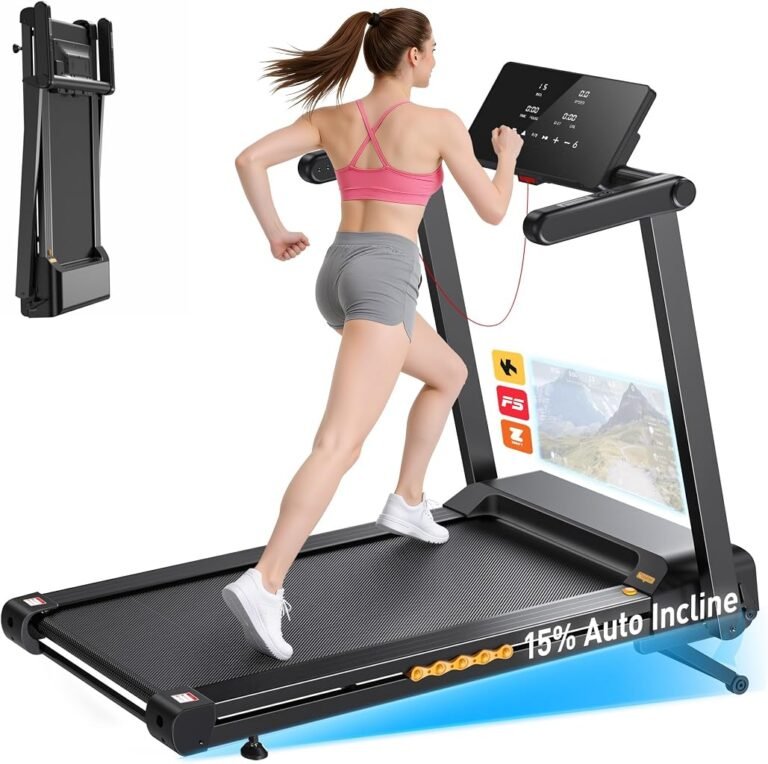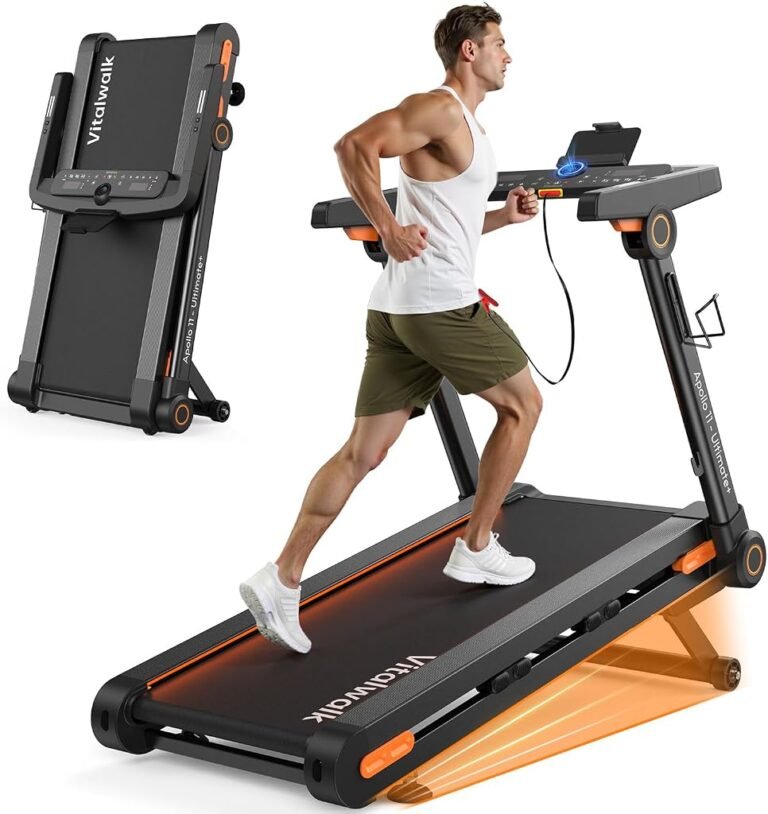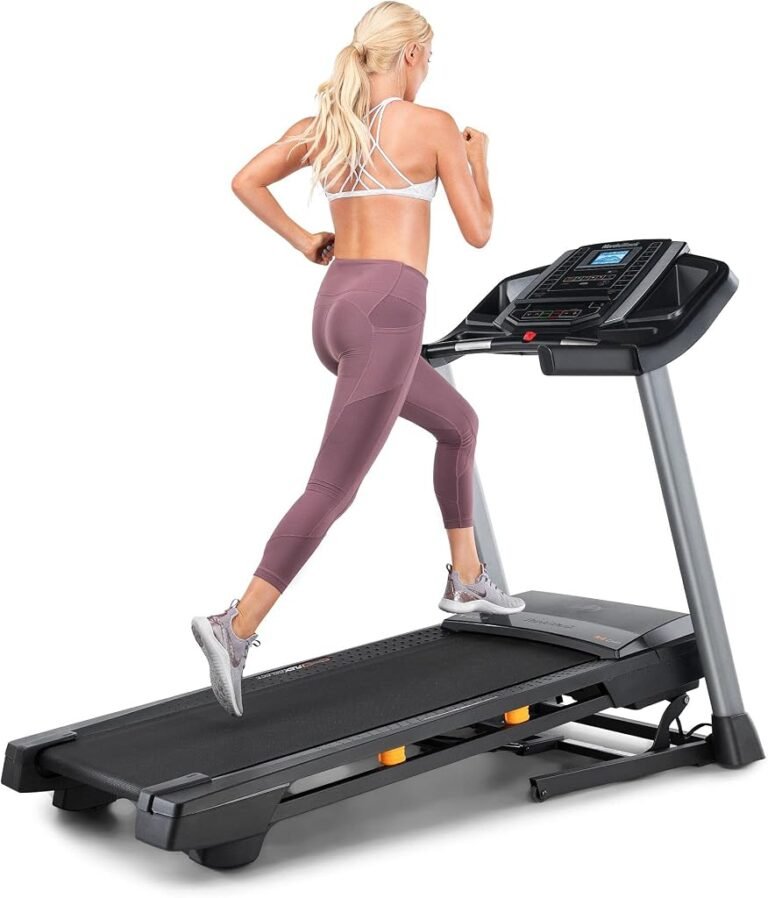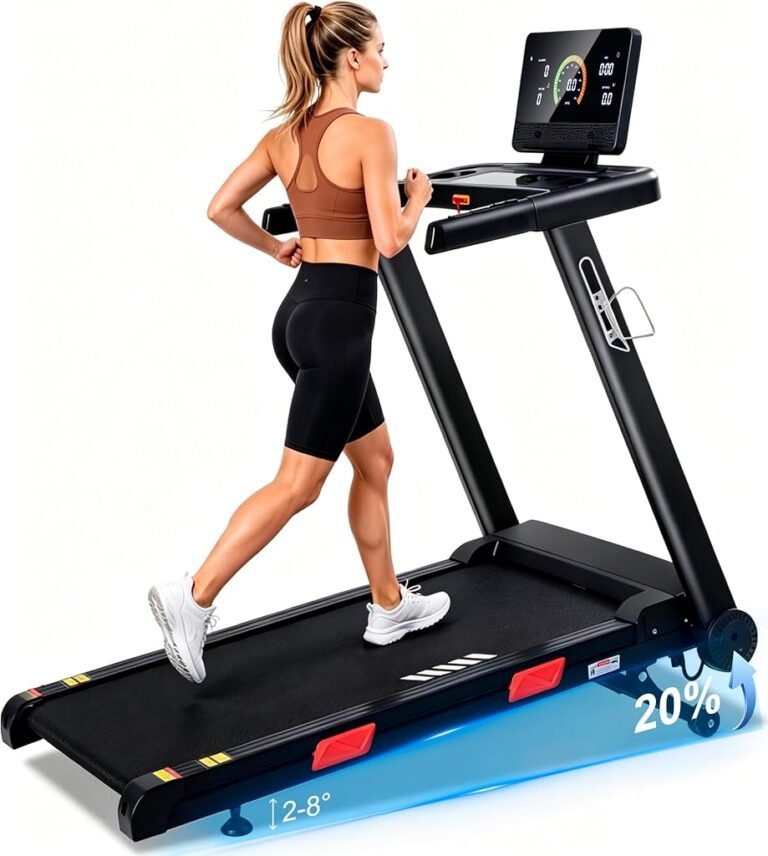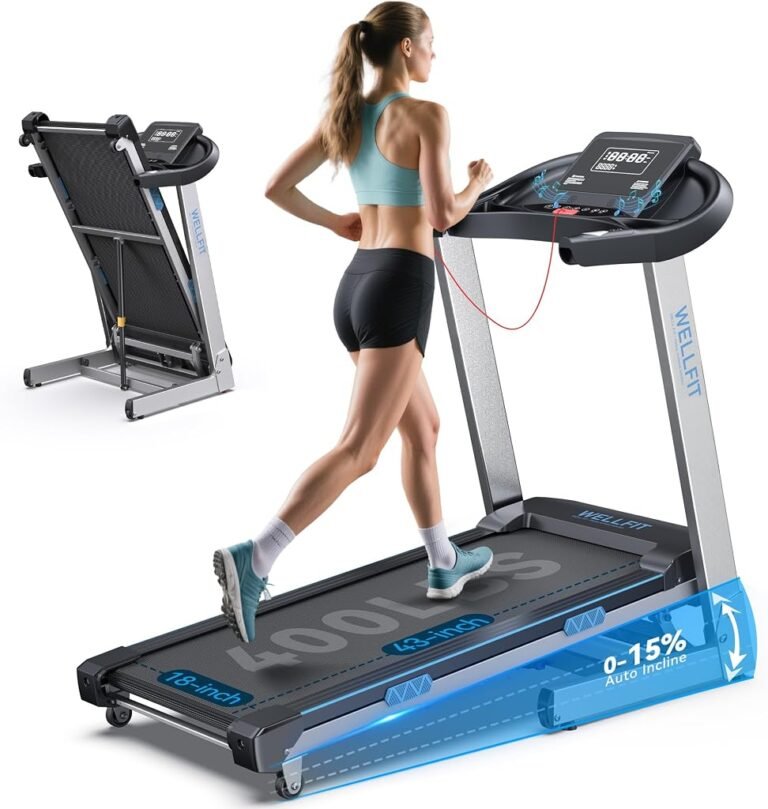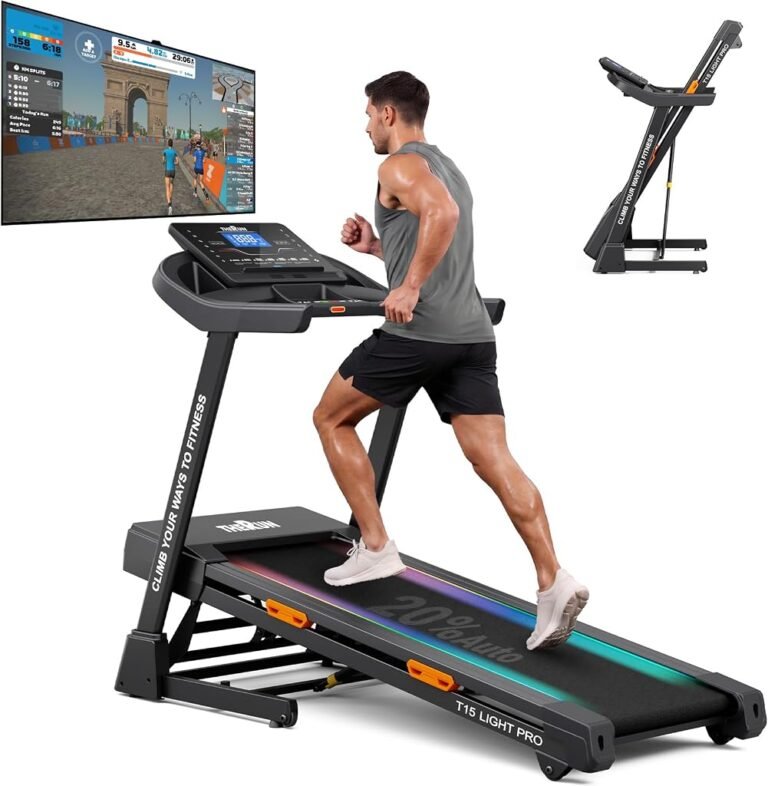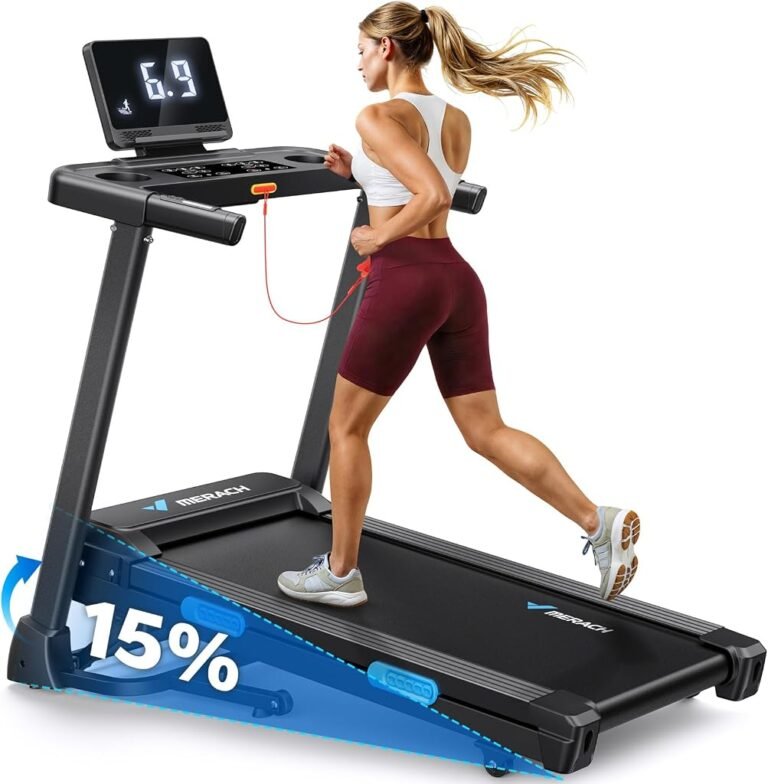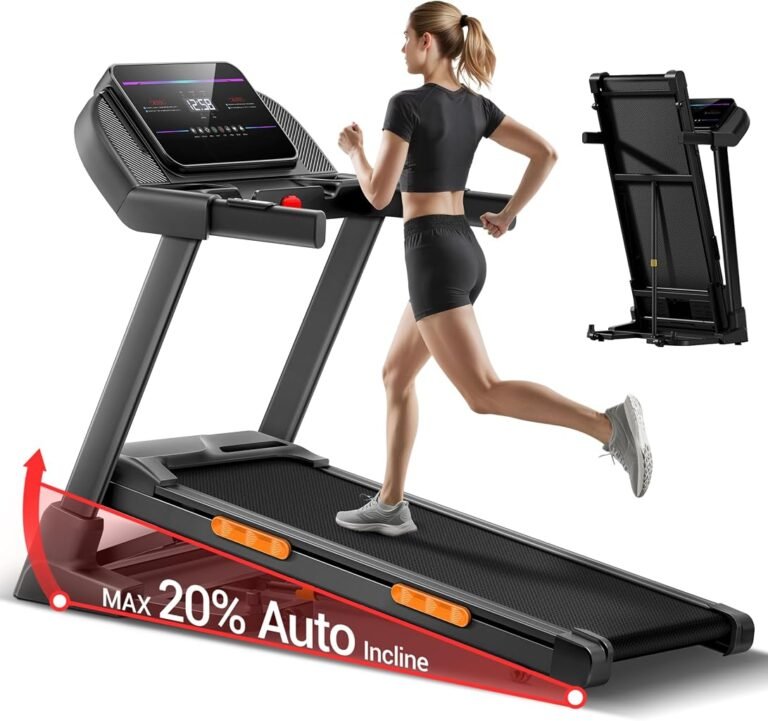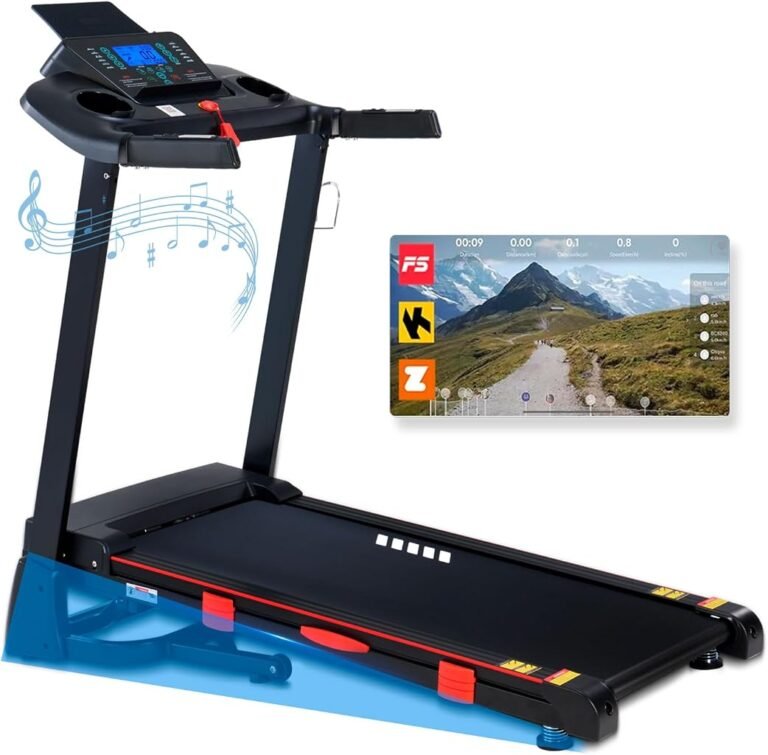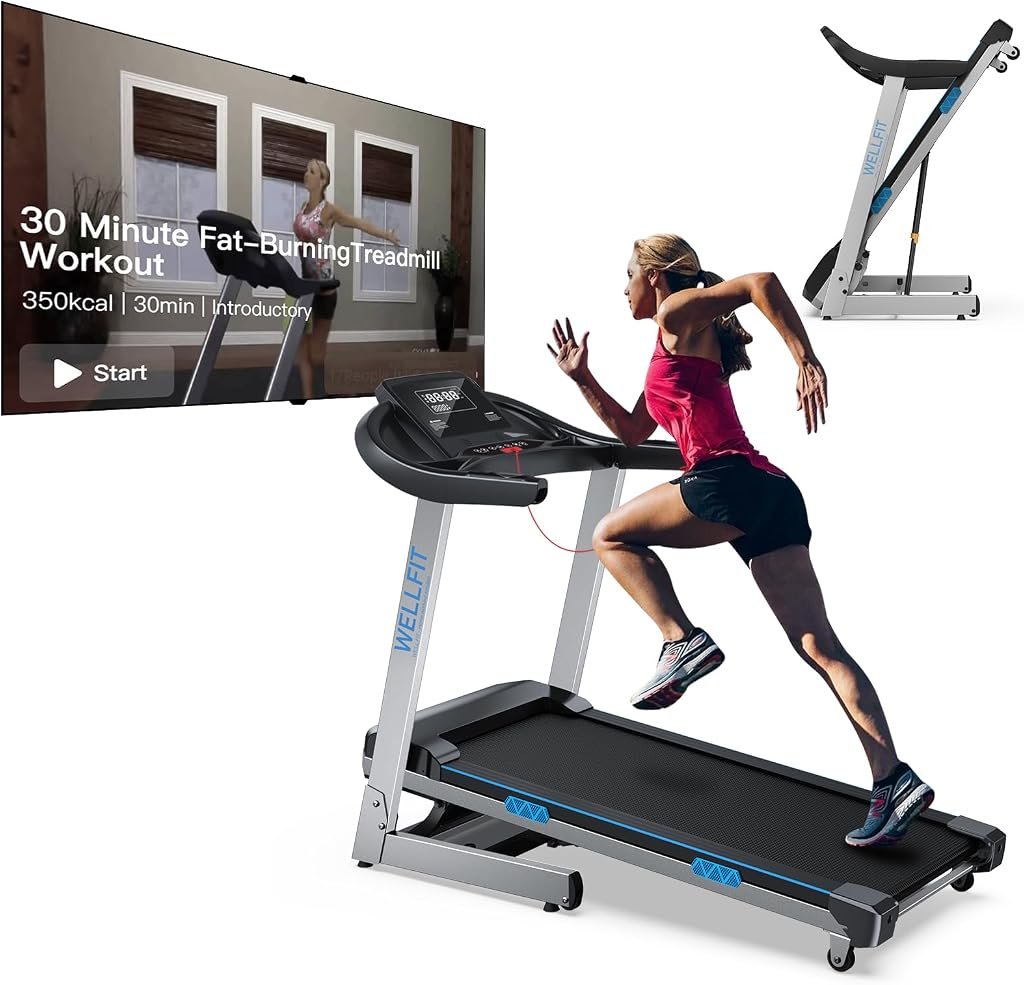
A treadmill carrying a 400-pound user limit, automatic incline, adjustable handrails, a 4.0 HP motor, and folding construction makes an ambitious promise. It is trying to accommodate larger users, runners, walkers, households short on floor space, and people who want hill training without moving into the price range of large premium machines.
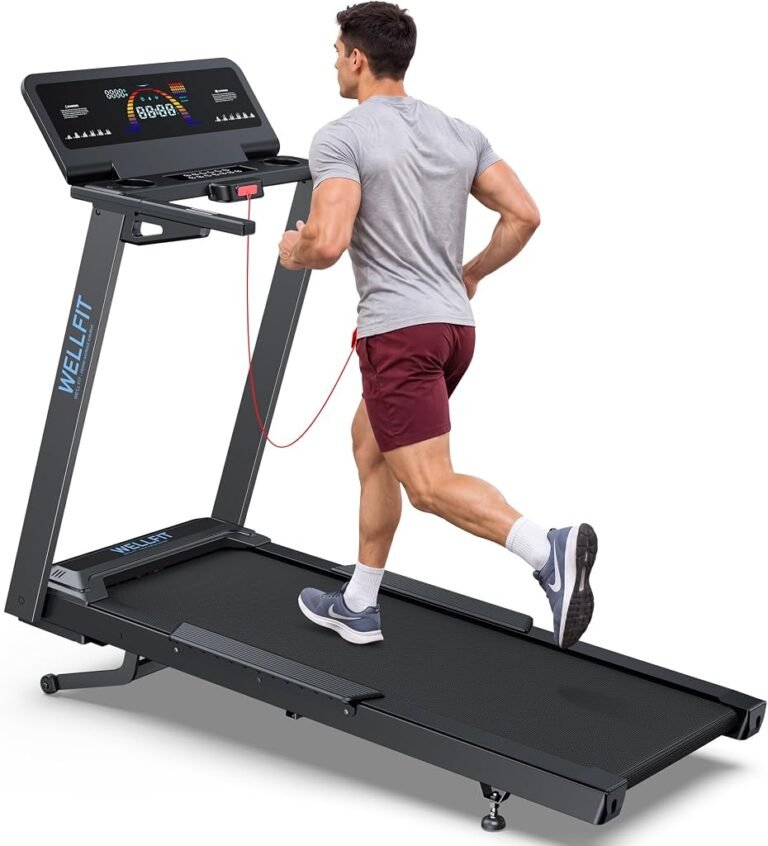
The WELLFIT Heavy Duty Foldable Treadmill attached to product identifier B0F2N2WBJ3 is identifiable as a WELLFIT ProSeries machine. That matters because conflicting retail metadata associates the identifier with an unrelated Sunny Health & Fitness title. Independent documentation tied directly to B0F2N2WBJ3 instead identifies WELLFIT as the manufacturer and supports the central specifications used in this assessment.
The WELLFIT ProSeries launch documentation identifies a 4.0 HP motor, speeds reaching 8.7 mph, a 400-pound stated capacity, automatic incline from 0% to 15%, adjustable handrails, folding construction, app compatibility, and 95% preassembly. The same announcement links directly to B0F2N2WBJ3.
That specification set gives the treadmill an unusual identity. It is more substantial than a walking pad, more compact than many full-size running machines, and more accommodating on paper than the 250- to 300-pound limits common across lighter residential equipment.
At the evaluated price of $399.99, the proposition is aggressive.
Our score is 8.62/10. Customer Sentiment is 8.72, Buyer Confidence is 8.62, and Value is 8.4. The ratings are tightly grouped, which signals a product with a relatively coherent relationship between capability, intended audience, and price. Customer Sentiment edges above the overall score, while Value is slightly lower because the compact running surface and 8.7 mph ceiling impose boundaries that matter to serious runners.
The 400-Pound Capacity Is the Defining Specification
The WELLFIT’s 400-pound stated user capacity immediately separates it from much of the compact treadmill market.
Documentation associated specifically with B0F2N2WBJ3 identifies a reinforced frame and 400-pound maximum user recommendation. It also describes the treadmill as a heavy-duty home machine rather than a lightweight walking pad.
That distinction has practical consequences.
A 250-pound treadmill limit excludes a substantial group of potential users outright. A 300-pound limit expands access, but users near that boundary may reasonably want additional capacity margin. A published 400-pound limit gives WELLFIT a broader potential audience.
Still, maximum capacity should not be confused with a guarantee of identical performance at every body weight.
Walking, jogging, and running create different dynamic forces. Stride pattern, foot strike, speed, incline, and body movement all affect how loads reach the deck and frame. A 390-pound walker moving at 2 mph does not interact with a treadmill in the same way as a lighter runner approaching maximum speed.
The 400-pound figure is therefore best interpreted as an important eligibility boundary.
Users comfortably below it can focus on the next questions: deck dimensions, speed, incline, handrail position, folding geometry, and electrical requirements.
The 4.0 HP Motor Needs Context Rather Than Admiration
WELLFIT describes the ProSeries with a 4.0 HP motor. The documentation tied to the exact product identifier likewise specifies 4 HP.
That number sounds substantial, particularly beside compact treadmills advertised with 1.5, 2.0, or 2.5 HP motors.
Horsepower still needs disciplined interpretation.
Consumer treadmill manufacturers do not always report motor power under identical sustained-load testing conditions. A large headline number cannot independently establish cooling capacity, controller quality, electrical efficiency, belt consistency, durability, or performance after prolonged operation.
The surrounding specifications are more informative.
The WELLFIT pairs its motor with an 8.7 mph maximum speed, 400-pound stated user capacity, and automatic incline. That combination suggests a machine intended to handle walking, jogging, hill work, and moderate running rather than merely low-speed movement.
For buyers, that operating range matters more than winning a horsepower comparison.
A motor exists to move the belt predictably under the intended load. The entire drive system, rollers, deck, controller, frame, and belt tension contribute to that task.
Four horsepower on a specification sheet cannot replace those engineering relationships.
An 8.7 MPH Ceiling Covers Most Recreational Use
The treadmill reaches a documented maximum speed of 8.7 mph.
That corresponds to a running pace of roughly 6 minutes 54 seconds per mile.
For walking, that ceiling is far beyond anything necessary. For jogging and ordinary recreational running, it leaves substantial room. Many users can perform progression runs, steady aerobic sessions, faster intervals, and incline workouts without reaching the maximum.
Serious faster runners face a different calculation.
A conventional performance treadmill often reaches 10 or 12 mph. Machines intended for demanding running can go faster still. An 8.7 mph limit therefore restricts anyone who routinely trains around seven-minute-mile pace or faster.
That is not a defect so much as a design boundary.
The WELLFIT’s identity is centered on capacity, incline, compact construction, and broad household usability rather than high-speed running.
For someone walking at 3 mph or jogging at 5 mph, paying for a 12 mph motor system may accomplish little. For an experienced runner doing fast intervals, 8.7 mph can become restrictive almost immediately.
The intended pace should decide whether the ceiling matters.
The Running Surface Creates the Most Important Trade-Off
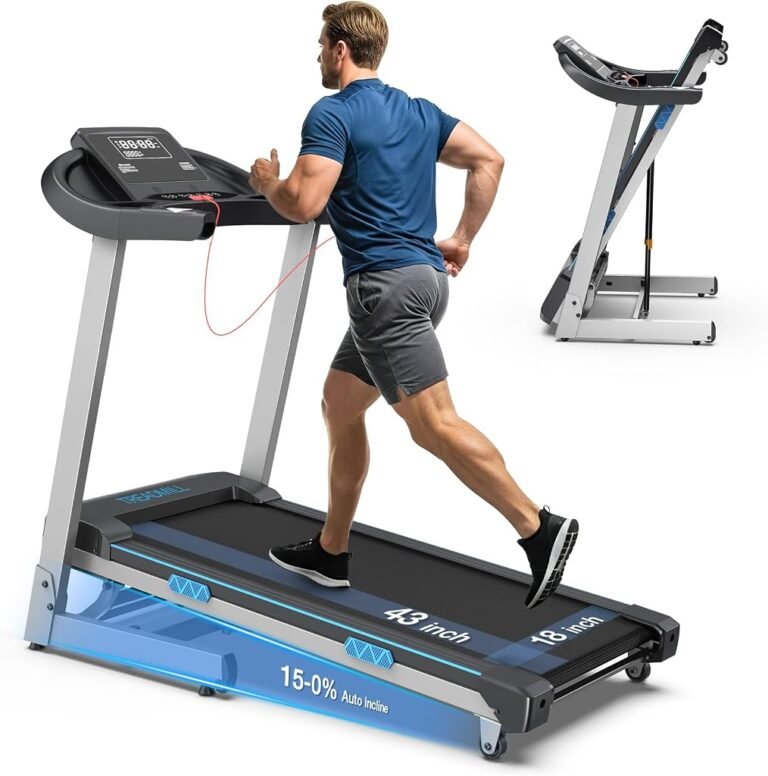
Documentation associated with B0F2N2WBJ3 identifies an approximately 18-by-43-inch running belt.
That is reasonably wide for a compact treadmill but short by full-size running standards.
Width and length affect treadmill use differently.
An 18-inch width gives a walker or runner lateral room around the center line of the belt. It is broader than many narrow walking pads, although larger running treadmills frequently provide 20- or 22-inch widths.
Length becomes increasingly consequential as pace rises.
A 43-inch deck can accommodate walking and shorter jogging strides, but it provides considerably less front-to-back margin than a 55- or 60-inch running platform. Taller users and faster runners generally produce longer strides, making available deck length more noticeable.
This creates an interesting tension in the WELLFIT’s specification sheet.
The motor and 8.7 mph ceiling permit running, but the compact belt encourages a more conservative interpretation of that capability.
A shorter user jogging moderately may find the geometry entirely workable. A tall runner approaching maximum speed may want substantially more deck.
Anyone buying primarily for running should measure stride expectations rather than assuming the high weight capacity automatically means full-size running dimensions.
Fifteen Percent Automatic Incline Adds Genuine Training Range
The ProSeries documentation describes an automatic incline system covering 0% to 15%.
This is one of the treadmill’s stronger features.
Powered incline allows the deck angle to change during exercise without requiring the user to stop, step off, and reposition mechanical supports. That enables gradual climbing sessions and workouts alternating flatter and steeper segments.
A 15% grade is substantial.
Percentage grade describes vertical rise relative to horizontal travel. A 15% grade therefore means 15 units of vertical rise for every 100 units traveled horizontally. It is not equivalent to a 15-degree angle.
For walkers, incline provides a way to raise exercise intensity without forcing a transition into running.
That can be especially useful for someone who prefers brisk walking but wants a wider progression path than speed alone provides.
Runners can also use incline for hill-oriented sessions, though the treadmill’s relatively short deck remains relevant as pace increases.
The important advantage is choice.
A treadmill capable of 15% incline does not require users to exercise at 15%. Lower grades may account for most ordinary sessions. The upper range simply provides additional room when a harder climb is appropriate.
Adjustable Handrails Are More Useful Than They First Appear
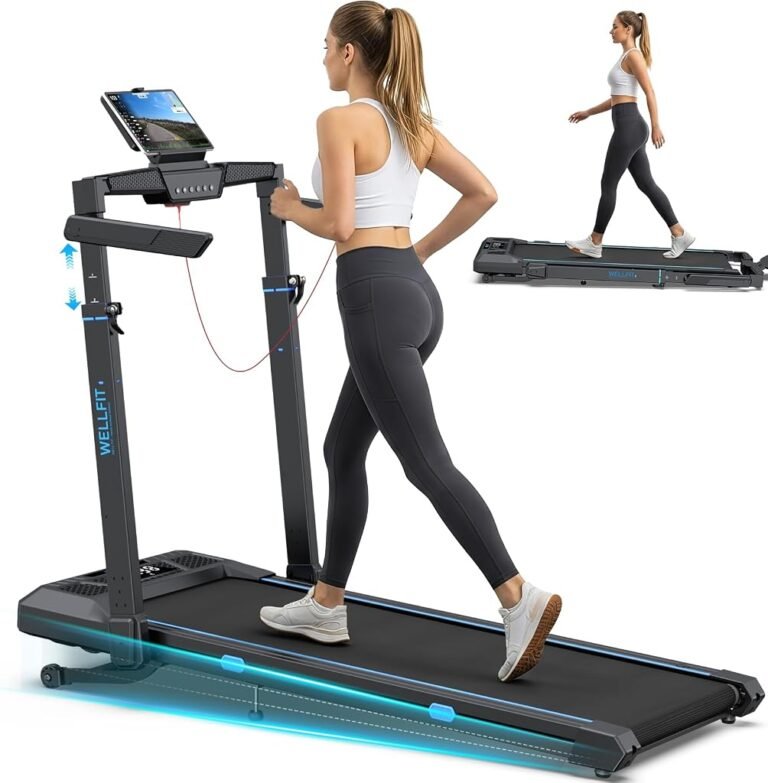
WELLFIT’s ProSeries documentation describes adjustable handrails spanning approximately 33 to 46 inches.
Adjustability is particularly relevant on a treadmill intended for a broad user population.
Fixed rails inevitably suit some body dimensions better than others. A grip position comfortable for a shorter walker may sit awkwardly low for a taller person.
Adjustable rails can improve access to support and controls when multiple household members share the treadmill.
They should not encourage continuous heavy leaning.
Handrails are useful for mounting, dismounting, regaining balance, and establishing stability during changes in speed or incline. Habitually transferring substantial body weight onto the rails can change walking or running mechanics.
The feature therefore works best as accessible support rather than something every user must grip throughout every session.
For households with people of different heights, the adjustment range adds more practical value than a fixed cosmetic handlebar.
Folding Design Solves One Problem but Cannot Erase Mass
The WELLFIT folds for storage and is described as 95% preassembled.
Those features address two persistent complaints about home treadmills: floor-space consumption and assembly.
Folding can reclaim part of a room when exercise ends. That matters in apartments, bedrooms, offices, and multipurpose living areas where a permanently open treadmill may be difficult to accommodate.
Yet “foldable” should never be translated into “effortlessly portable.”
Heavy-duty construction has mass. Moving a substantial motorized treadmill still requires control and enough physical capability to guide it safely.
The buying process should include a simple spatial audit:
- Measure the treadmill’s open position.
- Measure the intended storage area.
- Check door and hallway clearances.
- Identify the grounded electrical outlet that will power it.
- Leave adequate open space behind the belt.
- Confirm that folding does not block doors or walking paths.
- Decide who will reposition the machine when necessary.
- Account for ceiling clearance when using steep incline.
These questions are less exciting than motor power but often determine whether a treadmill fits comfortably into daily life.
Ninety-Five Percent Preassembly Is a Practical Advantage
WELLFIT states that the ProSeries ships 95% preassembled, with setup intended to require only a small amount of final work.
That is meaningful on a heavy treadmill.
Traditional treadmill assembly can involve large deck sections, uprights, console wiring, bolts, and components that are awkward for one person to position.
Reducing assembly does not merely save time. It reduces the number of opportunities for wiring to be pinched, fasteners to be installed incorrectly, or heavy components to be handled unnecessarily.
Owners still need to follow the setup instructions carefully.
A nearly assembled treadmill still requires inspection before operation. Fasteners should be checked, the safety key understood, belt condition inspected, electrical requirements followed, and controls learned before speed or incline rises.
Convenient setup should shorten preparation, not eliminate it.
Electrical Requirements Deserve Attention
The manual associated with B0F2N2WBJ3 instructs owners to connect the treadmill to a grounded power source.
This is easy to overlook because buyers naturally focus on fitness specifications.
A motorized treadmill is also a substantial electrical appliance.
Extension cords, overloaded circuits, damaged receptacles, or inappropriate adapters can create problems unrelated to exercise performance. The manufacturer’s electrical instructions should therefore be treated as part of installation rather than an afterthought.
The location decision should begin near a suitable outlet, not with a plan to improvise power delivery after the treadmill arrives.
That is particularly sensible for equipment combining a motorized belt with powered incline.
Shock Absorption Does Not Make Running Impact-Free
Documentation associated with the machine describes a multilayer running belt intended to provide cushioning and shock absorption.
Cushioning is useful, but marketing around treadmill decks can encourage exaggerated expectations.
Running remains a weight-bearing activity.
A cushioned treadmill deck can change the mechanical feel of foot strike relative to harder surfaces, but it does not eliminate loading on the body. Nor can a cushioning system guarantee comfort for every runner.
Footwear, running form, pace, training volume, prior activity, and individual anatomy all affect how exercise feels.
The appropriate interpretation is modest: deck cushioning is a relevant comfort feature, not permission to ignore gradual progression.
The Safety System Matters More Than Smart Features
The WELLFIT documentation identifies a safety key, and the manual instructs users to engage it before operation.
That feature deserves more attention than app connectivity.
The current ASTM F2115-25 treadmill specification addresses stability, accessible controls, handrails, foot rails, moving-surface traction, rear-roller protection, pinch and catch points, and stopping systems. ASTM states that motorized treadmills should incorporate an accessible stop switch that stops the moving surface and any powered incline motion.
For a treadmill capable of both running and steep incline, stopping behavior matters.
Users should:
- Learn the stop control before increasing speed.
- Attach the safety key correctly.
- Begin each session at a manageable pace.
- Increase incline progressively.
- Keep the area behind the treadmill clear.
- Keep children and pets away from the moving belt.
- Avoid loose objects near the deck and rollers.
- Stop the belt before stepping off whenever possible.
- Follow the manufacturer’s electrical instructions.
- Inspect the machine periodically for loosened hardware or unusual belt behavior.
These habits are ordinary, which is exactly why they are easy to neglect.
App Connectivity Is Useful but Secondary
The ProSeries launch documentation describes compatibility with the WELLFIT app, Kinomap, and Apple Health.
Connected exercise can make workout logging easier and may provide additional structure for users who enjoy digital tracking.
It should not dominate the buying decision.
Applications change. Phone operating systems change. Compatibility can change. A treadmill’s physical dimensions, motor, deck, frame, speed range, and incline mechanism remain far more fundamental to ownership.
The sensible hierarchy puts physical fit first.
If the 43-inch deck is too short for a runner’s stride, app compatibility cannot fix it. If the 400-pound capacity provides the margin a user needs, that matters regardless of whether a workout syncs to a phone.
Connectivity is best treated as an additional layer rather than the foundation of the product.
Exercise Capability Extends Beyond Running
The WELLFIT’s combination of speed and automatic incline means it does not need to be used as a running machine to justify its presence.
The CDC’s adult physical-activity guidance recommends at least 150 minutes of moderate-intensity aerobic activity each week, or 75 minutes of vigorous activity, or an equivalent combination. Adults are also advised to perform muscle-strengthening activity on at least two days each week.
Walking can therefore form a substantial part of an aerobic routine.
Automatic incline gives walkers another way to adjust workload without continually increasing belt speed.
That is one reason the WELLFIT’s 8.7 mph ceiling should not automatically be viewed as inadequate. A household interested primarily in walking, hill walking, and moderate jogging can use a large portion of the machine’s capability without approaching maximum speed.
The treadmill cannot replace resistance exercise or every other form of movement.
It can, however, make aerobic exercise easier to schedule when outdoor conditions, traffic, darkness, or household obligations make outdoor walking inconvenient.
Our Score: 8.62/10
Our score of 8.62/10 places the WELLFIT Heavy Duty Foldable Treadmill in excellent territory.
The rating reflects a product with a well-defined combination of capacity and versatility.
A 400-pound stated user limit broadens access. Automatic incline reaching 15% gives walkers and runners substantial progression room. The 4.0 HP published motor specification aligns with a machine intended for more than low-speed walking. An 8.7 mph ceiling supports walking, jogging, and moderate running.
Adjustable handrails, folding construction, app compatibility, shock absorption, and 95% preassembly strengthen the package.
The main compromise is the deck.
An approximately 18-by-43-inch running area is compact relative to the 20-by-55-inch and 20-by-60-inch platforms available on many larger running treadmills. That short length places a meaningful boundary around taller users and faster running.
The 8.62 rating therefore recognizes a capable heavy-duty home treadmill without pretending compact geometry disappears merely because the motor and weight-capacity numbers are large.
Customer Sentiment: 8.72
Customer Sentiment is 8.72, slightly higher than our overall score.
That difference suggests a product whose central design choices correspond well to its likely audience.
Heavy-duty home treadmills often force buyers to choose between capacity and compactness. WELLFIT’s approach attempts to preserve a 400-pound stated limit while maintaining folding storage and a relatively modest footprint.
The automatic incline also gives walkers a reason to use the treadmill beyond flat movement.
Customer Sentiment does not reach into the 9s because fit remains personal.
A 43-inch deck that feels entirely adequate to a moderate walker can feel restrictive to a tall runner. Adjustable handrails can accommodate different users, but they cannot alter belt length. Likewise, 8.7 mph is generous for many households and limiting for faster athletes.
The 8.72 rating reflects strong alignment with general home exercise rather than universal suitability.
Buyer Confidence: 8.62
Buyer Confidence is 8.62, identical to our overall score.
The exact product identifier helps considerably here.
B0F2N2WBJ3 is tied directly to WELLFIT documentation identifying the ProSeries treadmill, its 4.0 HP motor, 400-pound capacity, 0% to 15% automatic incline, 8.7 mph maximum speed, adjustable handrails, folding construction, and near-complete preassembly.
Those specifications give buyers concrete screening criteria.
Someone above the published capacity needs another machine. A fast runner requiring 10 or 12 mph can move on. A tall runner wanting a 60-inch deck should choose a larger platform. A walker seeking substantial incline and high capacity has a clearer reason to keep the WELLFIT under consideration.
The conflicting Sunny Health & Fitness retail title introduces unnecessary noise, but the exact identifier resolves the machine as WELLFIT.
Confidence comes from knowing both what the treadmill offers and where its boundaries sit.
Value: 8.4
Value is 8.4 at the evaluated price of $399.99.
That is a strong rating, though slightly below our overall assessment.
The feature package is substantial for the price: 400-pound stated capacity, automatic incline, 8.7 mph maximum speed, a 4.0 HP published motor specification, folding construction, adjustable rails, app compatibility, and near-complete assembly.
The limitation is that buyers do not receive full-size running geometry.
Someone seeking a 55- or 60-inch deck may reasonably spend more for a larger treadmill. A lighter user who only walks on flat settings may also find a simpler machine adequate at a lower price.
Value is strongest when the buyer actually needs the combination of high capacity, incline, and folding storage.
That explains why Value at 8.4 trails Customer Sentiment at 8.72. The WELLFIT can be a very good fit without being the most economical choice for every exercise pattern.
Who This Treadmill Fits Best
The WELLFIT makes its strongest argument for households needing more weight capacity than typical compact treadmills provide while still wanting folding storage.
It is particularly well suited to buyers seeking:
- A stated user capacity up to 400 pounds.
- Automatic incline reaching 15%.
- Walking, jogging, and moderate running capability.
- Adjustable handrails.
- Folding storage.
- A relatively compact home footprint.
- A safety-key stopping system.
- App-connected workout tracking.
- Minimal final assembly.
- One treadmill that can accommodate users with different exercise intensities.
Walkers who enjoy incline training are especially well positioned to use its strengths.
Who Should Consider Another Treadmill
Tall runners should treat the approximately 43-inch deck length as a major buying criterion.
Fast runners should also look elsewhere if their training regularly exceeds 8.7 mph.
Users who want a broad 20- or 22-inch belt may prefer a larger machine.
At the other end of the market, a buyer who weighs well below 300 pounds, walks slowly, and has no interest in incline may not need to pay for the WELLFIT’s heavy-duty frame and broader performance range.
The treadmill is strongest when its capacity and incline are genuine requirements rather than impressive numbers left unused.
Final Considerations
The WELLFIT Heavy Duty Foldable Treadmill is easier to understand once its exact identity is established. Product identifier B0F2N2WBJ3 corresponds to a WELLFIT ProSeries machine, not the unrelated Sunny Health & Fitness title attached to conflicting retail metadata.
The verified configuration is substantial.
A 4.0 HP published motor, 400-pound stated user capacity, automatic incline reaching 15%, speeds up to 8.7 mph, adjustable handrails, folding construction, connected workout functions, and 95% preassembly give the treadmill a broad range of home uses.
Its strongest quality is not any single number.
The appeal comes from combining high capacity with automatic incline and storage flexibility. Many compact treadmills sacrifice user capacity. Many heavy machines consume large amounts of permanent floor space. WELLFIT attempts to bridge those categories.
The compromise appears at the running surface.
An approximately 18-by-43-inch belt is much shorter than the decks used on many full-size running treadmills. That makes the machine easier to accommodate in a home but limits its appeal to taller and faster runners.
Our score of 8.62/10 captures that balance.
Customer Sentiment at 8.72 sits slightly higher because the treadmill’s capacity, incline, and folding design correspond well to practical household priorities. Buyer Confidence at 8.62 reflects a clearly identifiable WELLFIT product with concrete operating boundaries. Value at 8.4 recognizes an appealing $399.99 price while accounting for the compact deck and sub-10-mph speed ceiling.
For shoppers comparing the best treadmills for home, the WELLFIT demonstrates why physical fit should outrank headline specifications.
A 400-pound capacity matters greatly to someone who needs it and very little to someone who does not. Fifteen percent automatic incline can transform a walking routine for a person who enjoys hill training, while remaining unnecessary for a flat-ground walker. An 8.7 mph ceiling is more than enough for many households but immediately restrictive for a faster runner.
The buying decision should therefore begin with the user.
Body weight should sit comfortably inside the published capacity. Stride should fit the available deck. Maximum training speed should remain below the treadmill’s ceiling. The room should accommodate both open and folded positions. The electrical supply should follow the manufacturer’s instructions. Incline should correspond to an exercise pattern that will actually be used.
When those conditions align, the WELLFIT presents an unusually coherent heavy-duty package at its evaluated price. It offers considerably more training range than a basic walking pad, more user capacity than many compact residential treadmills, and enough storage flexibility to work in homes where a large permanent running platform would be impractical.
Its limitations are measurable rather than mysterious.
The deck is short for serious running. The maximum speed is moderate rather than athletic. Folding does not make a substantial treadmill weightless. Connected features cannot compensate for poor physical fit.
Those boundaries do not diminish the machine’s central achievement. They define it.
For a household seeking high user capacity, steep automatic incline, moderate running capability, and folding storage in one machine, the WELLFIT Heavy Duty Foldable Treadmill makes a strong editorial case at $399.99. For tall or fast runners, a larger deck remains the more sensible direction. The difference comes down not to which treadmill carries the biggest numbers, but to which dimensions and capabilities correspond to the person who will step onto the belt week after week.