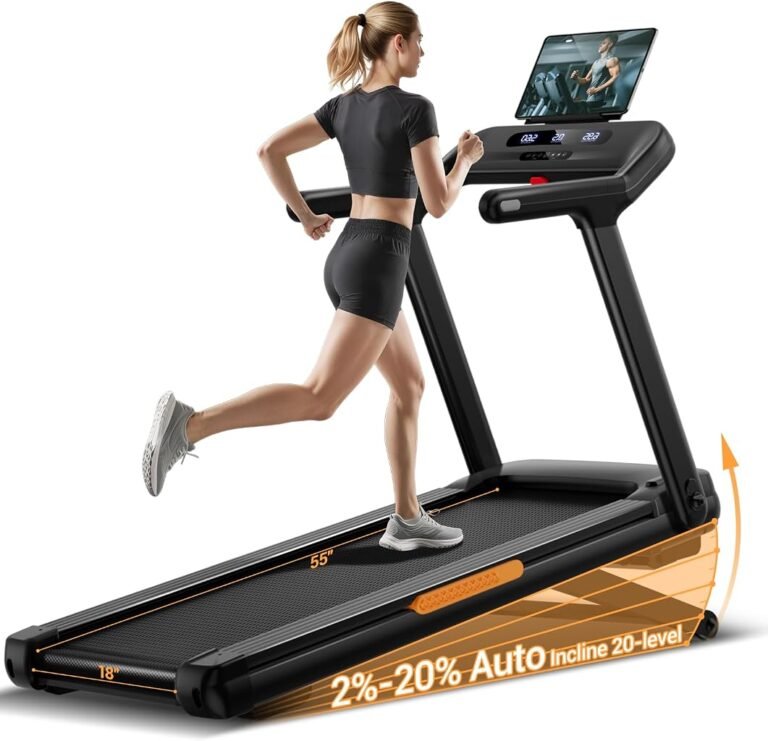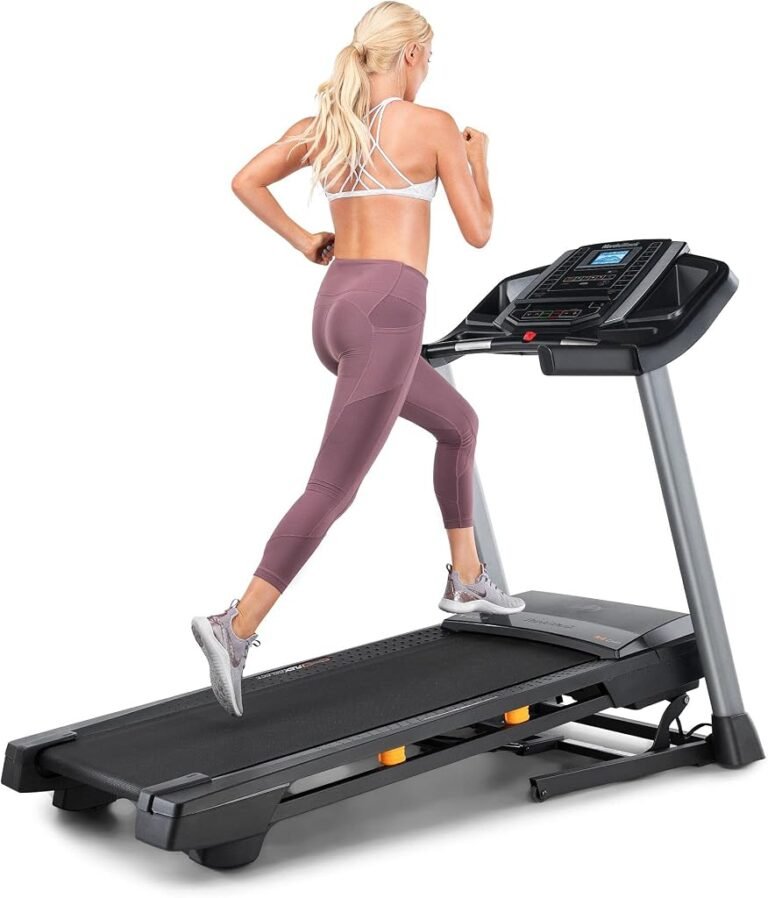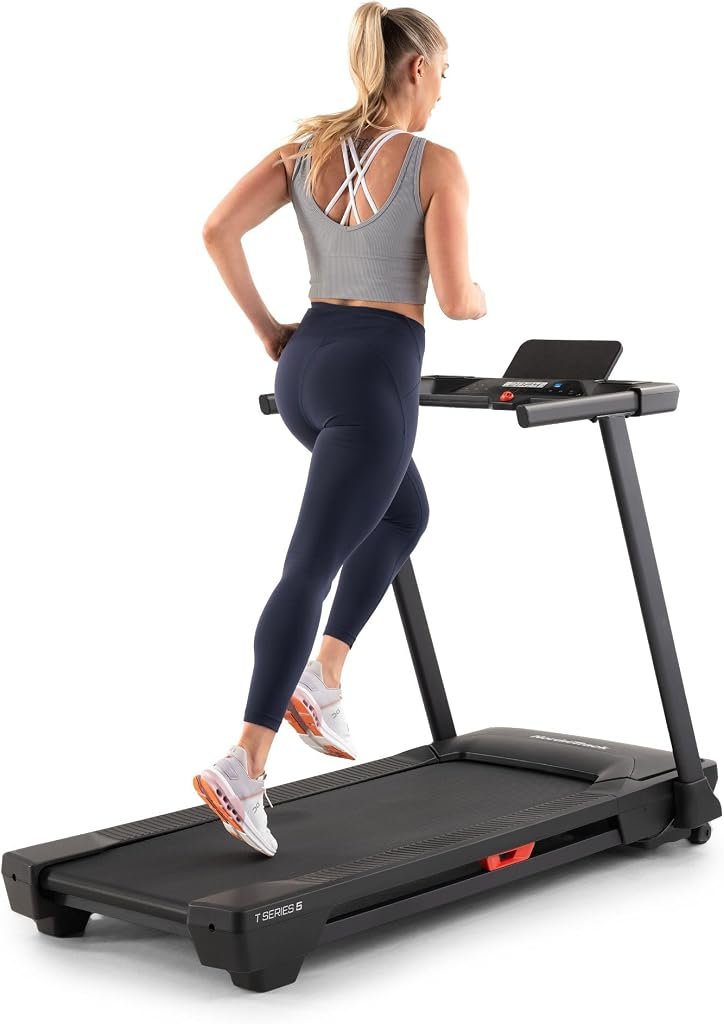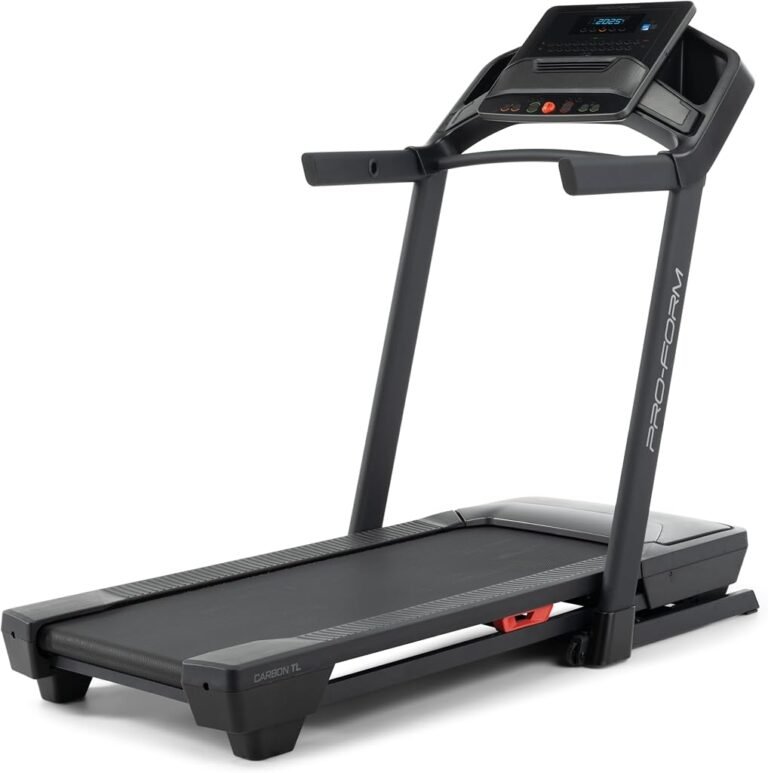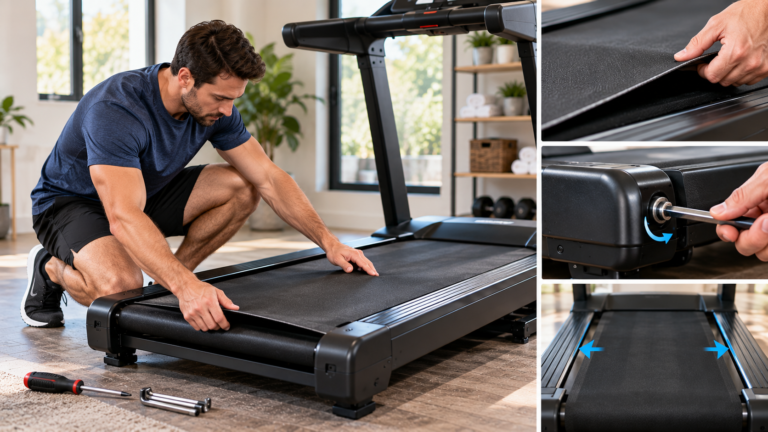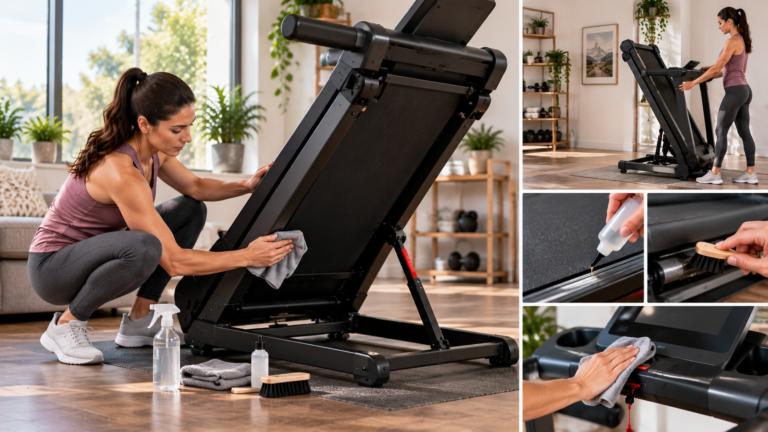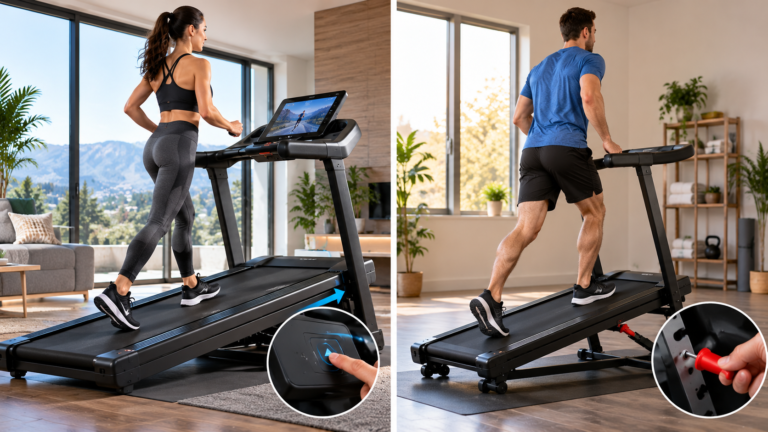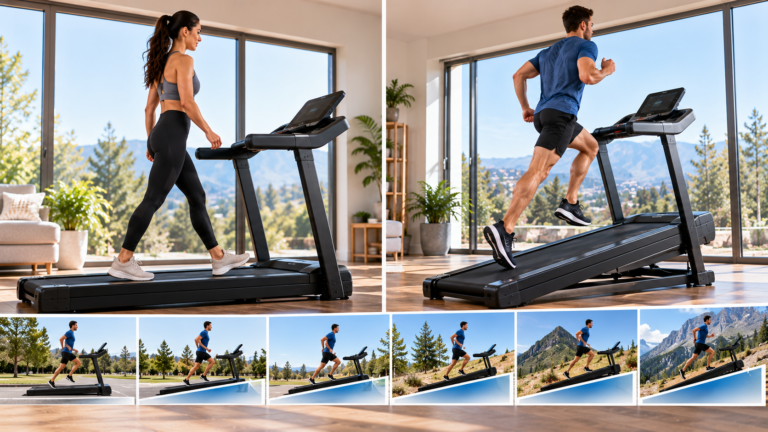
The NordicTrack T Series Treadmill and ProForm Carbon Treadmill present an unusually revealing comparison because their similarities are substantial enough to make their differences matter.
Both sit in the home-fitness market rather than the specialist commercial-gym category. Both can accommodate walking and running. Current versions of both product families offer incline training and access to the iFIT ecosystem. Yet the two families approach the home treadmill from noticeably different directions.
NordicTrack places greater emphasis on an integrated screen, adjustable cushioning, and a treadmill-centered connected experience. ProForm’s current Carbon Series is more restrained: smaller built-in displays, device shelves, ProShox cushioning, and the ability to connect a phone or tablet to iFIT.
Our scoring reflects how close the contest is. The NordicTrack T Series earns an 8.4/10 Our Score, compared with 8.3/10 for the ProForm Carbon. ProForm counters with slightly stronger Customer Sentiment and Value scores, while NordicTrack carries a much larger advantage in Buyer Confidence.
Neither machine wins every category. The better choice depends on what the buyer expects to interact with every time the treadmill starts.
NordicTrack T Series vs ProForm Carbon at a Glance
The NordicTrack T Series Treadmill is priced at $799 in our comparison. We rate it 8.4/10, with Customer Sentiment at 8.06, Buyer Confidence at 9.8, and Value at 8.03.
The ProForm Carbon Treadmill is priced at $764.04. Its Our Score is 8.3/10, accompanied by 8.28 Customer Sentiment, 8.54 Buyer Confidence, and 8.15 Value.
The numbers immediately reveal the central tension.
ProForm costs about $35 less and earns the stronger Value and Customer Sentiment scores. NordicTrack’s overall rating is marginally higher, but its 9.8 Buyer Confidence score separates it more clearly.
That 0.1-point difference in Our Score should not be exaggerated. These are closely matched products editorially. The purchase is better decided through design, interface, training habits, and long-run expectations than through a decimal-place victory.
Two Treadmill Families With Different Priorities
The comparison becomes more useful when the current product families are examined rather than treating each name as a single fixed specification.
Current NordicTrack T Series specifications show T Series 10 and T Series 16 models. Both reach 12 mph and provide a 0-12% incline range. The major visual difference is apparent in the names: one uses a 10-inch tilting HD touchscreen and the other a 16-inch tilting HD touchscreen. Both also use NordicTrack’s adjustable SelectFlex cushioning and SpaceSaver folding design.
The current ProForm Carbon Series consists of the Carbon TLX and Carbon TLS. ProForm lists 0-12% incline for both. The TLX reaches 12 mph and uses a 7-inch display, while the TLS uses a 5-inch display and reaches 10 mph. Both include device shelves and ProShox cushioning.
This is an important distinction for anyone searching for the best treadmills for home. A family name does not guarantee identical speed, motor, screen, or other specifications across every model.
The exact model number matters.
Screen and Interface: NordicTrack Has the Clearer Hardware Advantage
The most visible difference is the display.
NordicTrack’s current T Series uses 10- or 16-inch tilting HD touchscreens. ProForm’s Carbon TLX and TLS use 7- and 5-inch displays respectively, supplemented by a device shelf.
For a buyer who wants the treadmill itself to be the entertainment and training interface, NordicTrack’s approach is materially different.
A 10- or 16-inch touchscreen gives guided workouts a permanent visual home on the machine. There is no need to position a personal tablet for the central experience. NordicTrack also says its screens tilt, which matters for users who follow off-treadmill training through iFIT.
ProForm’s philosophy is more utilitarian. The smaller display handles treadmill information while a phone or tablet can become the richer connected interface.
Neither architecture is inherently superior.
A buyer who already owns a good tablet may regard a large treadmill touchscreen as duplicated hardware. Someone who dislikes mounting personal devices before exercising may find NordicTrack substantially more coherent.
The difference also has implications years after purchase. A large integrated display makes the treadmill more dependent on its built-in electronics. A simpler console paired with a replaceable personal device separates the fitness hardware from the consumer electronics more clearly.
That distinction rarely dominates showroom comparisons, but treadmills often remain in homes longer than tablets do.
Speed: Compare the Exact Carbon Model
Speed produces a partial tie rather than a universal one.
NordicTrack lists both current T Series models at up to 12 mph. ProForm lists the Carbon TLX at up to 12 mph and the Carbon TLS at up to 10 mph.
For walking and ordinary jogging, either ceiling is far beyond what many users require. For faster running, the difference between 10 and 12 mph becomes more consequential.
Twelve miles per hour corresponds to a five-minute-mile pace. NordicTrack explicitly uses that benchmark in its T Series documentation.
The practical lesson is straightforward: NordicTrack T Series vs ProForm Carbon cannot be reduced to “which brand is faster?” The correct question is which exact Carbon model is being compared.
Against the Carbon TLX, the speed ceiling is effectively tied at 12 mph.
Against the Carbon TLS, NordicTrack has the higher stated maximum.
For most recreational walkers, that distinction will remain theoretical. For runners who routinely train at faster paces or perform short intervals, it becomes relevant.
Incline: Essentially Even on the Current Families
Incline is considerably simpler.
NordicTrack lists a 0-12% incline range for both current T Series treadmills. ProForm lists the same 0-12% range for its current Carbon models.
That makes incline a weak reason to choose one family over the other.
More broadly, incline can change workout intensity without requiring a corresponding increase in speed. For someone who prefers brisk uphill walking to faster running, a 12% maximum grade provides considerably more variation than a flat treadmill.
Both families therefore cover the same stated incline range. Buyers should focus instead on how incline integrates with their preferred training method and whether automatic workout adjustment through iFIT will actually be used.
Cushioning: Adjustable vs Fixed-Concept Design
Cushioning is one of the more meaningful design differences.
NordicTrack uses SelectFlex cushioning on the current T Series. The company states that it can be adjusted from soft to firm.
ProForm uses ProShox cushioning on the Carbon Series, which the manufacturer describes as being intended to absorb impact and provide stability during walking, hiking, jogging, and running.
The significant distinction is adjustability.
NordicTrack gives the user a choice between softer and firmer deck characteristics. That can appeal to households in which several people prefer different sensations underfoot.
ProForm’s system is conceptually simpler. The cushioning is part of the treadmill’s running experience rather than another user-adjustable setting.
Claims that one system definitively reduces injury better than the other would require evidence beyond manufacturer descriptions. That judgment should not be invented from product terminology.
From a buying perspective, NordicTrack offers more control. ProForm offers fewer decisions.
Folding and the Reality of Home Space
A treadmill can have excellent training specifications and still be the wrong machine if it dominates a room.
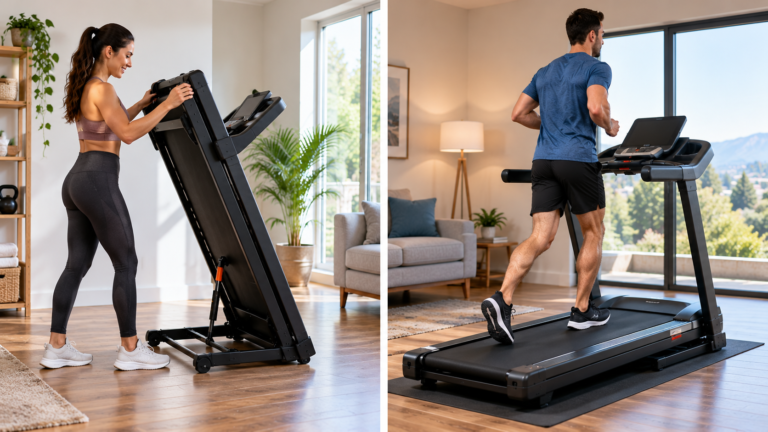
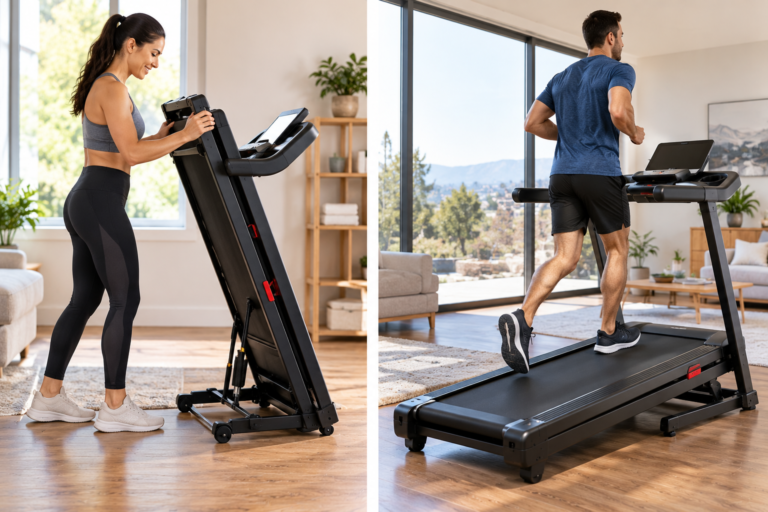
NordicTrack explicitly lists its current T Series machines as foldable and describes a SpaceSaver design that allows the treadmill to be folded and rolled away.
The manufacturer’s current specifications list a footprint of 75.1 inches long by 34.3 inches wide by 58.4 inches high for both T Series 10 and T Series 16. It also lists a 325-pound user capacity.
Those measurements illustrate an often-missed reality about “home” treadmills: folding does not make a machine tiny.
Buyers should measure the operating position, not merely the storage position. Doorways, furniture, ceiling height, power access, and the path needed to move the treadmill all deserve consideration before delivery.
For apartment residents or people using a bedroom or office as a workout room, storage mechanics can matter more than an extra display feature.
The best treadmills for home are not necessarily the machines with the longest feature lists. They are the ones that coexist successfully with the home.
Running Surface and Capacity Matter More Than Entertainment
NordicTrack’s current T Series documentation lists a running belt at 60 by 20 inches and a user capacity of 325 pounds for both current models.
Those figures are more consequential than they may appear.
A treadmill is an exercise surface before it is a screen, speaker system, or streaming device. The user’s stride has to fit naturally. The stated capacity has to accommodate the intended user. The machine has to fit physically in the room.
A purchaser should verify equivalent dimensions and capacity for the exact ProForm Carbon configuration under consideration before ordering, especially because treadmill families can change over time.
This model-specific discipline prevents one of the more common treadmill-shopping errors: assuming that a specification belonging to one machine applies to every treadmill carrying the same family name.
Connected Training: More Similar Than the Branding Suggests
NordicTrack and ProForm share more technological DNA than their branding initially suggests.
Both current families integrate with iFIT. NordicTrack states that its T Series can automatically follow trainer speed and terrain through iFIT and use SmartAdjust to personalize future workout intensity. ProForm describes similar automatic trainer-following and SmartAdjust functionality for the Carbon Series. Full connected functionality requires a paid iFIT Pro subscription and Wi-Fi.
This makes the software comparison less dramatic than the hardware comparison.
The real difference is how the software is presented.
NordicTrack places iFIT on a larger integrated touchscreen. ProForm’s Carbon family relies more heavily on connecting a phone or tablet for the richer visual experience.
That gives NordicTrack the more self-contained design and ProForm the more device-dependent one.
For a household already committed to guided connected training, NordicTrack’s integrated display can justify part of its higher price.
For a household that expects to use manual treadmill controls while watching a television, listening to music, or using an existing tablet, ProForm’s simpler display strategy may be entirely sufficient.
Subscription Costs Should Enter the Purchase Decision
Connected fitness hardware creates an unusual ownership equation because the initial machine price is only part of the potential expenditure.
NordicTrack explicitly states that a paid iFIT Pro subscription and Wi-Fi are required to access full content and equipment features. ProForm gives the same qualification for its Carbon Series.
That does not make either treadmill unsuitable without a subscription. It does mean a buyer attracted specifically by guided workouts, automatic trainer control, personalized sessions, or connected content should calculate recurring software costs alongside the equipment price.
The issue becomes especially relevant when comparing the $799 NordicTrack entry in our assessment with the $764.04 ProForm.
The initial gap is only $34.96.
A difference that small should not dictate a multi-year equipment decision. Display preference, cushioning, exact model specifications, and likely subscription use matter more.
Our Scores: NordicTrack Wins Overall, ProForm Wins on Value
Our editorial scoring captures the narrowness of the contest.
NordicTrack receives:
- Our Score: 8.4/10
- Customer Sentiment: 8.06
- Buyer Confidence: 9.8
- Value: 8.03
ProForm receives:
- Our Score: 8.3/10
- Customer Sentiment: 8.28
- Buyer Confidence: 8.54
- Value: 8.15
NordicTrack therefore leads by 0.1 on Our Score and by a substantial 1.26 points on Buyer Confidence.
ProForm leads Customer Sentiment by 0.22 and Value by 0.12.
The resulting editorial judgment is more nuanced than declaring NordicTrack the winner because 8.4 is larger than 8.3.
NordicTrack has the stronger overall profile for a buyer who wants an integrated treadmill experience and places weight on confidence in the purchase.
ProForm has the more compelling case for a buyer trying to preserve much of the same core training capability while spending slightly less and avoiding a large integrated display.
Who Should Buy the NordicTrack T Series?
The NordicTrack T Series is the better fit for buyers who place the interface near the center of the workout.
Its current 10- and 16-inch tilting HD touchscreens are considerably larger than the displays in the Carbon family. Both current T Series models also reach 12 mph, offer 0-12% incline, use adjustable SelectFlex cushioning, and fold for storage.
That combination makes NordicTrack especially logical for:
- Households intending to use guided iFIT sessions frequently.
- Buyers who prefer an integrated touchscreen over supplying a personal tablet.
- Users who value adjustable cushioning.
- Faster runners who want a 12 mph ceiling regardless of which current T Series size they choose.
- Shared households where different users may appreciate changing cushioning characteristics.
Its $799 comparison price is only moderately above ProForm’s $764.04, so the additional cost is not large enough by itself to undermine the proposition.
The more meaningful question is whether the integrated technology will be used.
Who Should Buy the ProForm Carbon?
The ProForm Carbon is more compelling for a buyer who wants the treadmill to remain primarily an exercise machine rather than a large-screen media platform.
Current Carbon models still provide 0-12% incline, ProShox cushioning, connected iFIT functionality, and device shelves. The TLX also reaches the same 12 mph maximum as the current NordicTrack T Series, while the TLS tops out at 10 mph.
ProForm therefore fits:
- Buyers comfortable using their own phone or tablet for connected workouts.
- Users who prefer a smaller built-in display.
- Households where the treadmill will often be used without immersive screen-based training.
- Buyers prioritizing Value, where ProForm scores 8.15 against NordicTrack’s 8.03.
- Shoppers whose intended speed range fits the exact Carbon model selected.
ProForm also earns the higher Customer Sentiment score in our assessment, 8.28 versus NordicTrack’s 8.06.
Its case is not that it overwhelmingly outperforms NordicTrack. Its case is efficiency: it retains many of the functions that matter while asking less of the built-in display.
The Broader Health Context
The treadmill comparison ultimately matters only if the equipment gets used.
The CDC recommends at least 150 minutes of moderate-intensity activity per week for adults, or 75 minutes of vigorous-intensity activity, or an equivalent combination. Adults are also advised to perform muscle-strengthening activity on at least two days each week.
A treadmill can make the aerobic portion easier to schedule, but the brand name does not change the underlying arithmetic.
Thirty minutes of brisk walking on five days reaches 150 minutes. A machine that makes those sessions convenient has done more useful work than a more elaborate treadmill that rarely gets switched on.
This is where purchasing psychology deserves scrutiny. Buyers frequently compare maximum speed, incline, displays, apps, motors, and entertainment functions as if the largest numbers guarantee adherence.
They do not.
Convenience, comfort, accessibility, placement, noise tolerance, and whether the machine’s interface feels inviting at 6:30 on a winter morning can matter far more.
Final Considerations
NordicTrack T Series vs ProForm Carbon is close enough that a universal winner would obscure the more useful answer.
Our overall scoring favors the NordicTrack T Series Treadmill, 8.4/10 against 8.3/10. Its 9.8 Buyer Confidence score is the largest numerical advantage in the comparison, and the current T Series hardware makes a coherent argument for buyers who want an integrated connected treadmill.
Its 10- and 16-inch tilting HD touchscreens, 12 mph maximum speed across both current models, 0-12% incline, adjustable SelectFlex cushioning, and folding design create a treadmill that asks to become the central interface for home cardio.
The ProForm Carbon Treadmill takes a different route. Our 8.15 Value score edges NordicTrack’s 8.03, while Customer Sentiment is also higher at 8.28 versus 8.06. Current Carbon treadmills retain a 0-12% incline range and connected iFIT functionality while using smaller displays and personal-device integration. The TLX reaches 12 mph; the TLS reaches 10 mph.
For a buyer who wants a large integrated screen, adjustable cushioning, and the more self-contained connected-training experience, NordicTrack is the stronger fit.
For a buyer who already owns a tablet, prefers a simpler console, and gives slightly greater weight to purchase value, ProForm deserves the advantage.
The roughly $35 difference in the compared prices is too small to settle the issue responsibly.
Instead, the decision should come down to behavior. The treadmill that fits the user’s actual routine, room, pace, preferred interface, and willingness to use connected training is the better purchase.
That principle extends beyond these two brands. Among the best treadmills for home, the machine that earns its floor space is not necessarily the one with the largest screen or longest specification sheet. It is the one that makes regular exercise sufficiently convenient that using it becomes ordinary rather than exceptional.