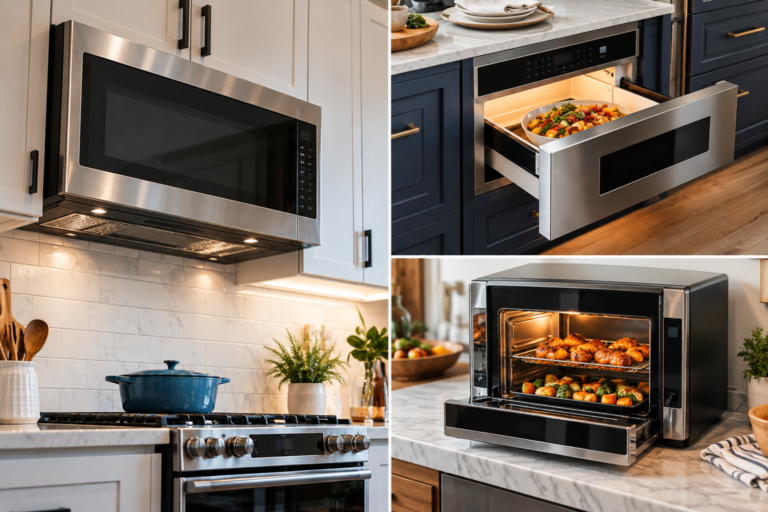
For an appliance associated with reheated coffee and hurried leftovers, the modern microwave can create a surprisingly consequential kitchen-design decision. A countertop machine can cost a few hundred dollars and move to another room in minutes. A drawer microwave can cost four figures, consume a precisely dimensioned cabinet bay, and become part of the architecture of the kitchen. An over-the-range unit doubles as ventilation equipment. A convection combination model may be expected to perform duties once divided among a microwave, toaster oven, conventional oven, and air fryer.
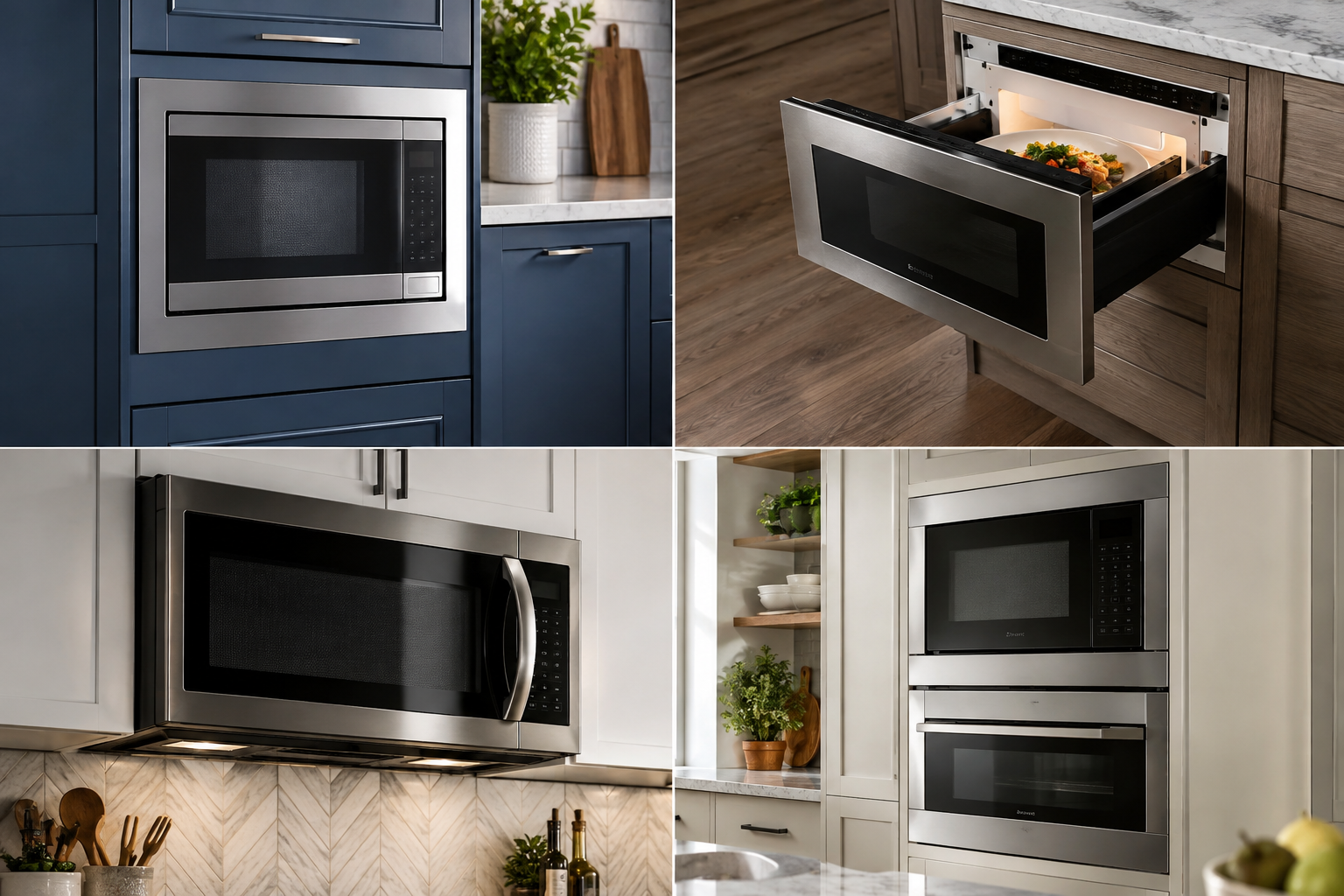
Those differences make wattage and cubic feet only the beginning of a useful comparison.
Installation geometry, ventilation, door movement, electrical requirements, control placement, usable cavity shape, cooking modes, service access, and replacement options can matter as much as headline capacity. The difference between a microwave that fits and one that almost fits can also mean cabinet modification rather than a simple appliance exchange.
The physics beneath these machines remains relatively straightforward. The U.S. Food and Drug Administration’s microwave guidance explains that microwave ovens use electromagnetic radiation similar to radio waves. Microwaves are reflected by metal, pass through materials such as glass and paper, and are absorbed by food. A magnetron produces the microwave energy, which interacts strongly with water and other polar molecules in food to generate heat. The FDA has regulated microwave-oven manufacturing since 1971 and states that ovens meeting its standard and used according to manufacturer instructions are considered safe under current knowledge.
The buying question, therefore, is less about whether one installation format possesses fundamentally different microwave physics and more about how that heating system is packaged around a household’s space, workflow, ventilation needs, cookware, and cooking habits.
Start With Architecture, Not Features
Microwaves fall into several overlapping categories: countertop, built-in, drawer, over-the-range or over-the-counter, and combination appliances incorporating convection, grilling, air frying, or a conventional oven.
A useful first decision tree is architectural.
A household with little counter space but an available upper-cabinet position may gravitate toward an over-the-range machine. A renovated kitchen with a large island may make a drawer more logical. A wall of cabinetry can accommodate a built-in microwave or microwave-and-oven combination. Renters and households expecting to relocate have a different calculation: a countertop model carries almost no installation commitment.
The distinction between countertop vs built-in microwave designs is particularly significant because appearance does not determine installation compatibility. GE Appliances explains that only selected countertop microwaves can be installed in cabinetry and that an appropriate model-specific trim kit provides both the finished appearance and the airflow the appliance requires. Enclosing an ordinary countertop machine without the correct provisions can obstruct its vents, leading to overheating and shutdown or component failure.
That makes one purchasing rule unusually simple: a countertop microwave should never be treated as a built-in merely because its exterior dimensions happen to fit a cabinet opening.
The Numbers That Actually Define Microwave Size
Capacity is measured in cubic feet, but external dimensions determine whether an appliance fits the kitchen.
Those two measurements are not interchangeable.
A useful industry reference comes from Whirlpool’s microwave sizing guide. Its guidance places built-in microwave capacity broadly from about 1.0 to more than 2.0 cubic feet, with many models between 1.2 and 1.6 cubic feet. Built-ins commonly correspond to 24-, 27-, or 30-inch cabinet widths. Over-the-range machines commonly span roughly 30 inches, while their capacities can range from approximately 0.8 to 2.1 cubic feet.
Those ranges are orientation points, not installation specifications.
When shoppers measure for built-in microwave installation, the cabinet opening is the critical object. Width, height, and depth should be measured at multiple points because cabinets, fillers, face frames, and finished panels can reduce usable clearance. The electrical outlet position, trim-kit dimensions, ventilation path, door projection, adjacent handles, and required support structure then have to be checked against the manufacturer’s installation document.
Built-in microwave sizing is consequently a cutout problem before it is a capacity problem.
A nominal 24-inch appliance does not necessarily require a 24-inch-wide rectangular hole. For example, Sharp specifies a 22 1/8-inch-wide, 15 9/16-inch-high and 23 1/2-inch-deep cutout for its 24-inch SMD2470AS drawer platform. That distinction between nominal appliance class and actual opening illustrates why cabinetry should not be fabricated from the product name alone.
Microwave Drawer vs Built-In: Similar Appearance, Different Ergonomics
The microwave drawer vs built-in question is sometimes treated as a matter of style. Functionally, the larger difference is access.
A conventional built-in microwave generally places food through a front-opening door. A drawer pulls the cavity outward and allows dishes to be lowered into it from above. That arrangement can place the appliance below a countertop without forcing the user to crouch and reach deeply into a side-hinged cavity.
The drawer also changes what happens to hot liquids. A bowl can be lifted vertically instead of pulled horizontally from a cavity at chest or eye level. In an island, the machine can sit near food preparation while remaining below the principal sightline.
There are tradeoffs.
Microwave Drawer Pros and Cons
The microwave drawer pros and cons become clearer when considered as architectural consequences rather than feature-sheet differences.
Advantages include:
- Below-counter installation can preserve upper cabinetry and sightlines.
- Island placement can put reheating and defrosting near a preparation surface.
- Top access can make loading plates and bowls more natural in some kitchens.
- A drawer avoids the large side-hinged door sweep associated with many conventional microwaves.
- Built-in installation creates a visually integrated result.
Disadvantages include:
- Drawer models generally command a substantial price premium over ordinary countertop machines.
- Installation demands accurate cabinetry dimensions.
- Replacement flexibility is lower because a future machine must work with the existing opening or the cabinetry must change.
- Controls can sit lower than some users prefer.
- A drawer mechanism introduces moving hardware beyond the door hinges of a conventional microwave.
- Large or unusually shaped cookware still needs to be checked against usable cavity dimensions rather than advertised cubic-foot capacity.
The format therefore makes the most sense when below-counter access solves a genuine layout problem. Paying for a drawer solely to hide the microwave can be harder to justify when a properly integrated conventional built-in serves the same cooking habits.
Microwave Drawer Comparison: KoolMore, GASLAND, Haven Coll and Sharp
The current group of drawer models illustrates how rapidly price spreads widen once cabinetry becomes part of the purchase.
The KoolMore KM-MD-1SS Microwave Drawer is priced at $801 in our comparison set. It has a stated 1.2-cu.-ft. capacity, 1,000-watt output and 10 cooking levels. Our score is 8.14/10, with Customer Sentiment at 7.84, Buyer Confidence at 9.27 and Value at 7.91.
For shoppers researching a KoolMore microwave drawer comparison, the KM-MD-1SS establishes the lower-priced reference point among several drawer machines here. The KoolMore KM-MD-1SS deserves consideration when the project calls for the drawer format but budget discipline still matters.
A KoolMore KM-MD-1SS review should not ignore that arithmetic: its $801 price is $696 below the $1,497 Sharp SMD2470ASY figure in this comparison. That difference can pay for a meaningful portion of installation or cabinetry work.
The GASLAND 1.2 cu. ft. Microwave Drawer sits at $1,099.99 and receives an 8.19/10 overall score. Customer Sentiment is 7.84, Buyer Confidence 9.48 and Value 7.91. In a GASLAND microwave drawer review, its position is therefore less about undercutting every alternative and more about the combination of a slightly higher editorial score and particularly high Buyer Confidence. The GASLAND 1.2 cu. ft. Microwave Drawer fits shoppers willing to spend more than the entry point in this group without reaching the Sharp SMD2470ASY price.
The Haven Coll 1.2 cu. ft. Built-In Microwave Drawer costs $1,249.99. It earns the highest overall score among the drawer products in this set at 8.58/10, accompanied by Customer Sentiment of 8.72, Buyer Confidence of 8.43 and Value of 8.40. A Haven Coll microwave drawer review therefore produces an unusual profile: the editorial numbers are strongest overall, while Buyer Confidence is lower than several alternatives. The Haven Coll 1.2 cu. ft. Built-In Microwave Drawer suits buyers who place greater weight on the aggregate score, sentiment and value signals than on Buyer Confidence alone.
The KoolMore Reserve 1.2 cu. ft. Microwave Drawer costs $905 and receives an 8.14/10 score, with Customer Sentiment at 7.84, Buyer Confidence at 9.27 and Value at 7.91. A KoolMore Reserve microwave drawer review places the KoolMore Reserve drawer close to the KM-MD-1SS in editorial scoring, so the installation design and actual project price become more decisive than score differences.
The KoolMore KM-MD30-SS Microwave Drawer, priced at $1,145, also receives 8.14/10, with the same 7.84 Customer Sentiment, 9.27 Buyer Confidence and 7.91 Value marks. A KoolMore KM-MD30-SS review consequently hinges on the intended cabinetry plan and the physical configuration rather than an editorial-score advantage. The KoolMore KM-MD30-SS should be evaluated against the exact cabinet drawing before purchase.
Sharp Microwave Drawer Comparison
Sharp deserves separate treatment because its drawer products offer unusually well-documented installation specifications.
The Sharp SMD2470ASY is a 24-inch, 1.2-cu.-ft., 950-watt drawer. Sharp specifies sensor cooking, automatic opening, a control panel that angles outward, a keep-warm setting lasting up to 30 minutes, and a cavity intended to accommodate a 9-by-13-inch dish.
Our Sharp SMD2470ASY review assigns an 8.55/10 score, with Customer Sentiment at 8.28, Buyer Confidence at 9.80 and Value at 8.15. At $1,497 in our comparison, the Sharp SMD2470ASY is expensive, but its 9.80 Buyer Confidence is the highest figure among the drawer models considered here.
The Sharp KB6524PSY occupies a slightly lower price point at $1,297 and earns 8.38/10. Customer Sentiment is 8.06, Buyer Confidence 9.70 and Value 8.03. Sharp documentation identifies it as a 24-inch, 1.2-cu.-ft., 950-watt drawer with sensor cook, reheat and popcorn settings, plus a keep-warm function lasting up to 30 minutes. A Sharp KB6524PSY review therefore presents the KB6524PSY as the lower-cost Sharp drawer in this particular comparison while retaining a high Buyer Confidence score.
The Sharp SMD2470AH is the black-stainless counterpart within this part of Sharp’s drawer family. Sharp identifies the model as a 24-inch, 1.2-cu.-ft., 950-watt Microwave Drawer. At $1,597 in our comparison, it receives 7.99/10, with Customer Sentiment at 7.62, Buyer Confidence at 9.25 and Value at 7.79. A Sharp SMD2470AH review consequently makes the SMD2470AH primarily relevant when its black-stainless finish and specific design fit justify the additional spending.
Across this Sharp microwave drawer comparison, the SMD2470ASY combines the strongest editorial score and Buyer Confidence of the three. The KB6524PSY lowers purchase cost while retaining strong confidence metrics. The SMD2470AH answers a different design brief through its finish, but carries the highest price and lowest overall score of the three in this set.
Conventional Built-In Microwaves: Integration Without the Drawer Premium
A conventional built-in microwave can offer the visual discipline of an integrated appliance without requiring a drawer mechanism.
The trade is largely ergonomic. A built-in placed at comfortable standing height makes controls and food easy to see, but very high installation can make hot liquids awkward to remove. A low installation can reproduce some of the bending issues that lead buyers toward drawers.
The KoolMore KM-CWO30-SS Built-In Convection Microwave Oven costs $1,049 and receives an 8.14/10 overall score, Customer Sentiment of 7.84, Buyer Confidence of 9.27 and Value of 7.91. A KoolMore KM-CWO30-SS review should therefore place the KM-CWO30-SS in the integrated-convection branch of the decision tree rather than treating it as a direct substitute for a basic microwave.
The Dacor DMW2420S Microwave is priced at $849, with an overall score of 7.99/10, Customer Sentiment of 7.62, Buyer Confidence of 9.28 and Value of 7.79. A Dacor DMW2420S review puts the Dacor DMW2420S in an interesting position: its Buyer Confidence slightly exceeds the KoolMore figure, although the KoolMore receives the higher overall score.
The GASLAND 1.6 cu. ft. Built-In Microwave Oven costs $999.99. Our score is 8.19/10, with Customer Sentiment at 7.84, Buyer Confidence at 9.48 and Value at 7.91. A GASLAND built-in microwave review therefore gives the GASLAND 1.6 cu. ft. Built-In Microwave Oven the strongest overall score and Buyer Confidence among these three built-in examples.
None of those editorial differences overrides fit. A 0.20-point scoring advantage is irrelevant if a model cannot satisfy the cabinet opening, ventilation specification, electrical requirements or preferred control height.
Combination Models: When the Microwave Is Expected to Cook Differently
Combination appliances attempt to solve another problem: microwave heating is fast, but it does not naturally produce the dry, browned exterior associated with radiant or convection heat.
Adding thermal elements and a fan changes the appliance’s capabilities. The U.S. Department of Energy’s regulatory definition explicitly encompasses microwave ovens with thermal elements used for surface browning as well as convection microwave ovens.
That distinction matters when comparing convection microwave vs air fryer microwave designs.
A convection microwave circulates heated air, allowing baking and roasting functions that ordinary microwave energy cannot reproduce in the same way. An air-fry mode is also built around hot-air circulation but typically uses airflow, temperature programming and cookware arrangements intended to increase surface drying and browning.
The labels alone do not establish equal cooking performance. Cavity dimensions, heater power, fan design, rack position, preheating behavior and food loading all affect the result.
The KoolMore Built-In Oven Microwave Combination costs $931.09 and carries an 8.14/10 overall score, Customer Sentiment of 7.84, Buyer Confidence of 9.27 and Value of 7.91. A KoolMore oven microwave combination review should treat the KoolMore Built-In Oven Microwave Combination as a space-planning choice as much as a cooking-appliance choice: combining functions can reduce the number of separate appliance openings required in a cabinet wall.
The KoolMore Reserve Built-In Microwave Convection Oven costs $985 and receives the same 8.14/10 score, 7.84 Customer Sentiment, 9.27 Buyer Confidence and 7.91 Value. A KoolMore Reserve convection microwave review therefore leaves the KoolMore Reserve Built-In Microwave Convection Oven to be distinguished by its installation format and feature fit rather than editorial-score separation.
The Toshiba OptiChef PRO MAX Air Fryer Combo Microwave Oven costs $479.99. Our score is 8.12/10, with Customer Sentiment at 7.84, Buyer Confidence at 9.13 and Value at 7.91. A Toshiba OptiChef PRO MAX review places the Toshiba OptiChef PRO MAX in a different economic category: its appeal lies in multifunction cooking without the four-figure purchase price associated with several integrated models here.
For recreational vehicles, the RecPro 1.1 cu. ft. RV Convection Microwave addresses yet another installation environment. Its configuration is intended for the more constrained installation environment of an RV, where dimensions, clearances and electrical requirements deserve especially close attention.
Our RecPro RV convection microwave review gives the RecPro 1.1 cu. ft. RV Convection Microwave a 7.98/10 score, with Customer Sentiment at 7.62, Buyer Confidence at 9.21 and Value at 7.79. At $349.95, it serves a more specialized installation case than a typical residential built-in.
Over-the-Range Microwave Comparison: Two Appliances Sharing One Opening
An over-the-range microwave is not simply a microwave mounted high on a wall. It also assumes at least part of the role normally performed by a range hood.
That dual purpose explains both its appeal and its compromises.
It clears the countertop and consolidates two appliances into one opening. It also puts the microwave above a hot cooking surface, which means mounting height, ventilation configuration, cabinet depth and access all require attention.
Standard over-the-range models are generally around 17 inches high, with low-profile versions closer to 10.5 inches. Closed-door depth commonly falls around 15 to 18 inches, while an open door can extend overall depth to roughly 42 to 45 inches.
That open-door figure is easy to overlook on a floor plan. A microwave can fit perfectly between cabinets yet produce an annoying door conflict with an adjacent wall or tall cabinet.
Stellar Coll, Sharp and Kenmore
The Stellar Coll 1.3 cu. ft. Over-the-Range Microwave is priced at $308.99 and receives an 8.49/10 score. Customer Sentiment is 8.28, Buyer Confidence 9.48 and Value 8.15. A Stellar Coll 1.3 microwave review places the Stellar Coll 1.3 cu. ft. Over-the-Range Microwave at the lowest price among the three conventional over-the-range examples considered here.
The larger Stellar Coll 1.9 cu. ft. Over-the-Range Microwave costs $356.99 and receives the same 8.49/10 overall score, 8.28 Customer Sentiment, 9.48 Buyer Confidence and 8.15 Value. A Stellar Coll 1.9 microwave review therefore makes the 1.9-cu.-ft. model especially relevant when the larger stated capacity better matches the household’s cookware and the installation can accommodate it.
The Kenmore 1.7 cu. ft. Over-the-Range Microwave costs $399.99 and earns 8.13/10, with Customer Sentiment of 8.06, Buyer Confidence of 8.43 and Value of 8.03. A Kenmore over-the-range microwave review places the Kenmore 1.7 cu. ft. Over-the-Range Microwave behind the Stellar Coll pair on our editorial metrics, while its 1.7-cu.-ft. stated capacity falls between their named capacities.
There is also a less common format: the over-the-counter microwave.
The Sharp R1210TY provides a useful example. Sharp specifies 1.5 cu. ft. of capacity, 1,100 watts of output, a 14 1/8-inch turntable and 11 sensor-cooking settings. It costs $399 in our set and receives 7.71/10, with Customer Sentiment at 7.40, Buyer Confidence at 8.61 and Value at 7.67. A Sharp R1210TY review therefore positions the Sharp R1210TY as a layout-specific answer rather than the score leader in this over-the-range microwave comparison.
Countertop Models Still Make Economic and Practical Sense
Built-in appliances dominate renovated-kitchen photography, but a countertop microwave retains several structural advantages: minimal installation, straightforward replacement and freedom from a cabinet opening designed around one appliance generation.
That flexibility deserves more weight than it often receives.
The GE Profile PCHK11S1WSS Countertop Microwave is a 1.1-cu.-ft. model. GE lists dimensions of 11.87 inches high, 24 inches wide and 12.875 inches deep. GE also lists optional 27- and 30-inch built-in trim kits for the model, showing how a countertop-platform microwave can sometimes bridge countertop and integrated applications when the manufacturer explicitly supports that installation.
Our GE Profile PCHK11S1WSS review scores it at 8.36/10, with Customer Sentiment of 8.28, Buyer Confidence of 8.82 and Value of 8.15. At $461, the GE Profile PCHK11S1WSS offers a useful middle path for a buyer who wants flexibility now while retaining an approved path toward a more integrated installation.
The GE Profile PCHK11S1WBB Countertop Microwave costs $416 and receives the same 8.36/10 overall score, 8.28 Customer Sentiment, 8.82 Buyer Confidence and 8.15 Value. A GE Profile PCHK11S1WBB review makes the PCHK11S1WBB particularly straightforward to compare with its sibling: where functional requirements are equivalent, price, finish and availability can carry greater weight than identical editorial scores.
Wattage Matters, but It Is Not a Quality Score
Microwave wattage is output power, not a universal measure of appliance quality.
Higher output can shorten heating time, and recipes frequently assume a particular power range, but wattage does not reveal sensor accuracy, usable cavity geometry, control logic, noise, door design or installation quality.
Current countertop microwaves can span a broad range of output levels across different sizes and configurations. Sharp’s SMD2470AS drawer is rated at 950 watts, while the Sharp R1210TY over-the-counter machine is rated at 1,100 watts. The lower-wattage drawer is not therefore an inferior appliance category; it represents a different package and installation objective.
The practical consequence appears when following cooking instructions. If a packaged-food direction assumes a higher-output microwave than the appliance being used, additional time may be required. The reverse can also occur. Sensor programs can reduce some of that manual adjustment by monitoring cooking conditions and modifying time automatically, but they do not make every food equally suited to automated cooking.
Capacity Is More Misleading Than It Looks
Cubic-foot capacity is calculated from internal dimensions, yet the mathematically available volume is not the same thing as usable cookware space.
Manufacturers can calculate internal capacity using maximum width, depth and height, while actual capacity available for food is smaller.
For that reason, buyers should translate capacity into physical objects.
Will the cavity accept the household’s dinner plates? A 9-by-13-inch casserole? A tall measuring jug? A large mixing bowl? Does a turntable reduce usable width for rectangular cookware? Does a drawer have enough internal height for the vessels normally reheated?
Those questions reveal more than a comparison between 1.2 and 1.5 cubic feet.
Ventilation Can Decide Whether Over-the-Range Is the Right Format
An over-the-range microwave can replace a hood physically without necessarily reproducing the ventilation characteristics of a dedicated hood in every kitchen.
The issue becomes more pronounced with frequent high-heat frying, griddling or gas cooking. Capture area, airflow, duct configuration, blower settings and the location of front burners all affect how successfully cooking contaminants are collected.
The buying process should therefore include the ventilation specification, not merely microwave capacity and output. Buyers should establish whether the unit can vent outdoors, whether the kitchen is configured for ducted or recirculating operation, and what duct route the manufacturer permits.
A household that cooks lightly may accept the integration tradeoff readily. A household generating substantial smoke, grease and steam should give the ventilation side of the appliance the same scrutiny as its cooking cavity.
Installation Cost Changes the Value Equation
Sticker price is an incomplete measure for built-in appliances.
A countertop microwave can often be placed, plugged in and used. A drawer or built-in unit can require cabinet construction, electrical work, trim components and professional installation. An over-the-range model may involve mounting hardware and ventilation duct changes.
The future replacement should also be considered at the initial purchase.
A standardized opening gives the owner more options ten years later. A highly specialized cutout can turn an appliance failure into a cabinetry problem. Documentation should therefore be retained with the house records, including cutout dimensions, electrical requirements, trim-kit model numbers and installation drawings.
The cheapest integrated microwave can become expensive if its replacement requires carpentry. Conversely, a more expensive appliance installed into a well-planned standard opening may create fewer downstream constraints.
Energy Use Is Not Just About Cooking Minutes
Microwaves spend far more time waiting than cooking.
Historically, the U.S. Department of Energy has addressed microwave standby consumption as part of federal efficiency regulation, reflecting the fact that a microwave remains connected to electricity for far more hours than it actively heats food.
Those historical efficiency efforts help explain why regulation has considered standby operation rather than focusing solely on the few minutes required to heat dinner.
For the individual buyer, however, appliance format, replacement longevity and the amount of conventional-oven cooking displaced by combination functions may have more practical relevance than tiny differences in microwave cooking time.
Safety: What the Radiation Standard Actually Says
Microwave radiation is non-ionizing. It does not carry the same ionization mechanism associated with X-rays.
The FDA’s federal performance standard limits microwave leakage throughout an oven’s lifetime to 5 milliwatts per square centimeter measured approximately two inches from the oven surface. The agency further states that microwave energy falls sharply with distance and that a measurement 20 inches away would be approximately one-hundredth of the measurement at two inches. The standard also requires two independent door-interlock systems to stop microwave production when the latch is released or the door opens.
That makes door condition more than cosmetic. A microwave with damaged hinges, latches or seals warrants manufacturer or qualified service attention.
How to Clean a Microwave Drawer
Learning how to clean a microwave drawer is less complicated than its mechanism might suggest, but its horizontal loading surface changes where spills collect.
Food residue should be removed before it repeatedly heats and hardens. The drawer should be cool, and cleaning should follow the manufacturer’s care instructions. A soft cloth and non-abrasive cleaning approach are generally preferable to aggressive scouring around interior finishes and seals.
Particular attention belongs around the upper edges and drawer opening, where splashes may be less visible than they are inside a conventional front-opening microwave. The drawer tracks and motorized mechanism should not be flooded with cleaning liquid.
For stubborn interior residue, steam generated from heating water can loosen deposits in microwave-safe cavities when permitted by the appliance instructions. Selected microwavave models also include removable trays or racks; these should be cleaned separately only as directed by the manufacturer and returned to their specified positions before cooking.
Serviceability, Replacement and Long-Term Ownership
A microwave purchase becomes more consequential as the appliance becomes more integrated into the kitchen. Countertop models can usually be replaced with little more than a dimensional check. Built-ins, drawers and over-the-range machines create dependencies on cabinet openings, mounting systems, trim pieces, electrical locations and, in some cases, ductwork.
That makes service access worth considering before installation. A design that looks seamless should still allow a technician to remove the appliance without dismantling surrounding cabinetry. Installation instructions should be retained, and homeowners should record the model and serial number somewhere accessible rather than relying on labels that may become difficult to reach once the unit is installed.
Replacement planning is equally important. Exact model numbers will change over the life of a kitchen, so the useful question is not whether the same microwave will still be sold years from now but whether another appliance can reasonably occupy the opening. Nominal width, actual cutout dimensions, trim requirements, power supply and ventilation clearances should all be treated as part of the kitchen specification.
This is one reason standardized, well-documented openings have value beyond the first installation. The more cabinetry has to be tailored to a single appliance, the greater the risk that a future replacement becomes a small remodeling project.
A Practical Way to Choose Among Microwave Formats
The comparisons above become easier when the decision is made in the right order. Installation constraints should come first, followed by ergonomics and cooking requirements, with price and editorial scores considered only after unsuitable formats have been eliminated.
A countertop microwave is the logical baseline when flexibility, low installation cost and easy replacement matter most. A conventional built-in becomes more compelling when visual integration is important and the kitchen has an appropriate cabinet location. A drawer earns its premium when below-counter access, island placement or the elimination of a swinging door materially improves the layout. An over-the-range model is most persuasive when saving counter and cabinet space outweighs the compromises of combining microwave and ventilation duties. Combination convection and air-fry models make sense when their additional cooking functions will actually replace or supplement other appliances.
Within any of those categories, compare the physical installation document before comparing feature lists. Confirm the opening, clearances, electrical supply, ventilation arrangement, door or drawer movement and usable cookware dimensions. Only then do wattage, sensors, presets, finishes, connectivity and secondary cooking modes become useful differentiators.
The scores and prices in this comparison can help separate products that already satisfy those requirements, but they should not be used to force an architecturally unsuitable appliance into a kitchen. A slightly higher-scoring microwave that requires cabinet alteration, creates an awkward loading height or compromises needed ventilation may deliver less practical value than a lower-scoring model that fits the space and household better.
Final Considerations
The modern microwave is no longer a single appliance category with a simple good-better-best hierarchy. Countertop, built-in, drawer, over-the-range and combination machines solve different problems, and the most important differences often exist outside the cooking cavity.
For a renovation or new kitchen, begin with the cabinet plan and installation documentation. Decide where the appliance can safely and comfortably live, how its door or drawer will move, how it will be powered and ventilated, and whether the opening will remain practical when the microwave eventually needs replacement. For an existing kitchen, measure the available space rather than assuming that nominal appliance width or stated cubic-foot capacity establishes compatibility.
Then match the format to actual habits. Households that mostly reheat drinks and leftovers may gain little from paying for convection or air-fry functions. Frequent cooks may place much greater value on those modes, while households that rely heavily on range ventilation should scrutinize an over-the-range microwave as a ventilation appliance as carefully as they examine it as a microwave. Buyers considering a drawer should decide whether its ergonomics and placement genuinely improve daily use enough to justify the higher appliance and installation cost.
Finally, compare total ownership rather than sticker price alone. Installation, trim kits, cabinetry, electrical or duct changes, service access and eventual replacement can all alter the economics of an integrated appliance. The best-fitting microwave is therefore not necessarily the one with the largest cavity, highest wattage, longest feature list or strongest score. It is the one whose dimensions, installation requirements, cooking functions, access and long-term replacement path align most closely with the kitchen in which it will actually be used.