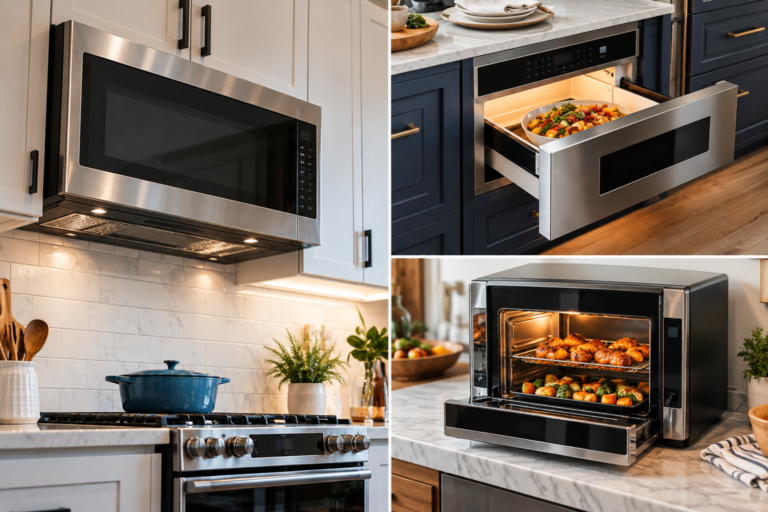
Three Sharp microwave drawers can look remarkably similar from across a kitchen. The SMD2470ASY, KB6524PSY and SMD2470AH are all 24-inch-class built-in drawer microwaves, all use a 1.2 cu. ft. cavity, and Sharp currently identifies each as a 950-watt model. Yet treating them as interchangeable would miss the differences that matter when an appliance is being built permanently into cabinetry.
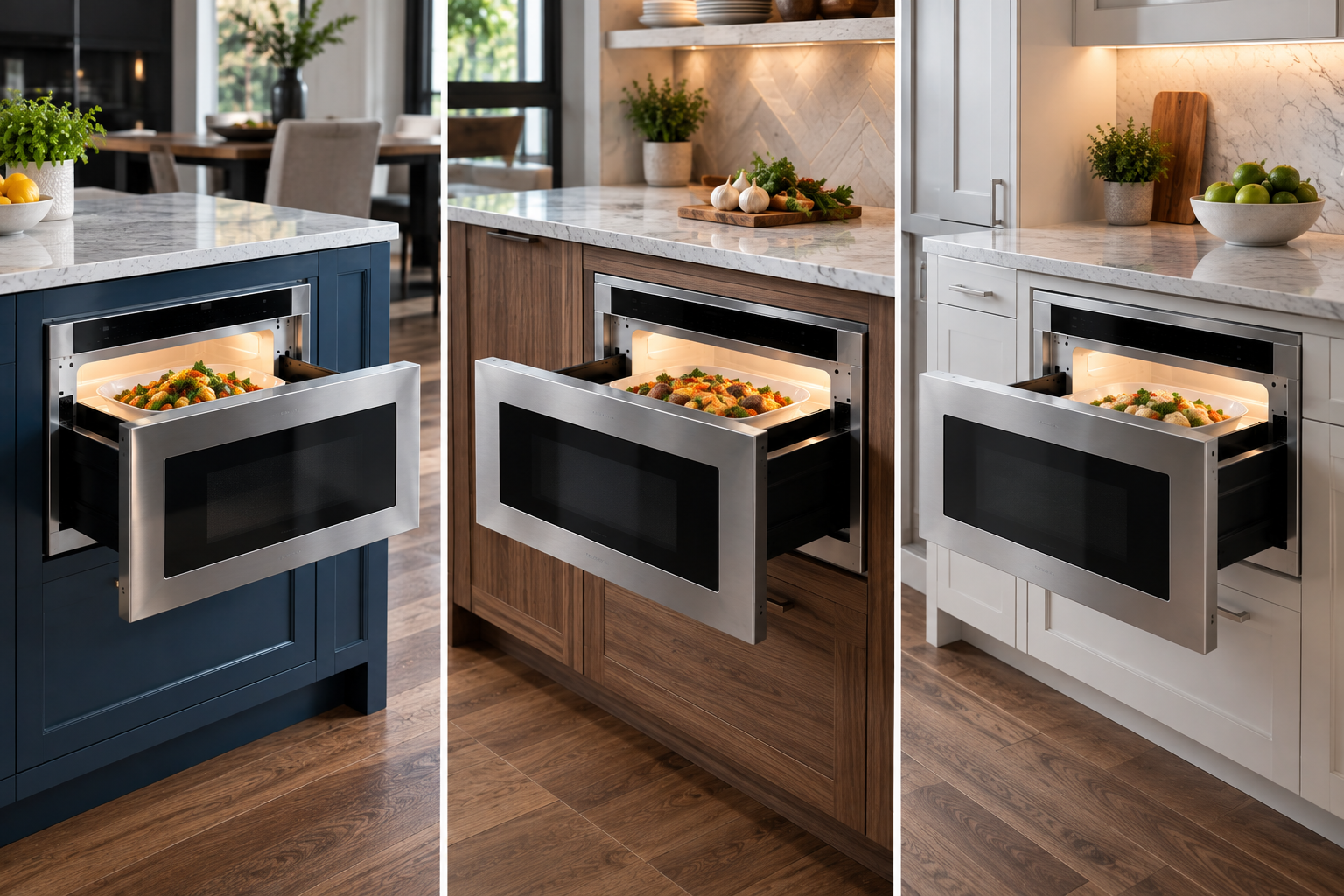
Price creates the first separation. The SMD2470ASY is evaluated here at $1,497, the KB6524PSY at $1,297, and the SMD2470AH at $1,597. Our scores follow a similarly narrow but meaningful spread: 8.55/10 for the SMD2470ASY, 8.38/10 for the KB6524PSY and 7.99/10 for the SMD2470AH.
Those ratings do not identify one universal answer. They reveal three variations on the same architectural idea, with differences in interface design, finish, price and editorial value.
The SMD2470ASY makes the strongest case for buyers seeking Sharp’s more contemporary stainless-steel drawer design. The KB6524PSY costs $200 less and retains the central advantages of a 24-inch microwave drawer, making it particularly relevant where budget matters more than having the newer control arrangement. The SMD2470AH takes the underlying SMD2470 design into black stainless steel, making finish coordination a larger part of the purchasing rationale.
That distinction matters because a microwave drawer is as much an installation decision as an appliance purchase.
The Three Models Share More Than Their Names Suggest
The comparison becomes clearer when the common ground is established first.
Sharp’s current official listings identify the SMD2470ASY as a 24-inch, 1.2 cu. ft., 950-watt stainless-steel Microwave Drawer Oven. The KB6524PSY is likewise listed as a 24-inch, 1.2 cu. ft., 950-watt stainless-steel model. Sharp’s SMD2470AH listing gives the same 24-inch format, 1.2 cu. ft. capacity and 950-watt output in black stainless steel.
That shared foundation limits how dramatic the performance comparison should become. There is no responsible basis for claiming that one cooks substantially faster merely because its exterior or control arrangement differs. All three are built around the same broad drawer-microwave proposition.
Capacity also tells only part of the story. Sharp says the SMD2470AH cavity can accommodate a 4-quart casserole dish or a 20-ounce beverage cup. The company’s KB6524PSY description makes the same basic accommodation claims. The SMD2470 family specification sheet also warns that stated internal capacity is calculated from maximum cavity dimensions and that usable food-holding capacity is lower.
That caveat is useful far beyond Sharp. Cubic footage is an abstract measurement. A household lives with plates, bowls, mugs and casserole dishes, not cubic feet.
SMD2470ASY: Our Score 8.55/10
The SMD2470ASY receives the highest overall score of the three at 8.55/10. Customer Sentiment is 8.28, Buyer Confidence reaches 9.8, and Value is 8.15.
The 9.8 Buyer Confidence score is especially revealing. This model has a clearly documented installation and operating framework, a current official Sharp product presence and a feature set that is easy to understand before cabinetry is altered.
Sharp describes flexible installation below an island, peninsula or standard cabinetry, as well as placement below a wall oven. That flexibility addresses one of the main reasons for choosing a drawer microwave in the first place: separating microwave placement from the conventional countertop or over-the-range positions.
The SMD2470 design also uses a concealed control panel that opens to a 45-degree angle and an automatic drawer system. Those characteristics change daily interaction more than another preset button would.
Controls on a below-counter appliance present an ergonomic problem. If they sit flat on the top surface, readability can suffer depending on user height and installation position. Tilting the panel upward addresses that geometry directly.
The automatic drawer mechanism has a similarly practical purpose. Sharp’s documentation describes the system as opening automatically and enabling hands-free closing.
None of this establishes faster heating than the other models. The advantage lies in interface and installation design.
At $1,497, however, the SMD2470ASY is not inexpensive. Its 8.15 Value score acknowledges that reality. A conventional countertop microwave can deliver 950 watts of microwave output for a fraction of the expenditure. The additional money buys integration, drawer access and the SMD2470 interface rather than a proportional increase in raw microwave power.
KB6524PSY: Our Score 8.38/10
The KB6524PSY earns 8.38/10 overall, only 0.17 points behind the SMD2470ASY. Customer Sentiment is 8.06, Buyer Confidence is 9.7, and Value is 8.03.
Its $1,297 price makes it the least expensive of the three in this comparison.
Sharp identifies the KB6524PSY as an Easy Open Microwave Drawer with an Auto-Touch control panel, low-profile design and stainless-steel finish. Its cavity is large enough for a 4-quart casserole dish and tall enough for a 20-ounce cup.
The product therefore preserves the essential microwave-drawer proposition without asking the buyer to pay for black stainless steel or the SMD2470 family’s more concealed control arrangement.
That can be an advantage rather than a deficiency.
Appliance comparisons often treat newer interface design as automatically preferable. Kitchens are less obedient to that assumption. A buyer replacing an existing KB6524 installation may care more about fit and continuity than visual novelty. Another household may simply prefer a visible, direct control arrangement.
The KB6524PSY also makes a strong economic argument within this particular group. It is $200 below the SMD2470ASY and $300 below the SMD2470AH.
Its Value score of 8.03 nevertheless sits slightly below the SMD2470ASY’s 8.15. Price alone does not define value. The newer SMD2470 design offers interface refinements that can justify its higher expenditure for buyers who care about them.
The KB6524PSY is therefore best understood as the more cost-conscious route into this specific Sharp drawer format, not as an inferior microwave simply because its overall score is fractionally lower.
SMD2470AH: Our Score 7.99/10
The SMD2470AH receives a 7.99/10 overall score. Customer Sentiment is 7.62, Buyer Confidence is 9.25, and Value is 7.79.
Its $1,597 price is the highest of the three.
Functionally, the official specification sheet describes a 1.2 cu. ft. cavity, 1,000 watts on that published sheet, 11 cooking power levels, sensor cooking, popcorn settings, two automatic reheating settings, six automatic defrost settings and a keep-warm function lasting up to 30 minutes. Sharp’s current retail page, however, identifies the model as 950 watts. Because the manufacturer currently markets it at 950 watts, that current figure is the safer basis for present-day comparison while the older specification document illustrates the importance of checking documentation tied to the exact production unit.
The principal visible distinction is black stainless steel.
That finish changes the buying logic. For a kitchen already built around black stainless appliances, matching the microwave can have genuine design value. For a buyer indifferent to finish coordination, paying $100 more than the SMD2470ASY and $300 more than the KB6524PSY becomes harder to defend.
That tension is reflected in the 7.79 Value score.
The SMD2470AH is not being penalized because black stainless is inherently worse. Its lower rating reflects the relationship between expenditure and functional differentiation. When much of the additional appeal is aesthetic, the value depends heavily on how much the household cares about visual continuity.
The SMD2470ASY and SMD2470AH Are Close Mechanical Relatives
The similarity between the two SMD2470 models is not merely visual.
Sharp publishes a shared installation manual covering the SMD2470AS, SMD2470AH and SMD3070AS. The document specifies installation clearances, grounding requirements and the anti-tip provisions required for safe installation. It also states that installation and service must be performed by a qualified installer.
That shared documentation matters when comparing the stainless SMD2470ASY with the black stainless SMD2470AH.
Their purchasing difference is therefore driven much more heavily by finish and price than by an entirely different appliance architecture.
The SMD2470AH’s official specification sheet gives exterior dimensions of 23 7/8 inches wide, 15 7/8 inches high and 23 1/64 inches deep. Its stated cutout dimensions are 22 1/8 inches wide, 15 9/16 inches high and 23 1/2 inches deep. Product weight is listed at 74 pounds.
Those numbers illustrate why a microwave buying guide for drawer models cannot stop at nominal width. “24-inch microwave” describes a product class, not the opening a cabinetmaker should cut.
Control Design Separates the Generations
The interface distinction between the KB6524PSY and the SMD2470 pair deserves more attention than it usually receives.
The KB6524PSY uses Sharp’s Auto-Touch control arrangement. The SMD2470 design places controls behind a concealed panel that opens to a 45-degree viewing angle.
A concealed panel creates a cleaner front when closed. It can also improve viewing geometry when the appliance sits below the counter.
The KB6524 approach is more visually explicit. Controls are part of the appliance’s visible operating identity.
Neither arrangement can be declared universally better. A household prioritizing a visually restrained cabinet run may prefer the concealed SMD2470 panel. Someone who wants controls immediately visible may find the KB6524 arrangement more intuitive.
This is a useful reminder that interface design cannot be reduced to feature count. A button that is easy to see and reach can matter more than several cooking presets that are rarely used.
Sensor Cooking Matters Across the Comparison
Microwave output is only one component of heating behavior. Food quantity, moisture, density, shape and starting temperature can all affect the result.
Sharp’s SMD2470 operating documentation includes sensor programs for popcorn, reheating, potatoes, vegetables and cooking. The manual explains that these programs allow users to cook or reheat many foods without manually calculating cooking time or power level.
That is a practical distinction between sensor-based cooking and a simple timer.
Sensor programs should not be interpreted as a guarantee of perfect heating. Microwave cooking can still create temperature variation, and dense foods can require standing, stirring or additional heating.
The benefit is narrower and more credible: sensor programs reduce the amount of manual timing required for compatible foods.
For buyers who repeatedly reheat leftovers or prepare standard microwave foods, that automation may matter more in daily life than decorative differences between models.
The Drawer Format Changes Kitchen Ergonomics
All three products share the central ergonomic feature of this category: the food is accessed from above rather than through a side-hinged door positioned at counter or eye level.
That arrangement can reduce overhead lifting when compared with an over-the-range microwave. It can also free the counter completely.
Yet lower installation is not automatically comfortable for every person. User height, mobility and reach remain relevant.
The National Kitchen & Bath Association’s microwave landing-area guideline recommends at least 15 inches of landing area above, below or adjacent to the handle side of a microwave oven. For accessible design, it recommends landing area immediately in front of or adjacent to the handle side.
That recommendation exposes a common design mistake. A microwave drawer can free counter space, but placing it far from usable counter space creates a new inconvenience when a hot casserole has to be carried across the kitchen.
Installation location should therefore be evaluated as a food-handling route, not merely as an empty cabinet opening.
Price Changes the Comparison More Than Power Does
The price spread is straightforward:
- SMD2470ASY: $1,497
- KB6524PSY: $1,297
- SMD2470AH: $1,597
The $300 difference between the KB6524PSY and SMD2470AH is substantial considering their shared 24-inch format, 1.2 cu. ft. capacity and current 950-watt classification.
That does not make the KB6524PSY automatically the better purchase.
The SMD2470 models provide a different interface and automatic drawer design. The SMD2470AH adds black stainless steel. Those distinctions can matter greatly in a carefully coordinated kitchen.
What price does expose is the cost of priorities.
A buyer interested mainly in drawer placement and stainless steel has a strong reason to examine the KB6524PSY. A buyer willing to spend more for the SMD2470 interface has a reason to move toward the SMD2470ASY. Black stainless coordination creates the clearest rationale for paying the SMD2470AH premium.
Reading the Editorial Scores Together
The scores reinforce those buyer profiles.
The SMD2470ASY’s 8.55 overall rating is accompanied by 8.28 Customer Sentiment, 9.8 Buyer Confidence and 8.15 Value. It produces the strongest balance across the four measures.
The KB6524PSY follows closely at 8.38 overall, with 8.06 Customer Sentiment, 9.7 Buyer Confidence and 8.03 Value. Its slightly lower ratings do not erase its $200 price advantage.
The SMD2470AH lands at 7.99 overall, with 7.62 Customer Sentiment, 9.25 Buyer Confidence and 7.79 Value. Buyer Confidence remains high, but its higher price and more finish-driven differentiation create a narrower economic case.
The recurring pattern is striking: Buyer Confidence is much higher than Value for all three.
That makes sense for built-in appliances. These products have clearly defined purposes and documented installation requirements, which can support confidence. Yet microwave drawers command prices far above basic countertop microwaves, placing persistent pressure on value.
A buyer can be highly confident that a product is appropriate without believing it is inexpensive.
Installation Is Part of the Purchase
Sharp’s installation manual makes clear that a microwave drawer is not simply placed inside a cabinet.
The SMD2470 installation documentation requires proper grounding and an anti-tip block and specifies that surrounding cabinetry and wall coverings must tolerate heat generated by the appliance. Sharp also warns against using the drawer as storage and against sitting, leaning or stepping on it.
Those requirements have practical consequences for renovation budgets.
Before ordering any of the three models, buyers should verify:
- Exact cutout width, height and depth for the specific model.
- Electrical supply and receptacle requirements.
- Required anti-tip provisions.
- Clearance for full drawer movement.
- Nearby landing space for hot cookware.
- Installation height relative to regular users.
- Access for future service and removal.
- Whether existing cabinetry needs reinforcement or alteration.
- Whether a replacement model could reasonably fit the opening later.
The last point deserves attention because built-in appliances eventually become replacement projects.
A countertop microwave can disappear from a kitchen in minutes. A drawer microwave leaves a precisely sized opening behind.
The KB6524PSY Better Suits the Price-Sensitive Drawer Buyer
Among these three, the KB6524PSY has the clearest appeal to someone who wants the drawer format while controlling acquisition cost.
At $1,297, it saves $200 against the SMD2470ASY and $300 against the SMD2470AH.
Its 8.38 overall score remains close to the SMD2470ASY’s 8.55. Buyer Confidence is similarly close at 9.7 versus 9.8.
The compromise lies mainly in choosing the older Easy Open and Auto-Touch design rather than the SMD2470 family’s concealed angled control interface.
For some kitchens, that difference will justify $200. For others, it will not.
The KB6524PSY therefore makes particular sense when drawer placement itself is the primary objective and the buyer does not assign substantial value to the SMD2470 control design.
The SMD2470ASY Better Suits the Buyer Seeking the Strongest Balance
The SMD2470ASY carries our highest overall rating because its scores are consistently strong without reaching the SMD2470AH’s higher price.
At $1,497, it costs more than the KB6524PSY, but the additional expenditure brings the SMD2470 design, concealed 45-degree control panel and automatic drawer arrangement.
Its stainless-steel finish also avoids the additional finish premium attached to the black stainless SMD2470AH.
This makes the SMD2470ASY particularly coherent for a new kitchen where the owner wants a current Sharp drawer design, conventional stainless coordination and a documented installation platform.
Its 8.15 Value rating prevents that recommendation from becoming indiscriminate. The appliance still costs nearly $1,500. Buyers who simply need microwave heating can solve that problem much more cheaply.
The SMD2470ASY makes sense when the drawer itself is part of the kitchen plan.
The SMD2470AH Better Suits a Black Stainless Kitchen
The SMD2470AH has the narrowest but clearest design case.
Its black stainless finish is not merely a technical specification; it can determine whether the microwave visually belongs beside other appliances.
Sharp itself positions the model as a companion for black stainless kitchens. The appliance otherwise retains the familiar SMD2470 format, including the automatic drawer and concealed angled controls.
At $1,597, however, finish coordination carries an economic premium.
That explains why its Value score falls to 7.79 and its overall score to 7.99. The product can still be the appropriate choice for a specific kitchen without becoming the strongest value proposition for a buyer who is indifferent to color.
Design consistency has value, but that value belongs to the household and the room rather than to microwave performance.
Final Considerations
The Sharp SMD2470ASY, KB6524PSY and SMD2470AH are more alike than their prices initially suggest. Each represents Sharp’s 24-inch, 1.2 cu. ft. microwave-drawer concept, and Sharp’s current product pages identify all three at 950 watts. The meaningful distinctions emerge through interface design, finish, price and installation context.
The SMD2470ASY earns our highest score at 8.55/10, paired with 8.28 Customer Sentiment, 9.8 Buyer Confidence and 8.15 Value. Its strength lies in balance: the more contemporary SMD2470 interface, stainless-steel finish and a price below the black stainless variant.
The KB6524PSY follows at 8.38/10, with 8.06 Customer Sentiment, 9.7 Buyer Confidence and 8.03 Value. Its $1,297 price creates a rational route for buyers who prioritize the drawer format but do not require the SMD2470 control arrangement.
The SMD2470AH receives 7.99/10, with 7.62 Customer Sentiment, 9.25 Buyer Confidence and 7.79 Value. Its strongest rationale is visual: a black stainless kitchen can make the finish premium relevant in a way that raw cooking specifications cannot.
None of the three should be selected solely by looking at wattage or capacity. Their shared fundamentals make those figures poor differentiators.
The more useful questions are physical and behavioral. How much is the buyer willing to spend for the drawer format? Which control arrangement is easier to use at the planned installation height? Does stainless or black stainless match the surrounding appliances? Is there adequate landing space? Does the cabinet opening meet the exact installation requirements? Can the appliance be serviced and eventually replaced without rebuilding the kitchen?
Those questions turn a superficial three-model comparison into a practical purchasing decision.
The KB6524PSY offers the lowest entry price. The SMD2470ASY combines the strongest set of our editorial scores with the newer interface design. The SMD2470AH asks the highest price but addresses a specific aesthetic requirement that the stainless models cannot satisfy.
There is no need to force those differences into a single universal winner. The three products solve closely related problems for buyers with different priorities. The more carefully those priorities are defined before cabinetry is altered, the less likely a microwave drawer costing well over $1,000 is to become an expensive lesson in choosing an appliance before choosing its place in the kitchen.