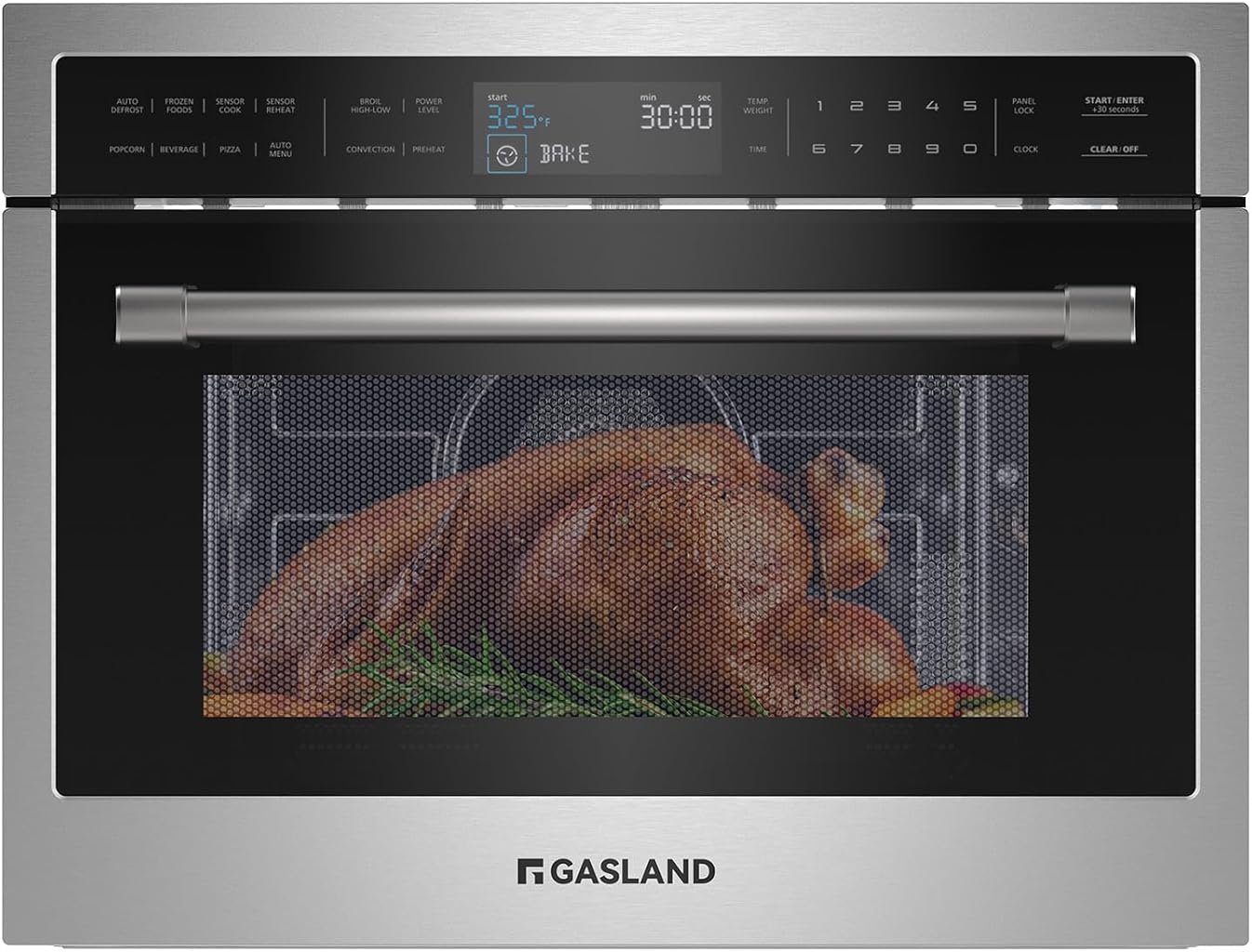
The GASLAND Chef BMD1602S is the kind of appliance that exposes how inadequate the word “microwave” can be. Its 24-inch built-in body contains a 1.6-cubic-foot cavity, 1,000 watts of microwave output, 10 variable power levels, sensor programs and convection capability. It is intended to move microwave cooking away from the countertop while adding enough dry-heat functionality to act as a compact secondary cooking appliance.
That broader identity matters because this is not a low-cost route to reheating leftovers. GASLAND Chef currently lists the BMD1602S at $1,099.99, while other retail pricing can differ. At that level, the relevant question is no longer how many watts a buyer receives for the money. The question becomes whether built-in integration, convection cooking, capacity and automated controls solve enough kitchen problems to justify the investment.
Our score is 8.19/10. Customer Sentiment stands at 7.84, Buyer Confidence at 9.48 and Value at 7.91. The scoring pattern describes the appliance rather neatly. Buyer Confidence is exceptionally high because its core specifications and installation requirements are documented across manufacturer and retail materials. Value is more measured because the BMD1602S asks buyers to pay for integration and multifunction cooking, not simply microwave power.
The strongest argument for this GASLAND is therefore architectural as much as culinary. It removes a large appliance from the worktop, places microwave cooking inside cabinetry and adds convection capability without requiring the space of another full-size oven.
The BMD1602S Is More Than a Standard Microwave
The GASLAND BMD1602S combines microwave and convection cooking in one built-in appliance. Retail documentation from Home Depot specifically identifies it as a “2 in 1 microwave and convection oven,” while GASLAND’s own product material specifies 1,000 watts of microwave output, 10 variable power levels and a 1.6-cubic-foot cavity.
That distinction changes how the appliance should be evaluated.
A basic microwave heats food through microwave energy. It is extremely effective at rapid heating, but conventional microwave operation does not reproduce the surface browning associated with dry heat. A convection system introduces heated circulating air, expanding the appliance’s usefulness beyond reheating and defrosting.
For a household with a conventional range, the GASLAND is better viewed as a secondary cooking cavity than as a replacement for the main oven.
That difference prevents unrealistic expectations. A 1.6-cubic-foot appliance cannot provide the cookware capacity of a conventional range oven. What it can provide is another cooking space for smaller portions, side dishes and situations where the primary oven is already being used.
This distinction also explains much of the price.
A 1.6-Cubic-Foot Cavity Offers Useful Working Space
Capacity numbers can become abstract quickly. The BMD1602S is rated at 1.6 cubic feet, while the manual identifies oven capacity as 44 liters and specifies a 14.17-inch turntable.
The turntable measurement is particularly useful.
A prospective buyer can measure commonly used dinner plates, bowls and microwave-safe dishes against 14.17 inches and obtain a much clearer idea of practical fit than a cubic-foot figure provides.
GASLAND also includes a removable rack intended to create an additional cooking level. The manufacturer describes this as forming a double cooking area so that more than one dish can be accommodated.
That rack changes how the cavity can be used, although cookware arrangement still has to respect the operating instructions for the selected cooking mode.
For families reheating multiple dishes, internal organization can matter as much as nominal volume. A large cavity with poor usable geometry is less helpful than its specification suggests. Here, the rotating platform and removable rack give the 1.6-cubic-foot figure some practical context.
The cavity is large enough to distinguish the GASLAND from compact microwaves, yet small enough that buyers should resist treating it as equivalent to a conventional oven.
Physical Size Makes Installation a Serious Part of the Purchase
The BMD1602S measures approximately 23.43 by 22.36 by 17.87 inches according to GASLAND’s technical specifications, and it weighs 88.8 pounds. The manufacturer lists a built-in opening of approximately 23.6 by 21.7 by 17.8 inches.
Those figures immediately separate the appliance from an ordinary countertop microwave.
Nearly 89 pounds is not something most owners will casually slide forward to reach an outlet or clean behind the enclosure. Once incorporated into cabinetry, the appliance becomes part of the kitchen installation.
That makes measurement a pre-purchase responsibility.
The cabinet should be checked at multiple points rather than measured once. Openings can be slightly out of square, particularly in older kitchens or modified cabinetry. Rear depth also needs to account for electrical hardware and any installation clearances specified by the manufacturer.
Nominal appliance width can be misleading here. “24-inch” describes the installation class rather than telling the buyer to cut a 24-inch square hole.
A serious microwave buying guide should therefore treat built-in measurements with the same care normally reserved for wall ovens and cooktops. Millimeters of optimism can become hours of cabinetry work.
The 1,000-Watt Output Is Sensible Rather Than Remarkable
GASLAND rates the BMD1602S at 1,000 watts of microwave output. The official manual confirms the same rated microwave output.
That provides a familiar power level for everyday microwave cooking.
Higher wattage can shorten cooking time under comparable conditions, but wattage alone is a poor proxy for the quality of an appliance. Food geometry, moisture, portion size, container shape, placement and power modulation all affect heating.
The BMD1602S provides 10 variable microwave power levels.
That flexibility matters because maximum output is not always desirable. Lower settings are useful for controlled heating, softening and other tasks where full power can overheat edges before the center reaches the desired temperature.
The manufacturer also provides a 30-second addition function for fast cooking adjustments.
This is a small feature, but small controls often dominate daily microwave use. Owners are more likely to add another 30 seconds to yesterday’s dinner than to explore obscure recipe programs every evening.
Sensor Controls Reduce Dependence on Guesswork
The BMD1602S includes eight automatic cooking programs. GASLAND identifies popcorn, pizza, beverage, sensor cook, sensor reheat, auto defrost, frozen foods and an auto-menu function.
The sensor functions are the more interesting part of that list.
Microwave timing is difficult because foods with similar volume can behave very differently. Water content, density, starting temperature and shape all alter how quickly a portion heats.
Fixed presets solve this only partially because they still begin with assumptions.
Sensor cooking is intended to respond to conditions generated while food is heating. It cannot compensate for every variable, and correct cookware and preparation remain necessary, but the approach can reduce repeated manual timing for common foods.
Sensor reheating is especially appropriate for a built-in microwave likely to see daily service.
Combination appliances sometimes become distracted by their secondary abilities. They accumulate convection, grilling and automated recipes while basic microwave usability receives less attention. The GASLAND’s sensor functions and adjustable power levels help keep ordinary reheating central to the design.
That balance is important. Most owners will probably use the microwave side more frequently than the convection side.
Convection Changes the Economic Argument
The presence of convection is what prevents the BMD1602S from being judged merely as an expensive 1,000-watt microwave.
Convection allows heated air to circulate through the cavity, creating a dry-heat cooking environment. That makes baking and roasting applications possible in ways that microwave energy alone cannot reproduce.
This is where the GASLAND begins competing with compact ovens rather than merely other microwaves.
For a kitchen with a large primary oven, a smaller convection cavity can be useful when preparing modest portions. Heating a large oven for a small dish can be unnecessary when a secondary cavity is available.
The second-oven argument becomes even stronger during larger meals.
If one dish requires a different temperature from another, two independent heated cavities give the cook more scheduling freedom. A compact convection microwave cannot match the capacity of the main oven, but it does not have to. Its usefulness comes from handling the smaller task.
This is also where buyer discipline matters.
Someone who never bakes or roasts in the secondary appliance is paying for capability that remains dormant. The convection system improves value only when it enters the household’s actual cooking routine.
The Turntable and Rack Make the Interior More Flexible
The BMD1602S uses a 14.17-inch turntable according to its manual.
Rotation is a familiar microwave mechanism, but its purpose remains relevant. Moving food through different positions inside the cavity helps reduce dependence on a single fixed placement during microwave operation.
The removable rack adds another dimension.
GASLAND specifically presents the rack as a way of creating additional cooking area. That can be useful when the operating mode and food arrangement permit multiple items inside the cavity.
The combination also demonstrates the appliance’s dual identity.
The turntable belongs to the familiar language of microwave cooking. The rack pushes the cavity toward oven-like organization.
Buyers should nevertheless evaluate the interior against their own cookware. Marketing photographs cannot answer whether a favorite casserole dish, dinner plate or baking vessel fits comfortably.
A tape measure can.
Cleaning Is Better Addressed Than on Some Combination Ovens
GASLAND describes the BMD1602S as having a nonstick interior cavity and a dishwasher-safe turntable.
That combination is useful because multifunction cooking creates more cleaning work than reheating alone.
Microwave splatter is usually straightforward. Convection cooking can introduce grease, baked-on food residue and longer exposure to heat. Any appliance expected to perform both jobs needs an interior that can be cleaned without excessive difficulty.
The manufacturer’s manual gives separate cleaning guidance for the cooking compartment, wire racks, door panels and seal. It directs users toward damp cloths or hot soapy water depending on the component and warns against inappropriate scraping methods around the door and seal.
Those instructions are mundane but consequential.
A combination appliance can accumulate the residue patterns of both a microwave and an oven. Cleaning habits therefore affect ownership satisfaction more than the glossy stainless-steel exterior might suggest.
Electrical Requirements Deserve Professional Attention
The BMD1602S operates at 120 volts and 60 Hz. Its manual lists maximum power at 3,400 watts while specifying rated microwave output at 1,000 watts.
The difference is significant because microwave output should never be confused with total appliance demand.
A combination oven can operate additional heating hardware beyond the magnetron used for microwave cooking. That is why installation planning should be guided by the electrical requirements in the manual rather than by the 1,000-watt microwave figure on the product description.
This matters particularly during replacement projects.
An existing microwave circuit should not automatically be assumed suitable merely because the new appliance also contains a microwave. Combination equipment can impose different electrical demands.
Electrical compatibility should therefore be established before cabinetry is finalized.
The appliance’s built-in character raises the stakes further. Discovering an electrical mismatch after an 88.8-pound unit has been positioned inside finished cabinetry is an avoidable problem.
The Built-In Design Is Its Strongest Spatial Argument
Counter space is one of the least renewable resources in a kitchen.
A freestanding microwave may require several square feet of working-surface territory once its physical body and surrounding usability are considered. Add a toaster oven, coffee maker and air fryer, and a large kitchen can begin to feel strangely small.
The GASLAND moves microwave capacity into cabinetry.
That does not eliminate its physical footprint; it relocates it. The distinction matters because wall and tall-cabinet volume is often easier to surrender than primary food-preparation surface.
Built-in integration also creates a more permanent visual arrangement.
This has both benefits and costs.
The kitchen appears less cluttered, but replacement becomes more complicated. A future appliance has to work with the existing opening or the cabinetry has to change. Countertop microwaves do not impose that obligation.
The BMD1602S therefore rewards buyers willing to think beyond the current appliance and consider the cabinet as part of a longer-lived installation.
Buyer Confidence at 9.48 Is the Strongest Editorial Result
Our Buyer Confidence score is 9.48, comfortably above the overall 8.19/10 rating.
That difference reflects the amount of verifiable information surrounding the model.
GASLAND publishes its 1.6-cubic-foot capacity, 1,000-watt microwave output, 10 variable power levels, automatic programs, dimensions, weight, voltage, turntable size, removable rack and cleaning provisions. Its manual supplies additional electrical and maintenance information. Retail documentation independently identifies the BMD1602S as a built-in microwave and convection oven.
That level of documentation gives a buyer a realistic opportunity to check fit before money is committed.
Built-in products need that precision more than portable appliances.
Buyer Confidence does not mean every household should buy the GASLAND. It means the household can determine with comparatively little ambiguity whether the product’s dimensions, electrical requirements and functions match the intended kitchen.
That distinction explains the high score.
Value at 7.91 Requires Regular Use of the Extra Capability
Our Value rating is 7.91.
The manufacturer currently lists the BMD1602S at $1,099.99, while Home Depot lists the model at $1,000 at the time of writing. Prices can change, but both figures establish the same broad reality: this appliance costs substantially more than an ordinary countertop microwave.
The premium buys more than microwave output.
It buys built-in installation, convection capability, a 1.6-cubic-foot cavity, sensor cooking, a removable rack, 10 microwave power settings and an appliance body intended to become part of the kitchen architecture.
The value equation therefore depends on avoided duplication.
If the GASLAND replaces both a microwave and a compact convection oven, its price becomes easier to defend. If it merely replaces a basic microwave while its convection system remains unused, value falls sharply.
Installation expense should also enter the calculation.
Cabinet alterations and electrical work can raise the actual project cost beyond the appliance price. A built-in appliance should be evaluated as part of an installation rather than as an isolated box.
Customer Sentiment at 7.84 Signals a More Selective Fit
Customer Sentiment stands at 7.84.
That figure sits below Buyer Confidence because knowing exactly what an appliance does is different from finding its combination of attributes suitable for every household.
The BMD1602S demands more commitment than a countertop microwave. It requires a compatible cabinet, appropriate electrical preparation and acceptance that future replacement may involve dimensional constraints.
Its convection capability also introduces additional controls and cleaning responsibilities.
For the right household, those are reasonable exchanges for a clear countertop and a secondary heated cavity.
For someone whose microwave use consists largely of beverages, leftovers and frozen meals, they are unnecessary complications.
That divide explains why the overall score remains below Buyer Confidence.
Who Should Buy the GASLAND BMD1602S?
The strongest buyer is planning or renovating a kitchen and wants a microwave integrated into cabinetry without giving up convection capability.
Several characteristics make the match particularly sensible:
- The household uses microwave cooking frequently but does not want a large appliance on the countertop.
- A secondary convection cavity would help with smaller baking or roasting jobs.
- A 1.6-cubic-foot capacity and 14.17-inch turntable suit the household’s common cookware.
- Sensor cooking and reheating would see regular use.
- Cabinetry can accommodate the specified dimensions.
- The electrical installation can meet the requirements documented for the combination appliance.
- The owner accepts that a built-in model requires more planning to replace than a freestanding microwave.
The weaker fit is equally apparent.
A household seeking the cheapest route to 1,000-watt microwave cooking does not need this machine. Someone with abundant counter space and a preferred countertop convection oven may also gain little from paying for integration.
The GASLAND is most rational when built-in placement and convection solve identifiable problems rather than merely adding specifications.
How It Fits Into a Microwave Buying Guide
A microwave buying guide dealing with the BMD1602S should start with four questions: fit, electrical supply, cookware and cooking behavior.
Cabinet fit comes first because the appliance is large, heavy and intended for integration. Manufacturer dimensions should be checked against the actual opening before purchase.
Electrical compatibility follows. The 1,000-watt microwave output figure is not the same as total electrical demand, particularly in an appliance with convection hardware.
Then comes cookware. The 14.17-inch turntable gives the buyer a useful physical reference. Plates and vessels used frequently should be measured rather than assumed to fit.
Finally comes behavior.
Will the household actually use convection? Does a secondary oven solve meal-preparation conflicts? Are sensor programs relevant to daily reheating? Is recovering countertop space worth the cost and permanence of a built-in installation?
Those questions reveal more about buyer fit than the length of the feature list.
Final Considerations
The GASLAND 1.6 cu. ft. Built-In Microwave Oven earns our 8.19/10 score because its specifications form a coherent appliance rather than a collection of unrelated extras.
The BMD1602S combines a 1.6-cubic-foot cavity, 1,000 watts of microwave output, 10 variable power settings, sensor cooking, sensor reheating, automatic defrosting, a 14.17-inch turntable and convection capability inside a 24-inch built-in format.
Buyer Confidence at 9.48 is the standout figure. Core dimensions, weight, electrical characteristics, cooking modes and maintenance instructions are documented well enough for meaningful installation planning.
Value at 7.91 is more conditional. At roughly four figures before installation, the BMD1602S needs to do more than heat leftovers. Its financial case becomes stronger when the convection system replaces another appliance and built-in placement returns useful worktop area to the kitchen.
Customer Sentiment at 7.84 reflects that narrower buyer fit. Combination appliances reward owners who use their broader capabilities. They make less sense when most cooking consists of short microwave cycles.
The BMD1602S ultimately works best as a compact second cooking station embedded in the kitchen rather than as an unusually expensive substitute for a countertop microwave. Its convection system, sensor controls, removable rack and substantial cavity give it enough functional breadth to justify that identity.
For a kitchen that needs built-in microwave convenience and a secondary convection cavity, the GASLAND offers a logically assembled set of capabilities. For a kitchen that needs only quick reheating, its price, installation requirements and additional cooking hardware solve problems that were never there.