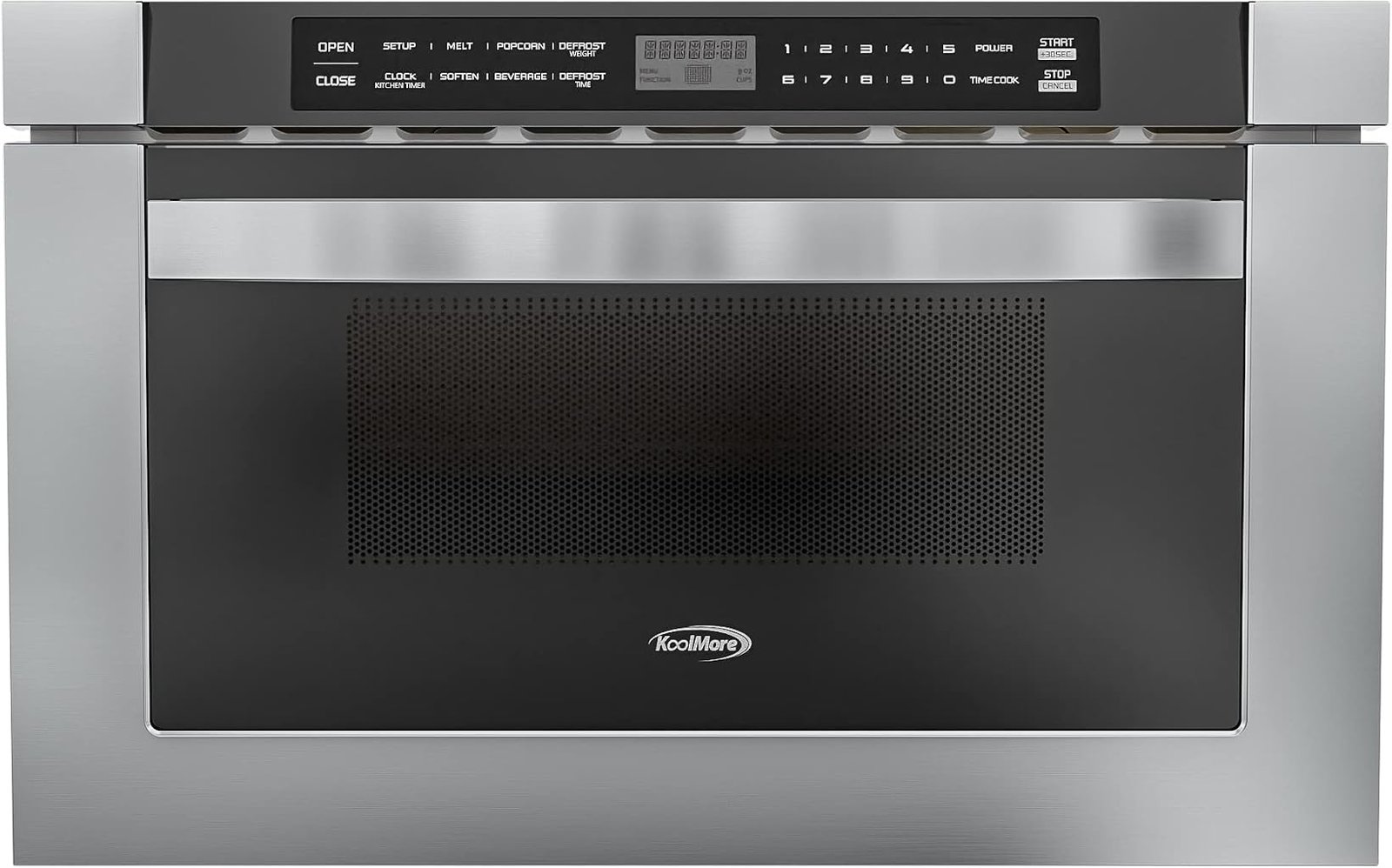
The KoolMore KM-MD-1SS makes a straightforward proposition: move the microwave off the counter and below the work surface, give it an electrically opening drawer instead of a swinging door, and package the result in a 24-inch stainless-steel format intended to become part of the cabinetry.
That sounds simple. The economics are not.
A microwave drawer is one of those appliances for which cooking ability tells only half the story. Cabinet dimensions, aisle clearance, control placement, electrical requirements and future replacement all matter because the machine is installed rather than merely placed. The KM-MD-1SS consequently has to justify itself as both a microwave and a piece of kitchen infrastructure.
Our score is 8.14/10. Customer Sentiment stands at 7.84, Buyer Confidence at 9.27 and Value at 7.91. Those figures describe an appliance with a convincing basic specification and unusually strong confidence, but with a value equation constrained by the inherent expense of the drawer format.
The more interesting question is not whether it can reheat yesterday’s dinner. A far cheaper microwave can do that. The question is what the KM-MD-1SS buys with its greater cost and installation commitment.
What the KM-MD-1SS Actually Is
The KoolMore KM-MD-1SS is a built-in residential microwave drawer with a stainless-steel front. KoolMore specifies 1.2 cubic feet of gross capacity, 1.0 cubic foot of net capacity, 10 microwave power levels and four one-touch settings. Its functions include time and weight defrost, express cooking, automatic menus, a kitchen timer, clock, melt and soften settings, plus electric door opening.
The exterior uses galvanized steel and 430 stainless steel, while the interior is painted steel. The drawer incorporates tempered glass, an incandescent cavity light positioned at the top and a safety lock. Controls are membrane switches positioned at the top of the front panel.
That specification is notable partly for what it does not attempt. This is not presented as a convection oven, air fryer or miniature combination range. It remains fundamentally a microwave. Its added expense goes toward format, installation and drawer mechanics rather than an expanding list of unrelated cooking technologies.
For buyers who already have a capable conventional oven, that restraint can make sense. A secondary cooking appliance does not necessarily become more useful merely because manufacturers add more modes.
The Dimensions Deserve More Attention Than the Feature List
The KM-MD-1SS is described as a 24-inch microwave drawer, but that label is only a starting point for installation.
KoolMore gives the exterior measurements as 23.62 inches by 23.19 inches by 14.96 inches. The specified cabinet opening is 22.13 inches wide, 23.5 inches from front to back and 14.81 inches high. The appliance weighs 69.78 pounds.
Those numbers should be checked against the finished cabinet opening rather than a kitchen plan that merely says “24-inch microwave.”
There is another measurement that deserves equal attention: with the drawer open, KoolMore specifies a depth of 40.12 inches.
That can materially affect an island installation.
Imagine a microwave drawer installed on the working side of an island. Closed, it is almost flush with the cabinetry. Open, the appliance extends into the user’s standing space. In a generous kitchen this is trivial. In a narrow aisle opposite a dishwasher, refrigerator or another cabinet run, it can become a traffic issue.
A sensible microwave buying guide therefore has to consider the appliance in motion. Cabinet drawings often depict appliances closed because closed appliances make tidy drawings. Kitchens are used with doors and drawers open.
Before purchase, the intended location should be measured twice: once for the appliance itself and once with approximately 40 inches of total depth represented on the floor.
Capacity Is Adequate, but the Gross Number Needs Context
The 1.2-cubic-foot headline requires a little interpretation because KoolMore distinguishes between gross and net volume.
The manufacturer specifies 1.2 cubic feet gross and 1.0 cubic foot net. Interior measurements are 17.28 inches by 17.51 inches by 7.87 inches.
Those physical dimensions are more useful than a single cubic-foot figure.
Microwave containers do not arrive in abstract cubic feet. They arrive as wide dinner plates, casserole dishes with handles, tall mugs and awkward storage containers. A household considering the KM-MD-1SS should measure the cookware it actually uses against those internal dimensions.
Height deserves particular attention. A drawer microwave is loaded from above, so a container must fit below the cavity ceiling after being lowered into place. That geometry differs from inserting something horizontally through the front door of a conventional microwave.
The flat-bottom drawer format also changes the experience compared with a familiar rotating glass turntable. Users moving from a traditional microwave should expect the cavity to look and operate differently.
The Electrical Specification Contains an Easy-to-Miss Distinction
KoolMore lists the KM-MD-1SS at 120 volts, 15 amps and 1,500 watts, with a NEMA 5-15P plug and a 39.37-inch power cord. The company specifies plug-in electrical installation and lists annual energy consumption at 273.75 kWh.
The 1,500-watt figure should not be casually interpreted as microwave cooking output. It appears in the manufacturer’s electrical specification rather than as a claim that 1,500 watts of microwave energy reaches the food.
This distinction matters because appliance input and microwave output are not interchangeable concepts.
Anyone comparing the KM-MD-1SS against another microwave should make sure the same kind of wattage is being compared. A large number beside the word “wattage” can be misleading if one manufacturer is describing electrical consumption while another is describing cooking output.
For installation, the more immediate facts are the 120-volt supply, 15-amp specification and standard NEMA 5-15P plug.
Electric Opening Is More Than a Styling Detail
The electrically opening drawer is central to the appliance’s identity.
A traditional microwave door swings outward. The KM-MD-1SS instead brings the cavity toward the user. Food can then be lowered into the drawer rather than pushed horizontally into an eye-level or countertop cavity.
That can be particularly useful for heavy bowls. Removing a hot container from an over-the-range microwave requires the user to lift it at chest or shoulder height before lowering it. With a drawer, the lifting operation begins below the countertop.
The trade-off is equally physical: low placement requires reaching downward.
For someone who finds overhead lifting uncomfortable, the geometry may be appealing. Someone who has difficulty bending or lifting from a low position may reach the opposite judgment. There is no universal ergonomic winner because bodies differ.
The best evaluation requires almost no technology. Before ordering, a buyer can place a heavy bowl on a shelf at approximately the planned drawer height, then practice lowering and lifting it with both hands.
That simple simulation reveals more about personal fit than a specification sheet can.
Controls Favor Familiarity Over Novelty
KoolMore uses membrane-switch controls rather than a more elaborate touchscreen interface. The control panel sits at the top of the front panel. The microwave provides four one-touch settings and 10 power levels, alongside automatic menus, express cooking, defrosting, melt, soften, clock and timer functions.
There is an appealing logic to conventional controls on a microwave.
Touchscreens can create cleaner appliance fronts and accommodate larger menu systems, but microwave use is often repetitive. A person reheating coffee or leftovers generally benefits from immediate access to time, power and start functions more than elaborate navigation.
The KM-MD-1SS therefore reads as a machine intended to remain recognizable as a microwave even after its physical format changes.
Its safety lock is particularly relevant because drawer microwaves are installed low enough for children to reach.
Cleaning Has Advantages and Compromises
The drawer layout alters cleaning in subtle ways.
Opening the appliance exposes the bottom of the cavity from above, which can make crumbs and spills relatively easy to see. The flat-bottom arrangement also avoids a loose rotating platter that has to be lifted out and cleaned separately.
The upper cavity presents the reverse problem. Because the appliance sits below the counter, cleaning the ceiling can require bending and reaching downward into the drawer.
That is not a severe flaw, but it illustrates a recurring theme with microwave drawers: almost every ergonomic advantage changes another movement somewhere else.
The FDA recommends regularly cleaning microwave cavities, cavity edges and doors using water and mild detergent and says a specialized microwave cleaner is unnecessary. The agency also cautions against scouring pads, steel wool and other abrasives.
Those recommendations are particularly sensible around painted interior surfaces and door-sealing areas.
Microwave Safety Is Well Established
The drawer orientation sometimes prompts questions about microwave radiation because the appliance operates below waist level rather than at counter or eye level. The underlying regulatory standard does not depend on whether a microwave has a conventional door or drawer.
The FDA states that it has regulated microwave-oven manufacturing since 1971 and that manufacturers must certify their products and meet federal safety-performance standards. The agency says ovens meeting its standard and used according to manufacturer instructions are considered safe.
Federal requirements limit microwave leakage throughout an oven’s lifetime to 5 milliwatts per square centimeter measured at approximately two inches from the surface. The FDA describes that limit as “far below the level known to harm people.”
The federal standard also requires two independent interlock systems that stop microwave production when the latch is released or the door opens, along with a monitoring system addressing interlock failure.
The more mundane kitchen risks deserve greater attention. The FDA reports that most microwave injuries involve hot containers, overheated food or exploding liquids rather than radiation.
For the KM-MD-1SS, the practical safety questions therefore concern hot-food handling, the moving drawer, correct installation and keeping the door and sealing surfaces undamaged.
Ventilation and Installation Should Not Be Improvised
KoolMore specifies front exhaust ventilation for the KM-MD-1SS. The appliance is intended for built-in residential installation.
That distinction matters because a built-in microwave should not be treated like a countertop machine that happens to fit inside an empty cabinet.
The cutout dimensions, electrical location and ventilation arrangement all need to conform to the current installation documentation. Cabinetmakers and remodelers should work from the exact model specification rather than nominal width.
This becomes especially relevant in an island, where electrical routing may already be constrained by drawers, plumbing, structural panels or other appliances.
The 69.78-pound appliance weight also argues against casual installation.
A drawer that repeatedly moves almost 70 pounds of installed appliance hardware needs properly constructed cabinetry and correct support. This is not a sensible place for improvised shelf dimensions.
The One-Year Warranty Is Ordinary Rather Than Generous
KoolMore specifies a one-year parts-and-labor warranty for the KM-MD-1SS.
That coverage does not create a special ownership advantage.
Warranty length should not be confused with expected service life; a one-year warranty does not establish that an appliance will fail shortly afterward. Yet built-in appliances impose more inconvenience when service becomes necessary because removal and replacement are less casual than with countertop equipment.
A buyer should still examine local service availability before installation. Warranty language is most useful when qualified service can actually reach the kitchen.
Our Score: 8.14/10
Our 8.14/10 assessment places the KM-MD-1SS firmly in favorable territory without treating it as an automatic purchase.
The reason is straightforward. The appliance has a coherent identity. It provides a purpose-built 24-inch drawer configuration, useful internal dimensions, electric opening, 10 power levels, familiar microwave functions, a safety lock and conventional 120-volt plug-in electrical requirements.
Its drawbacks are largely structural rather than mysterious.
The drawer format costs more than ordinary microwave architecture. Installation demands accurate cabinetry. Open depth needs to be planned. The one-year warranty is modest. Gross capacity is 1.2 cubic feet, but usable net capacity is listed at 1.0 cubic foot. Controls are conventional rather than unusually sophisticated.
Those trade-offs prevent the KM-MD-1SS from becoming a universal recommendation, but they do not undermine the central design.
Customer Sentiment: 7.84
Our Customer Sentiment score of 7.84 sits below the overall 8.14 rating.
That gap suggests an appropriate editorial interpretation: the KM-MD-1SS makes more sense when judged against a specific kitchen problem than when treated as an appliance everyone needs.
Microwave drawers invite unusually high expectations because they are expensive and visually integrated. A conventional microwave is often forgiven for being merely functional. A built-in drawer is expected to heat food, fit perfectly, operate smoothly and justify the cabinet space permanently assigned to it.
The 7.84 score therefore fits an appliance category in which satisfaction depends heavily on installation and workflow.
A buyer who dislikes bending will experience the product differently from one trying to eliminate an over-the-range microwave. A household with a narrow island aisle faces a different equation from one with abundant clearance.
The product cannot solve a poorly chosen location.
Buyer Confidence: 9.27
Buyer Confidence is the standout figure at 9.27.
That score reflects how clearly the KM-MD-1SS can be evaluated before purchase. KoolMore publishes unusually specific dimensional, electrical and installation information: interior measurements, exterior dimensions, cutout measurements, open depth, weight, plug type, voltage, amperage, ventilation location and warranty coverage are all identifiable.
That reduces ambiguity.
For a built-in appliance, specification transparency has real economic value. Discovering after delivery that a microwave is too deep, that the open drawer collides with opposing cabinetry or that the cutout is wrong can turn a purchase into a construction problem.
The KM-MD-1SS gives buyers enough dimensional information to perform that due diligence before money and cabinetry become committed.
Value: 7.91
Our Value score of 7.91 is intentionally lower than Buyer Confidence.
The reason is not weak functionality. It is that microwave drawers are expensive solutions to a task that ordinary microwaves perform cheaply.
The KM-MD-1SS becomes economically rational when its format solves another problem simultaneously: freeing counter space, removing a microwave from the upper sightline, integrating the appliance into an island or avoiding an over-the-range installation.
If none of those benefits matter, the drawer premium becomes difficult to defend.
KoolMore’s own catalog illustrates the contrast. Its 1.6-cubic-foot over-the-range KM-MOT-1SS is listed with more interior capacity and conventional microwave functions in a different installation format. The comparison reinforces a basic point: drawer buyers are paying partly for architecture, not merely cooking volume.
That is acceptable when architecture is part of the problem being solved.
Who Should Consider the KM-MD-1SS?
The strongest buyer fit is relatively specific:
- A kitchen remodel already incorporating a suitable 24-inch base cabinet or island location.
- A household seeking to preserve countertop and upper-cabinet space.
- Users who prefer loading hot dishes from above rather than removing them from an elevated microwave.
- Buyers who want conventional microwave functions rather than a multifunction combination appliance.
- Kitchens with enough aisle space to accommodate the drawer’s 40.12-inch total open depth.
- Households comfortable with a one-year parts-and-labor warranty.
Conversely, the KM-MD-1SS is harder to justify when price is the primary criterion, when the microwave must provide unusually large capacity, when bending is difficult, or when the existing kitchen would require extensive cabinet alteration.
What to Measure Before Buying
The final pre-purchase inspection should be physical rather than theoretical.
The cabinet opening should be checked against the 22.13-inch width, 23.5-inch depth and 14.81-inch height specified by KoolMore. The aisle should be evaluated with the drawer represented at its 40.12-inch open depth. Frequently used dishes should be compared against the 17.28-by-17.51-by-7.87-inch interior.
The electrical location should be checked against the 39.37-inch cord and NEMA 5-15P plug. The planned cabinet should accommodate the appliance’s 69.78-pound weight and installation requirements.
These checks are not glamorous. They are also far more consequential than debating whether another automatic menu would improve the specification sheet.
Final Considerations
The KoolMore KM-MD-1SS succeeds or fails according to the kitchen around it.
As a microwave, it presents a disciplined feature set: 10 power levels, defrost functions, express cooking, automatic menus, melt and soften modes, a timer, electric drawer opening and a safety lock. Its 1.2-cubic-foot gross capacity becomes 1.0 cubic foot net, with published internal dimensions that make cookware fit reasonably easy to evaluate before purchase.
As an installed appliance, it demands more thought. The cabinet opening has to be correct. The nearly 70-pound unit requires proper support. The open drawer extends the appliance’s total depth to 40.12 inches. The low position can improve hot-dish handling for some users while creating an undesirable bend for others. The one-year warranty provides standard rather than unusually long coverage.
Those trade-offs explain the score pattern. Our 8.14/10 overall rating recognizes a coherent and well-specified microwave drawer. Customer Sentiment at 7.84 reflects a category whose satisfaction depends heavily on personal workflow and installation. Buyer Confidence at 9.27 is the strongest figure because the product’s dimensions and requirements are unusually easy to investigate in advance. Value at 7.91 acknowledges that buyers pay substantially for the drawer architecture itself.
The KM-MD-1SS therefore makes the most sense when that architecture has a job to do. If the kitchen needs to reclaim counter space, keep upper cabinetry visually quiet or place the microwave conveniently in an island, the drawer format earns a functional purpose beyond appearance.
If the requirement is merely to heat food, the economics change sharply.
That distinction should drive the purchase. The KM-MD-1SS is not simply a microwave with a different door. It is a microwave whose usefulness is inseparable from where it is installed, how the household moves around it and whether its cabinet-level integration solves a problem worth paying to solve.