An RV kitchen is an exercise in compression. Counter space is scarce, electrical capacity is finite, cabinets are shallow, and every appliance must justify the volume it consumes. A conventional microwave solves reheating quickly but does little for browning or baking. A small oven handles dry heat but occupies space that many travel trailers and motorhomes simply do not have.
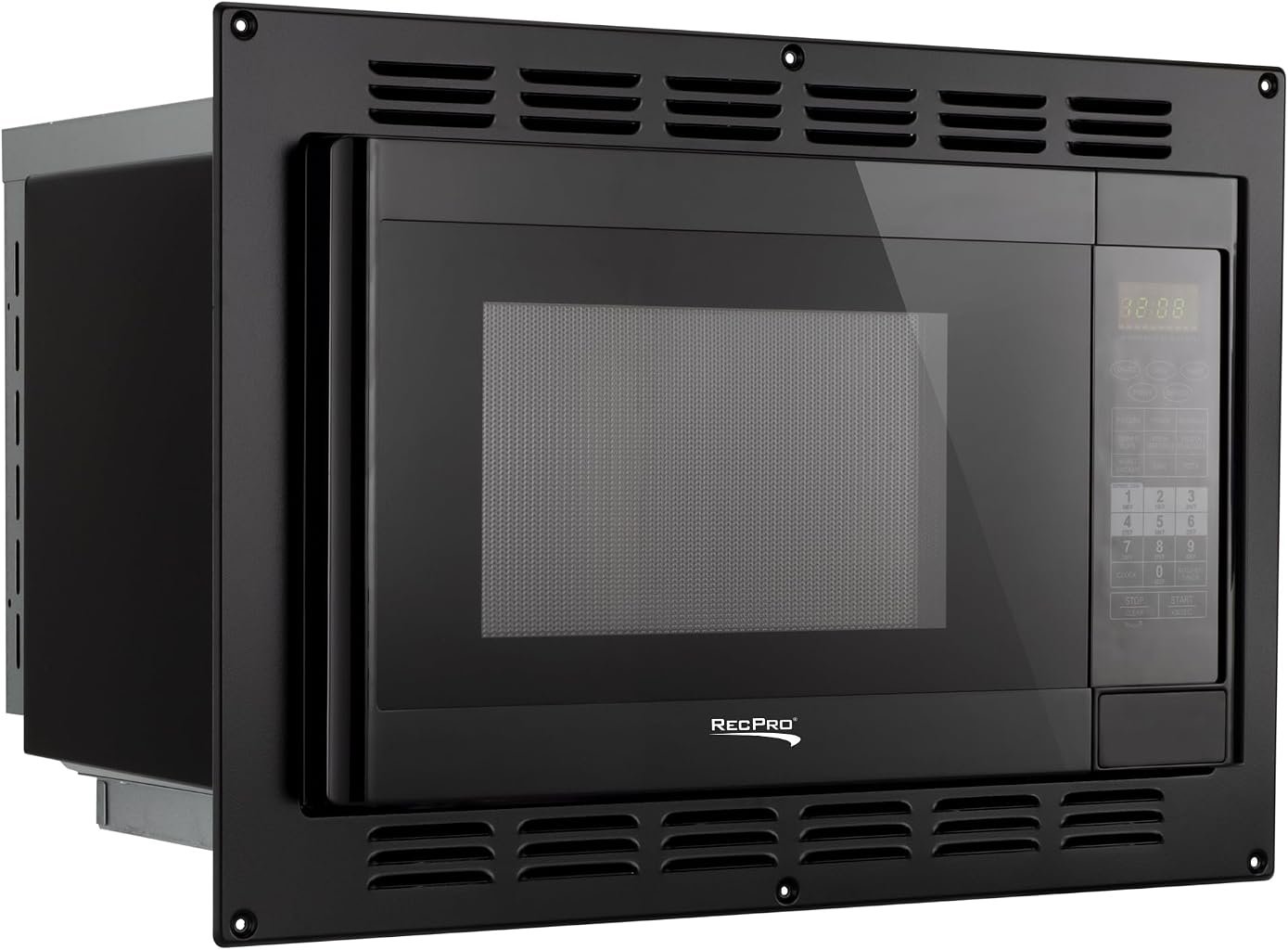
The RecPro 1.1 Cu. Ft. RV Black Convection Microwave approaches that problem by putting microwave, convection, grill, and roast functions into one built-in appliance. RecPro specifies a 1.1-cu.-ft. cavity, 1,000-watt microwave output, 1,500-watt microwave input, a 12.5-inch turntable, 10 microwave power levels, multi-stage cooking, and nine express-cook programs.
At $349.95, it occupies a different category from inexpensive countertop microwaves. The more useful comparison is with RV-specific built-in appliances and with the cost-in money, electrical demand, and cabinet space-of installing separate cooking equipment.
Our score is 7.98/10. Customer Sentiment stands at 7.62, Buyer Confidence at 9.21, and Value at 7.79. Those numbers describe a product with a fairly clear identity: credible specifications and unusually broad cooking functionality, accompanied by installation and power requirements that deserve as much scrutiny as the cooking modes themselves.
For an RV owner evaluating this model through a microwave buying guide, the central question is therefore not merely whether 1.1 cubic feet is enough. It is whether the coach can physically and electrically accommodate what this appliance asks of it.
Four Cooking Methods Change the Equation
The defining feature is not the microwave itself. It is the combination of four cooking modes: microwave, convection, grill, and roast. RecPro also lists a Quick Start mode combining microwave and convection cooking.
That distinction matters.
Microwave energy heats food differently from convection heat. The FDA explains that microwaves produced by a magnetron are absorbed by food and cause water molecules to vibrate, generating heat. Convection cooking, meanwhile, introduces the dry-heat behavior associated with an oven.
A combination appliance can consequently address tasks for which microwave-only cooking is poorly suited. Reheating soup remains microwave territory. Foods that need surface browning or oven-style heat have other available modes.
The appeal becomes clearer in an RV because appliance consolidation carries greater practical value when usable kitchen volume is measured in inches rather than generous stretches of cabinetry.
There is also an important regulatory distinction behind the terminology. The U.S. Department of Energy’s definition of a microwave oven explicitly includes appliances “with or without thermal elements designed for surface browning of food and convection microwave ovens.”
In other words, convection microwaves are not simply ordinary microwaves with an ambitious control panel. They are appliances combining microwave heating with thermal cooking capability.
Capacity Is Modest by Household Standards, Sensible by RV Standards
RecPro rates the cooking cavity at 1.1 cubic feet. The black model’s internal dimensions are listed as 13 inches wide by 13.5 inches deep, while its turntable measures 12.5 inches in diameter.
That turntable measurement is particularly useful because nominal cubic-foot figures can be abstract. Cookware compatibility is governed by actual geometry.
A 12.5-inch rotating surface gives the appliance enough room for common dinner plates and suitably sized microwave-safe cookware, but this remains an RV appliance rather than a full-size residential wall oven. Large rectangular bakeware and oversized dishes need closer scrutiny.
The cavity therefore strikes a defensible compromise. Smaller would constrain the usefulness of the convection function. Much larger would create obvious packaging problems in an RV galley.
This balance contributes to the 7.98 overall score. The RecPro is not remarkable because 1.1 cubic feet is unusually large in absolute terms. Its case rests on extracting several cooking functions from that volume.
Power Is Where Buyers Need to Pay Attention
The electrical specifications deserve more attention than the preset buttons.
RecPro lists the black model at 120 volts and 60 Hz. Rated microwave input is 1,500 watts, while microwave output is 1,000 watts. Grill input is 1,150 watts and convection input is 1,500 watts.
Input and output should not be confused.
The 1,000-watt figure describes microwave cooking output. For electrical planning, the 1,500-watt input specification is the more consequential number.
At 120 volts, 1,500 watts corresponds mathematically to 12.5 amps before considering any additional real-world electrical factors. Interestingly, RecPro’s product page separately lists “10 Amp,” so RV owners assessing circuit compatibility should follow the manufacturer’s installation documentation and the rating information attached to the specific unit rather than deriving a circuit requirement from one number alone.
This matters particularly in RVs where air conditioning, water heating, battery charging, coffee preparation, and other high-draw loads may be operating within the same limited electrical system.
For owners who spend most of their time connected to campground shore power, this may be a routine load-management issue. Off-grid use introduces another layer. An inverter and battery bank must support the appliance’s demand, and microwave cooking output cannot be substituted for electrical input when making that calculation.
That is one reason Buyer Confidence reaches 9.21 while Value remains 7.79. The product itself is well defined; whether it represents good value depends heavily on the installation around it. A $349.95 appliance that drops neatly into a suitable RV opening presents a different economic proposition from one requiring cabinet reconstruction or electrical changes.
Installation Is Not a Footnote
The RecPro’s external dimensions without trim are 20.5 inches wide, 14.25 inches high, and 18 inches deep. The black trim frame measures 24 inches wide by 16.75 inches high. RecPro specifies an installation space of 22.5 inches wide, 15.25 inches high, and 19.25 inches deep. Net weight is 45.4 pounds.
Those figures should be measured against the RV before purchase, not after delivery.
RecPro specifies at least one inch of clearance on all sides and identifies the model as a built-in microwave that is not intended for under-cabinet mounting. The company also states that mounting screws are not included.
That makes the included black picture-frame trim more than cosmetic decoration. Built-in appliance installations must account for ventilation as well as appearance.
The 45.4-pound weight is another practical consideration. RV construction frequently uses lightweight cabinetry and thin panels. A microwave opening cannot be treated like an empty shelf simply because its dimensions appear compatible. The supporting structure must be suitable for the appliance and its installation requirements, particularly in a vehicle subjected to repeated vibration and road movement.
Measure width, height and depth separately. Confirm clearance. Inspect the mounting structure. Confirm electrical suitability. Only then does nominal “replacement” compatibility become meaningful.
The Controls Favor Utility Over Novelty
The feature list is broad without becoming strange.
There are 10 microwave power levels, weight and timed defrost modes, a 30-second instant-start function, multi-stage cooking, and a child-lock setting. The nine express options cover popcorn, potato, pizza, roast chicken, beverage, soup, dinner plate, fresh vegetables, and frozen vegetables.
Multi-stage cooking is arguably more useful than several of those presets. It allows cooking to proceed through programmed stages rather than requiring the user to return repeatedly to the controls.
That becomes particularly relevant when a microwave is expected to operate as a primary cooking appliance rather than merely a reheating device.
Presets should still be treated as conveniences rather than guarantees. Food quantity, initial temperature, container material, moisture and geometry all affect cooking. A “potato” button cannot know whether the oven contains one small potato or several unusually large ones unless the program explicitly incorporates weight or quantity.
The controls therefore add flexibility, but the RecPro’s real functional advantage remains its hardware: four cooking modes in one cabinet opening.
Safety Deserves More Than the Usual Microwave Myths
Microwave safety is sometimes discussed in ways that blur the distinction between ionizing and non-ionizing radiation. The FDA states directly that microwaves are non-ionizing radiation and says microwave ovens meeting its standard and used according to manufacturer instructions are considered safe under current knowledge.
Federal requirements are quite specific.
The FDA’s microwave safety standard limits leakage throughout an oven’s lifetime to 5 milliwatts per square centimeter at approximately two inches from the oven surface. It also requires two independent interlock systems that stop microwave production when the latch is released or the door opens.
For RV owners, the more practical safety concern is physical condition.
Travel subjects appliances to vibration that a stationary household kitchen does not experience. Door alignment, hinges, latches and seals therefore merit periodic inspection. The FDA advises against using a microwave when its door does not close firmly or is bent, warped or otherwise damaged.
Cleaning is similarly mundane but consequential. The agency recommends regularly cleaning the cavity, cavity edge and door using water and mild detergent while avoiding abrasive pads and steel wool.
Those recommendations fit an RV especially well, where appliances can remain unused for extended storage periods and then return to service after hundreds of miles of road vibration.
Where the RecPro Makes a Strong Case
The appliance’s most persuasive attributes are interconnected rather than isolated.
- Four cooking modes reduce the need for separate microwave and compact-oven installations.
- The 1.1-cu.-ft. cavity and 12.5-inch turntable provide useful capacity without turning the unit into a residential-size appliance.
- A 1,000-watt microwave output places it in familiar cooking territory for common packaged-food instructions.
- Ten power levels, multi-stage cooking and two defrost methods give the microwave side more flexibility than a bare-bones reheating appliance.
- The included trim frame addresses the visual integration expected from a built-in RV installation.
These strengths explain why Buyer Confidence, at 9.21, is the strongest of our four measurements. The RecPro’s proposition is unusually easy to understand. Dimensions, electrical ratings, capacity, installation opening and cooking modes are all concrete specifications that can be checked against an RV before money changes hands.
That reduces uncertainty-provided the buyer actually measures.
The Drawbacks Are Mostly Physical and Economic
The RecPro’s weaknesses are less about an absent cooking feature than about what multifunction hardware demands from an RV.
First is size. An appliance measuring 18 inches deep before installation allowances cannot be assumed to fit simply because an existing microwave looks roughly similar from the front. RecPro calls for a 19.25-inch installation depth.
Second is weight. At 45.4 pounds, this is a substantial appliance in a vehicle where payload and cabinet construction matter.
Third is power demand. A 1,500-watt rated input requires realistic electrical planning, particularly for inverter-based use.
Fourth is price. At $349.95, the RecPro cannot compete with commodity countertop microwaves on acquisition cost alone. That is not the appropriate comparison for every buyer, but it establishes a meaningful threshold: the convection, grill, roast, trim and built-in format must actually be useful to justify the expenditure.
Those trade-offs are reflected in the 7.79 Value score. This is respectable value rather than an automatic bargain. Owners who routinely cook inside their RV have more opportunity to recover utility from the convection and grill functions. Someone who uses a microwave almost exclusively to warm coffee and leftovers is paying for hardware that may remain largely dormant.
The 7.62 Customer Sentiment score, meanwhile, sits below both Buyer Confidence and the overall 7.98 score. Editorially, that gap argues against treating an impressive specification sheet as sufficient reason to buy. Fit, installation quality, expectations about convection cooking, and the realities of RV electrical systems can affect ownership satisfaction in ways that a list of modes cannot resolve.
Who Is This Microwave Actually For?
The strongest fit is an RV owner replacing or installing a built-in appliance in a cabinet opening that closely matches RecPro’s requirements and who intends to use convection cooking with some regularity.
It also makes sense where appliance consolidation matters. A traveler who would otherwise carry a microwave plus another electric cooking appliance can potentially shift several jobs into one fixed unit.
The case becomes weaker for minimalist campers who rarely cook indoors, owners of small rigs where 45.4 pounds and the cabinet volume are difficult to justify, or installations that would require substantial reconstruction.
There is another dividing line: electrical strategy.
An RV that spends most nights connected to suitable shore power presents a simpler operating environment. A solar-and-battery-oriented rig requires closer examination of inverter capacity, battery storage and simultaneous loads. The relevant specification for that calculation starts with rated electrical input, not microwave cooking output.
This is the sort of distinction a useful microwave buying guide should emphasize. Capacity and wattage printed on a retail page tell only part of the story. In an RV, cabinet dimensions, ventilation, weight, electrical input and mounting format are purchasing specifications, not installation trivia.
Final Considerations
The RecPro 1.1 Cu. Ft. RV Black Convection Microwave earns its 7.98/10 overall score by solving a genuine RV-kitchen problem with a relatively concentrated piece of equipment. Microwave, convection, grill and roast functions sit inside a 1.1-cu.-ft. built-in appliance with a 12.5-inch turntable, 1,000 watts of microwave output and a matching black trim frame.
Its 9.21 Buyer Confidence score is the standout. The specifications allow a prospective owner to make a fairly disciplined compatibility check before purchase. The 7.79 Value score is more conditional: $349.95 makes sense when the additional cooking modes replace equipment or functionality the owner would otherwise need. The 7.62 Customer Sentiment score tempers the picture and reinforces the need to judge the appliance as part of an RV system rather than as an isolated countertop device.
The final buying decision can be reduced to several measurements and habits: a 22.5-by-15.25-by-19.25-inch installation space, the required clearance, structural support for 45.4 pounds, compatibility with a 120-volt appliance drawing up to 1,500 watts under specified operating modes, and genuine demand for convection-style cooking.
When those conditions line up, the RecPro has a coherent purpose. It turns one built-in opening into several distinct cooking tools without pretending that space or electricity is free.
When they do not, the extra modes cannot rescue a poor installation match.
That is the more useful way to judge this appliance. The RecPro is neither merely a microwave with additional buttons nor a miniature residential oven. It is an RV-specific compromise between cooking range, cabinet volume, electrical demand and installation complexity. Its success depends less on the length of its feature list than on whether that compromise matches the way a particular RV is built-and the way its kitchen is actually used.