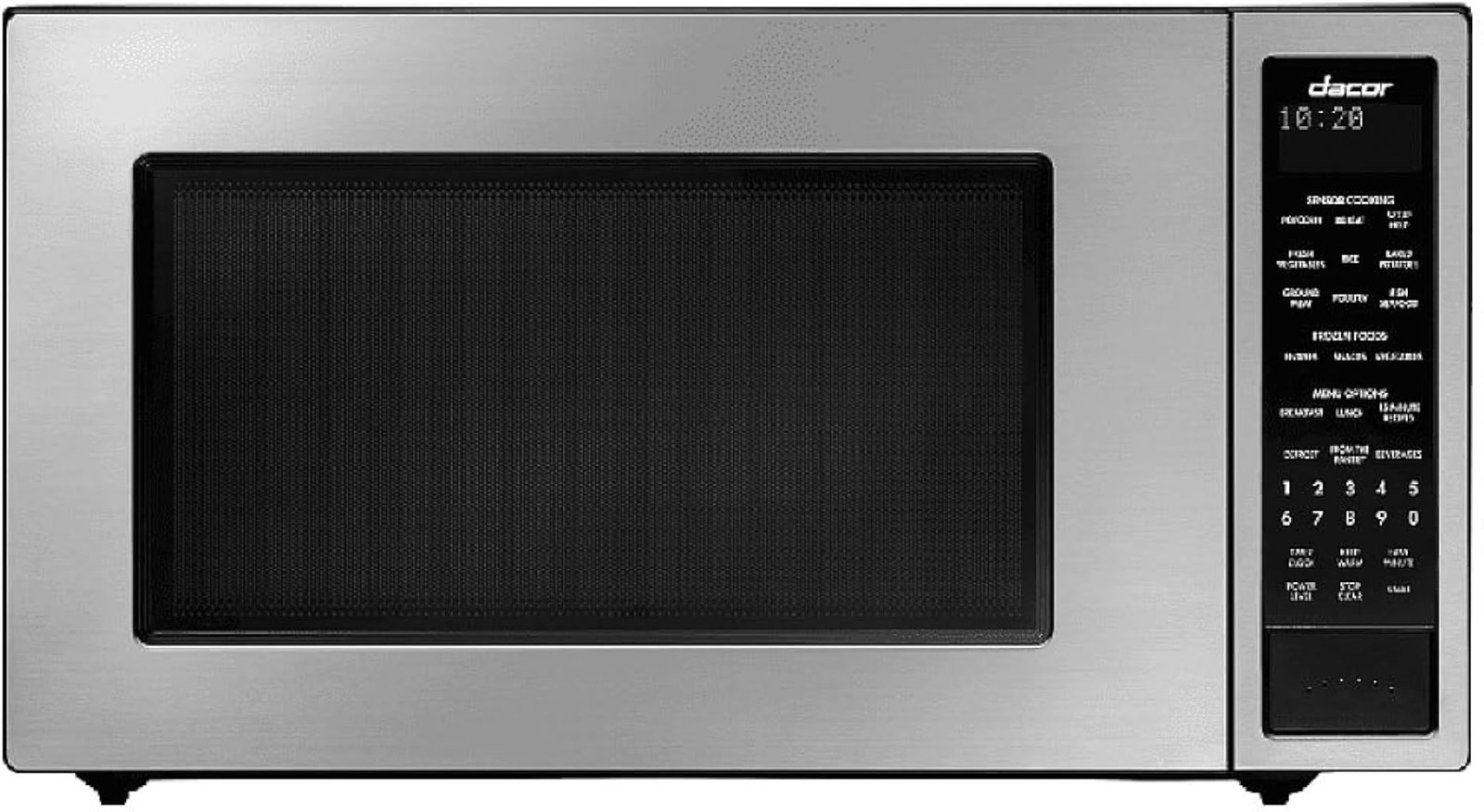
The Dacor DMW2420S occupies an unusual position in the microwave market. It is a 24-inch stainless-steel countertop microwave that can also be incorporated into cabinetry with a compatible trim kit, pairing a large 2.0-cubic-foot cavity with 1,100 watts of microwave output and a set of sensor-controlled cooking programs. Dacor currently lists the model at $849.
That combination immediately defines the product more accurately than appearance alone. This is not a convection microwave, speed oven or miniature wall oven. There is no convection system. Its purpose is conventional microwave cooking executed within a comparatively large cavity, with installation flexibility and a visual language intended to coexist with built-in kitchen appliances. Dacor’s specification material explicitly identifies convection as absent.
Our score is 7.99/10. Customer Sentiment stands at 7.62, Buyer Confidence at 9.28 and Value at 7.79. The unusually high Buyer Confidence figure reflects a product whose dimensions, power, capacity, electrical requirements, installation options and principal functions are well documented. Value is more restrained because the $849 price places the DMW2420S well outside basic microwave territory without adding convection cooking. Customer Sentiment at 7.62 similarly keeps the overall assessment grounded: this is a specialized purchase whose strengths are more architectural and functional than spectacular.
The question is therefore not whether the DMW2420S can microwave food. Its 1,100-watt output answers that easily enough. The more interesting question is whether its combination of capacity, sensor automation and installation flexibility warrants its price for the kitchen in which it will live.
The DMW2420S Is Simpler Than Its Price Suggests
High prices in cooking appliances often arrive with escalating feature lists. The DMW2420S takes a different route.
Dacor’s official product page specifies 1,100 watts of microwave output, 2.0 cubic feet of interior capacity, sensor technology, six menu categories and an automatic-start function. It can stand on a countertop or be integrated into cabinetry using an appropriate trim kit.
There is no convection fan, broiler or air-fry mode. There is no attempt to turn the microwave into a second oven.
That restraint can be interpreted in two ways.
A buyer comparing appliances by number of cooking modes may find the specification difficult to reconcile with the price. Combination microwaves can provide conventional microwave energy alongside dry-heat cooking at similar or overlapping price points.
A buyer who already owns a capable range or wall oven may reach the opposite assessment. Convection inside the microwave may simply duplicate equipment elsewhere in the kitchen. The DMW2420S concentrates on microwave functions while offering a large cavity and built-in installation option.
The result is less ambitious but also more clearly defined.
The 2.0-Cubic-Foot Cavity Is a Major Part of the Story
Capacity is one of the DMW2420S’s more consequential specifications.
The official user manual lists the cavity at 17⅜ inches wide, 10½ inches high and 18⅝ inches deep. Dacor calculates the nominal capacity at 2.0 cubic feet and equips the machine with a 16-inch-diameter turntable. The manual also makes an unusually useful distinction about capacity measurements: “Actual capacity for holding food is less.”
That sentence deserves attention because cubic-foot specifications can be misleading when treated as literal usable volume.
Manufacturers calculate cavity capacity from internal dimensions. Plates, bowls and casserole dishes do not use every cubic inch of a rectangular chamber. Turntable diameter can therefore be a more intuitive specification for daily ownership.
Sixteen inches is generous for a microwave turntable.
Large dinner plates, serving dishes and broad containers are more likely to fit without immediately colliding with the cavity walls. The generous internal depth also makes the appliance better suited to households that regularly reheat substantial dishes rather than individual mugs and small plates.
Yet capacity carries a physical cost. Large microwave cavities require large appliances.
The DMW2420S is not small.
Dimensions Need to Be Understood Before Purchase
Dacor lists the exterior at 24 inches wide, 13⅜ inches high and 19⅛ inches deep on its current product page. The user manual lists the depth as 19¼ inches, a minor documentation difference that reinforces the wisdom of consulting the installation documentation for the intended configuration before cabinetry is altered.
The appliance weighs approximately 46 pounds according to the manual.
Those figures make the DMW2420S entirely plausible as a countertop machine, but they also show why the countertop option will not suit every kitchen. Nineteen-plus inches of appliance depth represents a substantial footprint once working clearance and the door are considered.
For households short on counter space, the built-in option becomes much more interesting.
Dacor specifies compatible stainless-steel trim hardware for 30-inch installations, while its specification documentation has also listed compatible 27-inch and 30-inch trim-kit configurations.
That does not mean the 24-inch microwave itself suddenly becomes 30 inches wide. The trim system bridges the visual and installation relationship between the microwave body and a wider cabinet opening.
This distinction belongs in any serious microwave buying guide: appliance width, cabinet width and finished trim width are not necessarily the same measurement.
Built-In Flexibility Is One of Its Stronger Arguments
The ability to operate either as a countertop appliance or in a built-in installation materially changes the DMW2420S’s buyer profile.
Dacor explicitly states that the model is “Designed to work as a stand-alone or with built-in installations.”
That flexibility gives kitchen designers options.
A household can place the appliance on a counter without committing to custom cabinetry, while a renovation can integrate it into a cabinet arrangement using compatible hardware. The latter configuration allows the substantial microwave body to leave the primary work surface.
This is where some of the DMW2420S’s price begins to make more sense. It is not priced purely as a box that heats leftovers. Its role includes architectural integration.
The distinction also creates a responsibility for the buyer. Built-in installation should be planned from Dacor’s dimensions and compatible trim system rather than improvised around the appliance body. A microwave physically fitting inside a cabinet does not by itself establish an approved built-in configuration.
For replacement projects, the existing cutout deserves particular scrutiny. A previous 24-inch microwave or a nominal 30-inch trim frame does not guarantee that the DMW2420S will reproduce the old installation without cabinet work.
1,100 Watts Provides a Familiar Cooking Baseline
The DMW2420S produces 1,100 watts of microwave output. Its user manual specifies 1,500 watts of AC power requirement at 13 amps and identifies microwave output according to the International Electrotechnical Commission’s standardized measurement method.
The difference between input consumption and microwave output is normal and should not be confused.
For the buyer, the 1,100-watt output figure is the more useful cooking reference. Many packaged-food microwave directions are written around familiar high-output microwave ranges, and 1,100 watts avoids placing the Dacor at an unusually low-power end of the category.
Raw wattage still does not guarantee uniformly heated food. Container geometry, food composition, portion size, starting temperature and placement all affect results.
That is where the large turntable becomes relevant.
The rotating system continuously changes the food’s position relative to the microwave field, reducing dependence on a single static position inside the cavity. Dacor specifies a 16-inch turntable system for cooking uniformity.
The pairing of 1,100 watts and a large rotating platform is more meaningful than either specification considered separately.
Sensor Technology Addresses a Familiar Microwave Problem
Microwave cooking has always involved an awkward variable: time.
The user frequently has to estimate how long a particular portion needs, stop the machine, inspect the food and add another interval. Preset buttons partly automate the process but can still depend on fixed assumptions.
The DMW2420S uses sensor technology intended to adjust cooking time and power according to moisture detected during cooking. Dacor lists nine sensor-oriented food categories, including popcorn, reheating, fresh vegetables, frozen entrées, rice, baked potatoes, ground meat, poultry, fish and seafood.
That system is more consequential than a collection of decorative preset buttons.
Sensor cooking attempts to respond to what is occurring inside the cavity rather than relying entirely on a predetermined duration. It does not remove the need for appropriate containers, portions and food preparation, but it can reduce manual timing for frequently microwaved foods.
This feature also aligns well with the DMW2420S’s identity. Because there is no convection system competing for attention, the automation remains centered on ordinary microwave tasks.
The machine is sophisticated in how it microwaves rather than in how many different heating technologies it contains.
Menu Options Are Broad, Though Not Radical
Dacor organizes six convenience selections around Breakfast, Lunch, 15 Minute Recipes, Defrost, From the Pantry and Beverages.
The names are less interesting than the philosophy behind them.
Instead of forcing the user to memorize power levels and times for every routine task, the interface groups common jobs into recognizable categories. This approach is especially useful in a microwave likely to be shared among household members with different levels of cooking experience.
Three defrost options further address one of the appliance category’s more difficult jobs. Dacor’s specification sheet describes programs for defrosting meats and poultry by weight.
Defrosting is precisely where brute-force microwave power becomes counterproductive. Too much energy for too long can begin cooking thinner exterior sections while the center remains frozen. Automated programs are intended to manage the process more gradually.
The DMW2420S also includes Easy Minute, allowing one minute of high-power cooking to be initiated quickly, according to Dacor’s specification documentation.
That is a small feature, but arguably one that will see more frequent use than elaborate recipe presets.
Keep Warm Has More Practical Value Than It First Appears
The DMW2420S includes a Keep Warm function designed to hold hot food for up to 30 minutes after cooking.
A half-hour holding period can be useful in kitchens where meal components finish at different times.
Microwaves are frequently treated as isolated reheating appliances, but a large-capacity model can function as part of meal coordination. A dish can be heated and held while another component is completed on the cooktop or in an oven.
This does not transform the microwave into a warming drawer. It does make the cavity more useful between active cooking cycles.
The same philosophy appears in the Auto Start feature, which lets the user program cooking to begin at a designated time. Dacor specifically highlights that capability on the current product page.
As with any delayed cooking arrangement, appropriate food handling remains necessary. The feature is most useful where delayed operation makes sense for the particular food involved.
Electrical Requirements Are Relatively Conventional
The DMW2420S requires single-phase 120-volt, 60-Hz AC power. Its manual specifies 1,500 watts and 13 amps, while Dacor’s current product specification lists a 15-amp electrical requirement.
This is a less demanding electrical proposition than many combination ovens or speed ovens that require higher-voltage connections.
That distinction matters during renovation.
An appliance that can work within a conventional 120-volt kitchen electrical architecture may be easier to accommodate than a high-powered cooking appliance requiring a new 240-volt circuit. Actual receptacle placement and circuit compliance should still follow the installation documentation and applicable electrical requirements.
For buyers comparing built-in-looking appliances, electrical requirements deserve almost as much attention as physical dimensions. Two machines that appear similar from the front can impose very different demands behind the cabinet.
The Absence of Convection Is Both Limitation and Clarification
Dacor’s own specifications explicitly list convection as “No.”
That single specification draws a clean boundary around the DMW2420S.
It cannot perform conventional dry-heat baking. It is not intended to brown food in the manner of a convection oven. It cannot replace an air fryer merely because both appliances circulate through the same kitchen.
Buyers seeking a genuine second oven should look elsewhere, including toward Dacor’s separate DCM24S convection microwave, which combines microwave and convection functions. The DMW2420S is the simpler machine.
Yet feature absence is not automatically design failure.
A household with a wall oven, range and perhaps a dedicated air fryer may have no need to duplicate those functions inside its microwave. In that context, paying for a large, powerful conventional microwave with sensor controls can be rational.
The question is whether simplicity is being purchased intentionally or discovered after installation.
The Price Creates the Hardest Question
At Dacor’s current listed price of $849, the DMW2420S requires a different value calculation from a commodity countertop microwave.
Our Value rating is 7.79.
That figure reflects a machine whose price cannot be justified through wattage or capacity alone. Buyers are also paying for Dacor’s design language, installation flexibility, large cavity, sensor controls and the ability to integrate the microwave into a coordinated cabinet arrangement.
For someone seeking inexpensive reheating, the value proposition is weak.
For a kitchen where a visible countertop microwave would undermine the layout, built-in compatibility has tangible utility. The relevant comparison shifts from “How cheaply can 1,100 watts be purchased?” to “How well does this appliance fit the planned kitchen and its daily cooking pattern?”
Those are different economic questions.
The optional trim kit can also increase the effective cost of a built-in installation. Dacor’s specification documentation lists a 30-inch stainless trim kit separately rather than treating it as part of the microwave itself.
Cabinet modifications and installation labor can push the real project cost further beyond the appliance price.
Buyer Confidence Is the Standout Rating
Our Buyer Confidence rating is 9.28, considerably higher than the 7.99 overall score.
The reason is not mysterious. Dacor publishes detailed specifications, maintains official documentation for the model and identifies capacity, microwave output, exterior dimensions, electrical requirements, compatible installation approaches and warranty coverage.
The current official page specifies two years of full warranty coverage.
That level of documentation matters disproportionately with an appliance that may be integrated into cabinetry.
Replacement becomes expensive when specifications are vague. A documented 24-inch body, 2.0-cubic-foot cavity, 120-volt requirement and named trim accessory make planning more controlled.
Buyer Confidence should not be mistaken for a declaration that the DMW2420S suits every kitchen. It means the buyer can establish with unusual precision what is being purchased and what the installation requires.
That is a different virtue from raw performance.
Customer Sentiment and the Limits of a Premium Conventional Microwave
Customer Sentiment is 7.62, the lowest of our principal ratings.
That gap is revealing.
The DMW2420S is easy to understand technically, but its economic appeal depends heavily on the buyer’s priorities. A premium-priced microwave without convection will inevitably face comparisons with less expensive conventional models and similarly priced combination appliances.
Its strengths are concentrated in areas that matter greatly to some kitchens and barely at all to others.
A large cavity matters if large dishes are routinely reheated. Built-in compatibility matters if counter space or visual integration is a priority. Sensor cooking matters if automated microwave operation is used frequently.
None of those benefits has equal value to every household.
That is why the DMW2420S should not be approached as a generic premium upgrade. It is better understood as a specific solution for a specific kitchen arrangement.
Who Should Buy the Dacor DMW2420S?
The DMW2420S makes its strongest case for buyers who want a large conventional microwave and expect either to integrate it into cabinetry or to coordinate it visually with higher-end stainless-steel appliances.
Several characteristics define that buyer:
- A 2.0-cubic-foot cavity and 16-inch turntable are genuinely useful for large dishes.
- The 1,100-watt output provides substantial microwave power.
- Sensor programs reduce dependence on manually estimated cooking times.
- Countertop and compatible built-in configurations give the kitchen designer more placement flexibility.
- The 120-volt electrical requirement is comparatively straightforward.
- A two-year full-coverage warranty provides a defined ownership baseline.
The weaker fit is equally clear.
Someone primarily concerned with price can obtain basic microwave functionality for considerably less. Someone seeking baking, roasting or air frying needs a different appliance category. Someone with limited counter depth who does not intend to use a built-in trim system should carefully consider the Dacor’s 19-plus-inch body depth.
The model works when its size and installation options solve an actual kitchen problem.
How It Fits Into a Microwave Buying Guide
A useful microwave buying guide should place the DMW2420S in the conventional premium category rather than among convection combination ovens.
The buying decision can then be reduced to several concrete questions.
Does the household regularly use cookware that benefits from a 16-inch turntable? Is 2.0 cubic feet of nominal cavity volume useful, or merely larger than necessary? Will the appliance remain on a counter, where its physical depth matters every day, or will it be installed with a compatible trim system? Are sensor programs more relevant than convection capability? And does the design and installation flexibility justify the price premium over simpler microwaves?
These questions are more useful than counting presets.
The DMW2420S’s identity is unusually straightforward once the decorative stainless front is stripped from the analysis. It is a large, powerful conventional microwave with sensor automation and flexible placement options.
The buyer either needs those characteristics or does not.
Final Considerations
The Dacor DMW2420S earns our 7.99/10 score through a disciplined rather than extravagant specification.
Its 2.0-cubic-foot cavity, 16-inch turntable and 1,100-watt output give it the physical and electrical fundamentals expected of a large microwave. Sensor technology covers nine common food categories, while six menu groups, three defrost approaches, Keep Warm, Easy Minute and Auto Start expand everyday functionality without turning the control system into a catalog of unrelated cooking technologies.
Buyer Confidence at 9.28 is its strongest editorial result. Dimensions and electrical demands are documented, built-in and countertop installation options are explicitly identified, compatible trim hardware exists, and Dacor specifies two years of full warranty coverage.
Value at 7.79 is more restrained because $849 buys a conventional microwave rather than a convection combination oven. That price makes sense only when capacity, sensor control, design and cabinet integration have meaningful value to the household.
Customer Sentiment at 7.62 reinforces the need for a precise buyer match. This is not an appliance whose appeal comes from doing everything. Its appeal comes from doing microwave work inside a large cavity while fitting a kitchen plan that may reject the appearance or counter-space demands of an ordinary freestanding microwave.
The absence of convection ultimately clarifies the purchase.
A buyer seeking a compact second oven should choose another category. A buyer seeking the lowest-cost route to reheating food should do the same. The DMW2420S is aimed instead at a kitchen where a conventional microwave remains necessary but where capacity, sensor automation and architectural integration receive greater weight than bargain pricing or multifunction cooking.
That makes the Dacor DMW2420S neither an extravagant all-purpose cooking machine nor a basic microwave dressed in stainless steel. It is a narrowly focused premium appliance whose merits become persuasive when the kitchen itself calls for exactly what it offers.