The GASLAND 1.2 cu. ft. microwave drawer belongs to an appliance category in which location can matter almost as much as cooking power. A countertop microwave asks for horizontal work surface. An over-the-range model asks for space above the cooktop. A microwave drawer takes a different bargain: it moves below the counter and becomes part of the cabinetry.
That rearrangement has consequences. The kitchen gains counter or upper-cabinet space, but the microwave becomes more expensive to install and more dependent on precise dimensions. Food is loaded from above rather than through a swinging front door. Controls move lower. Children may find the appliance easier to reach. Replacement becomes a cabinet-planning question rather than simply buying another box of approximately the same size.
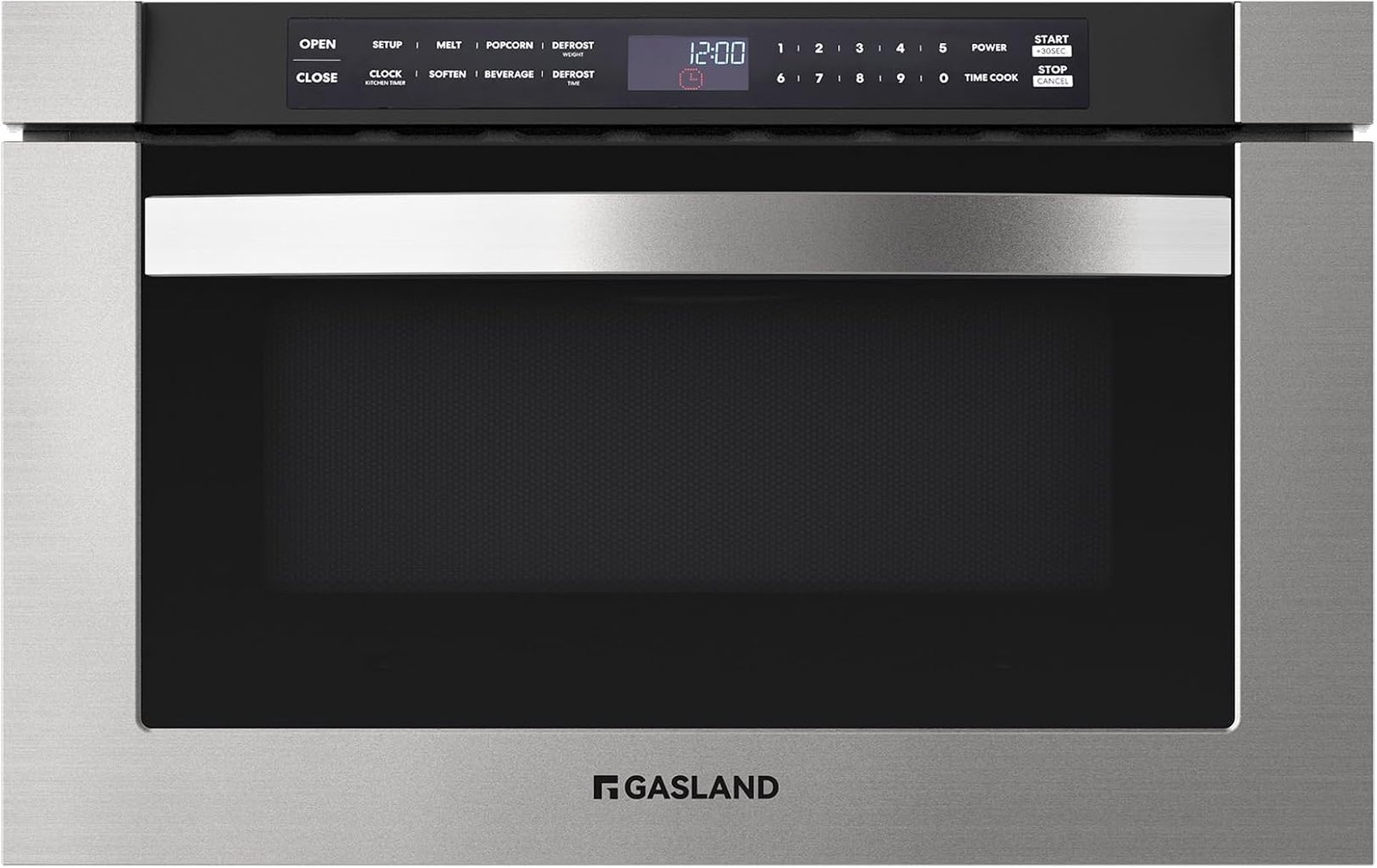
GASLAND’s 24-inch BMD2412S enters this category with a focused specification: 1.2 cubic feet of stated capacity, 1,000 watts, 10 power levels, one-touch automatic door operation, anti-pinch protection, child locking and a silent mode. The manufacturer currently lists it at $1,099.99.
Our score is 8.19/10. Customer Sentiment is 7.84, Buyer Confidence reaches 9.48 and Value stands at 7.91. The pattern is revealing. This is a product that can be evaluated with relatively high confidence, while its value remains constrained by a basic reality of the category: microwave drawers charge substantially for architecture and integration, not merely the ability to heat food.
What GASLAND Is Offering
The GASLAND BMD2412S product page identifies the appliance as a 24-inch built-in microwave drawer. GASLAND specifies a 1.2-cubic-foot cavity, 1,000 watts and 10 power levels. It also lists one-touch automatic opening, anti-pinch protection, a child lock and silent operation.
That is a sensible collection of features for a drawer microwave because most of them address the format itself rather than padding the specification sheet.
Automatic opening matters because the cavity moves horizontally out of the cabinet. Anti-pinch protection addresses interaction with that moving drawer. A child lock becomes more relevant when controls are positioned below a countertop rather than above a range. Silent mode acknowledges that an appliance can become irritating through repetitive beeps even when its cooking performance is perfectly adequate.
The BMD2412S is therefore not trying to disguise itself as a second oven. GASLAND describes microwave functions rather than presenting the machine as a convection, broiling or air-frying replacement.
For a kitchen that already has a conventional oven, that narrower mission can be rational. A microwave drawer earns its cabinet space through placement and convenience rather than by accumulating cooking modes.
The 1,000-Watt Specification Is Sensible
GASLAND rates the BMD2412S at 1,000 watts and provides 10 power levels.
Those figures are more meaningful together than separately.
Microwave power levels allow the magnetron’s effective cooking intensity to be moderated for tasks that should not simply receive maximum power continuously. Defrosting is an obvious example. So are foods that need gentler reheating to reduce the difference between an overheated exterior and a cold center.
Ten settings give the user familiar control without requiring an unusual operating method.
The 1,000-watt rating also places the GASLAND in a familiar range for household microwave instructions. Buyers should still follow package directions and adjust time according to results because food composition, quantity, shape and starting temperature affect heating.
A wattage number alone cannot guarantee uniform cooking. It can, however, make comparisons easier. GASLAND’s stated figure is cooking-related information a buyer can use directly rather than a vague description such as “high power.”
Capacity Requires More Thought Than the Number Suggests
The stated capacity is 1.2 cubic feet. GASLAND says the cavity can accommodate a range of dish sizes and containers, including a large dinner plate.
Yet cubic-foot measurements have an obvious limitation: nobody cooks a cubic foot.
Real kitchens use plates with rims, casserole dishes with handles, mugs with protruding handles and storage containers with tall lids. Shape can matter more than nominal volume.
That makes cookware measurement one of the more useful steps in a microwave buying guide. Before a built-in appliance is ordered, the household should identify the largest objects that routinely enter its existing microwave and compare those dimensions with the installation and interior documentation for the replacement.
This matters more with a drawer because the loading geometry changes.
A conventional microwave accepts cookware through a vertical front opening. A drawer is approached from above. The user lowers the container into the cavity and later lifts it vertically. That can feel considerably different with a large bowl or casserole.
Capacity therefore has two dimensions: what physically fits and what can be comfortably lowered into the appliance.
One-Touch Opening Is Central to the Experience
GASLAND describes the BMD2412S as having a one-touch automatic door. A press initiates opening rather than requiring the user to pull the drawer manually.
That is more than a decorative flourish.
A microwave drawer exists precisely because its cavity moves toward the user. Powered operation makes that motion part of the appliance rather than asking the user to treat the microwave like an ordinary kitchen drawer.
The arrangement can be useful when carrying a bowl with both hands. It also reduces the need to grip a handle while opening the appliance.
The trade-off is mechanical complexity. A traditional microwave door is mechanically simple compared with a motorized drawer. The BMD2412S therefore gives convenience in exchange for a more elaborate opening mechanism.
No responsible review can convert that fact into a prediction about reliability without service data. It does, however, mean that buyers should pay attention to warranty coverage and local support because the drawer mechanism is central to everyday operation.
The Anti-Pinch Design Is More Than a Footnote
GASLAND explicitly lists an anti-pinch design alongside its child-lock feature.
That pairing makes sense.
A drawer microwave creates a moving horizontal surface at approximately base-cabinet height. Hands can be near the front edge when it closes, and young children may have easier physical access to a low microwave than to one mounted over a range.
An anti-pinch design addresses the moving hardware. The child lock addresses unintended control operation. They solve different problems.
Neither feature eliminates the need for ordinary supervision or careful placement. An open microwave drawer can still extend into a walkway, and hot containers remain hot regardless of how sophisticated the closing mechanism is.
Still, safety features that correspond directly to the appliance’s physical design deserve more weight than novelty presets that may rarely be used.
Silent Mode Solves a Small but Repetitive Problem
Silent mode will never dominate an appliance brochure in the way capacity or wattage does, yet it can have disproportionate everyday value.
GASLAND lists silent mode among the BMD2412S’s standard features.
Microwaves generate interaction sounds frequently: button presses, completion signals and alerts. In a closed kitchen at midday, those noises may barely register. In an open-plan home, small apartment or kitchen used while others are sleeping, they can become more conspicuous.
Silent mode does not improve heating. It improves coexistence.
That distinction illustrates a broader point about appliance evaluation. Some features affect performance; others reduce friction. An appliance used several times every day can benefit substantially from reducing small irritations, even when those improvements never appear in a cooking test.
The Low Position Changes Ergonomics
Drawer microwaves are sometimes described as inherently more ergonomic than conventional machines. That claim is too broad.
Their ergonomics are different.
An over-the-range microwave requires hot food to be lifted at chest or shoulder height. For a heavy bowl of soup, that can be awkward. A drawer keeps the vessel below the countertop, allowing the user to look downward into the cavity and lift the food vertically.
That arrangement can be preferable for users who dislike reaching overhead with hot dishes.
The opposite problem also exists. Someone with limited ability to bend, reach downward or lift from a low position may prefer a microwave installed closer to chest height.
The GASLAND should therefore be evaluated at its planned installation height before cabinetry is finalized.
A simple simulation works: place a moderately heavy bowl on a low shelf at approximately the proposed drawer height, approach it with both hands, and repeat the motion of lowering and lifting it. The body will answer the ergonomic question faster than marketing language can.
Installation Is Part of the Purchase
GASLAND identifies the BMD2412S as a built-in appliance. Its product page also provides access to an electronic installation manual and advises reading the instructions before installation.
That designation should be taken literally.
A built-in microwave is not a countertop machine that happens to be surrounded by wood. Cabinet openings, ventilation, electrical access, structural support and drawer clearance have to be planned around the exact appliance.
The product page currently lists an item weight of 78.3 pounds. That alone argues for treating cabinet support seriously.
One published specification on the same page deserves caution: the technical-details section displays product dimensions of 28.9 by 30.1 by 20.9 inches despite the product being marketed as a 24-inch model. Those figures may describe packaging or another measurement convention rather than the required cabinet opening.
For installation, the current manual and cutout drawing should therefore take precedence over a retailer-style dimensions field. Cabinetry should never be fabricated from the phrase “24 inch” alone.
This is precisely where built-in appliance mistakes become expensive. A quarter-inch error in a countertop microwave barely matters. A wrong cabinet cutout can involve a carpenter.
Aisle Clearance Deserves Its Own Measurement
The microwave has to fit when closed, but the kitchen has to function when it is open.
That distinction is particularly relevant on an island.
A drawer extends toward the person using it. If a dishwasher, refrigerator, opposing cabinet or seating position is nearby, two independently reasonable design choices can collide once their doors are opened simultaneously.
Before installation, the buyer should mark the microwave location on the floor and represent the open drawer using the dimensions in the current installation manual. Then the surrounding kitchen should be used normally.
Can another person pass behind the user? Can the dishwasher open at the same time? Does the drawer project into a primary route between the refrigerator and range? Can an island stool interfere with it?
These questions are mundane. They also determine whether the appliance feels thoughtfully integrated or perpetually in the way.
Cleaning Is Easier in Some Places and Harder in Others
GASLAND describes the BMD2412S interior as easy to clean. The drawer format can indeed simplify access to the cavity floor because the bottom moves outward and can be viewed from above.
The upper interior is less conveniently positioned.
Cleaning the ceiling of an under-counter cavity may require bending and reaching into the open drawer. A conventional countertop microwave puts that surface closer to eye level.
The FDA’s microwave-oven safety guidance recommends regularly cleaning the cavity, cavity edges and door with water and mild detergent. It says a special microwave cleaner is unnecessary and advises against abrasive materials such as steel wool and scouring pads.
That guidance is relevant to any microwave, drawer or otherwise. Keeping sealing surfaces clean also makes it easier to inspect the appliance for physical damage.
Radiation Is Not a Special Drawer-Microwave Problem
Placing a microwave below the counter sometimes creates unnecessary concern about radiation because the machine sits closer to parts of the body than an over-the-range model.
The regulatory framework addresses microwave ovens regardless of that kitchen-design choice.
The FDA says it has regulated microwave-oven manufacturing since 1971 and requires manufacturers to certify compliance with federal safety-performance standards. The agency states that microwave ovens meeting its standard and used according to manufacturer instructions are considered safe.
Federal rules limit leakage throughout an oven’s lifetime to 5 milliwatts of microwave radiation per square centimeter at approximately two inches from the surface. The FDA states that this limit is “far below the level known to harm people.”
The standard also requires two independent interlock systems that stop microwave production when the latch is released or the door opens, plus a monitoring system addressing interlock failure.
The agency reports that most microwave-related injuries are heat-related burns involving hot containers, overheated food or exploding liquids rather than radiation injuries.
That shifts attention back to practical kitchen behavior: handling hot dishes carefully, keeping the appliance undamaged and following the manufacturer’s instructions.
The One-Year Warranty Is a Limitation
GASLAND currently includes one year of standard protection with the BMD2412S and identifies the appliance as carrying a one-year warranty. The manufacturer also offers paid extensions through its direct store.
One year is not unusually protective for a built-in appliance with a powered drawer mechanism.
That does not establish anything about expected reliability. Warranty length and product lifespan are different measures. It does mean that manufacturer-funded coverage ends relatively early unless additional protection is purchased.
The issue matters more here than with a cheap countertop microwave because removing a built-in drawer can involve more labor and inconvenience.
Service availability should therefore be investigated before the appliance is installed. A warranty is partly a legal promise and partly a logistical system; the second part determines how convenient that promise is to use.
Price and Value Need to Be Separated
GASLAND currently lists the BMD2412S at $1,099.99.
That price buys a 1.2-cubic-foot, 1,000-watt microwave. Viewed only through cooking output and capacity, the economics look difficult because ordinary countertop microwaves can provide similar fundamental heating capability for far less money.
But cooking output is not the only product being purchased.
The buyer is also paying to move the microwave into base cabinetry, remove it from the countertop or upper sightline, gain top-loading access and obtain a motorized drawer format.
That is why value depends so heavily on the kitchen.
If an island already has a properly planned microwave-drawer opening, the GASLAND can perform a spatial function that a countertop model cannot perform as neatly. If the kitchen would need substantial cabinet reconstruction merely to accommodate it, the effective cost rises beyond the appliance price.
Our Value score of 7.91 reflects that tension.
Our Score: 8.19/10
Our overall rating of 8.19/10 recognizes a focused appliance with a coherent feature set.
The BMD2412S combines 1.2 cubic feet of stated capacity, 1,000 watts, 10 power levels, automatic opening, anti-pinch protection, a child lock and silent mode. Those features fit the realities of a microwave drawer rather than simply creating a longer checklist.
The limitations are equally concrete.
The one-year standard warranty is modest. Built-in installation requires planning. The 78.3-pound listed weight makes structural support relevant. Low positioning will not suit every user. The manufacturer’s displayed dimensions field should not substitute for the installation manual when cabinetry is being fabricated.
An 8.19 score therefore represents a favorable assessment without pretending the drawer format makes sense in every kitchen.
Customer Sentiment: 7.84
Customer Sentiment stands at 7.84, below the overall score.
That difference fits the nature of the product. Microwave drawers invite strong reactions because their usefulness is tied closely to installation height, cabinet placement and household habits.
A buyer who wants to remove a microwave from a crowded counter may see immediate value. Someone expecting a 1.2-cubic-foot microwave to deliver radically different cooking results because it costs more than a countertop unit may be disappointed.
The distinction is architectural rather than culinary.
A drawer also introduces habits that are unfamiliar at first: looking down into the cavity, lifting containers vertically and waiting for a motorized opening mechanism. Those are not inherently better or worse actions. They simply fit some kitchens and bodies more naturally than others.
The 7.84 Customer Sentiment score captures that variability.
Buyer Confidence: 9.48
Buyer Confidence is the strongest editorial metric at 9.48.
GASLAND publishes the central specifications needed to understand what is being purchased: model identification, capacity, power, power levels, automatic opening, anti-pinch functionality, child locking, silent mode, warranty duration and an installation-manual route are all available from the manufacturer.
That supports a high-confidence buying assessment.
The score does not mean the appliance is suitable for every household. It means the decision can be made from identifiable criteria rather than guesswork.
Buyers can determine whether 1.2 cubic feet is enough. They can decide whether 1,000 watts meets their needs. They can assess whether silent mode or anti-pinch functionality matters. They can verify the cabinet against the manual before ordering.
Built-in appliances reward that kind of certainty because dimensional mistakes are disproportionately expensive.
Value: 7.91
Our Value rating of 7.91 sits below Buyer Confidence for a reason.
The BMD2412S is easy to understand, but understanding it does not erase the price premium inherent in the drawer format.
At $1,099.99 on the manufacturer’s current site, the appliance needs to solve a spatial or ergonomic problem to make economic sense.
Its value improves when it frees scarce counter space, allows an island installation, avoids putting a microwave above the range or gives the household a preferred top-loading workflow.
Its value weakens when none of those benefits matter.
That is not a criticism unique to GASLAND. It is the economic structure of microwave drawers generally. Buyers are purchasing cabinetry integration alongside microwave cooking.
Who Is the GASLAND BMD2412S For?
The product has a relatively clear buyer profile:
- A household planning a 24-inch built-in microwave-drawer location.
- A kitchen where counter or upper-cabinet space carries meaningful value.
- Buyers who want 1,000-watt cooking and 10 selectable power levels.
- Users who value automatic drawer opening.
- Households where anti-pinch protection and child locking are desirable.
- Open-plan homes where silent mode may reduce unnecessary appliance noise.
- Users comfortable loading and unloading cookware below counter height.
The weaker fit is equally identifiable.
Price-focused buyers who simply need reheating capability can find far cheaper microwave formats. People who find bending difficult should test the proposed installation height. Renters and households expecting to move appliances frequently gain little from a built-in configuration. Kitchens requiring major cabinet alterations should calculate those construction costs before judging the appliance’s price.
What to Check Before Buying
A disciplined pre-purchase inspection should include more than checking whether the cabinet is nominally 24 inches wide.
The buyer should verify:
- The exact cutout dimensions in the current BMD2412S installation manual.
- Cabinet depth and structural support.
- Electrical outlet location and electrical requirements.
- Full drawer projection into the aisle.
- Clearance from a dishwasher, refrigerator or opposing cabinet.
- Frequently used cookware against the cavity dimensions.
- Comfortable lifting from the proposed installation height.
- Local warranty and service arrangements.
- The practical cost of cabinet modification, if required.
- Whether a future replacement could fit the same opening without major reconstruction.
That checklist is less exciting than comparing presets, but built-in appliances punish casual measurement.
Final Considerations
The GASLAND 1.2 cu. ft. microwave drawer is most persuasive when evaluated as a kitchen-planning tool that also happens to cook with microwaves.
Its core numbers are straightforward: 1.2 cubic feet, 1,000 watts and 10 power levels. GASLAND adds features that make sense for the physical format, including one-touch automatic opening, anti-pinch protection, a child lock and silent mode. The manufacturer currently lists a one-year warranty and a $1,099.99 price.
Our scores reflect that balance. The 8.19/10 overall rating recognizes a focused and credible specification. Customer Sentiment at 7.84 reflects the reality that drawer ergonomics and installation will suit some households better than others. Buyer Confidence at 9.48 is the standout because the central buying criteria can be identified before installation. Value at 7.91 acknowledges that a four-figure microwave needs to solve more than a reheating problem.
The BMD2412S is therefore easiest to justify in a kitchen where its location has a purpose. An island installation can preserve counter space. Below-counter placement can remove a microwave from the main sightline. Top loading can reduce overhead handling of hot containers. Automatic opening and silent mode can remove small pieces of daily friction.
None of those advantages eliminates the trade-offs. The appliance is heavy, built-in installation demands accurate measurements, low placement will not suit every body, and the one-year standard warranty is relatively brief.
The decision should begin with the cabinet and the household rather than the feature list. Measure the opening. Map the drawer’s movement into the aisle. Test the installation height with a heavy bowl. Confirm electrical requirements. Read the current manual before cabinetry is fabricated.
When those pieces align, the GASLAND BMD2412S has a coherent reason to exist: it relocates a familiar appliance into a part of the kitchen where a conventional microwave cannot function as gracefully. When those pieces do not align, 1,000 watts and 1.2 cubic feet remain available in simpler, less expensive forms.