An over-the-range microwave is purchased as a cooking appliance, but it lives more like a piece of kitchen architecture. Once installed, it must coexist with cabinetry, the range below it, electrical infrastructure, ventilation arrangements, cookware, sightlines, and the daily choreography of a working kitchen. Capacity matters. Price matters. Yet neither tells the whole story.
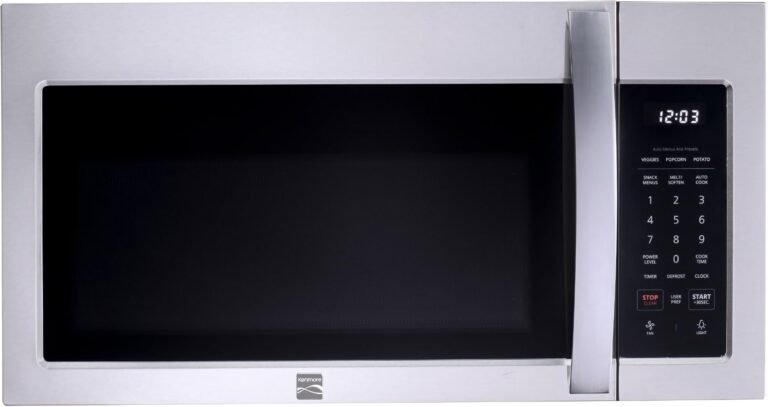
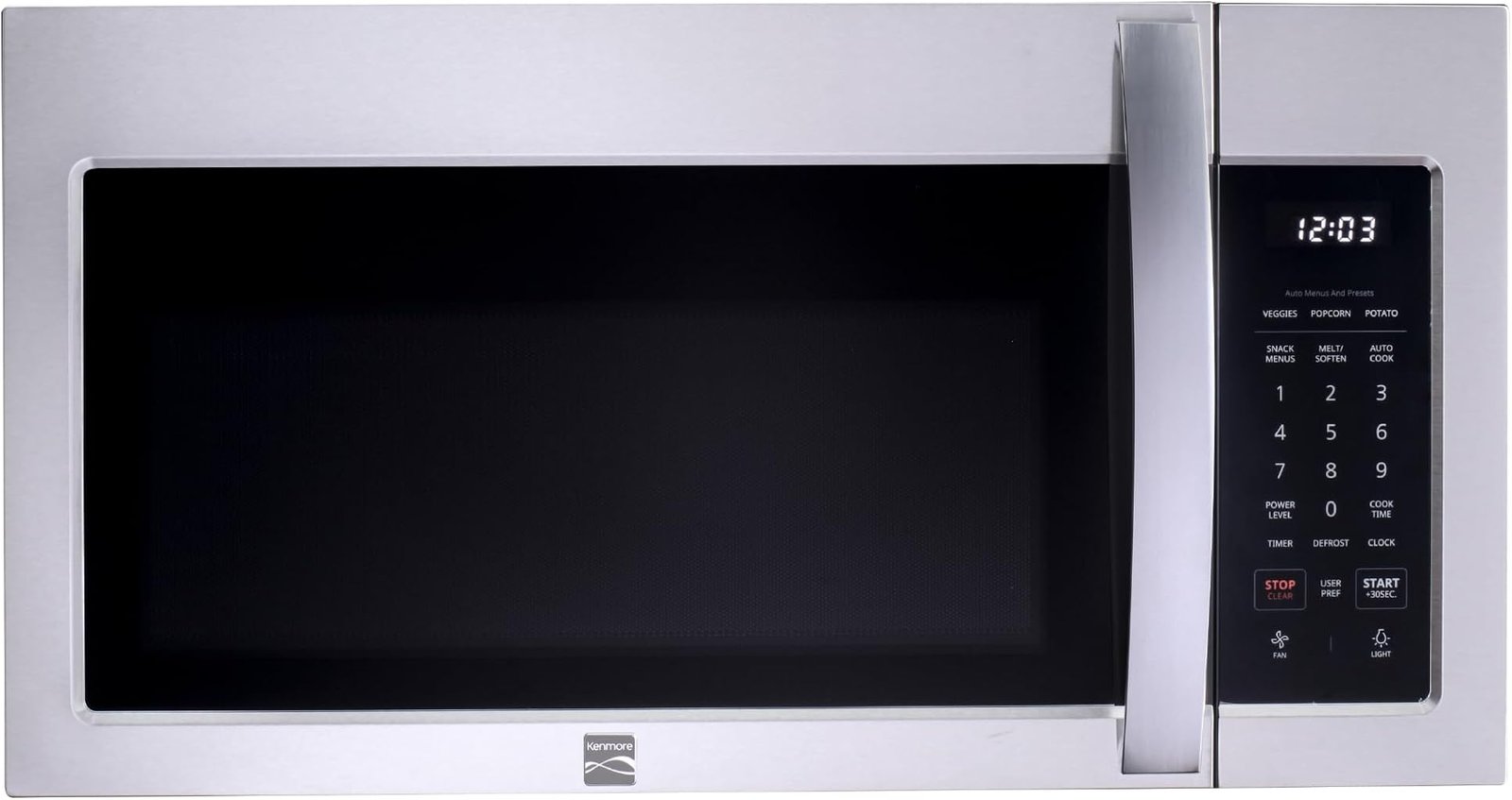
The Kenmore 1.7 cu. ft. Over-the-Range Microwave enters that equation at $399.99, with a stainless-steel finish and 1.7 cubic feet of stated interior capacity. Those facts establish a relatively straightforward proposition: this is a mid-capacity over-the-range appliance intended for buyers who want microwave functionality moved away from the countertop and integrated above the cooking area.
Our Score is 8.13/10. Customer Sentiment stands at 8.06, Buyer Confidence at 8.43, and Value at 8.03. The closeness of those four figures is revealing. No single rating races dramatically ahead of the others. Instead, the Kenmore presents a fairly balanced editorial profile, with Buyer Confidence providing the strongest measure and Value landing slightly below the overall score.
That balance is useful because the Kenmore 1.7-cu.-ft. over-the-range microwave is not an appliance that should be judged from capacity alone. At nearly $400, the decision has to account for installation compatibility, practical cavity requirements, kitchen layout, and the economic consequences of replacing or mounting an appliance above a range.
The result is a product with a credible buyer profile, but not one that rewards casual shopping.
The 1.7-Cubic-Foot Capacity Sits in a Practical Middle Ground
A stated capacity of 1.7 cubic feet sounds precise. In practical use, it is better understood as a broad indicator of available interior volume rather than a guarantee that every large plate, bowl, or casserole dish will fit.
Microwave cavities are three-dimensional spaces with specific proportions. Two appliances can advertise similar cubic-foot capacities while differing in internal width, depth, height, turntable diameter, and door geometry. A rectangular baking dish can therefore fit comfortably inside one 1.7-cu.-ft. microwave and awkwardly inside another.
That reality matters for the Kenmore because 1.7 cubic feet is one of its central specifications.
For households primarily reheating individual dinner plates, bowls, beverages, leftovers, vegetables, and ordinary meal containers, 1.7 cubic feet represents substantial nominal volume. Families using wider serving dishes or unusually tall vessels should go one step further and compare their cookware with the exact interior measurements of the appliance before purchase.
This is where an effective microwave buying guide departs from retail shorthand.
Cubic feet should be the opening question, not the final answer. Buyers should measure the dishes they actually use. The diameter of the household’s largest dinner plate, the width of its most frequently reheated casserole dish, and the height of covered storage containers can reveal more about day-to-day compatibility than a capacity figure printed on a product page.
That exercise costs nothing and can prevent a $399.99 mistake.
Over-the-Range Placement Changes the Economics
A freestanding countertop microwave can usually be moved with little drama. An over-the-range microwave asks for more commitment.
Its location is fixed. Installation can involve mounting hardware, upper cabinetry, an electrical connection, clearances, and a ventilation arrangement. Replacing the appliance later may involve labor that would never enter the ownership calculation for a countertop unit.
This difference makes the Kenmore’s $399.99 purchase price only one component of the actual cost.
A buyer replacing an existing over-the-range microwave should first establish whether the available opening, cabinet configuration, mounting conditions, and electrical arrangement suit the Kenmore. Existing hardware should not automatically be assumed compatible simply because another microwave already hangs in the same location.
The same discipline applies to a first installation. The wall, upper cabinet, range location, electrical access, and required clearances should be evaluated according to the instructions for the exact model.
This is not bureaucratic caution. It is basic cost control.
An appliance purchased at the right price can become expensive if cabinetry must be modified unexpectedly. Conversely, a $399.99 microwave that integrates cleanly into an existing compatible installation can make more economic sense than a less expensive unit requiring substantial alterations.
Value in the over-the-range category is therefore inseparable from fit.
Why Our Score Lands at 8.13/10
We rate the Kenmore at 8.13/10.
That score reflects a product whose stated fundamentals are coherent: 1.7 cubic feet of capacity, an over-the-range format, stainless-steel presentation, and a $399.99 price. The configuration addresses a recognizable household need without relying on extravagant positioning.
The score also leaves room between a good overall proposition and a product that would make equal sense for every buyer.
Over-the-range appliances are unusually dependent on the surrounding kitchen. The same Kenmore can be a rational replacement in one home and an unnecessarily complicated purchase in another. A household with a compatible installation and a need for 1.7 cubic feet of microwave capacity has a much clearer case than someone beginning with an empty wall and no established mounting or ventilation plan.
Our Customer Sentiment score of 8.06 sits close to the 8.13 overall rating. Value is similarly close at 8.03.
Buyer Confidence reaches 8.43, the highest of the four editorial measures. That difference is modest but meaningful. The product’s basic identity is easy to understand, and the capacity, price, finish, and appliance type create a defined purchasing proposition.
Confidence, however, should not be mistaken for universal fit.
The buyer still has to establish whether this particular microwave belongs in this particular kitchen.
The $399.99 Price Requires a Whole-Kitchen View
Price comparisons among microwaves can become misleading very quickly.
A basic countertop model and an installed over-the-range appliance both heat food using microwave energy, but the ownership experience is different. One takes up work surface and plugs into an accessible outlet. The other becomes part of the kitchen structure.
The Kenmore’s $399.99 price should therefore be evaluated in relation to what the household is trying to achieve.
If the objective is simply obtaining microwave capability for the lowest possible expenditure, an installed over-the-range model introduces costs and complexity that may not be necessary.
If the objective is removing a microwave from the counter while using the area above a range for an installed appliance, the calculation changes. Counter space itself has practical value, particularly in kitchens where preparation area is limited.
The financial assessment should also include installation labor where required, possible electrical work, disposal of an existing appliance, mounting requirements, and any changes needed around cabinetry or ventilation.
That broader accounting explains our Value rating of 8.03.
The score is favorable, but it does not treat $399.99 as an isolated number. Value is created when the appliance fits the kitchen and the household uses the advantages associated with its installation format.
Stainless Steel Solves an Aesthetic Problem, Not a Functional One
The Kenmore uses a stainless-steel finish, placing it within a familiar kitchen design language.
That can matter more for an over-the-range appliance than for a microwave hidden on a utility shelf. Installed above the cooking area, the microwave becomes a prominent visual object. Its relationship with the range, refrigerator, dishwasher, cabinetry, and hardware can affect how coherent the kitchen appears.
Still, stainless steel should remain in its proper place in the purchasing hierarchy.
A finish does not establish cooking performance, heating consistency, durability, fingerprint resistance, cleaning characteristics, or corrosion behavior unless those properties are documented for the exact surface treatment involved.
The defensible observation is narrower: stainless steel gives the Kenmore a finish commonly associated with contemporary appliance suites and allows it to coordinate visually with many existing kitchens.
That is useful, but dimensions and installation suitability deserve priority.
A microwave that matches the refrigerator but does not fit the cabinet opening is an expensive piece of visual harmony.
Installation Measurements Should Come Before Feature Comparisons
The most productive shopping process begins with a tape measure rather than a feature list.
For an over-the-range microwave, the household should verify:
- The available width, height, and depth.
- Cabinet construction above the intended location.
- Required mounting arrangement.
- Electrical access and applicable requirements.
- Clearances specified for the exact appliance.
- Existing ventilation configuration where relevant.
- Compatibility with surrounding cabinetry and the cooking surface.
- Interior space required by frequently used cookware.
This sequence reverses the way appliances are often marketed. Retail pages encourage shoppers to begin with features, finishes, and capacity. Installation reality is less forgiving.
Physical compatibility is binary in ways that convenience features are not.
A household can live without a favorite preset button. It cannot negotiate with a cabinet opening that is too narrow or a mounting arrangement that does not meet the manufacturer’s requirements.
The Kenmore’s 1.7-cu.-ft. capacity becomes relevant after those questions are answered.
Microwave Safety Has Decades of Federal Oversight
Microwave ovens sometimes attract anxiety because the word “radiation” sounds more alarming than the physics warrants. Federal oversight offers useful historical and technical context.
The U.S. Food and Drug Administration has regulated microwave oven manufacturing since 1971. Manufacturers are required to certify their products and comply with federal safety-performance standards, and the FDA states that microwave ovens meeting its standard and used according to manufacturer instructions are considered safe based on current knowledge.
The federal standard is quantitative rather than rhetorical. It limits microwave leakage throughout an oven’s lifetime to 5 milliwatts per square centimeter at approximately two inches from the oven surface. The FDA also requires two independent interlock systems that stop microwave production when the door opens or the latch is released.
Distance further reduces exposure. The FDA states that a measurement taken 20 inches from an oven would be approximately one-hundredth of the value measured at two inches.
Those standards apply to microwave ovens generally, rather than indicating a special concern about this Kenmore.
For owners, the more immediate safety issue is appliance condition and proper operation. Doors, latches, seals, and hinges should remain undamaged, and manufacturer instructions should govern use and installation.
The practical lesson is less dramatic than popular fears surrounding microwave radiation. A correctly manufactured and properly used microwave operates within a long-established federal safety framework.
Food Safety Is a Different Question From Appliance Safety
An electrically safe microwave can still heat food unevenly.
That distinction is central to responsible microwave use. The appliance’s safety systems concern the operation of the machine; food safety concerns whether the meal reaches an appropriate temperature throughout.
The USDA explains that microwave ovens can leave cold spots where harmful bacteria may survive. The agency recommends stirring, rotating, or turning food where possible during microwave cooking, even when the oven has a turntable. It also advises observing standing time and checking food in several places with a thermometer.
The USDA’s temperature guidance is specific. Ground meats should reach 160°F, poultry 165°F, and fish 145°F. For microwave reheating, leftovers should reach 165°F.
These figures are more useful than judging food by steam, touch, or appearance.
A plate can feel extremely hot at its edges while remaining cooler at the center. Dense foods can retain substantial temperature differences. Stirring and standing time allow heat to redistribute, while a food thermometer provides evidence that visual inspection cannot.
None of this is unique to the Kenmore. It does, however, establish a broader point about microwave shopping: capacity and price matter before purchase, but technique matters after installation.
Capacity Should Be Matched to Actual Household Behavior
The phrase “1.7 cubic feet” becomes more useful when translated into habits.
How many people regularly use the microwave? Are meals reheated one plate at a time? Does the household prepare large casseroles? Are tall storage containers common? Does someone routinely microwave oversized bowls? Is the appliance used mainly for leftovers, beverages, frozen meals, vegetables, or more substantial cooking?
These questions are mundane, which is precisely why they work.
Appliance purchases often become distorted by the instinct to buy more capacity simply because more appears safer. Extra interior space can be useful, but unused capacity does not automatically improve the ownership experience.
Conversely, buying too little space creates a daily irritation that no attractive finish can repair.
At 1.7 cubic feet, the Kenmore sits in a useful middle position conceptually. It is not defined as an unusually compact microwave, nor is its identity built around maximum stated volume. That makes cookware measurement especially worthwhile because the capacity figure alone does not reveal the usable geometry.
The household’s largest routinely microwaved dish should be the reference object.
Buyer Confidence of 8.43 Deserves Context
Our Buyer Confidence score is 8.43, compared with an Our Score of 8.13, Customer Sentiment of 8.06, and Value of 8.03.
The spread is narrow. That matters.
A product with wildly divergent scores can signal a polarized proposition: perhaps attractive pricing paired with uncertain fit, or impressive features paired with weak value. The Kenmore’s ratings cluster within four-tenths of a point.
That suggests a more stable editorial profile.
Buyer Confidence leads because the appliance has a readily identifiable purpose. A shopper seeking a stainless 1.7-cu.-ft. over-the-range microwave at roughly $400 can quickly determine whether the basic proposition aligns with the kitchen.
Value lands slightly lower because price cannot be separated from installation. Customer Sentiment at 8.06 is similarly positive while leaving enough distance from the confidence score to prevent the product from being treated as an automatic choice.
Our 8.13 overall assessment sits appropriately between those measures.
The editorial case is therefore one of balance rather than spectacle.
Who Is the Kenmore Best Suited To?
The Kenmore makes the clearest case for a household already committed to an over-the-range layout.
That includes replacement buyers whose kitchens are already configured for this appliance category, as well as renovation projects where moving microwave functionality away from the counter is a deliberate design decision.
The 1.7-cu.-ft. stated capacity makes the model relevant to households wanting more than a compact microwave cavity without making sheer volume the defining objective.
The stainless finish also fits naturally into kitchens built around similar appliance surfaces.
A different buyer profile should approach more cautiously.
Someone whose only objective is inexpensive microwave cooking has little reason to accept the installation demands of an over-the-range appliance. A household using unusually large cookware should verify interior dimensions before assuming that 1.7 cubic feet guarantees compatibility. Renters should also consider whether permanent installation is permitted and economically sensible.
The buyer fit is therefore fairly precise: this Kenmore is strongest when the kitchen already points toward an installed over-the-range solution.
Where the Product’s Trade-Offs Become Most Visible
Every appliance format exchanges one inconvenience for another.
A countertop microwave sacrifices work surface but gains portability and installation simplicity. An over-the-range microwave recovers counter area but introduces mounting and placement constraints.
The Kenmore follows that pattern.
Its $399.99 price is not trivial. The appliance should therefore solve more than the problem of heating food. Its value becomes more persuasive when reclaiming countertop space, integrating the microwave into the cooking zone, and maintaining a stainless appliance aesthetic all matter to the household.
Capacity presents another trade-off. At 1.7 cubic feet, the microwave offers a substantial stated cavity, but buyers still need exact interior dimensions for cookware-specific decisions.
Installation introduces the third trade-off. Once mounted, the appliance is less casually replaceable than a freestanding microwave.
These are not defects in the conventional sense. They are consequences of the format.
The correct editorial question is not whether those consequences exist. It is whether the household gains enough from the installed configuration to justify them.
A More Rational Way to Make the Purchase
The buying process can be reduced to a sequence of physical and financial checks.
First, establish installation compatibility. Measure the opening and surrounding cabinetry, then compare those measurements with the current documentation for the exact Kenmore model.
Second, inspect the electrical and mounting environment. A preexisting over-the-range microwave does not guarantee automatic compatibility with a replacement.
Third, measure actual cookware. The household’s largest plates, bowls, and frequently used containers should fit the microwave rather than merely fitting an abstract capacity category.
Fourth, calculate total acquisition cost. The $399.99 appliance price should be combined with any installation, electrical, cabinetry, disposal, or related expenses.
Finally, consider how much the household values recovered countertop space. That benefit is difficult to express in dollars, but in a compact kitchen it can be more consequential than an additional preset or cosmetic detail.
This process strips away much of the noise surrounding appliance shopping.
Final Considerations
The Kenmore 1.7 cu. ft. Over-the-Range Microwave earns an Our Score of 8.13/10 because its core proposition is balanced: a 1.7-cu.-ft. stated capacity, stainless-steel finish, installed over-the-range format, and $399.99 price create a recognizable product for a recognizable buyer.
Customer Sentiment at 8.06 sits close to the overall rating. Value at 8.03 reflects a product whose economics depend partly on installation compatibility rather than purchase price alone. Buyer Confidence at 8.43 is the strongest of the four measures, reflecting the relative clarity of the buying proposition.
The central limitation is not a dramatic flaw. It is the same constraint that defines every installed appliance: the kitchen gets a vote.
A buyer should know the available dimensions, mounting conditions, electrical arrangement, relevant clearances, and cookware requirements before committing. The household should also calculate installation expenses alongside the $399.99 purchase price.
Food-safety habits deserve equal discipline after installation. USDA guidance on cold spots, stirring, standing time, thermometer use, and reheating leftovers to 165°F demonstrates why microwave performance cannot be judged only by whether food feels hot.
For households already seeking an over-the-range configuration, the Kenmore presents a coherent middle-capacity option with closely aligned editorial scores. For buyers who simply need inexpensive microwave capability, its installed format creates complexity they may not need.
That distinction defines the review. The Kenmore is not compelling because every kitchen needs a 1.7-cu.-ft. microwave above the range. It is compelling when the kitchen, cookware, budget, and household habits already point toward that configuration.
At $399.99, that fit should be established before purchase rather than discovered afterward.