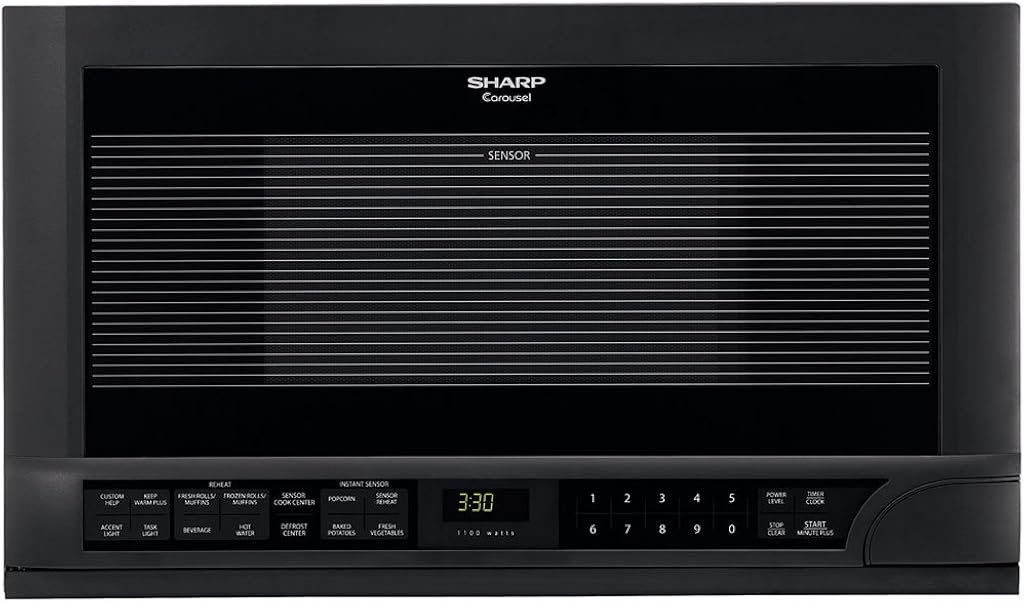
Microwave design usually forces a household into one of several familiar compromises. A countertop model consumes work surface. A built-in installation demands suitable cabinetry. An over-the-range microwave shares space with cooking ventilation and must satisfy another set of mounting requirements. The Sharp R1210TY takes a less common route: it is an over-the-counter microwave designed to mount beneath cabinetry while preserving the counter below.
That architecture is the central fact behind this appliance.
The Sharp R1210TY combines 1.5 cubic feet of stated capacity with 1,100 watts of cooking output and a black finish. Sharp lists product dimensions of 23 7/8 inches wide, 14 1/16 inches high, and 15 9/16 inches deep. Inside is a 14 1/8-inch Carousel turntable, which Sharp says can hold a 9-by-13-inch dish. The manufacturer also specifies 11 Sensor Cook settings, four sensor-reheat options, four defrost options, task lighting, 11 cooking power levels, a child safety lock, and a keep-warm function.
At $399, the R1210TY is not positioned like a basic countertop microwave. Its argument rests instead on placement flexibility, usable cavity size, and reclaiming countertop space without moving into a conventional over-the-range arrangement.
Our Score is 7.71/10. Customer Sentiment is 7.4, Buyer Confidence reaches 8.61, and Value is 7.67. Those figures describe a microwave with a convincing specialist purpose but a narrower audience than a conventional countertop appliance.
The distinction matters. This is not merely a $399 microwave. It is a particular answer to a kitchen-layout problem.
Over-the-Counter Is More Than a Naming Detail
“Over-the-counter” sounds deceptively similar to “over-the-range.” The two descriptions should not be treated as interchangeable.
Sharp positions the R1210TY as an under-cabinet, over-the-counter design intended to free countertop space. The manufacturer’s current product documentation states that the configuration works with standard cabinet sizes and does not require a built-in kit or shelf. The appliance also incorporates under-cabinet task lighting.
That creates a distinct use case.
A normal countertop microwave is straightforward to place but takes up counter area. In a small kitchen, that footprint competes with food preparation, coffee machines, mixers, storage containers, and every other object seeking permanent residence near an electrical outlet.
The R1210TY moves microwave capacity upward.
That can be particularly relevant in apartments, smaller kitchens, offices, secondary kitchens, and remodeling projects where usable countertop area is disproportionately valuable. Yet the design should not be mistaken for universal installation freedom. A microwave weighing dozens of pounds and installed beneath cabinetry remains an appliance whose mounting requirements deserve careful attention.
Sharp’s installation documentation should therefore govern placement rather than assumptions derived from photographs or nominal dimensions. The unusual configuration is the product’s defining advantage, but it is also the reason installation planning matters more than it would with a portable countertop box.
The 1.5-Cubic-Foot Cavity Is More Practical Than the Label Suggests
Microwave capacity measurements are useful but incomplete. The shape of the cavity and the dimensions of the rotating platform often tell a buyer more about everyday usability.
Sharp specifies a 1.5-cu.-ft. cavity measuring 17 1/2 inches wide, 14 15/16 inches deep, and 9 7/8 inches high. The Carousel turntable measures 14 1/8 inches in diameter. Sharp explicitly states that it accommodates a 9-by-13-inch dish.
That last specification is particularly informative.
A nominal capacity of 1.5 cubic feet can sound modest beside larger microwave figures, but a stated ability to accommodate a common 9-by-13-inch dish gives the number a recognizable kitchen context. Buyers frequently reheat food in real containers rather than theoretical cubic feet.
Sharp itself adds an appropriate qualification to the capacity specification: internal capacity is calculated from maximum cavity dimensions, while actual food-holding capacity is lower.
That distinction belongs in any credible microwave buying guide. Two appliances carrying the same nominal capacity can behave differently with wide plates, rectangular dishes, tall containers, or handles extending beyond the food itself.
The R1210TY therefore benefits from unusually useful dimensional documentation. A prospective owner can measure the dishes already in the kitchen and compare them with the published cavity and turntable dimensions before spending $399.
That is far more reliable than assuming “1.5 cubic feet” answers every capacity question.
1,100 Watts Gives the Microwave a Clear Power Specification
The R1210TY is rated at 1,100 watts of microwave output. Its manual states that this figure is measured using the International Electrotechnical Commission’s standardized method and describes that method as widely recognized. The appliance requires 120-volt, 60-Hz single-phase AC power, with Sharp specifying 1,530 watts and 13 amps of AC power requirement.
Those numbers should not be conflated.
The 1,100-watt figure describes microwave output. The 1,530-watt figure concerns electrical power required by the appliance. Buyers sometimes compare one microwave’s output rating with another appliance’s electrical input and mistakenly treat them as equivalent measures.
Sharp also provides 11 cooking power levels.
The practical advantage is control rather than merely maximum output. Microwave cooking is not always a matter of applying full power until a timer expires. Defrosting, warming, and handling foods sensitive to aggressive heating can benefit from reduced power settings.
No claim about measured cooking speed or heating uniformity is warranted without controlled comparative testing. The 1,100-watt specification nevertheless establishes that the R1210TY is not relying on its installation concept while leaving cooking power undefined.
Sensor Cooking Is a Meaningful Part of the Feature Set
Sharp equips the R1210TY with 11 Sensor Cook settings, four sensor-reheat options, a sensor popcorn function, four defrost choices, and eight Instant Action programs. The specification sheet also identifies a keep-warm function, hot-water setting, Minute Plus key, four programmable stages, timer, and audible-signal elimination.
This is a broader control package than a microwave limited to manual time-and-power entry.
Sensor cooking deserves some context, however. The presence of a sensor system establishes an automated cooking function; it does not by itself establish that every food will emerge at an ideal temperature or texture.
Food composition varies. Initial temperature varies. Container material, portion size, shape, moisture, density, and placement can alter heating behavior.
Sharp’s operating manual therefore remains more useful than generalized assumptions about what a sensor button can accomplish. Automated controls can reduce routine input, but they do not abolish the need to inspect food and follow appropriate cooking and reheating procedures.
That distinction keeps the feature in proportion. Sensor functions are genuinely useful conveniences. They are not a substitute for food-safety practices or judgment.
The Turntable Remains Central to the Design
Sharp uses its Carousel turntable system in the R1210TY, with a 14 1/8-inch rotating surface. The operating manual and installation instructions direct owners not to use the microwave without the turntable and support and note that the turntable may rotate clockwise or counterclockwise.
This detail sounds mundane until cookware enters the equation.
A rotating dish needs enough clearance to complete its movement. An oversized rectangular vessel might technically enter a cavity yet become impractical if it cannot rotate as intended. Sharp’s explicit statement that the turntable holds a 9-by-13-inch dish is therefore more useful than capacity alone.
The buyer should still measure frequently used cookware.
Handles, lids, protruding edges, and unusual shapes can turn a nominally compatible container into an awkward fit. Anyone purchasing the R1210TY specifically to handle large rectangular dishes should compare those dishes with the stated cavity measurements rather than relying solely on the 9-by-13-inch description.
The appliance provides enough dimensional detail to make that check straightforward.
Task Lighting Adds Logic to the Installation Concept
The R1210TY includes task lighting beneath the appliance.
This feature makes particular sense because of where the microwave is intended to live. An appliance installed beneath upper cabinetry can otherwise displace or interfere with the lighting traditionally used to illuminate the counter below.
Integrating task lighting acknowledges that architectural consequence.
Sharp also specifies a nightlight function.
Neither feature should dominate a $399 purchasing decision, but both reinforce the idea that the R1210TY was designed around an under-cabinet location rather than adapted casually from a countertop chassis.
That coherence matters. Specialty appliances are easier to justify when their secondary features support the installation concept rather than merely expanding the list of buttons.
Our 7.71/10 Score Reflects a Specialist Rather Than a Universal Microwave
We rate the Sharp R1210TY at 7.71/10.
That score recognizes a product with a well-defined purpose, useful capacity, substantial stated cooking output, and a control package that extends beyond basic manual operation.
It also recognizes the economic reality of the design.
At $399, the R1210TY asks substantially more of the purchasing decision than an inexpensive countertop microwave would. The additional expenditure makes the most sense when the over-the-counter format solves a real problem.
A household with abundant countertop space and no interest in mounting a microwave beneath cabinetry has less reason to pay for this architecture. A household where counter space is scarce can see the same appliance very differently.
That explains why our Value score is 7.67 rather than matching Buyer Confidence at 8.61.
Confidence is comparatively strong because Sharp documents the product clearly. Dimensions, cavity measurements, power, turntable diameter, electrical requirements, cooking programs, and warranty coverage are all stated. The buyer can determine with reasonable precision whether the R1210TY fits the intended use.
Value is more conditional because the $399 price must be justified by the installation format as well as the microwave functions.
Customer Sentiment at 7.4 is the lowest of our four measures. That tempers the overall assessment without overturning the product’s central case. The R1210TY remains a credible specialist appliance, but its strengths are most persuasive when a kitchen genuinely benefits from its unusual placement.
Warranty Coverage Deserves Attention at This Price
Sharp specifies a one-year limited warranty for parts and labor, plus an additional six years of coverage for the magnetron tube as a part only.
The distinction between general coverage and magnetron-part coverage matters.
An additional parts warranty on one component does not mean the entire appliance receives seven years of full parts-and-labor protection. Buyers evaluating long-term ownership should read the current warranty documentation carefully, including exclusions, service procedures, and any labor implications beyond the general warranty period.
That is particularly relevant for a mounted appliance. Service inconvenience is not identical to that of a lightweight countertop microwave that can simply be unplugged and carried away.
The R1210TY’s installation format makes serviceability part of ownership planning, even if repairs never become necessary.
Microwave Safety Has a Long-Established Federal Framework
Questions about microwave radiation occasionally cloud otherwise ordinary appliance decisions. Federal regulation provides useful context.
The U.S. Food and Drug Administration explains that it has regulated microwave oven manufacturing since 1971. Manufacturers are required to certify their microwave products and comply with federal safety-performance standards. The FDA states that, according to current knowledge, microwave ovens meeting its standard and used according to manufacturer instructions are safe.
Microwave energy is non-ionizing radiation, unlike X-rays. The FDA explains that microwaves are absorbed by food, causing water molecules to vibrate and producing heat.
Federal limits are quantitative. The applicable standard restricts microwave leakage over an oven’s lifetime to 5 milliwatts per square centimeter at approximately two inches from the appliance surface. The FDA also requires two independent interlock systems that stop microwave production when the door opens or its latch is released.
The more practical safety issue for an owner is appliance condition. The FDA advises against using an oven if the door does not close firmly or is bent, warped, or otherwise damaged.
Those principles apply to microwave ovens generally rather than representing a special concern about the R1210TY.
Food Safety Still Depends on Technique
A microwave can have 1,100 watts of output and sophisticated sensor settings while still requiring sensible food handling.
The USDA’s guidance for reheating leftovers calls for reheated food to reach 165°F, or 73.8°C, throughout. The agency recommends checking several locations with a food thermometer and covering, rotating, or stirring foods during microwave reheating.
That guidance illustrates why wattage should not be mistaken for a guarantee of uniform temperature.
Food density, geometry, starting temperature, moisture, container shape, and placement can all influence microwave heating. A steaming edge does not establish that the center of a dense portion has reached the same temperature.
Sharp’s sensor programs can assist with routine cooking decisions, but safe food handling remains a separate responsibility.
The distinction is particularly relevant to leftovers, where convenience can encourage abbreviated reheating. A few seconds saved are of little consequence compared with verifying that food has been heated appropriately.
Installation Should Be Treated as a First-Class Specification
The R1210TY measures 23 7/8 inches wide, 14 1/16 inches high, and 15 9/16 inches deep. Sharp lists a product weight of 46 pounds in its current specification sheet.
Those figures make casual installation a poor strategy.
The cabinet structure, mounting arrangement, available clearances, electrical supply, and installation instructions should all be checked before purchase. The buyer should not assume that an open section of wall beneath a cabinet automatically constitutes a suitable mounting location.
Sharp’s own positioning is attractive precisely because the appliance is intended to preserve counter space without requiring a conventional built-in kit or shelf.
That advantage is strongest when installation is planned correctly.
For replacement buyers, existing holes or hardware should not automatically be assumed compatible. Model-specific mounting instructions govern the job. For first-time installations, cabinet construction deserves particular scrutiny because the microwave’s weight and mounting method are fundamentally different from setting an appliance on a counter.
Professional installation can therefore be a rational part of the budget where structural or electrical suitability is uncertain.
Who Is the R1210TY Really For?
The buyer profile is unusually easy to define.
The R1210TY makes the strongest case for households that need to reclaim countertop space but do not want a conventional over-the-range microwave configuration. Its 23 7/8-inch width, 1.5-cu.-ft. cavity, 14 1/8-inch turntable, and 1,100-watt output create a substantial microwave package within that design.
Small kitchens are an obvious fit, but they are not the only one. Secondary kitchens, office kitchens, apartments, renovation projects, and spaces where counter area is heavily contested can all benefit from moving the microwave upward.
The product is less compelling for buyers whose primary objective is simply obtaining microwave cooking at the lowest possible price. Its $399 cost includes the economic burden of a specialized design.
It is also less relevant where mounting conditions are unsuitable or where cabinetry cannot accommodate the appliance according to Sharp’s installation requirements.
That buyer segmentation explains the difference between our 8.61 Buyer Confidence score and the 7.67 Value assessment. The R1210TY is easy to understand and comparatively easy to evaluate against a specific kitchen problem. Whether it represents strong economic value depends more heavily on whether the household needs what makes it unusual.
Strengths and Trade-Offs in Practical Terms
The Sharp’s strengths are concrete rather than theatrical.
Its over-the-counter configuration can preserve work surface. Its 1.5-cu.-ft. cavity provides meaningful stated volume. The 14 1/8-inch turntable is specified to accommodate a 9-by-13-inch dish. Output is rated at 1,100 watts. Eleven Sensor Cook settings, four sensor-reheat choices, four defrost options, multiple power levels, keep-warm functionality, task lighting, and a child safety lock broaden its everyday usefulness.
The trade-offs are equally concrete.
At $399, the appliance has to justify a substantial price through its placement advantage and feature package. Installation is more involved than placing a conventional microwave on a counter. The black finish may or may not align with an existing appliance suite. A mounted microwave also makes eventual replacement or servicing less casual than moving a freestanding unit.
Most significantly, the product’s defining feature has little economic value to someone who does not need it.
That is the central discipline required when evaluating specialty appliances. A distinctive design is not automatically superior. It becomes useful when it solves a matching problem.
Final Considerations
The Sharp R1210TY earns an Our Score of 7.71/10 because it approaches microwave placement differently without neglecting the specifications that determine everyday utility.
The 1.5-cu.-ft. cavity, 1,100-watt output, 14 1/8-inch turntable, sensor cooking functions, multiple power levels, task lighting, and documented ability to accommodate a 9-by-13-inch dish give the appliance a credible functional foundation. Its dimensions-23 7/8 inches wide, 14 1/16 inches high, and 15 9/16 inches deep-make the physical proposition unusually clear.
Customer Sentiment of 7.4 keeps the assessment measured. Value at 7.67 reflects a $399 appliance whose economics depend heavily on whether the over-the-counter architecture is useful in the intended kitchen. Buyer Confidence at 8.61 is stronger because Sharp publishes enough concrete specifications to make fit and function comparatively straightforward to assess.
The R1210TY is therefore better understood as a space-management appliance that also happens to be a capable microwave, rather than as an ordinary countertop microwave with an unusual mounting position.
For a household struggling to preserve counter area, that distinction can justify serious consideration. For a household with abundant counter space and no need for under-cabinet installation, much of the product’s reason for being disappears.
The buying process should begin with measurements. Cabinet structure, available width and depth, electrical access, mounting requirements, clearance instructions, and frequently used cookware should all be checked against Sharp’s current documentation. The $399 appliance price should also be considered alongside any installation expense.
Once those questions are answered, the R1210TY becomes easier to judge. Its appeal is not mysterious: it moves a 1.5-cu.-ft., 1,100-watt microwave off the counter while retaining substantial cooking capacity and adding task lighting beneath the cabinet.
That is a specific solution to a specific spatial problem. Our 7.71/10 rating reflects both sides of that equation-the usefulness of the concept when the kitchen needs it, and the narrower value proposition when it does not.