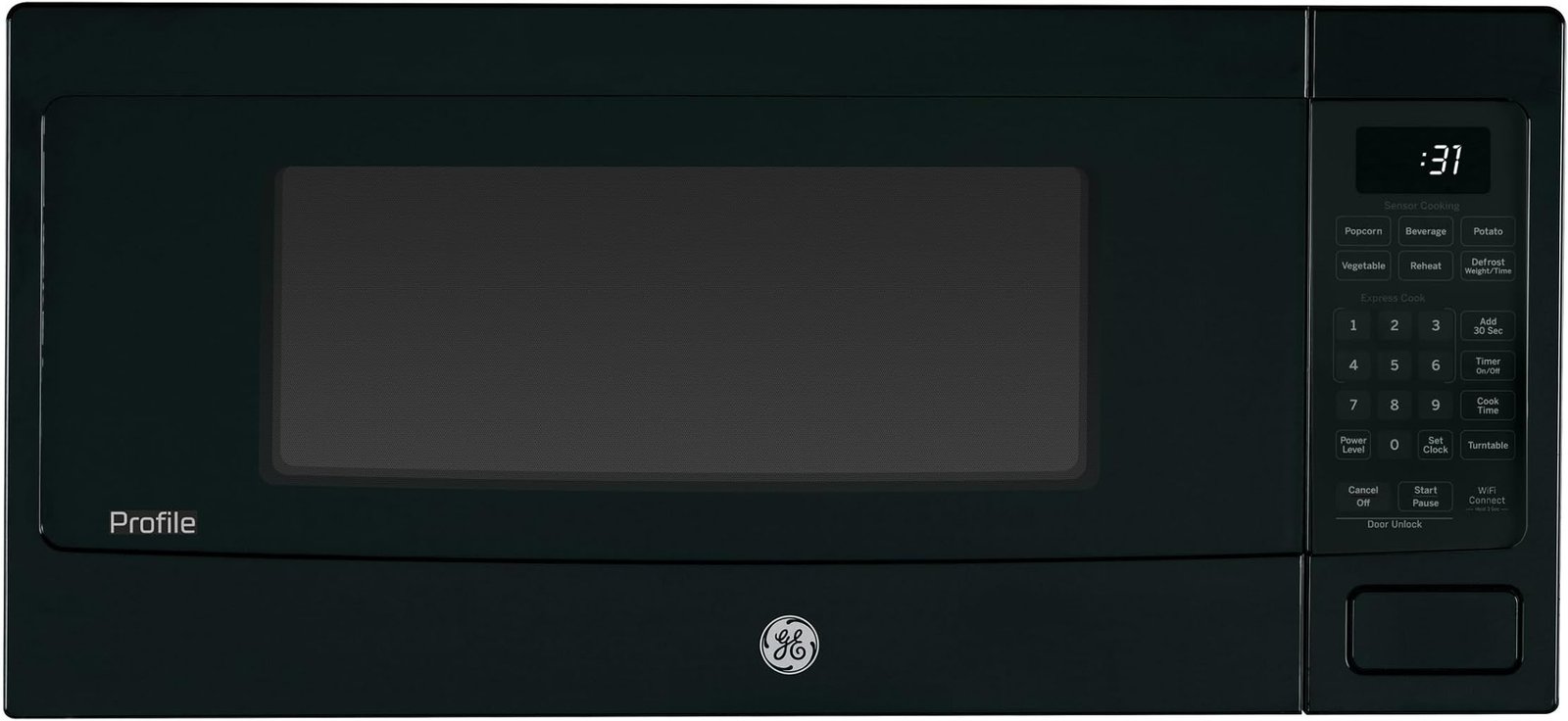
Countertop microwaves usually make a simple promise: find some counter space, connect the appliance to an appropriate outlet, and start heating food. The GE Profile PCHK11S1WBB complicates that familiar formula in an interesting way. It is fundamentally a countertop microwave, yet GE also supports optional built-in and under-cabinet installations. That flexibility gives the appliance a broader architectural identity than the category label initially suggests.
The fundamentals are straightforward. The PCHK11S1WBB is a black GE Profile microwave with 1.1 cubic feet of stated capacity and 800 watts of cooking power. Its price is $416.
GE’s official documentation identifies the model as the GE Profile 1.1 Cu. Ft. Countertop Microwave Oven, and the manufacturer lists features including Scan to Cook technology, built-in Wi-Fi powered by SmartHQ, optional built-in installation using a matching trim kit, and an optional under-cabinet mounting kit.
Those characteristics make the PCHK11S1WBB more interesting than a conventional portable microwave, but they also sharpen the central question surrounding its $416 price: how much value does a household place on flexibility, connectivity, and installation options when the underlying microwave offers 1.1 cubic feet of capacity and 800 watts?
Our Score is 8.36/10. Customer Sentiment stands at 8.28, Buyer Confidence reaches 8.82, and Value is 8.15.
The pattern is revealing. Buyer Confidence is the strongest measure, while Value is the lowest. The difference is not enormous, but it captures the editorial character of this microwave rather neatly. The PCHK11S1WBB is relatively easy to understand and unusually flexible in placement, yet its $416 price demands a buyer who will actually use those advantages.
The 1.1-Cubic-Foot Capacity Defines the Product
Capacity is one of the first numbers shoppers encounter, and 1.1 cubic feet establishes the GE Profile PCHK11S1WBB as a relatively compact countertop proposition rather than a large family-size cavity built around oversized cookware.
That distinction matters.
A household that mainly reheats dinner plates, bowls, beverages, frozen meals, leftovers, vegetables, and modest containers may find this capacity entirely aligned with its habits. Someone regularly using wide casserole dishes or unusually tall containers needs a more careful fit check.
Cubic feet alone cannot answer that question.
Microwave capacity describes volume, but cookware is governed by geometry. A plate cares about width. A covered container cares about height. A rectangular dish cares about width and depth simultaneously. Turntable dimensions can further restrict what fits comfortably.
This is why a serious microwave buying guide should never stop at advertised capacity.
Before spending $416, the household should measure the largest dish it expects to use routinely. That measurement should then be compared with GE’s current dimensional documentation for the exact model.
The exercise is mundane. It is also more useful than assuming that 1.1 cubic feet means the same thing for every kitchen and every collection of cookware.
Eight Hundred Watts Requires a Different Performance Expectation
The PCHK11S1WBB is rated at 800 watts.
Microwave wattage matters because cooking instructions for packaged foods are often sensitive to power level and heating duration. An 800-watt microwave should not automatically be treated as though it will follow the same timing as a more powerful appliance.
This is where users need to distinguish power from adequacy.
Eight hundred watts does not make a microwave incapable of heating food. It does mean that time and technique deserve attention, particularly when instructions were developed around a different microwave output.
Cooking time also varies with food quantity, shape, moisture, density, starting temperature, and container geometry. Wattage is only one variable.
The PCHK11S1WBB therefore makes the strongest case for households prepared to use the appliance according to its actual output rather than assuming that every microwave behaves identically.
That point becomes especially relevant when replacing a higher-powered unit. Familiar heating times may need adjustment.
The correct measure of success is not whether an old routine can be copied unchanged. It is whether food reaches the intended and, where applicable, safe internal temperature without unnecessary overcooking.
Why Our Score Lands at 8.36/10
We rate the GE Profile PCHK11S1WBB at 8.36/10.
That score reflects a microwave with a well-defined identity but a price that deserves scrutiny.
The core specifications are not difficult to understand: 1.1 cubic feet, 800 watts, countertop orientation, black finish, and a $416 price. GE then extends the proposition with Wi-Fi connectivity, Scan to Cook technology, and optional installation paths beyond ordinary countertop placement.
That combination produces a product that is more flexible than its basic category designation suggests.
Our Buyer Confidence score of 8.82 is the highest component of the assessment. Customer Sentiment at 8.28 sits close to the 8.36 overall score. Value reaches 8.15.
The Value rating is where the editorial restraint appears.
At $416, the PCHK11S1WBB is not making its case solely through cavity volume or wattage. Buyers are paying for a broader product concept. Its appeal depends partly on whether the household values the GE Profile positioning, connected functionality, Scan to Cook capability, and installation flexibility.
A buyer who uses those characteristics can interpret the price very differently from someone seeking only a compact appliance for reheating coffee and leftovers.
The Price Is the Central Trade-Off
Price is where this microwave demands the clearest purchasing discipline.
At $416, the GE Profile PCHK11S1WBB needs to solve more than the generic problem of heating food if it is going to deliver its strongest value.
That does not make the price unreasonable by itself. Price only becomes meaningful when compared with the household’s objectives.
Someone specifically seeking a microwave that can begin on a countertop and potentially move into an approved built-in or under-cabinet arrangement has a different value equation from a buyer who expects the appliance to remain on a utility counter indefinitely.
The same applies to connected features.
If Wi-Fi functionality and Scan to Cook fit established habits, they contribute to the product’s utility. If those functions are ignored, the buyer is left judging $416 primarily against 1.1 cubic feet and 800 watts.
That explains why our Value score of 8.15 trails Buyer Confidence by 0.67 points.
The product is easy to understand. The harder question is whether each household needs enough of what it offers.
Installation Flexibility Is a Genuine Differentiator
GE identifies the PCHK11S1WBB as a countertop microwave, but the manufacturer’s installation options make that description unusually broad.
GE states that the microwave is designed for countertop use or built-in installation with an optional matching trim kit. The company also lists an optional under-cabinet mounting kit.
GE’s support resources for model PCHK11S1WBB identify the appliance as manufactured from January 2025 onward and provide access to owner documentation, installation material, maintenance information, troubleshooting resources, and service support.
That flexibility changes how the product can fit into a kitchen over time.
A household may prefer straightforward countertop placement initially. Another may want to recover work surface through an approved under-cabinet installation. A remodeling project may make built-in placement more attractive.
The critical word is approved.
A countertop microwave should never simply be pushed into cabinetry because its exterior dimensions happen to fit. Ventilation, clearances, trim requirements, and installation instructions matter. GE’s explicit support for optional installation configurations gives buyers defined paths rather than requiring improvised cabinetry.
That is a meaningful advantage.
Optional Built-In Installation Changes the Ownership Story
Built-in capability deserves separate attention because it changes the relationship between appliance and kitchen.
A conventional countertop microwave can be moved easily. A built-in installation becomes dependent on cabinetry dimensions, clearances, trim components, electrical access, and the manufacturer’s installation requirements.
GE lists optional 27-inch and 30-inch built-in trim kits among the available accessories for the PCHK11S1WBB. The manufacturer also lists an under-cabinet mounting kit.
Those options increase placement flexibility, but they should not be confused with free installation flexibility.
Accessories can add cost. Built-in installation can add labor. Cabinet dimensions need to match the approved configuration. Future replacement also becomes more dependent on the opening created for the appliance.
The $416 purchase price is therefore not necessarily the complete project cost for a buyer planning anything beyond countertop placement.
A realistic budget should account for the chosen installation method before treating the microwave’s retail price as the final figure.
Under-Cabinet Mounting Addresses a Different Spatial Problem
Under-cabinet mounting is particularly interesting because it addresses one of the countertop microwave’s basic weaknesses: lost work surface.
A 1.1-cu.-ft. microwave can be modest in capacity while still consuming meaningful counter area. In a compact kitchen, that surface may be more useful for food preparation than permanent appliance storage.
An approved under-cabinet installation can alter that equation.
The microwave remains accessible without becoming part of a larger built-in cabinet opening, while the work surface below can potentially remain available.
Yet accessibility needs to be evaluated carefully.
Mounting height affects who can comfortably see inside the cavity and remove hot dishes. A placement that works well for one adult may be awkward for a shorter household member. Hot liquids deserve particular caution because reaching upward while handling them can increase the difficulty of controlled movement.
The installation decision should therefore consider users, not merely available wall space.
Scan to Cook Is About Automation, Not More Microwave Power
GE lists Scan to Cook technology among the PCHK11S1WBB’s features.
The manufacturer describes the system as allowing the user to scan the barcode on compatible frozen meals so the microwave can apply cooking instructions.
The concept addresses a familiar problem: packaged-food instructions can require users to select power levels, enter cooking times, pause, stir, or otherwise translate printed directions into microwave settings.
Automation can reduce some of that manual input.
What it does not do is turn an 800-watt microwave into a higher-powered appliance.
That distinction is important because convenience technology and cooking power solve different problems. One can simplify interaction; the other affects energy delivery.
The value of Scan to Cook will therefore vary with household behavior. Someone who regularly prepares compatible packaged foods has a more obvious use case than a household primarily reheating homemade meals.
The feature should be judged by frequency of use rather than novelty.
Wi-Fi Adds Connectivity, but Connectivity Needs a Purpose
The PCHK11S1WBB also includes built-in Wi-Fi powered by SmartHQ.
Connected appliances often create an odd purchasing dynamic. Connectivity sounds substantial on a feature list, yet its actual value can range from frequent utility to complete neglect depending on household habits.
The useful question is not whether a microwave can connect to a network. It is what the household intends to do with that connection.
GE describes the platform as supporting real-time feedback, alerts, and other connected functions. Those capabilities broaden the appliance beyond traditional keypad interaction.
Still, Wi-Fi should not outrank the basics.
Capacity, power, cookware fit, placement, controls, accessibility, and price affect every use. Connected features matter only when the household engages with them.
A disciplined buyer therefore treats Wi-Fi as an additional capability rather than evidence of better heating performance.
Countertop Placement Still Has the Lowest Commitment
Despite the alternative installation options, countertop use remains the simplest way to own the PCHK11S1WBB.
No dedicated cabinet opening is needed. No trim kit is required. No under-cabinet mounting project has to be completed.
That simplicity has long-run value.
If the kitchen changes, the appliance can move. If the microwave eventually needs replacement, the household is not necessarily tied to a particular cabinet opening. Renters and people expecting to relocate may especially appreciate that freedom.
The cost is work surface.
A microwave sitting permanently on the counter consumes space that might otherwise support meal preparation, storage, or another appliance.
The PCHK11S1WBB’s multiple placement paths make that compromise less rigid than it is with many countertop-only models.
Microwave Safety Is Governed by Federal Standards
Microwave ovens use electromagnetic energy, a fact that has produced decades of public concern about radiation. The regulatory record is more precise than the anxiety surrounding the word.
The U.S. Food and Drug Administration has regulated microwave oven manufacturing since 1971. Manufacturers are required to certify products and comply with federal safety-performance standards. The FDA states that microwave ovens meeting its standard and used according to manufacturer instructions are considered safe based on current knowledge.
The federal standard limits microwave leakage throughout an oven’s lifetime to 5 milliwatts per square centimeter at approximately two inches from the oven surface.
The FDA also requires two independent interlock systems that stop microwave production when the door opens or the latch is released. A monitoring system is required to stop operation if one or both interlocks fail.
Distance reduces exposure sharply. According to the FDA, a measurement made 20 inches from an oven would be approximately one-hundredth of the value measured at two inches.
These standards apply to microwave ovens broadly rather than identifying a special issue with this GE model.
Owners should still pay attention to physical condition and follow the manufacturer’s operating instructions.
Food Safety Requires More Than a Timer
The PCHK11S1WBB’s 800-watt output makes cooking technique worth discussing, but the principle applies to every microwave.
Microwave ovens can heat food unevenly.
The USDA explains that microwave cooking can leave cold spots where harmful bacteria may survive. The agency recommends stirring, rotating, or turning foods where possible during cooking, even when an appliance has a turntable. Standing time also matters because heating does not instantly stop throughout the food when microwave energy stops.
The USDA advises using a food thermometer to verify safe internal temperatures. Ground meats should reach 160°F, poultry 165°F, and fish 145°F. Reheated leftovers should reach 165°F.
These numbers are more useful than judging food by touch or steam.
An outer edge can be extremely hot while the center remains cooler. Dense food behaves differently from a thin layer. A large portion behaves differently from a small one.
An 800-watt microwave therefore rewards attention to package instructions, stirring, standing time, and temperature verification rather than reliance on habitual timing inherited from another appliance.
Buyer Confidence at 8.82 Reflects a Clear Product Identity
Our Buyer Confidence score is 8.82, ahead of the 8.36 overall rating.
The reason is straightforward.
GE provides a clear identity for the PCHK11S1WBB, along with official support documentation and defined installation accessories. The appliance has a known 1.1-cu.-ft. capacity, 800-watt output, countertop orientation, optional built-in flexibility, optional under-cabinet mounting, Scan to Cook technology, and connected SmartHQ functionality.
That gives buyers several concrete questions to answer:
- Is 1.1 cubic feet enough for the household’s cookware?
- Is 800 watts appropriate for its heating habits?
- Will the microwave remain on the counter?
- Would built-in or under-cabinet placement be useful?
- Will Scan to Cook be used regularly?
- Does SmartHQ connectivity fit the household’s appliance habits?
- Does $416 make sense for that collection of capabilities?
Those questions make the product relatively easy to evaluate.
The answer will not be the same for every household, but uncertainty about the product’s basic identity is limited.
Value at 8.15 Requires More Discipline
Our Value score is 8.15, the lowest of the four ratings.
That is not a poor assessment. It is a reminder that $416 buys more than raw microwave capacity and wattage.
A buyer focused narrowly on those two specifications will have reason to compare alternatives carefully. The PCHK11S1WBB’s value case becomes more coherent when its installation flexibility, connected features, and Scan to Cook functionality matter.
The optional installation routes also create an unusual paradox.
They increase versatility while potentially increasing total spending. A built-in trim kit or mounting hardware can make the appliance better suited to a specific kitchen, but the accessory and installation costs should be counted as part of the project.
Value therefore depends on using the flexibility rather than merely possessing it.
That distinction is the main reason Value trails Buyer Confidence.
Customer Sentiment at 8.28 Keeps the Assessment Grounded
Customer Sentiment stands at 8.28, just below our overall 8.36 rating.
The narrow difference fits the product’s broader editorial profile. The PCHK11S1WBB has an identifiable audience and a useful set of capabilities, but none eliminates the fundamental compromises of a 1.1-cu.-ft., 800-watt microwave priced at $416.
Capacity remains capacity. Power remains power. Countertop placement still consumes work surface. Built-in placement still requires planning. Under-cabinet installation still requires appropriate mounting. Connectivity only matters when used.
The 8.28 score therefore supports a favorable but measured view.
Who Is the GE Profile PCHK11S1WBB Best Suited To?
The strongest buyer fit is a household seeking a relatively compact microwave with more placement flexibility than a basic countertop model.
It is particularly interesting for kitchens where future configuration is uncertain. The ability to begin with countertop use while retaining approved built-in and under-cabinet possibilities can reduce the pressure to decide on permanent placement immediately.
The model also makes more sense for buyers who expect to use its connected functions or Scan to Cook capability.
A different buyer should be more cautious.
Someone seeking maximum cavity volume for the money may find 1.1 cubic feet restrictive. A household replacing a substantially higher-powered microwave should understand that 800 watts may change familiar heating times. Someone uninterested in connectivity or alternative installation methods may have less reason to pay for this particular feature combination.
Buyer fit is therefore less about whether the microwave is capable and more about whether its capabilities correspond with actual household behavior.
A Better Buying Process for This Model
The PCHK11S1WBB rewards a disciplined sequence of checks.
First, measure the cookware. The largest regularly used plate, bowl, and container should fit comfortably within the appliance’s usable interior.
Second, account for the 800-watt output. Buyers replacing another microwave should compare power ratings rather than assuming familiar heating times will transfer unchanged.
Third, decide on placement before calculating final cost. Countertop use creates a different budget from built-in or under-cabinet installation.
Fourth, assess whether Scan to Cook and SmartHQ connectivity will see regular use.
Fifth, compare the $416 price with the household’s actual priorities rather than with feature count alone.
Finally, consult the current GE installation and owner documentation before any non-countertop installation.
This approach turns a feature list into a practical ownership plan.
Final Considerations
The GE Profile PCHK11S1WBB earns an Our Score of 8.36/10 because it takes the familiar countertop microwave format and gives it unusually broad placement flexibility.
Its fundamentals are clearly defined: 1.1 cubic feet of stated capacity, 800 watts of microwave output, black finish, and a $416 price. GE adds Scan to Cook technology, SmartHQ connectivity, optional built-in installation with matching trim kits, and an optional under-cabinet mounting path.
Buyer Confidence at 8.82 is the strongest rating because the appliance has a clear identity and documented manufacturer support. Customer Sentiment at 8.28 stays close to the overall assessment. Value at 8.15 is more restrained because the $416 price makes the strongest sense when the household actually uses the additional capabilities that distinguish this model from a simpler countertop microwave.
The 1.1-cu.-ft. cavity deserves a cookware check before purchase. The 800-watt output deserves realistic expectations about heating time. Optional installation deserves a complete budget that includes appropriate accessories and any required labor.
Those are not peripheral details. They determine whether the product’s flexibility becomes useful or merely expensive.
The PCHK11S1WBB is therefore best understood as a compact microwave with several possible identities. It can remain a conventional countertop appliance. It can become part of an approved built-in arrangement. It can move beneath cabinetry using the appropriate mounting solution. Its connected functions can add another layer of interaction for households that use them.
That adaptability is the product’s most distinctive characteristic.
For a buyer who wants only basic microwave heating, the $416 price deserves close comparison. For a household that values flexible placement, connected functionality, Scan to Cook, and the possibility of integrating the appliance more deliberately into the kitchen, the value calculation changes materially.
The 8.36/10 overall rating reflects that balance. This is not a microwave whose case rests on raw capacity or high wattage. Its argument rests on flexibility.
The buyer who needs that flexibility will understand the PCHK11S1WBB quickly. The buyer who does not should recognize that just as quickly.