A microwave drawer is not merely a conventional microwave turned sideways and pushed into cabinetry. Its appeal rests on a different relationship between appliance, user and kitchen. Counter space remains open, the appliance moves below the work surface, and installation becomes a permanent architectural decision rather than a matter of finding an electrical outlet.
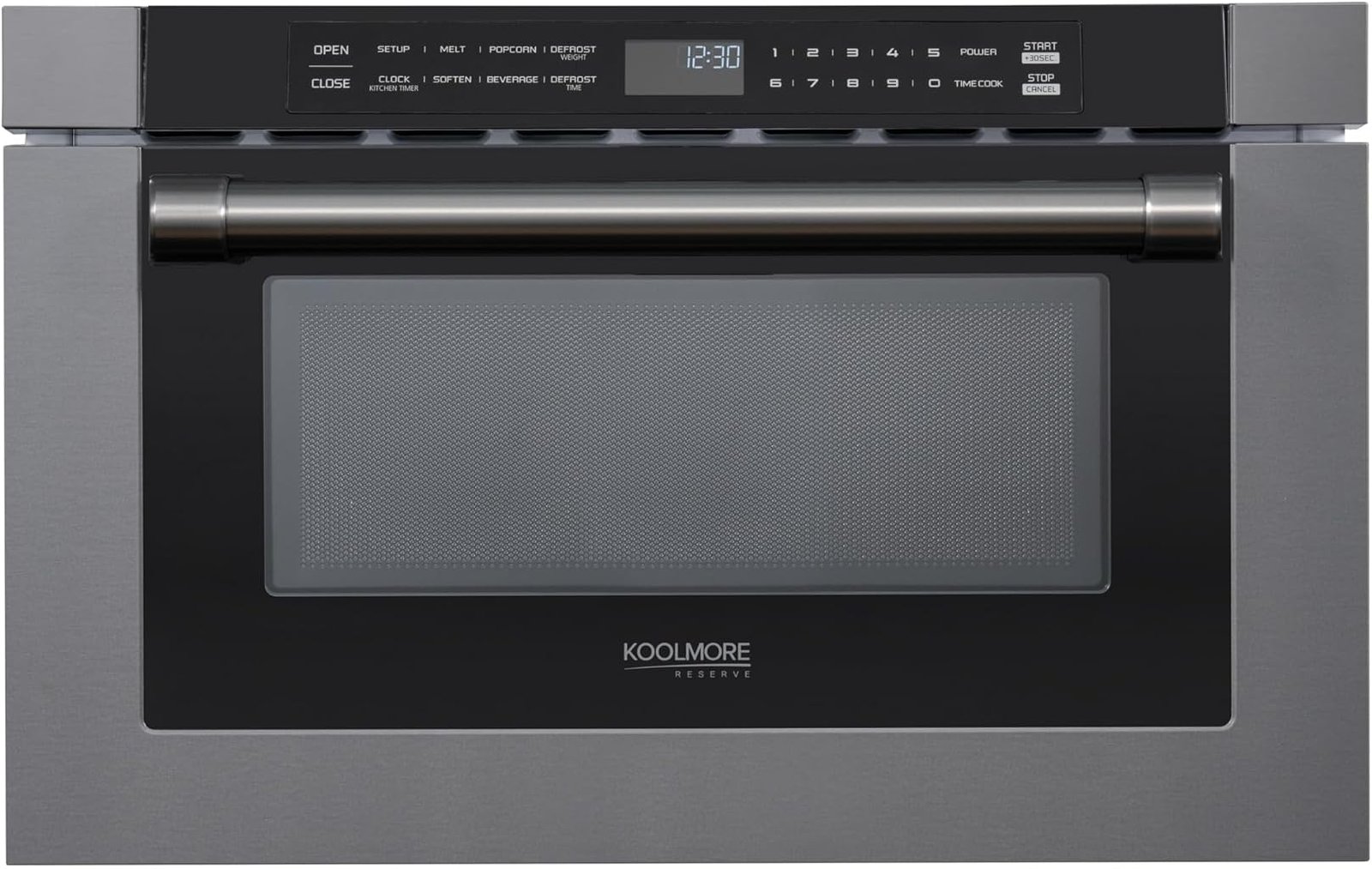
The KoolMore Reserve 1.2 cu. ft. Microwave Drawer enters that calculation at $905. It combines a built-in format with 1,000-watt microwave power, convection heating, broiling capability, a soft-close door, stainless-steel finish, touch-control LCD interface and a NEMA 5-20P plug. Those characteristics place it closer to multifunction built-in cooking equipment than to the inexpensive countertop microwave familiar to most households.
Our score is 8.14/10. Customer Sentiment is 7.84, Buyer Confidence reaches 9.27, and Value stands at 7.91. The spread between those ratings tells a more interesting story than the overall number alone. Confidence is particularly strong, while sentiment and value are more restrained. That pattern suits a product whose appeal depends heavily on installation circumstances, cooking habits and whether a household can make practical use of its broader heating functions.
At $905, the central question is therefore not whether microwave cooking can be purchased for less. It plainly can. The useful question is whether combining built-in placement, microwave heating, convection and broiling creates enough functional and spatial value to justify the commitment.
Our Score: 8.14/10
An 8.14/10 score places the KoolMore Reserve in favorable territory while leaving room for meaningful reservations.
Its proposition begins with consolidation. A standard microwave reheats and defrosts efficiently, but convection and broiling expand the potential cooking repertoire. That distinction matters in kitchens where appliance space is more constrained than the cooking ambitions of the household.
The underlying technologies perform different jobs. Microwave energy is particularly effective for rapid heating because energy interacts directly with water and other molecules in food. The USDA Food Safety and Inspection Service explains that microwave ovens typically operate at about 2,450 MHz and that microwave energy penetrates food only about 1 to 1½ inches before heat must move farther inward through conduction. The agency also explains why microwave cooking does not normally produce the browned, crisp surface associated with conventional ovens.
Convection and broiling therefore are not redundant additions. They address cooking effects that microwave energy alone does not naturally reproduce.
That gives the KoolMore Reserve a clearer functional identity than a built-in microwave concerned solely with reheating. The trade-off is equally clear: added cooking capability matters only when the household actually uses it.
A Built-In Appliance Changes the Buying Equation
A $905 microwave deserves to be evaluated differently from a countertop model because built-in appliances carry costs that do not appear on a retail price tag.
Cabinet compatibility is one. Electrical compatibility is another. Installation labor can become a third. Future replacement introduces a fourth consideration because the kitchen opening that accommodates today’s appliance may constrain tomorrow’s options.
This permanence can be an advantage when the kitchen has been designed around it. A built-in appliance removes a substantial object from the countertop and creates a more deliberate cooking station. It can be particularly logical in an island, peninsula or wall of integrated appliances where preserving uninterrupted work surfaces is a design priority.
Yet integration has a price beyond money: flexibility.
A countertop microwave can be relocated in minutes. A built-in appliance cannot. That difference becomes significant for renters, homeowners expecting another remodel, or anyone who prefers easily replaceable equipment.
This is why a microwave buying guide focused on built-in products should begin with the kitchen rather than the appliance. The available opening, electrical service, user height, nearby landing area and traffic pattern matter before secondary features do.
The 1.2-Cubic-Foot Capacity Requires Practical Thinking
The KoolMore Reserve is rated at 1.2 cu. ft. Capacity figures are useful for broad comparison, but they are poor substitutes for checking the dimensions of the cookware a household actually uses.
Cubic footage measures volume. It does not describe that volume’s shape.
A wide casserole dish, tall bowl or oversized dinner plate can expose the difference quickly. Two cavities with similar nominal volume can accommodate different cookware because their width, depth and height are distributed differently.
That issue deserves more scrutiny in a built-in appliance because discovering a poor fit after installation is expensive and irritating.
Before purchase, the sensible checklist includes:
- Measuring the intended cabinet opening in width, height and depth.
- Comparing those measurements with the manufacturer’s current installation documentation.
- Measuring frequently used plates, bowls and casserole dishes.
- Confirming required ventilation and clearances.
- Checking electrical requirements, including compatibility with the NEMA 5-20P plug.
- Evaluating the intended installation height for every regular user.
- Checking nearby counter or landing space for hot dishes.
- Confirming local service availability and warranty terms before installation.
The exercise may seem mundane beside discussions of convection heating and touch controls. It is arguably more consequential. A sophisticated cooking mode cannot compensate for a cabinet opening that does not fit.
Why 1,000 Watts Matters
The KoolMore Reserve specifies 1,000-watt microwave power, a figure with practical relevance rather than merely marketing relevance.
The USDA states directly that “The higher the wattage of a microwave oven, the faster it will cook food.” Its microwave guidance categorizes an oven in which a cup of ice-cold water boils in less than two minutes as a very-high-wattage unit of 1,000 watts or more.
That does not establish a specific heating time for this KoolMore appliance. Container material, food quantity, starting temperature, moisture distribution and efficiency all affect actual cooking.
The rating does provide useful context when following packaged-food directions. Microwave instructions are often sensitive to appliance output. A 1,000-watt specification gives the owner a concrete reference point rather than requiring guesswork about the oven’s nominal power.
Power also needs to be distinguished from evenness. High output does not guarantee uniform food temperature.
Microwave energy can create hot and cold regions, particularly in dense or irregularly shaped food. The USDA recommends arranging food evenly, covering dishes where appropriate, stirring or rotating food during heating and allowing standing time after cooking.
Those practices matter regardless of how polished the appliance looks in the cabinetry.
Convection Is More Than a Feature-List Addition
Convection heating changes the appliance’s potential use because moving hot air can create cooking effects that microwave energy cannot produce by itself.
KoolMore’s current built-in convection microwave range illustrates the company’s broader approach to this category. Its official specifications for related 24-inch built-in models combine microwave functions with baking, roasting, preheating and broiling modes.
For the Reserve reviewed here, convection and broiling are meaningful because they address one of microwave cooking’s familiar limitations: surface browning.
USDA guidance explains that food cooked by microwave does not normally become brown and crisp because the surrounding oven air remains comparatively cool.
Convection changes the thermal environment. Broiling introduces intense radiant heat. In practical kitchen terms, these modes can broaden the appliance’s purpose beyond reheating.
That does not mean every buyer needs them.
Someone who uses a microwave almost exclusively for coffee, leftovers, frozen vegetables and occasional defrosting is unlikely to extract the same value as a household interested in using one built-in appliance for several cooking methods.
Multifunction equipment earns its keep through use, not through the number of functions printed on a specification sheet.
The Soft-Close Door Deserves More Attention Than It Usually Gets
Soft-close hardware is easy to dismiss as cosmetic refinement. In a built-in appliance, however, repeated physical interaction matters.
A microwave can be opened and closed many times during meal preparation. A controlled closing action changes that experience and can reduce the abruptness associated with a conventional door.
The feature should not be interpreted as evidence about mechanical longevity without long-term testing. Soft-close mechanisms contain moving components of their own, and durability cannot be inferred simply from the presence of the feature.
Its benefit is more straightforward: it changes how the appliance feels during routine operation.
That matters because premium built-in equipment is partly judged by repeated small interactions. Door movement, control responsiveness, display readability and access height are encountered far more often than many specialized cooking modes.
The touch-control LCD display fits the same pattern. A digital interface can reduce visual clutter and centralize operation, but buyers should consider usability rather than appearance alone. Control labels need to remain understandable during hurried meal preparation, not merely look clean in product photography.
Ergonomics Can Make or Break the Installation
Lower placement changes the physical mechanics of microwave use.
Instead of lifting a dish toward an appliance mounted above a range, the user interacts with the appliance below the work surface. That can make sense for some users and feel unnecessarily low for others.
There is no universal ergonomic answer because height, reach and mobility vary.
The National Kitchen & Bath Association advises designers to think about traffic flow and locate microwaves so food can be retrieved without awkward reaching. Its kitchen-planning guidance also recommends at least a 15-inch landing area above, below or adjacent to the handle side of a microwave oven.
That landing area is easy to underestimate.
A microwave does not operate in isolation. Hot bowls, plates and containers have to go somewhere immediately after removal. A beautiful built-in installation that leaves no convenient surface for a steaming dish creates a problem that no electronic feature can solve.
The same logic applies to traffic. Installing the appliance where an open door interferes with a primary walkway can turn an elegant floor plan into a daily obstacle course.
Buyer Confidence: 9.27
Buyer Confidence is the strongest component of our assessment at 9.27.
That score indicates a high degree of confidence in the product’s purchasing proposition for the appropriate installation. It does not mean the microwave is equally suitable for every kitchen.
The distinction matters.
A product can inspire high purchasing confidence while still having a narrower audience than a portable appliance. Built-in products demand advance planning, but that planning can also remove ambiguity. Once cabinet compatibility, electrical requirements and desired cooking functions are established, the buyer knows considerably more about whether the appliance belongs in the project.
The Reserve’s combination of a defined built-in format, 1,000-watt microwave power, convection heating, broiling, stainless finish and specified NEMA 5-20P connection gives buyers several concrete points to verify before purchase.
KoolMore’s official documentation for its current 24-inch built-in convection microwave line also identifies NEMA 5-20P plug configurations, reinforcing the need to treat electrical compatibility as an installation requirement rather than an afterthought.
A 9.27 Buyer Confidence score should therefore be read as confidence conditional on proper planning. Measuring first remains non-negotiable.
Customer Sentiment: 7.84
Customer Sentiment is 7.84, noticeably below the 9.27 Buyer Confidence rating.
That separation gives the review useful texture.
Built-in appliances can look straightforward before installation and become more nuanced during ownership. Placement is permanent. Controls are encountered repeatedly. Cooking modes that seemed attractive at purchase may become either frequently used tools or largely ignored extras.
A 7.84 sentiment score remains positive, but it does not suggest universal enthusiasm.
The appropriate editorial interpretation is that buyer fit matters substantially. Someone who wants multifunction cooking and integrated placement has more reason to appreciate this appliance than someone who merely needs rapid reheating.
Price reinforces that divide. At $905, this is not an impulse replacement for a failing countertop microwave. Buyers are paying for the built-in configuration and additional heating methods as well as microwave functionality.
That makes pre-purchase discipline unusually useful. The closer actual household behavior matches the product’s design, the stronger the ownership proposition becomes.
Value: 7.91
Value receives a 7.91 rating, placing it below the overall 8.14 score and well below Buyer Confidence.
The reason is not difficult to identify.
Nine hundred and five dollars buys a great deal of conventional microwave functionality elsewhere. A buyer assessing value purely as dollars per minute of reheating would struggle to justify the Reserve.
But that is not the only reasonable definition of value.
Built-in placement recovers countertop area. Convection and broiling broaden cooking options. A stainless finish can integrate with an existing appliance suite. Combining functions can also be useful where there is insufficient room for several separate appliances.
The value equation therefore depends on avoided costs and recovered space as well as purchase price.
If convection functionality prevents the purchase or countertop placement of another appliance, its economic contribution is larger. If the convection and broil settings are rarely touched, much of that theoretical value disappears.
The 7.91 rating captures that tension. The Reserve can represent sound value in a carefully planned kitchen without becoming a universal bargain.
Food Safety Still Depends on Technique
Multifunction controls do not repeal the physics of microwave cooking.
Microwaves can heat food unevenly. USDA guidance specifically warns about “cold spots” where harmful bacteria can survive and recommends checking food in several places with a thermometer when food safety is at issue.
For reheated leftovers, the agency specifies 165°F and recommends standing time after microwave heating. Its guidance also advises stirring, rotating or turning foods where possible to improve heating uniformity.
This is particularly relevant when users move from simple reheating into more ambitious microwave cooking.
Power ratings can encourage an assumption that faster means uniformly cooked. It does not. A 1,000-watt microwave can still produce uneven temperatures in thick food because microwave penetration is limited and the center must partly heat through conduction.
The practical lesson is simple: use power intelligently, stir when appropriate, respect standing time and verify safe temperatures when cooking foods where internal temperature matters.
Energy Standards Provide Useful Background
Microwave ovens also exist within a changing efficiency framework.
The U.S. Department of Energy states that amended federal energy-conservation standards for microwave ovens became mandatory for covered products manufactured and distributed in commerce on and after June 22, 2026. The final rule establishing those amended standards was published in June 2023.
Those rules should not be converted into a claim about this appliance’s specific annual electricity consumption. No product-specific energy figure is being inferred here.
The broader point is that microwave energy use includes more than active cooking. Built-in appliances remain connected continuously, making standby behavior part of lifetime electricity consumption even though individual heating sessions may last only minutes.
For buyers comparing operating costs, manufacturer documentation for the exact model remains the appropriate source for product-specific energy figures.
Who Is the KoolMore Reserve For?
The Reserve makes the strongest case in a kitchen where integration and multifunction cooking are genuine priorities.
A remodel is an obvious setting. When cabinets and electrical work are already being planned, the incremental disruption of accommodating a built-in appliance may be far lower than during a later retrofit.
Compact kitchens present another plausible use case. Removing a microwave from the counter can return meaningful preparation space, while combining heating methods may reduce pressure to keep additional appliances on the work surface.
It can also appeal to households that deliberately separate the microwave from the primary range area. Doing so can allow one person to use the microwave while another works at the cooktop, provided the installation does not create a traffic conflict.
The weaker use cases are equally identifiable.
Renters gain little from a built-in format that cannot easily move with them. Households that microwave only occasionally may never recover the functional value embedded in the price. Buyers who dislike low appliance placement should not assume they will adapt merely because the finished installation looks tidy.
Ergonomics have to survive everyday use.
Installation Should Be Treated as Part of the Product
Built-in appliances cannot be reviewed sensibly as if installation were somebody else’s problem.
The cabinet opening, power connection, ventilation, access and surrounding work surface all affect the final experience. A poor installation can make a capable appliance feel badly designed.
The NEMA 5-20P connection deserves particular attention. Buyers should verify that the intended electrical provision matches manufacturer requirements rather than assuming that any nearby household receptacle is suitable. Electrical work should comply with the appliance instructions and applicable local requirements.
Cabinet measurements deserve the same discipline.
Nominal appliance width is not a cutout specification. Buyers should use the current installation documentation for the exact model and compare every required dimension with the finished opening before ordering.
That precaution also helps later. Keeping a record of cabinet-opening dimensions can simplify replacement decisions years from now, when the original appliance may no longer be available.
Built-in ownership has a longer memory than countertop ownership.
A Better Microwave Buying Guide Starts With Behavior
A useful microwave buying guide should begin with what the household actually cooks.
If microwave use means reheating beverages, warming leftovers and preparing occasional frozen foods, a simple microwave can perform those tasks at substantially lower acquisition cost.
If the household wants microwave speed alongside convection heating and broiling, the calculation changes.
Next comes location. Is counter space abundant or scarce? Is there a suitable cabinet opening? Would lower placement be comfortable for the primary users? Is there adequate landing space nearby?
Only after those questions are answered should aesthetic integration and interface preferences move toward the foreground.
For the KoolMore Reserve, this sequence is especially useful because its strongest argument is not one isolated specification. It is the combination of built-in placement and multiple cooking methods.
The product becomes more rational as those functions align with actual household needs.
Final Considerations
The KoolMore Reserve 1.2 cu. ft. Microwave Drawer earns our score of 8.14/10 by presenting a credible alternative to the conventional countertop microwave for kitchens where integration, recovered work space and broader cooking capability justify the added commitment.
Its rating profile is revealing. Buyer Confidence is the standout at 9.27, while Customer Sentiment is 7.84 and Value is 7.91. Those differences suggest a product with a well-defined purchasing case rather than universal appeal.
At $905, the Reserve should not be judged against an inexpensive microwave on price alone. Its 1,000-watt microwave capability sits alongside convection heating, broiling, a soft-close door, touch-control LCD interface, stainless-steel finish and built-in installation. Buyers who use those attributes are purchasing a more versatile cooking station. Buyers who do not are paying for capacity they may rarely exploit.
The strongest purchasing process is therefore grounded in behavior and measurement. Determine which cooking modes will actually be used. Measure the cabinet opening. Verify the current installation specifications. Confirm the electrical connection. Check the intended height against the people who will use the appliance. Identify where a hot dish will be placed immediately after removal.
Those mundane questions are more revealing than an extended inventory of features.
The Reserve’s 8.14/10 score reflects that balance. It is a serious built-in option with a particularly strong Buyer Confidence rating, but its economics depend on making use of what separates it from a basic microwave. In the right kitchen, multifunction cooking and integrated placement can justify the $905 expense. In a kitchen where reheating speed is the only requirement, the same expenditure becomes harder to defend.
That distinction is ultimately what makes the KoolMore Reserve interesting. It asks buyers to decide not simply how they want to heat food, but how much space, permanence and cooking flexibility they are prepared to assign to one appliance.