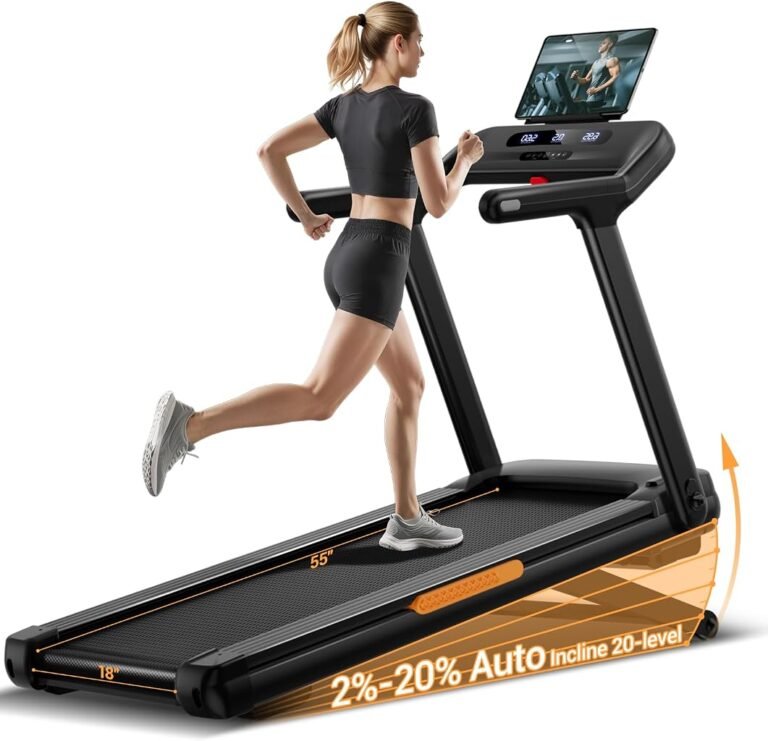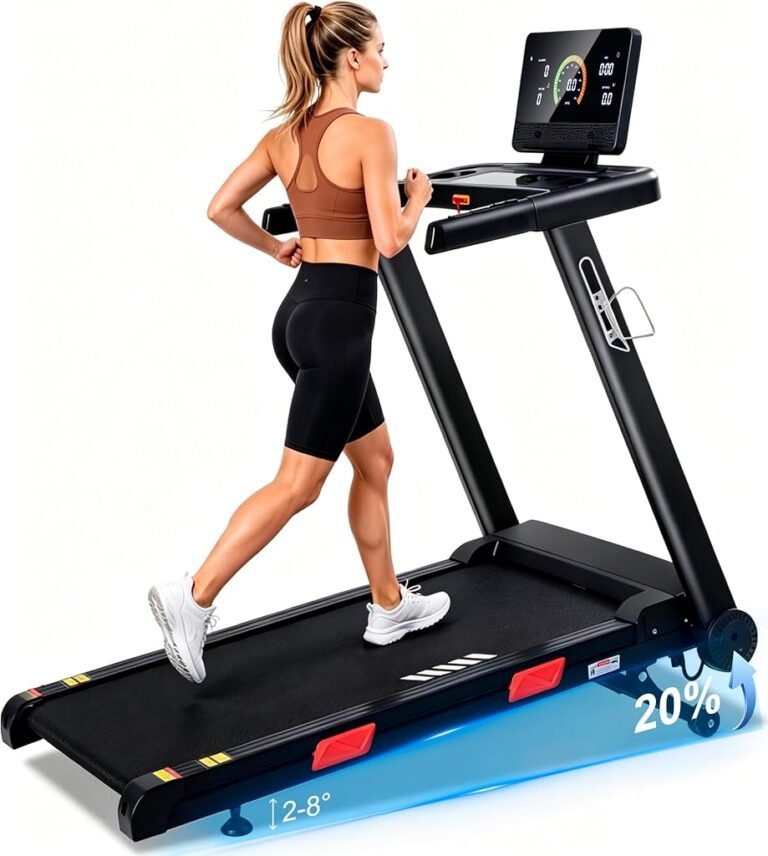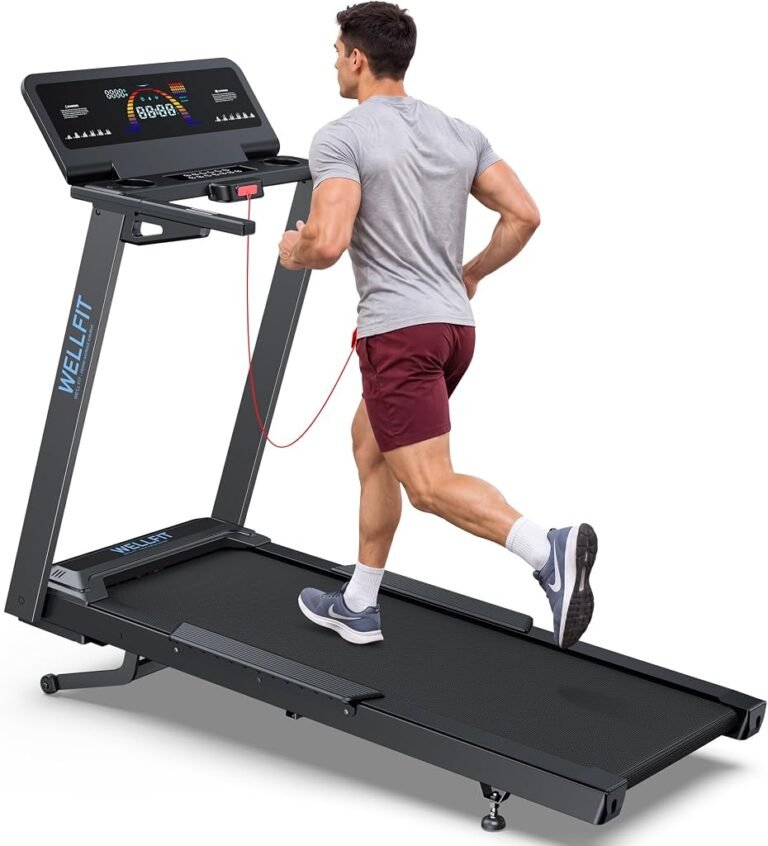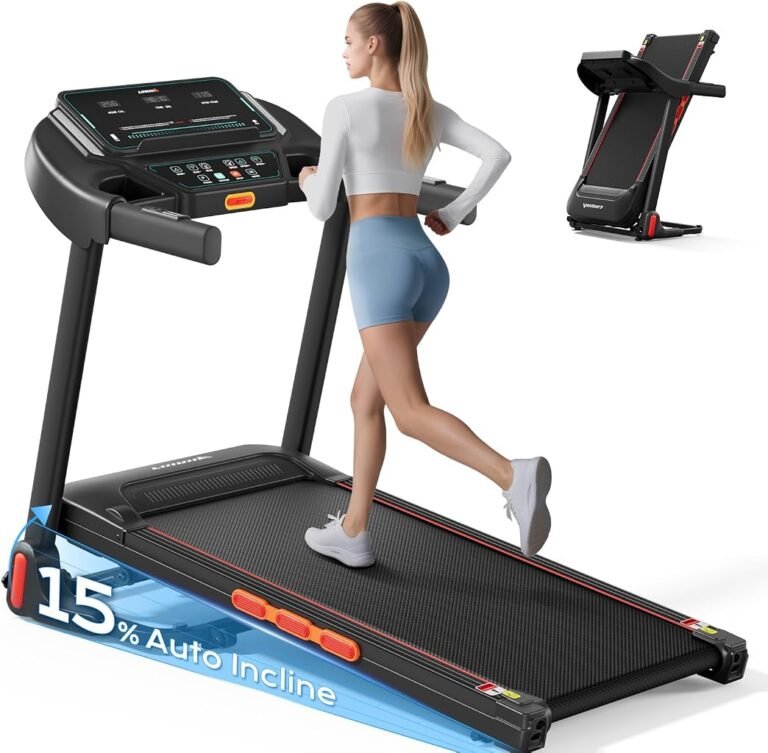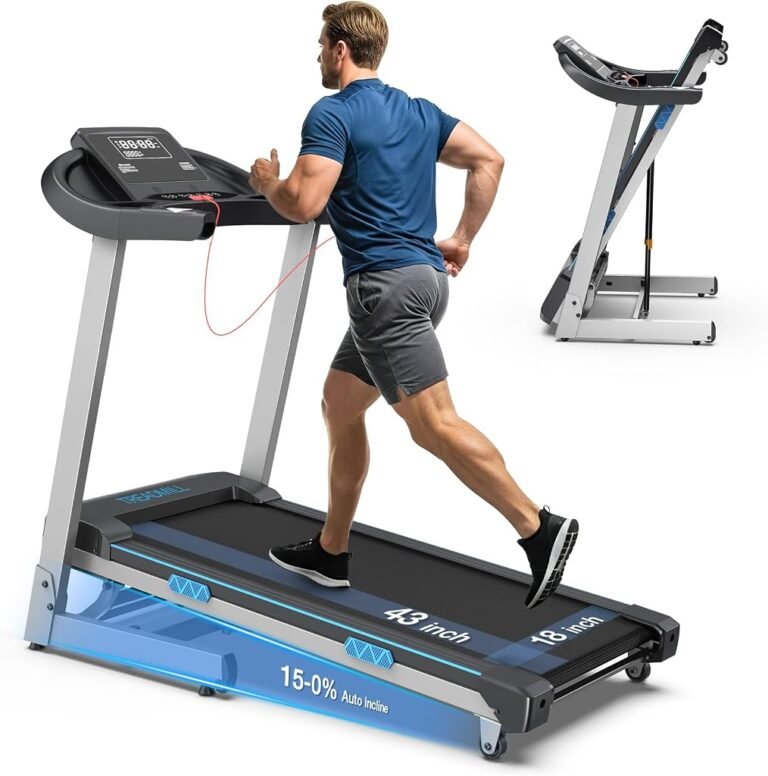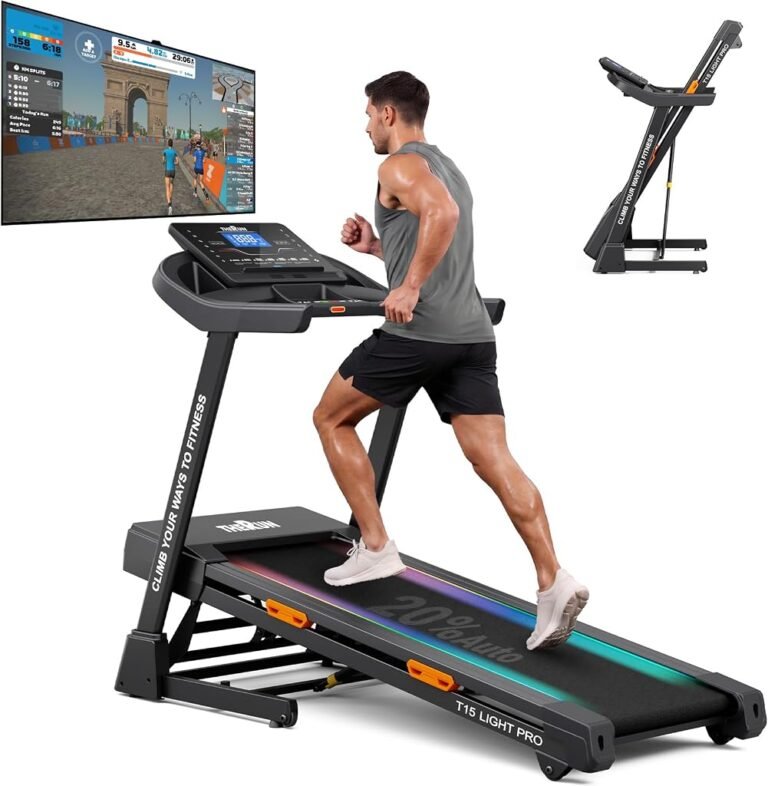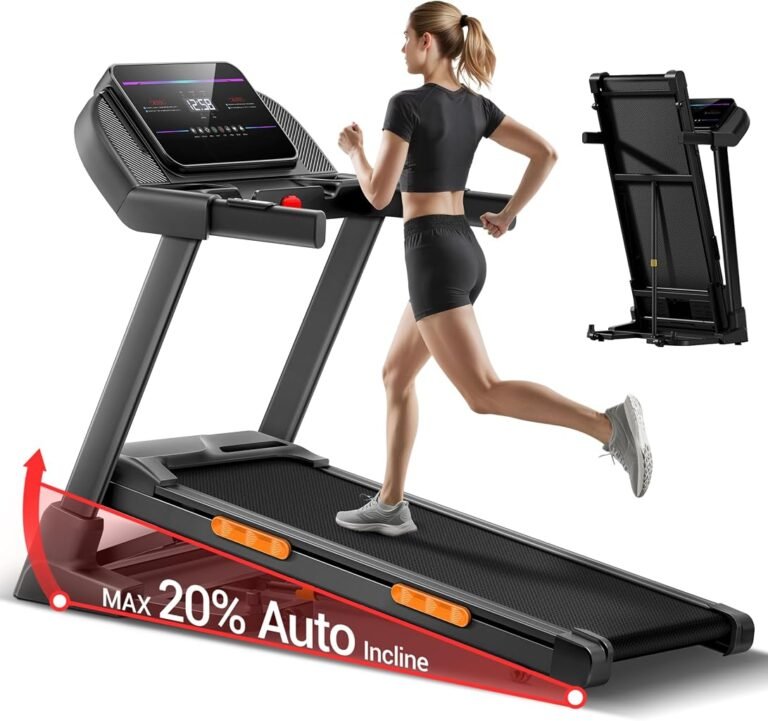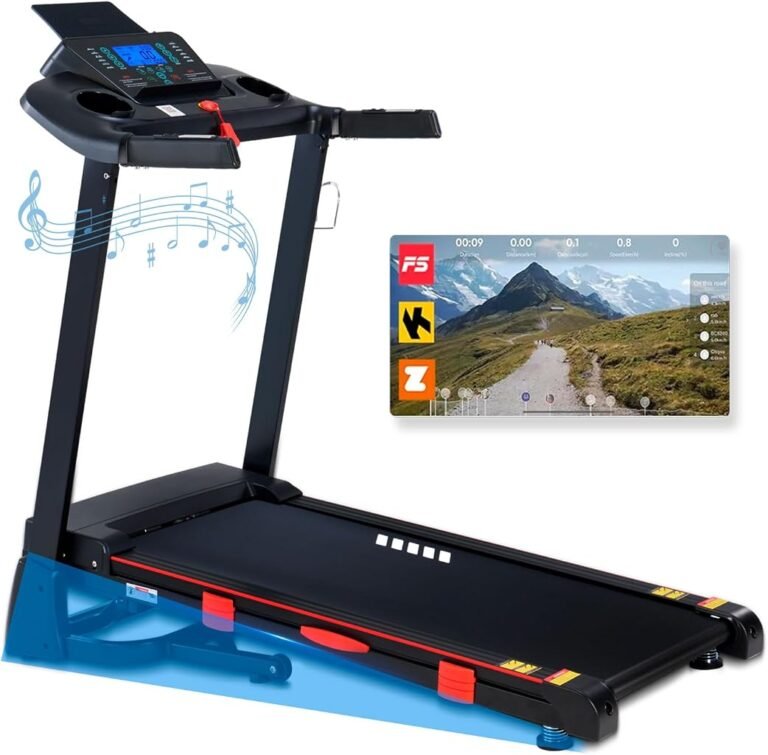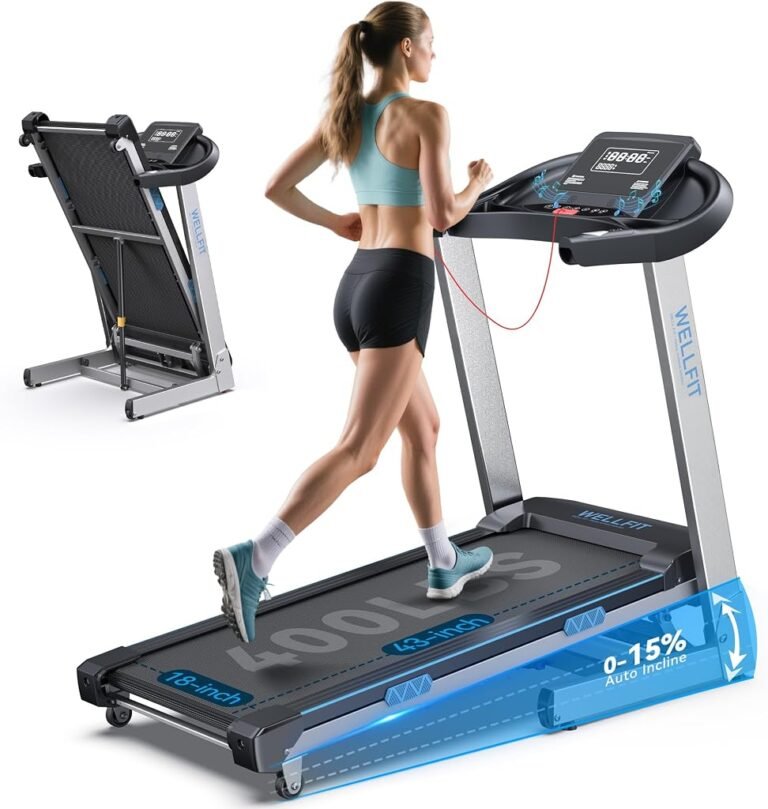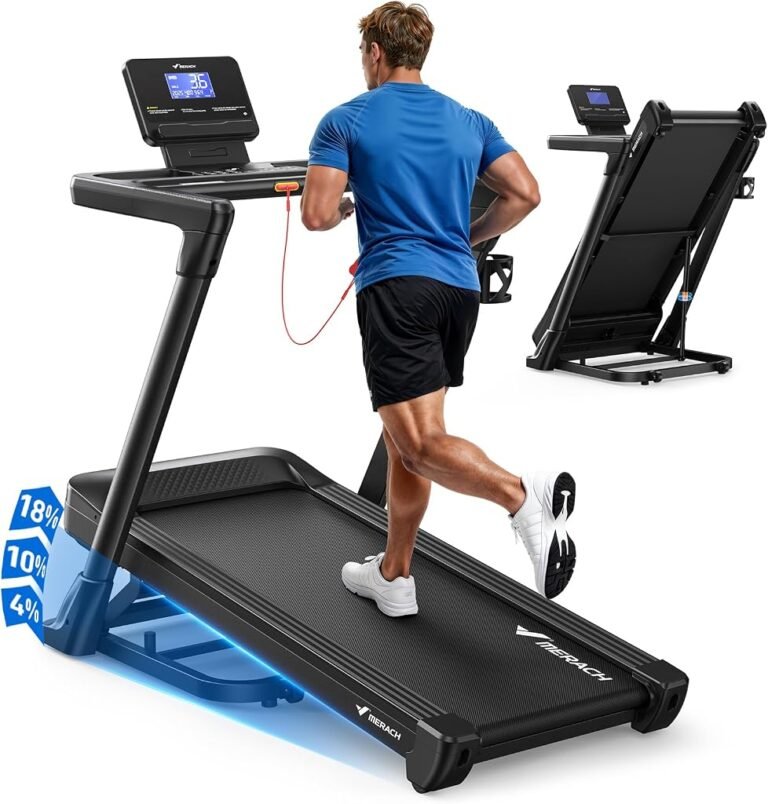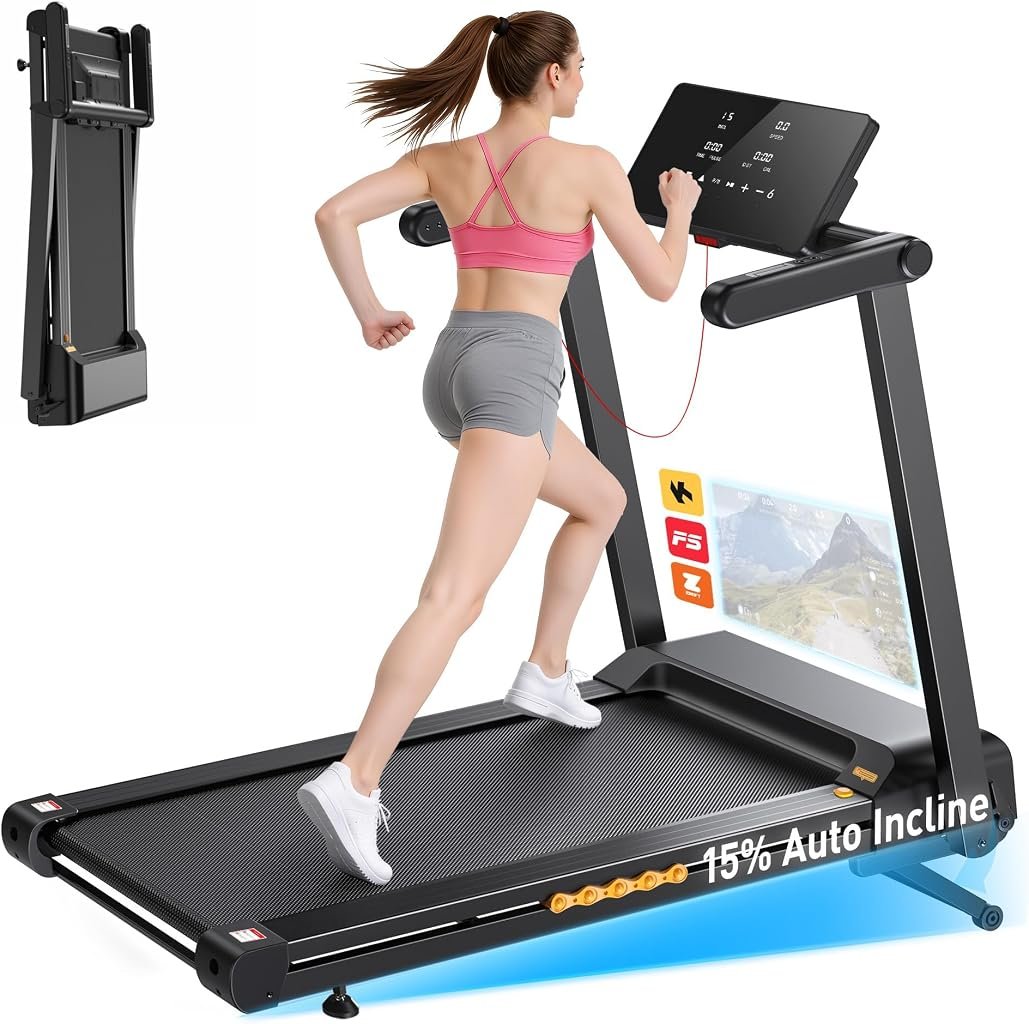
The JAGJOG Foldable Auto Incline Treadmill enters a crowded part of the home-fitness market with three specifications that immediately establish its purpose: a 15% automatic incline, an 8.8 mph maximum speed, and a stated 300-pound user capacity. Folding construction and heart-rate monitoring add practical dimensions to a machine priced at $359.99.
That combination deserves attention because the treadmill is attempting to solve competing problems. A useful running machine needs physical substance. A home treadmill benefits from taking up less space when exercise ends. Incline hardware adds capability but also mechanical complexity. A sub-$400 price keeps the machine accessible relative to more expensive running equipment, yet it also raises questions about where compromises may appear.
Our Score is 8.62/10. Customer Sentiment reaches 8.72, Buyer Confidence is 8.62, and Value is 8.4.
The narrow spread between those ratings is significant. Customer Sentiment exceeds our overall score by 0.10 points, while Value trails it by only 0.22. Unlike products whose score profiles reveal a major divide between conceptual appeal and ownership expectations, the JAGJOG presents a comparatively balanced picture.
That does not make it universally suitable.
The 15% incline is meaningful only for people who will use grade. An 8.8 mph ceiling is substantial for walking and recreational running, but faster runners may demand more. A 300-pound capacity broadens compatibility without answering questions about belt dimensions, stride fit, or room requirements.
At $359.99, the JAGJOG makes a strong case when those characteristics align with the buyer’s actual routine.
A 15% Incline Gives the Treadmill a Distinct Identity
Automatic incline is not a decorative addition here.
A maximum stated grade of 15% gives the JAGJOG enough range for incline to become a central training variable. The distinction between automatic and manually adjusted incline also matters. Powered adjustment allows grade to change during a workout without stopping the belt and physically repositioning the deck.
That can fundamentally alter session design.
A user can alternate flatter recovery periods with climbs, gradually increase grade, or hold a moderate incline while keeping speed relatively restrained.
The treadmill’s 8.8 mph maximum speed creates a second independent variable.
Together, speed and incline provide more exercise combinations than either feature alone.
The machine therefore has a broader identity than a basic walking pad. It can support walking, faster walking, incline sessions, jogging, and running within its stated performance boundaries.
That breadth is a major reason our assessment reaches 8.62/10.
Our Score: 8.62/10
We rate the JAGJOG Foldable Auto Incline Treadmill at 8.62/10.
That places it firmly in excellent territory.
The score reflects balance rather than dominance in one category. At $359.99, the treadmill combines a meaningful incline range, running-capable maximum speed, folding construction, heart-rate functionality, and a 300-pound stated user limit.
Each characteristic addresses a recognizable home-fitness requirement.
Incline expands training variation. Speed determines whether the machine remains confined to walking. Folding construction addresses floor-space pressure. Heart-rate monitoring adds another reference point during exercise. The 300-pound capacity broadens the population that can consider the machine.
The score also recognizes limits.
A 15% incline should not be treated as a requirement to exercise at 15%. An 8.8 mph maximum does not make the treadmill ideal for every runner. Folding does not erase the machine’s physical dimensions.
The JAGJOG succeeds because its capabilities fit together logically, not because every specification needs to be maximized.
Customer Sentiment: 8.72
Customer Sentiment is the highest rating at 8.72.
That matters because it sits slightly above both our overall score and Buyer Confidence.
The difference is modest, but the direction is encouraging. It suggests that the machine’s practical proposition aligns well with the experience expected from this type of equipment rather than depending entirely on an impressive specification sheet.
Several characteristics help explain that result.
The price remains below $400. The treadmill provides automatic rather than manual incline. Its 8.8 mph ceiling leaves room for running. The folding design addresses storage pressure. Heart-rate functionality gives users another way to observe workout intensity.
None of those features guarantees satisfaction.
Treadmills remain unusually personal purchases. User height, stride, weight, preferred pace, balance, room dimensions, floor construction, noise sensitivity, and exercise expectations all affect the ownership experience.
Customer Sentiment at 8.72 should therefore be read as a favorable editorial indicator rather than permission to skip measurement.
The treadmill still has to fit both body and building.
Buyer Confidence: 8.62
Buyer Confidence matches our overall score at 8.62.
That symmetry is useful.
There is no large confidence premium masking weaker value, nor is there an unusually low confidence figure undermining an attractive specification list.
The product concept is straightforward: a foldable home treadmill with automatic incline, running-capable speed, heart-rate functionality, and a stated 300-pound capacity.
Documentation available for JAGJOG’s JT60 treadmill family describes a 15% automatic incline, speeds reaching 8.8 mph, and a 300-pound maximum user capacity. The documentation also emphasizes use of a safety lock during operation.
Model identity still matters. Buyers should confirm that the exact machine being ordered matches the specifications they expect rather than assuming every JAGJOG treadmill shares identical dimensions, controls, programs, or construction.
That verification should happen before purchase, not after delivery.
Value: 8.4
Value receives an 8.4 rating.
It is the lowest score, but only by a narrow margin.
At $359.99, the treadmill’s economics are relatively easy to understand.
After 100 workouts, the initial purchase price represents approximately $3.60 per session. At 250 workouts, that falls to roughly $1.44. After 500 workouts, it is about $0.72 per workout.
Those figures exclude electricity, maintenance, repairs, financing, accessories, and any eventual replacement costs.
They are useful because home-fitness economics depend heavily on repetition.
A treadmill used four times every week accumulates more than 200 workouts in a year. A treadmill used twice a month accumulates only 24.
The 8.4 Value score therefore reflects both price and potential utilization.
At $359.99, JAGJOG offers a meaningful feature set. The machine becomes far more economical when automatic incline, folding construction, and running capability are actually used.
Incline Has a Measurable Physiological Effect
The case for automatic incline is supported by controlled research.
A 2021 study involving 24 healthy older adults examined treadmill walking at 0%, 10%, and 16% grades. Compared with level walking, researchers reported that net cardiopulmonary metabolic energy cost increased by 22.9% at a 10% grade and by 44.2% at a 16% grade. Several lower-limb muscles also showed greater activity as slope increased.
Those percentages should not be transferred directly to every JAGJOG owner. The participants were healthy older adults, and the experiment used controlled conditions.
The broader point is more durable.
Grade materially changes the physical demand of treadmill walking.
That gives the JAGJOG’s 15% maximum incline genuine exercise relevance.
A walker does not necessarily need to increase belt speed dramatically to create a harder session. Grade provides another route.
Fifteen Percent Is a Ceiling, Not a Target
Maximum specifications are easy to misread as goals.
A 15% incline is an available upper boundary. It is not an instruction to spend every workout climbing at maximum grade.
The difference matters for both safety and exercise quality.
If a steep incline forces a user to grip the handrails heavily, lean backward, shorten movement unnaturally, or struggle to remain centered on the belt, the selected combination of speed and grade may be inappropriate.
Moderate incline can still create substantial workload.
The JAGJOG’s advantage therefore lies in adjustment range rather than in the spectacle of reaching the maximum.
A user can move between flatter and steeper sections as fitness, comfort, and session objectives permit.
Automatic adjustment makes those transitions easier to incorporate into a continuous workout.
Walking Is Not a Lesser Use of This Machine
An 8.8 mph maximum speed makes running possible, but walking remains a legitimate reason to own the treadmill.
Current CDC physical-activity recommendations call for adults to complete at least 150 minutes of moderate-intensity activity such as brisk walking each week, alongside muscle-strengthening activity on at least two days.
That 150-minute target can be reached through five 30-minute sessions.
A treadmill makes those sessions less dependent on weather, daylight, route conditions, or travel to a gym.
Incline adds another dimension.
A user might perform 30 minutes of predominantly flat brisk walking one day, moderate hill intervals on another, and a sustained low-grade session later in the week.
Running capability broadens the machine.
It does not invalidate walking as a serious use case.
The 8.8 MPH Maximum Speed Needs Perspective
At 8.8 mph, the treadmill’s maximum speed corresponds to approximately a 6-minute-49-second mile.
That is substantially faster than walking and faster than many recreational users will ever need.
The speed ceiling therefore gives the JAGJOG a legitimate running range rather than restricting it to low-speed movement.
Yet maximum speed should be interpreted carefully.
A treadmill that can reach a particular speed is not automatically the correct machine for every person who runs at that speed.
Running-surface dimensions matter. User height matters. Stride changes with pace. Stability matters. Workout duration matters.
A runner who regularly trains near the machine’s upper speed boundary should evaluate the entire treadmill rather than treating 8.8 mph as the only relevant specification.
For walking, jogging, and moderate running, the available range is considerably broader than a walking-only machine provides.
A 300-Pound Capacity Is Meaningful but Incomplete
The stated 300-pound user capacity broadens the treadmill’s potential audience.
That deserves credit.
Fitness equipment can create an unfortunate contradiction when a low weight limit excludes people actively seeking accessible ways to exercise. A higher capacity reduces that barrier for some buyers.
Yet maximum weight is only one measure of compatibility.
A treadmill can support a person’s body mass while still having a running surface that feels restrictive for that person’s stride or preferred speed.
Handrail placement can matter.
Deck height can matter.
Available lateral space can matter.
The 300-pound figure should therefore be treated as a necessary specification for relevant buyers, not as a complete description of comfort or fit.
The body interacts with the whole machine.
Heart-Rate Monitoring Is Useful When Interpreted With Restraint
Heart-rate functionality can make exercise feel more measurable.
That can be useful, particularly during incline sessions where perceived effort may change quickly.
Yet treadmill heart-rate readings should not become the sole authority over exercise intensity.
Contact-based sensors depend on physical interaction with the machine and can be affected by grip, movement, contact quality, and other variables. A reading that looks unusually high or low should be interpreted in context rather than treated as unquestionable.
For many users, heart rate works best alongside perceived exertion, breathing, speed, grade, and workout duration.
The feature therefore adds information.
It does not eliminate judgment.
That distinction matters on a treadmill capable of combining meaningful speed with a 15% incline.
Folding Solves a Problem the Workout Does Not
A treadmill may be used for 30 to 60 minutes and remain stationary for the rest of the day.
That arithmetic gives folding construction practical value.
Home exercise equipment competes with desks, beds, sofas, storage, doors, pets, children, and ordinary movement through a room. Recovering floor space after exercise can determine whether a treadmill remains tolerable in a shared environment.
Folding, however, is not disappearance.
The machine still has mass. It still requires storage dimensions. Moving it may require effort. The folded configuration still needs somewhere to go.
Buyers should therefore examine two footprints: operating and stored.
Both need to work.
A treadmill that fits perfectly while folded but blocks furniture during exercise is poorly matched. One that works during exercise but has nowhere practical to go afterward defeats much of the purpose of folding construction.
Space Efficiency and Running Capability Pull in Opposite Directions
Home treadmill design contains an unavoidable conflict.
Users generally benefit from more running space.
Homes generally benefit from smaller equipment.
Manufacturers can fold frames, use transport wheels, reduce console structures, and alter deck geometry, but they cannot completely remove the dimensions required for human movement.
That trade-off becomes more important as speed increases.
A walking pad can prioritize compactness because walking generally requires less running-surface freedom than faster running. A machine reaching 8.8 mph has a different task.
This is why buyers comparing the best treadmills for home use should resist ranking machines by compactness alone.
Storage convenience matters.
So does having enough treadmill beneath the user.
The $359.99 Price Makes Consistency the Central Question
At $359.99, the JAGJOG avoids the financial commitment associated with many premium treadmills.
It is still expensive enough that neglect becomes costly.
The machine’s real economic question is not whether $359.99 is objectively cheap or expensive.
It is whether the treadmill will become part of a repeatable routine.
Four workouts per week create roughly 208 sessions per year. At that frequency, the purchase price alone works out to about $1.73 per workout during the first year.
Two sessions per month create 24 annual workouts, pushing that same initial purchase cost to roughly $15 per session during year one.
Usage changes the calculation radically.
The treadmill cannot supply consistency.
Its job is to reduce barriers that interfere with consistency.
Automatic incline can reduce monotony. Folding can reduce spatial inconvenience. Home placement can remove travel time. Running capability can allow routines to progress beyond walking.
Those are useful tools if the owner uses them.
Home Cardio Offers Control Over Circumstances
Outdoor walking and running offer advantages a treadmill cannot reproduce: changing scenery, natural terrain, outdoor air, and the possibility of integrating exercise with transportation or social activity.
A treadmill offers control.
Rain becomes irrelevant. Darkness no longer determines whether a route feels practical. Traffic is removed. Grade can be selected rather than discovered. Speed can be precisely adjusted. A workout can begin within minutes of deciding to exercise.
That control can be particularly useful for people whose schedules leave narrow exercise windows.
The CDC’s weekly activity recommendation does not require one uninterrupted block. Moderate activity can be distributed through the week.
A home treadmill fits naturally into that structure.
The value is logistical as much as physiological.
Who Is the JAGJOG Best Suited To?
The JAGJOG’s strongest candidate is someone who wants more than a basic walking pad but does not require the speed or scale of a premium running treadmill.
Walkers who expect to use incline regularly have a particularly clear reason to consider it.
Joggers and recreational runners can make use of the 8.8 mph speed ceiling.
The stated 300-pound capacity expands compatibility for users who exceed the limits of lighter-duty machines.
Folding construction strengthens the proposition for rooms where permanent treadmill floor space is difficult to justify.
The fit becomes weaker for someone seeking only slow under-desk walking. That user may be paying for speed and incline capability that remains unused.
Faster or high-mileage runners should scrutinize running-surface dimensions, stability, warranty coverage, sustained performance, and overall geometry before prioritizing price.
What Buyers Should Verify Before Purchase
A treadmill should be measured against both the user and the room.
Before ordering, buyers should verify:
- Exact running-surface width and length
- Maximum speed
- Automatic-incline range and adjustment increments
- Maximum supported user weight
- Operating dimensions
- Folded dimensions
- Machine weight
- Heart-rate sensor arrangement
- Safety-stop mechanism
- Control placement
- Electrical requirements
- Assembly requirements
- Transport-wheel arrangement
- Warranty coverage
- Maintenance instructions
- Recommended clearance
The room itself should then be measured.
Marking the operating footprint on the floor with removable tape can reveal conflicts that photographs conceal. Doors need room to swing. Chairs need room to move. Cabinets still need to open.
The folded footprint deserves the same exercise.
Storage is a physical measurement, not a marketing adjective.
Where the JAGJOG Gives Ground
An 8.62/10 rating leaves room for criticism.
The first limitation is inherent in the category: a foldable treadmill still requires meaningful room while being used.
The second is the 8.8 mph ceiling. It is more than sufficient for walking and substantial recreational running, but faster runners may require a different machine.
The third is the 300-pound capacity. It broadens accessibility, yet heavier users still need to verify running-surface dimensions and overall physical fit rather than relying on capacity alone.
The fourth concerns value.
At 8.4, Value trails Customer Sentiment at 8.72 and our overall score at 8.62. The difference is not large, but it reinforces an important point: $359.99 is attractive only when the machine’s broader capabilities are relevant.
Paying for unused incline, unused speed, or unnecessary folding functionality does not create value.
How It Fits Among the Best Treadmills for Home Use
The best treadmills for home use have to satisfy a different equation from commercial gym equipment.
A gym can dedicate large areas to machines that remain permanently open. A household cannot always make that sacrifice.
Home equipment must negotiate with floor space, noise, storage, electrical access, budgets, and other people.
The JAGJOG addresses several of those pressures without reducing itself to a walking-only platform.
Its 15% automatic incline creates substantial training range. Its 8.8 mph maximum speed supports running. Its stated 300-pound capacity broadens the user base. Folding construction addresses storage pressure, while heart-rate functionality adds a basic physiological reference during exercise.
At $359.99, that combination explains the 8.62/10 overall rating.
The treadmill does not need to dominate every specification to make sense.
It needs to combine enough useful capabilities at a price that remains defensible.
Final Considerations
The JAGJOG Foldable Auto Incline Treadmill earns an 8.62/10 overall score by combining meaningful incline capability, running-level speed, folding construction, heart-rate functionality, and a stated 300-pound capacity at $359.99.
Customer Sentiment is the strongest rating at 8.72. Buyer Confidence matches the overall score at 8.62, while Value reaches 8.4.
That narrow spread is one of the machine’s more persuasive characteristics.
There is no dramatic disconnect between confidence, value, and expected ownership appeal. Instead, the JAGJOG presents a relatively balanced proposition whose suitability depends primarily on physical fit and intended use.
The 15% automatic incline is more than a specification-sheet flourish. Controlled research demonstrates that increasing treadmill grade can materially increase metabolic demand, giving powered incline legitimate training relevance. The 8.8 mph maximum speed provides considerable room beyond walking, while the 300-pound stated capacity makes the treadmill accessible to a broader range of users than lower-capacity machines.
None of those numbers should become targets merely because they are available.
A user does not need to exercise at 15% grade for incline to be useful. A walker does not need to approach 8.8 mph to justify the machine. A 300-pound weight limit does not replace the need to verify belt dimensions and comfort.
The strongest buyer is someone who intends to use the treadmill repeatedly for walking, incline training, jogging, or moderate running and who benefits from folding the machine when exercise ends.
The weaker fit is somebody seeking only low-speed movement or a dedicated high-performance running platform.
At $359.99, the JAGJOG’s economics depend on repetition. A machine used several times each week can spread its purchase cost across hundreds of sessions. One used sporadically cannot.
That makes consistency more consequential than the longest feature list.
The JAGJOG cannot create a habit on its owner’s behalf. It can, however, remove several practical barriers that interfere with one: weather, travel time, fixed outdoor terrain, limited training variety, and permanent floor-space demands.
For the household that values those advantages, the 8.62/10 rating is well supported. The machine’s strongest quality is not one isolated number. It is the way incline, speed, folding, capacity, and price combine into a home treadmill that offers substantial exercise flexibility without demanding a premium-tier budget.