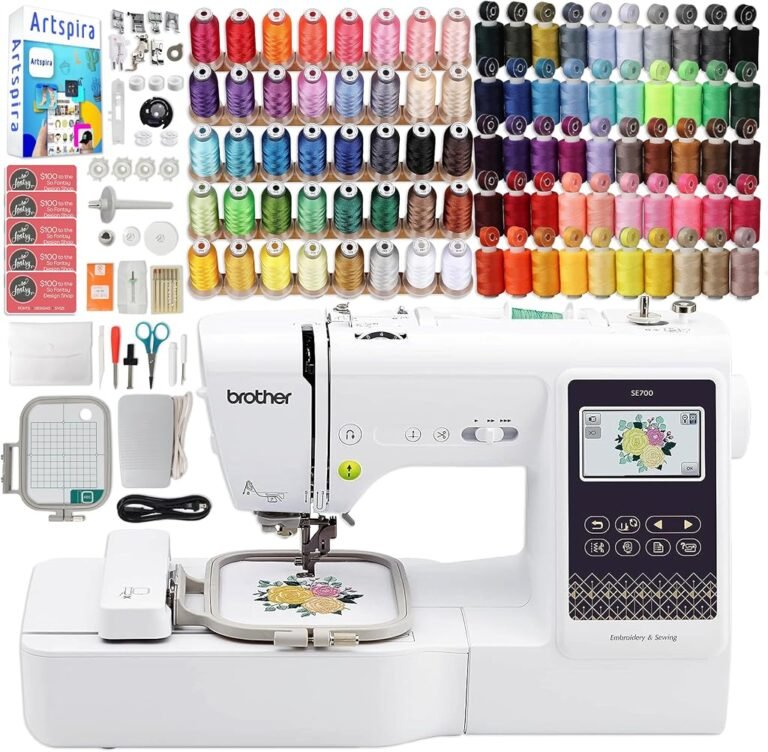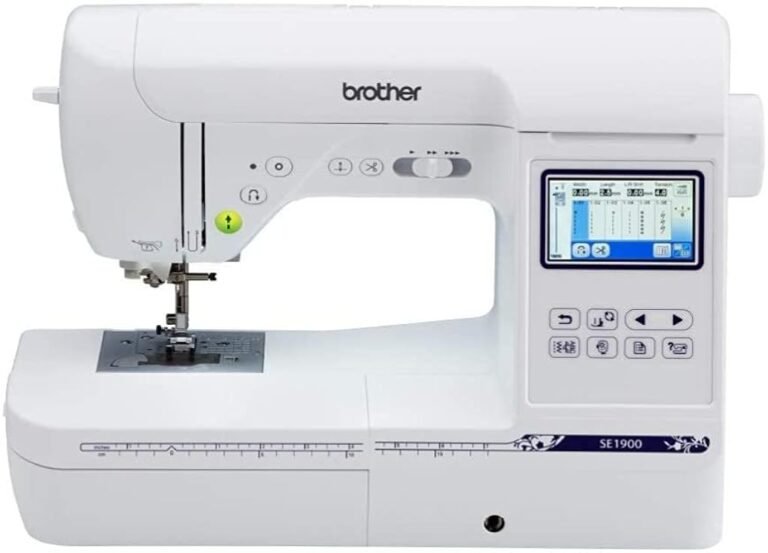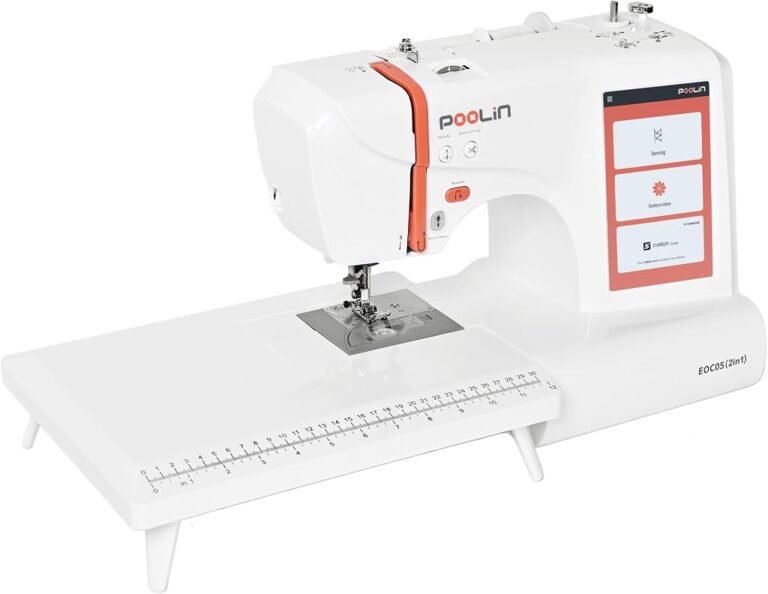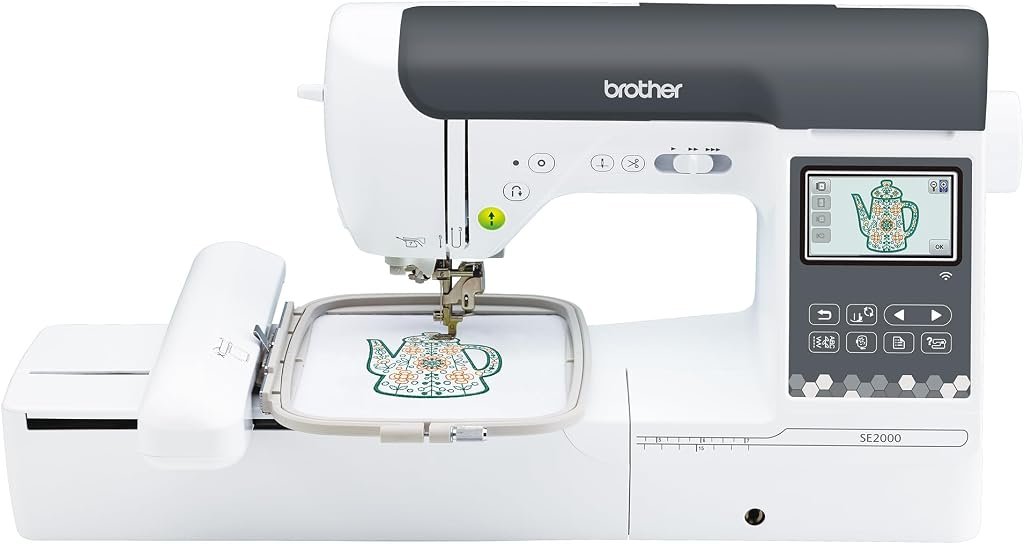
The Brother SE2000 sits in a consequential middle ground. It is neither a modest 4 × 4-inch introductory embroidery machine nor a multi-needle production system intended to keep numerous thread colors ready simultaneously. Instead, Brother combines a 5 × 7-inch embroidery field, conventional computerized sewing, wireless design transfer, mobile connectivity, a substantial built-in design library, and an 850-stitch-per-minute maximum sewing speed in one machine.
That combination makes the SE2000 more ambitious than entry-oriented combination machines. It also creates a more demanding value question. At this level, convenience alone is insufficient. The larger embroidery field, sewing capacity, digital workflow, and editing features must collectively justify the additional expenditure.
Our Score for the Brother SE2000 is 8.71/10. Customer Sentiment is 8.72, Buyer Confidence is 9.05, and Value is 8.4. The pattern behind those scores is revealing. The machine earns confidence because its capabilities are unusually well defined. Value is more restrained because buyers paying for the SE2000 should actually need its broader embroidery and sewing capacity rather than simply admiring a longer specification sheet.
The SE2000 is therefore best understood as a serious home combination machine for users who expect sewing and embroidery to remain substantial parts of the same creative workflow.
The 5 × 7-Inch Field Changes the Machine’s Practical Range
The defining specification is the embroidery field.
According to Brother’s official SE2000 specifications, the machine provides a 5 × 7-inch maximum embroidery area. It includes a corresponding 5 × 7-inch embroidery frame.
That extra area matters far more than the modest numerical difference from a 4 × 4 machine initially suggests.
A 4 × 4 field provides 16 square inches of theoretical rectangular area. A 5 × 7 field provides 35 square inches. In simple geometric terms, that is more than twice the rectangular area.
Embroidery designs do not necessarily use every square inch, but the comparison illustrates why hoop dimensions deserve attention.
The larger field allows more room for names, decorative compositions, larger motifs, grouped elements, apparel graphics, towel designs, bag panels, and lettering arrangements without immediately forcing the user into splitting or repositioning a design.
That reduction in workaround frequency is one of the SE2000’s strongest practical advantages.
Larger Embroidery Is About More Than Making Graphics Bigger
A larger embroidery field is sometimes treated as though its purpose were merely enlargement.
That misses much of its usefulness.
Five-by-seven space can be used for several smaller elements arranged as a composition. It can accommodate longer lettering. It can leave more freedom for positioning decorative elements around a name. It can reduce the need to divide designs that sit awkwardly just beyond the limits of a 4 × 4 machine.
This matters because every repositioning operation introduces additional setup.
Fabric placement, stabilizer, registration, and alignment all become more consequential when a composition must be divided across multiple embroidery positions.
The SE2000 does not eliminate those skills. Designs can still exceed 5 × 7 inches.
It simply moves the boundary farther outward.
For many home embroiderers, that may be the difference between routinely managing divided designs and completing a large portion of ordinary projects in one hooping position.
The Machine Includes 193 Embroidery Designs
Brother gives the SE2000 193 built-in embroidery designs.
The quantity provides considerable material for immediate experimentation, but design count should not be mistaken for embroidery capacity.
Digital patterns are replaceable and expandable. Mechanical travel is not.
The machine’s 193 built-in designs therefore matter most during early ownership, when a user may want to explore embroidery without first assembling an external file library.
Over time, wireless transfer and imported designs reduce the significance of the factory count.
This is a useful distinction when comparing the best sewing and embroidery machines. A model with hundreds of built-in patterns does not necessarily have greater long-term creative range than a machine with fewer patterns but a larger embroidery field and a flexible file-transfer system.
The SE2000 happens to provide both a substantial internal library and connected transfer options.
Thirteen Embroidery Fonts Improve Personalization
The SE2000 includes 13 built-in embroidery lettering fonts.
Lettering deserves separate consideration from decorative designs because personalization is one of the most common reasons households investigate machine embroidery.
Names, initials, dates, labels, monograms, and short phrases can transform otherwise ordinary sewn objects into individualized projects.
A larger 5 × 7 field complements those fonts.
Longer names and larger lettering arrangements have more physical room than they would on a 4 × 4 platform. The machine’s 3.7-inch color LCD also supports on-screen editing, including letter editing and combining designs.
That does not turn the SE2000 into professional digitizing software.
It does make basic composition work possible at the machine.
The 3.7-Inch Display Has a Defined Purpose
Brother equips the SE2000 with a 3.7-inch color LCD.
Screen dimensions matter because embroidery requires more visual interaction than conventional mechanical sewing. A user needs to select designs, examine layouts, adjust settings, work with lettering, and navigate embroidery controls.
The SE2000 supports on-screen editing, including combining designs and editing letters.
The screen is still compact compared with a tablet or computer monitor.
That establishes a sensible division of labor.
Detailed design creation and extensive editing are often better handled through external software or a mobile interface. The machine screen is more appropriately used for selection, placement, adjustments, and execution.
A larger display would provide more visual space, but the SE2000’s interface is sufficiently developed to support its combination-machine role without pretending to be a desktop design workstation.
Artspira Extends the Workflow to Mobile Devices
The SE2000 is compatible with Brother’s Artspira platform.
Brother’s Artspira transfer process allows a user to select and edit a design, choose a connected embroidery machine, transfer the pattern, and retrieve it through the machine’s temporary data area.
This changes where embroidery preparation can occur.
A project no longer has to begin at the sewing machine or desktop computer. Design browsing and some creative work can happen on a supported mobile device before the file reaches the SE2000.
The convenience is procedural rather than mechanical.
Artspira cannot correct unsuitable stabilizer, repair poor hooping, replace a damaged needle, or expand the 5 × 7 field. The final result still depends on the physical relationship between thread, fabric, stabilizer, needle, hoop, and digitized design.
Digital convenience removes steps. It does not remove embroidery fundamentals.
External Files Reduce Dependence on Brother’s Built-In Library
Artspira also supports imported embroidery designs.
Brother’s external-file guidance lists PES, PHC, PHX, and DST among supported embroidery file types for importing into the app.
That capability is strategically more significant than another collection of factory designs.
Embroidery tastes are personal. Someone making children’s gifts, another producing monogrammed linens, and another decorating bags may use almost entirely different design libraries.
Importing external files allows the machine to adapt to those preferences.
The buyer should still verify design dimensions and compatibility before transfer. A file format being supported does not mean every design automatically fits inside the SE2000’s embroidery field.
File compatibility and physical design size are separate questions.
Wireless Design Database Transfer Reduces File-Handling Friction
Brother also supports wireless computer-to-machine transfer through Design Database Transfer.
The company’s Design Database Transfer documentation describes a Windows application that sends embroidery data wirelessly to compatible Brother machines and displays design collections through a thumbnail viewer.
This feature becomes more useful as a design library grows.
A handful of files is easy to manage manually. Hundreds of files distributed across project folders create a different organizational problem.
Thumbnail-based management can make visual identification faster, while wireless transfer removes the recurring step of carrying removable media between computer and machine.
The improvement is mundane in the best sense: it eliminates repetitive administrative work.
That kind of convenience tends to matter more after months of ownership than it does in a showroom demonstration.
Mac and Windows Workflows Are Not Identical
Wireless capability deserves careful interpretation because computer platforms do not receive identical workflows.
Brother states in its Mac transfer guidance that there is currently no Mac application that transfers designs wirelessly to an embroidery machine in the same manner as Design Database Transfer.
Brother instead directs compatible users toward Artspira for wireless transfer from supported mobile devices.
This is a small technical distinction with practical consequences.
A Windows-centered workflow can use Brother’s dedicated Design Database Transfer application. A Mac-centered household may lean more heavily on mobile transfer or other supported routes.
The machine remains wireless in either purchasing discussion, but “wireless” is not synonymous with identical software support across every computer platform.
Artspira Is Connected, but It Is Not Unlimited Storage
The digital workflow has boundaries of its own.
Artspira transfers designs into the machine’s temporary data area. Brother also documents circumstances in which designs cannot be saved because available machine memory is insufficient.
That distinction matters because connected embroidery can create an impression that designs simply live everywhere simultaneously.
They do not.
Files still require organization, storage, and deliberate transfer.
The most effective workflow is likely to keep the master design collection organized on a computer or other suitable storage system while treating the machine as the endpoint for projects ready to be stitched.
That approach also reduces clutter inside machine memory.
The Sewing Side Is Substantially More Developed Than Entry Models
The SE2000 is not merely an embroidery machine carrying enough conventional stitches to satisfy a specification sheet.
Brother provides 241 built-in sewing stitches.
That is a significant range for garment construction, utility work, decorative sewing, quilting-related applications, and experimentation.
The machine also includes 10 styles of one-step auto-size buttonholes and five built-in sewing lettering fonts.
This matters because a combination machine should be evaluated on both halves of its identity.
A buyer interested almost exclusively in embroidery may receive little benefit from paying for 241 sewing stitches.
A buyer who constructs garments, quilts, bags, home furnishings, or other sewn projects before adding embroidery can use much more of the machine’s architecture.
The SE2000 is most defensible when both activities are genuine requirements.
Sewing Speed Reaches 850 Stitches per Minute
Brother specifies a maximum sewing speed of 850 stitches per minute.
That gives the SE2000 greater sewing throughput than slower entry-oriented combination machines, at least at the specification level.
Maximum speed is not automatically desirable on every seam.
Curves, precision work, unfamiliar materials, tight corners, and detail sewing often benefit from slower operation. Straight seams across stable fabrics can make greater use of available speed.
The machine therefore offers capacity rather than an instruction to sew continuously at the maximum.
Brother also lists embroidery speed up to 650 stitches per minute.
The two figures should not be directly conflated. Conventional sewing and machine-controlled embroidery involve different workflows, and design density, thread changes, setup, and project complexity can influence how long an embroidery job actually takes.
The Knee Lifter Is More Than a Decorative Specification
Brother includes a knee lifter with the SE2000.
This allows the presser foot to be raised using the knee rather than requiring a hand to leave the fabric.
The feature can be useful when fabric positioning demands both hands, particularly during detailed sewing or when managing larger pieces.
It is the sort of specification that can disappear beneath more conspicuous numbers such as 193 embroidery designs and 241 sewing stitches.
Yet features affecting physical workflow often matter disproportionately over long ownership.
The same logic applies to automatic needle threading, automatic thread cutting, Quick-Set bobbin operation, and start/stop control. None changes the size of the embroidery field, but each can reduce small repetitive actions.
The Included Accessory Package Is Substantial
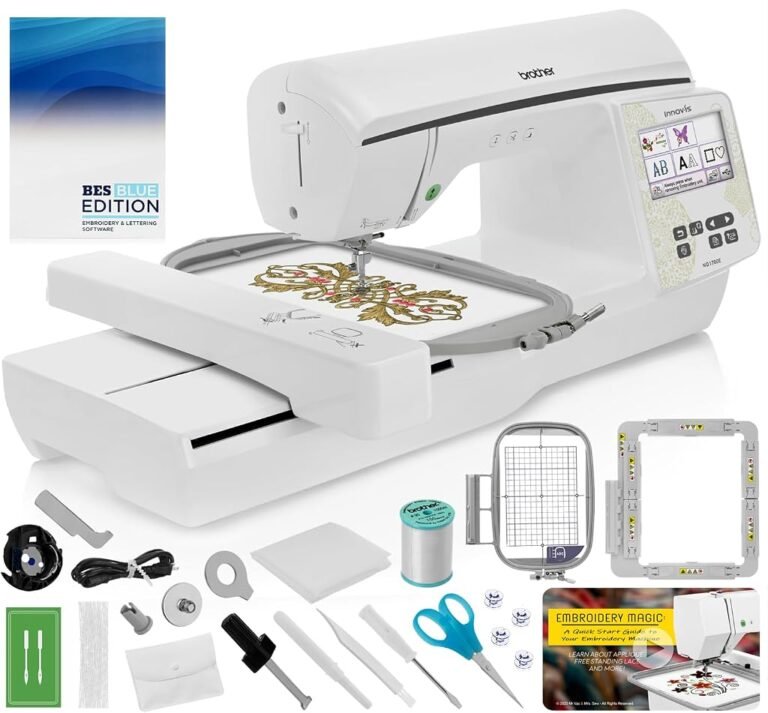
Brother’s standard SE2000 package includes eight presser feet: zigzag, monogramming, overcasting, zipper, blind stitch, button fitting, buttonhole, and embroidery feet.
The carton also includes a needle set, twin needle, four bobbins, seam ripper, scissors, cleaning brush, eyelet punch, several screwdrivers, spool accessories, a knee lifter, two bobbin cases, foot controller, 5 × 7-inch embroidery frame set, 60-weight white embroidery bobbin thread, accessory bag, grid sheets, and documentation.
This matters when comparing retailer bundles.
An accessory package should be judged against what Brother already includes rather than against an imaginary bare machine.
Duplicating standard tools adds less value than supplying consumables the buyer will actually use.
Thread, stabilizer, needles, bobbins, and genuinely useful compatible hoops deserve more attention than a large advertised piece count.
The Single-Needle Architecture Still Requires Operator Involvement
The SE2000 remains a single-needle embroidery machine.
That distinction matters for multicolor work.
A design containing several thread colors requires changes as the embroidery progresses. The machine automates hoop movement and stitch placement, but it does not keep a rack of different colors threaded and ready in the manner of multi-needle production equipment.
For home embroidery, this is normal.
For repeated commercial orders, operator involvement accumulates.
The SE2000 can certainly create sophisticated multicolor embroidery, but the workflow remains fundamentally different from a machine engineered around multi-needle production.
Buyers contemplating a small embroidery business should therefore think in terms of workload rather than simply design capability.
Being able to stitch a design and producing that design efficiently dozens of times are different requirements.
Our Score: 8.71/10
We rate the Brother SE2000 at 8.71/10.
The score reflects a machine with unusually broad home-use capability.
A 5 × 7 embroidery field, 193 built-in embroidery designs, 13 embroidery fonts, 241 sewing stitches, 10 one-step buttonhole styles, wireless LAN, Artspira compatibility, a 3.7-inch color display, 850-stitch-per-minute maximum sewing speed, and 650-stitch-per-minute maximum embroidery speed form a coherent combination platform.
The score stops short of treating feature density as automatic superiority.
The SE2000 is most rational when a buyer will actually use both the sewing and embroidery systems. Someone focused only on embroidery may be paying for sewing capability that remains idle. Someone interested primarily in conventional sewing may find the embroidery hardware equally unnecessary.
The machine earns 8.71 because the combined proposition is strong when the buyer genuinely needs the combination.
Customer Sentiment: 8.72
Our Customer Sentiment score is 8.72.
The near alignment with the overall score is revealing.
The SE2000 does not depend on one spectacular specification. Its appeal comes from the way several useful capabilities reinforce one another.
The 5 × 7 field gives embroidery more room. Wireless transfer improves file handling. Artspira introduces mobile workflows. The 241 sewing stitches give the machine substantial conventional utility. The larger display supports editing and design interaction.
This creates a machine that can satisfy a broad range of home projects without moving into multi-needle equipment.
The score also recognizes that complexity grows with capability.
A buyer must still learn stabilizer selection, hooping, thread behavior, design sizing, file management, needle selection, and machine maintenance. Connectivity does not remove the craft from machine embroidery.
Buyer Confidence: 9.05
Buyer Confidence is 9.05.
This is the highest of our four editorial ratings for the SE2000.
The reason is transparency.
Brother publishes detailed specifications, standard accessory contents, software compatibility information, manuals, warranty information, and model-specific support. The machine’s principal boundaries are also reasonably easy to understand.
The embroidery field is 5 × 7 inches.
It is a single-needle machine.
Design Database Transfer is a Windows-centered application.
Artspira provides a separate mobile-connected route.
The machine combines sewing and embroidery rather than dedicating itself exclusively to either.
These boundaries make buyer fit easier to judge.
High confidence does not mean the machine is appropriate for everyone. It means its role can be defined with relatively little ambiguity.
Value: 8.4
Our Value score is 8.4, lower than the overall rating and Buyer Confidence.
That difference deserves attention.
The SE2000 offers considerable capability, but value depends on how much of that capability will actually be used.
A buyer who regularly sews and embroiders can spread the machine’s cost across two substantial activities. Wireless transfer, a 5 × 7 field, 241 sewing stitches, automatic functions, and the included accessory package can all contribute to long-term utility.
A buyer interested almost entirely in one discipline has a harder value equation.
Dedicated embroidery machines may allocate more of their cost toward embroidery-specific capability. Dedicated sewing machines avoid charging for an embroidery system that may remain stored away.
The SE2000’s value therefore comes from consolidation.
It is strongest when one machine genuinely replaces the need to purchase two.
Where the SE2000 Fits Among the Best Sewing and Embroidery Machines
The best sewing and embroidery machines are not necessarily those with the highest design counts or longest lists of decorative stitches.
The more useful question is whether the architecture matches the intended work.
The SE2000 is particularly well positioned for users who find 4 × 4 embroidery restrictive but do not require the scale, cost, or production workflow of commercial multi-needle equipment.
Its 5 × 7 field represents a meaningful step upward.
The 241 sewing stitches also make the machine more substantial as a conventional sewing platform than models whose sewing functionality feels secondary to embroidery.
Wireless transfer and Artspira support bring file handling into a more current workflow.
Those features collectively make the SE2000 a broad home machine rather than a narrow specialist.
Who Should Consider the Brother SE2000?
The SE2000 makes the strongest case for buyers who want:
- A 5 × 7-inch native embroidery field
- Sewing and embroidery in one machine
- 193 built-in embroidery designs
- 13 built-in embroidery lettering fonts
- 241 built-in sewing stitches
- 10 one-step auto-size buttonhole styles
- Wireless design transfer
- Artspira mobile integration
- A 3.7-inch color LCD
- On-screen lettering and design combination
- Sewing speeds up to 850 stitches per minute
- Embroidery speeds up to 650 stitches per minute
- Automatic needle threading and thread cutting
- A knee lifter for hands-on fabric control
- An established manufacturer support system
The machine is especially logical for someone moving beyond 4 × 4 embroidery while retaining a strong need for conventional sewing.
Who Should Look Elsewhere?
A buyer interested exclusively in small monograms and occasional 4 × 4 embroidery may not need the SE2000’s additional capacity.
Someone who already owns a capable sewing machine should compare dedicated 5 × 7 embroidery models before paying for duplicate sewing functionality.
Production-focused users should also examine multi-needle alternatives if repeated multicolor orders are central to the intended workload.
Finally, projects routinely exceeding 5 × 7 inches will eventually expose the SE2000’s own physical boundary.
Five-by-seven is substantially more flexible than 4 × 4.
It is still a boundary.
That is why buying according to actual project dimensions remains more rational than buying according to design counts.
Final Considerations
The Brother SE2000 Sewing and Embroidery Machine earns an Our Score of 8.71/10 because it combines meaningful embroidery capacity with a developed conventional sewing platform rather than treating either function as incidental.
Its 5 × 7-inch embroidery field is the specification that changes the ownership experience most. Compared with 4 × 4 platforms, it creates substantially more room for lettering, decorative compositions, apparel graphics, personalized gifts, and designs that would otherwise require repositioning or splitting.
The supporting specifications are substantial: 193 built-in embroidery designs, 13 embroidery fonts, 241 sewing stitches, 10 one-step buttonhole styles, a 3.7-inch color LCD, wireless LAN, Artspira compatibility, on-screen editing, automatic functions, sewing speeds up to 850 stitches per minute, and embroidery speeds up to 650 stitches per minute.
Customer Sentiment at 8.72 reflects a machine whose appeal comes from the combined experience rather than one isolated specification. Buyer Confidence at 9.05 reflects clear manufacturer documentation and readily identifiable limitations. Value at 8.4 is deliberately more restrained because the SE2000 makes financial sense primarily when both sewing and embroidery capabilities will receive sustained use.
The machine is not a substitute for multi-needle production equipment, nor does a 5 × 7 field eliminate every embroidery-size restriction.
What it does is move the compromise.
Instead of asking whether a small 4 × 4 design will fit, the SE2000 gives the user substantially more physical room before splitting, repositioning, or redesigning becomes necessary. Instead of relying solely on built-in patterns or physical file transfer, wireless connectivity expands the digital workflow. Instead of requiring a second machine for conventional sewing, the SE2000 provides a substantial sewing system within the same chassis.
For households genuinely engaged in both disciplines, those capabilities form a coherent argument.
For buyers who need only one half of the machine, specialization may produce better value.
That distinction is the SE2000’s central purchasing test: its breadth is an asset only when the buyer intends to use it.