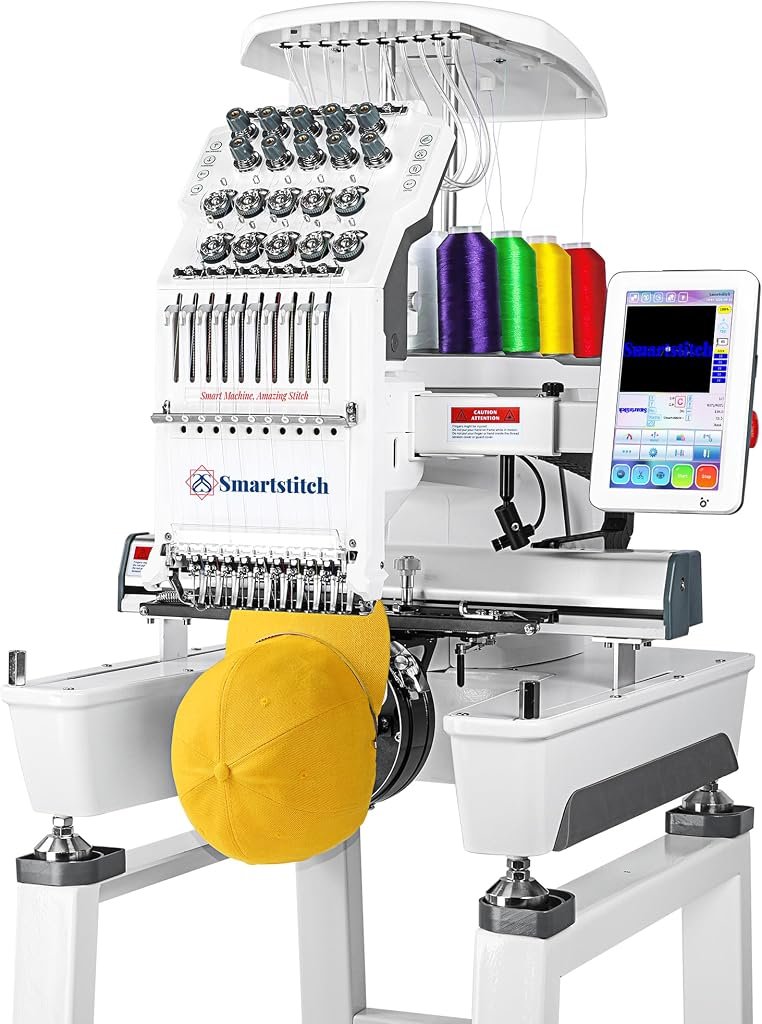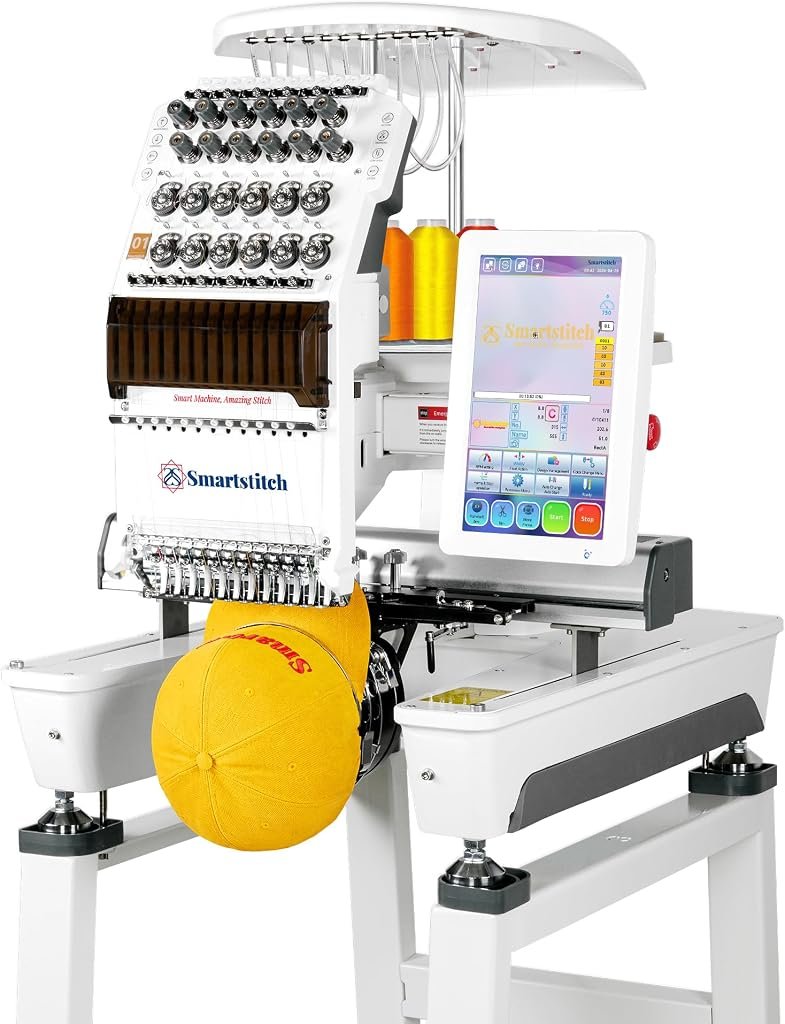
The Smartstitch S-1201 Plus is not built around the logic of occasional single-needle embroidery. Its design assumes that the operator wants more thread colors ready at once, larger working space, faster runs and fewer interruptions between one section of a design and the next.
That distinction starts with its 12-needle architecture.
Twelve needles allow twelve upper-thread colors to remain threaded simultaneously, turning many multicolor designs into automated color sequences rather than repeated manual changes. Smartstitch combines that arrangement with a 300 × 400 mm flat embroidery field, equivalent to roughly 11.8 × 15.7 inches, a 10-inch touchscreen and a maximum stated embroidery speed of 1,200 stitches per minute. The machine also supports cap work through a 270-degree cap driver and a 280 × 75 mm cap field.
According to Smartstitch’s current S-1201 Plus specifications, the machine weighs 52 kg, or 114.6 pounds, supports DST and DSB embroidery formats, transfers patterns through USB or Wi-Fi, includes pinpoint laser positioning and reaches up to 850 stitches per minute during cap embroidery. Smartstitch also lists operating noise at 60-65 dB and eight direct-access physical controls.
Our editorial rating is 8.97/10. Customer Sentiment is 9.16, Buyer Confidence is 8.87, and Value is 8.64.
Those figures describe a machine that offers substantial production capability but also asks considerably more from its owner than an ordinary home embroidery model. Its appeal comes from the relationship among its specifications: twelve needles, a large flat field, high speed, cap capability and a larger control interface all address real production bottlenecks. Its drawbacks are equally tangible, including weight, floor-space demands, training requirements, digitizing needs and the realities of maintaining commercial-style equipment.
Twelve Needles Change the Daily Workflow
The needle count is the defining specification.
A conventional single-needle embroidery machine can stitch a ten-color design, but every change of color usually brings the operator back to the machine. The existing upper thread must be removed, the next color loaded and the design restarted.
With twelve needles already threaded, the S-1201 Plus can assign many designs entirely across the installed colors.
The effect becomes more noticeable as order volume grows.
Consider a ten-color logo being stitched on 25 garments. On a single-needle platform, a design requiring nine changes per garment could create as many as 225 manual color-change events.
A twelve-needle machine can remove most or all of those changes if the necessary colors are loaded.
That does not mean the machine becomes unattended.
Garments still require hooping. Bobbins still need replacement. Threads can break. Finished pieces must be removed and new pieces mounted.
Yet one of the most repetitive interruptions largely disappears.
This is why multi-needle architecture matters more than decorative feature counts when embroidery begins moving from hobby work into regular paid production.
The 11.8 × 15.7-Inch Field Is a Major Physical Advantage
The S-1201 Plus provides a maximum flat embroidery field of 300 × 400 mm.
That works out to approximately 11.8 × 15.7 inches.
The nominal rectangular area is therefore roughly 185 square inches.
For perspective, a 5 × 7 field represents 35 square inches, a 6 × 10 field represents 60 and a 9.5 × 14.2 field represents about 135.
Those calculations are not perfect measures of usable design freedom because artwork must still fit both dimensions independently, but they show the scale difference.
A 300 × 400 mm field can accommodate projects such as:
- Large jacket-back artwork
- Sweatshirt designs
- Oversized logos
- Large appliqués
- Tote-bag decoration
- Quilt panels
- Workwear branding
- Decorative home-textile panels
- Larger personalization layouts
- Multi-element compositions
- Production graphics that would require splitting on smaller machines
The benefit is not simply the ability to stitch larger pictures.
A larger native field can reduce design splitting and re-hooping.
Every time a design is divided into separate embroidery sections, the operator introduces another alignment step. Fabric must be repositioned accurately, reference points must match and the second section has to meet the first without obvious displacement.
The S-1201 Plus pushes that problem farther away.
Twelve Needles and a Large Field Solve Different Problems
It is easy to place the needle count and field size into one mental category called “bigger machine.”
They actually solve different limitations.
The 300 × 400 mm field determines how large a design can be embroidered during one setup.
The twelve needles determine how many thread colors can remain ready without manual rethreading.
A buyer stitching large one-color designs benefits from the field but gains less from twelve needles.
A buyer running small twelve-color logos may benefit enormously from the needle count while barely using the maximum hoop.
A business doing both gains from the combination.
This distinction matters because it exposes what a specification sheet cannot answer by itself: whether the machine’s strengths correspond to the work actually being produced.
1,200 Stitches Per Minute Has Meaning at Production Scale
Smartstitch rates the machine at up to 1,200 stitches per minute for flat embroidery.
Speed becomes meaningful when converted into theoretical run time.
At an uninterrupted 1,200 stitches per minute:
12,000 stitches ÷ 1,200 = 10 minutes
A 24,000-stitch design represents 20 minutes of theoretical needle motion.
A 48,000-stitch design represents 40 minutes.
Actual jobs take longer.
Machines accelerate and decelerate. Color changes take time even when automated. Bobbins empty. Threads break. Dense sections may be run more slowly. Garments need to be mounted and removed.
Still, a higher stitch ceiling matters when the same design is repeated many times.
Saving three minutes on one garment appears minor.
Saving three minutes across 40 garments returns two hours.
That is the economic logic behind production speed.
The S-1201 Plus does not need to operate constantly at its maximum rate to benefit from having that capability available.
Cap Embroidery Extends the Machine Beyond Flat Goods
Smartstitch specifies a 270-degree cap driver for the S-1201 Plus, with a cap embroidery area of 280 × 75 mm and a maximum cap speed of 850 stitches per minute.
Cap embroidery deserves separate treatment because structured headwear behaves differently from shirts or flat fabric.
A cap has curvature.
Many designs cross a center seam.
The crown can resist movement differently from a flat garment.
Hooping accuracy becomes especially important because small placement errors are conspicuous on the front of a cap.
The reduced 850-SPM cap ceiling also demonstrates why headline speed figures should never be applied blindly across every project.
The machine is rated faster on flat work because cap embroidery places different mechanical demands on the system.
For a small apparel business, however, cap capability can substantially broaden the product range without requiring another embroidery machine.
The 10-Inch Touchscreen Fits the Machine’s Complexity
The S-1201 Plus uses a 10-inch screen.
That size matters more here than it would on a basic single-needle model.
A twelve-needle machine requires the operator to manage more variables: needle assignments, colors, design order, positioning, rotation, scale, speed and job progress.
The interface therefore functions less like a design browser and more like a control station.
Smartstitch also states that the S-1201 Plus includes 28 built-in fonts, allowing names, numbers and straightforward lettering to be created directly at the machine.
For simple personalization, that reduces dependence on external software.
For advanced work, digitizing software remains necessary.
Typing a name into a built-in font and preparing a corporate logo for reliable embroidery are completely different tasks.
Laser Positioning Targets One of Embroidery’s Most Expensive Mistakes
The machine includes pinpoint laser positioning.
That feature addresses a problem that is easy to underestimate until garments have monetary value.
A perfectly stitched logo in the wrong location is still a failed garment.
Left-chest embroidery, jacket backs, cap fronts and sleeve designs all depend on repeatable placement.
The laser provides a visible positional reference before stitching begins.
It does not eliminate measurement or good hooping practice.
A production shop still needs consistent placement rules. Operators still need to know where the design should sit in relation to seams, collars, pockets and garment edges.
What the laser can do is make those established measurements easier to translate into machine position.
That becomes increasingly useful when the same logo must appear consistently across a batch.
DST and DSB Support Make Digitizing Part of Ownership
The S-1201 Plus supports DST and DSB files.
That fact should shape purchasing expectations.
A commercial embroidery machine does not normally turn ordinary image files directly into finished embroidery merely because they can be displayed on a computer.
A JPG, PNG, SVG or PDF contains visual information.
An embroidery file contains stitch instructions.
The design has to describe how the machine moves, where stitches begin and end, when colors change and how density is distributed.
This conversion process is digitizing.
For simple lettering, built-in tools may be sufficient.
For logos, complex graphics and professional custom work, digitizing becomes a central part of the production pipeline.
A poorly digitized design can produce excessive thread breaks, puckering, inefficient travel, unnecessary stitch counts or rough edges even if the machine itself is operating correctly.
Hardware cannot repair bad stitch planning.
Wi-Fi and USB Create a Useful Backup Structure
The S-1201 Plus accepts patterns through both USB and Wi-Fi.
Wireless transfer is attractive because it reduces the need to move storage devices between workstation and machine.
USB remains equally relevant.
Production systems benefit from having two routes for a critical task.
If wireless connectivity becomes inconvenient, a USB device can keep the workflow moving.
The value lies less in technological novelty and more in redundancy.
A machine capable of producing paid orders should not become unusable merely because a router is being replaced.
The Picker-Free Circular Knife Deserves Attention
Smartstitch lists a picker-free circular knife as the S-1201 Plus thread-trimming design.
Automatic trimming matters because every manual cut is a small interruption.
On occasional embroidery, that interruption may be inconsequential.
Across repeated orders, small tasks accumulate.
A trimming mechanism that cuts threads automatically between designated stages reduces the amount of routine finishing required at the machine.
The same logic applies to automatic color sequencing.
No individual automatic function turns embroidery into unattended manufacturing.
Together, however, they reduce the number of moments when the operator must intervene simply to let the job continue.
Thread-Break Detection Protects Production Time
Thread breaks are unavoidable in embroidery.
Thread quality, tension, needle condition, fabric, design density and stitch sequencing can all influence how often they occur.
The S-1201 Plus includes thread-break detection so that the machine can stop rather than silently moving through stitches without producing embroidery.
This is especially important at high speed.
At 1,200 stitches per minute, the machine can theoretically process 20 stitches every second.
Even a brief undetected failure could therefore create a noticeable missing section.
Detection does not prevent thread from breaking.
It limits the damage caused by discovering the break too late.
The Machine Is Heavy Because It Is Not Desktop Equipment
Smartstitch lists the S-1201 Plus at 52 kg, or approximately 114.6 pounds.
Its assembled dimensions are approximately 19.1 × 28.3 × 59.2 inches.
Those specifications place workspace planning near the beginning of the purchase decision rather than the end.
This is not a machine intended to be placed temporarily on a kitchen table and returned to a closet after each session.
The embroidery system also needs clearance around the work area so hoops and garments can move without striking walls, shelves or nearby equipment.
Large garments create another requirement.
Loose fabric must be supported so that its weight does not pull against the hoop during carriage movement.
The workspace therefore needs to accommodate not only the machine body but the motion and material surrounding it.
Shipping Is a Serious Logistics Issue
Smartstitch lists the gross shipping weight at approximately 140 kg, or 309 pounds.
That figure is far more consequential than many buyers expect.
A machine weighing 114.6 pounds is already difficult for one person to maneuver safely. A 309-pound crate introduces another category of delivery planning.
Doorway dimensions, stairs, thresholds, elevators and the final placement location deserve attention before the machine arrives.
A buyer working in a basement or upper-floor studio should think about the physical route from delivery point to operating position.
This is one of the dividing lines between household equipment and commercial-style machinery.
The purchase does not end when the box reaches the building.
The S-1201 Plus Is a Single-Head Machine
Twelve needles do not mean twelve garments at once.
The S-1201 Plus is a single-head embroidery machine.
It stitches one mounted item per cycle.
This matters when buyers begin comparing single-head multi-needle systems with true multi-head production equipment.
A two-head embroidery machine can stitch two garments simultaneously.
A six-head machine can work across six.
The S-1201 Plus instead concentrates its advantages on one item at a time: more available colors, larger field, faster operation and reduced manual interruption.
That arrangement is well suited to customized orders where designs, names, garments or colors vary from piece to piece.
It becomes less efficient relative to multi-head machinery when a business repeatedly produces hundreds of identical items.
The S-1201 Plus Sits Above the Smaller Smartstitch Platforms
Smartstitch’s current machine comparison positions the S-1201 Plus as an upgraded 12-needle platform, while the smaller S-1001 is described around compact multi-needle use.
That difference can be quantified.
The S-1001 uses ten needles and a 240 × 360 mm field.
The S-1201 Plus provides twelve needles and 300 × 400 mm.
The difference is not merely two extra thread colors.
The larger platform provides an additional 60 mm of width and 40 mm of length in maximum flat embroidery capacity.
For buyers working with jacket backs, larger appliqués or broad garment designs, that added width may matter more than the two extra needles.
For someone mostly producing caps or small chest logos, the distinction may be less consequential.
This is why the best sewing and embroidery machines cannot be ranked meaningfully by feature count alone. The correct machine is partly determined by what physically has to fit inside the hoop.
Workflow Becomes the Next Bottleneck
A faster multi-needle machine solves some delays and exposes others.
Once thread changes require less manual attention, hooping can become the dominant source of lost time.
Backing has to be prepared.
Garments need accurate placement.
Completed pieces have to be removed.
New pieces must be loaded.
Bobbins need replacing.
Files need checking.
The operator may eventually discover that the machine finishes embroidery faster than the next garment can be prepared.
At that point, production improvement comes not from buying a faster machine but from redesigning the workflow around it.
Extra hoops, organized thread storage, prepared backing, clear garment staging and repeatable placement methods can all matter.
The S-1201 Plus therefore rewards operational discipline.
Training Is Part of the Machine, Not an Optional Extra
A twelve-needle commercial-style embroidery machine has a real learning curve.
Smartstitch provides one-on-one online training and technical support. Its current support program directs new owners through setup videos, support resources and training in threading, tension adjustment and basic embroidery operation.
That structure matters because multi-needle embroidery introduces more variables than a small home machine.
Needles need correct thread paths.
Tension needs observation.
Color assignments need to make sense.
Cap embroidery requires its own setup habits.
Machine familiarity is not merely about finding buttons on the screen.
It is about diagnosing why a stitch result looks wrong and determining whether the cause is threading, tension, needle choice, backing, hooping or digitizing.
Training shortens that learning process.
Firmware Support Matters on a Connected Machine
Modern embroidery equipment combines mechanical systems with software.
Smartstitch maintains a system-upgrade page that currently includes dedicated S-1201 Plus upgrade files and machine-parameter resources.
That matters for long-term ownership.
A machine dependent on digital controls should have a documented route for firmware and parameter updates.
Software support cannot guarantee indefinite compatibility, but an active update channel is preferable to equipment whose digital layer becomes frozen after purchase.
For a business owner, this is part of evaluating equipment maturity rather than merely comparing speeds and hoop sizes.
Warranty Coverage Is One Year
Smartstitch’s published warranty policy lists one year of coverage for parts and labor, electronic components and drivetrain on eligible machines, with standard accessories covered for 90 days.
The policy also excludes consumable components and describes exclusions involving misuse, unauthorized modification, inadequate maintenance, electrical problems and other circumstances outside normal defect coverage.
That one-year period deserves consideration because the S-1201 Plus is mechanically more involved than ordinary household sewing equipment.
A buyer evaluating long-term cost should think beyond the warranty window.
Replacement parts, technical knowledge, routine cleaning and maintenance all become part of ownership.
Customer Sentiment at 9.16 Reflects the Immediate Operational Gains
Our Customer Sentiment score is 9.16, the highest of the four editorial ratings.
That is consistent with the kind of improvements the S-1201 Plus provides.
Twelve pre-threaded colors reduce a repetitive task immediately.
The larger field expands project options immediately.
The 10-inch interface changes how comfortably designs and settings can be managed.
Cap capability expands the product range.
Speed reduces waiting.
These benefits do not require abstract interpretation.
They affect ordinary embroidery workflow.
That explains why Customer Sentiment rises above both Buyer Confidence and Value.
The machine can be highly satisfying once it is installed and understood, while the purchase itself demands more planning.
Buyer Confidence at 8.87 Reflects the Seriousness of the Commitment
Our Buyer Confidence score is 8.87.
That remains high, supported by published specifications, training resources, firmware updates, technical support and a documented warranty structure.
It does not rise as high as Customer Sentiment because purchasing a machine in this category involves genuine logistical and operational commitment.
The buyer needs suitable space.
Delivery has to be managed.
Training needs time.
Digitizing has to be addressed.
Maintenance becomes a recurring responsibility.
A 114.6-pound multi-needle embroidery machine cannot be treated like a compact appliance.
Buyer Confidence therefore reflects two realities at once: the product is well defined, but the ownership environment needs to be ready for it.
Value at 8.64 Depends on Whether Labor Savings Are Real
Our Value score is 8.64.
The S-1201 Plus becomes financially persuasive when its specifications reduce work the buyer was already doing.
A shop repeatedly rethreading single-needle equipment can benefit from twelve loaded colors.
A business splitting large designs can benefit from the 300 × 400 mm field.
A seller adding caps can benefit from the 270-degree system.
An operator facing lengthy stitch runs can benefit from the 1,200-SPM ceiling.
A casual owner producing occasional monograms may use only a fraction of that capacity.
The machine’s value therefore increases with production frequency, design complexity and project variety.
Understanding the 8.97/10 Overall Score
Our 8.97/10 overall rating reflects a machine whose major specifications support a coherent production role.
The twelve-needle architecture reduces manual thread changes.
The 300 × 400 mm field handles large flat designs.
The 10-inch display provides enough space for a more demanding control environment.
The 1,200-SPM maximum supports higher throughput.
The 270-degree cap system extends work beyond flat garments.
USB and Wi-Fi create two transfer options.
Pinpoint laser positioning addresses placement accuracy.
Thread-break detection and automatic trimming reduce avoidable interruptions.
The limitations remain substantial enough to matter.
The S-1201 Plus weighs more than 100 pounds. It requires real floor space. Digitizing remains part of the workflow. A single head limits one production cycle to one mounted item. The native DST and DSB formats require owners to organize file preparation accordingly.
Those boundaries do not weaken the machine’s identity.
They clarify it.
Final Considerations
The Smartstitch S-1201 Plus makes its strongest case when embroidery has stopped being an occasional craft activity and started becoming a repeatable production process.
Twelve needles are the center of that transition.
They reduce the number of times an operator has to stop a multicolor design simply to replace thread.
The 300 × 400 mm flat field addresses another major restriction by accommodating work approaching 11.8 × 15.7 inches without dividing the design.
The 1,200-SPM ceiling gives large stitch counts a credible production pace.
Cap support broadens the range of goods.
A 10-inch interface, laser positioning, thread-break detection, automatic trimming, Wi-Fi and USB transfer all support the same underlying goal: reducing avoidable friction around the embroidery itself.
Our 8.97/10 overall score reflects that consistency.
Customer Sentiment at 9.16 is the strongest rating because the operational gains are direct. More loaded colors, more field area and faster stitching are advantages an active embroiderer can feel during ordinary work.
Buyer Confidence at 8.87 remains slightly lower because the machine demands planning. Training, delivery, workspace, maintenance and digitizing cannot be ignored.
Value at 8.64 depends most heavily on how much production the owner actually performs. A machine capable of saving labor has limited financial relevance if there is little labor to save.
For a growing embroidery business, the calculation is different.
Repeated color changes consume time.
Re-hooping consumes time.
Slow stitch rates consume time.
Switching equipment to handle caps consumes time.
The S-1201 Plus addresses each of those pressures to some degree.
It does not turn a small studio into a factory. It remains a single-head machine that processes one mounted item at a time, and human work still surrounds every run.
What it does is move several repetitive tasks away from the operator.
That distinction is central to the machine’s appeal.
The Smartstitch S-1201 Plus is therefore best understood not as a larger hobby machine but as a bridge into structured production: substantial enough to change the economics of multicolor embroidery, yet still oriented toward a single operator, a single head and a workflow where customization matters as much as volume.