The Smartstitch S-1001 and S-1201 Plus sit close enough in price to invite a deceptively simple question: what does the extra money actually buy? The answer is not higher maximum flat-embroidery speed. Both machines are rated for up to 1,200 stitches per minute. Nor is Wi-Fi exclusive to the more expensive model. Both support USB and wireless pattern transfer.
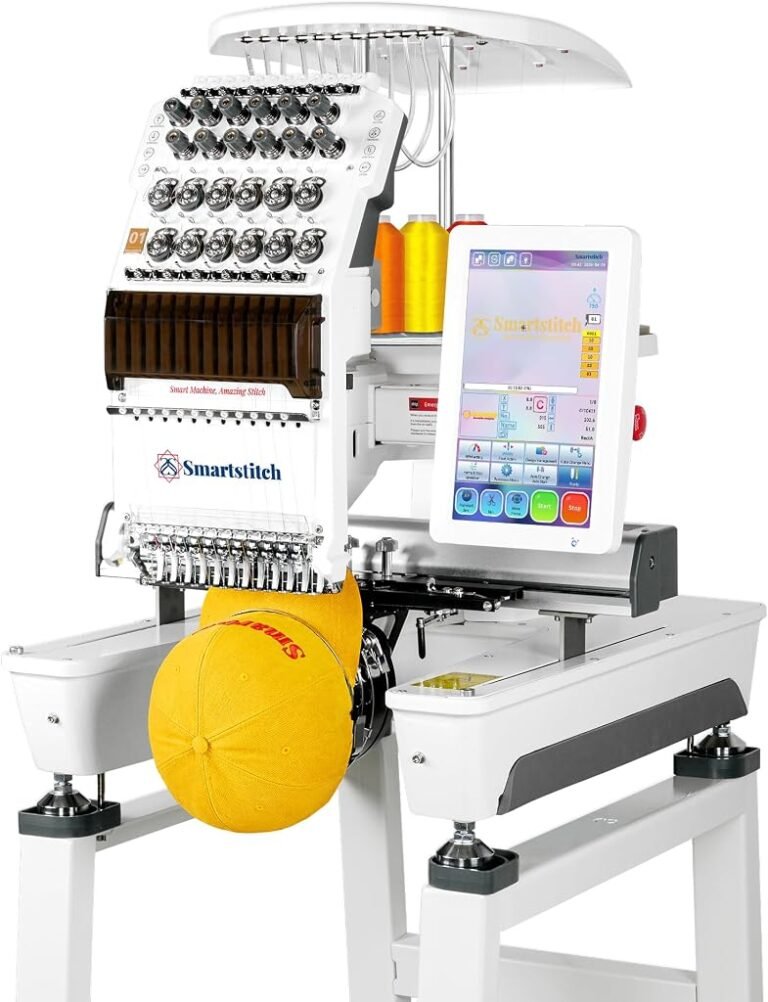
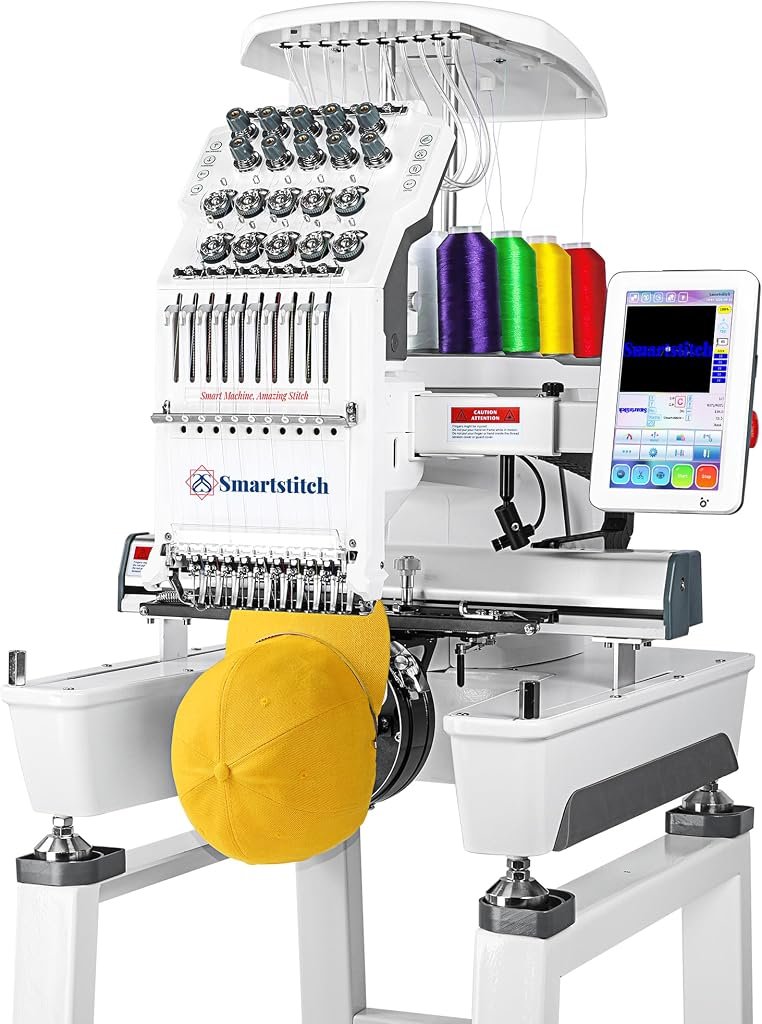
The real separation is mechanical capacity and operating interface. The S-1001 has 10 needles, a 7-inch touchscreen and a 240 × 360 mm flat embroidery field, approximately 9.5 × 14.2 inches. The S-1201 Plus increases the needle count to 12, moves to a 10-inch screen and provides a 300 × 400 mm field, approximately 11.8 × 15.7 inches.
Those differences matter because multi-needle embroidery economics are governed less by decorative feature counts than by interruptions, hoop restrictions, setup time and the number of colors that can remain threaded simultaneously.
Our scores reflect how close the machines are as buying propositions. The S-1001 earns 8.97/10, with Customer Sentiment at 9.16, Buyer Confidence at 8.84 and Value at 8.64. The S-1201 Plus also earns 8.97/10, accompanied by Customer Sentiment of 9.16, Buyer Confidence of 8.87 and Value of 8.64.
The identical overall and Value scores do not mean the machines are interchangeable. They indicate two different allocations of money: the S-1001 favors compactness and a lower reference price, while the S-1201 Plus spends more of the budget on working area, needle capacity and screen size.
These Are Not Ordinary Home Embroidery Machines
The first distinction is categorical.
Both Smartstitch models are single-head, multi-needle embroidery machines. That architecture differs sharply from the single-needle domestic machines commonly found among the best sewing and embroidery machines.
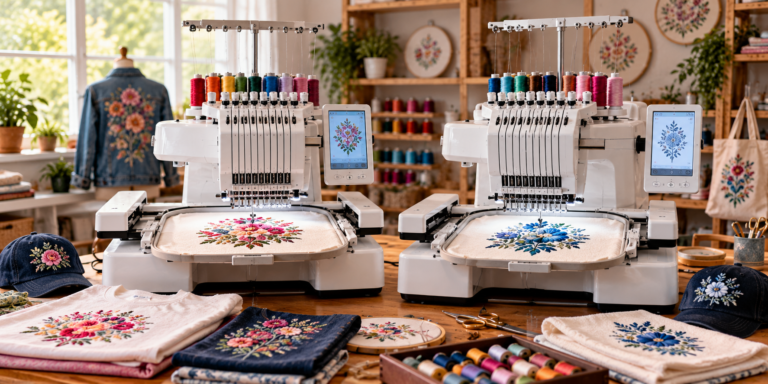
A 10- or 12-needle head allows several thread colors to remain threaded at the same time. When a design calls for another prepared color, the machine can change needles rather than requiring the operator to remove one thread and manually rethread the same needle repeatedly.
That changes workflow.
Imagine a design using eight thread colors. On a conventional single-needle embroidery machine, each required color transition may involve operator intervention. On a multi-needle system with those colors already assigned to needles, much of that repetitive handling can be removed.
Neither the S-1001 nor S-1201 Plus is therefore merely a larger hobby machine. Their architecture is directed toward repeated embroidery, multicolor designs and users for whom setup efficiency matters.
They are also embroidery machines rather than conventional sewing machines. A buyer still needing ordinary garment construction, straight seams, buttonholes or general repairs requires separate sewing equipment.
Ten Needles Versus Twelve Needles
The most obvious numerical difference is also one of the easiest to understand.
The S-1001 has 10 needles. The S-1201 Plus has 12. Smartstitch’s current specifications confirm those counts.
Two additional needles represent a 20% increase in available needle positions.
That does not make the S-1201 Plus 20% faster. Both machines share the same stated maximum embroidery speed, and needle count is not equivalent to stitch-production rate.
The advantage is thread availability.
A 12-color design can theoretically have every required color assigned at once on a 12-needle machine, assuming the design and workflow cooperate with that arrangement. A 10-needle system would require at least some thread reassignment when more than 10 distinct colors need to be available.
For designs using six or eight colors, the distinction may disappear completely.
That is why needle count should be interpreted against actual artwork rather than treated as a status number.
A shop specializing in simple two-color logos gains little from moving from 10 to 12 needles for that reason alone. A user routinely handling colorful illustrations, detailed patches or designs approaching double-digit color counts has a more defensible reason to prefer the S-1201 Plus.
The Embroidery Field Creates a Larger Divide
Needle count receives attention because it is easy to advertise. Working area may matter more.
The Smartstitch S-1001 product specifications list a maximum flat embroidery area of 240 × 360 mm, or roughly 9.5 × 14.2 inches.
The S-1201 Plus expands that to 300 × 400 mm, approximately 11.8 × 15.7 inches, according to Smartstitch’s current specifications.
Area makes the difference easier to visualize.
The S-1001’s nominal rectangular field covers 86,400 square millimeters. The S-1201 Plus reaches 120,000 square millimeters. That represents about 38.9% more rectangular working area.
This is a substantial physical increase.
Larger jacket-back designs, bag graphics and broad garment decorations have more room before the operator must confront design splitting, rehooping or a change in project plan.
That extra capacity also creates breathing room around designs that sit close to the S-1001’s limits. A design does not have to exceed 240 × 360 mm dramatically for the smaller field to become inconvenient. Exceeding either dimension is enough.
The S-1201 Plus therefore earns its strongest hardware advantage through the frame envelope, not through speed.
Both Machines Reach the Same 1,200-SPM Maximum
Smartstitch rates both machines for flat embroidery speeds up to 1,200 stitches per minute.
This parity deserves emphasis because price differences in machinery often imply greater throughput.
Here, the S-1201 Plus does not buy a higher stated maximum stitch rate.
Actual production time still depends on far more than the headline number. Designs contain trims, color changes, travel movements and sections where maximum speed may not be appropriate. Fabric, thread behavior, stitch density and design geometry also affect the process.
A 30,000-stitch design cannot simply be divided by 1,200 to predict exact completion time.
Yet sharing the same maximum speed means the S-1201 Plus needs to justify its additional cost through other efficiencies.
The two extra needles can reduce thread reassignment in color-heavy work. The larger field can prevent rehooping or design splitting. The larger screen can improve interaction with machine controls. Those workflow gains may save time even when the needle is not moving any faster.
Production efficiency is therefore broader than stitches per minute.
Cap Embroidery Is Surprisingly Similar
Flat embroidery separates the machines clearly. Cap specifications are much closer.
Smartstitch lists a 270-degree cap driver for both machines, with a cap embroidery area of 280 × 75 mm. Both are rated for cap embroidery speeds up to 850 stitches per minute.
This is an important buying detail.
Someone purchasing mainly for hats should not assume that the S-1201 Plus’s larger flat field automatically produces a larger advertised cap embroidery area. The manufacturer’s current specifications give both the same 280 × 75 mm cap field.
The extra two needles can still help with designs using many colors, and the larger screen remains available on the S-1201 Plus. But the basic advertised cap envelope and maximum cap speed do not separate them.
For a cap-focused operation using relatively simple logos, the S-1001 may therefore preserve much of the relevant capability at a lower reference price.
For a mixed operation moving between caps and large flat garments, the S-1201 Plus becomes easier to justify because its flat-work advantage has more opportunity to matter.
The 10-Inch Screen Is More Than a Cosmetic Upgrade
The S-1001 uses a 7-inch touchscreen. The S-1201 Plus moves to 10 inches.
Screen size does not change stitch formation, but embroidery machines are highly interface-dependent.
The operator interacts with design previews, color sequences, frame positioning, needle selection, machine status, trimming functions and other controls through the display. Smartstitch’s documentation for the S-1001 identifies functions such as design preview, color-sequence management, pattern memory, needle switching and frame movement on its touchscreen interface.
Three additional diagonal inches can therefore matter during daily operation.
The advantage should not be overstated. A larger screen cannot repair poor digitizing, correct unsuitable stabilizer or compensate for improper tension.
It can, however, make visual information easier to inspect and touch targets easier to navigate.
For occasional use, the 7-inch S-1001 interface may be entirely adequate. In a setting where the screen is used repeatedly across many jobs, the 10-inch display becomes a more defensible ergonomic advantage.
Wi-Fi Does Not Require the S-1201 Plus
Both machines support USB and Wi-Fi pattern transfer.
That parity is economically significant.
A buyer does not need the S-1201 Plus merely to gain wireless file transfer. The S-1001 already supports it.
Both machines also list DST and DSB among supported embroidery file formats. Those are established machine-embroidery formats commonly used in production-oriented workflows.
Wi-Fi can reduce dependence on physically moving a USB drive between the design computer and machine, although workflow still depends on network setup and file preparation.
More importantly, connectivity does not replace digitizing.
An image file is not automatically a stitch-ready embroidery design simply because the machine accepts wireless transfers. Embroidery files contain instructions governing stitch paths, color sequences, trims and other machine actions. Artwork must be translated appropriately into that structure.
Anyone budgeting for either machine should therefore distinguish machine connectivity from design creation.
Both Use Pinpoint Laser Positioning
Smartstitch lists pinpoint laser positioning on both the S-1001 and S-1201 Plus.
Positioning assistance matters because embroidery placement errors can destroy otherwise competent work.
A logo stitched several centimeters away from its intended location is still a failed garment even if every stitch is technically clean.
Laser positioning provides a visual reference that can assist alignment before stitching begins. It does not eliminate the need for careful hooping, measuring or tracing the design area.
That shared feature weakens another possible reason to spend more.
The S-1201 Plus is not the only model in this comparison with laser-assisted positioning. Buyers choosing the S-1001 retain that capability.
The S-1201 Plus Uses a Different Guiding System
Smartstitch identifies the S-1201 Plus with a direct vertical guiding system, while its current machine-comparison material describes the S-1001 with a shaft guiding system.
The manufacturer positions the S-1201 Plus arrangement around improved movement accuracy and stability.
That is a meaningful design distinction, but it should be discussed carefully.
Without controlled comparative testing, it would be inappropriate to assign a numerical improvement in stitch quality, vibration or long-term durability. Manufacturer architecture can be described; unverified performance gains should not be invented.
For buyers, the practical interpretation is that the S-1201 Plus is not simply an S-1001 chassis with two extra needles and a larger screen. Smartstitch identifies a different guiding arrangement as part of the Plus model’s hardware package.
How much that matters to a particular workload will depend on use.
Thread Trimming Is Shared Territory
Both machines use what Smartstitch describes as a picker-free circular knife trimming design.
Automatic trimming is particularly relevant on multi-needle equipment because multicolor designs can generate numerous transitions.
Reducing manual trimming helps keep the operator focused on thread management, hoop changes, garment preparation and job supervision rather than repeatedly reaching for scissors during machine-controlled transitions.
Again, the machines are more alike than their prices initially suggest.
The S-1201 Plus does not monopolize basic production conveniences. The S-1001 already includes a multi-needle system, automated color handling, thread trimming, Wi-Fi transfer and positioning assistance.
That makes the S-1001 a serious production-oriented machine rather than merely an entry model stripped of essential automation.
The S-1001 Is Meaningfully Lighter
Machine weight matters more here than it does with a 15-pound domestic embroidery machine.
Smartstitch lists the S-1001 at approximately 42 kg, or 92.4 pounds. The S-1201 Plus is listed at 52 kg, or 114.6 pounds.
That is a difference of roughly 22 pounds.
Neither machine should be treated as casual tabletop luggage. They require deliberate placement and adequate working space.
Still, the S-1001 is the more manageable option when a machine needs to be repositioned within a studio or moved for events.
Smartstitch lists the S-1001’s assembled dimensions at approximately 18.9 × 25.9 × 59.8 inches and the S-1201 Plus at approximately 19.1 × 28.3 × 59.2 inches.
The height is similar, but the S-1201 Plus asks for somewhat more depth and significantly more mass.
Space planning should therefore happen before delivery, not after a shipping crate arrives.
Noise Levels Are Closely Matched
Smartstitch lists the S-1001 at 65 dB operating noise and the S-1201 Plus at 60–65 dB.
These are manufacturer figures rather than independent acoustic measurements, so they should be interpreted accordingly.
Still, the specifications do not suggest a dramatic noise penalty for moving to the larger model.
Noise matters particularly in home studios, shared commercial spaces and rooms where multiple machines may eventually operate simultaneously.
A difference of a few decibels on a specification sheet should not dominate this comparison. Floor structure, machine placement, speed, maintenance and room acoustics can all affect perceived sound.
The larger questions remain working area, needle count and physical footprint.
Training and Support Deserve Attention at This Price
Multi-needle embroidery requires more setup knowledge than loading a decorative stitch on a domestic sewing machine.
Thread paths, bobbin condition, hooping, tension, design placement and file preparation all affect production.
Smartstitch currently describes a training process that includes setup videos, a dedicated support group, live training, tension instruction, hooping guidance and help with a first project. The company also states that remote support can continue after initial training.
This is relevant because neither machine is inexpensive enough to treat poor onboarding casually.
A new multi-needle owner is not merely learning where the start button sits. The user is learning a production system.
The S-1001’s lower price does not eliminate that learning curve. The S-1201 Plus’s larger display does not eliminate it either.
Training should therefore be treated as part of ownership rather than an optional accessory to the hardware.
Included Equipment Changes the Real Cost of Entry
Smartstitch’s current S-1201 Plus page lists multiple flat hoops, an extended table, stand, armrests, cap driver, cap ring, cap station, bobbin winder, starter materials and tools among the package components shown with the machine.
The S-1001 product material similarly presents it as a package intended for flat garments and cap work, with a starter kit and associated embroidery hardware.
Package contents matter because the sticker price of an embroidery head alone does not represent the full cost of beginning work.
Cap hardware, hoops, stands, thread, backing, bobbins and tools can all alter the initial budget.
Prospective owners should verify the exact package attached to the seller and configuration they are purchasing rather than assuming that every listing contains identical accessories.
That is particularly relevant when comparing marketplace prices against manufacturer-direct packages.
Price Difference: Small Relative to the Hardware
The reference price for the S-1001 is $3,682.37. The S-1201 Plus is $4,084.05.
The difference is $401.68, approximately 10.9% of the S-1001’s reference price.
For that increase, the S-1201 Plus provides two additional needles, a larger touchscreen and a substantially larger flat embroidery field while retaining the same 1,200-SPM maximum speed.
This is where the comparison becomes uncomfortable for the cheaper machine.
A $401.68 saving is meaningful in absolute money. It could purchase thread, stabilizer, hoops, digitizing software or other equipment.
Yet relative to a machine investment already approaching $4,000, the premium is modest if the larger field or additional needle positions will be used regularly.
The S-1001 therefore needs a specific justification rather than merely being cheaper.
Compactness is one. Lower weight is another. A workload that fits comfortably within 10 needles and 240 × 360 mm is a third.
If none of those factors matters, the S-1201 Plus becomes difficult to dismiss.
Why Both Receive the Same Overall Score
Our overall score is 8.97/10 for both machines.
That is not a tie produced by indecision.
The S-1001 earns its rating through a relatively compact multi-needle format, a 10-needle system, large 9.5 × 14.2-inch field, 1,200-SPM maximum, wireless transfer and a lower acquisition price.
The S-1201 Plus reaches the same rating through greater capacity: 12 needles, a larger 10-inch interface and an 11.8 × 15.7-inch flat embroidery field.
Customer Sentiment is also identical at 9.16, while Value is 8.64 for both.
Buyer Confidence creates the only scoring separation: 8.84 for the S-1001 and 8.87 for the S-1201 Plus.
That 0.03-point difference is too small to override buyer fit.
The ratings indicate that both machines present credible combinations of capacity and price. They do not suggest that the products are functionally identical.
The Value Calculation Changes With Design Size
The S-1001’s 8.64 Value score reflects how much production-oriented hardware it places below the $4,000 reference level.
Ten needles and a 9.5 × 14.2-inch field already represent a large departure from small single-needle domestic embroidery.
For many logos, shirts, patches, bags and cap projects, that capacity can be enough.
The S-1201 Plus earns the same 8.64 Value score because its higher reference price buys additional capacity rather than merely cosmetic differences.
Its flat embroidery field is roughly 38.9% larger by nominal rectangular area, while its price premium in this comparison is only about 10.9%.
Area alone does not determine value, but the relationship is difficult to ignore.
A buyer who uses the additional field regularly receives a considerable physical expansion for a comparatively modest percentage increase in machine cost.
A buyer who never exceeds the S-1001’s field gains far less.
Which Machine Is Better for Caps?
This category is closer than the model hierarchy suggests.
Both machines list a 270-degree cap driver, a 280 × 75 mm cap embroidery area and maximum cap speed of 850 SPM.
The S-1201 Plus still provides 12 needle positions rather than 10, which can reduce thread reassignment on color-heavy cap designs.
But a shop producing mostly simple three-, four- or five-color cap logos may not gain much from those extra positions.
For cap-heavy work with relatively restrained color counts, the S-1001 deserves serious consideration.
For a business combining caps with larger jacket, bag and garment work, the S-1201 Plus has the broader operating envelope.
Which Machine Is Better for Large Flat Embroidery?
The S-1201 Plus wins clearly.
Its 300 × 400 mm field gives it considerably more working area than the S-1001’s 240 × 360 mm maximum.
This is not a software preference or an interface convenience. It is physical capacity.
Buyers planning jacket backs, broad bag designs or other large flat projects should map typical artwork dimensions against both fields before purchase.
If common jobs regularly approach or exceed 240 mm on one axis, the S-1201 Plus can prevent repeated compromises.
A machine’s maximum field should be treated as a long-term boundary. Additional thread colors, software or Wi-Fi updates cannot enlarge the carriage.
Which Machine Is Better for a Small Studio?
The S-1001 has a credible advantage.
At about 92.4 pounds, it is roughly 22 pounds lighter than the S-1201 Plus. Its assembled depth is also lower according to Smartstitch’s current dimensions.
For a studio where every inch of floor area matters, the smaller model can be easier to accommodate.
The same logic applies to users who expect to reposition equipment periodically.
Compactness should not be mistaken for low capability. A 10-needle machine with a 9.5 × 14.2-inch field remains substantial embroidery equipment.
The S-1001 is smaller relative to the S-1201 Plus, not small in the domestic-machine sense.
Who Should Choose the S-1001?
The S-1001 is better suited to:
- Users who expect 10 needle positions to cover most recurring designs.
- Small studios where equipment weight and footprint matter.
- Cap-focused operations that do not need the S-1201 Plus’s larger flat field.
- Buyers whose artwork fits comfortably inside 240 × 360 mm.
- First-time multi-needle owners seeking a lower initial machine cost.
- Users who still want Wi-Fi, USB transfer and laser positioning.
- Buyers who would rather direct the price difference toward supplies, specialty hoops or other equipment.
Its principal limitation is not speed. It is capacity relative to the S-1201 Plus.
Who Should Choose the S-1201 Plus?
The S-1201 Plus is better suited to:
- Users who routinely work with designs requiring more than 10 prepared thread colors.
- Embroiderers needing a flat field larger than 240 × 360 mm.
- Shops producing larger garment and bag designs.
- Operators who value a 10-inch interface for frequent machine interaction.
- Buyers expecting project complexity or order variety to increase.
- Users willing to accept greater machine weight for more working capacity.
- Buyers for whom the roughly $402 reference-price premium is small relative to the cost of reaching the S-1001’s limits later.
The strongest reason to choose it is not that it is the newer or larger-numbered machine. It is that its additional capacity solves identifiable restrictions.
Final Considerations
The Smartstitch S-1001 and S-1201 Plus are unusually close in editorial rating because both provide a substantial amount of multi-needle embroidery hardware at prices separated by only a few hundred dollars.
The S-1001 offers 10 needles, a 7-inch touchscreen, a 240 × 360 mm flat embroidery field, Wi-Fi and USB transfer, pinpoint laser positioning, a 270-degree cap driver and maximum flat speed of 1,200 stitches per minute. Smartstitch lists the machine at about 42 kg, making it the lighter option.
Its 8.97/10 overall score, 9.16 Customer Sentiment, 8.84 Buyer Confidence and 8.64 Value rating reflect a machine that combines serious multi-needle capacity with a comparatively compact format and lower reference price.
The S-1201 Plus retains the 1,200-SPM maximum, Wi-Fi, USB transfer, laser positioning and 270-degree cap capability while expanding to 12 needles, a 10-inch touchscreen and a 300 × 400 mm flat embroidery field. Smartstitch lists its machine weight at 52 kg.
Its 8.97/10 overall score, 9.16 Customer Sentiment, 8.87 Buyer Confidence and 8.64 Value rating describe a machine whose additional spending is directed primarily toward capacity rather than headline speed.
At the reference prices used here, the gap is $401.68. That is small enough relative to the total purchase that buyers should resist choosing the S-1001 solely because it costs less.
The S-1001 makes the most sense when its smaller footprint, lower weight and 10-needle architecture already match the intended workload. There is little economic logic in paying for 12 needles and a larger frame if recurring designs never use them.
The S-1201 Plus becomes the stronger choice when larger flat embroidery or additional thread positions will be used regularly. Its nominal rectangular flat field is roughly 38.9% larger while the reference-price premium is about 10.9%. That relationship gives the Plus model a meaningful capacity argument.
Cap-focused buyers face a subtler decision because Smartstitch lists the same 280 × 75 mm cap embroidery area and 850-SPM cap maximum for both. For them, the S-1001 can retain much of the relevant capability unless extra needle positions or larger flat work are also priorities.
The larger lesson is that commercial-style embroidery machinery should be chosen around workflow rather than specification accumulation. More needles matter when designs use them. More frame area matters when artwork needs it. A larger screen matters when operators interact with it repeatedly. Lower weight matters when equipment must move.
Neither machine wins every version of that equation.
For a compact studio, restrained color counts and projects fitting inside 9.5 × 14.2 inches, the S-1001 is the more economical allocation of equipment and space. For growing project dimensions, more elaborate color sequences and users prepared to dedicate additional room to the machine, the S-1201 Plus offers more room before hardware becomes the restriction.
That is the practical divide between them: the S-1001 reduces the cost and physical burden of entering multi-needle embroidery, while the S-1201 Plus asks for a modestly larger investment in exchange for noticeably greater working capacity.