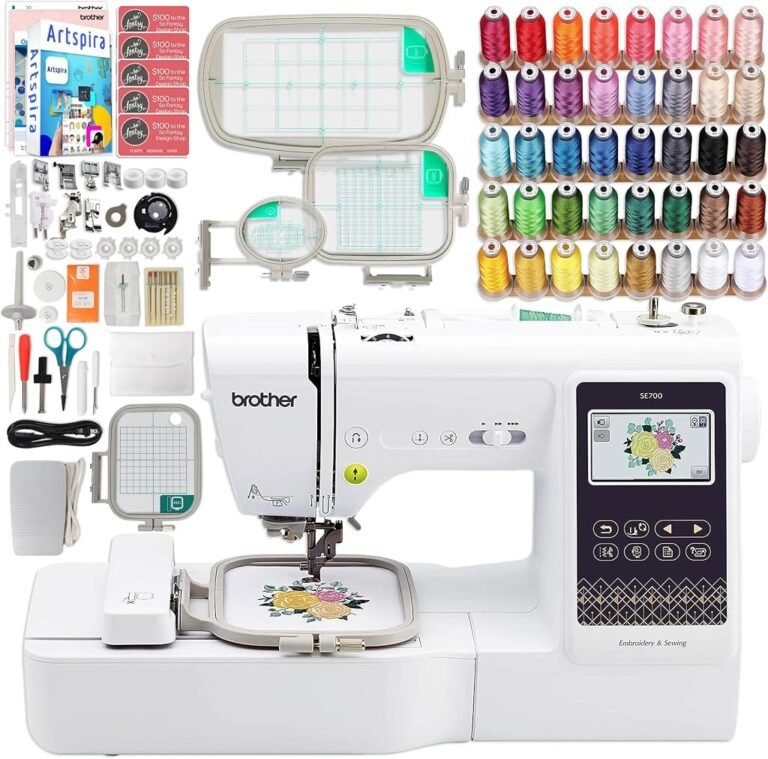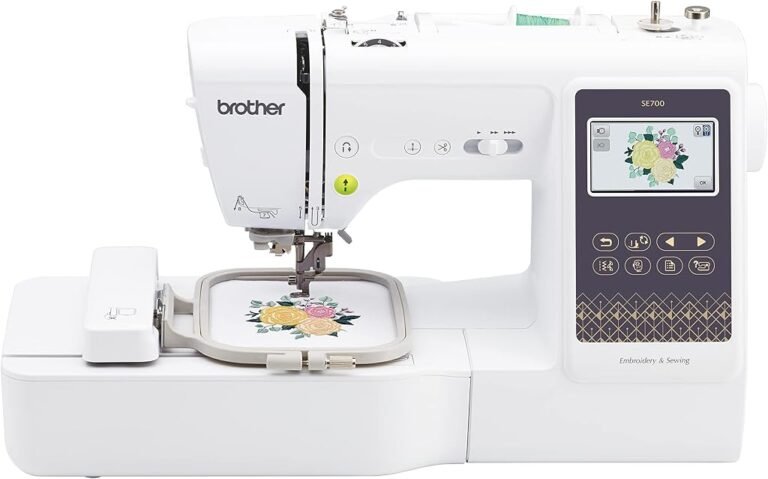
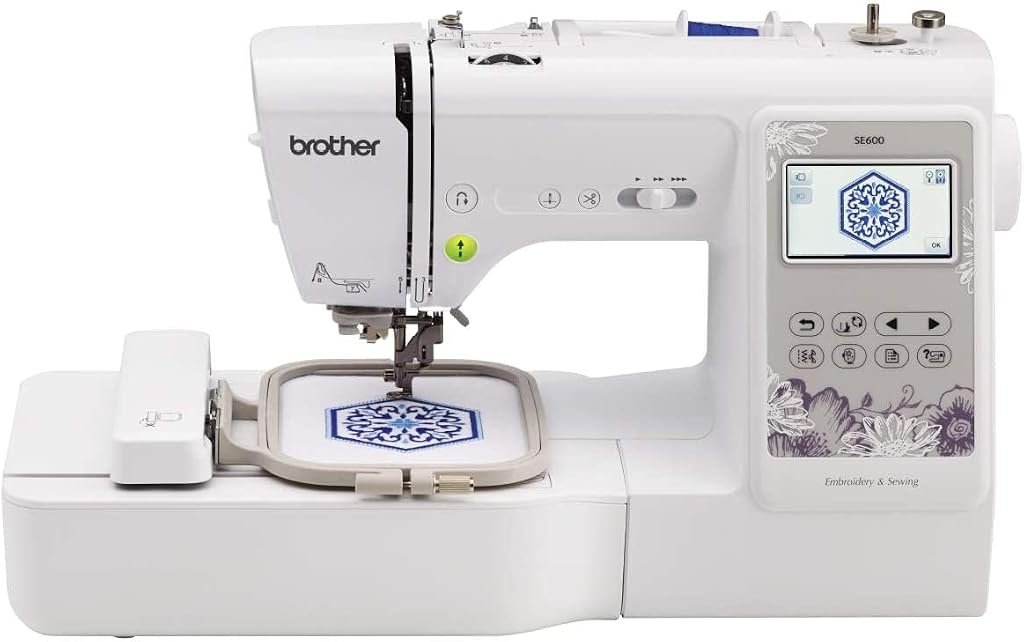
The Brother SE600 represents an interesting stage in the evolution of computerized home embroidery. It combines conventional sewing with a 4 × 4-inch embroidery system, a color touchscreen, USB design importing, automatic thread cutting, and enough built-in stitches and embroidery patterns to remain useful years after its introduction. Yet there is one fact that now changes the buying calculation: Brother lists the SE600 as discontinued.
That does not make the machine obsolete. Brother still maintains support resources for it, and the underlying functions remain practical for small-format embroidery. It does mean the SE600 should no longer be evaluated as though it were sitting beside current models under identical circumstances.
The distinction matters.
Our Score for the Brother SE600 is 8.86/10. Customer Sentiment is 8.72, Buyer Confidence is an unusually high 9.8, and Value is 8.4. Those figures describe a mature combination machine whose core design remains persuasive, particularly for sewing and compact embroidery, while its age and 4 × 4-inch embroidery ceiling require deliberate consideration.
The SE600 is not a connected embroidery platform in the manner of newer wireless machines. Its proposition is simpler: a capable computerized sewing machine, a small-format embroidery system, USB-based design importing, and an interface that gives beginners considerable control without requiring commercial equipment.
For the right buyer, that remains a coherent proposition.
The SE600 Combines Two Distinct Machines
The official Brother SE600 specifications describe a two-in-one sewing and embroidery machine with 80 built-in embroidery designs, 103 built-in sewing stitches, seven included accessory feet, and a maximum embroidery area of 4 × 4 inches. Brother also lists a 3.2-inch Sew Smart color LCD touchscreen and a maximum sewing speed of 710 stitches per minute.
Those numbers establish the machine’s identity.
The SE600 is not merely a sewing machine containing decorative stitches. Machine embroidery is a separate process in which fabric and stabilizer are secured in a hoop and the machine moves that hoop according to digital stitch instructions.
Conventional sewing works differently. Fabric moves through the machine using the feed system while the operator guides the project.
The SE600 performs both jobs.
That combination is particularly useful for households without a dedicated sewing room. One machine can construct a garment, sew buttonholes, perform decorative stitching, make repairs, and subsequently embroider a name or motif onto the project.
The compromise becomes visible with heavier workloads. A combination machine cannot sew and embroider simultaneously. A user producing embroidery while also constructing garments may eventually find separate machines more efficient.
For ordinary home use, however, consolidating both functions into one chassis can be more practical than maintaining two separate systems.
The 4 × 4-Inch Embroidery Field Is the Central Constraint
The SE600 has a maximum embroidery area of 4 × 4 inches.
That specification deserves more attention than almost any decorative feature because it determines the dimensions of a design the machine can execute in a single standard embroidery position.
Four-by-four embroidery works naturally for many projects:
- Monograms
- Children’s clothing motifs
- Small names
- Compact logos
- Patches
- Pocket-sized graphics
- Towels
- Napkins
- Small bag decorations
- Personalized gifts
Within that scale, the SE600 can be highly functional.
Larger projects expose its boundary.
A large sweatshirt graphic, broad jacket design, expansive home-decor motif, or substantial uninterrupted lettering may exceed the machine’s native field. A design cannot simply be loaded because the fabric itself fits around the hoop.
Brother’s guidance on embroidering with larger multi-position frames makes the distinction explicit: a larger frame can hold more fabric and support repositioning, but the machine’s maximum embroidery area for any single design remains 4 × 4 inches.
That fact prevents a common misunderstanding.
A physically larger hoop does not automatically give a machine a larger native embroidery field.
Multi-Position Embroidery Extends Workflow, Not Machine Travel
A multi-position hoop can still be useful with the SE600.
Instead of removing the fabric completely and hooping it again, a compatible larger frame can allow the user to move the clamp between positions. Multiple designs or sections can then be placed across a larger piece of fabric.
This can reduce rehooping.
It does not remove alignment work.
When a larger composition is divided into several embroidery sections, those sections must meet correctly. A small positional error can become visible where lettering, borders, or connected graphics are intended to align.
That changes the skill requirement.
A beginner working inside the standard 4 × 4 field can concentrate on fundamentals: stabilizer selection, thread management, hooping, placement, tension, needle choice, and design preparation. Multi-position projects introduce another variable before those skills may be fully established.
The SE600 therefore makes the strongest case when 4 × 4 embroidery is genuinely sufficient rather than merely tolerated until every project requires a workaround.
Eighty Built-In Designs Matter Less Than They First Appear
The SE600 includes 80 built-in embroidery designs.
That gives a new owner material for experimentation without immediately acquiring external files. Yet the built-in count should not carry excessive weight in a purchase decision.
Digital embroidery machines can work with imported designs.
The SE600 supports importing embroidery designs through USB, meaning the factory library is a starting point rather than a permanent boundary. A user can build a collection around personal interests and actual projects instead of remaining confined to the 80 designs installed at manufacture.
This changes the significance of the specification.
Built-in designs are immediately available. Imported designs provide long-term variety.
The physical embroidery field remains fixed.
A user can add another digital file. The same user cannot install software that turns the SE600 into a native 5 × 7-inch machine.
For long-term ownership, field size therefore deserves greater weight than design count.
USB Importing Is Functional but Reflects an Earlier Connectivity Model
The SE600 belongs to a generation in which USB-based design transfer was a meaningful step toward a more flexible embroidery workflow.
The system is straightforward.
Compatible embroidery files can be moved onto suitable USB media and brought to the machine. That creates access to designs beyond the internal library without requiring the SE600 itself to maintain a wireless connection.
Compared with newer wireless systems, the workflow involves more physical movement.
A user working at a computer must prepare the design, place it on the appropriate media, move that media to the machine, and retrieve the file.
None of those actions is especially difficult.
The difference appears through repetition.
Moving one file manually is trivial. Moving hundreds of files across years of embroidery makes wireless transfer more attractive because small procedural steps accumulate.
This is where the SE600’s discontinued status becomes relevant. Its fundamental embroidery capabilities have not disappeared, but expectations surrounding connectivity have changed.
The Color Touchscreen Remains One of the SE600’s Better Features
Brother equips the SE600 with a 3.2-inch Sew Smart color LCD touchscreen.
The screen allows designs to be viewed in color before stitching and supports editing functions including changing individual thread colors, moving designs through touchscreen controls, and arranging lettering in an arc.
This was an important improvement over machines that relied on more limited monochrome displays or external computers for basic visual interaction.
The screen is not large by current tablet standards, nor should it be treated as a substitute for dedicated digitizing software.
Its purpose is more focused.
The user can inspect a design, make routine edits, and interact with embroidery controls directly at the machine rather than repeatedly returning to a computer.
That division of labor remains sensible.
Detailed digitizing belongs on larger software interfaces. Machine-side adjustments belong at the machine.
The Sewing Side Is More Than an Auxiliary Feature
The SE600 includes 103 built-in sewing stitches.
That gives the machine a genuine identity outside embroidery.
Brother lists needle up/down control, variable speed control, and drop feed among its sewing features. Drop feed is particularly relevant for users interested in free-motion sewing because it allows the normal fabric-feeding mechanism to be disengaged.
The machine also provides 10 buttonhole styles.
This breadth matters when comparing the SE600 with embroidery-only equipment.
An embroidery-only machine can devote its engineering and price more narrowly toward embroidery. It cannot construct seams, install conventional buttonholes, or perform the broad range of ordinary sewing operations expected from a computerized sewing machine.
For someone who already owns a satisfactory sewing machine, that duplication may weaken the SE600’s case.
For someone starting without either machine, the combination format can be far more efficient.
Seven Included Feet Expand the Sewing Workflows
Brother lists seven included accessory feet with the SE600.
Presser feet are not glamorous specifications, but they influence how readily a sewing machine moves between different operations. Different feet support tasks such as buttonholes, zipper installation, overcasting, blind stitching, embroidery, and general sewing.
The practical benefit is reduced dependence on immediate accessory purchases.
This fits the SE600’s broader character. It is configured as a machine intended to let a newcomer explore multiple forms of sewing and embroidery without immediately constructing a large accessory collection.
That does not mean every included foot will be equally useful to every owner.
A garment sewer and a decorative embroiderer can own the same machine while using very different portions of its equipment.
Sewing Speed Reaches 710 Stitches per Minute
Brother specifies a maximum sewing speed of 710 stitches per minute.
Maximum speed should not be confused with a requirement to sew every project at that rate.
Fine control matters more than raw speed when working around curves, attaching small components, approaching seam intersections, or handling unfamiliar materials. Variable speed control gives the operator the ability to reduce machine speed when precision is more useful than throughput.
For longer straightforward seams, additional speed can reduce sewing time.
The figure is therefore best understood as the upper edge of the machine’s sewing capability rather than a performance target.
Embroidery introduces a different workflow because the machine controls hoop movement according to the digital design.
Thread Problems Often Begin Outside the Machine
Computerized embroidery can create a misleading impression that the machine alone determines stitch quality.
It does not.
Threading, bobbin installation, needle selection, thread choice, tension, fabric, stabilizer, and design density can all affect results.
Brother’s guidance for thread jamming and bunching identifies several potential causes, including incorrect upper threading, an incorrectly installed bobbin, inappropriate thread tension, an unsuitable needle-and-thread combination, and incorrect stabilizer selection.
That is useful context for evaluating the SE600.
A computerized machine automates needle movement and embroidery positioning. It does not automate material judgment.
Beginners can therefore improve results substantially by treating preparation as part of embroidery rather than as a nuisance preceding it.
Correct hooping and stabilization are not optional housekeeping. They are part of the stitching system.
Automatic Thread Cutting Reduces Repetitive Work
The SE600 includes automatic thread cutting.
This is a relatively modest feature with frequent practical consequences.
Sewing and embroidery create repeated moments when thread needs to be cut. Automating some of those cuts reduces manual intervention and can make transitions between operations less cumbersome.
The feature should not be interpreted as eliminating all trimming.
Embroidery projects can still require cleanup, particularly around jump stitches or areas where design construction leaves visible thread.
Automatic cutting is therefore best treated as a workflow aid rather than a promise of completely finished embroidery emerging untouched from the hoop.
Discontinued Does Not Mean Unsupported
Brother currently identifies the SE600 as discontinued.
That status changes how the machine should be purchased, but it does not mean Brother has erased the model from its infrastructure.
The manufacturer’s SE600 support portal still provides access to frequently asked questions, warranty information, drivers and downloads, manuals, support videos, contact options, and compatible supplies.
That support footprint is significant for an older computerized machine.
Mechanical sewing problems can often be diagnosed through conventional machine knowledge. Computerized equipment adds firmware, digital interfaces, file handling, and model-specific procedures that make documentation more consequential.
The continuing availability of official support material therefore contributes materially to our Buyer Confidence score.
The purchasing question shifts from “Is this machine old?” to “Does its age create a disadvantage for the intended work?”
For many 4 × 4 embroidery projects, the answer may be no.
For buyers prioritizing wireless transfer and current mobile integration, the answer is different.
Our Score: 8.86/10
We rate the Brother SE600 at 8.86/10.
That score reflects the coherence of the machine rather than technological novelty.
The SE600 combines 103 sewing stitches, 80 embroidery designs, a 4 × 4 embroidery field, a color touchscreen, USB design importing, automatic thread cutting, seven accessory feet, and conventional sewing capability in one machine.
Those features still form a credible home sewing and embroidery platform.
The score does not imply that the SE600 is preferable to every newer machine. Product generations introduce different connectivity options and larger or more flexible workflows.
Instead, 8.86 recognizes that the SE600’s core functions remain well aligned with the needs of users who want ordinary sewing and compact machine embroidery from the same equipment.
Its main restriction is physical rather than generational: 4 × 4 inches.
Customer Sentiment: 8.72
Our Customer Sentiment score is 8.72.
That rating reflects a machine with a clear audience and a mature feature set.
The combination format makes sense for users exploring embroidery while still needing an everyday sewing machine. The color touchscreen reduces the abstraction of digital embroidery by showing designs visually, while USB importing prevents the built-in library from becoming a permanent limitation.
The score remains below Buyer Confidence because satisfaction depends heavily on project expectations.
Someone buying the SE600 for monograms, children’s garments, towels, patches, and compact designs can encounter a very different ownership experience from someone repeatedly trying to force large graphics through a 4 × 4 platform.
Expectation alignment matters enormously here.
Buyer Confidence: 9.8
Buyer Confidence is the SE600’s strongest editorial score at 9.8.
The reasoning is straightforward.
The machine’s capabilities are clearly documented. Brother still maintains model-specific support resources. The major limitations are visible rather than hidden: the machine is discontinued, the embroidery area is 4 × 4 inches, design transfer relies on USB rather than the wireless workflows available on newer models, and it is a single-machine sewing-and-embroidery platform.
Those facts allow a buyer to make a relatively informed decision.
High Buyer Confidence does not mean every purchase is wise.
It means the machine is understandable.
That distinction matters. A product with clearly defined boundaries can inspire more purchasing confidence than one with an impressive feature list but poorly explained limitations.
Value: 8.4
Our Value score is 8.4.
Value for a discontinued machine is unusually price-sensitive because market conditions can vary widely.
The SE600 can offer substantial functional value when priced appropriately. It performs ordinary sewing and machine embroidery, provides a touchscreen interface, accepts imported designs, includes numerous stitches, and supports a broad range of home projects.
Its value weakens when the asking price approaches that of newer machines offering comparable core capabilities alongside wireless connectivity or other updated features.
Buyers should therefore avoid evaluating the SE600 by its original market position alone.
The relevant question is what alternatives are available at the price being asked now.
Age can create value when it produces a meaningful discount.
Age becomes a liability when the price fails to acknowledge newer alternatives.
Where the SE600 Still Fits Among the Best Sewing and Embroidery Machines
The best sewing and embroidery machines cannot be identified by arranging model numbers from newest to oldest.
Use case matters more.
A current machine with wireless transfer may be preferable for a user maintaining a large digital design library. A larger-field model is clearly more suitable for someone planning designs beyond 4 × 4 inches. A dedicated sewing machine may be more rational for someone with no interest in embroidery.
The SE600 remains relevant because its combination of conventional sewing, small-format embroidery, touchscreen editing, and USB importing addresses a coherent set of needs.
Its age is not the decisive weakness.
Its embroidery field is.
A buyer comfortable with that field can still use the machine for years of compact projects. A buyer already frustrated by 4 × 4 dimensions before purchasing should not expect accessories, multi-position hoops, or imported designs to erase that limitation.
Who Should Consider the Brother SE600?
The SE600 is most suitable for a buyer who wants:
- Conventional computerized sewing and embroidery in one machine
- Small-format 4 × 4 embroidery
- Monograms and personalized gifts
- Children’s garment decoration
- Compact patches and logos
- A color touchscreen for machine-side editing
- USB-based importing of external embroidery designs
- More than 100 sewing stitch options
- Automatic thread cutting
- A machine with established manufacturer documentation
It can also make sense as an entry point for someone who finds a well-priced unit and does not place high value on wireless design transfer.
The project list should make the decision.
If most intended embroidery fits comfortably inside 4 × 4 inches, the SE600 remains capable of doing useful work.
Who Should Look Elsewhere?
Buyers planning larger embroidery should begin with a larger native field.
Users who prioritize phone-based or wireless design transfer should also examine newer connected models rather than buying the SE600 and immediately wishing it behaved like one.
Someone who already owns a strong sewing machine may find better value in a dedicated embroidery machine.
Production-focused users face another limitation. The SE600 is a home-oriented combination machine rather than a multi-needle production platform. Multicolor embroidery requires considerably more operator involvement than equipment capable of keeping numerous thread colors ready simultaneously.
These distinctions do not diminish what the SE600 does.
They define its appropriate scale.
Final Considerations
The Brother SE600 is an older computerized sewing and embroidery machine that remains technically relevant because its useful features were never dependent on novelty alone.
Its 103 built-in sewing stitches, 80 embroidery designs, seven included accessory feet, 3.2-inch color touchscreen, automatic thread cutting, USB design importing, and 710-stitches-per-minute maximum sewing speed form a capable home platform.
Our Score of 8.86/10 reflects that underlying coherence. Customer Sentiment at 8.72 recognizes a machine whose usefulness rises sharply when buyer expectations match its project scale. Buyer Confidence of 9.8 reflects clearly documented capabilities and continuing manufacturer support. Value at 8.4 acknowledges that a discontinued machine can be financially attractive, but only when its price makes sense beside newer alternatives.
The 4 × 4-inch embroidery field remains the deciding specification.
No number of downloadable designs changes it. A larger multi-position frame does not change the maximum size of a single design. USB importing expands creative choice without expanding mechanical travel.
That boundary can be entirely reasonable for monograms, small motifs, patches, children’s garments, towels, and personalized gifts.
It can also become frustrating very quickly for someone whose ambitions begin at 5 × 7 inches and grow from there.
The SE600 should therefore be bought for what it already is, not for what a buyer hopes to make it become. When its 4 × 4 format matches the intended work and the purchase price properly reflects its discontinued status, it remains a capable combination machine with a mature, understandable feature set. When larger embroidery or wireless workflows are priorities from the outset, newer or more specialized equipment is the more rational direction.