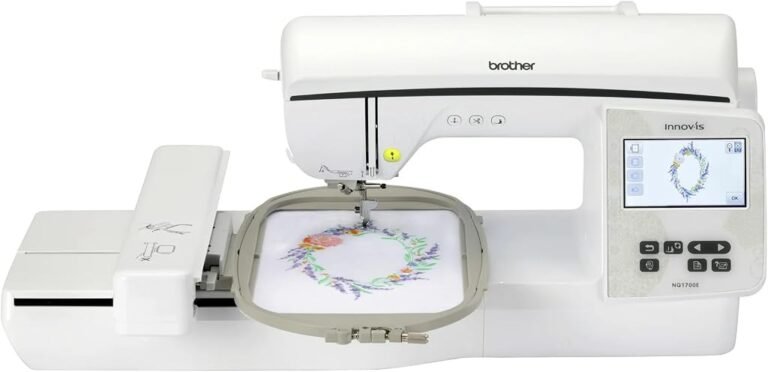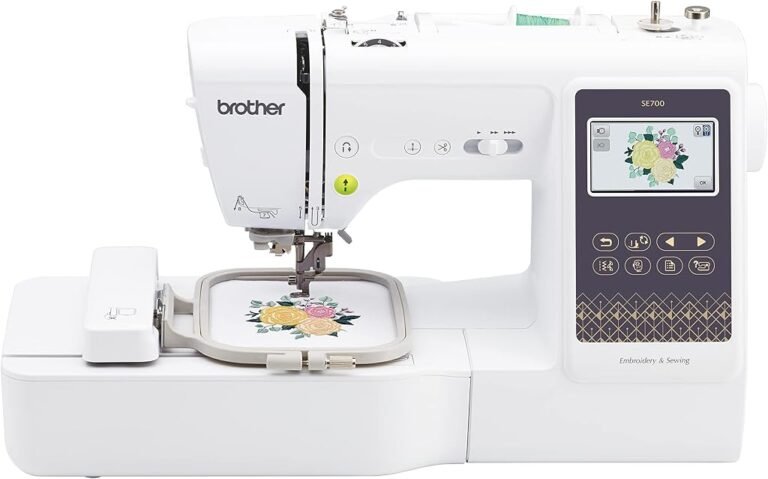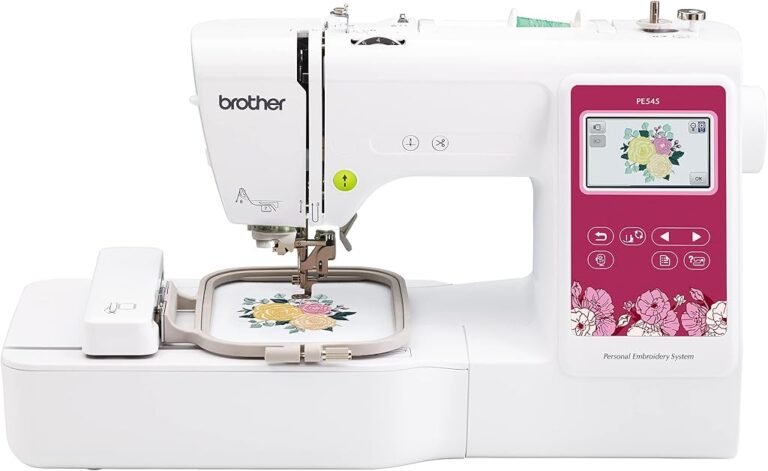
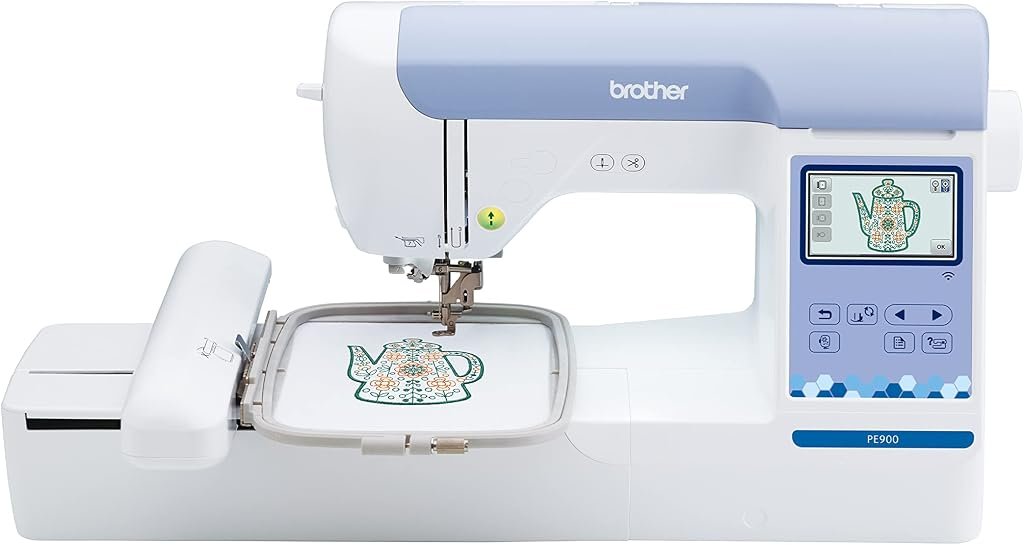
The Brother PE900 occupies a useful middle ground in home embroidery: large enough to escape many of the constraints associated with 4 × 4-inch machines, yet still clearly designed for individual makers rather than commercial production lines. Its 5 × 7-inch maximum embroidery area, 193 built-in designs, 13 lettering fonts, wireless connectivity, automatic jump-stitch trimming, Color Sort, and maximum speed of 650 stitches per minute give it a distinctly more capable profile than Brother’s entry-level embroidery-only models.
That profile earns the PE900 an Our Score of 8.59/10. Its Customer Sentiment score is 8.5, Buyer Confidence is 9.22, and Value is 8.28. Those figures describe a machine with a high degree of purchase confidence and a persuasive feature set, tempered by one uncomfortable fact: the current U.S. price places substantial weight on whether the buyer will genuinely use the larger embroidery field and workflow features.
Brother currently lists the machine at $1,179.99 and identifies its central specifications as a 5 × 7-inch embroidery area, 193 built-in embroidery designs, 13 embroidery fonts, 50 additional downloadable designs, a 3.7-inch LCD, and embroidery speeds up to 650 stitches per minute. Brother’s PE900 product page
That combination makes the PE900 much easier to recommend to an ambitious hobbyist than a smaller 4 × 4 machine. It also makes its limitations more important to examine carefully.
The 5 × 7 Embroidery Area Is the Defining Feature
The PE900’s most consequential specification is not wireless LAN, its color display, or the number of built-in designs. It is the 5 × 7-inch embroidery field.
A 4 × 4-inch machine offers 16 square inches of nominal design area. A 5 × 7 field offers 35 square inches. The comparison is not perfectly interchangeable because usable embroidery dimensions depend on design geometry, but the raw area more than doubles.
That difference changes the kind of projects that can be attempted without splitting a design across multiple hoopings.
Names can be longer. Decorative motifs can breathe. Larger appliqués become feasible. More substantial shirt, towel, tote-bag, pillow, and quilt-block embroidery fits in one setup. Designs that would feel cramped or impossible on a smaller field begin to make practical sense.
This is why hoop size should be examined before built-in pattern count when comparing embroidery machines.
A collection of 193 designs sounds impressive, but the machine’s physical sewing field governs what can actually be stitched in one pass. Design libraries can be expanded later. Hoop capacity cannot be expanded through software.
The 5 × 7 field therefore gives the PE900 a more durable ownership proposition than a smaller machine for users who already know that embroidery will become a serious hobby.
The PE900 Is Embroidery-Only, Not a Combination Machine
The PE900 performs embroidery rather than conventional sewing.
That distinction is fundamental.
It will not replace a general sewing machine for garment construction, seam work, hemming, buttonholes, repairs, or ordinary utility stitching. Anyone researching the best sewing and embroidery machines should separate combination models from dedicated embroidery machines before comparing prices.
For a household that already owns a capable sewing machine, specialization may be desirable. The embroidery setup can remain installed rather than repeatedly switching between sewing and embroidery modes. A separate machine also allows different tasks to be divided between devices.
A first-time machine buyer faces a less straightforward calculation.
Spending more than a thousand dollars on embroidery-only equipment makes sense when embroidery is already the primary goal. If sewing is equally important, the buyer may obtain broader functionality from a combination machine at a similar investment, although hoop size and embroidery features will vary by model.
The PE900 is therefore strongest when evaluated as a dedicated creative tool rather than an all-purpose sewing appliance.
193 Built-In Designs Matter Less Than Design Import Flexibility
Brother includes 193 built-in embroidery designs and 13 lettering fonts. The machine also comes with access to 50 downloadable embroidery designs according to the current manufacturer listing.
That is a healthy starting library, particularly for a new owner learning how different stitch patterns behave on different materials.
Yet built-in design totals often receive more marketing emphasis than their long-term usefulness deserves.
Embroidery owners tend to move beyond stock designs as their interests become more specific. Names, logos, seasonal artwork, purchased digital files, custom drawings, club insignia, children’s motifs, and project-specific patterns quickly become more relevant than the exact quantity preinstalled at the factory.
The PE900’s real strength lies in its ability to accept additional embroidery files through modern transfer methods.
Brother’s Design Database Transfer software can send compatible embroidery data wirelessly from a Windows PC to the machine. Brother describes the application as a dedicated Windows program that also organizes design files using thumbnail views. Design Database Transfer documentation
This shifts the machine away from a closed appliance and toward a broader digital embroidery workflow.
Wireless Transfer Is Useful, but Platform Differences Matter
Wireless LAN is one of the PE900’s headline features, and it is genuinely useful when properly configured.
Instead of repeatedly loading designs onto a USB drive, moving the drive to the embroidery machine, importing a file, and returning to the computer for the next change, designs can be transferred across the local network.
That removes a small but persistent source of friction.
However, computer platform matters.
Brother currently states that there is no Mac application allowing direct wireless transfer from a Mac computer to a compatible embroidery machine. Its support guidance directs Mac users toward Artspira on an iPhone or iPad for wireless embroidery transfers instead. Brother’s Mac wireless-transfer guidance
Windows users therefore receive the more direct desktop workflow through Design Database Transfer.
That difference should influence purchasing expectations. A feature described simply as “wireless design transfer” may suggest identical behavior across operating systems, but the actual workflow varies depending on the device used to prepare and transmit the file.
Artspira Extends the Machine Beyond the Desktop
The PE900 also supports Brother’s Artspira ecosystem.
Artspira permits designs to be selected, edited, created, and transferred from compatible mobile devices. Brother’s support documentation lists the PE900 among machines able to receive designs through the app. Brother’s Artspira transfer instructions
The app also supports external embroidery file formats including PES, PHC, PHX, and DST. Brother documents a workflow in which external files can be imported into Artspira and stored within the user’s creations. Artspira external-file support
There are operational restrictions.
Brother states that only one pattern can be transferred at a time through Artspira. Sending another design before retrieving the previous one can overwrite the earlier transfer. Artspira multiple-transfer limitation
That is not a severe restriction for casual work, but it illustrates the difference between wireless convenience and high-volume production workflow.
The PE900 is designed to make individual design management easier, not to behave like a networked commercial embroidery queue.
The 3.7-Inch Display Is Small but Functionally Important
The PE900 uses a 3.7-inch LCD.
Measured against modern tablets and smartphones, that sounds modest. In an embroidery machine, however, screen utility depends less on entertainment-style size and more on the editing functions attached to it.
Brother lists on-screen letter editing, enhanced zoom, resizing, rotation, repositioning, and design combining among the machine’s available functions.
These tools matter because embroidery placement is spatial.
A user frequently needs to answer questions such as:
- Is the name centered under the motif?
- Does the combined design fit within the 5 × 7 boundary?
- Should a design be rotated to use the hoop more efficiently?
- Is the lettering proportionate to the decorative element?
- Can two smaller elements be combined without exceeding the sewing field?
The display gives those decisions a visual interface rather than forcing the operator to plan every adjustment elsewhere.
It does not replace dedicated embroidery software for advanced editing or digitizing. It does make routine positioning and composition considerably more direct.
650 Stitches Per Minute Provides a Noticeable Throughput Advantage
Brother rates the PE900 at up to 650 stitches per minute.
That figure is meaningfully higher than the 400-stitch-per-minute ceiling found on some smaller entry-level machines.
The theoretical timing difference is easy to illustrate.
A 13,000-stitch design at 650 stitches per minute would require 20 minutes of stitching if the machine sustained maximum speed without interruption:
13,000 ÷ 650 = 20 minutes.
At 400 stitches per minute, the same stitch count would theoretically require 32.5 minutes.
Real embroidery takes longer than either number.
Machines accelerate and decelerate. Color changes interrupt stitching. Thread can require attention. The operator may pause for inspection. Some sections of a design may be sewn more slowly depending on stitch density and machine control.
Still, higher maximum speed reduces one source of waiting, particularly on medium-sized designs that take advantage of the larger 5 × 7 field.
The PE900 remains a single-needle machine, however. Each thread-color change still demands more operator involvement than a multi-needle machine that keeps several colors threaded simultaneously.
That distinction becomes increasingly significant as production volume grows.
Color Sort Addresses an Ordinary Source of Lost Time
Color Sort is one of the PE900’s more practical software features.
Brother describes it as a function that changes the stitching order of multi-color embroidery designs to reduce the number of color changes.
The underlying problem is simple.
A combined design may contain several separate objects that use the same thread color. Without optimization, the machine could sew one blue area, switch to red, return to blue, switch again, and repeat unnecessary thread changes because the design objects were created in a particular sequence.
Color Sort attempts to group compatible color stages more efficiently.
For a single small design, the time saved may be modest. Across larger combined layouts, repeated projects, or designs with many color sections, fewer interruptions can make the workflow less tedious.
This type of feature is easily overlooked because it does not expand the machine’s physical capability. It changes how often the operator must intervene.
That distinction becomes increasingly meaningful as embroidery projects become more ambitious.
Automatic Jump-Stitch Trimming Reduces Cleanup
The PE900 also includes automatic jump-stitch trimming.
Jump stitches are connecting threads that span separate stitched areas. Without trimming, they can remain visible across the front of the embroidery and require manual cleanup.
Brother states that the PE900 automatically trims excess thread jumps within a color.
Again, this is a productivity feature rather than a creative-capacity feature.
It does not improve hoop size. It does not increase speed. It does not make an unsuitable design suddenly fit.
What it can do is reduce one of the repetitive finishing tasks associated with detailed embroidery.
Owners working with lettering, isolated motifs, or designs containing many separated stitched sections may appreciate that convenience more than someone producing simple, continuous patterns.
The PE900’s Price Requires a More Deliberate Buying Decision
Our Value score of 8.28 is deliberately lower than the machine’s overall score and Buyer Confidence rating.
Brother’s current U.S. list price is $1,179.99.
At that level, the PE900 cannot be treated as an impulse purchase for someone merely curious about embroidery. The investment makes more sense when the buyer already understands why a 5 × 7 field, wireless design transfer, jump-stitch trimming, Color Sort, and 650-stitch-per-minute operation matter.
The price also raises the importance of comparison.
A lower-priced 4 × 4 machine may satisfy users focused on monograms and small decorative work. At the other end, buyers approaching small-business production may decide that spending more for a larger field or multi-needle machine reduces future replacement costs.
The PE900 therefore sits in a middle position where value depends heavily on matching machine capability to project ambition.
Its price purchases convenience and room to grow, but not unlimited growth.
A 5 × 7 Hoop Still Has Limits
The PE900’s larger embroidery area solves many problems associated with 4 × 4 machines, but it does not make hoop-size planning irrelevant.
Seven inches remains seven inches.
Large sweatshirt graphics, expansive jacket backs, oversized quilt designs, broad decorative panels, and some large-format commercial designs will exceed the machine’s maximum field.
Multi-hooping techniques can extend what is possible, but they require more planning and careful alignment.
Buyers should inspect actual design dimensions before purchasing rather than assuming that “larger than 4 × 4” automatically means “large enough for everything.”
This exercise is more useful than reading another dozen feature lists.
If most intended files fit inside 5 × 7 inches, the PE900 provides enough physical capacity for a substantial range of home projects. If many preferred designs already exceed those dimensions, the machine begins its ownership life with a known restriction.
Maintenance Deserves More Attention Than It Usually Gets
Embroidery machines are mechanical devices with motors, moving assemblies, thread paths, and lubrication requirements. Connectivity features can make them appear more like consumer electronics, but maintenance still matters.
Brother’s service guidance recommends professional cleaning and oiling after about 500 hours for light-to-moderate users operating two to three hours per day. For heavy or consistent users, or machines operated at high speed for extended periods, Brother recommends service after roughly 300 hours. Brother’s machine-service guidance
That recommendation is useful for anyone contemplating small-scale paid work.
A machine that runs several hours every day accumulates maintenance intervals far faster than one used for occasional weekend projects.
Ownership cost therefore includes more than thread, stabilizer, needles, and design files. Long-term use should also account for servicing and replacement consumables.
Included Accessories Cover the Basic Setup
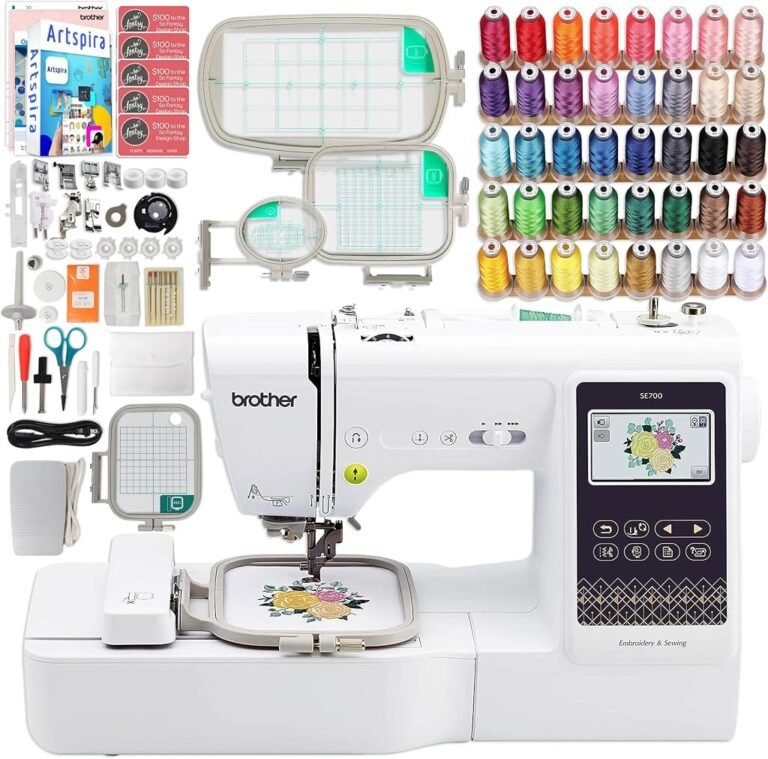
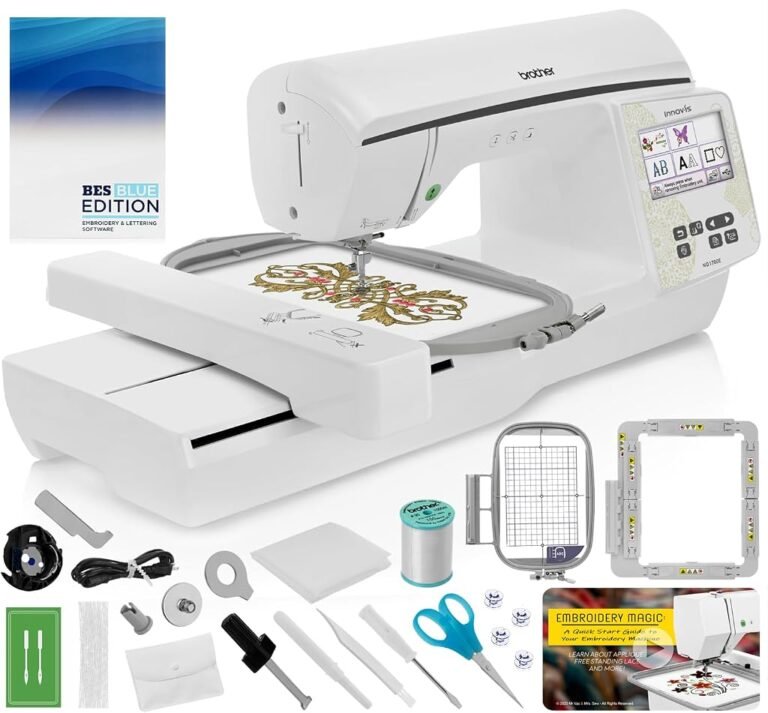
Brother packages the PE900 with the 5 × 7-inch embroidery frame set, embroidery foot “Q,” needles, four bobbins, seam ripper, scissors, cleaning brush, several screwdrivers, spool caps, spool net, bobbin accessories, white embroidery bobbin thread, an accessory bag, dust cover, operation manual, quick-reference guide, and embroidery design guide.
That means the machine arrives with the primary hoop required to use its full embroidery field.
Additional hoops can still become useful for smaller projects because repeatedly placing a small design in a large hoop is not always the most convenient approach.
Brother’s support catalog lists several compatible frames and supplies, including smaller hoops and a magnetic frame. PE900 support and compatible accessories
Accessory costs should therefore be treated as part of the ownership picture for users who expect to work across a wide variety of garment and project sizes.
The Warranty Structure Adds Buyer Confidence
Brother lists the PE900 with a 1/2/25-year limited warranty structure.
That phrasing should not be interpreted as identical 25-year coverage across every component. Different portions of the machine fall under different warranty periods, and buyers should review the actual warranty statement to understand what is covered and for how long.
Still, the availability of dedicated manuals, downloads, warranty materials, compatible supplies, troubleshooting resources, and direct support strengthens the machine’s ownership proposition.
This is one reason the PE900 receives a 9.22 Buyer Confidence score, the highest of our four ratings.
The machine is not difficult to research. Its capabilities, accessories, software ecosystem, service documentation, and support resources are clearly established.
That reduces uncertainty before purchase.
Who Is the PE900 Best Suited For?
The machine makes the strongest editorial case for users who already expect embroidery to become a sustained hobby rather than a brief experiment.
Typical fitting use cases include:
- Personalized towels and linens
- Medium-sized shirt and sweatshirt motifs
- Children’s clothing decoration
- 5 × 7 appliqué designs
- Tote bags and accessories
- Monograms and names
- Quilt-block embroidery
- Decorative home projects
- Gifts requiring repeated personalization
- Small batches of custom work
The 5 × 7 field provides enough flexibility that owners are less likely to encounter immediate design-size frustration than they would with a 4 × 4 machine.
The PE900 also makes sense for users who place a high value on reducing manual workflow friction. Wireless transfer, Color Sort, automatic thread cutting, jump-stitch trimming, and on-screen editing each remove small repetitive tasks.
None is transformative on its own.
Together, they create a machine that demands less unnecessary intervention during ordinary use.
Who Should Look Elsewhere?
The PE900 is less convincing for several distinct buyer groups.
Someone who only wants occasional monograms or very small decorative work may be paying for more embroidery field and automation than necessary.
A buyer who also needs conventional sewing should examine combination sewing-and-embroidery machines rather than buying the PE900 with the expectation that it can fill both functions.
Anyone planning large garment-back designs or oversized home-decor embroidery should begin with a larger maximum field.
A user moving directly into significant paid production should compare multi-needle machines, where multiple thread colors can remain loaded at once and operator intervention can be reduced substantially.
Mac users should also evaluate their preferred design-transfer workflow carefully because Brother’s direct PC wireless-transfer software is Windows-oriented.
These are not minor technicalities. They determine whether the machine will fit the owner’s actual process.
Interpreting Our Scores
Our 8.59/10 overall score reflects a machine with a coherent feature set and far more practical growth room than a basic 4 × 4 model.
The PE900 does not rely on a single headline feature. Its appeal comes from how the larger hoop, faster embroidery speed, wireless transfer, on-screen editing, jump-stitch trimming, Color Sort, and automatic thread management work together.
The 8.5 Customer Sentiment score indicates favorable reception while acknowledging that embroidery machines still require learning, setup, stabilization knowledge, thread management, file handling, and occasional troubleshooting. A computerized interface reduces friction but cannot erase the physical craft involved.
The 9.22 Buyer Confidence score is the strongest rating because the machine’s capabilities are well documented and its support ecosystem is established. Brother provides a dedicated support center with manuals, downloads, warranty resources, compatible accessories, and troubleshooting materials.
The 8.28 Value score is more restrained because $1,179.99 puts the PE900 beyond casual-entry pricing. The machine represents better value for someone who will use the larger embroidery field frequently than for someone whose projects could comfortably remain within 4 × 4 inches.
That gap between Buyer Confidence and Value captures the PE900 well.
There is little ambiguity about what the machine does. The harder question is whether a particular buyer needs enough of those capabilities to justify the price.
Final Considerations
The Brother PE900 is a serious home embroidery machine without pretending to be commercial production equipment.
Its 5 × 7-inch maximum embroidery area is large enough to change project planning meaningfully compared with smaller entry-level machines. The jump from 4 × 4 to 5 × 7 removes many early constraints and allows larger names, appliqués, decorative motifs, quilt designs, and garment embroidery to fit into a single hooping.
The supporting features are equally coherent.
A maximum speed of 650 stitches per minute reduces theoretical stitch time. Color Sort can cut unnecessary thread changes. Automatic jump-stitch trimming reduces cleanup. Wireless transfer removes repeated reliance on USB media. Artspira adds a mobile workflow. The 3.7-inch LCD supports resizing, rotation, positioning, lettering adjustments, and design combinations directly at the machine.
Our 8.59/10 score reflects that balance.
Customer Sentiment at 8.5 points to a generally favorable ownership profile without pretending computerized embroidery is effortless. Buyer Confidence at 9.22 reflects clear manufacturer documentation, active software support, available manuals, accessories, and service resources. Value at 8.28 acknowledges the central tension: the PE900 is capable, but its current price demands a buyer who will use that capability rather than merely admire it.
The decisive buying question is therefore project size.
A person whose embroidery plans already include medium-sized garment designs, 5 × 7 appliqués, substantial personalization, quilt blocks, larger names, and regular design imports has a rational reason to prefer the PE900 over a smaller machine.
A person whose plans rarely move beyond initials, patches, and tiny decorative motifs may find that much of the PE900’s price is purchasing unused room.
At the other extreme, someone already envisioning oversized jacket designs, broad sweatshirt graphics, heavy batch production, or multiple thread colors running unattended should regard 5 × 7 inches and a single needle as intermediate capacity rather than an endpoint.
That leaves the PE900 in a clearly defined position.
It is a machine for users who have moved beyond the smallest embroidery format but do not yet need industrial scale. The physical field is large enough to matter, the digital workflow is modern enough to reduce routine friction, and the automation features address repetitive tasks rather than merely decorating a specification sheet.
For buyers whose projects actually fit that profile, the PE900 offers a credible balance of space, speed, automation, and creative flexibility. Its strongest attribute is not any one electronic feature. It is the fact that the machine gives embroidery room to grow without immediately forcing the owner into a far larger and more expensive production category.