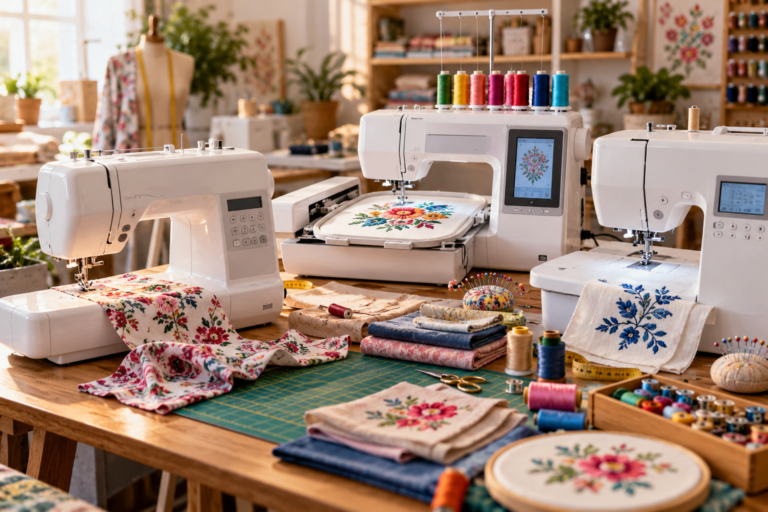
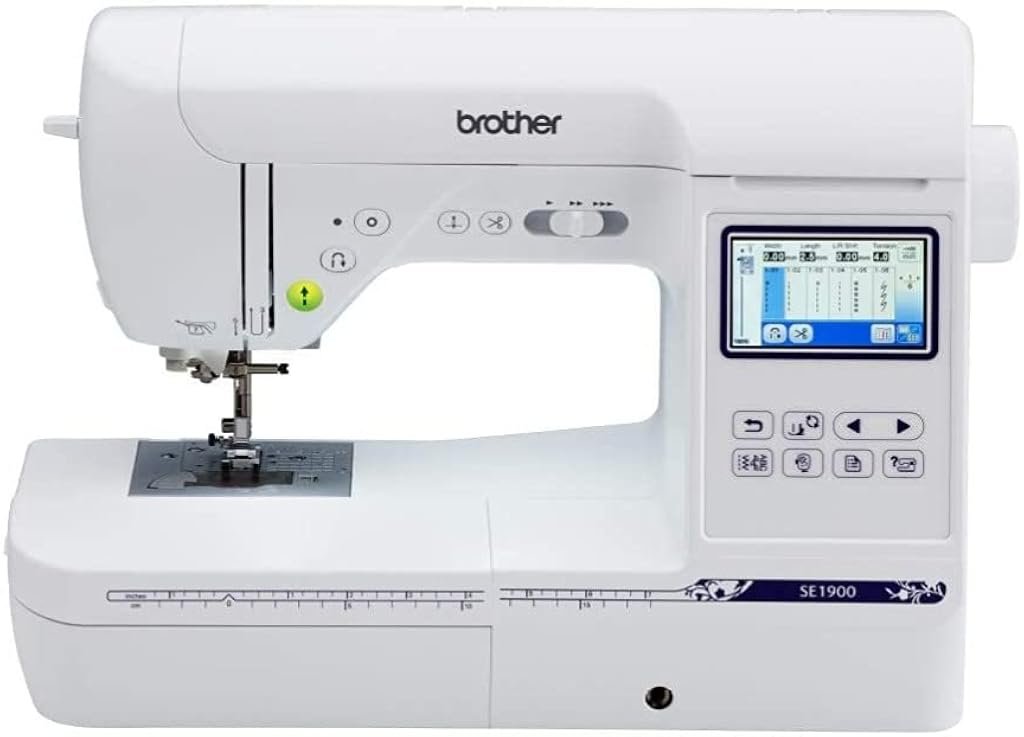
The Brother SE1900 belongs to an interesting generation of computerized sewing and embroidery machines. It offers enough electronic sophistication to make machine embroidery approachable, yet its design predates the stronger emphasis on wireless transfer and mobile-app integration found in newer Brother models. The result is a machine whose appeal rests less on connectivity and more on what it can physically do at the sewing table.
That distinction matters.
The SE1900 combines a 5 × 7-inch embroidery field, 138 built-in embroidery designs, 11 embroidery lettering fonts, 240 sewing stitches, a 3.2-inch color touchscreen, USB design importing, automatic thread cutting, and sewing speeds up to 850 stitches per minute. It is a substantial home combination machine rather than a compact introductory model.
Our Score is 9.01/10. Customer Sentiment is 8.94, Buyer Confidence is 9.8, and Value is 8.52. Those ratings reflect a machine with unusually coherent sewing and embroidery capabilities, tempered by an important purchasing reality: newer machines have changed expectations around connectivity.
The SE1900 therefore presents a different proposition from current wireless models. It asks whether mature hardware, a 5 × 7 embroidery field, broad sewing functionality, and USB-based design importing can matter more than mobile integration.
For many users, the answer can still be yes.
The 5 × 7-Inch Embroidery Field Defines the SE1900
The most consequential specification is not the number of decorative stitches, fonts, or included designs.
It is the embroidery field.
According to Brother’s official SE1900 specifications, the machine provides a maximum embroidery area of 5 × 7 inches.
That is a meaningful step beyond 4 × 4-inch combination machines.
A 4 × 4 rectangle contains 16 square inches. A 5 × 7 rectangle contains 35 square inches. Embroidery designs rarely consume every available square inch, but the comparison demonstrates how much additional working area becomes available.
The difference changes project planning.
Names can be longer. Decorative compositions can contain more elements. Larger motifs can fit without immediate resizing. Designs for towels, bags, children’s clothing, home textiles, and apparel have more room before the user needs to consider splitting or repositioning.
This is why embroidery-field dimensions deserve greater attention than design-library counts.
Digital designs can be added later.
Mechanical travel cannot.
Five-by-Seven Embroidery Reduces Workarounds
A larger embroidery field does not merely permit larger artwork.
It reduces the number of projects requiring workarounds.
On a smaller machine, a design that exceeds the available field may need to be divided into sections, resized, rearranged, or embroidered through a repositioning process. Each additional operation introduces opportunities for alignment errors.
The SE1900 does not eliminate those problems. Designs can easily exceed 5 × 7 inches.
It simply pushes the boundary farther outward.
That distinction is particularly important for buyers moving beyond introductory embroidery. A 4 × 4 machine can teach the fundamentals effectively, but users often discover their preferred project scale only after they begin collecting designs.
Five-by-seven gives those projects more breathing room.
For someone regularly embroidering names, medium-sized motifs, larger monograms, decorative arrangements, or designs that sit awkwardly beyond 4 × 4 dimensions, the SE1900’s field can materially reduce setup complexity.
The SE1900 Includes 138 Embroidery Designs
Brother includes 138 embroidery designs in the SE1900.
Built-in designs have practical value because they allow immediate experimentation without requiring the user to locate external files. They can also help a newcomer understand how different stitch densities, color sequences, and design dimensions behave.
Yet built-in design count should not dominate a purchasing decision.
Embroidery files are digital assets.
A machine capable of importing external designs is not permanently restricted to its factory library. The SE1900 includes a USB port for importing compatible embroidery files, which means its usable design collection can expand substantially over time.
That shifts the importance of the 138-design specification.
It is an opening library, not a lifetime ceiling.
The 5 × 7-inch field remains far more consequential because every imported design must ultimately fit within the machine’s physical embroidery limits or be adapted accordingly.
Eleven Embroidery Fonts Support Personalization
The SE1900 includes 11 built-in embroidery lettering fonts.
This matters because lettering is not a peripheral use of home embroidery. Names, initials, dates, monograms, labels, and short phrases are central to personalized projects.
The 5 × 7 field complements those lettering options.
Longer names and larger arrangements have more room than on a 4 × 4 platform. Users can also combine lettering with decorative elements while retaining more physical space for composition.
The machine supports embroidery editing through its touchscreen interface, allowing users to manipulate designs before stitching.
This does not replace dedicated digitizing software.
Digitizing is the process of translating artwork into stitch instructions, including stitch types, directions, densities, sequencing, and other parameters. Machine-side editing is narrower.
The distinction protects buyers from expecting the SE1900’s touchscreen to perform work better suited to specialized software.
The 3.2-Inch Touchscreen Handles Machine-Side Editing
Brother equips the SE1900 with a 3.2-inch Sew Smart color LCD touchscreen.
The screen allows users to view embroidery designs in color and perform editing operations at the machine.
Brother lists editing capabilities that include changing individual embroidery thread colors using its color palette, placing lettering in an arc, moving designs on the screen, and other layout adjustments.
These controls can reduce trips between the sewing machine and a computer.
The screen is still relatively compact.
That is not necessarily a serious limitation when its purpose is understood correctly. It functions as a machine-control and editing interface rather than a full graphics workstation.
Design creation, extensive file organization, and detailed digitizing remain more comfortable on larger computing devices.
At the SE1900 itself, the touchscreen provides immediate visual interaction with the project about to be sewn.
USB Importing Keeps the Design Library Expandable
The SE1900 supports USB design importing.
That gives the machine a route beyond its 138 built-in patterns without requiring a wireless network.
A compatible design can be prepared elsewhere, transferred using appropriate USB media, and accessed by the machine.
The process involves more physical steps than wireless transfer.
For one design, that difference is minor.
For a user maintaining a large embroidery library and moving files frequently, the extra actions accumulate. Newer wireless models can remove some of that repetitive file handling by allowing supported designs to travel electronically from another device.
The SE1900 therefore reflects an earlier digital workflow rather than an isolated one.
It can use external designs.
It simply moves them differently.
For buyers comfortable with USB media, this distinction may carry little weight. For users who strongly prefer mobile or wireless workflows, it is a meaningful reason to compare newer machines.
Connectivity Is Where the SE1900 Shows Its Generation
The SE1900’s age becomes most visible in connectivity.
Newer Brother combination machines can incorporate wireless LAN, Design Database Transfer, and Artspira mobile workflows. Those systems reduce dependence on removable storage and connect embroidery more directly with computers and mobile devices.
The SE1900 is built around USB transfer.
That difference should be neither exaggerated nor dismissed.
Wireless transfer does not improve stitch quality. It does not enlarge an embroidery field. It does not compensate for poor stabilizer selection or incorrect hooping.
What wireless connectivity changes is procedure.
A design can move between compatible devices without physically carrying storage media to the machine.
For someone who transfers designs occasionally, USB can remain entirely adequate.
For someone constantly downloading, editing, cataloging, and sending embroidery files, connectivity can become a meaningful part of everyday ownership.
The Sewing Side Is a Major Part of the Machine
The SE1900 contains 240 built-in sewing stitches.
That number immediately separates it from machines where sewing feels like a secondary capability attached to an embroidery system.
The stitch collection includes utility and decorative options, while the machine also provides 10 styles of one-step auto-size buttonholes.
This makes the SE1900 relevant to garment construction, home sewing, decorative work, quilting-related projects, repairs, bags, and other conventional sewing applications.
That breadth is central to its value proposition.
A dedicated embroidery machine may direct more of its engineering toward embroidery-specific functionality, but it cannot replace an ordinary sewing machine.
The SE1900 can move from seam construction to decorative stitching and then to computerized embroidery on the same platform.
For households that genuinely perform all three activities, that consolidation can justify the combination format.
Sewing Speed Reaches 850 Stitches per Minute
Brother specifies a maximum sewing speed of 850 stitches per minute for the SE1900.
Maximum speed should be interpreted as capacity rather than an instruction.
Long, stable seams can make use of higher sewing speeds. Tight curves, precision work, corners, unfamiliar materials, and detail sewing often benefit from slower operation.
The machine provides speed control, allowing the operator to adjust pace according to the project.
That control can be more useful than the maximum figure itself.
A beginner can work slowly while learning fabric guidance and machine response. An experienced sewer can increase speed when the seam and material allow it.
This range gives the SE1900 considerable flexibility as an ordinary sewing machine, which matters because embroidery may represent only part of its working life.
Automatic Thread Cutting Addresses a Repetitive Task
The SE1900 includes an automatic thread cutter.
Thread cutting seems minor until its frequency is considered.
Sewing and embroidery involve repeated stops, transitions, color changes, and project stages where thread must be managed. Automating some of those cuts reduces repetitive hand movements and can make the workflow more orderly.
It does not remove every trimming requirement.
Embroidery can still leave jump stitches or other thread requiring manual cleanup depending on the design and stitching sequence.
The useful distinction is between reducing a repetitive action and eliminating it.
The SE1900 does the former.
The Advanced Needle Threading System Reduces Setup Friction
Brother equips the SE1900 with an advanced needle threading system.
Needle threading is another small task whose significance increases through repetition.
The benefit is particularly noticeable when thread colors change frequently or when eyesight and dexterity make manual threading less comfortable.
The machine still requires correct upper threading throughout the complete thread path.
An automatic needle threader addresses the final passage through the needle eye; it does not compensate for incorrect threading elsewhere in the machine.
This distinction matters because embroidery problems are often blamed on electronics when their causes lie in setup.
Thread path, bobbin installation, needle condition, stabilizer, fabric, and thread compatibility remain fundamental.
Eight Included Presser Feet Support Conventional Sewing
Brother’s standard SE1900 package includes eight presser feet: zigzag, monogramming, overcasting, zipper, blind stitch, button fitting, buttonhole, and embroidery feet.
That accessory selection reinforces the machine’s dual-purpose identity.
The embroidery foot supports machine embroidery, while the remaining feet address common sewing operations.
This reduces the need to purchase basic accessories immediately after acquiring the machine.
Presser-foot count should not be treated as a proxy for sewing quality, however.
The more relevant question is whether the included feet correspond to operations the owner actually performs.
For a garment sewer, zipper, buttonhole, overcasting, and blind-stitch feet can be useful regularly. Another owner may spend far more time embroidering and use only a subset of them.
Knee Lifting Improves Fabric Control
The SE1900 includes a knee lifter.
This allows the presser foot to be raised with the knee, leaving both hands available to control the fabric.
The advantage is easiest to appreciate during sewing that requires frequent repositioning.
Instead of removing one hand from the project to raise the presser foot, the operator can use the knee while keeping the fabric controlled.
This feature rarely receives the attention given to embroidery-design counts, yet it addresses physical interaction with the machine rather than digital inventory.
Over years of sewing, such workflow features can matter more than decorative options that are rarely selected.
The Combination Format Has an Efficiency Limit
The SE1900 combines two machines, but it cannot perform two jobs simultaneously.
While the embroidery unit is stitching a design, the machine is unavailable for conventional sewing.
For a home user moving sequentially between garment construction and embroidery, that is rarely a serious problem.
For heavier workloads, the limitation becomes more visible.
Someone running a small embroidery operation while also sewing products may eventually benefit from separate machines. One can embroider while the other remains available for construction work.
The SE1900’s combination architecture is therefore most efficient when space, cost, and convenience matter more than simultaneous production.
That distinction separates household versatility from production throughput.
Single-Needle Embroidery Requires Color Changes
The SE1900 is a single-needle embroidery machine.
Multicolor designs therefore require thread changes as the color sequence progresses.
The machine controls stitch placement and hoop movement automatically, but it does not maintain multiple thread colors ready for immediate switching.
For occasional embroidery, this is normal and manageable.
For repeated production, operator involvement becomes more consequential.
Consider a design requiring several color changes repeated across a batch of garments. Each item requires the same sequence of thread handling. A multi-needle machine can keep several colors threaded simultaneously, changing the economics of repeated work.
The SE1900 can produce multicolor designs.
The distinction is throughput, not whether multicolor embroidery is possible.
Hoop Size Should Be Matched to Actual Projects
A rational SE1900 purchase begins with project dimensions.
Buyers should examine the embroidery files they already own or the types of designs they expect to use.
If most designs fit inside 5 × 7 inches, the SE1900’s field can support a broad range of work without repeated splitting.
If planned designs routinely exceed that area, the buyer should investigate machines with larger native embroidery fields before purchasing.
This exercise is more informative than comparing built-in design counts.
A machine can contain hundreds of factory patterns and still frustrate an owner whose preferred projects exceed its physical field.
Embroidery is ultimately constrained by geometry.
Our Score: 9.01/10
We rate the Brother SE1900 at 9.01/10.
That score reflects a particularly coherent combination of sewing capability and 5 × 7-inch embroidery.
The machine offers 240 sewing stitches, 138 embroidery designs, 11 embroidery fonts, 10 one-step auto-size buttonhole styles, USB design importing, a 3.2-inch color touchscreen, automatic thread cutting, advanced needle threading, a knee lifter, eight included presser feet, and sewing speeds up to 850 stitches per minute.
More significantly, these features support both halves of the machine’s identity.
The SE1900 is not an embroidery machine with token sewing functionality, nor is it an ordinary sewing machine with a superficial embroidery attachment.
Its 9.01 score reflects that balance.
Its age appears most clearly in file-transfer workflow rather than in the basic mechanics of sewing and embroidery.
Customer Sentiment: 8.94
Our Customer Sentiment score is 8.94.
That figure sits close to the overall score because the machine’s core proposition is easy to understand.
A buyer gets a substantial computerized sewing machine and a 5 × 7 embroidery platform in one chassis.
The most likely friction points are equally understandable.
USB transfer is less convenient than current wireless workflows for users who move files frequently. A 5 × 7 field, while substantially more flexible than 4 × 4, still limits larger designs. Single-needle embroidery requires operator involvement during multicolor projects.
None of those limitations is obscure.
They simply determine who will be satisfied with the machine.
Buyer Confidence: 9.8
Buyer Confidence is 9.8, the strongest rating in our SE1900 assessment.
The machine’s capabilities and limitations are well defined.
Brother maintains SE1900 support resources covering manuals, frequently asked questions, downloads, warranty information, compatible supplies, support videos, and contact options.
That matters for computerized equipment.
Long-term ownership involves more than basic mechanical maintenance. File handling, error messages, embroidery settings, accessories, and model-specific procedures can all require documentation.
The existence of a developed manufacturer support archive reduces uncertainty.
The high score also reflects the SE1900’s straightforward architecture. The buyer knows the field size, design count, stitch count, transfer method, and major accessories before purchase.
The boundaries are visible.
Value: 8.52
Our Value score is 8.52.
That rating is lower than Our Score and Buyer Confidence because the SE1900’s value depends heavily on current price and intended use.
A buyer who genuinely needs both sewing and 5 × 7 embroidery can extract substantial utility from one machine.
Someone interested almost exclusively in embroidery may obtain better allocation from an embroidery-only system.
Someone interested only in sewing has little reason to pay for embroidery hardware.
Connectivity also affects the calculation.
If an SE1900 is priced close to a newer wireless combination machine with similar physical embroidery capacity, the newer workflow may provide better long-term convenience.
If the SE1900 is available at a meaningful discount, USB transfer becomes easier to accept.
Value therefore depends not merely on what the machine can do, but on how much the buyer pays for capabilities that will actually be used.
Where the SE1900 Fits Among the Best Sewing and Embroidery Machines
The best sewing and embroidery machines are not necessarily the newest models.
Newer machines can provide more convenient connectivity while older models may retain comparable physical sewing and embroidery capacity.
The SE1900 illustrates that distinction clearly.
Its 5 × 7 embroidery field remains useful. Its 240 sewing stitches provide substantial conventional capability. Its 138 embroidery designs and 11 fonts offer a sizable starting library. USB importing keeps the machine open to external files.
What it lacks is the wireless ecosystem found on newer Brother machines.
That makes the SE1900 particularly appealing to users who value physical capability over connected workflow and who can purchase it at a price that reflects its generation.
Who Should Consider the Brother SE1900?
The SE1900 makes the strongest case for buyers who want:
- A 5 × 7-inch embroidery field
- Sewing and embroidery in one machine
- 138 built-in embroidery designs
- 11 embroidery lettering fonts
- 240 built-in sewing stitches
- 10 one-step auto-size buttonhole styles
- USB embroidery-file importing
- A 3.2-inch color touchscreen
- Automatic thread cutting
- Advanced needle threading
- Sewing speeds up to 850 stitches per minute
- A knee lifter
- Eight included presser feet
- Manufacturer documentation and model-specific support
It is particularly suitable for users who find 4 × 4 embroidery restrictive but do not require a production-oriented multi-needle machine.
Who Should Look Elsewhere?
Users who prioritize wireless design transfer should compare newer Brother models.
Buyers routinely working with designs larger than 5 × 7 inches should investigate larger-field machines rather than assuming that repositioning will remain convenient indefinitely.
Someone who already owns a capable sewing machine should compare dedicated embroidery models before paying for duplicate sewing functionality.
Commercially oriented users producing repeated multicolor orders should examine whether a single-needle workflow can meet their desired throughput.
The SE1900 is versatile, but versatility and production efficiency are different objectives.
Final Considerations
The Brother SE1900 Sewing and Embroidery Machine earns an Our Score of 9.01/10 because its fundamental architecture remains unusually coherent: a substantial computerized sewing machine and a 5 × 7-inch embroidery system share one platform without either side feeling incidental.
The embroidery field is central to that assessment.
At 5 × 7 inches, it provides more than twice the theoretical rectangular area of a 4 × 4 field. That extra space creates room for longer names, larger motifs, more ambitious decorative compositions, and projects that might otherwise require splitting or repositioning.
The supporting specifications reinforce the proposition. There are 138 built-in embroidery designs, 11 embroidery fonts, 240 sewing stitches, 10 one-step auto-size buttonhole styles, a 3.2-inch color touchscreen, USB design importing, automatic thread cutting, advanced needle threading, eight included presser feet, a knee lifter, and sewing speeds up to 850 stitches per minute.
Customer Sentiment at 8.94 reflects the consistency of that package. Buyer Confidence at 9.8 reflects well-defined capabilities, visible limitations, and continuing manufacturer documentation. Value at 8.52 is more restrained because an older USB-based machine must be priced sensibly beside newer wireless alternatives.
The SE1900’s age is therefore not primarily a mechanical problem.
It is a workflow question.
A needle does not stitch more accurately merely because its design file arrived over Wi-Fi. A 5 × 7 field does not shrink because the machine uses USB. Conventional seams do not become less useful because a mobile application is absent.
Connectivity affects convenience.
Physical architecture determines what the machine can actually sew and embroider.
For a buyer who wants 5 × 7 embroidery, substantial conventional sewing capability, and an expandable USB-based design library, the SE1900 remains a serious combination platform. For someone whose routine depends heavily on wireless transfer, mobile design tools, larger embroidery fields, or multi-needle production, newer or more specialized equipment presents a more rational path.
The buying decision ultimately rests on a simple division: whether the owner values the SE1900 for the work performed at the needle or primarily for the digital workflow surrounding it. The machine remains far more persuasive in the first category.