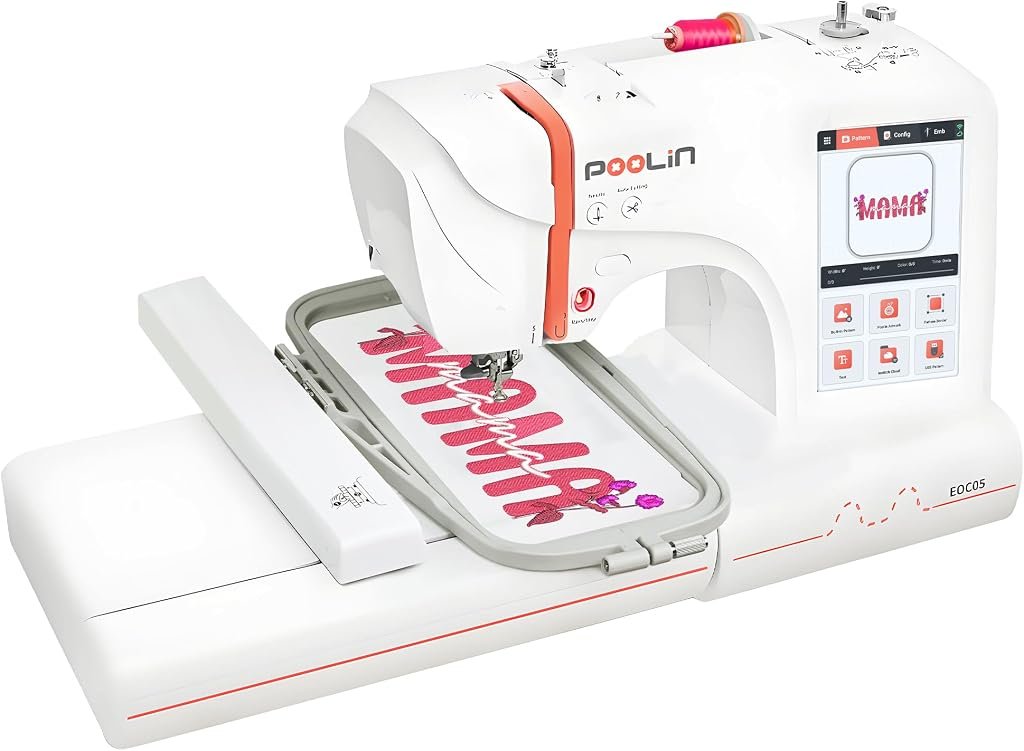
The Poolin EOC05 approaches home embroidery from a different direction than machines that compete primarily through ever-larger hoops. Its embroidery field measures 100 × 235 mm, roughly 3.9 × 9.25 inches, making it unusually long relative to its 3.9-inch width. That geometry immediately reveals the machine’s character: it is suited to names, borders, narrow decorative compositions, patches, lettering and horizontal motifs more readily than broad square artwork.
Poolin pairs that working area with a 7-inch HD touchscreen, a maximum embroidery speed of 650 stitches per minute, 130 built-in patterns, eight lettering fonts, 24 decorative borders, two included hoops, Wi-Fi and USB transfer, automatic thread trimming and an upper-thread break alarm. Poolin’s current European documentation also identifies the machine as embroidery-only, with no conventional sewing function.
Our editorial rating is 8.61/10. Customer Sentiment is 8.5, Buyer Confidence is 9.32, and Value is 8.28.
Those figures describe a machine that makes a credible case for beginners and home users who want a larger interface and elongated embroidery area without moving directly into the larger 7.9 × 11-inch class. Its strongest advantage is not raw capacity. It is the way its screen, transfer methods, editing tools and moderate physical dimensions lower several barriers that make computerized embroidery intimidating at first.
The 3.9 × 9.25-Inch Field Has a Very Specific Shape
The EOC05’s maximum embroidery area is 100 × 235 mm. Poolin’s U.S. comparison material rounds that to 4 × 9.25 inches, while its European documentation lists the metric measurement directly.
That shape deserves closer examination.
A conventional 4 × 4 embroidery field provides roughly 16 square inches. The EOC05’s approximate 3.9 × 9.25 field provides a little over 36 square inches of nominal rectangular area.
The gain is substantial, but it is not symmetrical.
Width remains near four inches. Length more than doubles.
That makes the EOC05 particularly relevant to projects such as:
- Long names and lettering
- Sleeve-style decorative arrangements
- Narrow border designs
- Tote-bag motifs
- Towel decoration
- Patches
- Children’s clothing
- Vertical floral compositions
- Small appliqués
- Personalized gifts
- Narrow quilt elements
- Long decorative motifs that would exceed a 4 × 4 hoop
The machine is less suited to artwork that needs substantial width.
A design measuring 6 × 6 inches will not fit simply because its total area is smaller than the EOC05’s nominal field. Hoop dimensions govern both axes independently. Six inches of width cannot be squeezed into a working area that is approximately four inches wide without resizing or restructuring the design.
This is why square-inch comparisons can mislead.
The EOC05 offers far more flexibility than a basic 4 × 4 machine for elongated projects, but it does not behave like a 6 × 10 or 7.9 × 11 platform.
Two Hoops Match Two Different Kinds of Work
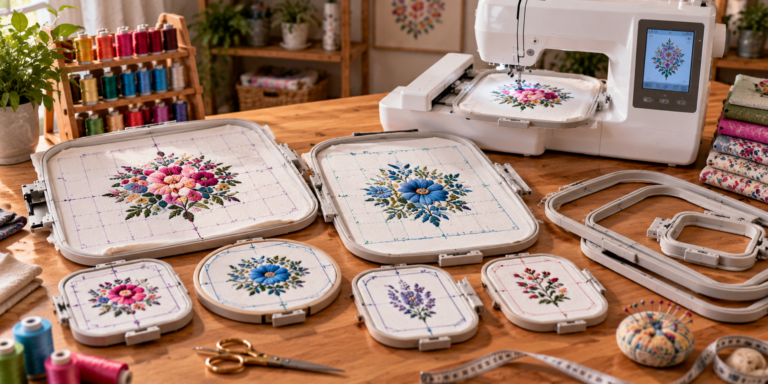
Poolin includes a 10 × 10 cm hoop and a 10 × 23.5 cm hoop with the EOC05. The smaller frame handles compact lettering, patches and small motifs, while the larger frame provides the full elongated working field. Poolin’s EOC05 hoop and feature overview documents the machine’s two-frame configuration.
The pairing is sensible because the largest available hoop is not automatically the most efficient choice.
A small monogram inside a 10 × 23.5 cm frame can consume more stabilizer than necessary and leave more surrounding material to manage. A 10 × 10 cm hoop keeps the setup compact.
The larger frame becomes valuable when the design needs length.
This arrangement also forces a useful buying question before any money changes hands: what shape are the projects?
Someone planning names across towels, decorative borders or tall narrow artwork may benefit heavily from the EOC05’s geometry. Someone envisioning broad sweatshirt graphics may reach the width limit quickly.
The EOC05 therefore rewards buyers who examine actual design dimensions rather than generic phrases such as “larger hoop.”
The Seven-Inch Screen Changes How the Machine Feels
Poolin equips the EOC05 with a 7-inch HD touchscreen.
That display is unusually large relative to the machine’s embroidery field and price class, and the company uses it for more than pattern selection. The interface supports dragging, zooming, rotation, resizing and other direct editing actions before stitching begins. Poolin also documents a trace function that allows the operator to check whether a design fits within the selected hoop.
A large interface matters because embroidery is spatial.
An operator needs to see where text sits relative to a decorative motif, whether a design approaches a hoop boundary, whether rotation creates better use of the available space and whether a resized element still produces the intended visual balance.
Smaller displays can perform many of the same tasks, but screen area affects how comfortably those tasks are managed.
The EOC05’s display does not replace dedicated embroidery software. Proper digitizing involves stitch sequencing, density, underlay, path planning and material behavior. Those decisions go far beyond moving an existing design around a screen.
For routine layout work, however, the touchscreen reduces the need to return to another device for every small adjustment.
650 Stitches Per Minute Is Sensible Rather Than Aggressive
Poolin rates the EOC05 at a maximum speed of 650 stitches per minute. Its official U.S. education material identifies the machine as a single-head, single-needle model using the Institch OS2 system.
Speed figures become easier to understand when translated into stitch counts.
At a purely mathematical 650 stitches per minute, a 13,000-stitch design represents 20 minutes of needle movement:
13,000 ÷ 650 = 20 minutes.
A 26,000-stitch design would represent 40 minutes at the same theoretical maximum.
Actual embroidery takes longer.
The machine accelerates and slows. Color changes interrupt operation. Thread can break. Bobbins require attention. Some design segments may run below the maximum rate. Hooping, stabilizing, positioning and finishing also occur outside the machine’s active stitching time.
The EOC05 is therefore not a production-speed machine.
Its 650-SPM ceiling is more aligned with home embroidery, personalized gifts and moderate project volumes.
That is consistent with the rest of its design.
One Needle Defines the Real Production Limit
The EOC05 is a single-needle embroidery machine.
This specification matters more than many decorative features because it determines how multicolor designs are handled.
If a design contains six thread colors, the operator will generally need to change the upper thread as each new color is requested. A multi-needle machine can keep several thread colors loaded at once.
That difference becomes increasingly expensive in human time as project volume rises.
For one personalized towel, manually changing thread can be perfectly reasonable.
For twenty identical multicolor garments, the same process becomes repetitive labor.
The EOC05 therefore fits home creativity and small batches more naturally than sustained production.
Its long embroidery field may accommodate artwork that looks commercially ambitious, but hoop capacity and production architecture are separate matters.
A machine can fit the design while still requiring too much operator attention for high-volume work.
The Built-In Library Is Useful but Not the Main Story
The EOC05 includes 130 built-in patterns, eight lettering fonts and 24 decorative borders. Poolin’s current product materials consistently list those figures.
For someone learning computerized embroidery, that library offers immediate value.
Known-compatible designs allow the operator to learn machine setup without simultaneously troubleshooting downloaded files. Built-in lettering also makes names and simple personalization possible without external design software.
Over time, however, pattern count becomes less decisive.
Embroidery becomes personal quickly.
Users begin looking for a specific animal, school motif, holiday graphic, logo, floral style or personalized composition. The number of factory designs matters less once external files become the dominant source of artwork.
That is where transfer support and file compatibility become more significant.
DST and DSB Support Require Attention Before Building a Library
Poolin lists DST and DSB as supported embroidery file formats for the EOC05. Other formats require conversion before use.
That deserves serious consideration.
Embroidery files are distributed in many machine formats. Someone who already owns a sizable design library should check those files before choosing the EOC05.
If the collection is primarily DST, the workflow is straightforward.
If it consists largely of another format, conversion becomes part of routine preparation.
Poolin’s U.S. store states that compatible third-party embroidery applications can be used to prepare designs in DST format and specifically names Wilcom, Hatch, Embird and Embrilliance as examples. Poolin’s EOC05 file-format guidance provides additional information about that workflow.
Conversion itself is not necessarily difficult.
The larger issue is organization. A buyer should understand the expected file workflow before accumulating hundreds of designs and discovering that every one needs an additional preparation step.
Wi-Fi Is Convenient, but the Network Requirement Matters
The EOC05 supports both Wi-Fi and USB design transfer.
USB provides a straightforward physical route: save the compatible design, move the drive to the machine and load the file.
Wi-Fi removes that physical exchange.
Poolin’s support documentation places an important restriction on the wireless feature: its embroidery machines support 2.4 GHz Wi-Fi rather than 5 GHz. The company also advises separating the 2.4 GHz network name from the 5 GHz network when troubleshooting connections. Poolin’s Wi-Fi and firmware support guidance provides further setup information.
That is a meaningful practical detail.
Many home routers use both frequency bands under a single network name. A buyer comfortable with router settings may resolve the issue quickly. Someone who has never changed wireless-network settings may find setup less intuitive.
This is why “Wi-Fi equipped” is not enough information when comparing connected embroidery machines.
The real question is whether the machine’s wireless requirements fit the network where it will operate.
USB remains valuable precisely because it gives owners an alternative when wireless transfer is inconvenient.
Institch OS2 Gives the EOC05 a Software Identity
Poolin identifies the EOC05 with its Institch OS2 interface.
The company states that imported designs can be viewed, edited, resized, combined and previewed on the 7-inch screen. This is more meaningful than simply saying the machine has a touchscreen.
A useful embroidery interface needs to make the relationship between design and hoop understandable.
The operator should be able to see where artwork sits, what can be resized, how elements relate to one another and whether the composition remains inside machine limits.
Poolin also links the machine to its Institch design environment, giving users a route for preparing artwork outside the machine.
That software ecosystem is one reason Buyer Confidence is materially stronger than Value in our scoring.
The machine is not merely a mechanical chassis with a USB port. There is a documented digital workflow around it.
Automatic Features Reduce Small Interruptions
The EOC05 includes a semi-automatic needle threader, bobbin winding, automatic thread trimming and an upper-thread break alarm.
None changes the fundamental embroidery field.
All address repetition.
An embroidery project may require numerous color changes, thread cuts and checks before completion. A broken upper thread can also waste time if the machine continues moving before the problem is noticed.
An alarm reduces that risk.
Automatic trimming similarly removes some manual cutting between color stages.
These features become more valuable as stitch counts rise, not because they make the machine autonomous but because they reduce how often routine actions interrupt the operator.
That distinction matters.
A computerized embroidery machine can automate motion and several housekeeping tasks while still requiring significant supervision.
The EOC05 Is Embroidery-Only
Poolin’s European specification page classifies the EOC05 as an embroidery machine with no sewing function. The same page lists physical dimensions of 445 × 365 × 385 mm, a weight of 8.5 kg and power consumption of 30–40 watts.
This makes category selection especially significant.
Someone researching the best sewing and embroidery machines may encounter combination models capable of conventional sewing and decorative embroidery.
The standard EOC05 reviewed here is different.
It does not replace a sewing machine for garment seams, hemming, buttonholes, repairs or construction work.
For an owner who already has a sewing machine, that specialization can make sense. Each machine can remain configured for its primary job.
For someone buying a first textile machine, the economics differ because ordinary sewing will require separate equipment.
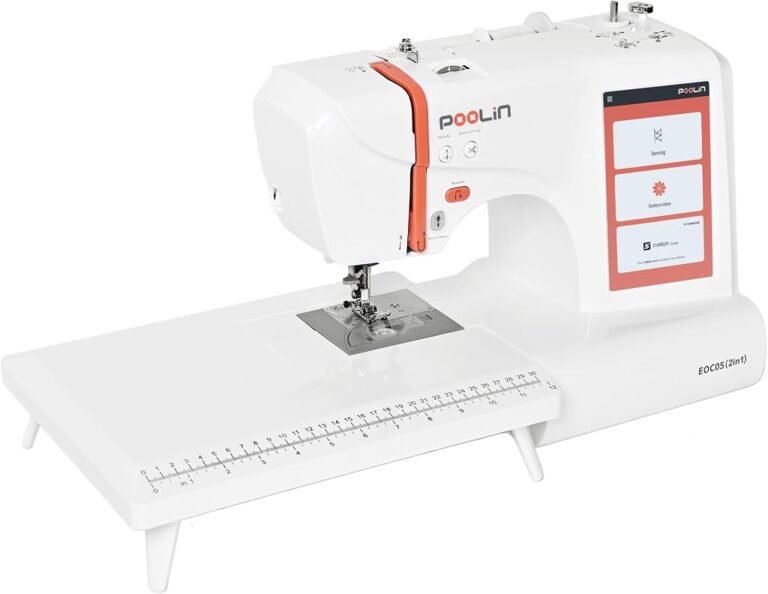
Poolin now also sells a distinct EOC05 2-in-1 model combining sewing and embroidery functions, which should not be confused with this embroidery-only version. Poolin’s separate EOC05 2-in-1 model documents that alternative configuration.
That distinction is necessary because two machines carrying closely related names can solve substantially different problems.
The Physical Footprint Is Manageable but Not Tiny
At 445 mm long, 365 mm wide and 385 mm high, with a stated weight of 8.5 kg, the EOC05 is more manageable than many larger-field embroidery machines.
That does not mean it can be placed anywhere.
The embroidery frame moves during operation, so clearance is required around the machine. The 23.5 cm hoop extends well beyond the needle area, and surrounding fabric must not catch on furniture or other objects.
Workspace depth therefore matters.
A table positioned directly against a wall may restrict movement depending on setup. Heavy or bulky fabric also needs support so its weight does not pull against the hoop.
The EOC05 is portable enough to be moved, but repeated setup and storage may become inconvenient for someone embroidering frequently.
A stable semi-permanent workspace is the more natural arrangement.
Buyer Confidence at 9.32 Is the Strongest Score
Our Buyer Confidence score of 9.32 is substantially higher than the overall rating.
That reflects how clearly the machine’s core proposition can be verified.
Poolin publishes the embroidery dimensions, speed, hoop sizes, file compatibility, touchscreen functions, built-in pattern count, Wi-Fi requirements and operating documentation. Its support site also provides manuals and firmware guidance for the EOC05.
The manufacturer’s U.S. product page states that the EOC05 carries a one-year manufacturer warranty covering mechanical malfunctions under normal use and provides tutorials, setup material, troubleshooting information and online technical support.
That support framework matters for a computerized machine.
The owner may need help with firmware, file transfers, Wi-Fi, thread alarms or design imports in addition to purely mechanical questions.
Buyer Confidence is therefore high because the machine is reasonably transparent about what it can and cannot do.
Customer Sentiment at 8.5 Reflects a Favorable but Hands-On Experience
Our Customer Sentiment score is 8.5.
That score reflects a machine designed to reduce the intimidation of computerized embroidery while still leaving the underlying craft intact.
The 7-inch screen can make navigation easier.
It cannot choose the correct stabilizer automatically.
Wi-Fi can simplify file transfer.
It cannot repair poor digitizing.
Automatic trimming can reduce repetitive cutting.
It cannot prevent puckering caused by inadequate stabilization.
The EOC05 reduces interface friction more effectively than it reduces textile complexity.
That is an appropriate balance for a home machine. Embroidery involves fabric, thread, tension, needles and physical movement. Software can make decisions easier to execute, but it cannot repeal those variables.
Value at 8.28 Depends Heavily on Project Shape
Our Value score of 8.28 is more selective.
The EOC05 provides meaningful extra room beyond a conventional 4 × 4 field, but most of that expansion occurs in one direction.
That makes value unusually dependent on design geometry.
Someone producing long names, borders, towel designs and narrow decorative compositions may use the 23.5 cm dimension constantly.
Someone producing mostly square or wide artwork may discover that the 10 cm width becomes restrictive sooner than expected.
This is also where comparison with the larger EOC06 becomes useful.
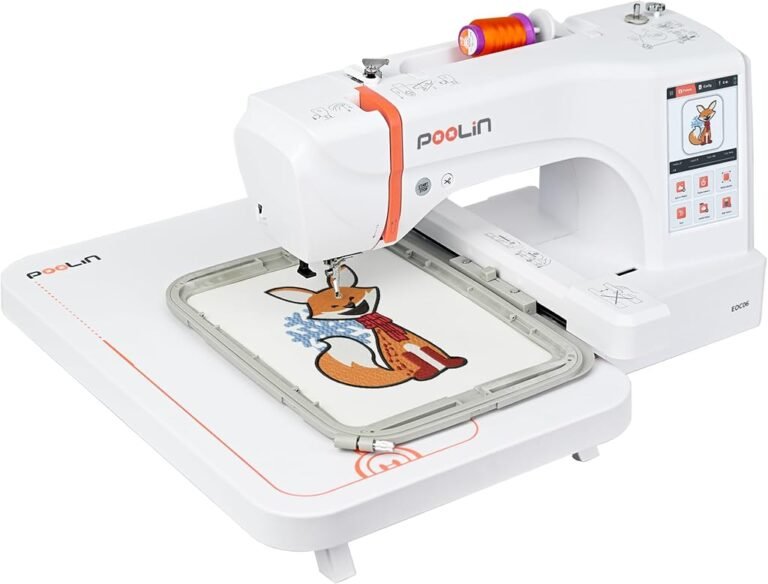
Poolin’s own product range places the EOC05 at 100 × 235 mm and the EOC06 at 200 × 280 mm. The latter therefore increases both width and length, whereas the EOC05 primarily expands length.
The EOC05 is not simply a smaller EOC06.
It serves a different design profile.
Who Is the EOC05 Best Suited For?
The machine makes the strongest editorial sense for someone who values a large screen and elongated embroidery area but does not need broad large-format hoops.
Likely users include home embroiderers making names, towels, decorative borders, children’s clothing, patches, tote bags, personalized gifts and modest batches of customized work.
Its interface also makes sense for beginners who prefer visual controls rather than small displays and layered button menus.
More advanced users may appreciate Wi-Fi, USB and direct editing but could eventually find the four-inch width restrictive.
Production-focused users are likely to encounter the single-needle limitation first.
Those distinctions explain the gap among our editorial scores.
Understanding the 8.61/10 Overall Score
Our 8.61/10 overall rating reflects a product whose strengths align closely with its intended home-use role.
The EOC05 combines a 7-inch touchscreen with a useful elongated embroidery field, two hoop sizes, 130 built-in designs, eight fonts, 24 border patterns, Wi-Fi and USB transfer, automatic trimming and a thread-break warning system.
Its 650-SPM ceiling is adequate for home use without presenting the machine as industrial equipment.
The design is also physically manageable at 8.5 kg.
The restrictions are equally concrete.
The machine is roughly four inches wide in embroidery capacity. It supports DST and DSB natively. Wi-Fi operates on 2.4 GHz. It has one needle. The standard EOC05 does not perform ordinary sewing.
These are not hidden defects.
They are boundaries, and the quality of the purchase depends on whether the buyer’s projects fall inside them.
Final Considerations
The Poolin EOC05 is a more interesting embroidery machine than its dimensions initially suggest.
Its 100 × 235 mm field is not conventionally large. It is elongated. That gives users more than twice the length of a basic 4 × 4 format while preserving approximately the same width.
For certain work, that geometry is unusually useful.
Names, decorative strips, long motifs, towel designs and narrow compositions gain space without requiring the larger chassis and broader hoop system associated with machines such as the EOC06.
The 7-inch HD touchscreen is the other major element of the design. It gives pattern selection, placement, resizing, rotation and preview functions enough visual space to feel approachable.
Poolin supports the machine with 130 built-in patterns, eight fonts, 24 borders, Wi-Fi and USB transfers, DST and DSB compatibility, Institch OS2, automatic thread trimming, bobbin winding, a semi-automatic needle threader and an upper-thread break alarm.
Our 8.61/10 score reflects how coherently those features fit the machine’s intended use.
Customer Sentiment at 8.5 acknowledges that the EOC05 can simplify navigation and file handling without eliminating the learning associated with stabilizer choice, hooping, thread behavior and design preparation.
Buyer Confidence at 9.32 is the strongest rating because specifications, firmware resources, manuals, transfer methods and support information are documented clearly enough for a buyer to understand the product before committing.
Value at 8.28 is more dependent on project selection. The elongated hoop is highly useful when designs need length. It offers less advantage when projects demand width.
That geometry should decide the purchase more than pattern count or screen size.
A person who regularly creates long names, border designs, narrow garment motifs or personalized home textiles can exploit the EOC05’s unusual proportions repeatedly.
A person hoping to stitch broad sweatshirt graphics, large square appliqués or expansive jacket designs should begin with a wider embroidery field.
Likewise, anyone expecting sustained commercial output should recognize that the EOC05 remains a single-needle home machine. Large numbers of multicolor orders will turn manual thread changes into a repeated production cost.
For the intended buyer, however, the machine presents a measured compromise: more embroidery room than a basic 4 × 4 platform, a markedly larger interface than many starter machines, multiple transfer methods and enough automation to remove several routine interruptions without pretending that embroidery requires no skill.
The Poolin EOC05 therefore makes its strongest case not by trying to be the largest machine in the room, but by using a distinctive shape and a large interface to make a specific kind of home embroidery easier to manage.