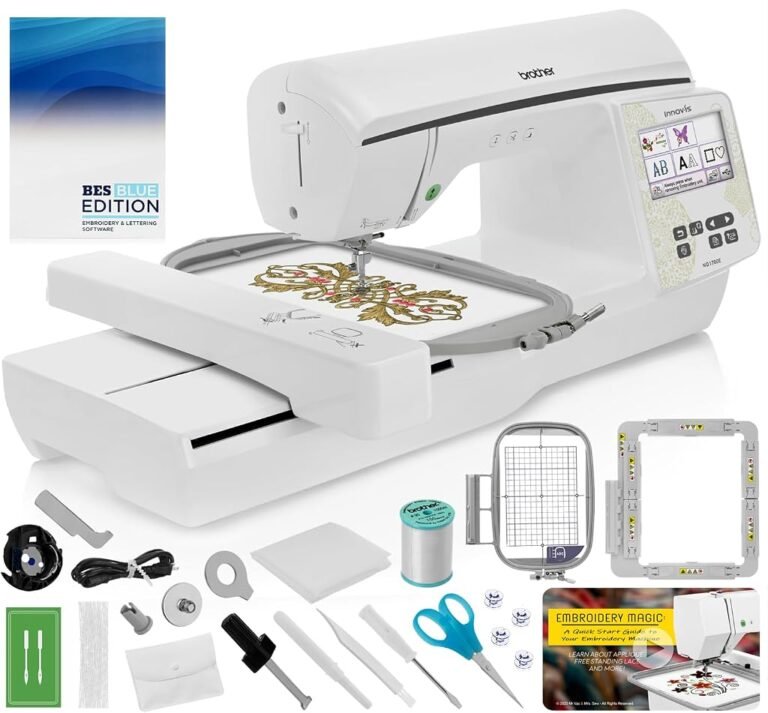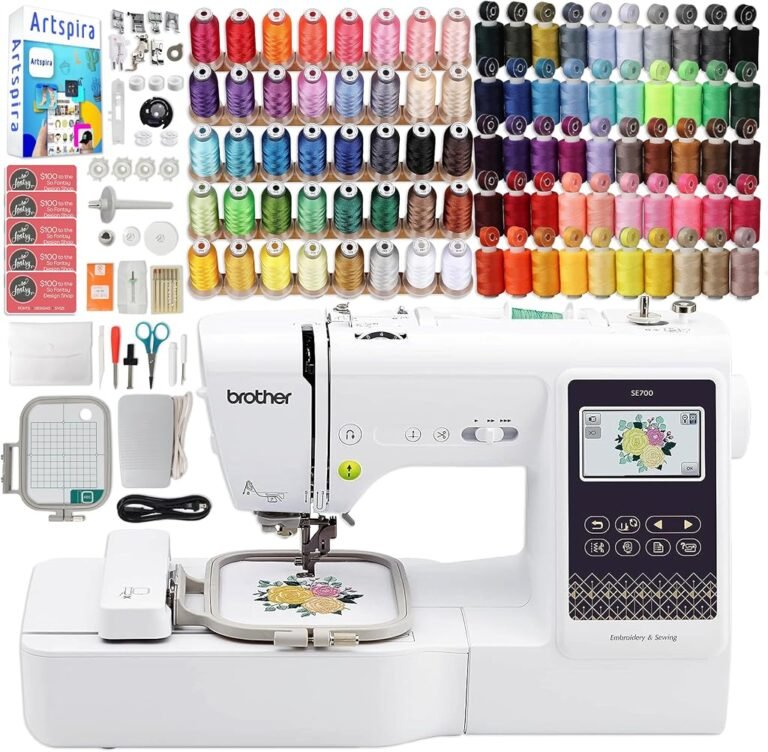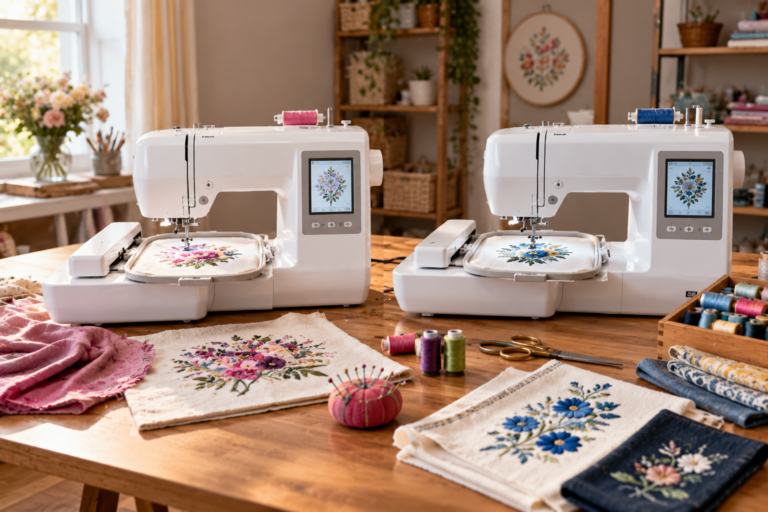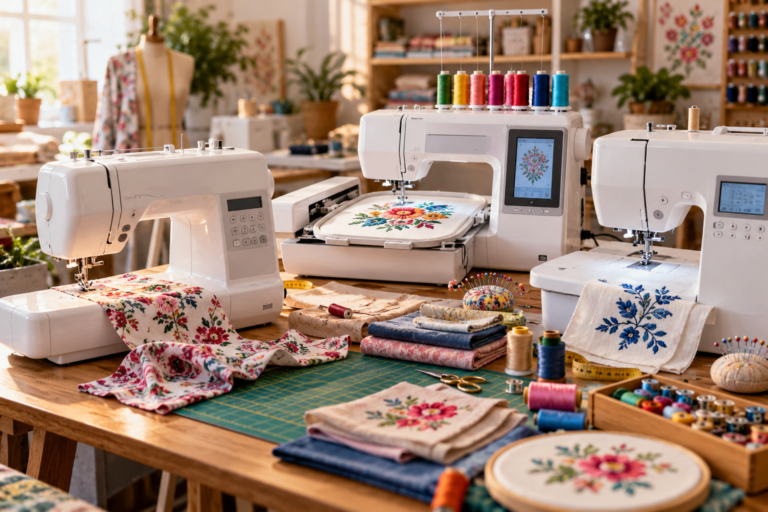
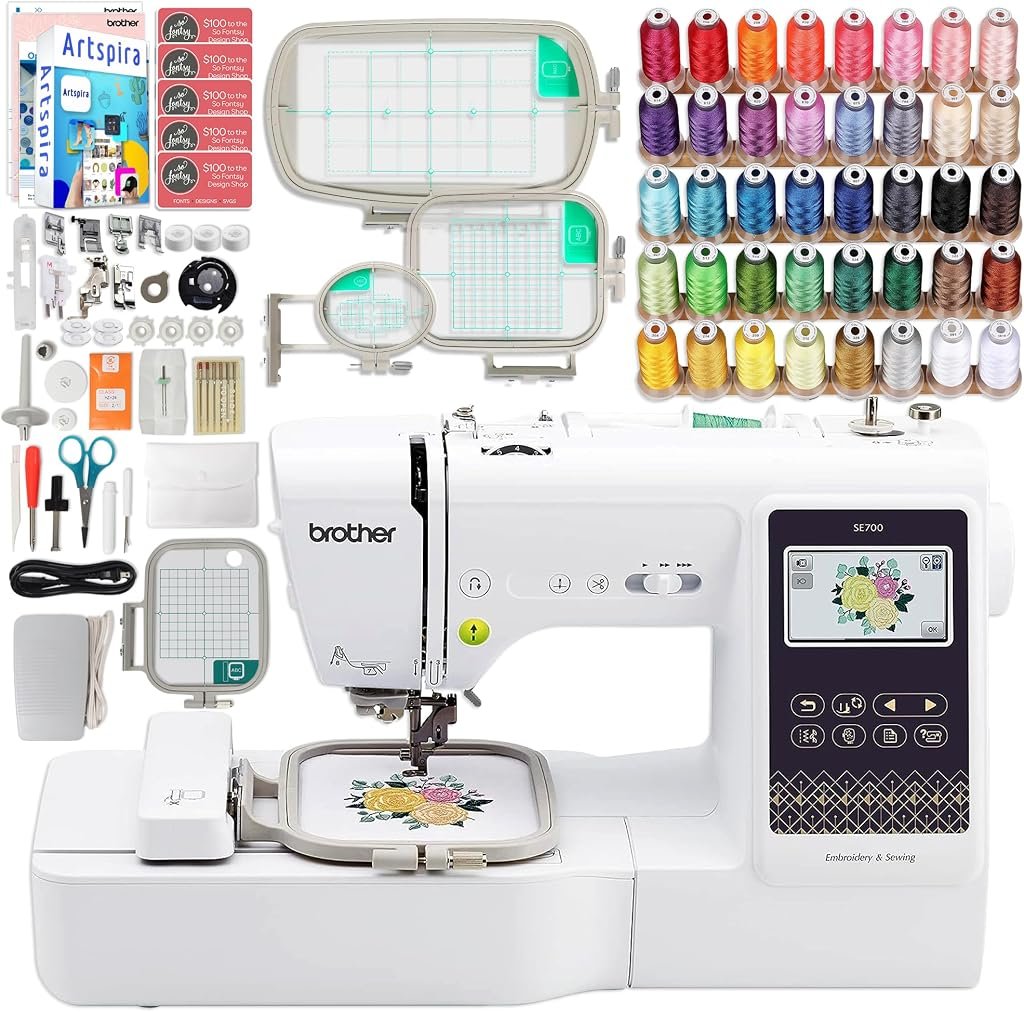
A bundle can make a sewing and embroidery machine look dramatically more capable than the machine inside the box actually is. Extra hoops, thread, bobbins, stabilizer, scissors, needles, and assorted accessories create visual abundance. Yet embroidery machinery obeys physical limits that no accessory count can erase.
That is the central issue in evaluating a Brother SE700 sewing and embroidery machine bundle.
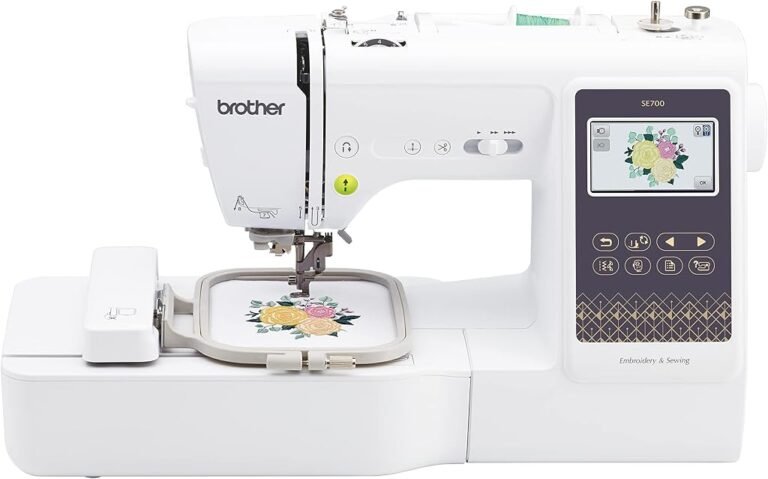
The SE700 itself is a computerized combination machine with a 4 × 4-inch maximum embroidery area, 135 built-in embroidery designs, 10 embroidery lettering fonts, 103 built-in sewing stitches, 10 one-step auto-size buttonhole styles, wireless LAN, a color LCD, automatic thread cutting, and sewing speeds up to 710 stitches per minute.
Those specifications make it a credible entry point for a household that wants both conventional sewing and digital embroidery. A bundle can make that entry easier by supplying consumables and accessories that would otherwise need to be purchased separately. It cannot turn the SE700 into a larger-field embroidery machine.
Our Score for this SE700 bundle is 8.73/10. Customer Sentiment is 8.94, Buyer Confidence is 8.43, and Value is 8.52. Those figures place the bundle slightly differently from a machine-only proposition: the accessory package strengthens convenience and perceived value, while confidence depends more heavily on exactly what a particular bundle contains.
That distinction should govern the purchase.
The SE700 Is the Asset; the Bundle Is the Variable
Bundle listings often encourage buyers to evaluate the number of included pieces. That is usually the wrong metric.
The machine is the durable asset. Thread, needles, bobbins, and stabilizer are consumables. Hoops are reusable accessories, but their usefulness depends on compatibility and the machine’s embroidery architecture. Scissors and small tools can be useful, yet they do not change what the machine can stitch.
The official Brother SE700 product page identifies the machine’s core capabilities clearly: a 4 × 4-inch embroidery area, 135 built-in embroidery patterns, 10 embroidery fonts, 103 sewing stitches, wireless LAN, a 3.2 × 1.8-inch LCD, an advanced needle-threading system, automatic thread cutting, and a maximum sewing speed of 710 stitches per minute. Brother also lists a 6.4 × 4.0-inch work area and a 1/2/25-year limited warranty.
Those characteristics remain the same regardless of whether a retailer surrounds the SE700 with 10 accessories or 100.
A disciplined buyer should therefore evaluate a bundle in two stages. First, determine whether the SE700 itself is suitable. Only then should the extra contents be assigned a monetary and practical value.
Reversing that order is how buyers end up purchasing the wrong machine because the accessory photograph looked generous.
What Brother Already Includes With the SE700
There is another reason to scrutinize bundles carefully: the standard SE700 package is not bare.
Brother lists eight presser feet, including zigzag, monogramming, overcasting, zipper, blind-stitch, button-fitting, buttonhole, and embroidery feet. The standard carton also contains needles, a twin needle, bobbins, pre-wound embroidery bobbins, bobbin clips, a seam ripper, scissors, a cleaning brush, an eyelet punch, screwdrivers, spool accessories, a foot controller, an accessory bag, a dust cover, manuals, an embroidery design guide, and a 4 × 4-inch embroidery frame set.
That list changes the economics of a third-party bundle.
If a retailer advertises a large accessory count by including objects already present in Brother’s standard carton, those pieces should not be treated as additional bundle value. The relevant question is what the bundle adds beyond the manufacturer’s normal equipment.
Thread can add genuine utility. Additional compatible hoops can add convenience. Appropriate stabilizer can allow embroidery work to begin sooner. Spare needles and suitable bobbin supplies are consumable resources with practical value.
Duplicating a seam ripper that Brother already includes is less consequential.
This is why accessory counts deserve skepticism. Fifty items can be less useful than five carefully selected ones.
Four Hoops Do Not Mean Four Embroidery Sizes
The language surrounding hoop bundles deserves particular scrutiny.
A listing may advertise several embroidery hoops, creating the impression that the machine has acquired several larger embroidery fields. That inference can be wrong.
Brother states that the SE700’s maximum embroidery area is 4 × 4 inches. Brother’s hoop guidance also explicitly warns that using a larger multi-position hoop does not increase the machine’s maximum embroidery space: the maximum design size per position remains 4 × 4 inches.
That technical distinction is central to this review.
A hoop is the physical frame that holds fabric and stabilizer. The embroidery field is the area the machine can address for a design within a given position. Those concepts are related, but they are not identical.
A larger or multi-position hoop can reduce the inconvenience of removing and completely rehooping material when repositioning designs. It can therefore be useful. What it cannot do is magically make the SE700 stitch an uninterrupted design requiring a native 5 × 7-inch embroidery field.
The distinction is easy to miss when bundle photography emphasizes hoop dimensions without explaining machine travel.
For buyers planning larger compositions, the machine’s 4 × 4 specification should outweigh the visual impression created by a stack of frames.
The 4 × 4-Inch Limit Is Still the Main Buying Decision
The SE700’s embroidery field is neither unusually poor for its category nor something that should be dismissed as a minor specification.
It defines the scale of the machine.
Four-by-four embroidery works naturally for initials, monograms, compact names, small decorative motifs, children’s clothing details, patches, pocket-sized graphics, towels, and many personalized gifts. A substantial amount of useful embroidery fits within that area.
Larger projects change the calculation.
When a design exceeds the machine’s native field, it may need to be divided, resized, repositioned, or redesigned. Every additional positioning step increases setup work and introduces another point where alignment can go wrong.
This becomes especially relevant for newcomers. A beginner already has to learn hooping, stabilizer selection, upper-thread management, bobbin preparation, needle choice, design placement, tension behavior, and digital file handling. Adding multi-position alignment before those fundamentals are comfortable can turn a seemingly simple project into an exercise in geometry.
A bundle should reduce that early friction, not disguise the physical limit causing it.
Thread Is Useful Bundle Value, but Quantity Is Not Quality
Embroidery thread is one of the more sensible additions to an SE700 bundle because multicolor designs immediately require a palette.
The economic benefit is straightforward: a buyer can begin experimenting without purchasing every color separately.
Yet thread should still be assessed as a consumable rather than a machine upgrade.
Embroidery places thread through repeated high-speed needle cycles. Thread feeding, spool behavior, tension, needle condition, design density, and stabilization can all affect the result. A large number of colors is useful only when the thread behaves consistently enough for the work being attempted.
The same logic applies to bobbin supplies.
Brother’s standard package already includes bobbins and three pre-wound bobbins using 60-weight white embroidery bobbin thread. Additional compatible bobbins can be genuinely useful because embroidery consumes bobbin thread steadily, but a large accessory count should not obscure compatibility or material quality.
The practical bundle question is therefore not, “How many spools are included?”
It is, “How much of the included thread and bobbin supply will actually be used?”
Stabilizer May Be More Useful Than Decorative Extras
For a new embroiderer, stabilizer can have more practical impact than many visually impressive accessories.
Embroidery repeatedly places stitches into concentrated sections of fabric. Stabilizer helps resist movement and distortion during that process. Different fabrics and designs can call for different stabilization strategies, so no small bundle can eliminate the need to learn the subject.
Still, having suitable starter stabilizer allows a new owner to move from machine setup to actual embroidery with fewer additional purchases.
This illustrates a broader rule for judging bundles: supplies that support the machine’s normal workflow deserve more weight than accessories that merely increase the item count.
Thread, bobbins, stabilizer, needles, and genuinely useful compatible hoops belong near the top of that hierarchy.
Generic notions belong lower.
Sewing Capability Makes the Bundle More Versatile
The SE700 is not simply an embroidery machine sold with sewing functions attached as an afterthought.
Brother specifies 103 built-in sewing stitches and 10 styles of one-step auto-size buttonholes. The standard equipment includes feet for common sewing operations such as zippers, buttonholes, blind stitching, overcasting, monogramming, and button fitting.
That matters because a buyer considering the best sewing and embroidery machines may be trying to avoid maintaining two separate machines.
The SE700 provides a plausible answer to that requirement.
A garment can be constructed in sewing mode and personalized in embroidery mode on the same machine. Repairs, utility stitching, decorative sewing, buttonholes, and embroidery can therefore share one workspace.
The compromise appears when workload increases.
While the SE700 is embroidering, it cannot simultaneously be used for garment construction. A household making occasional projects may never care. Someone sewing frequently while also running lengthy embroidery designs may eventually prefer separate machines.
The bundle does not change that operational reality.
Wireless Design Transfer Is a Meaningful Modernization
The SE700’s wireless LAN capability is one of its more substantive differences from older entry-level embroidery workflows.
Brother’s Design Database Transfer documentation describes a Windows application that can send embroidery data wirelessly to compatible Brother machines and manage design files through thumbnail views.
The practical benefit is reduced file-handling friction.
Digital embroidery collections can grow quickly. A design may originate from a purchased file, a personally created pattern, or an edited project. Wireless transfer allows compatible workflows to move files without repeatedly carrying removable media between devices.
The limitation is platform-specific. Brother states that there is currently no application for directly transferring embroidery designs wirelessly from a Mac computer to an embroidery machine in the same manner; its guidance instead points Mac users toward Artspira for compatible wireless design transfer from supported mobile devices.
That distinction deserves attention before purchase because “wireless” does not mean every computer and software combination behaves identically.
Artspira Expands the Digital Side of the Machine
Artspira is another reason the SE700 feels more contemporary than an isolated embroidery appliance.
Brother documents a workflow in which a user selects or edits a design in Artspira, chooses a connected embroidery machine, transfers the design, and retrieves it from the machine’s temporary data area.
The app can also import external embroidery files. Brother lists PES, PHC, PHX, and DST among the supported embroidery formats for that process.
For buyers who prefer working from a phone or tablet, this can make design handling less dependent on sitting at a desktop computer.
There is a boundary here as well. The Artspira transfer guidance states that only one pattern at a time can be transferred and that previously transferred server data can be overwritten if it has not been retrieved.
This is useful connectivity, not unlimited cloud-style project management.
The distinction fits the SE700 generally: it provides accessible digital tools without pretending to be a high-end embroidery workstation.
The Screen Is Functional Rather Than Expansive
Brother lists the SE700’s LCD at 3.2 × 1.8 inches and supports on-screen editing.
That display is large enough to support routine interaction with designs, but it should not be mistaken for a tablet-sized editing surface.
This matters because screen dimensions can affect how comfortable it feels to position, inspect, and modify embroidery elements directly at the machine.
The SE700’s interface belongs to an entry-oriented combination platform. Buyers expecting extensive visual editing may prefer to perform more design work externally and use the machine display for final adjustments and execution.
Again, bundle accessories do not change this aspect of ownership.
Twenty spools of thread cannot make the screen larger. Four hoops cannot expand the native embroidery field. Extra tools cannot add needles to a single-needle machine.
The durable machine specifications deserve more weight than the detachable contents.
Our Score: 8.73/10
We rate this Brother SE700 bundle at 8.73/10.
The score reflects a sensible combination of machine capability and bundle convenience. The SE700 already has a coherent identity: sewing and embroidery in one machine, wireless connectivity, Artspira support, 135 embroidery patterns, 10 embroidery fonts, 103 sewing stitches, automatic thread cutting, and a 4 × 4 embroidery platform.
A useful bundle reduces the number of additional purchases required before experimentation begins.
That can matter considerably for a newcomer. Discovering after delivery that embroidery also requires suitable thread, stabilizer, bobbin supplies, and project-specific notions can make the first week of ownership feel fragmented. A well-constructed package removes some of those interruptions.
The 8.73 score does not rise further because accessories cannot solve the machine’s largest limitation. The SE700 remains a 4 × 4 single-needle combination machine regardless of how many pieces accompany it.
The bundle improves readiness. It does not alter architecture.
Customer Sentiment: 8.94
Our Customer Sentiment score of 8.94 is the strongest indication that the overall proposition is likely to resonate with the intended buyer.
Combination machines are attractive because they condense several activities into one chassis. Bundle configurations add another layer of convenience by collecting startup supplies around the machine.
That pairing is particularly well suited to someone entering embroidery for the first time.
The buyer can sew, learn digital embroidery, explore lettering, transfer designs wirelessly, experiment with thread colors, and build familiarity with hooping without immediately assembling every component separately.
The score should not be interpreted as evidence that the SE700 suits every embroiderer. It indicates that the package has a well-defined audience and addresses that audience effectively.
Buyer Confidence: 8.43
Buyer Confidence is 8.43, lower than Customer Sentiment and slightly lower than the overall score.
That difference is editorially meaningful.
The SE700 itself is extensively documented by Brother, including its specifications, standard carton contents, support materials, manuals, compatible supplies, and warranty resources. Brother maintains a dedicated SE700 support portal with manuals, downloads, warranty information, compatible supplies, frequently asked questions, and support channels.
The uncertainty lies more with bundle composition than with the underlying machine.
Retail bundles can change. Thread brands, hoop sets, accessory quantities, and included consumables may differ between listings or over time. A buyer should therefore verify the exact package contents at the point of purchase rather than assuming every “SE700 bundle” is identical.
That is why the bundle earns good, rather than near-absolute, Buyer Confidence.
Value: 8.52
Our Value score of 8.52 is one of the bundle’s more persuasive numbers.
The reasoning is practical. A buyer planning to purchase embroidery thread, additional compatible hoops, and starter accessories anyway can receive real economic benefit when those items are included at a reasonable combined price.
But retail value and practical value are not identical.
An accessory with a nominal retail price of $30 has little practical value to a buyer who never uses it. Conversely, several rolls of suitable stabilizer may look unimpressive in a product photograph while saving immediate additional expenditure.
The bundle should therefore be valued according to avoided purchases.
A useful calculation is simple: list only the included extras that would have been purchased independently, assign realistic replacement prices to those items, and ignore everything else when comparing the bundle with the standalone machine.
That method strips away accessory-count theater.
Which Bundle Extras Matter Most?
For an SE700 buyer, the accessory hierarchy is reasonably clear.
The most useful additions tend to be:
- Compatible embroidery thread in colors likely to be used.
- Suitable embroidery stabilizer.
- Compatible bobbin supplies.
- Embroidery needles appropriate for planned fabrics and thread.
- Additional compatible hoops that make positioning or small-item work easier.
- Basic maintenance and trimming tools not already duplicated in the standard package.
The least persuasive extras are those that duplicate Brother’s normal carton contents without providing a meaningful spare, have uncertain compatibility, or are unlikely to be used.
Brother’s standard SE700 package is already fairly extensive. Any bundle should be judged against that baseline rather than against an imaginary machine-only box.
Additional Hoops Need Careful Interpretation
Brother lists compatible optional hoops for the SE700, including smaller frames, standard 4 × 4 frames, and a larger multi-position frame.
Different hoop dimensions can improve convenience for particular objects.
A smaller hoop can reduce the amount of material that needs to be secured for a compact design. A multi-position hoop can support workflows involving repositioned embroidery. A spare standard hoop can allow another item to be prepared while one project is being stitched.
Those are genuine advantages.
But none changes the machine’s 4 × 4 maximum design area per position. Brother explicitly states this in its hoop documentation.
This is perhaps the single most important fact for anyone buying the bundle because of the advertised hoop count.
Who Is This Bundle For?
The SE700 bundle makes the most sense for someone who needs both sewing and small-format embroidery and has not yet accumulated a large collection of embroidery supplies.
That includes beginners who want to personalize:
- Towels and linens
- Children’s clothing
- Small bags
- Pockets
- Compact patches
- Monograms
- Names
- Small decorative motifs
- Gifts
- Small apparel graphics
It also fits conventional sewers who want embroidery as an additional capability without dedicating permanent space to a second machine.
The bundle becomes particularly sensible when its extra thread, hoops, and supplies match projects the buyer already expects to make.
Who Should Skip the Bundle?
A bundle is less compelling for an experienced embroiderer who already owns thread, stabilizer, bobbins, needles, hoops, and tools.
Such a buyer may simply be paying for duplicates.
The SE700 itself is also a questionable fit for anyone who already knows that 4 × 4 inches is too small. Larger sweatshirt graphics, jacket designs, expansive decorative panels, and medium-to-large single-hoop compositions point toward a machine with a larger native embroidery field.
Production-oriented users should think carefully as well.
The SE700 is a single-needle combination machine. Multicolor designs require operator involvement as colors change. A multi-needle commercial machine addresses a different workload by keeping several colors threaded simultaneously.
No accessory bundle changes that distinction.
Bundle Marketing Should Not Override Machine Selection
The sewing and embroidery category creates an unusual psychological trap. Accessories are visible; machine architecture is abstract.
A photograph showing thread arranged in dozens of colors, multiple hoops, tools, bobbins, and notions can make one package look dramatically richer than another. Yet the permanent experience of ownership is governed mostly by the machine.
The embroidery field remains 4 × 4 inches.
The machine remains single needle.
The screen remains 3.2 × 1.8 inches.
The sewing speed remains up to 710 stitches per minute.
The machine still provides 135 embroidery designs, 10 embroidery fonts, and 103 sewing stitches.
Those are the facts a buyer lives with after the starter thread has been consumed and the packaging has been discarded.
This is why the SE700 can belong among the best sewing and embroidery machines for a particular kind of buyer while being entirely wrong for another. The category cannot be reduced to the longest feature list.
Final Considerations
The Brother SE700 Sewing and Embroidery Machine Bundle earns an Our Score of 8.73/10 because the underlying machine and the bundle concept complement one another reasonably well.
Customer Sentiment at 8.94 reflects the accessibility of a package that combines sewing, embroidery, wireless design transfer, mobile-connected creative tools, and useful starter supplies. Buyer Confidence at 8.43 is more measured because bundle contents require closer inspection than the machine itself. Value at 8.52 recognizes that genuinely useful consumables and compatible accessories can reduce the cost and inconvenience of getting started.
The distinction between machine value and bundle value remains decisive.
The SE700 is a 4 × 4-inch computerized sewing and embroidery machine with 135 built-in embroidery designs, 10 embroidery fonts, 103 sewing stitches, 10 one-step buttonhole styles, wireless LAN, Artspira compatibility, on-screen editing, automatic thread cutting, and sewing speeds up to 710 stitches per minute. Those characteristics determine its long-term capabilities.
The bundle determines how prepared the buyer is on the first day.
Extra hoops can improve positioning and workflow, but they do not create a larger native embroidery field. Thread provides immediate color choices, but it is eventually consumed. Bobbins, stabilizer, and needles can remove several early shopping trips, but they remain supplies rather than machine upgrades.
That leads to a disciplined purchasing rule: buy the SE700 because the SE700 fits the intended work. Choose the bundle only when its additional contents would otherwise have been purchased separately.
For small-format embroidery combined with general sewing, that can be a rational package. For anyone already planning work beyond 4 × 4 inches, the bundle’s abundance risks becoming camouflage for the one specification that accessories cannot change.